Rouge Forum News (Issue 13, Spring 2009)

Don’t forget about the upcoming Rouge Forum Conference in Ypsilanti, Michigan, May 15 to 17 this year. The program is clearly our best yet with Staughton Lynd as keynoter. Please spread the word.

In the mean time check out the Spring 2009 issue of the Rouge Forum News, edited by Adam Renner.

The RF News is the only clear expression of education radicalism in the US.

Contents

From the editor, Adam Renner
What is the Rouge Forum?
Why do you call it the Rouge Forum?
Blame the Schools, Kevin Vinson and E. Wayne Ross
The Obamagogue and Capital vs. the People, Rich Gibson
Whither the Anti-War Movement?, Tom Suber
UAW in a Route: Secrecy and the Sellout, Bob Apter
Math, Democracy and the Arts, Mindy R. Carter and Mary Ann Chacko
The Illusion of Education, Adam Renner
On Optimism, Cynicism, and Realism, Alan Spector
Why we need to blame ourselves [poem], Michael Simpson
Who will fill the cups? [poem], David Centorbi
Upcoming EventsRF conference, RF blog, RF News #14 and #15 call for papers

Download PDF version of The Rouge Forum News (#13)

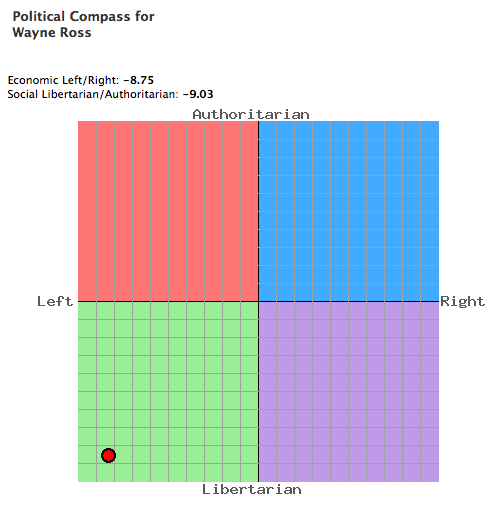
The political compass and the vanishing political spectrum

The “political spectrum” is a long time topic in high school social studies classes and the parlance of “left-wing/right-wing” is firmly embedded in the minds of most North Americans. However, the left-right dichotomy that is typically used to categorize political views in the media and elsewhere does more obfuscate than illuminate differences in political thought.

In the USA the political spectrum has shrunk to the point that there is effectively no difference between Democrats and Republicans on economics, while there are a few, but only a few, notable differences on social issues. So if you watch Fox News, CNN, etc. you’ll see teleprompter reading pundits making mountains of mole hills when it comes to who’s on the left and who’s on the right—Alan Colms on the left? (At least we don’t have to endure Hannity and Colms any more on FoxNews, although Colms continues to pose on Fox radio).

The terms “Right-wing” and “Left-wing” as applied to politics originated with the French government assemblies in the 18th Century, where the aristocrats sat to the right of the speaker and commoners (the bourgeoisie) to the left.

The oversimplication of political thought to a single scale of left/right is what allows some Americans to actually call Obama a socialist. These folks are sincere in their beliefs about Obama, but the ancient Greeks would have called them called idiots (ἰδιώτης or idiōtēs)—seen as having bad judgment in public and political matters.

Typically jejune public (and pundit) opinions about what constitutes the left and the right makes it difficult for folks to make sense of political positions that fall out of the narrow mainstream—Noam Chomsky and Ron Paul are examples of well known political figures who cannot be accurately characterized on the left/right political binary.

What’s at issue here is not just the accuracy with which we categorize political figures or political views. The left/right binary has the practical effect of forcing political discourse into artificial categories—every political disagreement becomes a two-sided argument, which is the typical cable news or local newspaper paradigm for political news coverage. This strategy works quite well in capitalist democracies, which cultivate the appearance of dissent, choice, and difference on political and social issues, while manufacturing consent amongst the public for policies designed to preserve the interests economic and political elites. The economic bailouts of recent months are a good example of this.

But the left/right binary also alienates, marginalizes, and confuses many people who fail to see a place for their own political views in the “objective” framework of what consitutes politics, so they do not participate (and I’m not talking about voting or elections, but the failure to image themselves as having political agency in the broadest sense of the concept).

Despite a wide variety of models that can provide multidimensional images of political positions, discourse about the political spectrum in the media and many classrooms remains shallow and unidimensional.

While models (and quizzes) like The Political Spectrum, Pournelle Chart, the Nolan Chart, etc. have their limitations, they can be useful pedagogical tools for teachers who want to encourage their students to think about politics beyond the oversimplified right/left divisions that dominate mainstream media (and this provides students with a good starting point for thinking critically about the MSM and the interests they serve).

Finance oligarchy captures US government; US government preps for civil unrest

The conventional wisdom, to this point, has been that current economic crisis cannot be as bad as The Great Depression. Conventional wisdom is apparently changing.

Last week, renowned investor George Soros said the world financial system has effectively disintegrated, adding that there is yet no prospect of a near-term resolution to the crisis.

Soros believes the current economic crisis has created more severe turbulence than the Great Depression and former Fed chairman Paul Volker, speaking at the same conference at Columbia University, agrees: “I don’t remember any time, maybe even in the Great Depression, when things went down quite so fast, quite so uniformly around the world,” Volcker said.

Referring to events in Septmeber 2008, when Lehman Brothers went under, Soros said, “We witnessed the collapse of the financial system. It was placed on life support, and it’s still on life support. There’s no sign that we are anywhere near a bottom.”

The bailout money is being abused in a number of ways, all of which recycle bailout cash back to corporate elites and the political class:

  • Former New York Governor Eliot Spitzer has criticize AIG, not for using bailout cash to give huge bonuses to its executives, but for repaying, in full, its investment banking partners—steering additional federal dollars to Goldman Sachs, Bank of America, Merrill Lynch, JPMorgan Chase and others when they already were already being propped up by Washington.

“Bank of America (which got $15 billion in bailout money) sent out $24,500 in the first two months of 2009, including $1,500 to House Majority Leader Steny Hoyer and another $15,000 to members of the House and Senate banking panels. Citigroup ($25 billion) dished out $29,620, including $2,500 to House GOP Whip Eric Cantor, who also got $10,000 from UBS which, while not a TARP recipient, got $5 billion in bailout funds as an AIG “counterparty.”

But Spitzer and Newsweek are talking small potatoes compared to the Simon Johnson’s assessment of the current economic crisis. In “The Quite Coup” (The Atlantic, March 2009),  Johnson, a professor at MIT’s Sloan School of Management and former chief economist at the International Monetary Fund, says that that the finance industry has “effectively captured our government” not through violence or bribes (Abramoff and K Street notwithstanding), but

Instead, the American financial industry gained political power by amassing a kind of cultural capital—a belief system. Once, perhaps, what was good for General Motors was good for the country. Over the past decade, the attitude took hold that what was good for Wall Street was good for the country. The banking-and-securities industry has become one of the top contributors to political campaigns, but at the peak of its influence, it did not have to buy favors the way, for example, the tobacco companies or military contractors might have to. Instead, it benefited from the fact that Washington insiders already believed that large financial institutions and free-flowing capital markets were crucial to America’s position in the world.

What we have is an ideological coup. The government quite clearly acting as the executive committee of the rich. Johnson explains why we have been been denied the pleasure of of seeing fat cats jumping out of Wall Street skyscrapers—the financial oligarchy remains in control, blocking essential reforms and continuing to push us toward the Greatest Depression.

Johnson’s article is the most clearly reasoned, knowledgeable, and accessible piece I’ve read on root causes of the current crisis and he presents a “tried and true” strategy for solving it too—IMF shock therapy. He likens the U.S. economic and financial crisis to what has been seen in emerging markets (and only in emerging markets) like South Korea (1997), Malaysia (1998), Russia and Argentina (time and again).

In each of those cases, global investors, afraid that the country or its financial sector wouldn’t be able to pay off mountainous debt, suddenly stopped lending. And in each case, that fear became self-fulfilling, as banks that couldn’t roll over their debt did, in fact, become unable to pay. This is precisely what drove Lehman Brothers into bankruptcy on September 15, causing all sources of funding to the U.S. financial sector to dry up overnight. Just as in emerging-market crises, the weakness in the banking system has quickly rippled out into the rest of the economy, causing a severe economic contraction and hardship for millions of people.

The financiers who created the crisis with the able assistance of Wall Street alumni in government (particularly ex-Goldman Sachs executives who have been ensconced at the Treasury Department for multiple administrations) are now, according to Johnson, “using their influence to prevent precisely the sorts of reforms that are needed, and fast, to pull the economy out of its nosedive. The government seems helpless, or unwilling, to act against them.” Well, the financiers are the government.

For Johnson the two major, interrelated problems are the banking sector “that threatens to choke off any incipient recovery that the fiscal stimulus might generate” and  “a political balance of power that gives the financial sector a veto over public policy, even as that sector loses popular support.” On the former, he suggests the IMF’s nationalization approach. On the latter, Johnson suggests replacing our current elites, with a new batch. Hmm.

While Johnson’s analysis is compelling, his solutions, unsurprisingly, aren’t—two scenarios: IMF approach solves the problem or catastrophic global depression smartens up the elites).

Meanwhile the US government moves forward to on plans to use the military to control civil unrest as a result of the collapsing economy, as legislation to establish internment camps on US military bases has been introduced into the House of Representatives.

Doesn’t look to me like the finance oligarchy is planning to step down any time soon.

Meet the new boss/Same as the old boss: Obama’s education policy ignores role of poverty in educational achievement (and evidence that NCLB should be scrapped)

In a Chicago Daily Observer column, which also appeared in the print version of the Chicago Sun-Times, Don Rose gives “Bad Grades for Obama on Education.”

Rose cuts Obama a break and doesn’t “fail” him because of his commitment to early childhood education (the federal stimulus bill he signed last month will provide $5 billion to grow the Early Head Start and Head Start programs nationwide, and expand access to child care for 150,000 more children from working families) and parental involvement. While I agree with Rose’s criticisms, he goes way too easy on Obama, who is betraying his “progressive” base in many areas, but none more so than on education policy where he is intensifying George W. Bush’s disastrous No Child Left Behind scheme.

As I’ve pointed out previously, Obama’s education plan is a continuation of the discredited and destructive No Child Left Behind Act. Rose makes this same point and notes that the rhetoric from Obama, and his education secretary Arne Duncan, is that NCLB just needs to be fixed, but the research evidence is clear that NCLB needs to be scrapped—see, for example, The Nature and Limits of Standards-Based Reform and Assessment and Grading Education: Getting Accountability Right, both published by Teachers College Press, for extended critical analyses of NCLB.

How exactly is Obama failing on education?

First, and most importantly, Obama and Duncan ignore the 800 lbs. gorilla of educational achievement, which is poverty. Poverty is the major factor in the differences in school performance. As Rose points out

“poor education is an economic issue; failure to acknowledge that is the single most egregious omission in their statements. Regardless of what the “bell curve” advocates tell you, or the way Duncan talks about education as a “civil rights” issue, it isn’t race, but class.”

Studies have repeatedly shown that socio-economic factors have the highest correlations with student test scores.

Randy Hoover, a professor at Youngstown State University, has conducted a number of studies that show that tests scores are primarily predictors of class and race. In Hoover’s latest study, the three factors he found were most likely to predict test performance were the percentage of single parent wage earners, the percentage of poor children and the median family income in a school district. When Hoover combined those factors into what he calls the “lived experience index” He found they were responsible for at least 61 percent of a district’s test performance. (Hoover studied about 60 variables to see which correlated best with test performance and “on most of them I got no correlation whatsoever,” he said.)

The US has made “closing the achievement gap” among racial and ethnic groups a key goal. This is the one of the main purposes of No Child Left Behind Act. NCLB uses student testing as the primary strategy for promoting changes within schools to accomplish that goal. The problem, of course, is analogous to the old saying “you don’t make the pig grow by weighing it,” and as many educators have pointed out you don’t improve educational achievement by giving tests.

A recent policy brief by David C. Berliner, Regents Professor at Arizona State University, makes this point crystal clear. Berliner’s report, Poverty and Potential: Out-of-School Factors and School Success, details six out-of-school factors (OSFs) common among the poor that “significantly affect the health and learning opportunities of children, and accordingly limit what schools can accomplish on their own”:

  • low birth-weight and non-genetic prenatal influences on children;
  • inadequate medical, dental, and vision care, often a result of inadequate or no medical insurance;
  • food insecurity;
  • environmental pollutants;
  • family relations and family stress; and
  • neighborhood characteristics.

Berliner also discusses is a seventh OSF, extended learning opportunities, such as preschool, after school, and summer school programs.

Because America’s schools are so highly segregated by income, race, and ethnicity, problems related to poverty occur simultaneously, with greater frequency, and act cumulatively in schools serving disadvantaged communities. These schools therefore face significantly greater challenges than schools serving wealthier children, and their limited resources are often overwhelmed. Efforts to improve educational outcomes in these schools, attempting to drive change through test-based accountability, are thus unlikely to succeed unless accompanied by policies to address the OSFs that negatively affect large numbers of our nations’ students.

One has to wonder how a supposed “progressive” president who, because of his own personal background, is sensitive to issues of poverty and its connections to race and ethnicity doesn’t see the connection between what goes on inside of schools and the social and economic conditions that affect students’ lives outside of schools. The simple answer is that Obama’s “progressivism” is a chimera and his education policy is not oriented to serving the needs of students, but rather interests of the corporate-capitalist class.

There is really no other logic to Obama’s pronouncements on education.

Obama wants give teachers pay for student test scores, ignoring the fact that history has proven such schemes to be debacles.

Obama praises charter schools for creativity and innovation, ignoring the fact that charter schools perform no better and often worse than public schools, pave the way for privatization, and allow teacher unions to be sidestepped. As Gerald Bracey says “you can’t bash the public schools on test scores then praise the charters which have lower scores.”

Like his predecessors, Obama misrepresents public education performance as a scare tactic and to open the door for the privatization. Obama claims that graduation rates have fallen from 77% to 67%, but the U. S. Department of Education says the best method for estimating it puts it at 74.5% nationally. Obama says dropout rates have tripled over the past 30 years. But how does a 10% decline in graduation rate equal a 300% increase in dropout rate?

Obama claims “Just a third of our 13- and 14-year-olds can read as well as they should.” Gerald Bracey calls this claim “outright garbage.”

Obama has “raved about South Korean schools but neglected to say that thousands of South Korean families sell their children–yes, sell–to American families so their kids can a) learn English and b) avoid the horrible rigidity of Korean schools. And while the US trails Korea on average test scores, it has a higher proportion of students scoring at the highest level on the Program of International Student Achievement (PISA). Moreover, it has the highest number of high scorers (67,000) of any country. No one else even comes close.”

Obama’s education stimulus package continues the regimentation of curriculum and test-driven approach to education by bribing states and school districts to apply for $5 billion in grants largely aimed at boosting student test scores. These grants, administered by the U.S. Department of Education, are known as the “Race to the Top Fund.”

Obama, Duncan, and the rest do this because that is what they must do in the social context they are in, and because they have chosen sides in what is the class war, the international war of the rich on the poor, which the rich recognize and the poor, at least in the US, do not—yet.

The core issue of our time is the interaction of rising inequality and mass, class-conscious, resistance. That is why the education agenda is a war agenda.

Rouge Forum Update, updated

Just a follow up to the Update from yesterday. Joe Bishop pointed out that Lewis Corey’s book, The Decline of American Capitalism, is online.

For those teaching anything to do with today’s financial collapse, Corey’s book, written in the early thirties, is so on point that it is almost breathtaking. Corey, aka, Louis Fraina, was expelled from the CPUSA very early on, on trumped up charges.

Taken together with John Bellamy Foster’s Great Financial Crisis, Marx, and R. Palme Dutt’s, Fascism and Social Revolution, it not only offers a clear look at what happened, but what may come.

Wayne and I took that up at Znet as  well.

While other groups are collapsing in this rush to the emergence of fascism, we in the RF are pretty well positioned to make sense of things and to develop strategies and tactics that are reasonable, yet forceful.

Please spread the word about our upcoming conference.

All the best

r

Rouge Forum Update: Apocalypse Now and Again

Dear Friends,

A reminder of the outstanding Rouge Forum Conference, Education, Empire, Economy and Ethics at the Crossroads, May 15 to 17, in Ypsilanti, Michigan, at Eastern Michigan U.

This is the only education-based conference in North America that will seriously take up questions of economic collapse, perpetual war, and the booming rise of inequality and irrationalism—and what to do. Keynote speaker, Staughton Lynd, will address the question at hand: What is to be done?

A blast from the past sets up our current condition: “Annual income twenty pounds, annual expenditure nineteen six, result happiness. Annual income twenty pounds, annual expenditure twenty pound ought and six, result misery.” Dickens speaking for Micawber in David Copperfield.

The Obamagogue: “But one of the most important lessons to learn from this crisis is that our economy only works if we recognize that we’re all in this together, that we all have responsibilities to each other and to our country.” March 24 2009.

Let us be clear: The Education Agenda is a War Agenda and agenda to mask class war, a war of the rich on the poor which the rich clearly recognize and the poor do not—yet. The most important lesson is we are NOT all in this together.

The core issue of our times is the accelerated rise of color-coded inequality met by the potential of mass class conscious resistance. The promise of perpetual war is every bit as real as it was with Bush. The same bankers who produced this very real economic crisis, collapse, are the bankers of the Obama regime. His transparent demagoguery has not worn out yet, but it may soon as the wars are lost and the economy spins into either deflationary chaos or the almost equally ruinous alternative: rampant inflation.

Here we see firms using bailout money to bribe the political class. Is it hard for liberals to hold up their notion of democracy inside what is now clearly a capitalist democracy, the former overwhelming the latter, while the near seamless merger of the corporations and banks with the political class is finalized? No it is not. Why?

Rolling Stone on “The Wall Street Revolution”.

George Soros Sees No Bottom to World Financial Collapse.

Quotes From the Great Depression—note the parallels.

Here are two pieces on what can happen if class conscious resistance does not begin to materialize:

On the upside, resistance and red flags are flying in France: Academic and student anger grows. The nation’s universities continued to be disrupted by strikes and protests against proposed teacher training reforms last week, while university presidents called for a year’s delay in introducing the changes to allow time for reflection and consultation.

On the downside, because of grotesque misleadership from groups like United For Peace and Justice, the potential of a million people in the streets in the US six years ago opposing the wars, only 5-10,000 turned up on the anniversary this year.

Could sanity be peeping up in this mire of crises in the US ? Some districts are limiting homework.

Wayne Ross and I have a piece under consideration at Z Mag: The Education Agenda is a War Agenda.

Is it not odd that DHS is going right into Mexico? “Through “strategic redeployments,” the Department of Homeland Security plans to send more than 360 officers and agents to the border and into Mexico, Napolitano said. Costs across the board, totaling up to $184 million, will be revenue neutral, funded by realigning from less urgent activities, fund balances, and, in some cases, reprogramming, she said. ”

And is it not odd that troops are going to be sent to the US side of border areas to do police work???????

Two sources to add to John Bellamy Foster’s current book, The Great Financial Crisis, are classics:
Dunayevskaya: Outline of Marx’s Capital. This is a terrific teaching tool.

Lewis Corey’s (aka Louis Fraina) book, The Decline of American Capitalism, written in 1932, arranges an understanding of the present collapse in notable, prescient, detail. Only a very few reasonably priced books are left in print.

The Rouge Forum Blog is up and you are welcome to join it.

And in hopes that this week we can leave ’em laughing:

Thanks to Susan, Perry, Steve, Wayne, Amber, Doug S, Joe B, Kenny, Sherry, Matt, Victoria, Joe C, Adam and Gina, Bob, Victoria, Tommie, Michael, David, Sharon A., Della, Barbara, Faith, Denny, Jim B, Kim B, Gil, Ernesto, Angel, Jackie, Ann, Candy, GF, Peter, Ricky, Steve, Dennis, Kirk, TC, Bob S, John and Mary, Mary and Paul, and to adjuncts everywhere.

Good luck to us, every one.

r

(more news on those Seattle teachers who resisted testing their students next week)

US Patriotism as Viewed from a (Short) Distance

Last November in Houston, TX, I participated in symposium titled “The Future of Patriotism”, which was cosponsored by the College and University Faculty Assembly and the International Assembly of the National Council for the Social Studies.

The session included a wide variety of perspectives on patriotism, with talks by Suzanne A. Gulledge (U of North Carolina), Rodney Reeves (Florida State U), Masato Ogawa (Indiana U), Joel Westheimer (U of Ottawa), James Leming (Saginaw State U) and me. The discussion that followed the panel was quite rich and illuminating. I’m pretty sure Leming’s provocative comments were generating the most light, as well as a bit of heat (which is good).

My comments on the panel follow.

US Patriotism as Viewed from a (Short) Distance

E. Wayne Ross

“Revolution is not ‘showing’ life to people, but making them live. A revolutionary organization must always remember that its objective is not getting its adherents to listen to convincing talks by expert leaders, but getting them to speak for themselves, in order to achieve, or at least strive toward, an equal degree of participation.” —Guy Debord [“For a Revolutionary Judgement of Art”]

For the last five years I’ve lived in Vancouver, British Columbia. I don’t have any intention of moving back to the United States, but even though my spouse and son have always been Canadian citizens (my son is a dual citizen), I have yet to apply for permanent residency. I’m up there working away thanks to NAFTA, an example of free trade in human capital.

When I’m asked about my status in Canada it is always by Americans. Canadians never inquire about such things. “Have you become a Canadian citizen yet?” my compatriots ask. And my answer is usually along the lines of “I’m already a citizen of one country and I’m not so sure about how that’s working out, so why would I want to join up with another one?”

Indeed, the worst thing about living in Canada, besides the wild fluctuations in the Loonie, is that I ordinarily have to endure two national anthems at Vancouver Canuck hockey games.

“Are you proud to be an American?” I’d have to respond to that question pretty much the same way the late, great social critic and comedian Bill Hicks did: “Uh, I don’t know, I didn’t have a lot to do with it. My parents fucked there, that’s about all.” Okay, that’s a vulgar and flip response, but it does make point that being a patriot is, for most people, an allegiance based upon an accident of birth.

Patriotism can be parsed in different ways, but in the US it basically comes down to love of country and often a willingness to sacrifice for it. Ritualized performances—such as pledging allegiance to the US flag, singing the “Star Spangled Banner,” voting in elections, jingoistic holidays, buying Chevrolet Trucks, symbols like the yellow ribbon and linguistic tropes like “Support Our Troops,”—are aimed at promoting “love of country.” Indeed, American patriotism results from a hegemonic branding campaign aimed creating a population who see their interests as one and the same as the state. And I’m reminded of this every time I watch the overwrought patriotic displays presented prior to every NASCAR race (and I watch these races weekly as I am from Charlotte, North Carolina).

When asked, “do you love your country?” The first response needs to be another question: “What do you mean by country?” Here I’ll cast my lot with the Noam Chomsky who in response to this question said:

“Now if you mean by ‘the country’ the government, I don’t think you can be proud of it. And I don’t think you could ever be proud of it. You couldn’t be proud of any government. It’s not our government…States are violent institutions. States are violent to the extent that they are powerful, that’s roughly accurate.” [1]

Marx and Engles were also deeply critical of the state describing it as “nothing but an instrument of oppression of one class by another—no less so in a democratic republic than in a monarchy.”[2] In the US, government policies that are driven by the interests of the capitalist class have created staggering levels of inequality in education, the economy, health care, and pursuit of justice.[3] Recent events have clearly illustrated the stranglehold Wall Street has on the federal government, and this most certainly did not change on November 4. Indeed, the US government is for all intents and purposes an “executive committee of the rich.”[4]

Alternatives to Patriotism American-style—Examples from North of the Border
Patriotism can be conceived as simply a commitment to a community—as opposed to one’s narrow individual interests, which opens the door for us to express affinity with communities other than country/government/state. George Orwell limits his definition of patriotism to acts that are defensive. Patriotism, he wrote is “…devotion to a particular place and a particular way of life, which one believes to be the best in the world but has no wish to force on other people.”

I believe Orwell’s definition works in reference to Canada. Canadians generally have much greater faith in government than Americans. The Canadian state is much kinder and gentler than the American state. But it has engaged in its share violent acts as part of the British Empire and in its own name. Racist, discriminatory laws targeted Chinese and South Asian immigrants; the indigenous peoples of Canada have been subjected to literal and cultural genocide; and there is the current war in Afghanistan to name a few examples. But patriotism in Canada is not the issue that it is in the US. What is at issue north of the border is the question of what it means to be Canadian. What it means to be American is not a question that is often considered because the dominant strain of “American patriotism” fixes that idea.

Yes, Canadians are proud of the symbols such as the Maple Leaf (and/or the Fleur de Lis). And Remembrance Day is still, more than anything else, a commemoration of the Armistice. While America patriotism is prepackaged and given the hard sell, Canadians seem to always be engaging the question of what it means to be Canadian.

Here are some examples.

Canadian identity is closely tied to the state institutions such as official bilingualism, the Canadian Multiculturalism Act (1985) and the Canada Health Act.

Canadians jealously guard their health care system and are proud of its basis in a utilitarian ethic where the metric of the system’s success its contribution to the care of all persons. Initiatives aimed at enhancing private health insurance and for-profit health care delivery systems are considered by many as “un-Canadian.” In health care debates, the conflict between corporate profits and the literal well-being of the populous is clearly established. Indeed, Tommy Douglas—who as Premier of Saskatchewan (1944-1961) led the first socialist government in North America and introduced universal public healthcare to Canada—was voted “The Greatest Canadian” of all time in a nationally televised contest organized by the CBC.[5]

A second example is Canadian Multiculturalism Act, which recognizes and promotes the understanding that multiculturalism is a fundamental characteristic of the Canadian identity and that it provides an invaluable resource in the shaping of what Canada is and will be. Canadian multiculturalism is most certainly contested terrain, but that is the point. The cultural pluralism of Canada is not merely about allowing groups to maintain their cultural identities within a dominant culture. But, the cultural diversity itself defines, in part, what it means to be Canadian.

And thirdly there is phenomenon in Canadian politics that is completely unfathomable in the US context: Bloc Québécois. The BQ is a left-wing, ideologically driven, regionally based political party whose primary aim in the creation of a sovereign nation of Quebec. The party is, of course, orientated towards Quebec and it’s not surprising that there is little or no support for the party outside the province. While its impossible to imagine a party with these characteristics having legitimacy on the national scene in the US, the Bloc Québécois was Her Majesty’s Loyal Opposition in the Canadian Parliament from 1993-1997.

I believe these are examples of what Joel Westheimer has called democratic patriotism and they contrast sharply with the shallow and authoritarian patriotisms that fix what it means to be an American and define absolutely what it means to be “A Patriotic American.”[6]

While folks like Westheimer and others are making valiant efforts to reclaim American patriotism as democratic. I don’t believe that patriotism is a salvageable concept, particularly in the US context. The mainstream of American patriotism today—the product of that hegemonic branding campaign aimed creating a population who see their interests as one and the same as the state—is a betrayal of the revolutionary ideals that birthed United States: the emancipation of the common person; the creation of participatory democracy; a voluntary federation of local communal institutions, perpetually re-created from below.[7] I think Guy Debord’s thoughts on revolution are relevant here:

“Revolution is not ‘showing’ life to people, but making them live. A revolutionary organization must always remember that its objective is not getting its adherents to listen to convincing talks by expert leaders, but getting them to speak for themselves, in order to achieve, or at least strive toward, an equal degree of participation.” [8]

Promoting a commitment to a community—as opposed to one’s narrow individual interests—is crucial project, but I believe that the nature of that community and the actions taken to express one’s commitment to a community are choices that individuals must make for themselves with no expectation that an accident of birth defines what your community or commitments are.

Notes
[1] Chomksy, N. (1992). Manufacturing Consent: Noam Chomsky and the Media [DVD].

[2] Engles, F. (1891). Postscript to Karl Marx, The Civil War in France.

[3] Ross, E. W. (2006). Introduction: Racism and antiracism in schools. In E. W. Ross (Ed.), Race, Ethnicity, and Education (Volume 4, pp. xiii-xxvi). Westport, CT: Praeger.

[4] Gibson, R. (2005). The search for what should be, within what is, by critical educators. Journal of Critical Educational Policy Studies, 3(1).

[5] http://www.cbc.ca/greatest/

[6] Westheimer, J. (Ed.) (2007). Pledging allegiance: The politics of patriotism in American schools. New York: Teachers College Press.

[7] Lynd, S. (1968). Intellectual origins of American radicalism. New York: Pantheon.

[8] Debord, G. (1981). For a revolutionary judgement of art. In K. Knabb (Ed.), The situationist anthology (pp. 310-314). Berkeley, CA: Bureau of Public Secrets.

Call for Papers: Working In, and Against, the Neo-Liberal State: Global Perspectives on K-12 Teacher Unions

Call for Papers
Special Issue for Workplace: A Journal for Academic Labor

Working In, and Against, the Neo-Liberal State: Global Perspectives on K-12 Teacher Unions

The neo-liberal restructuring of national education systems is a global phenomenon and represents a major threat to the possibility of a democratic, public education committed to meeting the needs of working class and oppressed groups. Teacher unions, across the world, despite all the attacks on them, represent perhaps the most formidable obstacle to neo-liberal restructuring. Teachers remain highly unionized and although they have suffered many setbacks in recent years, their collective organizations generally remain robust.

Despite the significance and importance of teacher unions they remain largely under-researched. Mainstream academic literature on school sector education policy often ignores teacher unions, even in cases where scholars are critical of the market orientation of neo-liberal reforms. Two recent exceptions to this tradition are the contributions of Compton and Weiner (2008) and Stevenson et al (2007). The strength of Compton and Weiner’s excellent volume is the breadth of international perspectives. However, individual chapters are largely short ‘vignettes’, and the aim is to offer fairly brief and readable accounts, rather than detailed and scholarly analysis. Stevenson et al offer a series of traditional scholarly articles, although the emphasis is largely on the Anglophone nations (UK, North America, Australasia), and the collection fails to capture the full breadth required of an international perspective. In both cases, and quite understandably, these contributions were not able to take account of the seismic developments in the world capitalist economy since Autumn 08 in particular. These developments have significant implications for the future of neo-liberalism, for the development of education policy in nation states and for the policies and practices of teacher unions. There is now a strong case for an analysis of teacher unionism that is detailed, scholarly, international and able to take account of current developments.

This special section of Workplace will focus on the ways in which teacher unions in the K-12 sector are challenging the neo-liberal restructuring of school education systems in a range of global contexts. Neo-liberalism’s reach is global. Its impact on the restructuring of public education systems shares many common characteristics wherever it manifests itself. That said, it also plays out differently in different national and local contexts. This collection of papers will seek to assess how teacher unions are challenging the trajectory of neo-liberal reform in a number of different national contexts. By drawing on contributors from all the major world continents it will seek to highlight the points of contact and departure in the apparently different ways in which teacher unions interface with the neo-liberal agenda. It will also ensure that analyses seek to reflect recent developments in the global capitalist economy, and the extent to which this represents threat or opportunity for organized teacher movements.

Compton, M. and Weiner, L. (2008) The Global Assault on Teachers, Teaching and their Unions, London: Palgrave.

Stevenson, H. et al (2007) Changes in Teachers’ Work and the Challengs Facing Teacher Unions. International Electronic Journal of Leadership for Learning. Volume 11.

Submissions
Contributions to Workplace should be 4000-6000 words in length and should conform to MLA style. If you are interested, please submit an abstract via Word attachment to Howard Stevenson (hstevenson@lincoln.ac.uk) by 31st July 2009. Completed articles will be due via email on 28th December 2009. All papers will be blind peer-reviewed.

Report Says Principal Put Dallas Students in Fight Cage

Report Says Principal Put Dallas Students in Fight Cage – NYTimes.com.

According to The New York Times, a high school principal and his security staff “shut feuding students in a steel cage to settle disputes with bare-knuckle fistfights.”

An internal report by the Dallas (TX) Independent Schools Districts says Donald Moten sanctioned “cage fights” between students in a steel equipment area in the boy’s locker room.

Moten resigned in 2008 while he was under investigation for a grade-changing scandal that resulted in South Oak Cliff HS relinquishing its 2005 and 2006 state boys basketball championships. The district found that Moten pressured teachers to change the failing grades of basetball team members so they would be eligible to play.

I guess nobody should be surprised by Moten’s performance as a principal, in his previous job as a Dallas police officer he lied about being kipnapped and robbed at gunpoint to get out of work.

Bearcats lose to Dook, but win NCAA “lobbying tourney”!

Well March Madness has just begun, but it’s been pretty good to me so far with both my alma maters (North Carolina and Ohio State) and two of my former employers’ teams in the field (Louisville and Binghamton).

The UNC Tar Heels sailed through the first round with a rout of Radford U (101-58) and Inside Higher Ed declared the Heels champions of their “Academic Performance Tournament.”

And while the Fight Hasidim, uhm, Bearcats of Binghamton University, lost to Dook in their first ever NCAA tournament game, the SUNY school can now hold their heads high as the Center for Responsive Politics (OpenSecrets.org) has declared the Bearcats winners of the “K Street Classic”, for their tremendous success in spending money on Washington lobbyists.

The Bearcats won the tournament by spending more money on lobbyists than any other school in the 64 team NCAA basketball tournament. In fairness, it should be noted that Bingo’s success in the K Street Classic is not entirely the result of its own efforts because CRP used data on lobbying expenditures for the entire SUNY system to catapult the Bearcats to the championship (Binghamton is the only SUNY school to make the tournament). But that’s okay because Binghamton University doesn’t really take responsibility for the academic or athletic performance of its own basketball team either.

So, now the Bingo Bearcats have made history, despite their loss to Dook, they’re the only team to take the K Street Classic in their first appearance in the tournament!

Track whether the teams spending the most money to influence the government are also scoring the most points on the court by following Open Secret’s lobbying bracket.