BC Teachers Federation scores landmark victory in academic freedom and freedom of expression #bcpoli

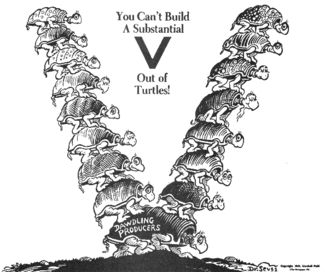
Well, it turns out that Dr. Seuss’s initial impression during the war that you can’t achieve a substantial victory out of turtles turns out to be wrong! This past week, after 3 years or a decade, depending how its measured, the BC Teachers’ Federation scored one of the most substantial court victories in academic and intellectual freedom for teachers in the last thirty years. The victory provides a substantial defense of educators’ civil liberties and free expression, critical education methods of instruction. And what’s more, it is a significant victory for students’ rights to critical content in the schools.

On 21 May, the BC Court of Appeal released its decision on the BCTF v. BC Public School Employers’ Association (BCPSEA) / Board of Education of School District No. 5.  The case concerned “the extent to which teachers’ expression of political views on education issues in public schools is protected freedom of expression under s. 2(b) of the Canadian Charter of Rights and Freedoms:”

The political expressions in issue were messages critical of specific government education policies, contained on posters posted on classroom doors and school bulletin boards, and on buttons worn by teachers. Pursuant to a directive from the school district that political posters and information should not be displayed in school hallways, classrooms, or on school grounds, some principals told teachers to stop displaying the posters and wearing the buttons.

This case dates specifically to January 2009, when campaign materials, such as posters and buttons, were circulated by the BCTF to teachers across the province. On 23 April 2009, the Director of Instruction and HR from School District No. 5 (Southeast Kootenay) forwarded a directive principals in the district advising them that the BCTF’s political materials had no place on school grounds other than the staff room. On 1 May 2009, the Cranbrook and Fernie Teachers’ Association forwarded a note to the Director advising that it disagreed with the 23 April directive.  Following a grievance filed by the BCTF, an arbitrator heard the case in March 2010 and denied the grievance, awarding in favour of the BCPSEA in October 2011.

The BCTF appealed the decision. Within Tuesday’s BC Court of Appeal decision is some of the strongest language for a defense of academic freedom for teachers and critical education methods:

There was no evidence in this case of any actual or potential harm to students from being exposed to the materials about educational issues, nor any facts from which an inference of harm could be drawn. On the contrary, Canadian jurisprudence, including Munroe, stands for the principle that open communication and debate about public, political issues is a hallmark of the free and democratic society the Charter is designed to protect. Children live in this diverse and multi-cultural society, and exposing them to diverse societal views and opinions is an important part of their educational experience.

Simply put, “the law supports the exercise by teachers of their right of free expression in schools.”

Court of Appeal Justice Hinkson provides a caveat:

I see no reason why students should receive less protection from the monopolization of the discourse of a societal issue than adults who are subjected to a flood of discourse on an electoral issue by proponents of one side to that issue. In the case of the students, the monopolization on the issue may deprive them of their right to be educated in a school system that is free from bias.

Where the issue upon which teachers choose to exercise their rights to free speech is a political one, their rights must be balanced against the rights of their students to an education that is free from bias. That brings into play, as it did in Harper, the concern that if a group is able to monopolize its message on any issue, competing views will be deprived of a reasonable opportunity to be heard…. However, the proportionality aspects of s. 1 of the Charter reserve for another case the evidence required to establish and the point at which teachers’ rights of freedom of expression in schools must yield to the rights of students to be educated in a school system that is free from bias.

This landmark decision  will certainly be put to test, as the case more generally dates back to over a decade of to-and-fro decisions over academic freedom for BC teachers and their right to free expression. Indeed, one of the best case studies of political speech and symbolic speech is that of the BCTF v. the BC Ministry of Education and BCPSEA from about 2002 to this present decision. Throughout this decade, BC teachers have progressively and systematically tested their rights to political and symbolic speech: posters on school bulletin boards, black arm bands, buttons, letters to parents, t-shirts, bumper stickers on cars in the school parking lot, and wearing black clothes.

“Your Majesty, please… I don’t like to complain,
But down here below, we are feeling great pain.
I know, up on top you are seeing great sights,
But down here at the bottom we, too, should have rights.”

In April 2012, amidst another round of disputed bargaining practices and the government’s imposition of the controversial Bill 22, teachers raised questions: “A Prince Rupert elementary teacher has been told a quote from Dr. Seuss’s Yertle the Turtle is a political statement that should not be displayed or worn on clothing in her classroom. The teacher included the quote in material she brought to a meeting with management after she received a notice relating to union material visible in her car on school property.”

Eight teachers in the Prince Rupert district received letters warning of “discipline for displaying political messages.” Joanna Larson, president of the Prince Rupert District Teachers’ local said “the administration doesn’t want students to see the messages.” “We feel very censored here right now. We have feelings that our rights to freedom of expression have been violated.”

To accent the 11th anniversary of BC government’s oppressive bills 27 and 28, which prevented the teachers from bargaining on issue such as class size, the BCTF and teachers organized a protest for January 28, 2013– a “Dark Day for Education” and “Wear Black Day.” Teachers wore black in their classrooms while the BCPSEA cautioned that “regardless of the colour of attire worn, teachers should not engage students in discussion about their political views.” Some teachers in Prince Rupert responded with new black t-shirts, this time remediating Shakespeare and quoting section 2(b) from the Canadian Charter of Rights and Freedoms. But three teachers  were told to remove or cover the shirts.
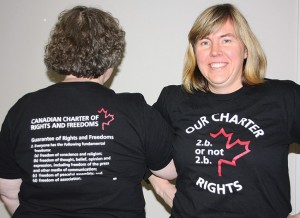
The BC Civil Liberties Association (BCCLA) weighed in on 4 February 2013 by forwarding a letter to the Prince Rupert School Board and arguing that the ban was unconstitutional: “The school district’s decision to ban free speech about free speech reminds us of a badly-written comedy sketch. But this isn’t an Air Farce skit, it’s a troubling violation of teachers’ constitutional right to free expression,” said Lindsay Lyster, President of the BCCLA. “The School District has an obligation to respect free speech, and there is no lawful justification for the District to ban these t-shirts.”

Of course, quoting or paraphrasing one’s civil liberties in defiance has been part and parcel of protests throughout the past 300 years. And arguably one of the best political works in the Dr. Seuss catalog, Yertle the Turtle has for five decades been used for purposes of instruction in the classroom and symbolic and political speech, inside and out. Notoriously, the Red Hot Chili Peppers first rocked their expressive version of Yertle the Turtle in 1985. Most recently leading up to the Prince Rupert teacher’s utilization of parts of the text, Yertle the Turtle was used in the protests at the Wisconsin legislature in 2011 and the Occupy movement beginning in September 2011.

ICES colleague E. Wayne Ross recently articulated the necessity of “dangerous citizenship”— “critical citizenship, or social justice oriented citizenship” and civil liberties citizenship— in opposition to liberal notions of “good citizenship” that somehow pass for education in the schools. “There is a misguided and unfortunate tendency in our society to believe that  activities that strengthen or maintain the status quo are neutral or at least non-political,” Wayne observes, “while activities that critique or challenge the status quo are ‘political’ and inappropriate.”

A breath of fresh air, Tuesday’s decision from the BC Court of Appeal changes the tide for teachers. BCTF President Susan Lambert was buoyed by the decision, noting that

it’s about the right of teachers to express their concerns about the working conditions that they teach in and the learning conditions the students are taught in… It’s very important that we as a society encourage teachers to express their views and that we take those views seriously…. You don’t discuss and encourage critical thinking in children by shielding them from diverse views.
BC Liberals candidate comments insensitive to special needs students

Dean Recksiedler, News1130, May 7, 2013– Critics are blasting a Liberal candidate in northern BC who made some controversial comments about special needs students in the school system.

In a recent all-candidates meeting, the incumbent MLA in Peace River North was asked if he thought there was a correlation between the degradation of the public school system and the increased enrolment in private schools/home schools.

Pat Pimm‘s response was:

“I think there is… We’ve certainly seen a decline in the public system. The public system since 2001, there’s been a decline of over 60,000 students. That’s a big decline. What’s driving that decline, I can’t honestly say. But I do think that there’s…… People don’t like to speak about this, so I’ll probably get in trouble for saying anything… When you’ve got special needs children in classes with other children, it does create some issues. I’ve heard that across the province, it causes some grief. How do you deal with that is a real hard question and it’s one that… is causing the teachers extra time and trouble and certainly, I think is causing some students to move into other areas in the private sector as well.”

The BC NDP and BC Teachers Federation seem to lead the charge in slamming Pimm; critics call his comments “insensitive” and “appalling.”

One comment on Twitter was even more pointed, suggesting the incumbent in Peace River-North was de facto admitting the BC Liberal government has under-funded classrooms with special needs kids in them.

Vancouver elementary teachers association endorse NDP in BC election #BCPoli

Given the BC Liberals history of underfunding public education, promoting corporate intrusion, and undermining of collective bargaining, the Vancouver Elementary School Teachers’ Association (VESTA) are  lobbying the BCTF to endorse the NDP leading up to the May 14 election.

“The change has been brought about by what we consider to be a decade… long attack on public education through government policy, strips of collective agreements, legislation,” said Gerry Kent, VESTA president.

“While (the BCTF is) not endorsing a political party, I think it’s clear that it’s time that maybe we do. Especially in light of the current budget that the Liberals propose, there doesn’t seem to be any help to remedy the difficulties that are affecting public education, which in our view have been put in place by the Liberal government.”

Listen to Media Mornings podcast of VESTA President Gerry Kent

BC schools face total budget shortfall of $130 million #bcpoli

CBC News, April 29, 2013– The B.C. School Trustees’ Association says it will call on the provincial government for more money after the election, as school boards across the province struggle with a budget shortfall of $130 million.

The trustees voted unanimously at its annual general meeting this weekend to ask whichever government is elected on May 14 to re-open the issue of school funding.

School boards are required by law to have balanced budgets, but Teresa Rezansoff, the newly-elected BCSTA president, says they are faced with wage increases and other rising costs.

“We’d like to see a commitment to sustainable, predictable funding that covers those annual cost pressures that are there,” said Rezansoff.

“There is no better investment you can make than in our future citizens and it should be an absolute top priority for any government,” she added.

The Vancouver School Board, which votes on next year’s budget on Monday night, is faced with an $8 million shortfall.

As a result, the board has decided to scrap its continuing education program and have another two-week spring break next year.

But parents say the time off means extra child care costs, adding to increasing fees and fundraising demands schools already places on families.

“It’s a direct hit to the children and to the low income families,” said parent Iraj Khabazian.

Last Week, the Coquitlam School Board took the drastic measure of cutting more than 140 jobs, after announcing a potential deficit of more than $7.5 million.

Read More: CBC News Story 1 and Story 2

Working toward tuition free post-secondary education in BC and Canada

I was interviewed for this story in The Georgia Straight, which raises the question of free post-secondary education in British Columbia and the lack of uptake on the topic in the current BC election discourse.

In my interview with The Straight, I highlighted the staggering debt load post-secondary students currently face. In Canada, student debt (not including provincial and private loans) is over $15 billion according to the Canadian Federation of Students. The high cost of post-secondary education in BC is a significant barrier to attendance by lower and middle income students. At least one in four non-attendees identify financial issues as an obstacle to further education.

The CFS notes that “Canadian research suggests that debt levels have a direct impact on success in post-secondary education. One study found that as student debt rose from less than $1000 to $10,000 per year, program completion rates for those with only loans (and no grants) plummeted from 59% to 8%. Similar conclusions can be drawn from Statistics Canada’s Youth In Transition Survey (YITS), which found that of those who cease their studies early, 36% cited financial reasons.”

Tuition at Canadian universities is rising faster than inflation, climbing 5% in 2012 (compared 2% inflation rate).

Neoliberal social policies have exacerbated the problems with student debt and access to higher education. Christy Clark’s BC Liberal government cut higher education by $46 million this year. In Alberta, higher education took a $100 million cut at the hands of the Alison Redford’s governing Progressive Conservative Party. As budgets are cut, colleges and universities (as well as K-12 schools) are encouraged to look for market-based solutions. BC colleges and universities are now ramping up efforts to recruit international students, who will pay five times the tuition charged to BC residence, in an effort to increase revenue. These recruitment efforts further restrict access to BC residents when there are already too few seats available in colleges and universities.

The ever increasing cost of higher education ultimately threatens existence of education as a public good in Canada (and the USA) and has deleterious effects on career choices and financial futures of millions of students as they face debt bondage. And this is not a circumstance limited to young people as many baby boomers who have gone back university are now struggling to repay their loans.

Lastly, student debt works to dampen critical thought and actions aimed at resisting the status quo. Noam Chomksy argues that “students who acquire large debts putting themselves through school are unlikely to think about changing society. When you trap people in a system of debt, they can’t afford the time to think. Tuition fee increases are a disciplinary technique, and, by the time students graduate, they are not only loaded with debt, but have also internalized the disciplinarian culture. This makes them efficient components of the consumer economy.” Exactly the kind of results neoliberal education policy makers are looking for.

Read The Georgia Straight article here:

Candidates should discuss free postsecondary education, say critics

by Carlito Pablo on Apr 25, 2013 at 3:11 am

Politicians on the campaign trail always say that education is a good thing. Yet many are silent about free university and college education.

Perhaps that’s because making this suggestion inevitably invites the question about money. What would it cost?

It doesn’t seem much, really. For fiscal year 2013-14, the B.C. government expects to collect about $1.4 billion in tuition and other fees. That’s only a small fraction—three percent—of a provincial budget totalling $44 billion.

The fact that many candidates don’t talk about free postsecondary education as a goal worth pursuing—one practical step at a time—indicates two things to Enda Brophy, an assistant professor of communications at SFU.

“On the one hand, I would argue that it demonstrates a lack of vision on their part,” Brophy told the Georgia Straight in a phone interview. “On the other, it quite obviously underscores their lack of commitment to a genuinely public education system. In other words, they can talk the talk regarding their commitment to public education, but walking the walk would mean taking concrete steps toward a free, public postsecondary system.”

According to the academic, there is an ethical argument to be made that “education should not be a commodity that is bought and sold.”

“In other words, that education and the production of knowledge, like health care, need to be accessible to anyone who wants it,” Brophy said.

As a nation, Canada committed to this ideal when it ratified the International Covenant on Economic, Social, and Cultural Rights in 1976. The treaty states: “Higher education shall be made equally accessible to all, on the basis of capacity, by every appropriate means, and in particular by the progressive introduction of free education.”

A study released in January 2012 by the B.C. office of the Canadian Centre for Policy Alternatives demonstrates that university-educated people pay, on average, $106,000 to $159,000 more in income taxes over their working lives than those with only a high-school diploma.

In Paid in Full: Who Pays for University Education in BC?, author and economist Iglika Ivanova notes that in contrast, a four-year degree costs $50,630, of which 40 percent is paid by students in tuition fees.

Ivanova concludes that “undergraduate education stands out as a profitable investment for the public treasury when all students’ payments for their education—both up-front tuition fees and additional income taxes paid over their careers—are compared with the costs of providing university education.”

In many countries in Europe and elsewhere, like Algeria and Cuba, free postsecondary education is more a rule rather than the exception, according to Simon Tremblay-Pepin. He is a researcher with IRIS (Institut de recherche et d’informations socio-économiques), a Quebec-based think tank that argues that the abolition of tuition fees is economically viable and socially just.

“If we’re talking about a progressive way to free education by lowering the fees year after year, it could be a good way,” Tremblay-Pepin told the Straight by phone when he was in Vancouver for a speaking engagement. “It’s not something that you need to do overnight. Still, you must have the objective in your head that you’re going to a free education and not just lowering fees for electoral reasons because you want to have the youth vote. That’s the difference between having a plan for society and trying to collect votes.”

B.C.’s Green party has declared that “universal and free” education at all levels is one of its long-term goals, promising an immediate reduction of 20 percent in tuition fees.

“The Green party is really out in front on this issue, much more so with a greater vision than either the [B.C.] NDP or the Liberals have offered at this point,” UBC education professor E. Wayne Ross told the Straight in an April 19 phone interview.

The ruling B.C. Liberals have pledged to cap tuition-fee increases at two percent. But with tuition fees having doubled since the Liberals returned to power in 2001, Ross noted that education is already “unaffordable”.

New Democrats have talked about a $100-million needs-based grant system. “That’s important because those needs-based grants have disappeared under the Liberals, but that’s a Band-Aid,” Ross said. “It doesn’t really address the overall problem that we face with student debt and the impact of the lack of access to higher education because of the tuition levels.”

Although the Greens are an “outlier” in the mainly Liberal–New Democrat contest, that’s a good thing, according to Ross. If their idea of free postsecondary education gets traction during this election campaign, the Greens may “pull parties like the NDP, in particular, maybe back towards the left side of the spectrum a little bit more”.

But Ross also noted that because neoliberalism, or the belief that the supremacy of the market trumps public good, is dominant in this age, perhaps the Greens might have a different message if their political fortunes were somewhat different: “If the Green party was more competitive, would the Green party ever say that? And I’m not trying to knock the Green party. I’m also trying to say that [as] the NDP moves towards what they see as the electable centre the closer, the better their [electoral] chances get.”

Source URL: http://www.straight.com/news/375006/candidates-should-discuss-free-postsecondary-education-say-critics

BC schools forced to market public education to stem trend toward private schools

Private school enrolment is rising

An “ambitious” new strategy for the Nanaimo-Ladysmith school district aims to lure private school students back into the public education system.

Nanaimo Daily News, April 10, 2013

An “ambitious” new strategy for the Nanaimo-Ladysmith school district aims to lure private school students back into the public education system. The district has suffered financial blows with its dropping enrolment, while the city’s independent schools have celebrated student population growth.

It’s been a grating issue for the school board, which says it is about to reveal thought-provoking and controversial recommendations for its facilities Thursday. According to school board chairman Jamie Brennan, the recommendations will improve public school offerings and aim to lure children back into the public education system.

Teacher-government disputes, “substandard facilities” and an inefficient school system have eroded families’ confidence in public schools and driven parents to enroll students in private institutions, Brennan points out. There were 140 fewer students than expected this year in the district; another blow to a district dependent on government operational studies.

Independent schools in Nanaimo, however, are following a provincial trend of population increases. Since 1997, independent school enrolment has risen by 22.4 per cent, while public schools have seen a 11.3 per cent decline, reports the Fraser Institute.

Aspengrove School is anticipating demand to continue to increase as more families become aware of its higher-learning international baccalaureate program. It has asked the District of Lantzville to change its zoning bylaw to allow the school to host 150 more students. Discovery Montessori, another independent school, says it has also already seen double the admission for next fall.

“With the availability of private education, families do have choices and they are making the choice to pull their kids out of public schools,” said Brennan. “We need to find ways to attract students back.”

Read More: Nanaimo Daily News

BC teachers want to regulate private interests in public education

GUIDELINES NEEDED TO PROTECT PUBLIC INTEREST
Straight Goods News

Delegates at the recent annual general meeeting of the BC Teachers’ Federation have voted to call on the provincial government to establish conflict-of-interest regulations governing school districts dealings with corporations.

Private businesses are seeking to profit from public education, and using increasingly sophisticated and aggressive schemes to market technology, textbooks, learning resources and many other products,” said Susan Lambert, past-president of the BCTF.

“It’s high time we had consistent and clear guidelines to protect the public interest.”

After more than a decade of chronic underfunding, schools, parents and teachers face mounting pressure to raise funds through private means to meet the needs of students across the province. Delegates voted to have the BCTF gather information on the extent of funding coming from corporate sponsorships and donations, Parent Advisory Committee fundraising and teachers’ personal donations.

“We believe it’s vitally important for British Columbians to understand the extent to which parents and teachers are subsidizing the public education system, and how hard individuals are working to bridge the gap between the needs in schools and the funding provided by government,” said Lambert. “Our study will document that.”

Read More: BCTF News release and Straight Goods News

BC Teachers’ Federation puts education front and centre in election #bcpoli

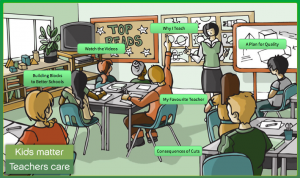
With their extensive Better Schools for BC campaign, the BCTF has placed education front and centre in the 2013 BC election. “BC teachers are worried that, after a decade of underfunding, our students are being short-changed. The latest numbers from Statistics Canada tell a story of the growing gap between education funding in BC and the rest of Canada. Teachers have a plan to build better schools for BC.”

 “After a decade of government cuts to education, too many BC students are struggling. We need to change that. This election in May, let’s vote for better schools — with smaller classes, more one-on-one time, and help when students need it.”

Some BC and Alberta schools dump percentage grading

Should schools move away from grading students? Yes!

Of course, it’s a time “honoured” tradition to use grades as the key means of sorting students to meet the demands of business. But, if you’re more more interested in motivating students to learn and less interested in treating education like a commodity, there’s really little room to debate the point.

School boards in Ridge Meadows, BC and Battle River, AB have decided to stop giving percentage grades to their students.

The Vancouver Sun recently ran a story on the Ridge Meadows Schools (Maple Ridge and Pitt Meadows BC) that have adopted an alternative approach to student assessment in which elementary teachers are no longer required to give letter grades to students.

Rather than assigning As, Bs or Cs to kids from grades 4 to 7, teachers can instead use the conference model to assess how well children are grasping course material, as well as their learning style, readiness to progress and comprehension of overall concepts. The standard reporting system does not assign letter grades for students in kindergarten to Grade 3, but under the new system, students in all elementary grades will be invited to participate more fully in their evaluations by completing self-assessments and setting future learning goals.

The alternative system will engage students while providing more meaning to parents than a simple letter grade, said Ridge Meadows school trustee Susan Carr, who has two children in the school system.

Ridge Meadows school trustees were unanimous in their support for the new approach, which was developed over the past two years by a district committee. The Ridge Meadows News reported that “Committee members noted the feedback from parents who have been involved so far is “through-the-roof positive.”

In Alberta, the Battle River School District’s has adopted an alternative grading system that replaces percentage grades with categories.

Under the assessment model, students are marked with an achievement level that indicates they are within a percentage range. A student scoring between zero and 50 per cent would be at the “beginning” level. A “developing” student is within the 50-66 per cent range, “achieving” is between 67 and 83 per cent and “excelling” ranges from 84-100 per cent. (The Edmonton Journal)

Camrose, AB parents don’t seem to be has uniformly positive about Battle River’s decision as about 150 recently protested the move.

Today on CBC Radio’s The 180 with Jim BrownSandra Mathison, a UBC education professor and member of the Institute for Critical Education Studies discussed the issue of grading students and provided some sharp counter-point to Michael Zwaagstra, a high school teacher who is affiliated with the Frontier Centre for Public Policy (a Fraser Institute clone that is primarily funded by right-wing outfits like the Donner Foundation).

The Frontier Centre and Zwaagstra’s views on education get a lot of play on the editorial pages of Vancouver’s daily papers, both of which prominently embrace and espouse neoliberal public policy, which places the interests of corporate capital and their shareholders over the interests of people.

It was interesting to hear Zwaagstra shift to center when confronted with Mathison’s counter-point.

Get the podcast of this episode of The 180 with Jim Brown here.


Third International Conference on Critical Education

Wayne Ross and Sandra Mathison will be keynote speakers.

Check the website for more information.