Tag Archives: CFP

Call for Submissions: Teaching for EcoJustice in an Era of Polycrisis

Teaching for EcoJustice in an Era of Polycrisis

A Special Issue for Critical Education

Co-Editors:
Brandon Edwards-Schuth, Augusta University
Maria Helena Saari, University of Oulu

We invite submissions for a special issue devoted to the theme of “Teaching for Multispecies Justice in an Era of Polycrisis.” This special issue seeks scholarship that critically examines the role of education in addressing the interrelated systemic injustices and logics of harm directed toward both human and more-than-human lives. As we face an intensifying polycrisis—characterized by the entanglement of climate catastrophe, capitalism, mass extinction, social inequities, and ongoing legacies of colonialism (Homer-Dixon, & Rockström, 2022; Homer-Dixon et al., 2022)—questions of justice, pedagogy, and educational transformation become urgent imperatives. We welcome contributions that explore how educators, teacher-educators, and scholars are reimagining educational practice to resist dominant cultural assumptions undergirding the polycrisis and to center multispecies flourishing.

Drawing from the fields of EcoJustice Education (Lupinacci et al., 2018; Martusewicz et al., 2021), Multispecies Justice-oriented education (Rautio et al., 2021; Tammi et al., 2023; Saari, 2025), critical ecopedagogies (Edwards-Schuth & Lupinacci, 2021; Lupinacci et al., 2023), Indigenous land based decolonizing pedagogies (Basso, 1996; Tuck et al., 2014), Critical Animal Studies (Corman & Vandrovcová, 2014; Nocella II et al., 2014; Pedersen, 2025), Earth Democracy (Shiva, 2015) and prefigurative politics (Raekstad & Gradin, 2020), and related frameworks, this special issue asks:

  • How has education become a transformative practice that challenges anthropocentrism, human supremacy, and hierarchical ways of being?
  • What pedagogical approaches enable learners to recognize, resist, and reconstitute relationships with the more-than-human world in ways that support social and environmental justice?
  • What can we learn with/from the more-than-human and land to (re)imagine ways of being in the here and now, and who/what counts as teachers/educators?
  • What kinds of learning and praxis occurs beyond formal classrooms that are essential to doing

Social and Environmental Justice?

We are particularly interested in work emerging from educational contexts—including but not limited to teacher education, K-12 classrooms, higher education, and community-based learning—that demonstrates how critical, creative, and arts-based pedagogies can foster multispecies consciousness and scholar-activist engagement with the polycrisis. We seek interdisciplinary contributions from environmental education, educational philosophy, curriculum studies, cultural studies of education, geography, anthropology, Indigenous studies, science and technology studies, and related fields. We especially welcome submissions from diverse contexts and bioregions, activists, and LGBTQIA+ and BIPOC perspectives.

Topics could include:

  • Ecocritical projects in teacher education
  • Teacher learning and professional development around EcoJustice, Ecopedagogy, humane education, and Critical Animal Studies
  • Multispecies Justice-oriented education in formal/non-traditional educational settings
  • Arts-based research around more-than-human relations
  • Indigenous and Decolonizing perspectives in education
  • Community Activism, Prefigurative Politics, and Earth Democracy in practice
  • Short Film and/or book reviews of 800-1200 words (please contact the editors with your ideas and/or for a list of suggested texts)

Abstract Requirements

  • Include author information, title and an abstract of 250 words max
  • Include 3-5 keywords
  • Email ABSTRACT SUBMISSIONS to: bedwardsschuth@augusta.edu by August 15th, 2026

Manuscript Submission Requirements (after abstract acceptance)

  • Manuscripts should be between 3,000 and 6,000 words (including references), APA 7th
  • Include an abstract of 250 words max
  • Include 3-5 keywords
  • All submissions will undergo blind peer-review
  • Submissions due November 15, 2026 (via Critical Education submission portal)

Timeline

  • August 15, 2026 – Abstract proposals due (250 words maximum)
  • September 15, 2026 – Authors will be notified of abstract acceptance by
  • November 15, 2026 – Full manuscript submissions due
  • December 15, 2026 – First round of peer review feedback to authors
  • January 31, 2026 – Revised manuscripts due
  • 2027 – Publication of special issue

Special Issue Editors

Dr. Brandon Edwards-Schuth
Assistant Professor of Educational Research
Augusta University
Email: bedwardsschuth@augusta.edu

Dr. Maria Helena Saari
Postdoctoral Research Fellow
University of Oulu
Finland
Email: maria.saari@oulu.fi

For inquiries about the special issue, please contact: bedwardsschuth@augusta.edu


References

Basso, K. H. (1996). Wisdom sits in places: Landscape and language among the Western Apache. University of New Mexico Press.

Corman, L., & Vandrovcová, T. (2014). Radical humility: Toward a more holistic critical animal studies pedagogy. Counterpoints, 448, 135–157.

Edwards-Schuth, B. & Lupinacci, J. (2021) Pedagogies of Diverse Bioregions: An Ecotistical Move from Ego to Eco. Europe Now, 45. https://www.europenowjournal.org/issue-45-november-2021/

Homer-Dixon, T., Renn, O., Rockström, J., Donges, J., & Janzwood, S. (2022). A call for an international research program on the risk of a global polycrisis (Version 2.0). Cascade Institute. https://cascadeinstitute.org/technical-paper/a-call-for-an-international-research-program-on-the-risk-of-a-global-polycrisi

Homer-Dixon, T., & Rockström, J. (2022, November 13). What happens when a cascade of crises occur? The New York Times. https://www.nytimes.com/2022/11/13/opinion/coronavirus-ukraine-climate-inflation.html

Lupinacci, J., Edwards-Schuth, B., Happel-Parkins, A., & Turner, R. (2023) Ecocritical pedagogies and curriculum. In P. Davies, E. Clinton, and G. Carolyn (Eds.) International encyclopedia of education, 4th edition, Volume 2 (pp. 202-209). Elsevier. https://dx.doi.org/10.1016/B978-0-12-818630- 5.08045-3. ISBN: 9780128186305

Lupinacci, J., Happel-Parkins, A., & Turner, R. (2018). Ecocritical scholarship toward social justice and sustainability in teacher education. Issues in Teacher Education, 27(2), 3-16.

Martusewicz, R. A., Edmundson, J., & Lupinacci, J. (2021). EcoJustice education: Toward diverse, democratic, and sustainable communities (3rd ed.). Routledge.

Nocella II, A. J., Sorenson, J., Socha, K., & Matsuoka, A. (2014). Defining critical animal studies: An intersectional social justice approach for liberation. Peter Lang Verlag. https://doi.org/10.3726/978-1-4539-1230-0

Pedersen, H. (2025). Post-anthropocentric pedagogies: purposes, practices, and insights for higher education. Teaching in Higher Education, 30(2), 344–358. https://doi.org/10.1080/13562517.2023.2222087

Raekstad, P., & Gradin, S. (2020). Prefigurative politics: Building tomorrow today. Polity Press.

Rautio, P., Tammi, T., & Hohti, R. (2021). Children after the animal turn. In N. J. Yelland, L. Peters, & N. Fairchild (Eds.), The SAGE handbook of global childhoods (pp. 341–352). SAGE Publications Ltd. https://doi.org/10.4135/9781529757194

Saari, M.H. (2025) A Multispecies Justice Approach to Climate Change Education. in L. Griffin, L. Ropartz, S. Bannister & A. Merrick (Eds.) Climate Change Education Research Collection. International Baccalaureate Organization. Commissioned Report.

Shiva, Vandana. (2015). Earth democracy: Justice, sustainability, and peace. North Atlantic Books.

Tammi, T., Hohti, R., Rautio, P. (2023). From child–animal relations to multispecies assemblages and other-than-human childhoods. Barn, 41(2–3), 140–156. https://doi.org/10.23865/barn.v41.5475

Tuck, E., McKenzie, M., & McCoy, K. (2014). Land education: Indigenous, post-colonial, and decolonizing perspectives on place and environmental education research. Environmental Education Research, 20(1), 1–23. https://doi.org/10.1080/13504622.2013.877708

Call for Submissions: Heed the Call of the Dreamers! Imagination and the Frontiers of Critical Scholarship

Heed the Call of the Dreamers! Imagination and the Frontiers of Critical Scholarship

Guest Editor
Abraham P. DeLeon
University of Texas at San Antonio

What happens when critical scholarship takes seriously, the potentials imbued within a collective social imagination? What occurs when radical ways of knowing and doing activate the imagination that points to a different kind of past, present, and future? These kinds of questions are what I hope will inspire the papers I am seeking for this special issue in Critical Education. The empiricism that dominates much of academic scholarship, especially within the social sciences and education in particular, casts aside the transformative potentials of the imagination. Concerned too much with measurement, validity, replicability, and fundable projects that reify a particular kind of reality, mainstream scholarship does not engage with an imaginary that animates humanity’s potentials that is radical, creative, imaginative, and weird. The imagination runs through our social body like connective tissue, capillaries of radical potentiality. Our history is imbued with the imaginary, crossing not only fictional works that appear in film or literature for just two examples, but also that have animated a utopian impulse of a radical kind of difference: a different future, a different world, a different way of being with each other.

The imagination cannot be reduced to simply cognition or a neuro-functionality that activates a purely Western, scientific understanding. A radical social imagination can begin from a place of nowhere (Ricoeur, 2024), a non-space that allows a new kind of freedom of form to materialize that exists beyond scientific discourses that try to ensure its capture. Like Sartre’s (1948) work that the imagination has the potentials for negation, freedom, and engagement with nowhere, this special issue wants to explore the limits and potentials for the imagination for a radical and different kind of social imaginary. This space of nowhere becomes a productive frontier for larger questions about the future, the potentials for social action, and the possibilities for new epistemological, ontological, and pedagogical encounters. This special issue is a call for us to begin a new kind of radical project that attempts to break free from the current shackles of this intellectual culture, what Foucault (1998) might have called “inventing a new body”, one that is “volatile” and “diffused” (p. 226-227). We heed the call of the dreamers and allow the imagination to burst furth in new scholarly directions.

Here are some possible provocations to guide a submission, but are just meant to act as creative sparks.

I welcome any submission with a creative and imaginative vision for the past, present, and future.

 What have been past historical examples by a variety of political, creative, or other affinity groups animated by the imagination?

  • What would it mean to embody a rhetoric of the future?
  • How can the avant-garde animate scholarship in new imaginative directions?
  • Do historical or cultural myths possess a generative moment that can inform social theory in fundamentally new ways?
  • What happens when social theory engages with the imagination? What kind of transformations are possible?
  • How can the imagination inform political organizing in fundamentally new ways?
  • What happens with social theory when it embodies the fictional worlds of a social imagination?
  • What become the limits of inquiry when the imagination is activated?
  • What would it mean to decolonize the future? How do indigenous ways of knowing inform our futures?
  • What kind of alternative futures emerge when we utilize an imaginative lens?
  • What are some examples of indigenous or non-Western forms of imagination that are instructive or visionary?
  • What do specific genres of fiction (horror, science fiction, fantasy, historical fiction, romance) offer the critical scholarly project?
  • How can fiction and creative writing inform social and critical theories?

The editor is available for any inquiries or questions on ideas about potential manuscripts and encourages conversations around potential ideas. Please email him at abraham.deleon@utsa.edu.

Manuscripts will be due on May 1st, 2025. Please see the guidelines for submissions at Critical Education: https://ices.library.ubc.ca/index.php/criticaled/about/submissions#authorGuidelines

References

Foucault, M. (1998). Aesthetics, method, and epistemology: Essential works of Foucault, 1954-1984, Vol. 2. (R. Hurley and Others, ). The New Press.

Ricœur, P., Taylor, G. H., Sweeney, R. D., Amalric, J.-L., & Crosby, P. F. (2024). Lectures on imagination. The University of Chicago Press.

Sartre, J.-P. (1948). The psychology of imagination. (B. Frechtman, Trans.). Philosophical Library.

CFM Deadlined Extended: Contemporary Educator Movements: Transforming Unions, Schools, and Society in North America

DEADLINE EXTENDED:

Critical Education

Call for Manuscripts: Contemporary Educator Movements: Transforming Unions, Schools, and Society in North America

Special Series Editors:
Lauren Ware Stark, University of Virginia
Rhiannon Maton, State University of New York College at Cortland
Erin Dyke, Oklahoma State University

Call for Manuscripts:

Throughout the past two years, educators have led the most significant U.S. labor uprisings in over a quarter century, organizing alongside parents and community members for such common good demands as affordable health care, equitable school funding, and green space on school campuses (Bureau of Labor Statistics, 2019a; Bureau of Labor Statistics, 2019b). These uprisings can be seen as evidence of the growth of a new form of unionism, alternately called social justice or social movement unionism (Fletcher & Gapasin, 2008; Peterson, 1999; Rottmann, 2013; Weiner, 2012). They can also be understood as evidence of contemporary educator movements: collective struggles that have developed throughout the past decade with the goal of transforming educators’ unions, schools, and broader society (Stark, 2019; Stern, Brown, & Hussain, 2016).

These struggles share much in common with other contemporary “movements of movements” (Sen, 2017) in that they develop in networks, utilize new technologies alongside traditional organizing tools, integrate diverse groups and demands, and often organize through horizontal, democratic processes (Juris, 2008; Wolfson, Treré, Gerbaudo, & Funke, 2017). They have been led by rank-and-file educators, who in many cases have organized in solidarity with parents and community members. While some recent scholarship on contemporary educator movements has conceptualized these movements as a unified class struggle (Blanc, 2019), other scholarship has emphasized heterogeneity, intersectionality, knowledge production, learning, and tensions within these movements (Maton, 2018; Stark, 2019).

This Critical Education special series builds on the latter tradition to offer “movement-relevant” scholarship written from within contemporary educator movements (Bevington & Dixon, 2005). Our aim for the series is to offer resources for contemporary educator movement organizers and scholars to:

  • understand the links between contemporary educator labor organizing and earlier struggles,
  • study tensions within this organizing,
  • explore how educator unionists are learning from each other’s work,
  • highlight urban and statewide education labor struggles in the U.S., as well as major struggles in Canada and Mexico, and
  • connect local education labor struggles to broader power structures.

Types of Submissions:

Specifically, we seek to include interviews with organizers, movement art, and empirical studies that engage critical and engaged qualitative methodologies (for example, autoethnographic, ethnographic, oral history, and/or participatory methodologies). We especially encourage submissions with and/or from rank-and-file education organizers.

  • Empirical research (4,000-8,000 words)
  • Interviews or dialogues with organizers (2,000-4,000 words)
  • Creative writing, including poems or short prose essays (<2,000 words; maximum three poems or one essay)
  • Art, including images of banner art and photographs (minimum 300dpi for images in .jpeg file format)

Examples of Possible Topics:

  • The significance of caucuses and/or labor-community organizing within a specific local context,
  • Challenges and possibilities for radical democratic or horizontal decision-making in contemporary educator movements,
  • Possibilities and challenges in transforming teacher unions to more radical entities,
  • Political education with and for rank-and-file educators,
  • Rank-and-file educator organizing to engage issues of race, indigeneity, language, and culture in education,
  • Issues of gender and/or sexuality in contemporary educator movements,
  • In-depth studies of rank-and-file educator-led campaigns and organizing experiences,
  • Tensions and possibilities between contemporary educator movements and specific North American social movements (i.e., climate justice movements, movements for decolonization, queer and trans liberation movements, prison abolition movements),
  • Critical whiteness studies and education labor organizing/movements,
  • Among others.

Timeline:

  • April 1, 2020 – Manuscript submissions due. (Note: Manuscripts will undergo a double blind peer review process. Invitation to submit a manuscript does not ensure publication.)
  • August 1, 2020 – Authors receive reviewer feedback and notification of publication decision (accept, accept with revisions, or reject for this particular series.)
  • September 1, 2020 – Manuscript revisions due.

Submission Instructions:

All submissions must follow the guidelines described here. Submissions should be maximum 8,000 words and use APA format (6th edition). All work must be submitted via the Critical Education submission platform.

Use this link to submit papers: http://ices.library.ubc.ca/index.php/criticaled/about/submissions#onlineSubmissions)

References:

Bevington, D., & Dixon, C. (2005). Movement-relevant theory. Social Movement Studies, 4(3), 185-208.Bureau of Labor Statistics (2019a, February 15). Major Work Stoppages (Annual) News Release. Retrieved from https://www.bls.gov/news.release/archives/wkstp_02082019.htm

Blanc, E. (2019b). Red State Revolt: The Teachers’ Strike Wave and Working-Class Politics. London & New York: Verso Books.

Bureau of Labor Statistics. (2019b, March 07). Eight major work stoppages in educational services in 2018. Retrieved from https://www.bls.gov/opub/ted/2019/eight-major-work-stoppages-in-educational-services-in-2018.htm

Fletcher, B., & Gapasin, F. (2008). Solidarity divided: The crisis in organized labor and a new path toward social justice. Los Angeles: University of California Press.

Juris, J. (2008). Networking Futures: The Movements Against Corporate Globalisation. Durham, NC: Duke University Press.

Maton, R. (2018.) From Neoliberalism to Structural Racism: Problem Framing in a Teacher Activist Organization. Curriculum Inquiry, 48 (3): 1–23.

Peterson, B. (1999). Survival and justice: Rethinking teacher union strategy. In B. Peterson & M. Charney (Eds.) Transforming teacher unions: Fighting for better schools and social justice (pp. 11-19). Milwaukie, WI: Rethinking Schools.

Rottmann, C. (2013, Fall). Social justice teacher activism. Our Schools / Our Selves, 23 (1), 73-81.

Sen, J. (2017). The movements of movements: Part 1. Oakland, CA: PM Press; New Delhi: Open Word.

Stark, L. (2019). “We’re trying to create a different world”: Educator organizing in social justice caucuses (Doctoral dissertation).

Stern, M., Brown, A. E. & Hussain, K. (2016). Educate. Agitate. Organize: New and Not-So-New Teacher Movements. Workplace, 26, 1-4.

Weiner, L. (2012). The future of our schools: Teachers unions and social justice. Chicago, Illinois: Haymarket Books.

Wolfson, T., Treré, E., Gerbaudo, P., & Funke, P. N. (2017). From Global Justice to Occupy and Podemos: Mapping Three Stages of Contemporary Activism. TripleC: Communication, Capitalism & Critique, 15(2), 390 – 542.

Call for Manuscripts: Radical Departures: Ruminations on the Purposes of Higher Education in Prison

Critical Education

Call for Manuscripts: Radical Departures: Ruminations on the Purposes of Higher Education in Prison

Series Editors:
Erin L. Castro, University of Utah
Mary Rachel Gould, Saint Louis University

Higher education in prison is experiencing a moment of increased attention throughout the United States. The Second Chance Pell Program, an Experimental Sites Initiative facilitated by the U.S. Department of Education, has helped to propel access to education inside prisons into mainstream discourse. The commonsense justification provided for increasing access to higher education in prison, a bipartisan language spoken across the political landscape, hinges on a compelling rationale: access to higher education in prison reduces recidivism, lowers cost, and increases safety and security. Departing from conventional logic regarding the rationale for higher education in prison, this special edition considers possibilities and futurities regarding postsecondary educational opportunity made available inside prisons.

The series aims to explore how various educational theories and theorists can inform understandings of and desires for higher education in prison. We invite manuscripts that provide imaginative and theoretically grounded visions for postsecondary education inside prisons that are disentangled from the logics of the carceral state and the afore mentioned commonsense rationales for higher education in prison. Authors are invited to put on hold narrow discourses of recidivism to explore higher education inside prison through conceptual, empirical, theoretical, pedagogical, narrative, and poetic articles that approach this topic from a variety of perspectives, frameworks, and positionalities.

In considering higher education in prison, we especially seek manuscripts authored and/or co-authored by currently incarcerated and formerly incarcerated people, co-written essays among diverse stakeholders, and other creative configurations.

Manuscripts may examine, but are not limited to, the following questions:

What does it mean to teach and/or learn on inside prisons?
How can educational theory inform possibility inside prison classrooms?
What does/should education mean inside prisons during hyperincarceration?
What should be the purposes of higher education in prison?
How can/do various educational theories take root inside prison classrooms?
Which theoretical bodies are useful in (re)imagining and (re)engaging higher education in prison?
How do examples in practice provide potential for re-theorization?

Manuscripts due: May 1, 2017.

For details on manuscript submission see: Critical Education Information for Authors

Additional questions can be directed to Erin L. Castro: erin.castro@utah.edu.

CFP: (Re)Considering STEM Education

Critical Education Special Series: Call for Papers

(Re)Considering STEM Education: A Special Series in Critical Education

Series Co-editors:
Mark Wolfmeyer, Ph.D., Kutztown University of PA
wolfmeyer@kutztown.edu
John Lupinacci, Ph.D., Washington State University
john.lupinacci@wsu.edu

Critical Education provides a space for inquiry into the philosophies and contexts of educational priorities set by today’s global elite and the role of STEM Education in the political and economic restructuring of education and educational research. The time is now for an ongoing, dedicated space that deconstructs and reconstructs the interdisciplinary, ubiquitous, powerful and perhaps dangerous STEM (Science, Technology, Engineering and Mathematics). The series title reflects our concerns and suggests a space for dedicated inquiries taking up oppositions to—and substantive and timely reframings of—STEM. It is the desire of the editors of this series to cultivate a series of articles from a diverse array of educational research occurring both within and from outside the critical-foundations community. The special series continues a long tradition of such critique, at least those occurring in STEM related journals like For the Learning of Mathematics, Journal of Urban Mathematics Education and Cultural Studies of Science Education, and will be the first location dedicated specifically to critical explication of STEM on the whole.

We invite manuscripts that contribute to understanding and defining STEM education in a variety of ways, from critical curricular and pedagogic explorations of STEM contents on their own and in total, to broader conception of STEM such as the infiltration of STEM culture throughout higher education and research programs. In considering STEM, we especially seek explorations (re)considering how STEM perpetuates systems of domination and hierarchy while potentially offering unexpected moments for reformations that foster alternatives. In other words, how is mainstream STEM a part of the problem? In (re)considering STEM, we hope contributions will provide the opportunities for scholarly projects that range from policy to grant research, curriculum to media, experiences in STEM education from diverse students, and from teacher innovation to student resistance.

The issue aims to critique STEM but also present it as a space for critical examinations that move beyond the traditional perspectives reproducing the dominance of STEM. Such endeavors might include but are not limited to manuscript submissions that draw from a variety of frameworks appropriate to critical-foundations work, including critical theories like, ecojustice education, critical race theory and critical disability studies and with goals that counter neoliberal projects and embrace community, democracy, anarchism and anti-capitalism. In general, this series seeks to foster an ongoing scholarly conversation through manuscripts that broadly engage the question: How are critical scholars engaging and working within STEM educational spaces and/or habits of mind?

All manuscripts, including references and notes, should be 4000-6000 words. Authors are encouraged to submit complete manuscripts that match this call for papers as soon as possible. For now, this is an open call lasting at least through December, 30 2016.

All manuscripts are subject to the journal’s blind peer review process and are to be submitted online at http://ices.library.ubc.ca/index.php/criticaled/about/submissions#onlineSubmissions).

Pending review and the editors’ approval, articles will be published in this special series of Critical Education. Articles should follow the journal style guidelines of APA 6th Edition

(For info: http://ices.library.ubc.ca/index.php/criticaled/about/submissions#authorGuidelines)

We also encourage essay reviews of books on these subjects. For more information about submitting a book review contact the editors. Reviews should be approximately 2500 words.

If you have any further questions, please don’t hesitate to contact us.

Mark Woflmeyer (wolfmeyer@kutztown.edu) and John Lupinacci (john.lupinacci@wsu.edu)

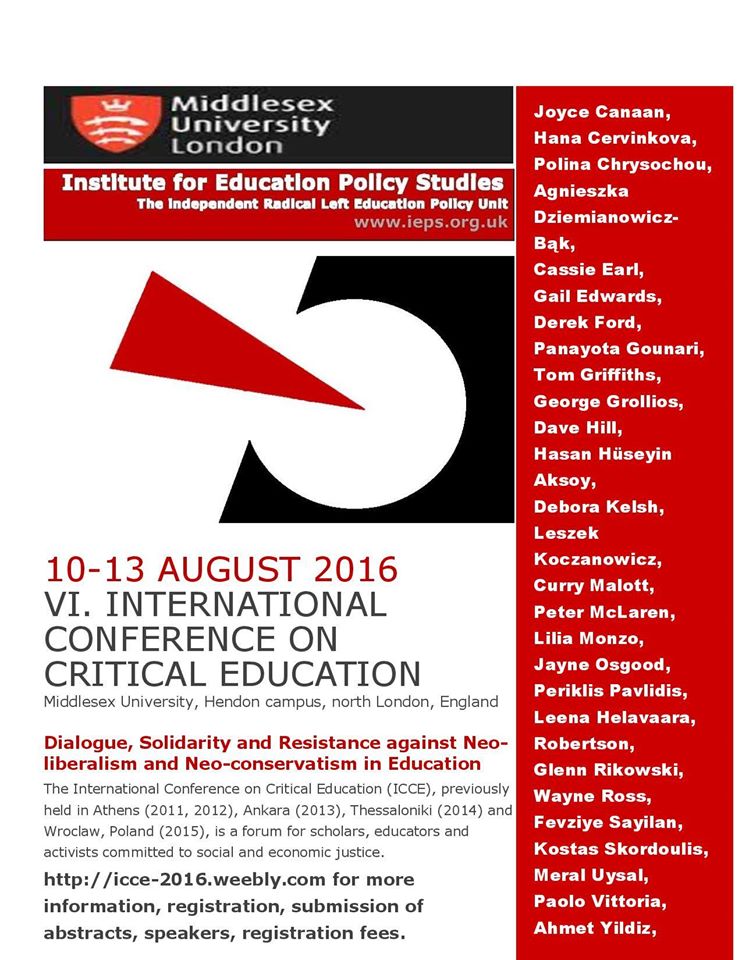
VI International Conference on Critical Education – Dialogue, Solidarity & Resistance Against Neoliberalism and Neoconservatism in Education

12640506_10208281467610451_7401944806829835272_o

CFP: AVPC 2016: Visual Pedagogies and Digital Cultures

Call for Papers AVPC 2016

We are pleased to announce the Second Call for Papers for the first Association of Visual Pedagogies Conference AVPC 2016: Visual Pedagogies and Digital Cultures. The conference is hosted by the University of Applied Sciences in Zagreb, Croatia, on June 18-19 2016.

 Peer reviewed conference articles will be published in The Video Journal of Education & Pedagogy (Springer) and a invited selection from the conference will be published as a special issue by conference organisers in consultation with the Editor-in-Chief, Michael A. Peters. 

Please send an abstract of no more than 400 words to Petar Jandrić (pjandric@tvz.hr) by 15 February 2016.                                                                                                                                                                        

Conference website: http://avpc.tvz.hr/

We look forward to meeting you in Zagreb!

 Conference Committee:

Petar Jandrić, University of Applied Sciences, Croatia, Michael A. Peters, University of Waikato, New Zealand, Tina Besley, University of Waikato, New Zealand, Jayne White, University of Waikato, New Zealand, Kathrin Otrel-Cass, Aalborg University, Denmark, John O’Neill, Massey University, New Zeland, Milan Bajić, University of Applied Sciences, Croatia.  

CALL FOR PAPERS: Special issue of Policy Futures in Education Lefebvre’s teachings

Screen Shot 2016-02-03 at 8.49.29 AM

CALL FOR PAPERS:

Special issue of Policy Futures in Education

Lefebvre’s teachings

Lefebvre’s teachings

Guest editor: Derek R. Ford, PhD

Although the person of Henri Lefebvre has been gone since 1991, the exploration of the implications of his thought for a variety of disciplines and social movements is still in its infancy. And it is likely to be a long life, as Lefebvre wrote over 60 books throughout his life, in addition to numerous articles, edited volumes, and lectures. Not only is the translation of his work into English still incomplete, but new manuscripts are still being discovered, Towards an Architecture of Enjoyment being the most recent.

Lefebvre’s thought has been most influential in geography and urban studies, animating key debates around, for example, the primary and secondary circuits of capital, industrialism versus urbanism, and spatial production more generally. It is primarily this body of secondary literature that has helped Lefebvre’s thought spread outward. Relatedly, his work on the right to the city has sparked a whole host of academic debates and policy formulations, and even some political coalitions. The growing importance of struggles over space in protest, social, and resistance movements across the globe has, to be sure, energized this interest.

Educational theory, research, and policy, however, have yet to engage with Lefebvre’s vast body of work in a sustained manner. There are just a handful of articles deeply engaging Lefebvre (e.g., Atasay and Delavan, 2012; Christie, 2013; Ford, 2013, in press; Taylor and Helfenbein, 2009) and one dedicated monograph (Middleton, 2013), although his work is referenced in and gestured toward quite a bit more often, primarily in sociology of education.

This special issue of Policy Futures in Education will be the first journal issue to focus specifically on Lefebvre’s thought and its import for educational theory, research, and policy. While authors need not be in the field of education proper, we seek submissions that represent sustained educational encounters with Lefebvre. Papers might examine Lefebvre’s work on everyday life and sociology, the state, rhythmanalysis, architecture, Marxism, dialectical materialism, Nietzsche, modernity, cities, space, or urbanism, and how this work relates to educational philosophies, practices, research, and policies. We are open to papers that explore Lefebvre’s relevance for education as well as papers that explore education’s relevance for Lefebvrean thought. If you are unsure if your topic will fit with the issue, please e-mail the editor for feedback.

Timeline:

An early expression of interest and a 200-300 word abstract is preferred by April 1st, 2016. Manuscripts—which should adhere to normal journal requirements—will be due October 1st, 2016. The expression of interest and abstract should be sent to drford@syr.edu. Authors of successful expressions of interest/abstracts will be directed to submit full manuscripts at http://mc.manuscriptcentral.com/pfie.

About the guest editor:

Derek R. Ford is a teacher, organizer, and writer living in Philadelphia, PA, USA. He received his PhD in cultural foundations of education from Syracuse University in 2015. He has published several articles on Lefebvre and education and recently co-edited a special journal issue on education and the right to the city. His most recent books are Marx, capital, and education: Towards a critical pedagogy of becoming (with Curry Malott) and Leaders in critical pedagogy: Narratives for understanding and solidarity (with Brad Porfilio). His latest book, The secret and struggle of study: Political economy, alterity, pedagogy, will be published this year by Lexington Books.

References:

Atasay, E., & Delavan, G. (2012). Monumentalizing Disaster and Wreak-construction: a case study of Haiti to rethink the privatization of public education. Journal of Education Policy, 27(4), 529-553.

Christie, P. (2013). Space, Place, and Social Justice: developing a rhythmanalysis of education in South Africa. Qualitative Inquiry, 19(10), 775-785.

Ford, D.R. (2013). Toward a Theory of the Educational Encounter: Gert Biesta’s educational theory and the right to the city. Critical Studies in Education, 54(3), 299-310.

Ford, D.R. (in press). A Pedagogy for Space: teaching, learning, and studying in the Baltimore Rebellion. Policy Futures in Education.

Middleton, S. (2013). Henri Lefebvre and Education: space, history, theory. London and New York: Routledge.

Taylor, H. L., & Helfenbein, R. J. (2009). Mapping Everyday: gender, Blackness, and discourse in urban contexts. Educational Studies, 45(3), 319-329.

Download PDF

CFP: Critical Theories in the 21st Century

Critical Education is proud to be the sponsor journal for Critical Theories in the 21st Century at West Chester University.

4th annual:
critical theories in the twenty first century:
a conference of transformative pedagogies
november 6th & 7th

location:


West Chester University
700 South High St, West Chester, PA 19383

2015 THEME:
CRITICAL PEDAGOGY VS. CAPITAL:
REIGNITING THE CONVERSATION

Sponsored by:
Educational Foundations
The Department of Professional and Secondary Education
West Chester University of Pennsylvania

Closing Conference Keynote (November 7th):
Dave Hill

Call For Papers
The 4th Annual Conference on Critical Theories in the 21st Century aims to reinvigorate the field of critical pedagogy. The primary question driving this conference is: What is to be done to make critical pedagogy an effective educational weapon in the current struggle against capitalism and imperialism?

There is no doubt that we are at a critical juncture in history in terms of the limits of nature’s vital ecosystems, the physical limits of the progressive accumulation of capital, and the deepening reactionary ideology and scapegoating that exacerbates the oppression of youth of color. If critical pedagogy is to play a significant role in intervening in the current context, then a sharpened sense of purpose and direction is needed.

Some examples of possible topics include:

  • Marxism
  • Post-structuralism/post-modernism
  • Anarchism
  • Challenging the unholy trinity of state, capital, and religion
  • Class and the capital-labor dialectic
  • Identity and economics
  • Hierarchical and vertical forms of organization (i.e., vanguards versus networks)
  • Reform versus revolution
  • Socialism, communism, & democracy
  • Affect theory and the new materialisms
  • The knowledge economy, post-Fordism, and “cognitive capitalism”
  • Critical geography

While this conference will include important presentations and debates in critical pedagogy, it will not be limited to this focus. In other words, as critical theory becomes more inclusive, global, and all encompassing, this conference welcomes more than just academics as important contributors. That is, we recognize students and youth groups as possessing authentic voices based on their unique relationship to capitalism and will therefore be open to them as presenters and discussion leaders.

While this conference will include important presentations and challenging discussions based in critical pedagogy, it will not be limited to this focus. In other words, as critical theory becomes more inclusive, global, and all encompassing, this conference welcomes more than just academics as important contributors.

Please submit abstract proposals (500-1000 words) to:
Curry Malott (cmalott@wcupa.edu)

Proposal due date: September 27th, 2015

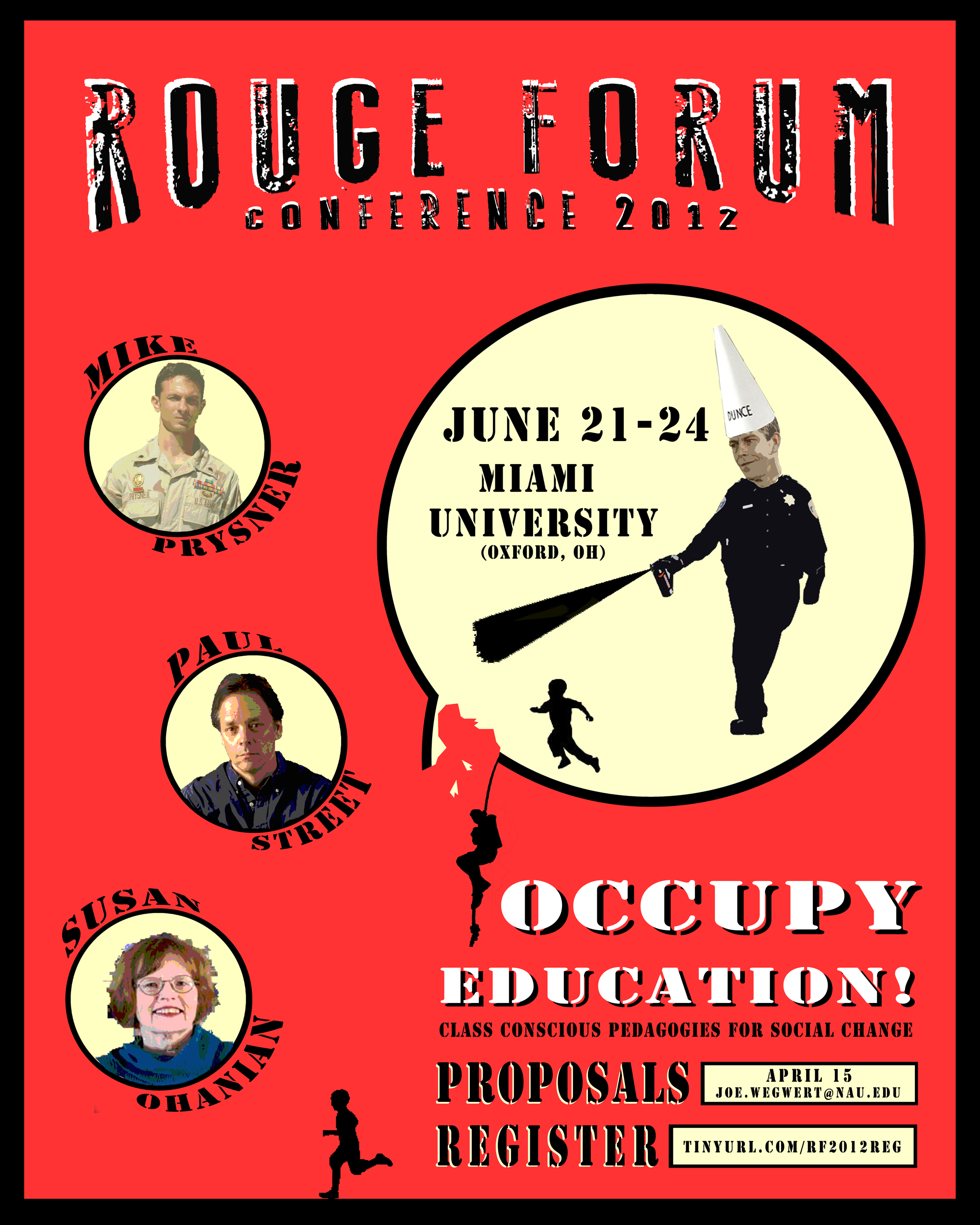
CFP Rouge Forum 2012 (Deadline April 15)

The Rouge Forum 2012 will be held at Miami University in Oxford, Ohio. The University’s picturesque campus is located 50 minutes northwest of Cincinnati. The conference will be held June 22-24, 2012.

Proposals for papers, panels, performances, workshops, and other multimedia presentations should include title(s) and names and contact information for presenter(s). The deadline for sending proposals is April 15.  The Steering Committee will email acceptance notices by May 1.

Read the Call for Proposals.

Featured speakers this year include Mike Prysner, Paul Street, and Susan Ohanian.