As the economic crisis sparks upheaval globally, analysts fear possibility of class war in the USA

As global capitalism implodes there is has been a marked uptick in social upheaval worldwide and now establishment analysts are expressing their concerns about “class conflict” and “civil war” in the USA.

The Economic Meltdown Sparks Global Unrest

The financial crisis has sparked unrest globally and particularly across Europe, with demonstrations, strikes, and protests in 16 European countries. Here are a just a few examples:

  • Tens of thousands of workers marched in Lisbon, Portugal on March 13 against the policies of the Socialist government, which unions say are increasing unemployment and favoring the rich at a time of crisis;
  • Hundreds of workers at Bulgaria’s Kremikovtzi steel mill protested on March 9 over planned lay-offs and unpaid salaries, demanding the Socialist-led government find a buyer for the insolvent plant; thousands of police officers marched in Sofia on Sunday to demand a 50 percent wage rise and better working conditions;
  • In Greece, the fatal police shooting of a 15-year old in December sparked the country’s worst riots in decades, fueled by anger at economic hardships and youth unemployment. Anarchists and left wing guerrilla groups have followed up with a wave of attacks against banks and police; Greek unions, representing about 2.5 million workers, have also staged repeated protests against the government saying its measures to tackle the global crisis only burden the poor;
  • Last month over 100,000 people marched against cutbacks in Ireland.

High unemployment rates have led to protests in Latvia, Chile, Greece, Bulgaria and Iceland and contributed to strikes in Britain and France.

Last month, a half-million Mexican truckers shut down the countries highways to protest high fuel prices.

In December, Russian riot police busted up protests in Vladivostok against new taxes intended to “help prop up Russia’s domestic car industry and prevent people buying cheaper, imported products.” BBC reports that the protests were fuelled by the severe impact of the global economic crisis on Russia. According to Newsweek, “the Russian Interior Ministry set up a special command center in Moscow, packed with surveillance equipment designed to deal with street unrest. The Duma, on Kremlin instructions, added seven new articles to the criminal code including a law that makes “participating in mass disorders” such as the one in Vladivostok a ‘crime against the state.'” 800,000 Russians lost their jobs in December and January, making the total number of unemployed more than 6 million or 8.1 percent. Gennady Gudkov, former KGB colonel and current chair of the Duma’s security committee, said, “We are expecting mass unemployment and mass riots. There will be not enough police to stop people’s protests by force.”

There a have been massive general strikes in the French territories of Guadeloupe, Martinique, and Réunion. The general strike in Guadeloupe prompted the French government to fly in riot police (Guadeloupe is a French “overseas department” in the Caribbean). And while the general strike lasted 6 weeks—it ended on March 4 with an agreement among the strike collective, the employers federation and local and French governments, which granted 20 of the strikers primary demands and set out negotiations on a long list of remaining issues—strikes and protests continue, involving tens of thousands of workers.

The agreement to end the Gaudeloupe strike , called the “Jacques Bino Accord”, identifies the underlying cause of discord as “the present economic and social situation existing in Guadeloupe [that] results from the perpetuation of the model of the plantation economy”. An economy “based on monopoly privileges and abuses of dominant positions that generate injustices.” The accord calls for an end to these obstacles “by establishing a new economic order enhancing the status of everyone and promoting new social relationships”.

Just as the general strike ended in Guadeloupe, social unrest over economic conditions spread to Réunion (a French “overseas department” in the Indian Ocean).

There is a definite pattern developing world wide. And now, US elites are starting to worry about what might happen if the American workers take action as a result of their frustrations with massive economic inequalities.

USA Prepares for Class War

YouTube Preview Image

In his latest monthly commentary (Mar. 15, 2009, Commentary No. 253), sociologist and world-systems analyst Immanuel Wallerstein discusses the breakdown of taboos as the world’s economy continues to disintegrate.

He notes, for example, that “nationalization” of banks and industry is now being seriously discussed by establishment intellectuals and analysts such as Alan Greenspan, Senator Lindsay Graham, and economist Alan Blinder.

But Wallerstein’s most dramatic example of the breakdown of taboos is the open discussion of the possibility of class war breaking out in the USA. Wallerstein says that “after hearing nationalization proposals by arch-conservative notables, we are now hearing serious discussions about the possibilities of civil war in the United States. Zbigniew Brzezinski, apostle of anti-Communist ideology and President Carter’s National Security Advisor, appeared on a morning television talk show on February 17, and was asked to discuss his previous mention of the possibility of class conflict in the United States in the wake of the worldwide economic collapse.”

In Brzezinski’s interview with Joe Scarborough on MSNBC about his recently published book—America and the World: Conversations on the Future of American Foreign Policy, co-authored with another former National Security Advisor (to Gerald Ford and George H. W. Bush) Brent Scowcroft—Brezenzki was straightforward about the belief that class war in America is real possibility:

JOE SCARBOROUGH: You also talked about the possibility of class conflict.

ZBIGNIEW BRZEZINSKI: I was worrying about it because we’re going to have millions and millions of unemployed, people really facing dire straits.  And we’re going to be having that for some period of time before things hopefully improve. And at the same time there is public awareness of this extraordinary wealth that was transferred to a few individuals at levels without historical precedent in America…And you sort of say to yourself: what’s going to happen in this society when these people are without jobs, when their families hurt, when they lose their homes, and so forth?

We have the government trying to repair: repair the banking system, to bail the housing out.  But what about the rich guys? Where is it?  [What are they] doing?

Brzezinski went on to compare the current economic meltdown to the “Panic of 1907”:

It sort of struck me, that in 1907, when we had a massive banking crisis, when banks were beginning to collapse, there were going to be riots in the streets. Some financiers, led by J.P. Morgan, got together.  He locked them in his library at one point. He wouldn’t let them out until 4:45 AM, until they all kicked in and gave some money to stabilize the banks: there was no Federal Reserve at the time.

Where is the monied class today? Why aren’t they doing something: the people who made billions, millions.  I’m sort of thinking of Paulson, of Rubin [former treasury secretaries]. Why don’t they get together, and why don’t they organize a National Solidarity Fund in which they call on all of those who made these extraordinary amounts of money to kick some back in to [a] National Solidarity Fund?

Brzezinski continued saying,

“And if we don’t get some sort of voluntary National Solidarity Fund, at some point there’ll be such political pressure that Congress will start getting in the act, there’s going to be growing conflict between the classes and if people are unemployed and really hurting, hell, there could be even riots!

Wallerstein points out that “almost simultaneously” LEAP/Europe a European agency that issues monthly confidential bulletins for its clients—politicians, public servants, businessmen, and investors—devoted its February issue to global geopolitical dislocation, discussing the possibility of civil war in Europe, in the United States, and Japan; and foreseeing a “generalized stampede” that will lead to clashes, semi-civil wars.

Wallerstein quotes the Global Europe Anticipation Bulletin as saying:

“If your country or region is a zone in which there is a massive availability of guns, the best thing you can do…is to leave the region, if that’s possible.”

And Wallerstein also points out that, “the only one of these countries which meets the description of massively available guns is the United States. The head of LEAP/Europe, Franck Biancheri, noted that ‘there are 200 million guns in circulation in the United States, and social violence is already manifest via gangs.’ The experts who wrote the report asserted that there is already an ongoing emigration of Americans to Europe, because that is ‘where physical danger will remain marginal.'”

Wallerstein emphases that “these analyses are not coming from left intellectuals or radical social movements.…Verbal taboos are broken only when such people are truly fearful. The point of breaking the taboos is to try to bring about major rapid action – the equivalent of J.P. Morgan locking the financiers in his home in 1907.”

And US elites are obviously fearful enough to start planning for military responses to potential social upheaval as a result of the collapsing economy.

Last November, the US War College’s Strategic Studies Institute posited a number of  “strategic surprises” that the country should be prepared for, including potential for disruption and violence caused by the economy’s failure. The report Known Unknowns: Unconventional ‘Strategic Shocks’ in Defense Strategy Development, says “widespread civil violence inside the US would force the defense establishment to reorient priorities in extremis to defend basic domestic order and human security.”

And now, for the first time ever, US military units are staged and are training inside the country to address civil unrest rising from inequality. The Army Times has reported on the US Northern Command’s (NORTHCOM) deployment of the 3rd Infantry Division’s 1st Combat Brigade Team (BCT) on U.S. soil for “civil unrest” and “crowd control” duties. The 5,000-member force was one of first units deployed in Baghdad.

Power, class, and warfare: Springsteen’s “Born in the USA” turns 25

Christian Christensen explores the quarter-century long misunderstanding of Bruce Springsteen’s most famous song in a short, but incisive critique published in yesterday’s edition of CounterPunch.

Born in the USA is one of a small number of songs, films or television programmes (produced in large part in the United States) that can generate near-physical negative reactions with a mere mention of the title. (Films like Rambo and TV shows like The Jerry Springer Show fall into this category.) When the song was released, my own response to Springsteen’s creation, as a 15-year-old American boy living in the United Kingdom, was in line with those of many of my British friends: bemusement and indignation toward what appeared to be little more than a mindless anthem trumpeting the virtues of patriotism and American egomania. The song was brash, bragging and – to the irritation of people who despised the politics of Thatcher and Reagan – amazingly popular.

The song was embraced by the right as an anthem of triumphant nationalism in the 1980s, despite it’s critical lyrics. Springsteen’s politics in the eighties where not so well known and allowed listener’s to easily construct contradictory meanings.

In a 2004 interview in Rolling Stone magazine, Springsteen was philosophical about the relationship between himself and his fans, noting that audiences often engage in selective listening, suggesting that the meaning of popular music is as much the creation of the fan as it is of the band or the musician. Perhaps he was thinking of the various interpretations of Born in the USA when he said: “Pop musicians live in the world of symbology. You live and die by the symbol in many ways. You serve at the behest of your audience’s imagination. It’s a complicated relationship”.

Despite the right’s co-optation of Born in the USA, Christensen argues “the song continues to provide listeners with a reminder of the relationship between power, class and warfare.” And I agree. Indeed the same could be said of the majority of Springsteen’s oeuvre. But Christensen argues there is huge gap between image and reality when it comes to Springsteen work these days and points to the contradictions of his musical themes and images against his exclusive distribution deal with Wal-Mart, playing the Bridgestone/Firestone Super Bowl Half Time Show, etc.

The singer noted that when an artist’s work meets reality, the results can be painful for fans. “The audience and the artist are valuable to one another as long as you can look out there and see yourself, and they look back and see themselves,” he said. “When that bond is broken, by your own individual beliefs, personal thoughts or personal actions, it can make people angry. As simple as that.”

PLAY BALL! MLB 2009 predictions. Put your money down, what follows is a lock!

National League-East
New York Mets
Atlanta Braves
Philadelphia Phillies
Florida Marlins
Washington Nationals

National League-Central

Chicago Cubs
Milwaukee Brewers
St. Louis Cardinals
Cincinnati Reds
Houston Astros
Pittsburgh Pirates

National League-West

Los Angeles Dodgers
Arizona Diamondbacks
San Francisco Giants
Colorado Rockies
San Diego Padres

American League-East
Boston Red Sox
Tampa Bay Rays
New York Yankees
Baltimore Orioles
Toronto Blue Jays

American League-Central

Cleveland Indians
Detroit Tigers
Minnesota Twins
Kansas City Royals
Chicago White Sox

American League-West

Los Angeles Angels of Anaheim
Oakland Athletics
Seattle Mariners
Texas Rangers

NL Wildcard: Atlanta Braves
AL Wildcard: Tampa Bay Rays

NL Pennant: Los Angeles Dodgers
AL Pennant: Boston Red Sox

World Series Champion: Los Angeles Dodgers

NL MVP: Manny Ramirez, Los Angeles Dodgers
AL MVP: Dustin Pedroia, Boston Red Sox

NL Cy Young: Carlos Zambrano, Chicago Cubs
AL Cy Young: C.C. Sabathia, New York Yankees

NL Rookie of the Year: Tommy Hanson P, Atlanta Braves
AL Rookie of the Year: David Price P, Tampa Bay Rays

NL Comeback Player: Jeff Francouer, Atlanta Braves
AL Comeback Player: Mike Lowell, Boston Red Sox

Detroit, America’s most epic urban failure, part 2


Michigan Central Station, Detroit’s main train station, opened in 1913 has not been used since 1988. (Photo by Yves Marchand and Romain Meffre)

Earlier this month I blogged about Detroit as America’s most epic urban failure. My buddy Detroit Rich just tipped me off to a depressingly beautiful Time magazine photo essay of Detroit—Detroit’s Beautiful, Horrible Decline—which features the photography of Yves Marchand and Romain Meffre. Also check out the Marchand and Meffre “Ruins of Detroit” photo essay on their web site.

The Fighting Hasidim vs. Dook Blue Devils

Well it’s March Madness once again. And this year I feel just a bit more connected to the big college hoops tournament than usual (even though no Canadian newspaper prints a two page spread of the brackets where I can fill in my predictions).

Of course, my beloved Tar Heels, from the University of North Carolina, are in the mix (and have a No. 1 seed in the South Regional) and have to be considered one of the favorites to win the whole shebang. Indeed, just today they were proclaimed the winner of Inside Higher Ed’s Academic Performance Tournament! Although IHE’s tournament has little to do with who actually wins the hoops competition (e.g., past APT winners include Bucknell, Holy Cross, and Davidson).

I’m particularly interested in the Midwest bracket of the NCAA tournament, where my other alma mater, the Buckeyes of THE Ohio State University are an eight seed and open play against the Siena Saints. Siena was the only local Division I hoops team when I lived in Albany, NY and thus I logged a lot of time following the Saints (both the men’s and women’s teams). Siena, btw, changed their nickname from the “Indians” back in the 1990s—more on nickname changes later.

The winner of the Ohio State v. Siena game will likely play the University of Louisville Cardinals (who will surely trounce the winner of the the “opening round” game between Alabama State and Morehead St.). I spent two and a half, let’s call them “interesting”, years on the faculty at UofHell (as it is often unaffectionately referred to) , arriving in town about the same time Planet Red landed former UK (“Go Cats”)/Boston Celtics coach Rick Pitino. Pitino outlasted me at The ‘Ville and for reasons that I will keep to myself, I’ll be cheering for either the Buckeyes or Saints in the second round match up, but admit that the Cards do have a spot in my heart (it’s just down the list, a bit at about No. 6, behind the Bearcats of Binghamton University).

The Bearcats have that special (No. 5) place in my heart because I played a very small, yet I believe significant part, in their climb from Division III mediocrity to grasping the brass ring of Division I basketball success (even if they did it by tossing academic standards in the gutter).

Back in the 1990s there was a very contentious debate on campus at Binghamton about moving its athletics program from Division III (where no athletic scholarships are offered) to the big time of Division I. The argument broke down on familiar lines. Many (probably most) faculty members at Binghamton sided against the move because it was perceived as a potential threat to academics (Binghamton was and is one of the most highly regarded campuses of the State University of New York system, the “academic jewel of SUNY” as they say). The pro-Division I argument was that ratcheting up the athletics programs would allow BU to rub shoulders with it’s academic peers in conferences like the Patriot League (incidentally the home of two past champions in IHE’s Academic Performance Tournament, Bucknell and Holy Cross).

The first move toward Division I membership by Binghamton was made in the late 1990s, when I just happened to be on the BU Athletics Board. We endorsed taking the first step to Division I by voting to move the athletics program to Division II (as required of the NCAA) and then to study the impact of that move on both the finances and academic standards of the university.

I left Binghamton for a position at the UofL in 2001, just before BU’s president and athletic director ignored a BU faculty senate vote and took Binghamton to Division I against the faculty’s will. My support for the initial move toward Division was not really popular with some of my faculty colleagues (or Dr. Mathison for that matter), but I do believe there are ways around “either/or” thinking that tends to crop up in debates over academics and athletics on campus.

So there you have my connections to this year’s tournament. But let’s not forget one indisputable bonus of BU’s move to Division I—getting that new nickname, the Beacats! Once the move to big time athletics became a real possibility, the administration wanted to tap into the profits schools derive from selling branded clothing to alumni and fans and the old nickname, the “Colonials”, just wasn’t moving t-shirts.

The Colonials mascot always reminded me of The Jolly Dumple, the famous mascot of Crazy Go Nuts University. The Jolly Dumple appears to be a dumpling with two large hands forming “thumbs-up” signs, with a drop of saliva flying out of his mouth, and wearing a tricorn hat. The costume is made of a highly combustible material called polymascotfoamalate (according to the HomeStarRunner wiki).

BU hired a marketing firm and spent big bucks in the search for a new nickname, a process that Tony Kornheiser skewered in a hilarious Washington Post column in 1999 (see below). The marketing company set out the following criteria for the new name: “gender-neutral, non-offensive, powerful, aggressive, dignified and marketable.”

I suggested a new nickname for BU that aimed at highlighting the university’s high academic standards and in particular the strong connection of its faculty to theory-building in the social sciences: “The Post-Colonials,” a choice that clearly fit the criteria.

Kornheiser’s suggestions included: The Smelt. The Binghamton Empowered Persons. The Bisexuals. The Binghamton Bada-Bing! The Bolivian Swarming River Rats. The Golden Geldings. The Binghamton Crosbys. The Fighting Beiges. The (Name of Your Corporation Here). The Binghamton Bacilli. The Fighting Hasidim. And, his favorite, The Swiss.

Go Bingo! Beat Dook!

The Fighting Hasidim
Tony Kornheiser

5 December 1999
The Washington Post

After 53 years of proudly being called the Colonials, my alma mater, Binghamton University, recently rated by Der Spiegel as one of the “better schools” in south-central New York state (motto: “We’re Only 207 Road Miles From Yale”), has decided to change the nickname of its athletic teams.

No, this wasn’t some political-correctness fix. Colonials isn’t a hideously embarrassing racial slur, like, say, Redskins–if there could possibly be somebody insensitive enough to use that as a name for a sports team. Colonials is a benign term, meaning either “a member or inhabitant of a colony” or, as I’ve just learned, those pathetic buckle shoes nobody has worn since the time of the Pilgrims, with the possible exception of Elton John.

(Jeez. All this time we were named after shoes? Whose idea was that, Judy Garland’s?)

Binghamton decided to dump “Colonials” for a much more practical reason: “Colonials” wasn’t moving T-shirts. End of discussion.

Name changes are nothing new to my school, which was originally Triple Cities College and then–when I went there–Harpur College. When people asked me where I went to school, I would say “Harpur” very fast and deliberately slur the pronunciation to see if I could fool some dopes into thinking I went to “Harvard.”

Later, it became SUNY–Binghamton. Now it’s simply Binghamton U. In a few years, it’ll probably be a Starbucks. (I took my daughter up there a few years ago, showed her the familiar red brick neo-penal architecture, and she said, “Daddy, it looks like a drug rehabilitation center.” I smiled and told her, “Sweetie, you don’t know how close you are.”)

I have to laugh when I think back to the athletic teams we had when I was in school. We were not a jock school. There was no football team. The center on our basketball team was only 6 feet 2; he had a terrific view of the opposing center’s armpits. After his junior year, he left to join the circus! Everything you need to know about the state of Harpur College athletics is embodied in the name of one of the school’s legendary stars: Jack “The Shot” Levine.

We never won anything. It wasn’t just that your guys could beat our guys; your girls could beat our guys. The piccolo section of your band could beat our guys.

Along with a new nickname, Binghamton wants a mascot, too. When I was at Harpur, we never actually had a mascot the students could relate to–I’d have suggested a cuddly stuffed animal who sat immobilized for five hours playing the first side of the “Moby Grape” album and babbling about how if you cut open a Cheez Doodle, the colors were really far out.

It’s okay with me if they want to change “Colonials” to something else, but I must express my outrage at how the new nickname was arrived at.

A marketing company was hired to prepare a list of 30 names. I quote from the alumni newsletter: “The following qualities were considered in selecting the name: gender-neutral, non-offensive, powerful, aggressive, dignified and marketable.”

(So I guess “Big Hairy Chicks on Crack” had no chance.)

What kind of nickname can you get from that commercialized, politically correct crap?

I asked my friends at work to brainstorm a name using those guidelines. Here’s what they came up with:

The Smelt.

The Binghamton Empowered Persons.

The Bisexuals.

The Binghamton Bada-Bing!

The Bolivian Swarming River Rats.

The Golden Geldings.

The Binghamton Crosbys.

The Fighting Beiges.

The (Name of Your Corporation Here).

The Binghamton Bacilli.

The Fighting Hasidim.

And my personal favorite: The Swiss.

But for some reason, Binghamton picked Bearcats.

There’s no such thing as a bearcat. It’s a mythical animal. A fraud.

My friend Tammy, who has two cats, points out quite correctly: “Of course, it is mythical. I am absolutely, positively certain my cats would never, ever, like, do it with a bear.”

(Tammy also asks, “Why aren’t there beardogs?” But that is a question for another day–and possibly another galaxy.)

The alumni journal praises the choice of Bearcat: “A cross between the power and ferocity of a bear, and the cunning and quickness of a cat.”

Well, if what you want is power and ferocity, and cunning and quickness, why not choose a nickname like “Psychotics With Chain Saws”? You think that’s not marketable? That’s got big-time “WWF Smackdown!” potential!

The University of Cincinnati has been the Bearcats for 100 years. And Cincinnati is a good athletic school. Its basketball team is No. 1 in the country now. Everyone will assume that Binghamton stole the nickname from Cincinnati. And, let’s face it, stealing from Cincinnati is about as desperate as it gets. I mean, what a dump. If Binghamton is the way your foot smells, Cincinnati is the way your foot tastes.

If you’re going to steal somebody’s nickname, steal something with power and majesty. Call yourselves: the New York Yankees.

(The Smelt is looking better, isn’t it?)

Not only isn’t “Bearcats” original, but the logo they picked is almost exactly the same as that of the NHL’s Florida Panthers. So we’ve got a phony-baloney animal and a rip-off logo. It’s all schmutz. As an alumnus in good standing (well, okay, an alumnus still standing), I am herewith ripping up the $50,000 check I had just written to the Binghamton Alumni Association.

And they can forget about a major donation until they come up with a nickname that stands for something. Something that says it all. How about the Binghamton Balding Kornhuskers!

http://www.washingtonpost.com
Copyright 1999, The Washington Post Co. All Rights Reserved

Rouge Forum Update

Dear Friends,

The Rouge Forum Conference, May 15-17, in Ypsilanti, Michigan, is lining up to be a terrific event. Come meet friends, hear keynoters like Staughton Lynd and get ready for a falling sky. The RF conference link is here.

Please help spread the word about the conference. It looks like our best yet. The lineup of presentations is terrific. You will have a hard time picking which ones you want to attend. The conference will set the north star for education resistance for yet another year. This is our eleventh conference. Time flies.

The Seattle special ed teachers who were suspended for refusing to give their students high-stakes exams that would invariably fail them are back in the classroom and working with a lawyer on their appeal. A note of encouragement would be more than appropriate—solidarity with the notion that an injury to one just goes before an injury to all.
Lenora Stahl

It was a loud and busy week in education. The One, who we dubbed The Obamagogue, in somewhat good humor, came out in favor of merit pay and a series of regressive educational measures (more regimented curricula, more sophisticated testing) summed up here.

The bosses of the National Education Association (paid upwards of $450,000 a year aside from expense accounts) joined their favorite bedfellows, the US Chambers of Commerce and the National Association of manufactures, to promote, among other things, a national curriculum.

The group hug of business profiteers, labor bosses, and government hacks went on to support what many people feel is the utterly out of date, pre-sky-falling, litany of what’s been called the Tough-Tough Project.

Then Tim Geithner and Arne Duncan went on the road to promote The One’s projects. Here is a report on The Obamagogue’s Liars and Our Future.

Let us be clear. The education budget is a war budget. The core issue of our times is booming color-coded inequality challenged by the potential of rising mass class conscious resistance, in schools and out.

There is continuing debate about the Employee Free Choice Act, now pending before congress and drawing about $200 million in lobbying money—both sides, labor and management combined–in a struggle that may not be exactly about the best interests of workers or the nation, though all the big players say otherwise. Here is a link to the discussion in the Historians Against the War.

There are many demonstrations coming this week around the US and the world. This week marks the sixth year of the US invasion of Iraq, a failed adventure propelled by hubris, oil, regional control, and deception–a mix that could spell tyranny. All who can should be on the march, not only to raise a peace sign, a fist, or a finger, against this travesty, but to test our own strength and resolve.

Remember to spread the word about the conference in Ypsi!.

Want to explain Madoff and a Ponzi scheme to your kids? $9.7 trillion to the banksters and still counting.

Here are some good Great Depression Songs to get us through the week.

Good luck to us every one.

Thanks to Joe B and C, Greg and K, The Bill’s, Bob A and D, Erica, Donna, Shelly, Ann Arbor Ann, Candace, Niki N, Sharon A, Amber, Wayne, Perry, Kev, Curry, M…Y…,Hanna and Cal, Kelly, Elaine, Dominique, Luis, Tanya, Summer, Paul and Mary, Alex and Jeff, Gil G, Kirk, Jimmy B and G, Kathy Young, and Z’s.

All the best,

r

Rouge Forum Update

Dear Friends,

There is still time to submit a proposal for the Rouge Forum Conference. Come enjoy the company of sane people.

Is it trite to say that the class war that we noticed, among a very few others, years ago, rages now, in schools and out?  Surely, elites know it, even if too many on our side don’t.

Bloomberg News group seems to be the only section of the corporate press truly interested in tracking where the $9.7 billion(+) bailout went. They filed suit and came up nearly blank. Secrecy, as we know, is a cornerstone of tyranny.

Here we see Oregon schools gutted by the collapsing economy (better termed as Their Economy)

California is, right now, issuing thousands of layoff notices to school workers.

People will fight back. There is always resistance. Here are two Seattle teachers who retained their integrity by supporting their kids right to opt out of exams that were completely inappropriate for them. The teachers were suspended. You can email your thought to the Seattle Superintendent at andy.dorn@k12.wa.us

After months of secrecy, NEA’s bosses finally advised some members that they have been working behind the scenes, again, to merge NEA’s 3.5 million members with the AFL-CIO and the splinter group, Change to Win. On the face of it, solidarity might be appealing. But neither the AFL-CIO nor the CTW has ever practiced solidarity unionism. To the contrary, the labor bureaucrats have systematically disorganized workers’s job actions, as with the Detroit Teachers Wildcat, and they have used violence against labor reformers, as with the SEIU attack on Labor Notes in 2008. All NEA would get would be a more undemocratic structure, a la the AFT.

Meanwhile, NEA mis-leaders joined AFT, the Business Roundtable, and other employer groups to promote national teaching standards. Why national standards? It is not possible to split foreign policy and domestic policy. The education budget is a war budget. The crux of the US education project is to produce students so witless, docile, loyal, yet useful,  they will support the poor of their home nation going off to fight and die for the rich. Bill Blum noticed this recently when he reminded us of this quote from the song about racism from the Broadway classic show, “South Pacific”  “You’ve got to be taught” …

You’ve got to be taught
from year to year.
It’s got to be drummed
in your dear little ear.
You’ve got to be taught
before it’s too late.
Before you are 6 or 7 or 8.
To hate all the people
your relatives hate.
You’ve got to be carefully taught.

From the NEA press release:

NEA partners to develop standards for measuring 21st century skills.Education collaborative strives to ensure global competitiveness for students:

WASHINGTON – February 23, 2009 – NEA is pleased to announce its partnership with the Council of Chief State School Officers, the National Governors Association, Achieve, Inc., the Alliance for Excellent Education, the Hunt Institute, the National Association of State Boards of Education, and the Business Roundtable, in a new state-led initiative to improve the access of every student to a complete, high-quality education that provides the skills and knowledge needed to thrive in the 21st century. The Common Core State Standards Initiative is working to produce a common core of voluntary state standards across grades. The K-12 standards would cover English/language arts, math, and eventually science. The initiative plans to be an inclusive and transparent process that will include input from education, civil rights and business leaders among others. “NEA welcomes the opportunity to participate in this effort to provide manageable, high-quality standards for adoption by states to guide efforts to improve education,” said NEA President Dennis Van Roekel. “We are pleased that the voices of classroom educators will now be a part of this process…

When the bosses say Cut Back. We must say Fight Back. No Concessions. No Layoffs. No wage or benefits cuts. Cap class size at 20 for everyone. Hire more people to combat unemployment. Go get us the Schools Tarp. Or we will shut your schools down and open freedom schools, teaching things that matter: Class struggle, love, sensuality and reproduction, rational knowledge in an atmosphere that promotes critique and freedom. All of that is illegal in California right now.

Meanwhile, AFL-CIO leaders cavort and bicker at the pricey Miami Fountainbleau Hotel

David Berliner has a new piece out, Poverty and Potential: Out-of-School Factors and School Success,
demonstrating once again Jean Anyon’s thesis: Doing school reform without social and economic reform is like washing the air on one side of a screen door. It won’t work.

For those who enjoy irony, here is General Motors, long the siren of Buy American, demanding a bailout, from Europe.

What happened to the capitalist economy anyway? Here are two quick insights, this one from old Marx himself: For Marx, there was never any doubt about the root cause of capitalist economic crises:

The ultimate reason for all real crises always remains the poverty and restricted consumption of the masses as opposed to the drive of capitalist production to develop the productive forces as though only the absolute consuming power of society constituted their limit.

Here is an extension from John B. Foster, author of the recently released, Great Financial Crisis, responding to an inquiry:

No I am not equating stagnation, stagflation, and overproduction. though they overlap. Stagnation, i.e. slow growth, rising unemployment/underemployment, high excess capacity, etc. reemerged in the 1970s. Initially, there was a period of stagflation (stagnation plus inflation). The inflationary part was brought under control but not the underlying stagnation, which continued. Under monopoly capital (or monopoly-finance capital) actual overproduction is not the dominant tendency since the demand shortfalls show up in overcapacity rather than overproduction. Corporations cut back on output pretty quickly and lower their capacity utilization (fully competitive capitalism didn’t work this way). You could say, though, that it is a case of implicit overproduction, so there is no real contradiction. Of course a build up of productive capacity, which is increasingly underutilized, fits just as well with Marx’s statement, ‘the real barrier of capitalist production is capital itself,’ which you quote.

All of which adds up to why you should book now to join us at the Rouge Forum Conference, May 15 to 17 in Ypsilanti! Keynotes: Staughton Lynd, Greg Queen, Rebecca Martusewicz .

All the best, r

Thanks to Gil, Bob, Susan and Susan, George and fam, Paul and Mary, Cindy, Amber, Della, Evan and Ethel, Tony H, Suber, Beau, Kelly, Jan, Dionne, Sandy and Sally, Shea, Holly, Peter M, Tom H, Cassie, Jean and Ken and fam, Jim the 3rd, Travis, Dan H, Gina, Sharon Ag, Carol Panetta, and Bobby.

The big lie that “progressives” tell themselves about Obama

This issue is been bugging me since the US presidential campaign heated up, oh two years ago.

Why is it that so-called “left-liberals” (including venerable liberal publcations like The Nation) think that Obama and his policies are progressive?

Is it that the notion of progressivism has lost all meaning; has become detached from progressive liberalism of the early 20th century that focused on issues of social justice and social democracy? I think so.

The vague, meaningless slogans of Obama the campaign (“Change” and “Hope”) offered no indication of the actual substance of how societal (or governmental) conditions might be improved. The lack of substance in the campaign allowed, no, encouraged people to project their own meanings onto Obama’s slogans and campaign promises.

But what really amazes me is how so many left-liberals ignored or did not believe Obama meant what he said when it comes to war and Wall Street.

How do peace activists and the anti-war movement in general back Obama when he balances his promise to end the war in Iraq with a promise to intensify the war in Afghanistan? I just don’t get the logic and apparently there is none, these folks are just hoping for Obama to be something different from what he says he is.

But if you take a look at Obama’s team there is really no doubt about where he’s coming from or where he’s headed. His cabinet appointments are—as Alexander Cockburn and Jeffrey St. Clair at CounterPunch put it, “a slap in the face to Obama’s base”—ex-Harvard, pro-business, and pro-war.

Even Karl Rove praised Obama’s economic team in a Wall Street Journal column!

Here are some of the heavy hitters in the Pro-War line up: Rahm Emanuel (the only Illinois Congressman to vote Yes to the war in Iraq); Hillary (another yes vote for the Iraq war); Robert Gates (Bush’s Pentagon chief!)

The Pro-Business line up is populated by Wall Streeters and Clinton-era appointees who help create the current economic crisis: Lawrence Summers (head of the National Economic Council and Clinton’s Treasury Secretary); Treasury Secretary Timothy Geithner (Summers’ former deputy at the Clinton Treasury, who has also worked for Kissinger and Associates and as head of the NY Fed decided to bailout Bear Stearns and AIG and let Lehman Bros go bankrupt); Interior Secretary Ken Salazar has proven his loyalty to ranchers and the coal industry; Ag Secretary Tom Vilsack is a lobbyist for genetically engineered biocrops (“Monsanto pinup boy,” according to Cockburn, who “comes factory guaranteed as a will-do guy for the agro-chemical complex.”)

And perhaps most disappointingly for “progressive” (whatever that means) educators, Obama’s man at the Education Department is the former “CEO” of Chicago Public Schools (and one of Obama’s Hyde Park basketball buddies), Arne Duncan.

Duncan is an “education reformer”, which is today’s media nomenclature means he aims to reshape schools to better serve the interests of capital through privatization and militarization of public schools and the commodification of childhood. See for example Chicago’s Renaissance 2010 project.

I actually harbored some of that Obama hopefulness when Linda Darling-Hammond was advising O’s campaign on education issues and headed the his transition team on education. Darling-Hammond is a Stanford education professor, who is no political radical, but is certainly one of the most highly respected scholars in the world on issues of teacher education; school redesign; educational equity; instruction of diverse learners; and education policy.

Instead of a thoughtful, educational researcher in the ED—who understands much about what’s wrong with No Child Left Behind and has ideas about how to right federal education policy so that works in the interests of student learning—we have a tool of the Business Roundtable who offers no hope for change from Bush’s Education Secretaries Margaret Spellings and Rod Paige (who famously called the National Education Association a “terrorist organization” because it criticized NCLB.)

Over at the huffingtonpost.com, Jerry Bracey describes the “hatchet job” on Darling-Hammond that paved the way for Duncan to be appointed to the ED slot.

If you want to read about the trail of dead that Duncan leaves behind in the public schools of Chicago, check out Substance News, edited by long-time Chicago teacher and journalist George Schmidt. You can start your reading with this article:

“Duncan leaves to continue attacks on public education from Obama cabinet post as U.S. Secretary of Education”

Detroit, America’s Most Epic Urban Failure

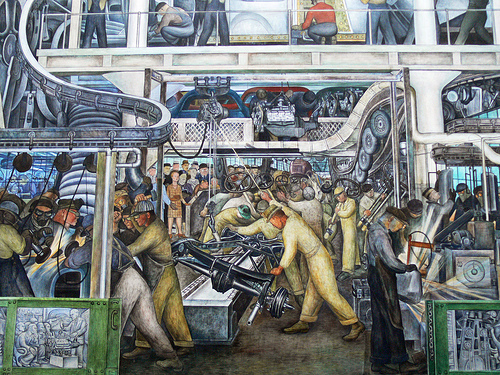
[Above image: “Detroit Industry” – Detroit Institute of Arts ( Diego Rivera ) – View 1, from DetroitDerek’s Flickr photostream.]

Over the past decade or so, I’ve visited Detroit many times, so as I read Mark Binelli’s profile of this dying city in the most recent Rolling Stone (#1073) there was a lot of resonance with my Motown experiences.

The article, of course, focuses on the auto industry, the government bailouts and Binelli uses a visit to the Detroit Auto Show to explore the decline of the industry and the city. But the most compelling part of the article describes a tour of the deindustrial wastelands of downtown Detroit that Binelli takes with Detroitblogger John to see abandoned factories, houses, and office buildings; grassy fields, which used to be crowded working and middle class residential neighborhoods and are now homes to coyotes and other wild life.

Check out photos at DetroitBlog.org or KenTakesPictures “Detroit” Flickr photoset or Derek Farr’s “Detroit Ruins” Flickr photoset to get an idea of what Detroit looks like these days. (KenTakesPictures describes the areas around the old GM factories as resembling scenes from 28 Days Later and Mogadishu)

You can also explore disappeared Detroit here and here.

Binelli vaguely hints at but doesn’t explore Detroit’s spirit of resistance, which is too bad because the history of the city is in many ways a history of resistance. There’s no doubt that Detroit is ground zero of the urban crisis in the US, but it is also home to many people who have and continue to work against racism, labor exploitation, and other inequalities.

Detroit’s also the birthplace of The Rouge Forum, which drew inspiration for it’s name from Detroit’s River Rouge and the River Rouge auto factory, which at one time was the largest factory in the world.

“The Rouge is both nature and work. The Rouge has never quit; it moves with the resilience of the necessity for labor to rise out of nature itself. The river and the plant followed the path of industrial life throughout the world. The technological advances created at the Rouge, in some ways, led to better lives. In other ways, technology was used to forge the privilege of the few, at the expense of most–and the ecosystems, which brought it to life, The Rouge is a good place to consider a conversation, education, and social action.”

Join us at the Rouge Forum annual conference this May, we’ll be meeting at Eastern Michigan University in Yspilanti, close enough for a quick trip to Detroit.

[Rich Gibson has a good collection links that explore the urban, and particularly the educational, crises in Detroit at his web site.]

Fourth International Conference on Education, Labor and Emancipation

Fourth International Conference on Education, Labor and Emancipation

This year’s Theme: Manifesto for New Social Movements: Equity, Access, and Empowerment

It will be help in Salvador, Bahia, Brazil on June 16th – 19th 2009.

Scholars, teachers, students and activists from various fields and countries will convene in Salvador, Bahia (Brazil) to compare theoretical perspectives, share pedagogical experiences, and work toward developing a global movement for social justice in and through education. We invite proposals from the following perspectives: indigenous, feminist, postcolonial, Marxist/neomarxist, queer theory, critiques of neoliberalism/globalization, CRT, liberation theology, anthropology, comparative/international education, etc. Visit our website for more information. http://academics.utep.edu/confele

We appreciate if you can forward this invitation to others who may be interested.

Please do send in your proposals, here are the guidelines:

CALL FOR PROPOSALS
We are currently witnessing the emergence of a new context for education, labor, and emancipatory social movements. Global flows of people, capital, and energy increasingly define the world we live in. The multinational corporation, with its pursuit of ever-cheaper sources of labor and materials and its disregard for human life, is replacing the nation-state as the dominant form of economic organization. Faced with intensifying environmental pressures and depletion of essential resources, economic elites have responded with increased militarism and restriction of civil liberties.
At the same time, masses of displaced workers, peasants, and indigenous peoples are situating their struggles in a global context. Labor activists can no longer ignore the concomitant struggles of Indigenous peoples, African diasporic populations, other marginalized ethnic groups, immigrants, women, GLBT people, children and youth. Concern for democracy and human rights is moving in from the margins to challenge capitalist priorities of “efficiency” and exploitation. In some places, the representatives of popular movements are actually taking the reins of state power. Everywhere we look, new progressive movements are emerging to bridge national identities and boundaries, in solidarity with transnational class, gender, and ethnic struggles.

At this juncture, educators have a key role to play. The ideology of market competition has become more entrenched in schools, even as opportunities for skilled employment diminish. We must rethink the relationship between schooling and the labor market, developing transnational pedagogies that draw upon the myriad social struggles shaping students’ lives and communities. Critical educators need to connect with other social movements to put a radically democratic agenda, based on principles of equity, access, and emancipation, at the center of a transnational pedagogical praxis.
Distinguished scholars from numerous fields and various countries will convene in Salvador, Bahia (Brazil) to compare and contribute to theoretical perspectives, share pedagogical experiences, and work toward developing a global movement of enlightening activism. Issues related to education, labor, and emancipation will be addressed from a range of theoretical perspectives, including but not limited to the following:

Critical Pedagogy

  • Critical Race Theory
  • Postcolonial Studies
  • Marxist and Neo-Marxist Perspectives
  • Social Constructivism
  • Comparative/International Education
  • Postmodernism
  • Indigenous Perspectives
  • Feminist Theory
  • Queer Theory
  • Poststructuralism
  • Critical Environmental Studies
  • Critiques of Globalization and Neoliberalism
  • Liberation Theology

Proposals may be offered as panel presentations or individual papers. Please indicate type of proposal with the submission.

Individual paper proposals should contain a cover sheet with the paper title, contact information (e-mail, address, telephone number, and affiliation), a brief bio, for each presenter, and an abstract of no more than 250 words (not including references). Please indicate whether you will present in Portuguese, Spanish or English. Presenters who wish to present in Portuguese should nevertheless include an English or Spanish translation of the abstract with their submission.

Panel proposals must include a cover sheet with the panel title and organizers’ contact information (e-mail, address, telephone number, affiliation), as well as an abstract of the overall panel theme (no more than 400 words, not including references) and abstracts/bios for each paper included in the panel. Please indicate whether panel members will present in Portuguese, Spanish or English. Proposals submitted in Portuguese should include translations (either English or Spanish) of the panel theme with each individual abstract.

Please submit proposals by E-mail only to: confele@utep.edu . THE DEADLINE FOR PROPOSALS IS March 1st, 2009. Proposals must be accompanied by your conference registration in order to be considered.

Following the tradition of the last three conferences, a book will be produced comprising the most engaging papers from CONFELE 2009, as selected by an editorial board. Presenters wishing to be considered for this volume should submit full papers (in APA style) for review by August 1st, 2009.