Tag Archives: design

Design Thinking & ADST

Design Thinking is a series of steps that can help people understand the nature of a problem, then consider and test solutions. These steps are part of a cyclical process: the proposed solution may not solve the problem, and then participants will have to go back to earlier steps and work their way through again. Although Design Thinking can be easily embedded in any Applied Design Skills and Technologies (ADST) project, from start to finish, it can be used as a way to think about problem-solving in any subject or classroom.

BC’s newest K-9 curriculum is Applied Design Skills and Technologies. It is interesting to consider the opportunities for teachers to integrate “STEAM” (Science, Technology, Engineering, Arts and Math), Makerspace, computational thinking (including coding) and entrepreneurship in their teaching, and Design Thinking  fits perfectly with inquiry-based projects and hand-on learning. To learn more about the ADST curriculum, please visit the related post on our Scarfe Sandbox Blog.


The Steps

To get students thinking about the entire design process for ADST, from beginning to end, teachers can implement a Design Thinking framework. Design Thinking is a human-centered approach to problem-solving and solution creation. It’s used widely by companies to promote innovation and develop new products. There are 5 standard steps:

  1. Emphasize – try to understand the need
  2. Define – clarify the problem
  3. Ideate – generate lots of ideas
  4. Prototype – build the solution you think might work
  5. Test – see if the prototype solves the problem

For more information, you can check out Stanford University’s Introduction to Design Thinking: Process Guide

Reverse Ideation

Teachers can also encourage students to try Reverse Ideation, which can help to stimulate creative thinking and get students generating ideas from a fresh approach. In Reverse Ideation, students will try to make the problem worse. This approach can take the pressure off of students from having to find the perfect solution and can get ideas flowing (it can also be a fun way to break the ice and get students talking and connecting with each other). Once the worst ideas are out, that can free students to think about possible solutions, using the worst ideas as a starting point. Check out this blog post for an example of what Reverse Ideation can look like in practice.

whiteboard showing multi coloured responses to the question "How to prepare for practicum"

Reverse Ideation in Action! “How to prepare for practicum: worst ideas only”

At a recent Scarfe Foyer session, teacher candidates had the chance to try out Reverse Ideation to help them prepare for their upcoming short practicum.

We set up a white board with our question: “How to Prepare for Practicum? Worst Ideas Only!” We provided white board markers, as well as post-it notes, and asked TC’s to generate ideas. This is a set-up that’s easily replicable in a classroom using whatever materials are on hand, such as chart paper, white/black boards, post-it notes on desks, etc. The unconventional approach to this topic, preparing for practicum, generated a lot of interest and discussion.

Greta, Lindsay and Nashwa host a Scarfe foyer session about reverse ideation and design thinking. Greta writes an idea on the whiteboard.

A Scarfe foyer session highlighting design thinking.


Edited by Peer Mentor Lindsay Cunningham (Ph.D. student, EDCP), October 2023

Leave a Comment

Filed under AppliedDesignSkillsTechnologies, Blog Posts, Curriculum, Engineering, Not Subject Specific, STEAM

Design Challenges: Creating Class Community

Providing students with opportunities to work together, to set and achieve goals and problem solve through the process can help foster community building. Having students participate in a design challenge (developed by the teacher) is one way to facilitate purposeful, interdisciplinary engagement, in your classroom. As students become more familiar with the design thinking process, they can progress to designing their own challenges.

While obviously not a new concept to educators, the principle of learning-by-doing has been applied in one particular framework, credited to UCLA professor Doreen Nelson, called Design-Based Learning (DBL). Also sometimes called Project- or Problem-Based Learning (PBL), DBL / PBL encourages students to think about how to address a problem in its context, specifically by thinking with the end in mind. As a formal methodology in contemporary education, DBL / PBL gained wider recognition during the 1990s, particularly as the oncoming millennium posed the perceived need for students to learn what popularly became known as 21st century skills.

Design-based learning (and project-based learning) methods encourage experiential learning as a way to overcome student disengagement (Kim, Suh, & Song, 2015; Washor & Mojkowski, 2014), such as increasing the enrolment of women in the field of Information Technology (Jessup & Sumner, 2005). DBL / PBL enables students and their teachers to make use of prior learning to address authentic experiences and so-called real-world problem-solving (Wang, Derry, & Ge, 2017) as compared to the more sheltered lessons and linear hypotheticals of the traditional classroom.

You will find a variety of design challenges freely available online. It is important to consider your own teaching context and learning objectives in selecting or crafting a challenge to meet your/your students and your curricular needs. Design challenges typically offer a well-crafted ‘challenge statement’, design constraints and may include accommodations or may be varied based on the needs/differences in the class.

An Example:

One of my favourite design challenges for upper intermediate, secondary and post-secondary groups is the ‘Newspaper Structures Challenge’:newspaper structures cube shaped example

Materials: large pile of newspaper (broadsheet works better than tabloid style), masking tape, 1-2 m length of dowling or a straw (optional to assist with rolling the newspaper into tubes – starting at a corner of a flattened sheet of newspaper, use the dowel to role a tube, then remove the dowel and tape up the tube)

  • The Challenge: Design and build a free standing structure that your whole team can fit inside.
  • Design constraints: Use only the available materials,  (the dowel is to be used as a tool not a part of the structure); use only a ‘set amount’ of tape; time limit…
  • Process: You might provide students with a  live demo or video example of how they can create rolled newspaper ‘rods/dowels’ (rolled sheets of paper using a straw or wood dowel) to utilize as building material and have the prep multiple dowels before providing the challenge. Alternatively, you might provide the challenge and have students work together to ‘discover’ the best way for them to use the newspaper to create a structure… (time available and your students resilience, experience problem solving and working as a group are among considerations)
  • Variations: the structure may be fastened at certain points to a chair, wall, floor; only X number of people need to fit within the structure; the structure is built to house a stuffy or other object instead of people…

DiscoverE  has a PDF resource entitled “Strong Paper Structures” that is an example of an adaptation of the above activity (to make smaller structures and including a bit more leading instructions on designing ‘strong’ structures than I typically provide to older or adult learners if my purpose is community building. If my purpose is more curricular (engineering, science and structures), this project could either be a summative activity or it could be incorporated at the outset of a unit of study as an open-ended way to assess prior knowledge (with little prior instruction provided) and then used as a ‘performance task’ to assess learning at a later point in a unit of study.

This link will take you to a

A key consideration will be the ability of your learners to work together within a group. Regardless of age of learning, the teacher is an important facilitator of learning during this activity (and not simply a by-stander!). Activities like this will provide opportunities to introduce or reinforce and allow students to self-assess their progression in the personal, social and communication ‘Core Competencies’.

A few supportive Resources:

Design a Design Challenge Google Slide Deck:

The slide deck resource below was co-developed with UBC Engineering’s Geering Up program for teacher candidates in the UBC BEd science methodology course. This presentation deck includes the ‘cat in a tree’ design challenge using found objects (lesson plan on their website). It is accompanied by a ‘design your own challenge template’ that teachers/students can use as they plan their own activities. The Geering Up team share many different challenges on their teacher resource site (filter by ‘Challenges’) . They also offer professional development workshops, classroom workshops and will even schedule Zoom consults with teachers wishing to incorporate STEM learning in the classroom.

Another favourite activity:

Cross the river (move from Point A to Point B given different materials or constraints):

  • The ‘small’ table top version:
    • use a table and paper as a model of land bisected by a water body and provide the challenge: How can you move your lego figure/pom pom/etc from the mainland to the island without touching the water. Provide craft sticks, string, elastic bands, wooden spoons, other materials from around the house/recycling box etc. Consider how you might address environmental impact in your constraints (i.e. amount of material used or that all built structures need to be able to be dismantled and recycled – aka – no glue and limit use of tape)
  • The ‘large body’ PHE version:
    • Students, in small groups, each have two matts and are challenged to move from one end of the gym to another. Get from point A to point B without anyone in your group ever touching the floor (the floor is lava!). If any member of the team falls out or touches the ground, the group restarts… they need to replan/strategize/discuss…
    • A variation: River Crossing – a popular group activity in PHE classes.
  • Exploratorium offers educational resources including design challenges.
  • Science World has a repository of free resources including design challenges for teachers.
  • A few of my favourite challenges:

References

Jessup, E. & Sumner, T. (2005). Design-based learning and the participation of women in IT. Frontiers: A Journal of Women Studies26(1), 141-147.

Kim, P., Suh, E., & Song, D. (2015). Development of a design-based learning curriculum through design-based research for a technology-enabled science classroom. Educational Technology Research and Development63(4), 575–602.

Wang, M., Derry, S., & Ge, X. (2017). Fostering deep learning in problem-solving contexts with the support of technology. Journal of Educational Technology & Society20(4), 162–165.

Washor, E. & Mojkowski, C. (2014). Student disengagement: It’s deeper than you think. The Phi Delta Kappan95(8), 8–10.

Leave a Comment

Filed under Active Learning, AppliedDesignSkillsTechnologies, Curriculum, Engineering, Planning, STEAM

ADST Woodworking Basics Resources

Woodworking is an activity that can support life long skill development and the ADST curriculum across grade levels. With careful planning and consideration for safety (as well as appropriate school permission!) even very young children can learn to use hammers, saws, screwdrivers and other woodworking tools. In my own elementary school teaching, I had the opportunity to work with students using wood and the associated tools to ‘make’. One project, where students designed and built their own bird feeder based on the feeding characteristics and needs of a particular bird (think animal adaptations!) was particularly successful. Leading up to this kind of design project, I provided students with plenty of center time/playtime where they learned to use tools with no major product or project in mind.

Time spent hammering nails (to add to a class peg board, geoboard or piece of ‘art’) or screwing in some screws using different types of bits provided many hours of engagement and skill development. Through this play, students can develop their competence and were able to then recognize what kinds of structures they might be able to build using the skills they’d developed.

Recently, I connected with the wonderful educators at the Construction Foundation of British Columbia. This amazing group supports teachers (and their students) with learning woodworking and other building skills. In the Winter of 2020, I welcomed Randy Grey & Jordan Perrault to Scarfe where we got busy with the tools of their trade (and some pizza!) alongside 50 teacher candidates over two days!

Here is a booklet from the Construction Foundation that includes the Lesson Plan for our ‘phone/tablet stand’ and other simple projects: https://skillsready.ca/wp-content/uploads/2020/01/21323-Wood-First-Carpentry-Project-Workbook-_web-2.pdf

Below are additional RESOURCES from Randy Grey and the Construction Foundation

Taking_Making_into_Classrooms BC

ADST Woodwork makerspace practices

Design Placement Student Final

Design Placement Teacher Guide Final

Desing thinking mindset ILC

Elementary-heads-up-for-safety

Handbook

ILC Design Thinking sheet

iphone holder drilled 2

iphone holder nailed 2

Ministry adst_learning_standards_elab

Primary Partner Template a

Primary Partner Template TEACHER GUIDE

 
Please feel free to check in with any questions. ALSO – be sure to look at the other ‘STEAM’ resources we’ve developed here @scarfesandbox!
Skills Ready
Construction Foundation of BC

Leave a Comment

Filed under AppliedDesignSkillsTechnologies, Engineering, Math, Technology

Pop Up Making! (in LLED 350 and 360)

This month, in the Scarfe Digital Sandbox (Scarfe 155) every teacher candidate in the Bed program (elementary, middle and secondary) will have the opportunity to participate in a ‘Makerspace’ as part of your orientation to Library and Information Literacy with your LLED 350 and LLED 360 course.

In Scarfe 155 (through the ed lib), we’ll begin with a brief overview and discussion about the ‘maker movement’ and ‘maker ed’ and how this fits with the revised BC Curriculum including the Core Competencies and the BC Applied Design Skills and Technologies Curriculum (ADST).

Following this brief overview, it’s all hands on, minds-on exploration. You will have the opportunity to play and learn at several different stations. You are also invited to return to play during some noon hour ‘pop up making’ opportunities during the month of September or you can drop by the TC Tech Coach table in the Scarfe foyer Tuesdays and Thursdays 12 – 2 beginning Sept. 12th.

During your orientation, you will also participate in an Augmented Reality exploration of the library. There are a number of applications that teachers can use to create their own AR experiences – Aurasma, Zappar, Augment to name a few. In your library orientation, you will use an app created by a UBC student as part of a project developed by Wendy Traas, our own Ed Librarian!

Making Stations include the following:

Ozobots – mini-robots. Code these using coloured markers, block/visual coding or javascript! So many access points and a great deal of extention potential. There are even online lessons and resources to help develop conceptual understanding in upper level sciences and maths.

Keva Contraptions (Bricks or Planks) – explore concepts including force and motion as you create a course or even a Rube Goldberg machine! The Keva website has some design challenge ideas and lesson plans to get you thinking. Check out ‘Audri’s Monster Trap’ video to see the engagement that might occur when a child designs and tests their own machine!

Unplugged Coding – Help students build their computational thinking skills without the need for digital devices! There are many examples of unplugged coding activities you might engage in with your students. We might try ‘binary bracelets‘ or My Robotic Friends. Visit Code.org for many plugged and unplugged coding ideas and resources. Check out ‘hour of code’ for some one hour lesson plans from K – 12.

Osmo – Some interesting possibilities (particularly at the elementary level) with this hardware and the associated apps… We’ll also have some interesting augmented reality applications at this station.

Button Maker – procedural knowledge is important to literacy! Creatively design your unique visual story and learn to follow the steps to create a button… ok, this one isn’t so much about the valuable learning opportunity as the sheer fun of creating a unique button! Add a little ‘flare’ to your wardrobe!

On the Maker Kit Shelf during the session – feel free to explore!:

Makey Makey – create your own game controller using any conductive material. I’ve even seen interactive posters created using Makey Makey kits! The Makey website has some lesson plans you can adapt for your own use.

Squishy Circuits – explore conductivity, circuitry and electricity as you problem solve and persevere to make a buzzer buzz, an LED light shine or a motor spin.  Visit the University of St. Thomas Squishy Circuit website for recipes and lessons ideas.

Magnet Play – what can you learn when you simply play with various types of magnets? K-7 Science curriculum includes properties of matter at most every grade level… allowing children the opportunity to free play and explore the properties of magnets helps to naturally scaffold their learning. Students will learn about polarity, attraction, repulsion and more and may even invent a new toy or device as they play!

Sphero – a programmable robotic sphere that is not only fun to play with but also an excellent access point for students of any age to explore coding. Consider creating a ‘design challenge’ using a Sphero as a motor (The Sphero website has an example of a chariot challenge... how can you take this to the next level? Perhaps open up the challenge to include any type of vehicle (yes, the sphere is also waterproof!). Students can work together to use the iterative design process to create their own land or water vehicles using various found materials and then use  the Sphero to test their prototypes.  Once satisfied with the vehicle, they can then program a path using drag and drop programming (use of such programming language is included in Grades 6 – 9 of the BC ADST curriculum and can be incorporated even in the early primary years)

and more….

If you didn’t get a chance to play with one of the above and would like to try it out, check out the kits available on the shelf in Scarfe 155 – (available for loan beginning September 25th with more to come – Use them in Scarfe 155 anytime or sign them out at the circulation desk)


Leave a Comment

Filed under AppliedDesignSkillsTechnologies, Blog Posts

Canada Learning Code : Introducing coding in your classroom

whatisit.png

Canada Learning Code


Canada Learning Code is a charitable initiative dedicated to advancing digital literacy for all Canadians. Founded in 2016, it has focused on designing, delivering and unifying coding education in Canada through partnerships with technology education programs such as Ladies Learning Code, Teachers Learning Code, Kids Learning Code, Girls Learning Code and Teens Learning Code. Its mission is to equip, educate and empower Canadians to thrive in the global economy. In 2017, Canada Learning Code hosted the Canada Learning Code week in order to help Canadians learn about Canada’s history and re-imagine it digitally with a distinct voice.


Why-is-it-relevant-360x82.png

Canada Learning Code is a great resource (both online and offline) for educators to learn about how to integrate coding into their classes, and how to train their students with computational thinking and coding skills. In fact, educators don’t need to be experts in technology or coding. There are lessons for non-technical educators and resources that support lesson plans that do not require computers at all, which are known as “unplugged” lessons. To learn more about unplugged lessons such as unplugged coding, click here.


how-to-get-started-360x80.png

To familiarize yourself with codes and get started with introducing coding in your classroom, begin by exploring the Teacher Guide provided by Canada Learning Code. Generally speaking, there are a few steps to get started:
  1. Become familiar with what you want to teach. You don’t need to be an expert, but be prepared with the content you wish to discuss with your students. Scratch is an example of a simple tool to use for both plugged and unplugged coding activities. Get familiar with Scratch here.
  2. Bring outside experts in. Think about inviting guest speakers and volunteers who are familiar with coding and willing to be a mentor in your class. You are encouraged to find a mentor via your networking, or register your event at CA/WEEK and get help from the Canada Learning Code team.
  3. Prepare yourself for troubleshooting and debugging your students.
  4. Take a few minutes for evaluation and collecting feedback from your students.

To find more lesson plans, click here to get started.


videopng-360x61.png

https://www.youtube.com/watch?v=jTrRZ6MaqZU&feature=youtu.be

Leave a Comment

Filed under AppliedDesignSkillsTechnologies, Resources

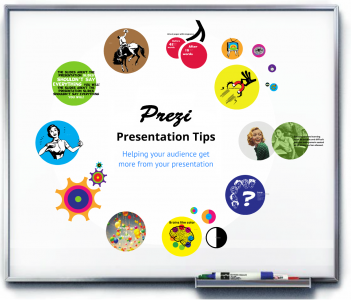
Prezi Presentation Tips: Dos and Don’ts

Untitgfgfled


by leonor brilha

whatisit.png

Prezi is a visually based presentation software that supports a non-linear storytelling approach to presentations. With many affordances, including the ability for the audience or presenter to zoom in and zoom out of the screen, Prezis can be powerful but they can also be problematic.

You may have used or seen a Prezi presentation. In case you’re not sure, Prezi is a presentation tool, that instead of following a linear format (slide after slide), it uses zoom and pan to connect the frames, changing not only the dynamics of a presentation, but also changing the way the audience makes connections between the ideas presented. Or at least, that’s what’s supposed to be the main advantage of using Prezi over other tools. However, as you may have seen, the zooms and pans are used by presenters only as fancy transitions between frames, with a lot of us in the audience left wondering, “What’s the point in all of this? All of this coming in and out of the screen, it’s so confusing. Should’ve just stuck to the good old slides.”

Below are some tips to support creating effective Prezi Presentation.


Why-is-it-relevant-360x82.png

What many presenters don’t realize is that, when choosing one presentation tool over another one, you have to make the most of what it has to offer. Prezi’s strength is in its non-linearity, but that doesn’t mean that the frames should be displayed randomly on the screen. The non-linear flow allows for seemingly unrelated concepts to come together by making new meaningful connections between them. Meaning through visual metaphors can be created by significant (hierarchical for example) spatial positioning on the screen and differentiation or similarity of concepts can be achieved by exploring design elements (colors and shapes). The biggest lesson is to use less text and bullet points, and let the visuals and transitions tie in the concepts of your presentation.


how-to-get-started-360x80.png

Before starting work on Prezi:

  • Think about what are the main goals of the presentation and what’s a good visual metaphor to represent it. This will be your main layout, which can be a path, map, tree, etc.
  • Also take into consideration what kinds of connections are there between your ideas and design the frames in relation to the layout. Where on the layout does it make the most sense to place each frame? How does it connect with the frame immediately before and after it, and how does it connect in general with the other frames?
  • Think about your presentation with a view of the whole in your mind, because at many times the audience will be able to see all the frames, and you want to draw the eye towards focus points.
  • Think about what visual/temporal patterns you’re creating with your presentation and how that’s going to influence the pattern of thoughts and learning process in the audience.

For a visual summary of these ideas and more tips for Prezi (made with Prezi!), please refer to this Prezi and video below it that walks through it.


videopng-360x61.png

Leave a Comment

Filed under multimedia creation, Not Subject Specific, Resources

ThingLink: Annotate Images and Videos

Thinglink is a web-based and iOS / Android application that allows you to embed  audio, video and other rich media links directly into images and share them across the web. Using Thinglink, you can engage your students with images text, video, songs and sound clips allowing them to explore the concept or big idea of a unit or lesson.

Thinglink has a limited free version for educators (and various paid levels). The free version comes with enough features to allow you to create engaging interactive posters, maps or other artifacts and you can even create a class account for up to 100 students. You can link to and embed YouTube content, upload images and sound and add text blocks or titles. You can even embed 360° Videos and create interactive 360° images with embedded ‘hot spots’.


Thinglink is a tool that fits various subjects and different grades. As a teacher, you can use ThingLink to provide interactive professional learning experiences and present information to your students. It can also be used as an Augmented Reality tool in a field trips as well: you can work on a ThingLink map, and add multimedia information to different spots on the map. When students come to a certain place, they can click on the accordingly place on the map and be directed to the information you have prepared for them (such as Youtube videos, audio, images, or webpages!)

With a free teacher account, you can create a class group of (up to 100) students and do not need student personal information (emails or full names) in order to add students. Given that Thinglink is not Canadian housed, I would recommend avatar names or initials and also be sure to educate your students about privacy protection. To create multiple classes, you need a paid account.

In a Social Studies classroom, for example, students might use an historical image and add features (video, hyperlinks, text, sound) to the image in order to tell a story about a particular event or period in time. Hover your mouse of the example below to see images from the past and present integrated to tell ‘my’ story. Teachers might create a video of their own story to share with their students as inspiration for discussion or student-created stories.


1. Sign up: select the free education version and sign up with your email address. (You can always upgrade to pro after you try it, if you think you’ll use it and/or if you want to use it with your students)

2. Start: Click on the “Create” tab to start making your own interactive images and videos.

3. Tagging your image:

  • Click anywhere on the image to add your first tag
  • Click on the icon image to select an icon

4. Sharing Your Videos and Images

  • Open up the image or video and select the “Share” button
  • Either click on an icon for one of the linked platforms or copy and paste the URL or embed code
  • Sharing your image

For more detailed tutorials, go to ThingLink Standard Features Tutorial.

ThingLink in 3 Minutes or Less – highlights uses of the app:


Leave a Comment

Filed under AR & VR, Not Subject Specific, Resources