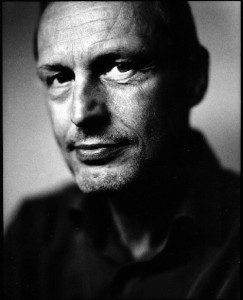
Steven Salaita – First Peoples, Palestine, and the Crushing of Free Speech (Talks at SFU & UBC)

First Peoples, Palestine, and the Crushing of Free Speech

Monday, January 12 at 7:30pm
SFU Harbour Centre, 515 West Hastings Street, Segal Rooms; Vancouver, BC
Facebook EVENT

Wednesday, January 14 at 5:00pm
Coach House at Green College, UBC; 6201 Cecil Green Park Road (off NW Marine Drive, opposite Chan Centre and Rose Parkade)
Facebook EVENT

A talk by Professor Steven Salaita, who is at the centre of an international protest against academic censorship.

Salaita, author of six books and many articles, was “unhired” from a tenured position in American Indian studies at the University of Illinois when donors pressured the university because of Salaita’s tweets on his personal Twitter account about the Gaza massacre last summer.

Because this action is widely recognized as part of a broad effort to silence voices for Palestinian rights and justice, and as one incident in the long history of colonial treatment of indigenous peoples, the case has attracted international attention.

Salaita’s books will be available at this event.

Steven Salaita & Academic Censorship“: an interview on Voice of Palestine

Embarrassing recent events in Canadian higher education #cdnpse #GeorgeRammell #RobertBuckingham @usask

I’ll admit to a quaint hope that universities are still places where dialogue and dissent are both possible and desirable, but two incidents in the last week leave me scratching my head. The first is the theft of professor George Rammell’s sculpture by the Capilano University administration, and the second is the firing of Robert Buckingham, Dean of the School of Public Health at the University of Saskatchewan. The issues in the two cases are not the same, but what both share is an unbelievable authoritarianism on the part of the upper administration, a willingness to trample on academic freedom and the absolute intolerance of resistance or disagreement about program cuts and restructuring. The point is not whether each of these universities plans for budget cutting and trimming are appropriate (that would be a different post), but the response to faculty and middle management who DARE to disagree with the upper administration. If this doesn’t have a chilling effect on everyone in Canadian higher education, well we are all being just too polite.

THE CASE OF THE MISSING SCULPTURE

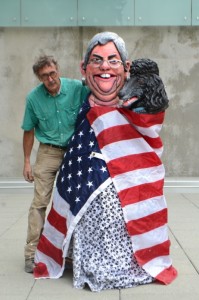
At Capilano University there have been severe program cuts. One program area in which cuts are deep is the arts. George Rammell, sculpture instructor, used his scholarly form of expression to comment on those cuts ~ he created Blathering on in Krisendom, a work in progress  depicting Capilano University president Kris Bulcroft wrapped in a U.S. flag with a poodle. The sculpture went missing last week:

“I immediately called security and the guard told me that orders were given by the top level of the Administration to seize it. I could hardly believe my ears. The Administration had ordered my piece removed off campus to an undisclosed location, without any consultation or prior discussion. I was shocked and not sure if this was Canada,” Rammell stated (as reported in the Georgia Straight).

Jane Shackell, chair of the Board of Governors, released a statement saying that Capilano was “committed to the open and vigorous discourse that is essential in an academic community.” But she had the sculpture removed because it was “workplace harassment of an individual employee, intended to belittle and humiliate the president.” A post for another time, but this might well be the most egregious, inappropriate use of respectful workplace rhetoric to create a workplace where dialogue, dissent, and discourse are not allowed.

Of course, Rammell’s work is easy for the University to steal, but the parallel for some of us might be an administration that comes to your office and wipes all of the files for that critical analysis of higher education book you are working on from your computer. After being AWOL for a week, Capilano University has agreed to return Rammell’s work, but has banned the sculpture from campus and Rammell calls that censorship. It is and it isn’t harassment either. So much for academic freedom.

THE SILENCE OF THE DEANS

Then comes the news, Robert Buckingham, Dean of the School of Public Health at the University of Saskatchewan was fired, relieved of his professorial appointment and tenure, and escorted of the campus ~ for disagreeing publicly with the administration’s restructuring and budget cutting plan, TransformUS.

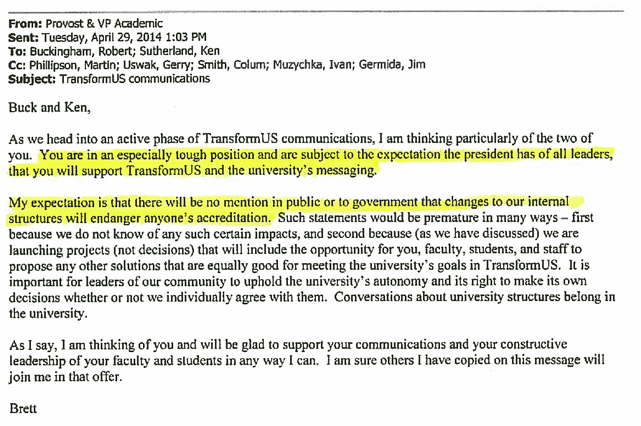
In discussions of TransformUS, middle managers were ordered to get in line and on board with the plan, and threatened if they spoke publicly against it. Here’s the email from the provost:


That a University would want deans who are lackeys and submissive to the upper administration’s “messaging” says a great deal about that administration. Unlike the CapU incident, this is less about academic freedom and all about the importance of maintaining an openness to dialogue and disagreement within the University. Such a heavy handed administrative approach assaults our sensibilities about how even the modern, corporatized U operates. On top of all that, the termination of Buckingham comes a mere five weeks from his retirement and is amazingly mean-spirited.

CAUT director, Jim Turk said:

What the president of the University of Saskatchewan has done is an embarrassment to the traditions and history of the University of Saskatchewan and it’s an embarrassment to post-secondary education across Canada. It’s inexcusable.

He’s right about that!

BC school district adopts anti-homophobia policy #bcpoli #bced #yteubc #ubced

ABOUT A THIRD OF ALL BC SCHOOL DISTRICTS HAVE A SIMILAR POLICY IN PLACE

Renee Bernard, News1130, November 15, 2013– The largest school district in the province will become the latest to adopt an anti-homophobia policy.

Surrey school board trustees have voted unanimously to embrace the new anti-discrimination code.

Gioia Breda of the Surrey Teachers Association worked on the document and says it’s an important philosophical statement to support students facing homophobic bullying.

“You can compare students who experience racism, for example. When they go home, those students have parents who are often supportive and sympathize, whereas LGBTQ youth may not have come out to their parents,” she explains.

She calls it a pro-active code.

“It offers a positive and inclusive curriculum, more sexual health education for LGBTQ youth, and education for administrators, staff and counsellors about LGBTQ issues.”

She says the policy is designed to protect both students and staff.

Just over a decade ago, the school board made national headlines in its fight to ban books featuring same-sex couples, a policy it eventually changed.

The board’s anti-bullying code was adopted with relative ease, compared to the situation in Burnaby a few years ago, when that school board encountered protests from parents.

About a third of all BC school districts have anti-homophobic bullying policies in place.

Read More: News1130

Students say “We’re young, not stupid:” Keep big oil out of our schools #bced #yteubc #bcpoli #DavidSuzuki #occupyeducation

pump jack writes curriculum

This is what you call genuine pro-activism. Barely a month into its launch of Energy IQ (yes, “IQ”), Canadian Geographic is sheepishly back-pedalling and having to answer to students. Energy IQ is to be The Energy Curriculum for the entire nation. The first hint that something was suspect about this was the photo gallery in the June Canadian Geographic Magazine that featured and introduced the new Energy IQ curriculum. As if the author of the curriculum, the proud Pump Jack, “iconic symbol of the West,” dominates. Is this is a curriculum about, for, and from BIG power?

That’s the question students in Vancouver are asking as they join forces with Power Shift, a green grass roots environmental movement. “We’re young, not stupid,” they say, “Keep big oil out of our schools.” The students’ Open Letter and petition are generating international interest and momentum. Dear CAPP, the students write: “The Energy IQ program is of serious concern to us as current high school students, specifically because of its inherent corporate bias and the ideals it will promote…. Propaganda has no place in our schools.” The high school activists currently have over 600 supporters signed on to the petition and were featured by the CBC (tv and radio) on 14 November.

The two student-activists at the front of the protest, Sophia and Sydney, note that “We just believe we should not have corporations in our public classrooms” “It’s just not saying the full truth and we really believe that it shouldn’t be used in the classrooms.”

And this pro-activism is excellent timing, as the new Pump Jack curriculum begins to make its way into the schools. Just as oil and gas dominate clean energy in Canada, the students are asking why Pump Jack is behind the Energy IQ Curriculum.

Yes, teachers and students can criticize the curriculum and politically remix it, but prior questions are those the students are asking, whether Pump Jack ought to be authoring and issuing curriculum for the schools. Or why is Canadian Geographic joined with Pump Jack?

Or what in the world is going on with the Geography curriculum? The Pump Jack curriculum is linked to the Canadian National Standards for Geography, but the energy and economics Standards within might as well have been written by Pump Jack itself. The word “capitalism,” Pump Jack’s child and daddy (go figure) economic system for a century, does not appear in the Standards. For the Environment and Society standard, students can “Speculate on the environmental consequences of a major long-lasting energy crisis (e.g., high/low crude oil prices),” and maybe speculating is enough. Surely, documenting and acting on climate change need not be a standard. Of course, “climate change” does not appear in the Standards either.

Invented in Oil City (it’s true) in 1913, Pump Jack is celebrating its 100th birthday this year so maybe it is appropriate that it authors and teaches the global Energy IQ curriculum. Happy Birthday Pump Jack! Remember the combination: 40-31-24-5.

BC gov wasted $66-million over 12 years on failed aboriginal child services #bcpoli #bced #yteubc #idlenomore

Lindsay Kines, Victoria Times Colonist, November 6, 2013– The B.C. government’s failed attempt to reform the aboriginal child welfare system during the past 12 years has wasted nearly $66 million without helping a single child, the province’s child watchdog says in a new report.

Mary Ellen Turpel-Lafond accuses the government and aboriginal organizations of blowing money on consultants, pointless research projects and endless meetings that go nowhere and deliver no tangible results.

“To be blunt, a significant amount of money has gone to people who provide no program or service to directly benefit children,” she writes in her 86-page report, When Talk Trumped Service.

More than half the money was spent on a failed effort to set up Regional Aboriginal Authorities, while the rest went to self-governance initiatives in the Ministry of Children and Family Development that bled money away from front-line services, the report says.

Turpel-Lafond said the “colossal failure of public policy” took place at a time when many aboriginal children have no safe place to live and no help coping with violence, abuse, mental illness and learning disabilities.

“Children and youth deserve better, and the best contrition for this rather shameful debacle would be a real effort to improve the outcomes for those children by actually knowing what they require and what works to support them — to stop directing the money into the big theoretical fixes, and instead shore up the front lines of the system, especially in those places where the paved roads end in B.C.,” the report says.

Turpel-Lafond spares no one in her report, noting that aboriginal organizations — particularly political groups — have been willing participants in the fiasco.

“Whether this is because they have been so overburdened by so many agendas . . . or if they believe that they are actually making progress, the representative is unsure,” the report says.

The report urges the Ministry of Children and Family Development to refocus its energy on delivering front-line services to children and leave discussions about a self-government to the Attorney General.

Turpel-Lafond said Children’s Minister Stephanie Cadieux has indicated that she was unaware of the problems.

Cadieux, who is slated to speak with reporters this afternoon, issued a statement in which she said the ministry agrees with Turpel-Lafond’s findings and recommendations.

“We know our focus needs to be on providing direct services to aboriginal children and families,” the statement said. “That’s why, two years ago, the newly appointed deputy minister began the process of shifting the focus of contracts from governance to service delivery.”

All aboriginal contractors have been told that future contracts will focus on direct services, Cadieux said.

She denied, however, that the money spent over the past decade was wasted. “Our efforts to build relationships with First Nations communities have established a solid foundation for government as it continues to move forward on the development of government structures.”

Read More: Victoria Times Colonist

All forms of hands-on play banned at BC kindergarten #NoMoreTag #bced #yteubc #occupyeducation

One might find a ban on “all forms of hands-on play… This includes tag, holding hands, and any and all imaginary fighting games,” in no Funcouver, especially if the Sedin brothers are on a penalty kill (some Canucks fans will assess a 5 minute major to me here), but who’d thunk it on a kindergarten playground in Aldergrove? That’s correct, no more tag on this playground. No holding hands either.

Here’s the letter from administrators at Coghlan Elementary sent home in the children’s backpacks:

Coghlan Fundamental Elementary SCHOOL (SD35)

November 1, 2013
Dear Kindergarten Families,

Over the past couple of weeks during outside play time, we have had a number of injuries as a result of various games and types of hands-on play. This has impacted the safety of all the children outside.

Consequently, we have unfortunately had to ban all forms of hands-on play for the immediate future. This includes tag, holding hands, and any and all imaginary fighting games. “Star Wars” games have been particularly difficult for the Kindergarten children to remember to keep their hands to themselves. We will have a zero-tolerance policy with regards to hands-on play, resulting in the missing of playtime and trips to the office for those who are unable to follow the rules.

If you could please help to remind your child about keeping his or her hands to themselves, and reinforce other imaginary games (rather than fighting games) it would really help us to get the message across.

 We really appreciate your cooperation and support in this matter.


Read More: CBC

BC elementary school bans touching at recess #NoMoreTag #bced #yteubc #occupyeducation

Letter to parents: Aldergrove school says policy prompted by playground injuries

Gordon McIntyre & Ian Austin, The Province, November 5, 2013– You’ve heard the Alice Cooper lyrics “no more pencils, no more books … .” For kindergarten kids at Coghlan Fundamental Elementary School, tucked away in a remote rural area of Aldergrove, it’s no more tag, no holding hands, or you’ll get teacher’s dirty looks.

A letter went out to Coghlan kindergarten students’ parents on Friday, one of those types that often sit in backpack over a weekend or are put aside to be read later and somehow never are.

Julie Chen found the letter, explaining a new no-touch policy for kindergarten students, on Monday morning as she was packing lunch for her five-year-old daughter.

It reads, in part: “We have unfortunately had to ban all forms of handson play for the immediate future … we will have a zero-tolerance policy.”

Penalties for making physical contact with a schoolmate include being grounded during play time and/or a trip to the office “for those who are unable to follow the rules.”

“I read the letter, it said there had been quite a few injuries, I said, ‘OK,’ and kept reading,” Chen said. “When I saw no hands-on would be allowed, I just got mad, I got so upset.

“What is happening in our society when our kids aren’t even allowed to be kids any more? “Kids get hurt all the time. What are we going to do next, put them in a bubble to go to school?” Chen said she talked to other moms on Monday and most hadn’t read the letter. Based on what Chen told them, she said, they were appalled.

“I’m not going to tell my daughter she can’t push her friends on the swing,” Chen said. “Do we expect our kids to be robots? How can they possibly do this? They’re five-yearolds – you can’t stop them from running around and having physical contact.”

Read More: The Province

Some still consider social justice in schools to be “indoctrination” #bced #yteubc #occupyeducation

Perhaps not too surprising all things considered in BC, the Social Justice 12 course continues to be dismissed as indoctrination. One one hand, it’s not surprising given the swing right over the past dozen years in the province. On the other, any subject or course that is not one of the official nine (i.e., art, careers, applied skills, language, math, music, physical education, science, socials) is nearly doomed to skepticism or marginalization. In the Surrey Leader, Tom Fletcher belittles the course as  “student indoctrination” and curriculum activities endorsed by the BCTF as “one-sided caricatures:”

Their buzzword is “social justice,” which is portrayed by leftists as superior to plain old justice, in ways that are seldom defined. So what exactly are the goals of this “social change”? Here’s some of what I’ve gleaned.

Parents may recall the 2008 introduction of an elective high school course called Social Justice 12. This was mainly the result of intense protest by a couple of gay activist teachers, and the ministry curriculum describes its emphasis on inclusion of racial, cultural and sexual differences…. BCTF bosses love to talk about the importance of “critical thinking.” These one-sided caricatures of Nike, Enbridge and other familiar villains seem designed to produce the opposite.

Today’s follow-up response to the column reiterates the conservative, anti-union politics at hand:

Great column. I consider this one as one of the most important ones that Tom Fletcher has written, alongside the one about “science gives way to superstition”.

If the B.C. Teachers’ Federation advocates a collectivist ideology such as socialism, the chances of saving our children from the influence of dangerous, very militant, egalitarian philosophy are slim.

Like it or not, the BCTF is one of the most astute, successful labor unions in the country and Social Justice 12 stands as the single-most progressive curriculum innovation in BC over the past 25 years. Given its origins in the passionate commitments to education by a courageous, gay couple, tenuous existence and tests in and out of courts for almost a decade, conservative challenges to deny enrolment in certain districts, and a challenge to the official curriculum, the course triumphed. This was against nearly all odds. Social Justice 12 is that important– not as content per se but as an example and precedent that curriculum can be transformative and transformed.

And the lesson is this simple: Through its professionalism, insights, and yes, politics, BCTF finds the way, opens the doors, and welcomes these necessary additions to an overly officious curriculum. In that way, the BCTF’s social justice politics and the course are refreshing for a change in this province.

BCPSEA backs down on free expression dispute with teachers / BCTF #bced #yteubc

Over the last decade, the British Columbia Teachers’ Federation has systematically tested the limits of free expression for teachers. Through a series of grievances, arbitrations, and court cases, the BCTF has provided one of the most important legal records for teachers’ freedom of expression. The result is nothing short of a significant precedent for the schools.

Earlier this month, a bit of cleaning up after a court decision in the spring resolved the issue of Yertle the Turtle. The BC Public School Employers’ Association (BCPSEA) finally backed down on the BCTF local’s challenge to the BCPSEA’s ban of certain quotes from the venerable Dr. Seuss book. Finally again, we will see teachers quoting truth to power: “I know up on top you are seeing great sights, but down here on the bottom, we too should have rights.”

This is far from the end, as free expression and academic freedom in the schools require active, living tests of boundaries and lines. The ban lifted on Yertle the Turtle turns a page but does not yet finish the chapter. The quotes from Yertle were spoken for a larger scope of rights, including rights to bargain contracts and define class sizes. For that, the BCTF’s appeal has gone back to the Supreme Court.

Children’s book ‘Yertle the Turtle’ now OK again in unionized B.C. classrooms

Terri Theodore, Globe and Mail, October 11, 2013– “Yertle the Turtle” is no longer under ban.

“Yertle the Turtle” can gather more fans — in school districts around British Columbia.

A freedom of expression grievance has been settled between the BC Teachers’ Federation and the B.C. Public School Employers’ Association based on the Dr. Seuss children’s book about a turtle trying to assert its rights.

The complaint was one of several made by the union when some school districts were banning classroom displays of union posters, buttons and T-shirts in the middle of a teachers’ contract dispute.

In one case, an administrator vetoed a quote for classroom display in Prince Rupert from the book “Yertle the Turtle,” saying it was too political.

Dave Stigant, with the Prince Rupert district, was given about 20 quotes from the book to determine if they would be appropriate to expose to students during an ongoing labour dispute.

He didn’t like this quote: “I know up on top you are seeing great sights, but down here on the bottom, we too should have rights.”

BCTF President Jim Iker said the quote was just a small example of several instances where the union felt it had a claim of unfair labour practices in the province.

“But definitely the ‘Yertle the Turtle’ one out of Prince Rupert highlighted the whole issue of freedom of expression and our constitutional rights.”

Iker said several such claims went to arbitration over the last four or five years before the issue was ironed out.

The complaints were settled based on a previous court case, a key arbitration ruling and an agreement with the employer on freedom of expression rights.

Teachers are now allowed to display or wear union posters, buttons and T-shirts.

“I’m hoping it clears it up. I think it actually gives both sides certainty and we know where the limits are in terms of materials and what we’re able to display or not display, and I think the employer knows what the expectations are,” Iker said.

He said teachers also know that they can’t discuss any kind of political or union messaging with students during instruction time.

Read More: Globe and Mail

Teach for America and the Future of Education in the US (Critical Education special series)

Critical Education
Special Series
“Teach for America and the Future of Education in the US”

Founded in 1990 by Princeton graduate Wendy Kopp, Teach for America (TFA) has grown from a tiny organization with limited impact to what some supporters call the most significant force in educational reform today. Indeed the organization has recently been embraced by both the president of the National Educational Association and U.S. Secretary of Education Arnie Duncan as a force for tremendous good.

Critics argue otherwise, pointing to data that is mixed at best while questioning the almost $500 million annual operating budget of the non-profit, a significant portion of which comes from U.S. taxpayers. In light of questionable results and practices (such as using non-certified TFA recruits to work with special education students in direct violation of the Individuals with Disabilities Education Act) organizations are working to end TFA’s “highly qualified teacher” provision in 2013, an effort TFA is aggressively trying to thwart.

In an effort to provide assistance to those organizations working to maintain the integrity of the teaching profession, Critical Education is publishing a series of articles on TFA’s practices, procedures, outcomes, and impacts.

Articles in the series will be published across three issues of the journal:

  • “Problematizing Teach for America” (October, 2013)
  • “Life as a Corps Member” (November, 2013)
  • “Altering TFA’s Trajectory” (December 2013)

Guest Editors of the special series are Philip E. Kovacs, (University of Alabama, Huntsville) and Kathleen deMarrais, (The University of Georgia).

1. Problematizing Teach for America
Bringing Teach for America into the Forefront of Teacher Education: Philanthropy Meets Spin
Kathleen P. deMarrais, The University of Georgia
Julianne Wenner, University of Connecticut
Jamie B. Lewis, Georgia Gwinnett College

Teach for America and the Dangers of Deficit Thinking
Ashlee Anderson, University of Tennessee

Teach For America and the Political Spectacle of Recruiting the “Best and the Brightest”
Kara M. Kavanagh, Georgia State University
Alyssa Hadley Dunn, Georgia State University

An Analysis of Teach for America’s Research Page
Philip E. Kovacs, University of Alabama, Huntsville
Erica Slate-Young, University of Alabama, Huntsville

2. Life as A Corps Member
From the Trenches: A Teach For America Corps Member’s Perspective
T. Jameson Brewer, University of Illinois at Urbana-Champaign

Are Teach For America Corps Members Highly Qualified to Teach English Learners?: An Analysis of Teacher Preparation for Culturally and Linguistically Diverse Populations
Megan Hopkins, Northwestern University
Amy J. Heineke, Loyola University Chicago

Infinite Jurisdiction: Managing Student Achievement In and Out of School
Katherine Crawford-Garrett, University of New Mexico

Personal Responsibility: The Effects of Becoming a Teach For America Teacher
Patricia Maloney, Texas Tech University

3. Altering TFA’s Trajectory
“I want to do Teach For America, not become a teacher.”
Mark Stern, Colgate University
D. Kay Johnston, Colgate University

An Issue of Equity: Assessing the Cultural Knowledge of Preservice Teachers in Teach for America
Eric Ruiz Bybee, The University of Texas at Austin

The Outsized Effects of Equating Teaching with Leadership: Implications of Teach for America’s Vision for Engaging Teachers in Reform
Laura Gutmann, University of North Carolina at Chapel Hill

Refashioning the Master’s Tools: Imagining a Teach for America that Really is for America
Erinn Brooks, North Carolina State University
Kathleen Greene, Beloit College