Gen ’97 the youth of #HongKongStudents #scholarism

hong-kong-democracy-protest

Yoichi Shimatsu, New American Media, October 3, 2014– Hong Kong – On both sides of the barricades blocking this city’s streets, media pundits from New York and Beijing assert that the protests in Hong Kong arise from demands for greater autonomy. Completely unnoticed is a major demographic shift in the region’s population, which is redefining the issues that motivate the younger generation to shut down this global financial center.

The leadership and activist numbers are coming from Generation ’97, young people born during the 1997 handover of the then-British Crown colony to Chinese sovereignty. These youngsters, most still in the secondary level (high school), are finding themselves at the forefront of a populist struggle for electoral rights. They are motivated by anxieties about local identity and a consequent need for better representation, reflecting attitudes that differ subtly but significantly from the traditional opposition parties.

Leadership of the democracy movement was suddenly thrust onto this youth cohort before the protests, when a corruption scandal broke involving the controversial publisher of the Apple Daily press paying illegal contributions to politicians in the opposition parties. The Independent Commission Against Corruption investigation turned up examples of pocketing of unreported donations for personal gain. This corruption further taints the image of a pan-democratic alliance that was already divided by rivalries and unexplained dropouts prior to the street protests.

Underlying the youth movement’s strategy of civil disobedience is a deepening distrust of their pre-1997 elders in both camps, who operate in a political culture of “deal-making” and an elitist obsession with property and wealth, regardless of political affiliation. What the young radicals confronting tear gas and riot police reject is the selling out of Hong Kong’s unique way of life to the highest bidder, whether wealthy businessmen from China or globalist financial corporations.

In contrast with the figureheads of the opposition parties, these youth are not aligned with Britain or the United States, but are battling instead for their own Hong Kong as the last bastion of Cantonese culture. For that goal, the ever-increasing ranks of post-1997 youth realize the vital importance of equal voting rights to chose leaders who will represent the people of Hong Kong, especially the poor and disadvantaged, and not just its wealthy elite.

A manga antihero

The most charismatic figure to emerge from the youth movement is Joshua Wong, one of four student leaders of Scholarism, a political front of high school students and college freshmen. The Gen ’97 teen activists with Scholarism are the driving force behind the street protests, overshadowing the Occupy Central organizers and their seniors in the Federation of Hong Kong University Students.

These secondary schoolchildren are prepared to cast away university admission and promising careers — unimaginable sacrifices in this upwardly mobile society that cherishes education above all — in their commitment to political rights. By making the unthinkable break with traditional values in a conformist urban society, the rebellious youth have shocked anxious parents, unionized workers and the lower middle class of this Cantonese-speaking city into worried support with food donations, cash, praise and admiration. The example of teenagers holding out against tear gas has convinced many formerly passive residents to take a stand on the streets.

Joshua, 17, shows a precocious understanding of the complexities of Hong Kong politics, and yet remains adamant in remaining an outsider to the establishment. His strong commitment to street agitation is not based on an alpha male image from kung fu movies. To the contrary, the slim teenager is modest and soft spoken, while succinct in explaining his viewpoints. A Bruce Lee-style bowl cut touches his wide-set almond eyes, which are exactly like those of maverick antiheroes in Japanese comics known as manga. This lad is clearly the role model for young people across East Asia, who are disaffected by traditional career paths, choose a variety of lifestyles and are tuned in to social media.

“I admit it’s annoying to hear nothing but Mandarin in the metro instead of Cantonese,” he says, “but I am not a right-winger who makes comments against visiting mainlanders.” His statement should come as a surprise to the National People’s Congress in Beijing, whose worst nightmare is the electoral victory of an anti-China secessionist figure. Out of these gut-level fears, the NPC voted unanimously to require all nominees to gain its approval before the 2017 election of a new Chief Executive, the highest position in Hong Kong.

In contrast to the leaders of the opposition parties, or Hong Kongers who emigrated to Canada or Britain before 1997, Scholarism members simply do not have any personal memory of UK rule, and therefore hold no attachment to the British lifestyle that the last royal governor Chris Patton mistakenly referred to as “the Hong Kong way of life.” Gen ’97 accepts the “one country, two systems” formula as a fact of life. It is the only political order they have ever known.

“The relationship between Hong Kong and the People’s Republic of China cannot be amended at this late stage,” Joshua explains. “There is no other road than ‘one country, two systems’.” By the same token, he adds, “Under that formula, our first priority is equality for all residents, and this means greater equality in the electoral system. We cannot let our common future be determined by a 1,200-member election committee instead of by the 7 million people of Hong Kong.”

Read More: Truthout

If you have a job, thank a #bced teacher #bctf #bcpoli

BCEDRally

If you have a job, if you want a job, thank a teacher. And those of us who work in British Columbia truly are indebted to the teachers. Not in some academic way; rather, we are indebted for the BC teachers’ / BCTF’s stand for workers’ rights, for fair bargaining rights, for the right to call into question the failures of employers and governments.

If you don’t have a job, and more and more do not, thank the government and your local elected economist. The economy continues to fail and labour discontent is increasing for good reasons.

This particular teachers’ strike is over but more labour unrest is on the horizon in BC. Who’s next?

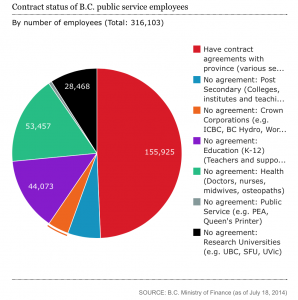
Nurses, doctors, postsecondary educators and workers at major Crown corporations including B.C. Hydro and the Insurance Corp. of B.C. are some of the public-sector workers who have not yet accepted the government’s standard offer of 5.5-per-cent wage increases over five years.

The public sector contracts that are still up in the air represent half of the workers, but they include some of the most expensive contracts, accounting for two-thirds of the government’s $21-billion wage bill this year.

That creates significant uncertainty for a B.C. budget that remains balanced on a razor’s edge…

Contract Status of BCPSECRead More: Justine Hunter, Globe & Mail

Tentative contract for #BCed teachers #bctf #bcpoli

CBC, September 16, 2014– A tentative deal has been reached in the months-long B.C. public school teachers’ strike, but the final details still have to be worked out, mediator Vince Ready confirmed this morning.

 The breakthrough in negotiations between the B.C. Teachers’ Federation and the B.C. Public School Employers’ Association comes on the fourth day of marathon talks at a Richmond, B.C., hotel.

  • No details about the deal will be released before it is finalized, said Ready, who emerged from the hotel to confirm the tentative deal shortly after 4 a.m. PT.

The BCTF first tweeted that a tentative deal had been reached around 3:50 a.m. A few minutes later, Ready told reporters both sides would be meeting again later Tuesday to finalize the details.

Read More: CBC

#BCed teachers vote 99.4% to binding arbitration #ubc #bcpoli

FINALvote-result

“It’s time Government makes at least one move,” BCTF President Jim Iker pleaded as he announced that an overwhelming 99.4% of teachers voted “Yes to binding arbitration” today to end the strike.

The BC Government remains entrenched, with the Minister of Finance Mike de Jong flippantly commenting on the CBC this morning that “the only people bound in binding arbitration are the tax payers.” Ah, the dreaded bogey of the tax hike…

Like de Jong, the BC Minister of Education Peter Fassbender has been faced squarely looking into the past. Or most would say stuck in the past. Again, nearly every blog has to end this way: As NDP Leader John Horgan put it at the BC Fed-BCTF Rally on Friday: “Mr. Fassbender I say you failed at negotiation, you don’t understand mediation, you couldn’t spell arbitration, so how about resignation?”

BC public sector unions in solidarity with #BCTF #bced #bcpoli

BC Federation of Labour, September 9, 2014

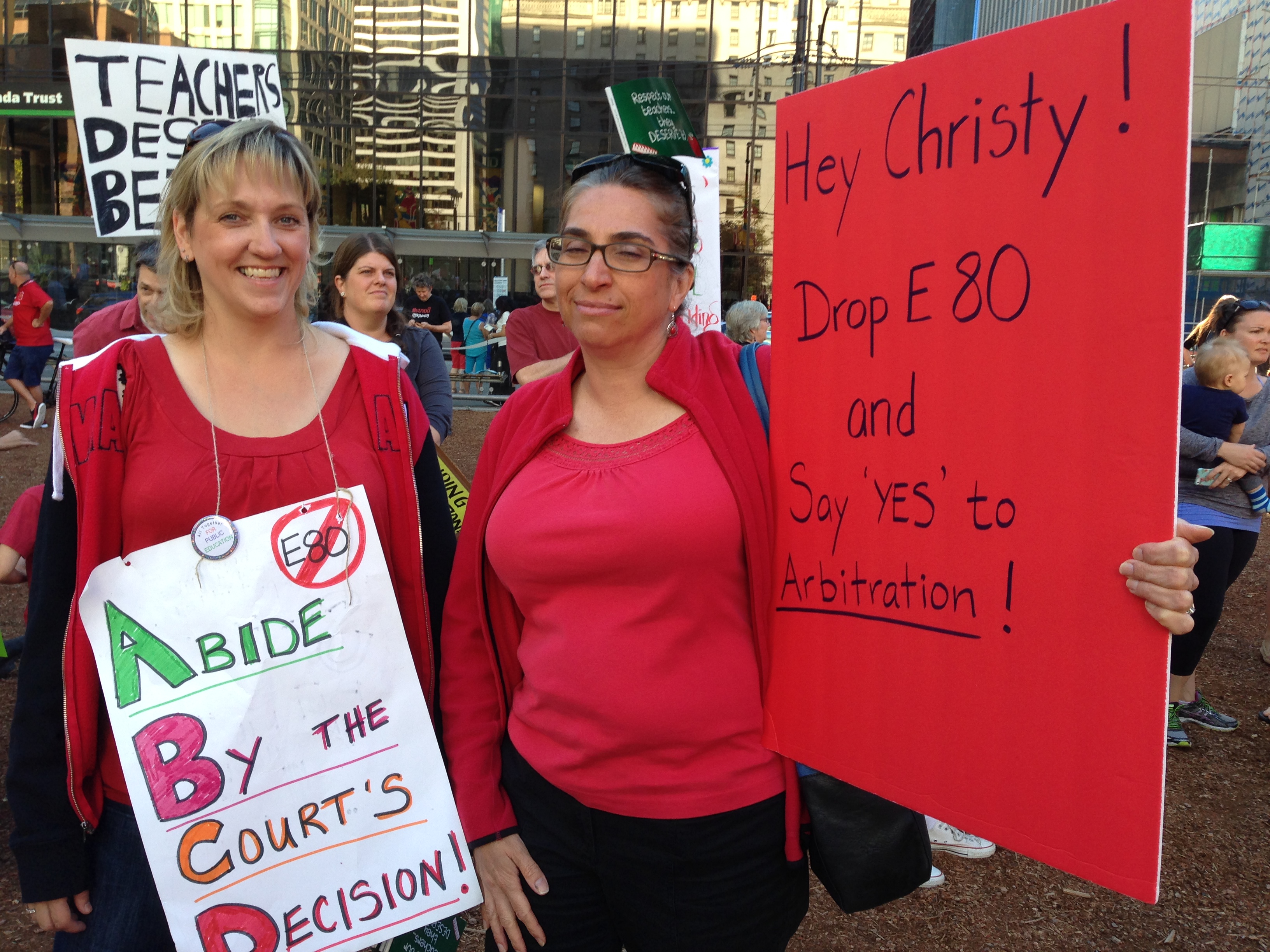
BC public sector unions are sending a message to the Premier that they stand in solidarity with BC teachers and are urging her to accept the proposal for binding arbitration.

“The Premier is attempting to use other settlements in the public sector to create a divide among workers in the province,” said Jim Sinclair, President of the B.C. Federation of Labour.

“This tactic is not only an insult to working people in BC, but it also shows how little the Premier understands and respects the collective bargaining process.”

A letter, signed by the presidents of BC’s largest public sector unions, states their full support for BC teachers and reminds the Premier that every bargaining table is unique and every process to settlement different.

The letter states: “We urge you to immediately stop attributing your refusal to bargain critical issues with teachers because you want to be ‘fair to other public sector workers.’ If you want to be fair to all public sector workers, send the outstanding issues to binding arbitration as proposed by the BCTF and remove E80 from the bargaining table.”

“Our unions stand in solidarity with BC teachers in their efforts to win a fair collective agreement and improve educational resources for BC’s children.”

Read full letter

#BCTF putting to vote ‘Yes to binding arbitration’ #bced #bcpoli

BCTFIker Sept8-2014

BCTF President Jim Iker announced this morning that the union’s membership will vote on binding arbitration on Wednesday. This ‘Yes to binding arbitration’ vote is immensely important, as this will formally put the power of the union’s members behind President Iker’s request to the BC Government on Friday to move the stalled contract negotiations to binding arbitration. This also reaffirms the union’s pressures on the BC Government to bargain in good faith.

It’s whal all teachers, students, and parents want,” the BCTF affirms.

The “only hold out so far” is the BC Government, marked by Minister of Education Peter Fassbender’s blinkered neglect of the public and the strength and resolve of the BCTF, and his stubborn inability to move from timeworn, original positions. As NDP Leader John Horgan put it at the BC Fed-BCTF Rally on Friday: “Mr. Fassbender I say you failed at negotiation, you don’t understand mediation, you couldn’t spell arbitration, so how about resignation?”

BC Premier #ChristyClark put the hard hat on and fire @FassbenderMLA #bced #bcpoli #bctf #teachers

Christy Clark

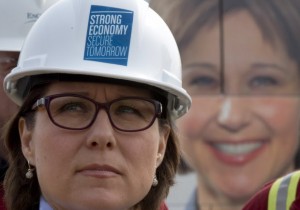
It is due time Premier Clark, to put the hard on again, and make two tough decisions: Fire Minister Fassbender and agree to binding arbitration to settle the contract with the BC Teachers’ Federation. Two tough decisions. Put the hard hat on.

The Minister of Education has to go as his failures in the aggregate are destructive and disruptive. He has to go. As the opposition NDP Leader John Horgan put it at the BC Fed-BCTF Rally yesterday: “Mr. Fassbender I say you failed at negotiation, you don’t understand mediation, you couldn’t spell arbitration, so how about resignation?”

Premier Clark, how about firing Minister of Education Fassbender? And agree to binding arbitration. Put the hard hat on and make two tough decisions.

#BCTF requests binding arbitration to end #bced strike #bcpoli

Taking the high ground in a prolonged labour dispute, the BC Teachers’ Federation (BCTF) has requested binding arbitration. BC Premiere Christy Clark and Minister of Education Peter Fassbender have been counter-productive in agitating the teachers to suspend the strike. Feeling the pressures of sustained job action– the likes of which BC has not seen in a long time– the Premier and Minister have consistently underestimated the BCTF and made a series of awkward mistakes.

Clark-Fassbender

Now, here again is the BCTF taking the high ground and waiting for the Liberals’ response.

BCTF, September 5, 2014– Today, in an effort to find a fair settlement for all parties involved, open schools, and get children and teachers back into classrooms, the BCTF has called for binding arbitration. If the BC Public School Employers’ Association agrees to binding arbitration, the BCTF would quickly put the vote to teachers to end the strike. 

BCTF President Jim Iker made the announcement as teachers across the province gathered together for study sessions. 

His speaking notes (check against delivery at http://new.livestream.com/BCTF/Sept0514) are below. 

Good morning,

First, I want to speak directly to the 40,000 teachers watching around the province in today’s study sessions.

Thank you. 

Your determination, solidarity, and support move me every day. You have given up so much for your students and the future of BC’s education system. All British Columbians owe you their gratitude. 

Earlier this week, I outlined a simple, pragmatic, and practical way forward to ensure all parties involved reach a fair settlement so we can get schools open. 

I also said we would consider all options and close no doors. 

So today, I would like to open another one. 

Throughout this dispute, BC teachers have led the way in trying to reach a fair deal that gives our students more support. We have made moves, proposed creative ideas, and taken job action only when absolutely necessary. 

In return, the government has put up road blocks. 

Their focus has been on delay tactics, a $40-a-day payout scheme, and attack ads on Twitter. 

I hope that all comes to an end today. 

This week, the BCTF Executive Committee met with our provincial Bargaining Team and we are proposing another way forward to get students and teachers back in the classroom.

Today, we are not closing any doors, just opening a new one. Mediation with Vince Ready in our view is still a viable option. However, BCPSEA and government made it clear last weekend that they were not ready or willing to get the job done. 

They did not respond in any meaningful way to any of the significant moves teachers made. 

Today, we are putting forward another option for all of us—government and teachers to resolve this dispute and reach a fair settlement. 

Today, the BCTF is calling on BCPSEA and the BC Liberal government to agree to binding arbitration.

Read more: BCTF

Does size matter when it comes to public school classes?

Does size matter when it comes to public school classes?

This question was debated on CBC Radio’s The Current this morning. Burnaby, BC grade 4/5 teacher Jennifer Heighton, Russ Whitehurst of the Brookings Institution, and I weighed in on the question.

Important context is the ongoing BC teachers strike, where class size and composition are key elements of contract negotiations. The ruling BC Liberals stripped class size and composition rules from the BC teachers contract in 2002, a move that has twice been judged as illegal by BC courts.

I’ve written a brief summary of class size research, with key references, which you can find here.

You can read a very recent review of the research on class size here.

Last month, Global TV BC broadcast a “town hall” discussion on a wide variety of education issues related to education in BC and the ongoing dispute between teachers and government, including class size. You can watch that segment here.

Here’s a good background piece from The Tyee: Everything You Need to Know about BC Teacher Bargaining

Listen to The Current segment (21 minutes) on class size here.

Why BC Teachers are Angry

Private education funding is undemocratic

Public funding for private schools is at odds with creating a more equitable, just, and democratic society.

It is a policy that almost always privileges families with more disposable income over the less wealthy and poor and often privileges religious education over secular education.

Moreover, public funding of private schools supports a two-tiered system of education that allows some schools to cherry pick who attends and undermines the concepts of the public good and community in favor of individual gain.

Public school budget cuts result in closed libraries, reduced special education services, and increased class size, while private schools are publicly subsidized to provide the advantaged with more benefits. These include such as smaller class sizes, which allow teachers to be more responsive to student needs and customize learning activities and to provide private school students with enriched curricula in art, sports, and music programs.

For the first one hundred years of its history there was no public funding of private or religious schools in British Columbia. The Social Credit government introduced public funding of private education in 1977 and only then did enrolment in private schools begin to increase, taking a larger share of the provincial education budget.

Since the BC Liberals ascended to power, British Columbians have been subjected to a steady stream of ideologically driven public policy decisions that shift responsibility for providing and financing public services from the public to the private domain. As with other public assets, their aim is to privatize the commonwealth of the province.

Public funding of private schools is a form of privatization consistent with fundamental ideological positions of the BC Liberals and the corporate media in BC, which include reducing taxes on the wealthy and corporations and cutting public spending for social services.

Privatizing public enterprises, goods, and services is usually done in the name of increased efficiency, but mainly has the effect of concentrating wealth in fewer hands (the gap between the wealthiest and the majority of BC families has grown dramatically over the past 30 plus years) and making the public pay more for its needs (see, for example, BC Ferries).

Not unlike academy schools in England or charter schools in the US, public funding of private schools in BC is privatization through the back door.

Elite private schools are subsidized by the public, while public schools are told to look to the market—recruiting tuition paying international students, setting up school district business companies, or opening their doors to corporate programs—or to parent fund raising, to solve a budget crisis imposed by government’s distorted priorities.

In a recent editorialThe Province charged critics of public funding for private schools with being “long on ideology and short on intelligence,” but it seems this paper’s own market ideology has blinded them to some key facts.

The fundamental idea of public funding for private schools is based on the false premise that private schools do a better job. In reality, public school students outperform private school students.

A recent study of first-year physics students at UBC found that those who had graduated from public schools in Metro Vancouver outperformed their private schools peers.

This finding is reiterated in a study just published by the University of Chicago Press, which concludes public schools achieve the same or better mathematics results as private schools with demographically similar students.

In 2006, the Educational Testing Service reached similar conclusions, finding that US public school students outpaced private school students in both reading and math.

Private school enrolment is soaring because it is encouraged by public policies that divert public money to support private interests and by ideologies that promote individualism and private gain over community and shared interests.

[Edited version published as op-ed column, “Private education funding is undemocratic,” in Times Colonist, June 28, 2014: http://www.timescolonist.com/opinion/op-ed/comment-private-education-funding-is-undemocratic-1.1185002]

[Shorten version published as letter, “Education: Privatization through the back door: Responsibility for public services shifting to private domain,” in Vancouver Sun, June 21, 2014:
http://www.vancouversun.com/business/Saturday+June+Education+Privatization+through+back+door/9960264/story.html]

BC Labour leaders statement in solidarity w #BCed teachers #BCTF #bcpoli #yteubc #criticaled

B.C. Federation of Labour Statement of Solidarity with Teachers

17 June 2014

As leaders of British Columbia’s Labour Movement we speak with one voice today in solidarity with the 40,000 teachers in the province who are standing up for the rights of children to a quality public education by demanding a fair collective agreement.

It is becoming more and more apparent that, despite statements to the contrary by Premier Christy Clark, there is little desire by the B.C. Liberal government to bargain in good faith and end this dispute for the good of all.

The B.C. Teachers’ Federation has shown a willingness to find a path forward, putting forth significant changes that would have brought teachers and the employer closer to an agreement. But the government refused to even discuss them, and chose to move backwards instead of forwards.

Teachers want to stay in the classroom but they know how important it is to hold strong against the government’s assault on our public education system. Their fight is bigger than one union – they are fighting for the rights of all workers to be treated with dignity and for all children to have a solid start in life.

Christy Clark and the B.C. Liberals need to get the clear message from British Columbians that it is time for the government to respect the work of our teachers and the two court decisions, and negotiate a settlement in good faith. There is no need to let this dispute continue through the summer and into the fall. The time to settle is now.

We know that workers and parents across the province support teachers – they understand and respect the important role they play in our communities.

It is now time for all of us to take action. Demonstrations of solidarity with teachers are more important now than ever.

As labour leaders and parents we are calling on our members, and all British Columbians, to bolster the picket lines to ensure teachers know they are not standing alone, and the government knows we are a united movement.

Such acts of solidarity over the last two weeks have made a difference. Other unions, including 25,000 CUPE members, have been active on the picket lines – and as the teachers move into a full strike, we all need to play our part.

Write the Premier, the Education Minister and your local MLA. Tell Christy Clark to stop wasting taxpayers’ money on fighting the courts, and start investing in public education so that our kids have the best chance for success.

And join the rallies being hosted by the B.C. Federation of Labour and the B.C. Teachers’ Federation. A strong showing sends a strong message – both to the teachers of the province who need your support, and to the government who needs to hear your frustration.

As working people, public education has never been more important for our young people. Their success in finding meaningful work and in being active members of their communities is tied directly to a fully-funded public education system where all educational staff are respected.

We are all responsible for protecting that system now.

In solidarity,

Val Avery, HSA
David Black, COPE 378
Lynn Bueckert, BCGEU
Brian Cochrane, IUOE
Laird Cronk, IBEW
Robert Demand, UNITE HERE!
Victor Elkins, HEU
Mark Gordienko, ILWU
Mark Hancock, CUPE BC
Amber Hockin, CLC
Steve Hunt, USW
Jim Iker, BCTF
Bob Jackson, PSAC
Dusty Kelly, IATSE
Irene Lanzinger, BCFED
Ivan Limpright, UFCW
Lee Loftus, BC Building Trades
Gavin McGarrigle, Unifor
Cindy Oliver, FPSE
Bonnie Pearson, HEU
Karen Ranalletta, CUPE BC
Jim Sinclair, BCFED
Stephanie R. Smith, BCGEU
Joie Warnock, Unifor

Rally for public #BCed support teachers June 19 6pm #bcpoli #ubc #yteubc

BCTF-BCFedRally

All Together for Public Education
Rally for Better Support for Kids | Rally to Support BC Teachers

Thursday, June 19, 2014 – 6:00 p.m.

Canada Place, Vancouver

 
The Officers of the BC Federation of Labour held a conference call today and pledged full support for the BC Teachers Federation who are now engaged in a full strike province-wide for a fair collective agreement.
 
A mass rally for teachers, activists, parents, and union members is this Thursday, June 19, 2014 at Canada Place in downtown Vancouver, starting at 6 p.m.  (Music and creative poster making at about 5)

Petition to support #BCed teachers #BCTF delivered @ChristyClarkBC #bcpoli #yteubc

BCTFRallyJune2014b

Today, we delivered a petition signed by 477 faculty members, librarians, administrators, students, and staff in post-secondary institutions across BC to Premier Christy Clark and Minister Peter Fassbender.

Thanks you to all who signed! Comments made by signatories are extremely insightful and emphasize the widespread support of the teachers / BCTF. We will leave the petition open to reach another goal of 600 signatures.

SIGN THE PETITION TO SUPPORT BC TEACHERS / BCTF

Dear Premier Clark and Minister Fassbender,

We the undersigned, faculty members, librarians, administrators, students, and staff in post-secondary institutions across British Columbia, encourage you to increase your support of public education by recognizing the value of our teachers. We encourage you to demonstrate this recognition by bargaining with the BCTF with an open mind to quickly meeting the teachers’ very fair proposals. The BC Public School Employers’ Association’s (BCPSEA) retaliatory lockout further eroded the teachers’ right to bargain and threatened fair labour practices across the BC public sector. BCTF President Iker argues “It’s time for Premier Christy Clark to provide the employer with new funding that will help bring the two sides closer together on class size, composition, staffing levels for specialist teachers, and wages.” We agree.

Please invest in education and labour by resolving this dispute at the bargaining table rather than through retaliatory lockouts and unrealistic proposals. Please meet the teachers’ most recent proposal for common ground. The teachers, who are the BCTF, and all public sector employees through their unions, deserve a fair, timely process of reaching a collective agreement. Thank you.

Petition to support #BCED teachers #CapilanoU #EmilyCarrU #RoyalRoads #SFU #TWU #UBC #UFV #UNBC #VIU #UVic

BCTFRallyJune2014Students, teachers and supporters at BCTF VESTA rally, June 10, 2014

 SIGN THE PETITION TO SUPPORT BC TEACHERS / BCTF

BC Premier Christy Clark and Minister Peter Fassbender,

We the undersigned, faculty members, librarians, administrators, students, and staff in post-secondary institutions across British Columbia, encourage you to increase your support of public education by recognizing the value of our teachers. We encourage you to demonstrate this recognition by bargaining with the BCTF with an open mind to meeting the teachers’ very fair proposals. This includes de-escalation by backing down on the BC Public School Employers’ Association’s (BCPSEA) retaliatory lockout, which further erodes the teachers’ right to bargain and threatens fair labour practices across the BC public sector. BCTF President Iker argues “It’s time for Premier Christy Clark to provide the employer with new funding that will help bring the two sides closer together on class size, composition, staffing levels for specialist teachers, and wages.”  We agree.

Please invest in education and labour by resolving this dispute at the bargaining table rather than through retaliatory lockouts. The teachers, who are the BCTF, and all public sector employees through their unions, deserve a fair process of reaching a collective agreement. Thank you.

Sign the petition in support of BC teachers / BCTF

Rally to support #BCed teachers #ubc #sfu #ucapilano #yteubc #bcpoli

BCTFRallyJune2014

Rally today (10 June) to support BC teachers @ 4-6pm
BCPSEA 1333 West Broadway (between Hemlock and Birch)

 SIGN THE PETITION TO SUPPORT BC TEACHERS / BCTF

Petition to support #BCED teachers #CapilanoU #EmilyCarrU #RoyalRoads #SFU #TWU #UBC #UFV #UNBC #VIU #UVic

BCTFRallyUHill

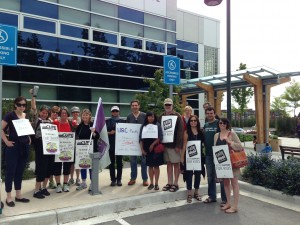
BC teachers picketing at University Hill Secondary School, Vancouver, with support of UBC faculty and staff

 SIGN THE PETITION TO SUPPORT BC TEACHERS / BCTF

BC Premier Christy Clark and Minister Peter Fassbender,

We the undersigned, faculty members, librarians, administrators, students, and staff in post-secondary institutions across British Columbia, encourage you to increase your support of public education by recognizing the value of our teachers. We encourage you to demonstrate this recognition by bargaining with the BCTF with an open mind to meeting the teachers’ very fair proposals. This includes de-escalation by backing down on the BC Public School Employers’ Association’s (BCPSEA) retaliatory lockout, which further erodes the teachers’ right to bargain and threatens fair labour practices across the BC public sector. BCTF President Iker argues “It’s time for Premier Christy Clark to provide the employer with new funding that will help bring the two sides closer together on class size, composition, staffing levels for specialist teachers, and wages.”  We agree.

Please invest in education and labour by resolving this dispute at the bargaining table rather than through retaliatory lockouts. The teachers, who are the BCTF, and all public sector employees through their unions, deserve a fair process of reaching a collective agreement. Thank you.

Sign the petition in support of BC teachers / BCTF

Petition to support #BCed teachers / #BCTF #bcpoli #ubc #sfu #yteubc

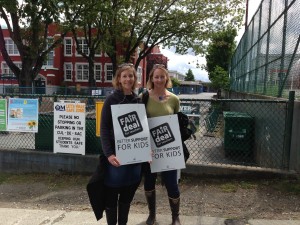
BCTFQueenMaryElementary2014BC teachers picketing at Queen Mary Elementary School, Vancouver

 Sign the Petition to support BC teachers / BCTF

BC Premier Christy Clark and Minister Peter Fassbender,

We the undersigned, faculty members, librarians, administrators, students, and staff in post-secondary institutions across British Columbia, encourage you to increase your support of public education by recognizing the value of our teachers. We encourage you to demonstrate this recognition by bargaining with the BCTF with an open mind to meeting the teachers’ very fair proposals. This includes de-escalation by backing down on the BC Public School Employers’ Association’s (BCPSEA) retaliatory lockout, which further erodes the teachers’ right to bargain and threatens fair labour practices across the BC public sector. BCTF President Iker argues “It’s time for Premier Christy Clark to provide the employer with new funding that will help bring the two sides closer together on class size, composition, staffing levels for specialist teachers, and wages.”  We agree.

Please invest in education and labour by resolving this dispute at the bargaining table rather than through retaliatory lockouts. The teachers, who are the BCTF, and all public sector employees through their unions, deserve a fair process of reaching a collective agreement. Thank you.

Sign the petition in support of BC teachers / BCTF

On the #BCed student movement #bcpoli #ubc #yteubc #edstudies

BCStudentWalkout2012

The myth of the infantile and third Person

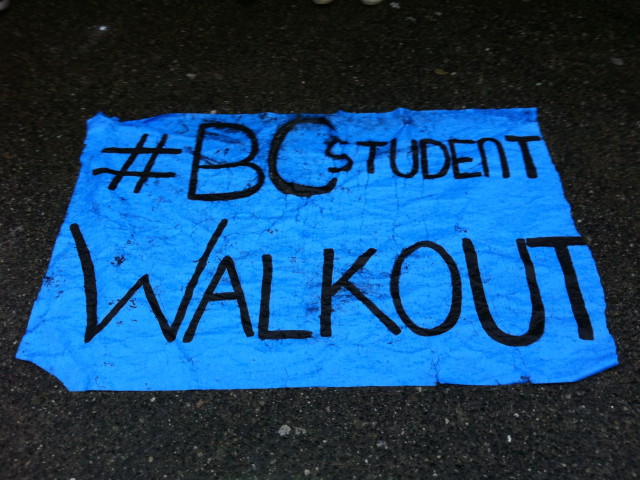
On 4 June I watched as a small group of students walked out of our local high school in frustration, a quiet stand but not quite a protest. One student muttered “hardly an angry crowd.” Just as candidly, another student posted: “The walk out was shit.” Another used the f-word to emphasize “failure.”

Wisely, the students were counselled by teachers to stay in class. But equally wisely, students encouraged each other to figure out how and when to take a stand as student-activists. Compared with the walkout in support of teachers in March 2012, this did not reflect the students’ ability to organize. It was just a minor test of the system. And unlike the Quebec student movement in early 2013, which drew secondary and post-secondary students together for a shared cause, the BC student movement has yet to materialize or find common ground across levels of education.

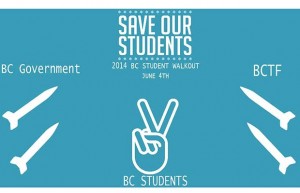
One of the problems at this moment is that students are infantilized and familialized, reduced to children caught in the throes of a bad parental relationship.  It’s unclear how or why this happened. The @BCWalkout2014 Twitter and “Save our Students” Facebook, which began organizing the walkout at the end of May had a bit to do with it: “The two sides are like parents who are divorcing and have stuck their children in the middle for the last thirteen years,” the appeal to walkout went. “Each side claims to be “fighting for the students” yet each side fails to show how they are doing so.”

SoSBCStudentWalkout2014

On 2 June, major media providers, such as the Vancouver Sun and CTV News repeated and quoted the lines and logic. Student frustrations, CTV News reported, were “built up like emotions in a child caught between two divorcing parents.” I hear teacher educators at UBC repeat the same, seemingly afraid to offend the government by supporting the teachers.

On queue, the day before the 4 June walkout a grade 12 student wrote a letter to The Province:

I am writing to express my discontent on behalf of a vast population of public-school students concerning the current collective bargaining between the B.C. Teachers’ Federation and the provincial government. To say a dysfunctional relationship between two parents doesn’t affect the children would be an outrageous lie. The relationship between the BCTF and the province is very much the same and the effects are mostly felt by the students.

The day after the walkout Carolina Tedula tried to work with the metaphor in the Times Colonist, but concluded that “the teachers and the government are far from being different faces of the same coin:”

With respect to the student walkout, and its comparison of the teacher/ government fight to the fight between two divorcing parents. To me, a more realistic comparison is this: The government is the deadbeat spouse, the teachers are the spouse asserting his/her rights and his/her children’s rights, with full backing of the Supreme Court of B.C.

In the entire history of childhood, those unfortunately experiencing painful break-ups, separations or divorces have never once been able to organize a collective opposition movement. Obviously it is not difficult to comprehend why or why not. Freud did not allow it and daddy or mommy won’t allow it either. So it is impossible for this logic to work to any degree in organizing a student movement. Here, one is infantilized as much as one subscribes to the storyline.

It’s equally impossible to build a movement out of third persons– those that seemingly rise as silent majorities and voices of reason at the point of politics. The myth of the third person is the myth of the Canadian way. These myths have had their day but will never underwrite momentum for a student movement.

At some point soon, a major test of the BC system has to materialize, as there has to be something more to education and life than the promise of a job when youth unemployment rates are increasing toward unprecedented numbers.

#BCED and the politics of education funding #bcpoli #yteubc

BCTFMay2014

Tara Ehrcke, May 28, 2014, RankandFile.ca— Two days into rotating strikes and a “partial” lockout by the BC government, independent polling shows strong support for the teachers. An Angus Reid poll showed that among the general public, 41 percent supported the teachers while 30 percent support the government. Among parents with children in school, the support is stronger, with 51 percent supporting the teachers and only 28 percent support for the government.

The issue has also drawn the attention of BC’s opposition parties – both the NDP and the Greens (who have one sitting MLA). But while neither party supports the current actions of the government, they are also unwilling to take a clear stance supporting the demands of the teachers – in particular, the restoration of class size and class composition limits and a fair salary increase.

The NDP does not have a great track record on this issue. I’ve been following their position in every election since the limits were illegally stripped back in 2002. Not once since 2002 has the NDP come out in support of restoring the limits and reinstating teachers’ collective agreement language. I have personally asked this question in 2005, 2008 and 2013, and never has an NDP candidate I have spoken to committed to restoring the language or the funding.

In the last election, in 2013, the NDP platform included $100 million for education. This is dismally short of the $300 million needed to restore class sizes and additional funding to address increased costs to school boards. But sadly, it is even less than the $178 million they were proposing in 2005.

While the NDP is happy to attack the Liberals for their bargaining tactics, they haven’t made a concrete commitment to do anything different with respect to funding and restoring our contract. In yesterday’s question period, new NDP leader John Horgan chastised Education Minister Peter Fassbender saying, ”a 12-year record of destabilizing public education. A child who started in grade 1 in 2002 has had 12 years of confusion as the result of this government’s policies.”

But never once in that twelve years has the NDP promised to do the right thing. The issue is not “confusion” as he claims, rather the issue is large, complex classes and too few resources.

It sometimes feels that the NDP simply like to use our situation to play partisan politics rather than address the issues. The biggest media story they made of the last court case (when our contract stripping was found illegal for a second time) was the fact that the judge found the government to have provoked a strike. While important, the revelation about the government’s deliberate provocation of the strike pales in comparison to systematically underfunding schools and robbing teacher’s of their constitutional rights.

The Greens have also weighed in on the dispute, with a frustrating opinion piece by interim party leader Adam Olsen and a more thoughtful, if still problematic, blog post from MLA Andrew Weaver. Both refuse to take sides, implicitly suggesting the teachers’ complaints are not justified. Olsen writes, “it appears they have given up on making a real effort to find common ground, and instead focused their efforts on winning a publicity battle that is detrimental to our children and their teachers.”

I wonder if either Olsen or Weaver believe that if someone steals your house, and you get into a feud about it, the right answer is to just split it in half in a compromise?

Party politics aside, teachers are strong on the ground and the mood solid.Teachers are angry about the lockout, in which we do all our work for 90% of our pay. But spirits are high – we’re giving it our 90%!

Tara Ehrcke is bargaining chair and past president of the Greater Victoria Teachers’ Association.

Read More: RankandFile.ca