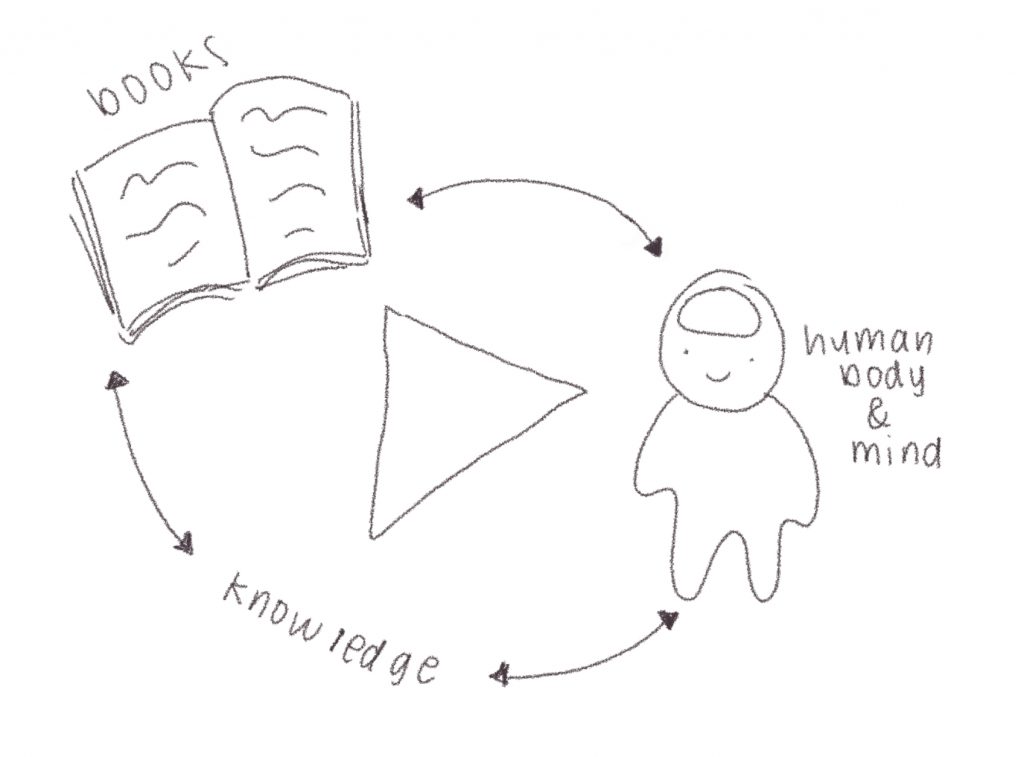
Making MDIA 300: How Ingold’s Making Applies to Our Class

In his book Making, Tim Ingold proposes a full re-evaluation of how we approach media, product, process and how we interact with them. Much of his theory clearly reflects Marshall McLuhan’s understanding of media, namely that the “media is the message”, not a product that is separate from its intended purpose (McLuhan 2).

Ingold’s propositions reflect an arguably more realistic way of examining the world. The world and what it contains (including us as audiences) are irrevocably intertwined, simultaneously affecting and being affected by one another. Not only is the world an ever-fluctuating, ineffable entity where nothing is ever concrete, every perception of the world is unique. Ingold proposes that the relationships between media and audience, including those that we form within MDIA300, can be divided through three main lenses: learning, making, and telling. 

Learning

Ingold first mentions restructuring our approach to media in the book’s introduction, prompting the reader to examine how they learn. He cites Gregory Bateson’s concept of deuterolearning, a method that aims to provide us with “facts about the world as to enable us to be taught by it”(Ingold 2). This concept lays the foundation for a more communicative viewpoint of learning, using the world as an active asset used to enrich our knowledge rather than an object whose information remains stagnant and separate from its contexts. 

Ingold relies heavily on the distinction between anthropology and ethnography to effectively convey how his definition of learning differs from its academic understanding. Similar to anthropology, Ingold claims we must “learn from” the subject of our interests instead of solely documenting our findings, which is otherwise known as ethnography (2-3). Despite these distinctions, anthropology and ethnography customarily work in tandem, providing different elements that together create a more beneficial learning experience. The documentarian process of ethnography provides the information needed to effectively conduct an anthropological study.

Ingold’s concepts of learning are directly applicable to MDIA300 overall. We are instructed to further our understanding of our readings by considering what the information they contain can tell us about how they are situated in the world. This class facilitates inter-exchange between media and audience by forcing us to reflect on these ‘finished’ media products and how they relate to one another and the world as we understand it. Moreover, we are encouraged to discuss our understanding of this media, expanding our perspectives and learning from one another. The collaborative nature of this class allows us to partake in what Ingold defines as an effective learning process. 

Our work on the class blog mirrors Ingold’s discussion of anthropology and ethnography. The assignments that are published to the blog act as an ethnographic documentation of our learning, while our discussion and comments fulfill the anthropological acts of learning with one another, instead of taking what we say at face value.

Making

Building off his discussion of learning, Ingold transitions to defining the titular concept of the book: making. Ingold constantly redefines making, weaving complex layers through his definition of the word. Initially, he defines making as “a process of growth”(Ingold 21). Expanding on this, Ingold invokes hylomorphism, explaining the concept while comparing a maker’s intentions. A maker working with a hylomorphic worldview–looking to inflect their image onto material–has more egocentric intentions than one who is observing making as a process of growth, focusing on the process rather than the ‘product’ (Ingold 21). 

To further reinforce his definitions, Ingold relies on artistic examples to effectively analyze the process and products of making. Ingold’s example of the Ancheluen handaxe prompts the reader to reexamine how they understand the ‘final’ products they encounter. He warns us against “conflating the final form of an artefact, as it is recovered from an archaeological site, with the ‘final form’ as it might have been envisaged by its erstwhile maker”(Ingold 39). In class, we study media in a way that highlights its different interpretations. Therefore, no media can have a ‘final form’ as we are constantly reexamining it and what it means. Similarly, Ingold uses a pottery wheel to more accurately describe how we should view our relationship with making media. He views making not as “an imposition of form on matter but a contraposition of equal and opposed forces immanent respectively”(101). In essence, we must work in tandem with media, respecting its place in the making process, and acknowledging different affordances.

The assignments we make for class adhere to these definitions. For example, the Critical Terms chapters we covered at the beginning of the term continue to be relevant as we move onto new subjects, rendering the assignments we created in response to them dynamic documentations of our learning. The analyses are a comprehensive foundation for the more complex applications this material has been used for in the many posts that are now on the blog. Our making is a byproduct of our learning, and because our learning is a dynamic and conversational process, the analogies, comparisons, and connections that we make are dynamic and conversational as well.

Telling

Ingold further develops his theories of dynamically approaching media through his discussion of telling. He separates the term ‘telling’ into its two definitions: being “able to recount the stories of the world” and being “able to recognise subtle cues in one’s environment and to respond to them with judgement and precision”(Ingold 110). He emphasizes that the act of telling is not only “a vector of projection” meant to impute an image into reality but an active member of the relationship between image, maker, and material world. In effect, telling is a “process of thinking” versus a “projection of thought”(Ingold 128). In this way it is the act of co-operating with one’s work, invoking Ingold’s philosophies of making and learning in the process.

These definitions of telling integrate themselves with Ingold’s definitions of making and learning and are implemented in our course’s workload, including our study of Sherry Turkle’s Evocative Objects. Without Ingold’s methods of learning, we could not fully understand the scope of the material we observe. We would not be capable of forming a relationship between ourselves and Evocative Objects, failing to fully contextualize each objects’ message both in its creation and in our understanding. In essence, we would not be able to tell what meaning lies in the media. Without Ingold’s multi-faceted approach to making media, we would not reach the full capacity of our ability to tell others our message, including applying Turkle’s theories to objects in our own lives. We worked with the text to fully understand it. In that understanding, we told each other our findings, exhibiting the interconnectivity between Ingold’s concepts of learning, making, and telling. 

Conclusion

Ingold’s theories concerning learning, making, and telling are applicable to how we have observed media throughout our study in MDIA300 thus far. We use the media we study as an active participant in our learning, making connections that continue to develop even after the publication of our assignments, and using the skills and understanding we gain through these methods to effectively tell our stories and points to our peers.


Critical Terms for Media Studies, edited by W.J.T Mitchell and Mark, B.N. Hansen, The University of Chicago Press, 2010.

Ingold, Tim. Making, Routledge, 2013.

McLuhan, Marshall. “The Medium is the Message,” Understanding of Media: The Extensinos of Man, New York, NY, 1964

Turkle, Sherry. Evocative Objects: things we think with, MIT Press, 2007.

Image by Molly Kingsley

Written by Molly Kingsley

Touch your books: that’s kind of what they’re for

Within (and for) this course, I have read, reflected, said and written so much about materiality of media, that it has become a challenge to not comment on the materiality of every evocative object I see on our blogsite. This, of course, is in large part due to the very first assignment which gave me this new lens to look at things through. Now I get to analyse the importance of materiality in everything I touch and loan the only physical copy of “Making” in the library over and over again (sorry). So, obviously, I cannot go past the question of materiality of books and knowledge in the case of Umberto Eco and his majestic library of the world. 

Library of the world

A large part, if not all, of the documentary either takes place in or is based around Umberto Eco’s impressive library of over 30,000 books: it is mentioned that civil engineers were worried Eco’s collection would be too heavy for the building to hold it (which is wildly impressive if you ask me). 

It is natural that a scholar, professor and thinker would have a large library of his own. Umberto Eco valued physical books deeply and has been gathering them throughout his life – academic writings, comics and manga, encyclopedias, anything that he found interesting, really. But Eco’s library was not just for storing, – this can be done online, too, – but accumulating over time, displaying and, most importantly – interacting with books, which is what brings the importance to physicality of his library. Interacted by adults who get to curate, annotate, leave their bookmarks in, but also by Eco’s grandson. He remembers reading practically ancient books as a child. Because knowledge cannot and must not be simply accumulated by one person without sharing it, and because most grandparents have a soft spot for their grandkids. I think this particular moment stuck with me the most, because we are so used to seeing older books protected from destruction, and it was so fascinating to hear about the other perspective on that. I doubt my grandparents would ever let me touch a medieval book should they’ve had it (they’re both historians, so I would actually expect them to). In the documentary, Eco describes the difference between a bibliomaniac and bibliophile as such: the former would secretly flip through his collection in the evening like Scrooge McDuck bathing in his dollars, the latter would want people to know about the wonder of the book they are holding. 

Given Umberto Eco’s openness about his library and its treasures, given that his family donated it to the public and I doubt they’d go against his will, I believe it is safe to assume Umberto Eco was a bibliophile. 

Physicality

When explaining the inconvenience of e-books for him, Eco says books “must be touched with hands”, re-read, underlined, dog-eared. If you cannot interact with the book meaningfully, it is a different, less fulfilling process, so why settle for a book in your phone, if you can have it in your lap? 

This, of course, brings us to “Making”, in which Ingold argues that meaning and knowledge is co-produced through human-material interaction, not simply transmitted through abstract content. In the same way as a potter both changes and is changed by the clay through the means of a pottery wheel, so does the reader both affect and be affected by the knowledge through the means of a physical book. The reader adds to the knowledge in the book by meaningfully interacting with it: underlining what matters, questioning paragraphs that don’t make sense, dog-earing the most important pages. And the knowledge, obviously, also changes the reader: their perception of the world, their thoughts, their actions, in the best of scenarios. We read with the book, as Ingold would say.  

True or real?

Another connection between Eco’s library and physicality is the question of truthfulness. One of the most beautiful things about Eco’s library is his passion for untrue knowledge: scholars who have been proven wrong, theories that were debunked, conspiracy theories, you name it. In Eco’s library, the discredited is not discarded: it is archived, annotated, and re-read with attention and affection.

The documentary focuses, in part, on Athanasius Kircher, a German polymath: jack of all trades, a master of both all trades, but also somehow not really. He managed to both completely misinterpret Egyptian hieroglyphics and notice the inconsistency in magnetic north. He suggested plague’s reasons lying in microorganisms and went on to describe dragons with the same vigor. But wrong or not, Kircher is forever remembered for his writings and drawings: Eco specifically implies their significance. The schemes, diagrams, illustrations all provide a layer of validity to the information, because lies are more interesting to prove.

Authority of the physical

But more interestingly, I want to discuss the effect of materiality on the perceived truthfulness of the media. In “Always Already New”, Lisa Gitelman explores how the physicality of print media has influenced perceptions of the written word as authoritative and truthful. She claims that physical qualities of books, such as their weight and texture, mediates to the viewer the sense of legitimacy that digital media often lacks. In the nineteenth century, Gitelman explains, print’s authority was derived from its tangibility: its position of a fixed media created the assumption of stability and truth. This “fixity”, as James Secord calls it, glorifies “textual authenticity and legitimates textual evidence”, says Gitelman. 

But once the industrial revolution did its thing and industrial printing rose, so did the mass literacy and so did the critical attention to those texts. I find it very insightful how Gitelman explains it: she says that before the mass publications, reading went hand in hand with appreciation of the text, not its interpretation. Now that more and more people were able to publish anything, “mass literacy met cheap editions” and it changed the public’s perception of physical media’s authority. So here is a quick reminder that truth is not guaranteed by any one medium but negotiated through it.

Eco’s library, of course, mostly comes from the times before industrial printing, the books there often being as wrong about the world as they seem to be correct: the books are heavy, large, leather-bound, old as time and therefore radiate the aura of higher knowledge and ultimate wisdom. This is why, I believe, it is so interesting to study this contrast between the authority-mediating form and the dilly-dally content.

Conclusion

In Eco’s library, in Ingold’s book, and in Gitelman’s reflections on print and digital media, the material form of knowledge is inseparable from its content and meaning. Truth and understanding are not abstract or disembodied, they are shaped through interaction. By underlining your favourite quotes, by weaving baskets, by touching what you read. If knowledge lives through material contact, a book is never only a vessel for ideas – it is a collaborator in their creation. I’m sorry, but the medium is still the message. To read, make, or preserve knowledge is always to engage with its material body. So go touch a book. Maybe ask me to return “Making” to the library so you can loan it yourself. 


Works cited:

Ferrario, Davide. Umberto Eco: The Library of the World. Italy: Rossofuoco, 2022. Documentary Film.

Gitelman, Lisa. Always Already New: Media, History, and the Data of Culture. Cambridge, MA: MIT Press, 2006.

Ingold, Tim. Making: Anthropology, Archaeology, Art and Architecture. London: Routledge, 2013.

Picture and text by Bara Bogantseva

Eco’s “The Three Astronauts” – Learning, Stories, & Thinking Like a Child

We may think of semiotics as far too dense and abstract a concept for a child to have any hope of understanding, but Umberto Eco didn’t seem to think this was the case at all. In 1966, he partnered with abstract artist Eugenio Carmi to write the children’s book “The Three Astronauts,” turning dense and esoteric media theory into a simple children’s story. Eco and Carmi’s story can tell us all sorts of things about how we learn, how we can spread ideas, the power of story, and why it may be absolutely vital that we think like a child.

Much of the experience of learning media theory is the feeling of unraveling, unearthing or unlearning a set of assumptions we’ve taken for granted. But perhaps, if someone grew up with some awareness of these different understandings of the world, these perspectives might not have to be so difficult to unearth. If the insights of media theory are truly valuable and have real implications for how we live and conceive of the world, shouldn’t we then consider how to help these ideas grow and take root? We may have begun to understand these concepts in our young adulthood, by directly reading the writings of philosophers and thinkers. But is that how it ought to be for the next generation? What is the point of this thinking about the world if it only reaches a single cultural and economic in-group late in our youth? Is it true that these concepts can only exist in their most dense and esoteric forms, or could they be refitted for a general, or perhaps younger audience? Should we instead think of how to build an understanding from the ground up for the next generation, so they might consider these ways of looking at the world while they are first experiencing the world? How could we possibly make ideas like semiotics digestible to a child?

It is hard to shake the perception that academic, technical, philosophical literature is more important, prestigious and effective than simple stories. However, this could not be further from the truth. Stories are the most powerful tool human beings have ever created. As much as we may like to think of ourselves as empirical, rational thinkers, it is undeniable that we see the world in stories. History, as any historian would tell you, is not objective; it contains objective facts, but those are not what we call history – history are the stories we tell about that information- how we string it together. Politics are the narratives, stories, we build around societal information. Religion is a set of stories that inform everything we believe about the universe. For millennia, we used oral stories to remember our history and knowledge of the world. Every conversation we have in our lives is simply an exchange of stories. As anthropologist Clifford Geertz writes: “culture is the stories we tell ourselves about ourselves.”

There is one more thing that stories can do for us as media theorists that we may have overlooked. As Ingold argues, any attempt to have an idea truly take root cannot be done by teaching it; simply spitting the information at the learner. It must be done with experiential learning; learning with; learning by doing. This may have a clear application for material subjects like craftsmanship, but how do we learn an abstract philosophical concept experientially? The answer, you might have guessed, is in stories.

Let’s return to Eco’s The Three Astronauts. Eco puts an enormous amount of trust in the children that are reading his book. He hopes that, through the book, they will learn the concept of semiotics but, strangely, he does not teach them a single thing about semiotics.

This sleight-of-hand begins with Carmi’s illustrations, which are entirely abstract – scraps of newspapers in different languages that are supposed to signify Russian, Chinese and American astronauts. Some may argue that the children would get confused, making the book an utter failure at teaching. Umberto, however, does not talk down to the child. He does not explain everything to them and answer every question before they arise. He wants the child to wonder, because wondering is an active exercise – it is experiential learning. The experience of wondering and wrestling with an idea is much like the experience of feeling and working with a piece of clay. The child may ask themselves, “why is he calling that scrap of newspaper an astronaut?” But by the end of the book, the child has answered that question for themselves. Wondering, and therefore experiential learning, is inherent to experiencing a story, because a story is always about what happens next.

“It so happened that the American didn’t like the Russian, and the Russian didn’t like the Chinese, and the Chinese was suspicious of the other two.

This was because the American, to greet somebody, said “How do you do?”

and the Russian said “Здравствуйте”

and the Chinese said〝你們好…” “

In this passage, the child is presented with three different sets of symbols, and three different systems of meaning. They aren’t taught what systems of meaning are, or even given the language – “symbol,” “semiology,” “system of meaning.” Regardless, through wondering what happens next in the story, they learn experientially that different signifiers can refer to the same signified thing, that different cultures have different systems of meaning, and also, by the end of the story, how we can reconcile those differences compassionately.

We might think that this is a ‘dumbed down’ way of explaining semiology, but in fact, it is a way that cuts out any of the esoteric, in-group language that has to be learned, gives active, relevant examples of how this concept will actually play out in the world, and allows the reader to learn experientially – all without the reader even realizing they are learning. This is the power of explaining an idea through story, as if we were explaining to a child. But in the process of explaining this way, we gain even more – by stripping out the arbitrary, context-dependent language with which semiotics is usually explained, we avoid a common pitfall in the way we learn language.

We acquire language not as individual words, but as whole ‘chunks’ of language. This is what linguist Michael Lewis calls “the lexical approach.” We learn these ‘chunks’ – pre-set phrases – like “give me that” or “what’s the magic word?” from our parents, teachers, and the media around us. We then repeat them back, and ingrain them in our minds. This is why you may be able to finish the sentence “we’ll cross that bridge when…” or “all’s well that ends…” Often, however, we only get a general idea of what these phrases mean, we don’t think about why we use them over other ways we could choose to say something, and we don’t think about what their individual parts mean out of context. We can find proof of this in “fossil words” – words that stay frozen only in specific phrases long after we’ve stopped using them in any other context. We repeat these words inside the chunks in which we learned them without ever noticing that we don’t know what they mean anymore, like fro in “to and fro”  or amok in “running amok.”

The way we learn ideas is much the same. If we think of our learning and understanding as building a house, we are not neat builders. We do not carefully lay new ideas down brick by brick in sequential order. We instead grab and throw down messy chunks of ideas full of things we’ve never considered properly, unchecked assumptions, and arbitrary cultural biases. This is a tendency not at all remedied by academia. We learn to ‘sound smart’ – to repeat the terms and ways of speaking we hear from academics, often without really thinking about what they mean. This is made worse when we are forced to take in massive amounts of input of ideas and produce huge amounts of output in a tremendously short amount of time. Though this allows us exposure to more ideas, it often does not give us the space to sit with concepts, interrogate them, think about them like a child; ask all the ‘why’ ‘where’ and ‘how’ questions.

We do all sorts of things without quite knowing why, we use all sorts of things without knowing quite what they are or where they come from, and we say all sorts of things without knowing quite what they mean. We have a dangerous tendency to forget that this is the way we learn language, and also the way we learn ideas in media theory. If you cannot explain an idea to a child, if you cannot conceive of it or express it without repeating the chunks of esoteric, academic language in which you read it, perhaps you don’t understand it as well as you must to help it spread beyond your academic in-group or cultural system of meaning. Perhaps you don’t understand it like a child. To think like a child is to question everything, to take nothing for granted, and to build your understanding from the ground up. In stripping his idea down until it was simple enough to be understood in a children’s book, and explaining it experientially through a story, Eco was able to think about semiotics in the best way we can – like a child.

Eco, Umberto & Carmi, Eugenio. The Three Astronauts. Secker & Warburg, 1966.

Ingold, T. (2013). Making: Anthropology, archaeology, art and architecture. Routledge, 2013.

Geertz, Clifford. The Interpretation of Cultures. Basic Books, 1973.

Lewis, Michael. The Lexical Approach. Heinle, 1993.

When the World Moves Back: Making as a Conversation

1. Introduction

When we began thinking about this project, both of us instinctively were drawn to James J. Gibson. Not because his name was on all things, but because his ideas immediately spoke to what we are most interested in. At first glance, he seems to be just another psychologist with theories about how people perceive and make sense of the world. But then we read Tim Ingold’s Making, and we realized that Gibson’s ideas are more exciting because they are about how we move through the world, how we perceive it with our bodies, and how we make beings there. His texts go beyond the idea of vision as passive and show us that perception is an active process that takes place when we are most engaged with the world.

Design is the object of our research and design interests, and Gibson’s work deals with exactly that. As media studies students we are constantly interested in how people interact with objects, spaces, and media not just visually but also through bodily and affective interactions. The idea of “affordances” points out that the world is not a static background but an active participant, inviting people to move and act. This is the way in which one may view design as not being fixed but as a dialogue between humans and material reality.

By exploring how Ingold takes Gibson’s ideas further, we will learn how theories of perception are embodied in tools for making and how these inform our knowledge of creativity and design. It is also a project about finding inspiration for our own creative work and how design can be a way of knowing and exploring the world.

2. Background: Who is James J. Gibson?

Let’s begin by learning more about his background. Gibson (his full name: James Jerome Gibson) was born in McConnelsville, Ohio, in 1904. He developed an interest in philosophy from a young age and began his undergraduate studies in philosophy at Northwestern University. He then transferred to Princeton University, where he studied experimental psychology under Herbert S. Langfeld. After his PhD, Gibson began his academic career as a faculty member at Smith College. 

Gibson’s research focused primarily on visual perception. He explored how organisms perceive their visual environment and his understanding of perception as a direct process. During his career, he challenged traditional psychology’s emphasis on mental reconstruction and inferential processing, proposing what he called the ecological approach to perception. However, the world entered World War II, and Gibson was no exception. He was forced to serve in the U.S. Army Air Forces. During his time there, he worked on applied vision tasks, such as visual identification of aircraft and the production of training films. 

After the war, Gibson returned to Smith College, and then in 1949 moved to Cornell University, where he spent the rest of his life devoted to research and teaching, passing away in 1979. His work will undoubtedly remain indelibly etched in the minds of psychologists, designers, architects, and others around the world.

3. Gibson’s Key Works and Concepts

The Ecological Approach to Visual Perception(1979) is one of Gibson’s most influential and most important works, and is also the main piece Ingold cited from in Making. In the book, he introduced the connection between perception and action and one of the central concepts of the book, affordance

Affordance is the action possibilities the environment offers to an organism, and is “measured relative to the animal”, which means that they are unique for each organism. Gibson explained how organisms perceive their environment in terms of the possibilities of what they can do with it. He emphasizes that perception is an interaction with the environment, not mental representation, which corresponded with Ingold’s insight on the relations between people learning and materials. Thus, pictures and films are limited in terms of reflecting the natural environment since they only respond to visual perception. 

Gibson’s other works include The Perception of the Visual World(1950), which challenged the traditional idea that perception is an interpretive process where the mind constructs an internal picture of the external world based on sensory inputs. Gibson instead states that people perceive the external world itself, not the imagery we construct in our own minds. He also introduces the “ground theory”, in which the ground provides a framework for the distance, scale, and direction of perception, and the senses that build on top of it – making it three-dimensional in a figurative way – is based on the physical interaction to the objects. 

Another key concept raised by Gibson is Gradient in perception. Texture gradients and motion gradients come together, providing still and dynamic information to allow people to perceive the object as it is in reality, without mental interference. Gibson believes that what we “perceive” is the result combining what we visualize and what we feel. This theory also laid the foundation for his work later on, which is mentioned above.

4. How Ingold Uses Gibson in Making

Ingold is heavily dependent on Gibson’s concepts in presenting his case about how people engage with the world through making. Gibson’s theoretical notion that perception is not a reception of information but more an active engagement of the individual with the environment lies at the heart of Ingold’s own theory. People, for Gibson, do not just look at the world and interpret from a distance. Instead, they only move across it, respond to it, and understand it by performing within it. Ingold finds this perspective crucial to his thinking, as he argues that knowledge emerges not from abstracted thinking but from the bodily act of doing and making.

The most influential concept Ingold draws upon is “affordance,” Gibson’s term for the possibility of action offered by the world to an organism. Ingold uses this concept to illustrate that materials, tools, and landscapes are not passive things waiting to be used. They actually influence the way we think, act, and make. For example, when a carpenter is working with wood, he is not simply insisting on his intention onto a clump of stuff. He is being challenged by the resistance, strength, and feel of the wood, its affordances, and he is adjusting his behavior in response. This dialogical exchange of human intentionality with material properties is, for Ingold, the essence of making.

Ingold also pushes Gibson’s theory beyond perception to suggest that making is a way of knowing. Since perception arises from movement and engagement, so does understanding. Through constant contact with worlds and materials, people acquire skills, techniques, and knowledge unavailable through theory. Gibson’s inheritance enables Ingold to show that making is not object-production but being actively involved in a relationship with the world.

By integrating Gibson’s theories into his argument, Ingold demonstrates that creativity and knowledge are derived from interaction rather than isolation. Perception and making are inextricably linked processes, and Gibson’s theory enables Ingold to position making as a form of thought, one that is based in the body, the senses, and the dialogue of humans with the environment.

5. Critical Reflection

Rereading “Making” and incorporating the ideas of James J. Gibson, we gradually realized that “making” isn’t simply the act of completing a “specific work,” but rather a process of ongoing understanding and interaction. Gibson’s theory teaches us that perception isn’t a static “seeing,” but rather “feeling” and “responding” through the body’s interaction with the environment. This line of thought resonates with Ingold’s view: true knowledge doesn’t come solely from external observation, but is discovered through action, experimentation, and the response of materials.

When we consider “making” from this perspective, it becomes more than a unilateral plan by the designer, but rather an ongoing exchange between people, materials, and the environment. Every adjustment, failure, and re-attempt is part of the creative process. This process merges “knowing” and “doing,” transforming creation into a way of thinking and learning.

For those of us studying media, this understanding is particularly meaningful. Whether shooting images, editing videos, engaging in interactive design, or working with digital tools like digital sculpting and rendering, we are all experiencing “responsive creation.” Media isn’t just a tool for conveying information; it constantly communicates with us, influencing our choices, feelings, and expressions. Through the ideas of Gibson and Ingold, we recognize that media practice is a way of “understanding through doing”—it allows us to relearn how to perceive the world, understand materials, and generate new meanings through interaction in the process of creation.

Image Credits

Header image designed by Mio on Canva

“James Gibson” image courtesy of Cornell University

Mio Hashimoto, Rai Yanagisawa, Saber Wang, Siming Liao

Umberto Eco on Books and Life

In Umberto Eco’s Library of the World, he narrates his relationship with books, libraries, and physical media as a crucial feature of his own life and body. His entire life journey, from the collection of books he read as a child to his face as an honorary feature on newspapers after his death, the evolution of his writing and consumption of media follows cultural and personal changes he uniquely experienced. 

Evolution of Memory

Umberto starts the first section of the film discussing the origin of books. As they are descendants of living trees, they have something he calls “vegetal memory”. The counterparts of this concept are the “organic memory” that resides in human brains, and “mineral memory” from the silicone in digital devices. This concept of unsentient objects holding a very human concept of “memory” is one also brought up by Ingold, who states that all objects evidenced other lives, whether human, animal, or other, but in becoming objects, had broken off from these lives. Umberto describes libraries as “mankind’s common memory”. These physical collections hold information from generations ago, immortalizing history and bringing it to our current world in both its words and materiality. Umberto notes the importance of this memorialization for two main reasons. Firstly, as humans living in time, we cannot move forward without memory. This is an especially relevant concept within politics – as Spanish-American philosopher George Santayana famously said, “those who cannot remember the past are condemned to repeat it”. As scholars and historians send out warning signals connecting current events to the rise of fascism and other devastating historical incidents, Umberto’s warning for the entirety of our human race becomes more and more urgent. Secondly, this archive of past intelligence does not provide benefit if there is no shared human memory. Umberto describes how through writing and reading books about others’ experiences, he also lived and thrived through them. This is the power he posits that libraries hold – the ability to spread once unique and inaccessible knowledge to whoever seeks it. Umberto argues that this sustainable and growing base of archives is constrained to physical media. Books, manuscripts, and drawings have already survived and prove to be useful after hundreds of years, whereas floppy disks and certain USBs are already incompatible and rendered obsolete just years after their release. This evolution of memory, from the journey of the very tree that created a book to the experiences poured into it by the now-deceased authors, display the need for a shared and universal place of information – which Umberto describes as libraries.

Culture and Storytelling

Umberto provides reassurance to the audience that he equally values popular forms of mass media and in-depth scholarly works. He describes how growing up, he gathered fulfillment by “stealing others’ stories” in the form of consuming books from philosophers and cheap novelists alike. Another uniquely human ability in media creation is the capacity to describe things that aren’t there in real life – otherwise known as telling stories. The capability to imagine, and create entire worlds other than the one we are living in is an amazing power that Umberto does not discount under the standards of book ratings or intellectual prestige. At the same time, he argues the contradiction that fiction supplies us with irrefutable truth. He brings up an interesting example of two people being able to argue forever about their respective religious beliefs, but being forced to agree upon the fact that Clark Kent is Superman. The simultaneous creation of stories and cultural standards connects back with Ingold’s critique of the hylomorphic model. Ingold argues that rather than seeing making as a combination of matter and form, it is an entire process of growth, and the maker acts as a participant in a world of active materials. Additionally, in the process of making, the maker joins forces with these worldly processes and merely adds his own intentions into them. In absorbing and using other stories as inspiration for writing his own, Umberto shapes the culture that he participates in, and his own works both shape and are shaped by the context around him.

Information Noise

Lastly, Umberto humbly acknowledges his own preference for physical media while objectively addressing the shortcomings of a digital information age. He describes that mass media overloads us with too much information than we can realistically process, creating noise that serves no effective purpose. He calls this a communication black out, which occurs with the lack of a shared library of common knowledge. Though the popularization of recording information leads to archives of knowledge that benefit generations to come, Umberto posits that if everything is recorded, we don’t feel the need to remember it. He describes how our memory first serves its purpose to preserve, but it then selects which pieces of information to keep in our minds over long periods of time. Within an era where we consume information in the form of 10-second videos and micro-essays from the moment we wake up to after we fall asleep, we don’t absorb or produce any valuable knowledge. Astutely, he predicts that we are entering an era of education where we learn not how to supply knowledge, but how to be selective with it. 

Relevance to Course:

Umberto’s focus on the tactile and material experience of creating and consuming books directly reinforces Ingold’s theories of making, and the idea of writing as a morphogenetic,  or form-generating, process. Both this theory and Umberto’s film softens the distinctions between organism and artefact. Cultural and mediated contexts prove that works are not always created by the form the maker has in mind, but rather by engagement with materials (or in Umberto’s case, information and knowledge). I would argue that Umberto uses books to mediate his body and the world. From his physical connection with touching and altering his books, it is clear that his library serves as an extension of himself. Wegenstein describes that new media splits the body and self into multiple agents, creating a multiwindowed experience through different forms of expression. However, despite his thorough engagement with an incredible variety of media creation, Umberto is able to carve his own place in various cultural contexts, from semiotics and philosophy to cartoons and mystery novels – demonstrating his unique interdisciplinary ability to create a sense of self through his writing.

Eco, U. (Director). (2015). Umberto Eco: The library of the world [Film]. Stefilm International.

Ingold, T. (2013). Making: Anthropology, archaeology, art and architecture. Routledge.

Santayana, G. (1905). The life of reason: Or the phases of human progress. Charles Scribner’s Sons.

Wegenstein, B. (2010). Body. In W. J. T. Mitchell & M. B. Hansen (Eds.), Critical terms for media studies (pp. 19–33). University of Chicago Press.

Media is like being an athlete, to move forward one must be the most popular. : The Umberto Eco Reflection

During a rewatch of La Biblioteca de Monde, I could not help but relate the theme of media and memory to the current political extremism throughout media and erasure of common knowledge. Throughout the film, Umberto Eco emphasizes the importance of memory; he states that humans who live in time cannot build a future without memory. He compares living in time to being an athlete, “to spring forward, we must back up first (Umberto Eco).” In the film, Umberto Eco initially establishes different kinds of memory: organic memory, vegetal memory, and mineral memory. Eco describes organic memory as the one in our brain and vegetal memory as books and physical understandings, a parallel to organic memory. Mineral memory is memory that is kept in the “silicon of our electronic devices (Umberto Eco).” The interesting dynamic Eco points out, however, is the effect that mineral memory has on the other two. Because humans can offload our memory to external resources, Eco believes we are essentially choosing not to remember. The structure of memory is a paradigm of social structure and, if memory is offloaded, then there is no space for human connection to others and to one’s own mind. Thus, using digital technology as a crutch or replacement for memory is putting functioning society and our organic memory at risk of loss.  

In parallel with Umberto Eco’s concept of media and memory, Caroline Jones in “Evocative Objects: Things We Think With” shares concern with the reliance on technology to that effects memory (pp. 232–43). Jones recounts her experience with a painting in her attic, one of which she made and emphasizes that a physical memory’s medium narrows the scopes of perception via the technology of which that is created. Using Jones’ example, her painting purposefully excludes her sister and creates Jones’ idealistic version of her family. As the maker of this piece of art, she controlled the image that the audience would see. Technology and mediums of correspondence have the ability to capture all parts of the picture, yet it is the user’s responsibility to include or omit any information. The autonomy of technology has even grown autonomous outside of human interference within systems that are growing more advanced as time moves forward (Ellul). For example, AI has replaced the strenuous process of writing a cover letter, to an extensively narrower process; replacing 10 steps with one. 

After the publication of the medium of communication, it is up to the viewer’s interpretation of how the message is received. In Jone’s case, the medium is her painting, and her older self is the viewer, so she is interpreting a false representation of her family as true because there is no context except her own. Ultimately, Jones is warning readers about how when authors use technology, they can control perceptions which can narrow perceptions about the entire reality of a situation. 

 The painting in the attic was used to reload this memory in the mind of the maker. It was not until Jones revisited the painting that she realized a different perspective (Jones). The internet can be used as a tool to record, essentially, an infinite number of texts; however, it has oversaturated the world with information. Umberto Eco states that the functions of memory consist of (1) preserving memory and (2) selecting memory. Memories are preserved and selected, and the rest are filtered out for being too useless or too complicated. Due to the internet, information is now dispersed and abundant with little to no filtering. Eco states that the effect of the lack of filtering is overloading information to humans, which is promoting the use of mineral memory, which, in turn, is erasing organic memory.  

A physical representation of the overloading of the human mind using technology would be the employed content moderators. In Casey Newton’s article “The Trauma Floor,” there is a recount of the working conditions and traumas of the content moderators employed by Cognizant. In the article, Newton describes the graphic memories that the employees must keep and preserve, to filter the internet for every other user. The Cognizant content moderators are a real-life comparison to Funes el memorioso, the anecdote Umberto Eco used in the film to represent how the surplus of information can drive one mad.  

The internet has created a mechanism for a mass dispersion of information, which has led to an erasure of common knowledge within a society. In result of the erasure of common knowledge, Umberto Eco states that there can be no human relationships. “There is a virtual change that 6 billion people on the planet surfing individually on the net could come up with 6 billion different opinions on what knowledge is, which could cause a communication black out.” This reliance on digital media as a news source has created a digression in politics because of extended sources of information. Currently, there is no more concentration of information that generates common knowledge amongst society. Walter Benjamin’s theory of Cult of Mass Distraction articulates the point that a distracted audience is not one substance (The Work of Art in the Age of Mechanical Reproduction). In political media, the tsunami of information has desensitized audiences which has resulted in apathy or extremism from audiences. Amongst extremists, there seems to be a migration of groups that hold power in the spreading of information; people are looking for community in the age of information and working in numbers is the most effective (Michael).  

The issue of these groups forming that control information is that there are no more individual thoughts within those groups. Having shared common knowledge does not mean that opinions are the same (Eco).  Because of this information that is being flown in the wind, there is no time to critically think. Thus, our memories are not holding anything but attaching to one that creates the most commonality. There is now no communication among others, but movements of ideologies. Media has become the method of communication that political parties use to create their image of iconography. It has been weaponized and a source of attention grabbing, where world leaders are chosen by popularity. The only resolution is to convene information so that people can share knowledge and develop individual opinions (Olanrian & Williams, 2020).  

Ultimately, Umberto Eco has highlighted the importance of memory and has demonstrated how media has affected the processes that affect our memory functions. History tells us how to move through the future effectively: information historically was preserved in vegetal memory and physical memory, which is how information was passed. Humans were accustomed to offloading and spreading knowledge. However, because of the digital age and the internet’s seemingly endless memory space (mineral memory), humans have offloaded too much memory to the point where so much memory has been almost lost. The results of the loss of memory have seemingly taken effect in today’s political media. The desensitization of media audiences has resulted in audiences that cannot learn from history because there is too much noise to form an opinion. Humans cannot handle every point of information; there needs to be a filter to determine what to preserve in organic memory or vegetal memory to pass information. Information has been used as a tool for growth; now it has been weaponized as a tool for power. The only resolution that is reasonably attainable is a reconvention of knowledge and a safe space for opinion.  

Works Cited 

Cover Photo is the poster from Umberto Eco: La Biblioteca del Mondo.

Benjamin, Walter. The Work of Art in the Age of Mechanical Reproduction, translated by Harry Zohn, Random House, 1936, https://www.marxists.org/reference/subject/philosophy/works/ge/benjamin.htm.  

Ellul, Jaques. “The “Autonomy of the Technological Phenomenon.” Philosophy of Technology: The Technological Condition – An Anthology, edited by Van Dusek, Wiley Blackwell, 2003, pp. 386-397, https://nissenbaum.tech.cornell.edu/papers/autonomy.pdf

Jones, Caroline A. “THE PAINTING IN THE ATTIC.” Evocative Objects: Things We Think With, edited by Sherry Turkle, The MIT Press, 2007, pp. 232–43. JSTOR, http://www.jstor.org/stable/j.ctt5hhg8p.31

Michael, George. Extremism in America, edited by George Michael, University Press of Florida, 2014, pp. 1–14. JSTOR, http://www.jstor.org/stable/j.ctvx079sk.4.  

Newton, Casey. The Trauma Floor, The Verge, Feb 25, 2019, https://www.theverge.com/2019/2/25/18229714/cognizant-facebook-content-moderator-interviews-trauma-working-conditions-arizona.  

Olaniran, Bolane, and Indi Williams. “Social Media Effects: Hijacking Democracy and Civility in Civic Engagement.” Platforms, Protests, and the Challenge of Networked Democracy 77–94. 27 Feb. 2020, doi:10.1007/978-3-030-36525-7_5. 

Umberto Eco: La biblioteca del mondo. Directed by Davide Ferrario, archival interviews with Umberto Eco, 2022. 

Making in the Eco Chamber

“Those who buy only one book, read only that one and then get rid of it. They simply apply the consumer mentality to books, that is, they consider them a consumer product, a good. Those who love books know that a book is anything but a commodity.”

― Umberto Eco

Umberto Eco: A Library of the World is a documentary that delves into Italian literary critic and semiotician Umberto Eco’s life and his personal library, which houses over 30,000 volumes of novels and 1,500 rare and ancient books. Director Davide Ferrario discusses with Eco, conducts interviews with his family and friends, and retrieves archival footage of Eco to beautifully encapsulate Eco’s life through his love and passion for books and the exploration of the truth. The 80-minute film presents Eco’s library as a living archive that mediates the relationship between media and memory, providing insights into how media shapes thought, culture, and history. Expanding to the scope of this course, the film explores the importance of the distinction between material and digital media, semiotics, and the body. I will connect these concepts to Tim Ingold’s novel Making, specifically, with Ingold’s claim that media as living matter and his distinction between ‘objects’ versus ‘things’. I argue that Eco’s approach to media and memory through books parallels Ingold’s concept of making as a continuous process between the conscious and material world.

The film’s themes of media and material knowledge emerge most vividly through Eco’s private library, which serves as both a physical living archive and a conceptual framework for understanding his worldview. The library, which is a growing personal collection of Eco’s books, then becomes a symbol of a living system of knowledge, rather than a static collection of objects. The film strengthens this idea by presenting Eco’s notion of vegetal memory, which mediates memory and knowledge through paper and books. Eco claims, in his paper on vegetal memory, that libraries are ‘the most important way of keeping our collective wisdom’ (Eco, 1). For him, books and their mass presence through the space of a library become a physical thing that mediates memory, linking memory to material forms. This idea parallels Ingold’s argument that material form is flowing, not fixed. He claims that the material world and human thought are mediated through correspondences, where the flow of materials and the flow of consciousness are intertwined, where making becomes a process of mediation (Ingold, 21). For Eco, making comes in the form of curating books for his personal archive, where he engages thought and memory with the physicality of books. Ingold proposes that making is an embodied interaction that occurs before and during meaning is made (Ingold, 96). Eco mirrors Ingold’s claims as he physically turns the page of each book, engaging with it at every turn. Beyond completing the reading, he continues to engage with the material by keeping a collection of books. Here, the meaning of books changes before, during, and after the activity of reading the actual contents of the object. With embodied interaction with its material, as Eco refuses to put on gloves to preserve its material, rather letting it decay, breathe, and live in its environment, the books transform from a commodity to a physical vessel of memory and knowledge.

To further explore the library as a metaphor for collective knowledge, Eco’s fascination with semiotics exhibits many parallels with Ingold’s distinction between objects and things and their affordances. Eco connects semiotics, the study of signs as a means of meaning-making, back to vegetal memory, where every book is a sign whose contents reference other signs and histories. Through these signs and the curation of other signs through books, humans can form frameworks to understand the world. Because of this, Eco’s library transforms into a semiotic system that not only houses these vessels of signs and knowledge but also creates a network that connects books through categories and cross-referencing. Furthermore, Ingold’s interpretation of seeing things as things, rather than as objects, is extremely relevant in exploring how Eco engages with books through a semiotic lens.

Ingold quotes philosopher Martin Heidegger’s claim that objects are complete in themselves, where correspondence does not occur because it does not interact with the world and its surroundings (Ingold, 85). On the other hand, Ingold claims that things are with us as opposed to objects being against us. Things can be experienced in a way that corresponds with their surroundings, rather than merely witnessing or existing alongside an object. A thing is a dynamic gathering of material matter that engages with other things, such as people or the environment (Ingold, 85). Ingold concludes his claim by stating that things exist and persist because they leak, where materials interact with each other physically across the different surfaces they encounter. Through these types of leakages and interactions, things can be living and dynamic and possess a sort of bodily agency that can die, decay, or transform over time (Ingold, 95). With this distinction between ‘objects’ and ‘things,’ it is clear that Eco’s books are not static or to be read and stored once completed. Rather, his consciousness corresponds with the book’s materiality, and even goes beyond his personal interpretations of his texts when he connects different texts and shares his understanding with the public. As mentioned in the quote at the start of this post, Eco’s passion for books goes beyond viewing them as a mere object or commodity; rather, it affords him knowledge and understanding of the world around him. Through this ongoing dialogue between mind and material, Eco transforms reading into a living practise, one that blurs the boundaries between individual memory and the collective intelligence stored within his library.

Ultimately, Umberto Eco: A Library of the World reveals that knowledge is never static but is continually made and remade through our material and intellectual engagements with media. Through the lens that books are dynamic ‘things’ rather than ‘objects,’ the film presents Eco’s books as a living, constantly growing system of knowledge. A point in the film that struck me the most was the intimate moments of Eco physically interacting with his books. Sensory actions such as touching the covers or each page, smelling the books, or rearranging books in categories became systems and processes of thinking. This reminded me that reading is not just an intellectual activity, but also a tactile and relational practise. Reflecting on our course discussions, I found parallels with the Critical Terms chapter I read for my presentation, “Writing,” where theorist Andre Leroy-Gourhan emphasises graphism in writing. Specifically, how literacy is not only used as a means of communication but as a tool that links mind, body, and material. The film offers a powerful reminder that media are not passive containers of knowledge but active participants in the making of knowledge itself.

Works Cited

​​Eco, Umberto. (2022). Umberto Eco: A Library of the World [Film]. Directed by Davide Ferrario.

Eco, Umberto. “Vegetal and Mineral Memory: The Future of Books.” Academia.Edu, 21 June 2015, www.academia.edu/13152692/Vegetal_and_Mineral_Memory_The_Future_of_Books_by_Umberto_Eco. 

Ingold, Tim. Making: Anthropology, Archaeology, Art and Architecture. Routledge, 2013.

Cover image from The Belcourt Theatre

Noise versus Knowledge: Umberto Eco on the Internet

Throughout his time on earth, Umberto Eco was renowned for his great ideas, works, and qualities — he was an Italian semiotician, novelist, media theorist, philosopher, and, perhaps above all, a critic of the internet. As the internet and digital media rose rapidly in development and public use in the late 90s and early 2000s, Eco addressed this upsurge with the statement that “information can damage knowledge, because it is too much… noise, and that noise is not knowledge” (Umberto Eco: La biblioteca del mondo). Eco vocalized criticism of the way in which information is overly-accessible online, and its detriment to materiality and genuine knowledge. Using Eco’s thoughts to think about digital media nowadays is especially relevant, as we suffer from a paradox: we have never had more access to information with the internet, yet we struggle to turn it into understanding. Amid misinformation, algorithmic feeds, and social media noise, Eco’s ideas feel urgent today. His reflections on digital media reveal that information abundance without critical literacy leads to collective amnesia. His work pushes us to see media as objects that shape, and sometimes distort, how we learn, remember, and communicate.

I recognize myself and my own habits in Eco’s warnings. Everyday, I scroll through my phone and I consume a littany of posts that I forget moments later. It’s as though my attention is on shuffle. Eco might say I am lost in “semiotic overfeeding,” a term he used to describe being bombarded by information without the ability to filter it (Kristo 55). He compared this to a kind of social Alzheimer’s, where the abundance of data infringes on our ability to remember meaningfully. I feel this when I can recall countless fragments, like a certain headline, tweet, or meme, but I still struggle to string them together into concrete knowledge. Still, I don’t see the internet as purely destructive. It connects me to art, ideas, and communities I would never have known otherwise. Eco himself understood this potential: even while critiquing digital excess, he created Encyclomedia, a multimedia platform designed to link history, literature, and culture through the web (Kristo 56). He was not anti-technology; he simply demanded we use it consciously, with care.

In 2000, Eco Umberto contributed a commentary piece on Project Syndicate’s website called “The Virtual Imagination”, which one must make an account to access. In his writing, Eco anticipated the world we live in now: anyone can be a writer, editor, or storyteller via the internet. He described how computers and hypertext were transforming the reading process, allowing users to “ask for all the cases in which the name of Napoleon is linked with Kant” instantly (Eco, “Virtual Imagination”). This, he wrote, would change literacy itself. But he also worried that such “boundless hypertextual structures” would dissolve the boundaries that give stories meaning. If every reader can rewrite War and Peace, he mused, “everyone is Tolstoy” (Eco, “Virtual Imagination”). His distinction between systems (language’s infinite possibilities) and texts (closed, crafted worlds) speaks to our current internet condition, as it is an endless system of signs where meaning is endlessly deferred and interpreted, never settled. In that sense, Eco saw digital media as both a marvel and a mirror. It can reflect the human urge to create while also carrying the chaos of infinite interpretation (Eco, “Virtual Imagination”).

Renata Martini Kristo’s essay Umberto Eco and Emotions in the Time of Internet helps contextualize Eco’s critique in the era of social media. Kristo reminds us that Eco’s famous “legions of idiots” comment — a jab towards the platforms that are now accessible to supposed idiots — was not elitist frustration, but rather a demand for education. Essentially, Eco argued that the real problem wasn’t speech itself, but the lack of filtering and critical thinking. If society lacks the ability or simply overlooks the importance of evaluating the information that is fed to them, society risks drowning in its own noise (Kristo 52-53). Kristo expands on Eco’s view that schools should teach students “how to filter the immense information found in the Internet,” since even teachers, Eco stated, often lack the skills to do so (57). This idea feels strikingly modern; today, our digital environments rely more on algorithmic curation than human criticality. Eco would likely view our For You Pages as dangerous precisely because they mimic discernment while erasing the effort of it. His solution was not disconnection but education, a “discipline of memory,” as Kristo calls it, one that reintroduces intentionality and consciousness to our engagement with and consumption of media.

The AHEH article “Umberto Eco on Culture, Media, and the Internet” extends this by situating Eco’s thought within his semiotic framework of open and closed texts. Open texts invite interpretation, dialogue, and multiplicity; closed texts fix meaning and manipulate perception. Eco admired open systems such as art, literature, or media that provoke critical engagement, but he feared how digital culture could turn open texts into closed circuits of misinformation. He saw mass media as a double-edged sword as it is capable of democratizing knowledge but equally prone to ideological control. In our digital world, both dynamics coexist. The internet can amplify marginalized voices and communities, yet it also fuels misinformation on the daily when its power is placed in the wrong hands. Eco’s cautious middle-ground position calls for media literacy as a form of semiotic resistance. To understand media as objects, in Eco’s sense, is to recognize that every platform, post, and interface is encoded with a certain view and message (AHEH).

Sherry Turkle’s Evocative Objects collection offers a lens through which to humanize Eco’s theories. In Annalee Newitz’s chapter “My Laptop,” the computer becomes a literal extension of the self, Newitz referring to it as “a brain prosthesis” (Newitz 88). She writes about the emotional intimacy people build with their machines, describing her laptop as both tool and companion, worn down by her hands and filled with her history. Reading Newitz alongside Eco reveals a paradox: where Eco warns that digital media externalize memory and fragment attention, Newitz embraces technology as a vessel of emotional and intellectual connection. Her computer is an “apparatus for the realization of inner-human possibilities,” echoing Vilém Flusser’s idea at the start of the chapter that technology helps us create alternative worlds. This emotional relationship to media complicates Eco’s cautionary stance. The internet may scatter our focus, but it also holds our loves, friendships, and creative selves.

When I think about my own laptop, it feels like both Eco’s nightmare and Newitz’s much happier dream. My laptop contains every essay I’ve written, photos I’ve taken, and countless conversations with friends who live thousands of kilometres away. However, it’s also the source of my distraction — I do love it, but it tires me. Eco might say that I’m caught in a hypertext of my own making, while Newitz would remind me that this machine is an “evocative object,” one that shapes who I am and how I remember. The key, perhaps, is not to reject the medium but to use it mindfully and to build a relationship with technology that honours its materiality rather than erases it. Just as Eco defended the tactile book for its “dog-ears and underlines,” we can reclaim the digital object by using it deliberately, slowing down our consumption to preserve meaning (Umberto Eco: La biblioteca del mondo).

Ultimately, Eco’s work teaches us that media, whether a book or a screen, are not neutral vessels. They embody choices, values, and modes of thought. The danger lies not in technology itself but in our passive use of it. So, when I enter the realm of social media each night, I will try to remember Eco’s message that information without human reflection is just noise. But, I will also keep in mind Newitz’s tenderness towards her laptop, and that our devices can hold love, memory, and imagination. Somewhere between the noise and the meaning, between Eco’s library and Newitz’s laptop, lies the task of our generation as we move forward: to learn how to think with our media without letting anyone else think for us.

Sources

Aheh. “Umberto Eco on Culture, Media, and the Internet.” AHEH, 27 Aug. 2025, www.artshumanitieshub.eu/news/umberto-eco-on-culture-media-internet/.

Eco, Umberto. “The Virtual Imagination.” Project Syndicate, 7 Nov. 2000, https://www.project-syndicate.org/commentary/the-virtual-imagination.

Kristo, Renata Martini. “Umberto Eco and Emotions in the Time of Internet.” International Journal of Social and Educational Innovation, vol. 4, no. 7, 2017, pp. 51–58.

Newitz, Annalee. “My Laptop.” Evocative Objects: Things We Think With, edited by Sherry Turkle, The MIT Press, 2007, pp. 87–91.

Umberto Eco: La biblioteca del mondo. Directed by Davide Ferrario, 2018.

Following the Grain: How David Pye Shapes Tim Ingold’s Theory of Making

Source Traceback in Ingold’s “Making” (Week 6)

Woodcuts

When I initially read Tim Ingold’s Making: Anthropology, Archaeology, Art and Architecture (2013), I was captivated not only by the elegance of his prose but also by the vitality of his conception of making. Ingold doesn’t discuss creation as occurring once a plan is established or a design is completed. He views making as a continuous dialogue between individuals and materials, involving learning, adapting, and reacting as forms evolve.

Reading further, I realized that this idea didn’t come out of nowhere. Ingold is building on the work of David Pye, a twentieth-century furniture maker and design theorist who questioned what craftsmanship really means in a world increasingly dominated by machines. Pye’s ideas about risk, skill, and material responsiveness give Ingold the vocabulary to describe making not as mechanical execution but as an act of correspondence, a two-way relationship between maker and material. In this post, I’ll trace how Ingold uses and expands Pye’s concepts, and how this exchange between them helps us think differently about creativity, design, and even knowledge itself.

Who Was David Pye?

David Pye (1914–1993) was a British craftsman and teacher at the Royal College of Art in London, known for his detailed thinking about how things are made. He wasn’t an anthropologist or philosopher, he built furniture, but his observations about craftsmanship turned out to be surprisingly theoretical.

In his influential book The Nature and Art of Workmanship (1968), Pye defined two types of workmanship: the workmanship of risk and the workmanship of certainty. In the workmanship of risk, the quality of the outcome depends directly on the maker’s skill. A potter, for example, never knows exactly how the glaze will fire, or how the clay will behave under pressure. Every movement could lead to success or ruin. The workmanship of certainty, by contrast, describes industrial or mechanical processes where results are predetermined and uniform, the maker’s skill no longer matters, only the machine’s precision (Pye, 1968).

Pye also distinguished between properties and qualities in materials. Properties are measurable, weight, density, elasticity. Qualities, however, are felt and interpreted: the warmth of wood, the shine of metal, the resistance of fabric. For Pye, design might start with measurable properties, but true craftsmanship happens through attention to the material’s qualities, which reveal themselves only in the act of working with them.

Pye’s central insight, that design is what can be drawn or described, while workmanship is what happens in action, creates a bridge between the conceptual and the practical. It is precisely this bridge that Ingold crosses in Making.

Pye’s Influence Inside Making

Ingold explicitly cites Pye’s The Nature and Art of Workmanship in both Making and his earlier essay “The Textility of Making” (2010). He uses Pye’s concepts as stepping-stones for his own argument that making is not about imposing form on matter, but about following materials as they unfold in time (Ingold, 2010).

In Chapter 2 of Making, “Materials of Life”, Ingold borrows Pye’s distinction between properties and qualities to reframe how we think about materials. He argues that materials are not passive substances waiting to be shaped by human intention; they are lively, responsive, and in motion. While scientists or engineers might focus on fixed properties, the maker experiences materials through their shifting qualities, how they stretch, absorb, or resist (Ingold, 2013). As Ingold puts it, “The world is not ready-made, but continually in the making” (p. 21).

Here, Pye’s language gives Ingold a bridge between the craftsperson’s workshop and the anthropologist’s field site. Both are spaces where knowledge emerges through doing. Just as a carpenter learns by sensing the wood grain, an anthropologist learns by being immersed in the flows and rhythms of life rather than standing apart from them.

From Workmanship of Risk to Correspondence

Pye’s “workmanship of risk” becomes, in Ingold’s hands, the foundation for his own key concept: correspondence. For Pye, risk means that each gesture in the making process contains uncertainty, every cut or stroke carries the potential to change the outcome. Ingold takes this further by framing that uncertainty as a relationship. Making, he argues, is not simply risky; it’s relational and dialogic.

Ingold often uses vivid examples: a carpenter following the grain of wood, or a draughtsman tracing a line that “goes for a walk.” Both figures are guided not by strict design but by attention, a kind of mutual responsiveness between maker and material (Ingold, 2010). In The Textility of Making, Ingold writes that practitioners are “wayfarers whose skill lies in finding the grain of the world’s becoming and following its course” (p. 92). That phrase, finding the grain of the world’s becoming, could almost be Pye’s motto rewritten in anthropological language.

For Ingold, then, risk is not a flaw or obstacle in making, it’s the condition of creativity. The outcome cannot be predicted because it doesn’t yet exist; it emerges through the unfolding relationship between hand, tool, and material. In the same way, knowledge for Ingold is not something discovered after the fact but grown along the way, an improvisation in motion.

Expanding Pye Beyond Craft

What makes Ingold’s use of Pye so interesting is how he expands it beyond the traditional craft context. Pye’s observations were rooted in woodworking and design; Ingold applied them to anthropology, art, and architecture, the “Four A’s” that structure Making.

For instance, Ingold compares archaeology to craftsmanship: excavating isn’t about extracting finished objects but about corresponding with the materials of the earth, responding to their fragility, texture, and depth. In architecture, he critiques the Renaissance notion of perfect design (what he calls the “architectonic”) and instead celebrates the improvisational, textilic work of medieval builders who built cathedrals “from the ground up” without fixed plans (Ingold, 2010). This echoes Pye’s celebration of skilled, adaptive practice. Even anthropology, he argues, is a kind of workmanship of risk. Fieldwork depends on responsiveness, not certainty. It requires being open to the world’s unpredictability, just as a potter or carpenter must adapt to their material’s behavior.

In all these examples, Pye’s craftsman becomes Ingold’s wayfarer, someone who learns and creates through movement, uncertainty, and care. Ingold generalizes Pye’s philosophy of making into a philosophy of living, where every action participates in the world’s ongoing formation.

The Thread That Connects Them

In both The Textility of Making and Making, Ingold often uses metaphors of thread, weaving, and flow. He argues that the Western tradition of design (the “hylomorphic model”) has privileged straight, abstract lines, the kind you see in blueprints or computer renderings, over the curved, living lines of hand-drawn work (Ingold, 2010). The shift from spinning thread to stretching string between points, he writes, marks the historical move from bodily making to intellectual design.

This thread imagery resonates with Pye’s emphasis on the tactile, felt qualities of materials. For both thinkers, making is rhythmic and embodied, a process of continuous adjustment. A machine may repeat the same movement perfectly each time, but a human maker must respond to small differences, to tension, resistance, sound, and feel. Ingold calls this responsiveness “itineration” rather than “iteration”: a rhythmic, sensory way of moving through the world rather than mechanically repeating steps (Ingold, 2010).

That shift, from perfect repetition to living rhythm, captures what both Pye and Ingold value most: the vitality of process.

How Pye Strengthens Ingold’s Argument

Ingold’s dialogue with Pye gives his anthropology of making a concrete foundation. Without Pye, Ingold’s philosophy might seem too abstract, too poetic to be practical. But Pye’s distinction between risk and certainty provides the empirical grounding Ingold needs to argue that uncertainty is essential to creativity. It’s not just about craft anymore; it’s about how humans think, learn, and relate to the world.

By borrowing and expanding Pye’s ideas, Ingold also makes a subtle argument about knowledge production itself. Academic research, he suggests, should be more like craftsmanship: experimental, responsive, and aware that outcomes can’t be fully known in advance. In this sense, Ingold’s anthropology is a form of intellectual workmanship of risk. His writing performs what it describes, it moves, weaves, and improvises rather than delivering a fixed, finished theory.

Conclusion: Thinking With the Hand

Reading Ingold through Pye changed the way I think about creativity. Both remind us that making is not simply about control or execution; it’s about attention, care, and risk. The moment of uncertainty, the slip of a tool, the unexpected bend of a material, is where new possibilities emerge.

For Pye, this was the essence of craftsmanship. For Ingold, it becomes the essence of life itself: the idea that we are all continually making the world in correspondence with the forces around us. To make it is to think with the hand, to learn by feeling our way forward.

And maybe that’s why Ingold’s Making still feels so fresh, it’s not just theory about making; it’s theory made through making.

References

Ingold, T. (2010). The textility of making. Cambridge Journal of Economics, 34(1), 91–102. https://doi.org/10.1093/cje/bep042

Ingold, T. (2013). Making: Anthropology, archaeology, art and architecture. Routledge. http://ndl.ethernet.edu.et/bitstream/123456789/8315/1/179.pdf

Pye, D. (1968). The nature and art of workmanship. Cambridge University Press. file:///Users/mehagupta/Downloads/4959-Article%20Text-50710-1-10-20210904.pdf