Digging into Heidegger

Upon reading Ingold’s “Making”, we discovered that Martin Heidegger, a German Philosopher and one of the most important thinkers of modern times, was cited numerous times to support the text’s main arguments. Born in 1889, Heidegger published his first major work, “Being and Time”, at the age of 1933, when he was recognised for his philosophical contribution to phenomenology and the movement of existentialism. In philosophy’s realm of metaphysics, Heidegger focuses on the study of fundamental ontology, which can be more easily understood as the study of “what it means for something to be”. In Ingold’s “Making”, 4 of his other works are cited, which are ”Poetry, Language, Thought” (1971), “Parmenides” (1972), “Basic Writings” (1993) and “The Fundamental Concepts of Metaphysics: World, Finitude, Solitude (1995).

From these works of Heidegger, his diatribe against the typewriter was used to support Ingold’s argument in the chapter “Drawing the Line”, as well as in the chapter “Telling by Hand”, where the philosopher’s criticism of technology’s effects on human essence was employed. His fundamental ontology was also greatly useful to Ingold’s, as in the chapter ”Round mound and earth sky”, it was drawn to make the important distinction between an object and a thing, where “people” are said to fall into the latter of these two categories of existence. So, in summary, we can see that Heidegger’s Philosophy laid the essential foundation for Ingold’s main arguments in these three chapters, but how exactly do they support the text in “Making”?

The Object at Hand…

For Heidegger, the category of an object is definable as being “complete in itself”. The confrontational “over-againstness” that characterises an object can be understood by the example of a chair. We may look at the chair and interact physically with it, but there exists an invisible distance between us and the chair as an object, for we are unable to join in with the process of its formation. In short, an object exists independent of our perception of it and is in itself complete. A thing, on the other hand, Heidegger defines as a “coming together of materials”; it is fluid and inviting. When we interact with a thing, we do not experience such a distance as with an object, and, as such, “people” would be considered a thing under this definitive categorisation.

Further in the chapter “Telling by hand”, Heidegger challenged the notion that human essence lies in the mind, proposing a focus on the hand instead. He argued that rather than being a mere instrument of the mind, the hand is the precondition of the possibility of having instrumentality. Hence is the saying, having a thing “at hand”, even when it is intangible, such as an upcoming event. For Heidegger, humans having hands is the fundamental essence that differentiates man from mere animals, as we are creatures capable of “world-forming”. On the other hand, he insists humans do not “have” hands, rather the hands hold the very essence of what makes us human to our core (Parmenides, 80). The hand offers us a world of contradictions; through our hand, we can enact greetings, commit murder, and even document the world. 

The Irony of Typing…

In his work, Parmenides, he deepens his perception of the hand to an extension of communication. He explains, handwriting is defined to be words as script (by the hand), and inasmuch as it holds the pen, it also holds one humanity; this is the essential difference between writing and typing with a typewriter. He describes typing as a transcript or a preservation of the handwritten word. In the realm of writing, the typewriter has essentially robbed the hand of its power. Now the act of typing affords a sense of anonymity over the more personalised counterparts; the handwritten words contain meaning beyond the text’s inherent interpretation. Ingold highlights Heidegger’s aversion to the typed word; “with scarcely disguised revulsion, ‘writes “with” the typewriter’. [Heidegger] puts the ‘with’ in inverted commas to indicate that typing is not really a writing with at all”(Making, 122). The hand loses its agency and signature on its writing. Stripped down to its core meaning by type, he claims the very essence of each individually written word is misunderstood when labelled as “the same when typed”. (Heidegger would NOT like this work…) To tell, or more specifically, write a story, one must feel the world and be in the world. Through type, experiences, stories, and lives are reduced to transmissions of encoded information.

Ingold’s Refute

Although Heidegger has some interesting interpretations on the human interaction with media, Ingold notes that Heidegger is a rather bitter older man. Most of his work is obsessed with picking apart the rise of technology and the decay of humanity in response. In comparison he showcases Leroi-Gourhan, a genuine technology enthusiast who encouraged the rise of technology in place of human’s inferior physiological forms. Through the many objects our hand holds, Ingold notes–above all–the hand of others to be held, both in guiding and to be led by the hand. He lingers on the distinct qualities of the human hand, down to the anatomy. Not only does he note the importance of the hand, but the hierarchy of fingers, for the finger may offer feeling and touch, yet it cannot hold without help from the thumb. Through the vehicle of typing, he compares other similar extensions of the hand. He questions a forklift driver’s ability to feel the weight of the load he lifts. Aside from the otherwise two-dimensional medium of typing, he also notes the sensation of the keys while typing, and questions if the typist notices the nuance in shape.

As a fierce guardian of the physical, manual space, Heidegger strongly disavows the integrity of technological assistance and its ability to portray a meaningful story. In this interpretation, the very act of typing in favour of writing, strips inherent depth from a piece. He emphasises the value of the human hand as the pinnacle symbol of the essence of humanity.

Maxine Gray & Nam Pham
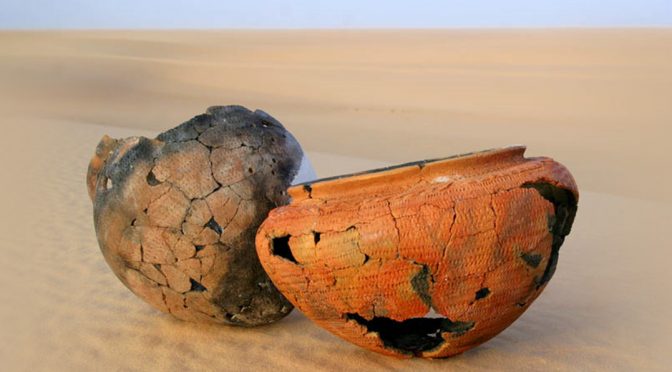
Ingold and Cornelius Holtorf: A pot is a pot is a pot? Or just when we know it is?

Ingold’s “Making” describes the experiential process of creating things as a project. An inceptive idea translated into raw materials, birthing an intention in the form of an artefact. This is the basic structure that Ingold uses to introduce the concept of hylomorphism. A longitudinal interaction where forms created by the mind are imposed on material objects, creating things under Thomas’ description of ´material culture´, “rendered cultural” (qtd in Ingold, 20). Ingold is particularly critical about hylomorphism as he details that the creation of things should not be looked at as projects, but in his argument of the experiential, creating things should be considered as a process of growth. The maker in itself is part of a process, but their involvement can’t ignore the ever-moving activity of materials and materiality. Creating is not an imposition but a synergy of the animal with its environment that is not sedentary, as the hylomporphic model would suggest. Now, what I found most interesting about this argument is the involvement of materiality in the process of making. 

In the second chapter, Ingold details the process and relationship between form and material, not only as a linear model by which a structure is followed in the same sense as a hylomorphic model, but as an interplay of the process of making as the creation of shifts in a material that already has matter-based movements. A modular dance, in Ingold’s terms, that disrupts predetermined material structures like grain or, in the case of iron, welding. Now moving towards the idea of materiality, Ingold divides theorists between the assumption of materiality as in the physical material and the potential interplay of the human, and the notion that materiality refers to the appropriation of physical material by human nature. Ingold connects this debate to the concept of human nature as a similar theoretical discussion. Human nature as a sort of brute, raw, instinctual material or that of adaptation and is placed on a higher level of being, more than natural. Ingold even states that “materiality, like humanity, is Janus-faced” (27).

Although Ingold argues that this debate does nothing to create a definition of materiality, the importance lies in the appeal of materiality in the actual process of becoming materials. That being said, I found the second argument to have a greater validity, both in what is considered to be materiality and in a slight psychological aspect if one thinks about the debate between nurture and nature. 

To support his explication of materiality as an appropriation of materials by human nature, Ingold refers to Cornelius Holtorf and his text Notes on the Life History of a Pot Sherd.  Holtorf is a German archaeologist and anthropologist working as a professor of archaeology at Linnaeus University in Kalmar, where he also serves as the UNESCO Chair on Heritage Futures. His main research focus has been in the areas of contemporary archaeology, heritage theory and futures. 

Ingold refers to Holtorf’s text as a counterpoint in the debate of the definition of materiality against Geoff Bailey’s definition, which states that a material’s cultural materiality precedes several lives of an artefact or ‘thing’ as being an amalgamation of material traces, but in the end, its materiality lies in the process of outlasting moments in its formation. In a way, it signifies a hylomorphic scale of materiality where the human has an interplay in the material, but the thing itself is determined by its physical structure. Holtorf, in his example of Pot Sherds, sees materiality from a different viewpoint. As quoted by Ingold, a thing’s materiality is “no more no less than the ways in which, throughout its history, it was variably enrolled in human

life-projects” (Ingold.28). Ingold sees Holtorf’s definition as a switch between a definition based on the physicality of matter and social appropriations to its form.  I would argue that, although Ingold, in a sense, criticises both arguments and theorises that the debate ultimately doesn’t give an understanding of materiality or material culture, Holtorf’s article, although inadvertently, connects to a lot of Ingold’s arguments, does in fact lay a structure by which material culture is defined by human interaction rather than the material by itself.

In Holtorf’s Notes on the Life History of a Pot Sherd, he recapitulates the process of finding a pot shard in the Monte Polizzo in Sicily. He goes deep into the process of seeing a piece of material, completely devoid of any context, being identified by one of the workers of the site as a pot shard. He describes the archaeological process of selecting what is potentially important and what is essentially garbage as a way of reflecting how materiality can depend on human perspective and categorisation. He then describes the process of analysing the shard through different layers of ethnographic research. In short, through the text, he details how the involvement of human identification and knowledge is the product of not the physical construction of matter, but as the material culture that identifies a ‘thing’s’ status as an artefact

In a sort of layman’s terms, Holtorf suggests that a piece of matter will remain an object, stripped of cultural materiality, until the human process of classification, analysis and knowledgeable assertions places it in its rightful status. For Holtorf, an artefact’s life cannot be assumed before its discovery. All the properties, including its material identity, are ascribed by the gradual process of research and exploration, creating a slow assembly of its form. He states that since the past lives of ‘things’ are a direct outcome of their present lives in discovery, material identity is attributed to elements not conjoined to their essential material properties but rather a product of the relationship between humans and things. If the pot shard was left hidden or discarded with the rest of the rubble, is it still an ancient artefact that can tell us about society? Or since it’s discarded, is it just trash? He states that “materiality is multiple and has a history” (Holtorf 64). This even connects to his idea of shifts in a thing’s materiality. If research is restricted to the tools and knowledge we have in the present, who is to say that a thing’s materiality won’t shift as these tools evolve?

I connect this idea if we contextualise it to the argument that Ingold brought up about the parallels to human nature. If one visualises humanity as the ‘thing’, it alone cannot evolve and progress. Yes, it may have a natural animal instinct in a sort of “raw material” form, but it is shaped by its environment and the environment in turn shapes it. It is an interconnection between the human and physical world that gives a sort of meaning to human life. It is looking at existential questions or navigations through human thought to be a product of the surrounding physical environment, as well as past experiences and knowledge we build. Holtorf quotes Thomas, a theorist also quoted in Making, when he describes how materials are identified as things depending on previous understanding, knowledge and prejudices. After the human process is done, if there is no interaction with a human or their understanding of a “thing”, then the thing is essentially reduced to the notion of an object. Something that just is. 

Ingold, perhaps inadvertently, uses a source that actually connects thoroughly to the argument he places in the beginning and throughout the book. Holtorf signifies a process of research that, in its source, is ethnographic. A scientific explanation as to what a thing is, rather than what it would mean. It does not follow the anti-hylomorphic rhetoric of the Ingoll text, but in itself, the process reveals a sort of anthropological study of the epistemology of materiality. By creating these connections between the material element of a thing and the material culture imposed by human research, this understanding is in itself an experiential study of how we define materiality. It is ‘with’, not ‘about,’ as Ingoll describes in earlier chapters. 

Sources Cited

Holtorf, Cornelius. “Notes on the life history of a pot sherd.” Journal of Material Culture, vol. 7, no. 1, Mar. 2002, pp. 49–71, https://doi.org/10.1177/1359183502007001305.

Ingold, Tim. Making: Anthropology, Archaeology, Art and Architecture. Routledge, 2013.

From Material to Object: Weaving the In-Between

In Chapter 2 (The materials of life) in Making, Ingold describes the lifelike qualities of raw materials we use to create objects. He illustrates how we are accustomed to think of making as a project: we start with an idea of a goal, and with raw material to achieve it, and once we think the material has taken on intended form, we have produced an artefact. However, he argues that the entire process of making is actually one of growth, and the maker is a participant in a world of active materials. To support his position, Ingold references French philosopher Gilbert Simondon and his critique of the hylomorphic model of making. The Aristotelian word itself is a combination of Latin words hyle (matter) and morphe (form). This scheme posits each object and body as a combination of form and matter, and Simondon, through a detailed description of the creation process of a brick, argues that this model neglects a very important aspect of this process: the energy involved to transform the “formless” clay into a “finished” brick. Thus, rather than the maker imposing her designs on a world that is waiting to receive them, Ingold, supported by Simondon, argues that the maker is simply intervening in worldly processes that are already going on.

About Gilbert Simondon

Our focus is primarily extracted from the work of Gilbert Simondon of Saint-Étienne, France, born on October 2, 1924. From an early age, Simondon became interested in the act of questioning things, a habit that had transitioned into a lifelong passion for research and teaching. He had completed his secondary studies at the Lycée Fauriel in Saint-Étienne and went down the post secondary avenue of which he was most loyal to: philosophy at the École Normale Supérieure in Paris under the supervision of Martial Gueroult, a French philosopher preceding Simondon. It was during his studies in Paris when he had started expanding his palette within the sciences, exploring physics, mineralogy, and psychophysiology, and within the arts, developing interest in the cultures of literature, music, and surrealist art. Science, however, was where he found that his philosophical studies could be enlightened by the most, even branching out to obtain a degree in psychology at other institutions. After several years of teaching philosophy, psychology, languages, and 20th century literature at secondary and post secondary level, Simondon ventured back into academia to get a Master’s degree in philosophy at Sorbonne University. Simondon began studying the subject of individuation in 1952, when he reframed the individual being starting from the process of individuation rather than individuation starting from the individual.

I have chosen the notion of individuality and, for a year, I have been trying to make a reflexive theory of the criteria of individuality. (…) in fact, one must grasp the being before it has been analyzed into individual and environment: the individual-environment ensemble is not sufficient in itself; one can neither explain the individual by the environment nor the environment by the individual, and one cannot reduce one to the other. The individual and the environment are an analytical phase genetically and logically posterior to a syncretic phase constituted by the existence of a first mixture.” 

— Gilbert Simondon, January 1954 to Martial Gueroult.

https://gilbert.simondon.fr/content/biographie

Simondon on the Hylomorphic Model

Simondon’s thesis, Individuation in Light of Notions of Form and Information, invites a new perspective on remodelling frameworks in metaphysics. Rather than adhering to the hylomorphic model, which proposes that the results of making and production stem from the imposition of form onto matter, Simondon argues that products are formed through the simultaneous contraposition of form and matter (Simondon 2005, 41). Simondon believes that the preexisting model is too narrow and presupposes individuation, which itself is the process through which form and matter come into relation (Simondon 2005, 21). Therefore, Simondon argues that the hylomorphic model simplifies this complex process of making into the two innate ideas of ‘form’ imposed onto ‘matter,’ when in reality, the process of individuation is far more dynamic. More specifically, within the process of individuation, Simondon believes that form is ever emergent rather than fixed and given in advance. Therefore, Simondon argues that the hylomorphic model simplifies this complex process of making into the two innate ideas of ‘form’ imposed onto ‘matter,’ when in reality, the process of individuation is far more dynamic and grounded in information. He argues that information emerges in events, where form and matter coexist and coemerge in the process of individuation, rather than one forming the other (Simondon 2005, 36). Through shifting his perspective and rejecting the hylomorphic model, Simondon shifts his attention from being to becoming, where he explores what happens in between, rather than simply observing from the outside looking in. Through this perspective, he wants to approach organisms, objects, and even people as open, relational, incredibly dynamic things that are constantly in flux with their pre-individual fields.

How Ingold Uses the Quote

For Simondon, the creation of a brick illustrates how form emerges through interaction rather than from a predetermined design: the clay and mould converge in a “bringing together or unification of two ‘transformational half-chains’” (Ingold 2013, 25). This reflects the “first mixture”: the brick’s form emerges through the interaction of materials rather than from any pre-existing design. Simondon emphasizes that one cannot understand the individual in isolation from its environment: “one must grasp the being before it has been analyzed into individual and environment… one can neither explain the individual by the environment nor the environment by the individual”. This idea of the “first mixture” — that the individual and environment are inseparable in their formation — aligns closely with Ingold’s anthropology of making. Form emerges not from the imposition of a predetermined plan, but from the ongoing interaction between maker, materials, and environment. Making is a morphogenetic process — a dynamic flow of materials, forces, and energies in which the maker participates alongside the same forces that shape all living and nonliving things (Ingold 2013, 22). Both thinkers emphasize that materials are active participants in shaping outcomes rather than static matter. Ingold likens this idea to basket weaving, where shape arises from the interplay of willow branches, the weaver’s hands, wind, and bodily rhythm. All elements interact simultaneously from the start. Like the “first mixture,” the basket, maker, and environment emerge together, and only later can we consider the basket as a separate object or the maker as an individual agent. The maker follows the materials’ tendencies, contributing through movement, rhythm, and responsiveness. As Ingold notes, “in the field of forces, the form emerges as a more or less transitory equilibration” (Ingold 2013, 25), concluding, “perhaps bricks are not so different from baskets after all.” For Ingold, making is a longitudinal process, following materials as they grow and transform over time. The final form doesn’t exist independently of the materials or maker. Form arises through the continuous interaction of people, materials, and environment — a dynamic process in which individuals and their environments shape each other, reflecting Simondon’s insight.

Relevance to course

In our attached activity, we were able to roughly recreate Ingold’s students’ basket weaving experience through weaving yarn through handmade cardboard looms. We followed a tutorial on Instagram and immersed ourselves within the environment and process of tangibly making an object. We followed many of the same lessons Ingold described that his students did. Though we initially struggled with the set-up of our raw materials, the exceptionally separate pieces of yarn melded together naturally through the slow process of weaving and tightening – displaying the surprisingly recalcitrant properties of the material. We also ran into the problem of not knowing when to stop: despite the physical limitations of our loom, you could always tighten the previous stitches and make room for another row. Our deciding factor ended up being a lack of time, creating differences in our “finished” products. Throughout the making and reflection process, we discovered direct links between our activity, Ingold’s theories, and the critical term of body as defined by Wegenstein. Through expressing our learning in the tactile process of making an object with our hands, we were able to ground ourselves in nature and media creation more immersively than simply reading about it. By feeling the texture of the yarn and practicing the specific movements, we were able to connect our bodies to the bodies of the materials. Despite following the same tutorial, each of our final works depicted our own self-expression, and we were able to absorb knowledge through the medium of our body and learn from Ingold’s teaching through the experience of embodiment.

Citations:

Ingold, T. (2013). Making: Anthropology, Archaeology, Art & Architecture. Routledge.

Mitchell, W. J. T., & Hansen, M. B. N. (Eds.). (2010). Critical Terms for Media Studies. University of Chicago Press. 

Simondon, G. (2020). Individuation in Light of Notions of Form and Information (T. Adkins, Trans.). University of Minnesota Press.  (Original work published 1964)

Simondon, G. (2012, December 8). Form & Matter: Gilbert Simondon’s critique of the hylomorphic scheme (Part 1). The Funambulist Magazine. Retrieved from https://thefunambulist.net/editorials/philosophy-form-matter-gilbert-simondons-critique-of-the-hylomorphic-scheme-part-1

Wegenstein, B. (2010). Body. In W. J. T. Mitchell & M. B. N. Hansen (Eds.), Critical Terms for Media Studies (pp. 19–34). University of Chicago Press.

Ela, Lorainne, Dea, Victoria

Maurice Merleau-Ponty – The World Through our Perception in Ingold’s Making


Background on Maurice Merleau-Ponty

Maurice Merleau-Ponty (1908-1961), was a French Philosopher who focused heavily on Phenomenology. This field of philosophy, founded by Edmund Husserl and popularized by thinkers like Martin Heidegger seeks to gain knowledge of the world not through scientific inquiry, but through investigating our own lived experience; the way we consciously perceive the world through our bodies and senses.

Merleau-Ponty studied at École Normale Supérieure in Paris. It was here he met his contemporaries Simone de Beauviour and Jean-Paul Sartre, with whom he would go on to co-edit a magazine called Le Temps Moderne. These three would fall out in the mid 1950s over differing opinions in radical Marxism. Merleau-Ponty is most known for his integration of Marxism, Psychoanalysis and Gestalt psychology into Phenomenology. 

Some of his greatest inspirations include, Henri Bergson, Martin Heidegger, Max Scheler, and Edmund Hesserl. Husserl being one of Ponty’s professors at École Normale Supérieure.

Ponty’s major theoretical published works from his lifetime include The Structure of Behaviour (1942) and Phenomenology of Perception (1945). In which Ponty argues that the Gestalt, or the whole that is more than the sum of its parts, fundamental to our perceptual experience. Ponty suggests that the mind and body are one; both grounded in the physical world, and that we derive all perception from living in our world. Phenomenology of Perception, is what Ponty is most well known for. Some other works he published in his life include; Humanism and Terror (1947), Adventures of the Dialectic (1955), Sense and Non-Sense (1948) and Signs (1960/1964). Two works were published after his death; The Prose of the World (1969/1973) and The Visible and the Invisible (1964).

Merleau-Ponty died suddenly of a stroke in 1961 at age 53 while preparing for a class he was teaching on René Descartes.  

Merleau-Ponty’s Works Referenced in Ingold’s Making

Le Visible et L’invisible (The Visible And The Invisible) is the name given to a collection of unfinished works published first 1964 in French. Among the editor’s notes in first English edition from 1968, Claude Lefort terms Le Visible as an “uncompleted work” (xvii) which “bear[s] every where the palpable trace of a thought in effervescence,” cut off from from completion due to Merleau-Ponty’s 1961 death (xv) Lefort describes the work as one which suggests a “new ontology” for understanding how objects perceived “acquire their full meaning” from external interpretation (xxi). Advancing the notion that our socio-cultural conventions mediate somatic perception, referred to as “perceptual faith,” Merleau-Ponty argues for a non-dualistic approach to the study of perception which conceives the observer and the object as intertwined and woven of the same “flesh” (Todavine, 2025). Allegorical for the necessary connection between “visible” and “invisible” — all that presupposes the visible — flesh, he contends that together, they combine fundamentally into a singular “chiasm” or vessel of understanding.

The second text that Ingold cites is the final essay completed in Merleau-Ponty’s lifetime: Eye and Mind. Published posthumously in 1964, the text explores how artistic creation constitutes a single action which connects immersion into one’s perception with the conventions of output. He focusses his argument on that of the painter; how their practice requires of them the correction of how they themselves visually experience the world through use of the grammar, techniques, and syntax of the creative medium, requiring embodied action in the accountability separate but essentially married realms of perception and form. 

Though Eye and Mind doesn’t explicitly reference the ideas of the incomplete Le Invisible, they connect in their perspective on the line blurring individual perception with the exterior world. Both penned toward the end of his life, the texts share the view that the observable world we interact with constitutes higher social abstracts that are delegated and sublimated into one’s own experience, eventually feeding back into shaping such broader abstracts in a necessary process. Though Eye and Mind does not place these observations in the sharp ontology of flesh or chiasm, it ascribes visual artistic works the character of being “the inside of the outside and the outside of the inside”; similarly proposing a cyclical duality where perception mediates and is mediated through formal reality (Merleau-Ponty, 1964, p. 164). 

Ingold’s use of Merleau-Ponty’s Theory in Making

Tim Ingold first references Merleau-Ponty in exploring a strange quality that creative ideas seem to have – how they seem to ‘fly away from us’ before we can write them down; paint them; play them on an instrument – how our imagination, and our creative ideas seem so fleeting & ephemeral compared to how slow are bodies can work with material. As Ingold quotes in Le Visible et L’invisible, Merleau-Ponty wrote about this quality as well, speaking of how a melody being played by a violinist seems to fly out in front him and he “must dash on his bow to follow it.”

Ingold asks, then, how do artists reconcile this – how are makers able to overcome the fleeting nature of ideas? Ingold’s answer is in the ‘distance’ – conceptual or physical, between the maker and the material. To illustrate this, Ingold uses Merleau-Ponty’s observation about sight from Eye and Mind – that you cannot see what is right in front of your eye because the boundary between yourself and the what is in front of you will become blurred. The only way to see, as Ponty argues, and the only way to make, as Ingold argues, is to keep yourself at a distance from what you are making.

The other reference to Merleau-Ponty in Making is incorporating his observations about lines into Ingold’s deconstruction of the abstract ideas we project onto materials. As Merleau-Ponty argues in Eye and Mind, true lines and physical borders don’t really exist in our conscious perception – they are a conceptual idea that we project onto materials, but we don’t really see them. However, Ingold argues, while lines aren’t true to our conscious perception, they are true to our rationalized understanding of movement; while we might not see a real line behind a fish as it moves, we rationalize the arc of its movement as a line. Lines, here, are not physical realities that we perceive, but active concepts behind our perception that we use to understand forces, a concept that becomes crucial to Ingold’s whole conception of how materials function.

Maurice Merleau-Ponty’s observations rooted in the perception of lived experiences offers Ingold an understanding of creative ideas, lines, and our relationship to material that is grounded in our direct experience of the world, and what it can teach us.

Lefort, Claude. (1968). Editor’s Note. In M. Merleau-Ponty, The Visible and Invisible (pp. xv-xxi). Northwestern University Press. https://monoskop.org/images/8/80/Merleau_Ponty_Maurice_The_Visible_and_the_Invisible_1968.pdf 

Merleau-Ponty, M. (1964). Eye and Mind. In The Primacy of Perception (p. 164). Northwestern University Press. https://voidnetwork.gr/wp-content/uploads/2016/09/The-primacy-of-perception-by-Maurice-Merleau-Ponty..pdf 

Todavine, T. (2025). Maurice Merleau-Ponty. The Stanford Encyclopedia of Philosophy (Fall 2025 Edition). <https://plato.stanford.edu/archives/fall2025/entries/merleau-ponty/>. 

Ingold, T. (2013). Making: Anthropology, Archaeology, Art & Architecture. Routledge.

Django, Colin & Daniel

Jacques Derrida and Tim Ingold: Making Through Blindness

Image of Jacques Derrida

Introduction

What does sight and hand inform us about making? Through Jacques Derrida’s own theories regarding our use of sight and hand, Ingold supports his own arguments while also challenging Derrida via his book Memoirs of the Blind: The Self-Portrait and Other Ruins. Throughout this work, we will analyze how Derrida’s philosophies on sight (and its contrast with blindness) alongside the hand (and drawing with it) has been cited to articulate its importance in making as argued by Ingold.

Derrida’s Background

Derrida is a French philosopher whose works involve theories regarding the humanities, which we have seen references of in class through the language and writing chapters of Critical Terms for Media Studies. With his background in philosophy, he puts forward his thesis with terms such as “deconstruction,” where he analyzes the flawed nature of Western philosophy and viewing concepts in opposition (e.g. culture and nature, speech and writing, mind and body, etc.). This sort of “deconstruction” of seemingly oppositional ideas is what will inform Derrida’s arguments, as we will see in his analysis of “sight and blindness” as well as “drawing and the hand” (“Jacques Derrida”). 

Sight, Blindness, and Weeping

Derrida’s hypothesis of sight postulates that it is “always set on convincing you” and is the “grafting of one point of view onto another”(2). Through this hypothesis, the definitions of blindness and sight develop ambiguity. Sight is both what we believe to be true, and an imparting of our personal perspective onto another, influencing them with our interpretation. Derrida discusses the space of blind as one that conjugates the “tenses and times of memory”: foreseeing “there where they do not see, no longer see, or do not yet see”(5, 6). Ingold furthers this temporal approach to considering sight when he describes it as “an activity of seeing forward” and a way to stay one step ahead of the material (69).

While Derrida’s discussion of sight concerns itself more with the metaphysical, distinguishing between “believing [what one sees], and seeing between” and explaining that the root of skepsis lies in the eyes and visual perception, Ingold applies his concepts to the process of making (Derrida 2). Ingold discusses drawing as a way to “look back on lines already drawn” to open our eyes, effectively making ourselves the “master of truth… who sees and guides the other towards the spiritual light” as Derrida describes it (Ingold 131, Derrida 6).

Derrida’s study of blindness eventually expands to a discussion of the eye itself. He defines eyes as the essence of the man and, as Ingold cites, its ultimate destiny is “not to see but to weep”(Derrida 125, Ingold 111). As such, the eye simultaneously veils sight and reveals the truth of the eyes (Derrida 126). In essence, the eye’s truth and what they observe is revealed as the world is covered, allowing a person to properly digest what they have seen. 

Similar to how Ingold claims technology is what separates humans from animals, Derrida differentiates between us in that we are the only ones who weep as an emotional response (126). Through weeping, humans “go beyond seeing and knowing”, using our eyes in both functions of telling: we understand the world around us through sight, and can convey our emotions through weeping (Derrida 126). Though we can not effectively observe our surroundings and openly weep congruently, Derrida’s emphasis on this dual use for eyes opposes Ingold’s theories of the individuality of the hand. However, Ingold stresses that the hand is distinct as it combines both aspects of telling, effectively clarifying any argument potential.

Drawing and the Hand

In Memoirs of the Blind, Jacques Derrida argues that “drawing is blind” (2) and that the act of drawing is dependent on blindness. To Derrida, drawing is an anticipating act, predicting what is to come. He describes how the hand moves across a surface before the eye can register what is being inscribed. He sees this process as taking initiative or “to take (capere) in advance (ante)”(4). The moment in which the artist first makes the first trace (trait), they are opening the path to invention. This trace is neither visible nor predetermined by what is already present. Even if there’s a model in front of an artist, the outcome is not predetermined. As there’s always a gap between the subject and the drawing, no matter how similar the deception of the subject is, a distance always remains.

As someone draws, their hands move ahead of their sight, meaning that they cannot see the entire line until it unfolds on the page. He argues that drawing “escapes the field of vision”(45) and rejects spectacular objectivity, which is the realm of everything visible and knowable. Derrida critiques the West’s dependence on this spectacle, holding onto the idea that vision provides truth. Drawing lives outside of this spectacle, as it goes against the idea that sight is all-encompassing, as it’s not a reproduction of what’s seen, because it occurs outside of visibility. Derrida’s overarching argument is that drawing is a process of touch, memory, and invention that isn’t beholden to vision.

Building on Derrida’s work, Tim Ingold’s Making reinforces his argument that making is a process of discovery rather than something representative. He rethinks the relation between drawing and writing, emphasizing that both originate from the hand, which he says works to tell the stories of the world. The hand is active as it probes and caresses; these actions precede visions and representation. In accordance with Derrida, Ingold argues that a mark is not in the realm of visibility but a lived movement: the practice of making. To Derrida, vision is haunted by blindness, but Ingold sees this haunting as fundamental to creativity. He sees the separation of sight and drawing as something that hinders how intertwined touch, memory, and perception actually are.

Conclusion

As media theorists, both Ingold and Derrida pose crucial questions and ideas that pertain to our relationship with the media. Much like drawing, when we produce media, there is a sense of “blindness” where we are obfuscated by the process of production itself. The notion that creating as a process is seen in both Derrida and Ingold’s arguments, where we see them discuss products as an unfinished, ongoing process. Ingold uses Derrida’s work to reinforce his main argument that making is a correspondence between the maker and the material. Both scholars argue that making is not a process determined by preconceived notions of reality but rather a relation between body and material. However, Derrida highlights this through his philosophies on the hand and blindness, revealing that the artist “creates or makes” without full knowledge of what will be the outcome. Ingold builds on this perspective and focuses on materiality. He describes the lived experience of making and how the maker and material are constantly working with one another. Just with the artefacts and buildings that Ingold puts forth his analyses on, media, too, are unfinished products constantly being reshaped with what is unseen (blind) as well as the hands that create them under new contexts. We see this often with how media are constantly edited, adapted into different forms of media, and also recontextualized under new perspectives. As academics, understanding each medium, not as its own standalone finished project, but in a perpetual state of change, is what guides us and our studies in the media landscape.

Citations

Britannica Editors. “Jacques Derrida”. Encyclopedia Britannica, 4 Oct. 2025, https://www.britannica.com/biography/Jacques-Derrida. Accessed 17 October 2025.

Derrida, Jacques. Memoirs of the Blind: The Self-Portrait and Other Ruins. University of Chicago Press, 1993. 

Ingold, Tim. Making: Anthropology, Archaeology, Art and Architecture. Routledge, 2013. 

Written by:

Molly Kingsley, Christine Choi, Aminata Chipembere

Learning to Learn: Bateson Through Ingold’s Making

Image of Gregory Bateson

Contributors: Adela Lynge, Eira Nguyen, Maryam Abusamak

Gregory Bateson: The Mind in Everything

If Tim Ingold’s Making is a conversation between hands, minds, and materials, then Gregory Bateson is one of the most intriguing voices echoing through it. Bateson (1904–1980) was a British anthropologist and systems theorist whose curiosity ranged from communication and psychology to dolphin research and cybernetics. His big question was simple but radical: how do living systems learn and know?

Bateson’s most influential work, Steps to an Ecology of Mind (1973), gathers essays that link culture, biology, and communication into one vision. He argued that the mind is not really locked inside a human skull but distributed across relationships between people, tools, and environments. This idea formed his “ecology of mind,” which essentially is a living system of thought that includes the world itself. 

One of his key concepts, deutero-learning or “learning to learn,” describes how organisms adapt not just by gaining information but by tuning into patterns of interaction. It’s the skill of learning from experience, of letting the world teach you. 

Bateson’s influence stretches far beyond anthropology; he inspired thinkers in systems theory, ecology, and even digital design. (Fun fact: he was once married to anthropologist Margaret Mead, and their joint fieldwork in Bali transformed how both understood culture and communication.) 

For Ingold, Bateson provides the perfect foundation. Making takes up Bateson’s call to think relationally: knowing and making are not separate from the world but arise within it. Bateson’s insight that “everything is connected” becomes Ingold’s guiding thread, the sense that to know is to correspond with the materials and forces that shape life itself.

Tim Ingold: Embodying the Ecology of Mind

We kept circling back to that opening scene in Making, where Ingold recalls the Saami people telling him, “Know for yourself!” (p. 1). At first, it sounds like tough love. But by the next page, it becomes the seed of his entire method. He realizes that “the only way one can really know things… is through a process of self-discovery” that knowing is movement (pp. 1–2). Bateson’s idea of learning within an ecology of mind (1973) suddenly becomes embodied. The world, Ingold says, “becomes a place of study… [we] learn from those with whom we study” (p. 2).

That insight, learning with rather than about, is the engine that drives the book — every chapter is a variation on it.

Bateson imagined learning as recursive feedback within an “ecology of mind” (1973): perception and action constantly reshape one another. Ingold keeps this loop but breathes life into it. He argues that anthropology itself must be a process of engagement rather than extraction. Participant observation, he insists, is “absolutely not a technique of data collection … it is enshrined in an ontological commitment … a way of knowing from the inside” (p. 5). To cut the loop into “data” is, he warns, to “turn the relation between knowing and being inside out” (p. 5).

Bateson’s deutero-learning describes how we acquire habits of response, learning to perceive and adjust to patterns across contexts. Ingold builds directly on this by introducing the concept of correspondence, which is essentially the mutual shaping that happens between the maker, the materials, and the environment. “The conduct of thought,” he writes, “goes along with the fluxes and flows of the materials with which we work. These materials think in us, as we think through them” (p. 6). To know from the inside is to inhabit that flux, to move and be moved, to think as life thinks.

Bateson’s theories become especially relevant in Making’s seventh chapter: Bodies on the Run. To Ingold, a body is alive when it leaks, exuding itself into its environment and engaging in a constant exchange of material between surroundings and self. Ingold once again relates this to the concept of correspondence, arguing that we are our bodies and experience ourselves moving in ongoing response to the materials surrounding us. Bateson’s concept of deutero-learning is referenced when Ingold expresses that the body, as a site of unfolding activity, is something to think from rather than about (p. 94). 

Bateson’s voice holds strong in Making when placed in conversation with other theorists. As Ingold ponders the mind’s role in the flow of materials, Bateson’s concept of the ecology of mind is used as an argument against Chris Gosden’s beliefs (p. 97). While Gosden is against studying the concept of the mind altogether, Bateson argues for our ability to retain an ecology of mind that complements an ecology of substance, the first dealing with information and the second with the exchange of energy and materials. Bateson’s legacy also ripples through later thinkers that Ingold references, such as Andy Clark, whose influential theory of the “extended mind” argues that cognition spreads across brain, body, and environment (p. 97).  

Tim Ingold, Lecture: “Telling by Hand: Weaving, Drawing, Writing Photography” at Text and Textiles Conference, University of Aberdeen, 2012. Photography by: Patricia Pires Boulhosa.

As a group, we were intrigued by how Ingold’s argument keeps circling back to the body in motion, particularly the hand. Ingold writes that, “Hands, in a word, can tell, both in their attentiveness to the conditions of a task as it unfolds, and in their gestural movements and the inscriptions they yield” (p. 116). Here, the hand becomes a site of knowing. He writes that its intelligence, “arises as an emergent property of the entire ‘form-creating system’… comprising the gestural synergy of human being, tool and material.” Ingold earlier in the book describes this as “a correspondence between mindful attention and lively materials conducted by skilled hands “at the trowel’s edge” (p. 11). 

This again echoes Bateson’s idea of learning as a continuous adjustment to patterns and relations, but Ingold grounds it in body practice. The hand learns by feeling its way forward, guided by touch, rhythm, and resistance. It knows through kinesthesia, the awareness of movements that connects body and world. In this way, Ingold transforms Bateson’s theoretical circuit of learning into a living, embodied correspondence, showing that knowing is not something the mind possesses but something the body performs in motion.

Ingold brings his argument full circle by linking the movement of the hand to that of the entire body, drawing a beautiful connection between dance, writing, and kinesthesia. The quality of movement when writing by hand shares the rhythm and tempo of one’s bodily gestures, and “extends into the lines that appear on the paper,” with these lines arising from experiences and in turn carrying us through life. Rejecting the idea of movement as the mere connection between points, Ingold argues that there is no singular end goal to learning as new opportunities are constantly emerging, and that one must wander the world at their own pace in a constant act of curious self-discovery (pp. 140, 141)

In this final sentiment that concludes Making, Ingold reiterates Bateson’s idea of learning as an ongoing process of adaptation within a living system, an ecology of mind where every gesture, like every thought, grows through its connections to what came before and what is yet to come.

Tracing the Source: Learning to Read Critically

As a group, we wanted to go beyond simply accepting Ingold’s use of Bateson at face value and instead ask: what happens when we go to Bateson himself? What steps does Steps to an Ecology of Mind actually give us that Ingold selectively uses for his own argument-making purpose? 

Ingold takes Bateson’s cybernetic loops and transforms them into lines of correspondence, which are less mechanical and simpler. Where Bateson spoke of systems and information exchange, Ingold speaks of walking, waving, and touching. As he says, “We owe our very being to the world we seek to know” (p. 5). So while Ingold emphasizes harmony through openness, Bateson was more cautious. Bateson’s notion of double bind also shows how communication can entrap rather than enlighten, which is something that Ingold barely acknowledges. 

We realized that maybe Ingold chooses the generative side of Bateson’s ideas, the more optimistic ones, sustaining growth. Still, this selective use of Bateson’s theory gives Ingold’s research a more distinctive perspective. He does not simply borrow Bateson’s idea, but as a companion to think with and bring his theory to life. 

This assignment really made us think about how theory travels, how one thinker borrows from another, reshapes their ideas, and sometimes leaves important pieces behind. Going back to Bateson’s theory helped us see that Ingold is rather reinterpreting it, molding it to fit his vision of anthropology as a living, embodied practice.

We learned that while authors may present strong and convincing arguments, the way theories are chosen, interpreted, and explained is often shaped by their own biases, purposes, and perspectives. This is natural. We are not neutral beings. It doesn’t mean that we should doubt everything we read, but we should stay aware of how knowledge is constructed and framed. 

As media studies students, we think maintaining a critical mindset allows us to engage more deeply with theory, to see not only what an author is saying, but also why and how they are saying it. It’s about reading with curiosity and care, recognizing that every interpretation is a creative act that both reveals and reshapes the ideas it draws from.


References

Ingold, Tim. Making: Anthropology, Archaeology, Art, and Architecture. Routledge, 2013. 

“Gregory Bateson.” Encyclopaedia Britannica, Encyclopaedia Britannica, Inc.,https://www.britannica.com/biography/Gregory-Bateson

Image credits: 

Haftner, Keeley. “Keeley Haftner.” Bad at Sports, 30 Jan. 2018, badatsports.com/2018/thinks-tim-ingold/

Vincent van, Vliet. “Gregory Bateson Biography, Quotes and Books.” Toolshero, 27 Aug. 2024, www.toolshero.com/toolsheroes/gregory-bateson


Contributors: Adela Lynge, Eira Nguyen, Maryam Abusamak

Tim Ingold and James J. Gibson on Knowing Through Engagement

By: Alisha, Sam, and Nihitha

Tim Ingold and James J. Gibson on Knowing Through Engagement

Tim Ingold, a British anthropologist and theorist, is known for examining the boundaries between anthropology, archaeology, art, and architecture. His 2013 book, Making: Anthropology, Archaeology, Art and Architecture, looks at ideas about creation, knowledge and material engagement. Not just looking at the realization of a fixed design, Ingold offers thoughts about the process between humans and the materials they work with. He argues that making is not about shaping material but an interaction between a creator and their material. His redefinition of making reflects his commitment to understanding life as a continuous process of how the environment evolves through active involvement. His book brings together anthropology, art and philosophy, allowing readers to look at boundaries between creator and material through action and humans. 

For Ingold, the act of making reveals how humans come to understand and inhabit the world. He points out that knowledge is not abstract or detached from material practices, but it shines through with the act of doing, from working hands-on and interacting with the environment. From his example on weaving and architecture sketches, structures are not just an act of thinking in the form of a motion but a process that he calls correspondence, which he defines as responding to movements and the possibilities that the material presents. This new understanding changes how we look at creativity, directing the appreciation towards the creator and the materials in use. From focusing on people’s relation with making, Ingold looks at the process between people and material and how it brings together the creators, materials and the environment that surrounds them. Through this view, creativity is not a singular act but a shared experience and process grounded in our environment. 

James J. Gibson (1904–1979) was an American psychologist whose work transformed understandings of perception across psychology, philosophy, and the human sciences. Educated at Princeton and later a professor at Cornell University, his theories rejected the dominant idea that perception depends on internal representations or mental reconstructions of sensory input. Instead, he argued that organisms perceive their environments directly, through the detection of invariant information present in the ambient array of light, sound, and texture. Central to his framework was the concept of affordances, the action possibilities that the environment offers to a perceiver relative to their capabilities. His approach was initially controversial within experimental psychology, where the prevailing models of perception emphasized cognitive mediation and mental imagery. However, his work has since gained significant influence beyond psychology, shaping fields such as anthropology, design, architecture, robotics, and human–computer interaction. 

Gibson’s theories redefined how perception is understood in relation to its environment. His most influential book happens to be The Ecological Approach to Visual Perception (1979), which argues that perception is not necessarily a process of interpreting sensory data within the mind; instead, it is more so a direct engagement with the world. This work is used as a theoretical source for Tim Gold in his writing, as he draws on Gibson’s ecological psychology to develop his own concept of learning through “an education of attention”(Gibson 254; cf. Ingold) .

Gibson’s earlier works laid the basic ideas for this ecological perspective. In The Perception of the Visual World (1950), he broke away from traditional psychological models that viewed perception as a mental reconstruction of visual images. He instead proposed that perception and action were inseparable processes. He further expanded on this idea by writing that we perceive the world through the ways we move and orient within it. For instance, vision, explained by Gibson, is not just a picture, but an unfolding process where our understanding of depth and distance depends on movement through this space. As we shift, walk, or turn our heads, the changing visual provides continuous information about the environment. Therefore, perception is inherently dynamic and happens through our engagement with the surroundings. 

Later on, he wrote The Senses Considered as Perceptual Systems (1966). This is where he furthered his challenge to conventional psychology by reframing senses as active systems engaged in continuous exploration. Traditional psychology would typically isolate the senses like sight, sound, and touch and treat perception as a sum of these, later processed by the mind. However, Gibson disagreed by emphasizing that perception is a coordinated activity of the whole organism. For example, while one is walking down the street, they would use vision, hearing, and coordination of movement to navigate through the space. In this way, all the senses form an integrated system.  Across all of Gibson’s works, he presents the idea that the vision of perception is relational and participatory. Essentially, meaning is not imposed upon the world by the mind but discovered through living and engaging with it. This idea has a large influence on Ingold’s own expansive theories in Making.

Ingold examines the thoughts of psychologist James J Gibson throughout his work, with a particular focus on Gibson’s concept of affordances from his book The Ecological Approach to Visual Perception (1979). Gibson proposes the idea that perception is not a detached or mental process, but a direct engagement with the environment. He claims that we understand the world as a way of affordance, what it can do for us. For example, a surface affords walking, a chair affords sitting, and materials afford shaping. Ingold uses Gibson’s theory to support his arguments that making us not about forcing fixed ideas on materials, but about responding to what the materials offer to us. 

Chapters 2 and 3 of Ingold’s Making go over the process of hands-on making, from basket weaving to axe making. Ingold emphasized that creators’ knowledge comes through interaction with material rather than execution through the process of fixed plans. An example he uses is basket weavers, and how they must adjust the tension and flexibility of the materials they use to take shape, different from how an axe maker must rely on the type of wood and stone as a tool to take shape. These examples show us how materials aren’t passive objects to be controlled but a partner in creating that helps guide creators throughout the process of making. 

Ingold incorporates Gibson’s education of attention in his discussion of novices learning through guided rediscovery. Ingold writes that individuals grow into the knowledge of their predecessors, “[…]through a process that could best be described as one of ‘guided rediscovery’”(Ingold 110). This relates closely to Gibson’s idea that perception and learning arise through active engagement with the environment, which “educates” individuals by presenting affordances—opportunities for action that are inherently available. Ingold’s emphasis on storytelling and following trails supports the view that knowledge is cultivated through embodied, participatory interactions with the world, rather than passive reception.

An example of Ingold’s application of Gibson’s theory can be seen in how a new parent makes sense of an infant’s subtle signals. Initially, the sounds and movements are indistinct and overwhelming. But through daily, attentive engagement—touching, listening, and responding—the caregiver begins to develop a finely tuned perceptual sensitivity. This process of making is relational; as Ingold suggests, perception is not the detached observation of a world already made but an evolving relation between beings who learn to attend to one another within it. Over time, both caregiver and infant co-create a shared perceptual space, shaping each other’s awareness through continuous, engaged practice. It is through this ongoing process of making and responsive interaction that understanding emerges, not simply taught but lived and made anew with each shared moment. 

Tim Ingold’s Making: Anthropology, Archaeology, Art and Architecture allows us to redefine how we think about knowledge and perception, as he writes about them in the context of material engagement and lived experience. Using James Gibson’s psychology, specifically about affordances and the education of attention, Ingold discloses that perception emerges through direct engagement with the environment. Both theorists merge the boundaries between mind and matter, as well as theory and practice, as they emphasize that to know is to engage, move, and attend. 

Work Cited

Gibbons, James J. Approach to Visual Perception. 1st Edition, Psychology Press, 2014. taylor & francis, https://doi.org/10.4324/9781315740218.

Gibson, James J. The Perception of the Visual World. 1st Edition, Houghton Mifflin, 1950

PhilPapers, https://doi.org/10.2307/2181436

Gibson, James J. The Senses Considered as Perceptual Systems. 1st Edition, Houghton 

Mifflin, 1966. PhilPapers, https://doi.org/10.1086/406033

https://www.britannica.com/biography/James-J-Gibson
Ingold, Tim. Making: Anthropology, Archaeology, Art and Architecture. Routledge, 2013.

Tim Ingold and Four French Philosophers Walk Into a Bar: The Fight Against Hylomorphism 

Illustration by Bridghet Wood / Image by Edgar Chaparro

Gilles Deleuze, a philosopher, and Félix Guattari, a psychoanalyst and political activist were notable figures in French political thought following the Second World War. Deleuze believed much of philosophy consisted of bureaucracy, while Guattari sought to demolish “the hierarchy between doctor and patient” to achieve “collective critique of…power relations” (pp. iv-v). In collaboration with each other, they authored a series titled Capitalism and Schizophrenia, with the first book, Anti-Oedipus, being published in 1972, and the sequel, A Thousand Plateaus, in 1980. By quoting their arguments from the second book, A Thousand Plateaus, Tim Ingold demonstrates the correspondence between form and matter. This correspondence is exemplified by dichotomies of state and nomad science and machine and thing

In Chapter 2, Ingold (2013) quotes the “Treatise on Nomadology–The War Machine”, the twelfth chapter of A Thousand Plateaus, in which Deleuze and Guattari extend “Simondon’s crusade against hylomorphism” (p. 25). According to Ingold, Deleuze and Guattari critique the hylomorphic model which illustrates form as static and matter as “homogenous’” (p. 25). Ingold extracts excerpts of this chapter to demonstrate the living, evergrowing state of materials. While doing so, however, he excluded Deleuze and Guattari’s (1980/1987) greater discussion of “the war machine”–a nebulous opponent that questions superiority and “impedes the formation of the State” (pp. 358, 422). Many attribute the destructive war machine to nonhylomorphic “nomad science”, which seeks to ‘follow…the “singularities” of a matter’, rather than “a form” (p. 372). While Deleuze and Guattari believe that nomadism produces the “smooth”, open space for the war machine’s “vortical…movement”, they also claim it enables radical change (pp. 381, 423). Its dichotomous other, “State science”, is derived from a separated structure of “governors and the governed” and “intellectuals and manual labourers” (p. 369). It remains inseparable to hylomorphism, as it assigns “matter…to content” and “form” to “expression”, keeping the two categories separate (p. 369). Furthermore, it creates a fixed society, grounded in a “constant form” of “reproduction, iteration and reiteration” (p. 372). Conversely, nomad science connects “content and expression”, with both categories combining “form and matter” ; unlike hylomorphism, nomad science produces a spontaneous “intuition in action” (pp. 369, 409). Ingold argues its “artisans” use matter for evolutionary rather than reproductive means (p. 25). Altogether, Deleuze and Guattari (1980/1987) demonstrate the importance of nonhylomorphic, nomad science; despite its catalysis of State-opposed war machines, its undisciplined, deterritorial nature can lead “to a new earth” (p. 423). 

Illustration by Bridghet Wood / Image by Andrea Castro

In the beginning chapters of Anti-Oedipus, Deleuze and Guattari (1972/1983) introduce the concept of desiring-production as a process of making that is the “production of production, just as every machine is a machine connected to another machine” (p. 6). Desiring-production is material, social, and political all at once, it continuously creates and connects flows of life, matter, and meaning. To them, desire produces reality itself rather than expressing a lack of, which pertains to Ingold’s view of making as growth and correspondence as forms can arise through interactions between maker and material. Additionally, Deleuze and Guattari also introduce an anti-production concept of the body without organs, which describes the unformed plane of potential that resists organization and structure. However, this concept is not “proof of an original nothingness, nor is it what remains of a lost totality” (Deleuze & Guattari, 1972/1983, p. 8). Deleuze and Guattari argue that the body without organs is not nostalgia for a pure origin, but rather a positive and productive field for potential new connections and forms to emerge. These ideas are echoed throughout Tim Ingold’s Making through the rejection of hylomorphism and his emphasis on form as correspondence as an ongoing negotiation between maker and material. The body without organs is reflective of Ingold’s materials holding their own agency and potential, shaping outcomes through interaction instead of obedience. While both thinkers resist dualisms of form and matter, they also share an ethical stance on care, attentiveness, and openness toward the world through what Foucault promotes as a non-fascist life and what Ingold calls non-instrumental making. Ultimately, Deleuze and Guattari’s theories are effectively embedded in Ingold’s Making, imagining creativity not as domination nor mastery but as a continuous production of worlds through collaboration, responsiveness, and becoming. 

Deleuze and Guattari’s objections of hylomorphism could be compared to Descartes’ concept of mind-body dualism. Similarly to Ingold’s rationalization against objectifying things instead of understanding the entirety of the thing, Descartes separates the functions of the body by looking at comprehensive processing. 

“For example, when I imagine a triangle, not only do I understand it to be a shape enclosed by three lines, but at the same time, with the eye of the mind, I contemplate the three lines as present, and this is what I call imagining” (Descartes, 1641, p. 51)

The mind and body are separate entities. The mind is differentiated from the body by establishing that the mind is a soul which is a “thinking thing” (Descartes, 1641, p. 52). Descartes emphasizes Ingold’s point that humans are not the only “things” (Ingold, 2013, p. 17) that have a soul, yet differentiates that things such as plants and animals have a different kind of soul from humans (Descartes, 1641, xxviii). Humans have an immortal soul that satiates desires outside of basic necessities or nutrients. The body is a vessel of our mind, and even though the two cannot live without the other, there are functions that both entities can do that the other cannot. For example, the mind can think and the body cannot. Though the mind and body are different things, they work in synchronicity. Therefore, they are different but not separate.This concept is contrary to Aristotle’s theory, that form is the correspondence of matter (Metaphysics), without the idea of a soul. Thus, matter is what things are made of, which is contrary to the distinction that Ingold is making, where objects are not only made of matter but have their own metaphysical processes. According to Descartes, hylomorphism’s argument is not applicable to reality because it does not recognize the metaphysical elements of the world. 

Illustration by Bridghet Wood / Image from Canva

Simondon’s original brick-making example in Individuation in Light of Notions of Form and Information (2005/2020) was one of the first to establish the developing cracks in Aristotle’s original hylomorphic schema in terms of individuation, which he defines as the process in which a thing becomes distinct from other things, thus influencing Deleuze and Guattari’s later arguments. He states that, in practice, it never truly works as notions of matter and form create a generalization that ignores the constant formation, genesis, and recomposition that occurs in the living world. With brick, the clay–its original form–undergoes changes through the process of pressing, moulding, and firing, which creates instances in which “the form is not united with the material” (Ingold, 2013, p. 25). The difficulty that emerges in the hylomorphic schema is that “it grants [form and matter] an existence prior to the relation that joins them” therefore it cannot indicate “the principle of individuation of the living being”–and hence “the manner in which the form informs the matter is not sufficiently specified” (Simondon, 2005/2020, p. 31). Individuation is an ever-emergent process that cannot be defined in advance, which “the form-receiving passivity posited by hylomorphism” does (Ingold, 2013, p. 25). Here, one sees how Simondon’s original argument begins to influence Deleuze and Guattari and thus Ingold in how hylomorphism is insufficient in comprehending the correspondence between beings, but also things and processes. 

According to Ingold (2013), Deleuze and Guattari further refute the hylomorphic model through the field of metallurgy (p. 25). This is true, as Deleuze and Guattari (1980/1987) illustrate metallurgic flows as “confluent with nomadism”; metal continuously changes, thus demonstrating the “vital state of matter” that is universally concealed by hylomorphism (p. 404). Furthermore, metallurgy rejects hylomorphism, as it does not consist of distinct chronological stages of growth, but a “deformation or transformation” that “overspills…form” (p. 410).  As a result, Ingold borrows Deleuze and Guattari’s belief that metal changes continuously as it is fired, forged, and quenched (p. 410). Through promoting Deleuze and Guattari’s example, Ingold demonstrates the correspondence of matter and form. Thus, the idea of form and matter as separate from each other is only one side of the coin.

by Bridghet Wood, Emily Shin, Kim Chi Tran, and Xelena Ilon

References

Deleuze, G. & Guattari, F. (1983). Anti-Oedipus. (Capitalism and Schizophrenia, Vol. 1). (R. Hurley, M. Seem, & H. R. Lane, Trans.). University of Minnesota Press. (Original work published 1972).

Deleuze, G. & Guattari, F. (1987). A thousand plateaus (Capitalism and Schizophrenia, Vol.1) (B. Massumi, Trans.). University of Minnesota Press. (Original work published 1980) https://files.libcom.org/files/A%20Thousand%20Plateaus.pdf 

Descartes, R. (1641). Meditations on first philosophy. Cambridge University Press. 

Ingold, T. (2013). Making: Anthropology, archaeology, art and architecture. Taylor & Francis Group. https://doi.org/10.4324/9780203559055 
Simondon, G. (2020). Individuation in light of forms and information (T. Adkins, Trans.) University of Minnesota Press. (Original work published 2005)

When Clay Becomes Code: Reimagining AI as Digital Material

Introduction

Contemporary digital media, often understood as the transmission of information and the exchange of symbols, and the associated theories have undergone dramatic development with the emergence of AI. This blog explores the rapidly growing perspective of technology, including generative AI, and connects it to Ingold’s theory of clay and wood, which are considered materials in his theory. How is it that AI, in which even emotions and ideas are digitally “encoded,” is able to behave like a material that “co-creates” with us? We apply Ingold’s “correspondence” as a theoretical framework, using our own experiences writing and editing with AI as a concrete example. Through these explorations, we hope to reconsider AI as a new “digital material” or medium, rather than treating it as a mere tool or black box, and to encourage its discovery and development.

Theoretical frame work

Ingold’s concept of “craft” is not simply a technical handiwork or task. For him, craft is a process of correspondence between humans and materials, a way of thinking and cognition that “knows the world through making.” While it’s commonly believed that knowledge and form are acquired after a material is completed, Ingold’s theory is different. Rather, it emerges during the interaction that occurs during the process of creation. Therefore, focusing on the material’s properties and resistances, and the process of responding to them are crucial.

Ingold also uses examples of working with materials like clay and wood to demonstrate that each material has its own affordances and constraints, which create resistance. Artists, specifically saying that potters, do not “give” clay a shape, but “discover” it by receiving its response. The response Ingold advocates here refers to the properties of clay, such as deforming when pressed and hardening as it dries. What he is trying to argue is that in this dialogue, the creator’s hands move as if they are “listening” to the power of the material, and that therefore production is an act of collaboration rather than domination.

His theory, which argues that “materials themselves mediate,” further supports this idea. If we consider that materials themselves, such as clay or wood fibers and their texture, mediate the relationship between humans and the world, then mediation does not simply involve the “transportation” of meaning, with the material world simply receiving it. But rather is the act of existence and recognition being collaboratively formed, actively influencing the generation of meaning. This understanding of the “mediacy of materials” makes it possible to fundamentally reexamine the common notion in media theory that media are technological channels for transmitting information.

From Material to Medium: Rethinking AI

At first glance, AI would appear to share nothing at all with Ingold’s clay or wood. It has no smell, no resistance, no texture. But when we use an AI model to write, generate images, or brainstorm, we notice that it behaves less like an inanimate pen and more like a living material.

We can ask ChatGPT to write a paragraph, but it rarely writes exactly what we intended. Its tone either overshoots or undershoots; it introduces unexpected twists, or it stubbornly misinterprets. The process becomes iterative: We adjust the prompt, clarify the request, reject, re-ask, and build from what it offers. The dialogue is not unlike how Ingold describes craft—attending, adjusting, and responding to the material at hand.

AI is not raw material, but far from inert. It “pushes back” in its own affordances and constraints. A large data-trained model has tendencies, biases, and styles that we must work with, just as a sculptor works with the properties of marble. If Ingold were writing today, we think he might view AI as a type of “digital material”—a medium that demands attention, negotiation, and responsiveness.

The Co-Making Process

Working alongside generative AI reveals that making has more to do with coparticipation and less with control. Coparticipation happens at several levels:

1. Iteration and Resistance
When the clay slumps or fractures, so also do AI outputs often fail. The “resistance” is stylistic or semantic rather than physical. Our job is to adapt—amending our input, redirecting, or embracing the surprise.

2. Unpredictability and Surprise
Ingold highlights how makers tend to be surprised by what happens. This surprise is magnified in AI. The algorithm taps into patterns that are invisible to us, and the outcome can be lovely, infuriating, or creepy. But it is here that new knowledge comes into being.

3. Shared Agency
Ingold would oppose isolated human authorship. In creation aided by AI, authorship is yet more openly dispersed. We bring purpose, provocation, and judgment. The AI brings trained statistical relationships and probabilistic imagination. What we get is neither all ours nor all machine-made—it is a joint artifact.

A Personal Example: Writing with AI

When I use AI as a writing or brainstorming tool, the activity is not so much that of typing on a blank page but rather that of joining a studio discussion. Suppose I am attempting to come up with a theme for a fantasy essay. I put a rough concept into ChatGPT. It returns with a partially clichéd but partially stimulating outline. I seize upon a phrase it generated, flip it on its head, and follow it where it goes. Then I give feedback to my rewritten version, and the model suggests edits.

What amazes me is how learning is achieved through this process. I do not receive ready-made answers. I learn things by being in touch. Ingold speaks of making as a kind of thinking in action, and I am living that on the internet. The “thinking” is not internal to my head. It is distributed between me and the AI system. The medium itself is integrated into my mode of thinking.

Broader Implications: Rethinking Media

Ingold’s remarks also lead us to ask what we mean by “media.” If we take his argument seriously that materials themselves mediate, then AI is not just a platform where communication occurs—it is itself a medium.

Clay facilitated the connection between potter and vessel. AI facilitates the connection between digital representation and human imagination. The “material as media” idea is now applied to the algorithmic.

This has ethical and cultural implications. If AI is an agential medium, then producers must pay attention to how it shapes effects—through biases within data sets, through the aesthetics it values, through the forms of image and language that it authorizes. Just as a weaver is sensitive to the nature of threads, a digital producer has to be sensitive to the nature of AI outputs.

Why This Matters

For us, applying Ingold’s model to consider AI changes our entire perspective. It keeps us from thinking about AI as if it were a magic black box or as a neutral computer. Rather, it is more like wood or clay, something which requires skill, patience, and sensitivity to work well with.

At the same time, it extends Ingold’s ideas. Making is not confined to physical substance anymore. It can happen in virtual, algorithmic space, where “material” consists of data and statistical inference. But the rules remain the same. Knowledge emerges in the dialogue between maker and medium, human and material.

Connection to other theories

This perspective also resonates with other theories that we’ve read in class. Semiotics teaches us that signs mediate meaning, but Ingold reminds us that material does. Critical Terms in media studies are often about representation, but Ingold re-centers the process. Evocative Objects suggest that things are given meaning by personal and cultural associations, but Ingold—and we would argue, AI—suggests that things are also given meaning by their becoming, by the process of being made.

AI invention highlights the limits of a purely symbolic or representational conception of media. It shows that mediation is not just about the transmission of messages but co-production with material—material that may be wood, clay, or code.

Written by Mio, Rai, Saber

Dwelling: Roots of Life in Ingold’s Making

Growing Downward

A plant never rushes. It waits for the right moment — sunlight shifting through the air, a brief touch of rain — and then begins, quietly, to grow. Its roots grow downward, not to dominate the soil, but to become part of it. Above the ground, its leaves unfold to meet the wind, trembling but certain, aware that to stand upright one must first hold fast below. Observing a plant’s growth made us question what it really means to exist. Perhaps living isn’t about striving to move forward or reach higher, but learning how to maintain—with the ground, with others, and with the conditions that make life possible. 

A plant doesn’t stand apart from the world—it lives through it, shaped by what it touches and what touches it. Heidegger might call this “dwelling”: living in care and attention to what sustained us, being between earth and sky rather than above them. Ingold builds on this idea—he turns Heidegger’s notion of dwelling into something lived and practiced. In Making, Ingold writes about how knowing and creating are not detached acts of control but ongoing relationships with materials. We learn and make from the space between the earth and sky, where we actually live. Instead of being distant observers, we are part of the world’s unfolding. As he describes, when the traveller’s body merges with the “shimmering luminosity of the sky” and the “embrace of the damp earth,” earth and sky are no longer divided by the horizon but unified at the very center of being (Ingold 137). To “grow downward” is to understand this form of relationship—to see that we exist not by hovering above, but by rooting ourselves within.

Sorge: Turning Towards the World

Martin Heidegger was a German philosopher whose work reshaped how we think about being itself. Raised in a Catholic family in Messkrich, he began studying theology before turning to philosophy under the influence of Edmund Husserl’s phenomenology (Wrathall). Yet Heidegger soon moved beyond Husserl’s focus on consciousness. His work “Being and Time” marked this shift: rather than asking what beings are, Heidegger asked what it means to be.

At the center of Heidegger’s “Being and Time” lies the idea of the term “Dasein”, which is his preliminary explanation of human existence as constituted by our relationships to the practical and social contexts that give meaning to our actions (Wrathall). Yet this is never purely individual. Most of the time, we exist as part of the one, absorbed in everyday routines and social habits that pull us away from authentic awareness of our existence. Heidegger calls this withdrawal not an absence, but a reminder that being is never fully available; it always withholds itself, keeping us in a state of searching and care. From this tension comes sorge, or care—a way of being that turns us toward the world and others, responding to what continually reveals itself and then slips away.

The Mound

Ingold extensively utilizes the mound as a metaphor for his concept of the continuation of life. He resists the idea that life, like edifices, is built from the ground up. Instead, like the fluid accumulation of the mound, matter does not have a clear boundary of beginning and end—its very process of becoming is its reason for becoming. And human life, even though one may argue, ends at the decay of flesh, does not truly end as it transforms into layering, sedimentation, and decay (Ingold 77). Humans, as a “thing” and not an “object”, adhere to this principle. Ingold directly cites Heidgger to distinguish between “things” and “objects”, thus as to why “things” require unique interventions: “The object, he argued, is complete in itself, define by its confrontational ‘over-againstness’ -face to face or surface to surface- in relation to the setting in which it is placed” (85). Participation is key to the ongoing process of “things” on earth’s surface. Similar to the nature of the mound, Ingold’s experiment with the village houses demonstrated how dwelling required involvement and movement. Heidegger’s presumption enhances Ingold’s idea of dwelling as performance, “The spaces of dwelling are not already given, in the layout of the building, but are created in movement” (85). The moment of movement is the moment of gathering, and is the act of joining the mound rather than terminating the worlding of things.

The Thing 

In “The Thing”, Heidegger describes a “thing” not as a functional object but an instrument of gathering the fourfolds—a place where earth, sky, divinities, and mortals come into relation. A “thing”, for him, is not merely a tool or container. Instead it holds the world together through this act of gathering. Ingold picks on the earth and mortal aspects of this idea by inviting instances of lived experience. In his critique of the monument versus the the mound, Ingold claims that, “A cairn, for example, is just a pile of stones that grows as every traveller, passing by a particular place, adds a stone picked up along the way as a memento of the trip” (83). Essentially, the cairn embodies the earth (stones) and the mortal (humans adding stones), justifying Ingold’s belief that a “thing” exists beyond to be looked at. It exists by being in the moment of contact between movement and matter. It emerges in the very act of relation, in the meeting of weight, texture, and gesture.

Heidegger’s concept of the “thing” is vital because it shapes our understanding of Ingold’s theory of correspondence. Ingold doesn’t merely cite Heidegger–he reworks Heidegger’s thinking of the “thing” to a more sensory and material appraoch. He frames gathering into a process of mutual formation in which he coined as correspondence. As Ingold writes, “To touch it, or to observe it, is to bring the movements of our own being into close and affective correspondence with those of its constituent materials” (85). In this reimagining, correspondence is all established on the basis of the material and our movement, forming a dynamic flow of transduction–a continual exchange of forces that mutually transforms the maker and the material. In this sense, Ingold preserves Heidegger’s insight that being is relational but makes it tangible, where life itself is sustained through the harmony of making and response.

From Thought to Touch

Heidegger’s concept of dwelling is largely metaphysical, unlike the lived and sensory approach that Ingold pursued. Although Ingold inherits from Heidegger the belief that humans do not stand apart from the world but dwell within it (Heidegger 1971; Ingold 3), the poetics of the fourfolds cannot be fully defined but can only be evoked. Hence, to situate this Ingold turns dwelling into a lived process. For this reason, he doesn’t always cite Heidegger directly, and that absence is intentional. Ingold had already acknowledged Heidegger explicitly in earlier chapters, such as “The Materials of Life,” where he draws on The Thing to describe how touching and observing bring our being into correspondence with materials (21). Transitioning to the chapter “Round Mound and Earth Sky”, Heidegger’s influence has already been absorbed into the fabric of Ingold’s prose, as seen in his description of the earth as “not the solid and pre-existing substrate that the edifice builder takes it to be” but “rather the source of all life and growth” (77). That said, Ingold departs from Heidegger’s abstract meditation to ground dwelling in the immediacy of sensory experience. In the case where “buildings are part of the world, and the world will not stop still but ceaselessly unfolds along its innumerable paths of growth, decay and regeneration, regardless of the most concerted of human attempts to nail it down, or to cast it in fixed and final forms” (48), Heidegger would reflect the human impulse as an interruption of gathering, but Ingold would rather stress the ceaseless unfolding as the flow of material and life that is necessary of becoming.

Conclusion

“The Lord God took the man and put him in the garden of Eden to till it and keep it” (Genesis 2:15) expresses a perennial truth about human life that it is rooted in care, not command. Modernity, however, teaches us that to live is to rise—to build higher, reach farther, and transcend. Cities embody this logic in glass and steel, lifting us above the very earth that sustains us. Ingold offers a resolute reversal: to live is to grow downward, to take root, to correspond. A plant’s growth is not an escape from the soil but a deepening within it, an act of grounding rather than ascent. He translates Heidegger’s metaphysics into lived experience: the sky is what allows things to breathe, and the earth is what lets them grow. To “grow downward,” then, is not to retreat but to recognize our place within the flow of life—to live with the world, not above it. Anthropology, in this sense, becomes the practice of rooting knowledge. To understand, then, is to return to the ground: not to possess it, but to dwell within it—to let thought take root where life already grows.

Works Cited

Ingold, Tim. Making: Anthropology, Archaeology, Art and Architecture. Routledge, 2013. 

Wrathall, Mark. “Martin Heidegger.” Stanford Encyclopedia of Philosophy, Stanford University, 31 Jan. 2025, plato.stanford.edu/entries/heidegger/#:~:text=Martin%20Heidegger%20was%20born%20on,at%20the%20University%20of%20Freiburg.

The Holy Bible: New International Version. Zondervan, 2011.

Cover art: “Antonio Mora on Instagram: ‘Plant Fashion’ En 2025: Arte, Estatuas, Disenos de Unas.” Pinterest, 8 Aug. 2025, www.pinterest.com/pin/26247610323734509/. 

By Gina Chang and Nicole Jiao