Category Archives: Miscellaneous

Is an Emancipatory Communism Possible?

Is an Emancipatory Communism Possible?
A talk by Allan Armstrong

Wednesday, April 13th at 7:00 PM

at TRS, Inc, 44 East 32nd Street, 11th Floor
Manhattan (between Madison & Park Avenues)

Presented by Marxist-Humanist Initiative & The New SPACE

===========

Mention of the word “Communism” today conjures up visions of tyrants. Young people, even when they clash violently with the representatives of global capitalism in Seattle or London, call their protests “anti-capitalist,” not communist. However, anti-capitalism is not enough. Revolutions can lead to
immediate feelings of intense liberation, but they are usually followed by much longer periods of defense, setbacks, and painful reconstruction. The 20th century was the “Century of Revolutions,” but it eventually produced so little for humanity at such a high cost, that it is not surprising that many are very cautious, despite growing barbarism.

Allan Armstrong will argue that it is vital that we outline a genuine new human emancipatory communism, which takes full stock of the failings of both “official” and “dissident Communism,” and which can persuasively show that human liberation can still be achieved. He will explore Marx’s vision, particularly as detailed in his “Critique of the Gotha Program,” which emphasizes the need to break with capitalist production relations rather than expecting a new society to come about through political changes.

Allan Armstrong, a republican, Scottish internationalist, and communist, is currently co-editor of Emancipation & Liberation, the journal of the Republican Communist Network. He is also involved with the commune, a collective dedicated to outlining a new communism for the 21st century. Armstrong is the author of “Why We Need a New Emancipatory Communism” and “The Communist Case for ‘Internationalism from Below

Red scare at Georgia university

Inside Higher Ed: The Would-Be Provost Who Quoted Marx

“In the university, the higher up the hierarchical structure, the more one has decision-making power and the further one is from the actual ‘work’ (discovering and disseminating knowledge).”

Timothy J. L. Chandler, the co-author of a 1998 journal article with that quote about university hierarchies, is going to stay a step closer to actual work. On Thursday, he announced that he is turning down the position of provost at Kennesaw State University — in part because of furor set off in the local area over the article, which applies class analysis and several times cites Marx.

Announcing the Purple Thistle Institute! Radical social change from below

Announcing the Purple Thistle Institute!
RADICAL SOCIAL CHANGE FROM BELOW

The Purple Thistle in East Vancouver, Coast Salish Territory is super‐pleased to announce that in JULY 2011 we will be running a three‐week summer institute. We’d be thrilled if you would consider attending.

WHAT IS IT? The PTI will be something like an alternative university, or maybe better: an alternative‐to-university.

The idea is to bring together a bunch of engaged, interested people to talk about theory, ideas and practise for radical social change. We’ll have a great time, meet good people, get our praxis challenged and with luck refine and renew our ideas, politics and energies.

Importantly, the conversations will very deliberately cut across radical orientations – anarchists, socialists, lefties, progressives, anti‐colonialists, anti‐authoritarians, ecologists of all stripes are welcome.

The idea is to work, think and talk together – to articulate and comprehend differences sure – but to find common ground, get beyond factionalized pettiness and stimulate radical ecological and egalitarian social change. We want to get good people with good ideas together to talk and listen to each other.

WHEN IS BEING HELD? July 4th – 23rd, 2011

WHAT WILL THE SCHEDULE LOOK LIKE? Essentially all three weeks will follow the same pattern. We will be running 6 days a week with Sundays off. We will be offering 8 morning classes of which participants will be able to choose up to four to attend. Then we will all have lunch together, then every afternoon community work placements will be offered. Evenings will be a mix of open‐space activities, shows, speakers, films and free time.

WHAT WILL THE CLASSES BE LIKE? We have put together an awesome roster of instructors and speakers including Astra Taylor, Cecily Nicholson, Carla Bergman, Am Johal, Matt Hern, Geoff Mann, Glen Coulthard and lots more. The classes will be fairly rigourous (loosely at an upper‐year university level) and include a certain amount of reading and some writing. Attendance is not mandatory and you can engage with as much or as little as you like. The classes include: Decolonization, Activist Art, Urban Studies, Deschooling, Understanding Economics, Contemporary Social Philosophy and Critical Theory.

WHO IS THIS FOR? The PTI is for anyone, of any age, but we will be giving priority to youth, racialized and low‐income folks. As mentioned the classes will be pretty rigourous intellectually, but please don’t let that scare you off. The language will not be overly academicized and as long as you like to read, think, talk and listen you’ll probably be OK. The one real requirement is that you are keenly interested in radical social transformation and come with a generous spirit ready to listen and collaborate.

WHAT WILL IT COST? The three weeks are priced on a sliding scale: $350 ‐ $500. This includes lunch six days a week. If you are coming from out of town, need a place to stay and want to kick down an extra $100 we will find you a good billet who will give you a bed and feed you. There will be a few bursaries available, but we are going to need most people to pay at least the minimum.

HOW DO I APPLY? Hit us with an email at institute@purplethistle.ca and we’ll send you a formal application and instructions.

Update to issue 17 of Workplace: A Journal for Academic Labor

The current issue of Workplace: A Journal for Academic Labor has been updated with two new field reports.

Issue No. 17 of Workplace “Working In, and Against, the Neo-Liberal State: Global Perspectives on K-12 Teacher Unions” is guest edited by Howard Stevenson of Lincoln University (UK).

The new field reports include:

The NEA Representative Assembly of 2010: A Longer View of Crisis and Consciousness
Rich Gibson

Abstract
Following the 2009 National Education Association (NEA) Representative Assembly (RA) in San Diego, new NEA president Dennis Van Roekel was hugging Arne Duncan, fawning over new President Obama, and hustling the slogan, “Hope Starts Here!” At the very close of the 2009 RA, delegates were treated to a video of themselves chanting, “Hope starts Here!” and “Hope Starts with Obama and Duncan!” The NEA poured untold millions of dollars, and hundreds of thousands of volunteer hours, into the Obama campaign. In 2009, Van Roekel promised to tighten NEA-Obama ties, despite the President’s educational policies and investment in war. What happened in the year’s interim? What was the social context of the 2010 RA?

Resisting the Common-nonsense of Neoliberalism: A Report from British Columbia
E. Wayne Ross

Abstract
Faced with a $16 million budget shortfall, the Vancouver school trustees, who have a mandate to meet the needs of their students, have lobbied for more provincial funding to avoid draconian service cuts. The government has refused the request, and its special advisor to the Vancouver School Board criticizes trustees for engaging in “advocacy” rather than making “cost containment” first priority. The clash between Vancouver trustees and the ministry of education is not “just politics.” Rather, education policy in BC reflects the key features of neoliberal globalization, not the least of which is the principle that more and more of our collective wealth is devoted to maximizing private profits rather than serving public needs. British Columbia is home to one of the most politically successful neoliberal governments in the world, but fortunately it is also a place to look for models of mass resistance to the neoliberal agenda. One of the most important examples of resistance to the common-nonsense of neoliberalism in the past decade is the British Columbia teachers’ 2005 strike, which united student, parent, and educator interests in resisting the neoliberal onslaught on education in the public interest.

Critical Education launches new series: A Return to Educational Apartheid? Critical Examinations of Race, Schools, and Segregation.

Critical Education has just published its latest issue at http://m1.cust.educ.ubc.ca/journal/index.php/criticaled. We invite you to review the Table of Contents here and then visit our web site to review articles and items of interest.

This issue launches the Critical Education article series “A Return to Educational Apartheid? Critical Examinations of Race, Schools, and Segregation”, edited by Adam Renner and Doug Selwyn.

Thanks for the continuing interest in our work,

Sandra Mathison, Co-Editor
E. Wayne Ross, Co-Editor
Critical Education

Critical Education
Vol 1, No 7 (2010)
Table of Contents
http://m1.cust.educ.ubc.ca/journal/index.php/criticaled/issue/view/18

Articles
——–
A Return to Educational Apartheid?
Adam Renner, Doug Selwyn

Abstract: Series co-editors Renner and Selwyn introduce a special series of articles focusing on the articulation of race, schools, and segregation. Each of the articles in this series will analyze the extent to which schooling may or may not be returning to a state of educational apartheid.

A Separate Education: The Segregation of American Students and Teachers
Erica Frankenberg, Genevieve Siegel-Hawley

Abstract: Despite the obvious connection between the two, student and teacher segregation are rarely examined together. To help fill that gap, this essay explores what is known about the extent of interracial exposure for students and teachers in U.S. public schools. This article reviews evidence underscoring the paramount importance of school integration. A description of the legal landscape governing desegregation follows, as well as a discussion of why current patterns of racial isolation persist. The essay next describes the demographics and segregation of today’s students and teachers. In particular, the essay focuses on the growing segregation of students of color, the lingering isolation of white students, and the ways in which the overwhelmingly white teaching force reinforces patterns of student segregation. We close with a discussion of the implications of these trends.

Workplace No 17 (2010): Working In, and Against, the Neo-Liberal State: Global Perspectives on K-12 Teacher Unions

Workplace: A Journal for Academic Labor No 17 (2010):
Working In, and Against, the Neo-Liberal State: Global Perspectives on K-12 Teacher Unions

Table of Contents
http://m1.cust.educ.ubc.ca/journal/index.php/workplace/issue/view/8

Articles
——–
Working In, and Against, the Neo-Liberal State: Global Perspectives on K-12 Teacher Unions: Special Issue Introduction
Howard Stevenson

Terminating the Teaching Profession: Neoliberal Reform, Resistance and the Assault on Teachers in Chile
Jill Pinkney Pastrana

Social Justice Teacher Unionism in a Canadian Context: Linking Local and Global efforts
Cindy Rottmann

Australian Education Unionism in the Age of Neoliberalism: Education as a Public Good, Not a Private Benefit
Jeff Garsed, John Williamson

“What’s Best for Kids” vs. Teacher Unions: How Teach For America Blames Teacher Unions for the Problems of Urban Schools
Heidi Katherine Pitzer

Gramsci, Embryonic Organic Intellectuals, and Scottish Teacher Learning Representatives: Alternatives to Neoliberal Approaches to Professional Development in the K-12 Sector
Alex Alexandrou

Pedagogy of Liminality? The Case of Turkish Teachers’ Union Egitim-Sen
Duygun Gokturk

Book Reviews
——–
Review of Industrial Relations in Education: Transforming the School Workforce
Merryn Hutchings

A Portrait of Authenticity: A Review of Carl Mirra’s (2010) The AdmirableRadical: Staughton Lynd and Cold War Dissent, 1945-1970. Kent, OH: Kent University Press
Adam Renner

Review of Union Learning Representatives: Challenges and Opportunities
Becky Wright

Review of How the University Works: Higher Education and the Low-Wage Nation
Marisa Huerta

Review of Academic Repression: Reflections from the Academic-Industrial Complex
Leah Schweitzer

The Sociopathology of Everyday Business: A Review of The University Against Itself: The NYU Strike and the Future of the Academic Workplace
Jim Rovira

Review of The Rich World and the Impoverishment of Education: Diminishing Democracy, Equity and Workers’ Rights
Paul Orlowski

Technology and (Human) Rights: A Review of Human Rights in the Global Information Society
Stephen Petrina

Review of The Developing World and State Education: Neoliberal Depredation and Egalitarian Alternatives
Steven L. Strauss

Miscellany
——–
Connecting Teacher Unions and Teacher Union Research
AERA Teachers’ Work/Teacher Unions SIG

New issue of Critical Education: “Dialogic Pedagogy: : Looking to Mikhail Bakhtin for Alternatives to Standards Period Teaching Practices”

Critical Education has just published a new issue.

Visit http://www.criticaleducation.org to read:

A Dialogic Pedagogy: Looking to Mikhail Bakhtin for Alternatives to Standards Period Teaching Practices
Trevor Thomas Stewart

Abstract
Instructional practices in American schools have become increasingly standardized over the last quarter century. This increase in standardization has resulted in a decrease in opportunities for teachers to engage in student-centered instructional practices. This article discusses how the theories of Mikhail Bakhtin can serve as the foundation for educators who are seeking alternatives to standards period teaching practices. A Bakhtinian view of language can be the basis for the creation of a dialogic pedagogy, which can help teachers and students navigate the complexities of teaching and learning in the secondary English classroom. More importantly, perhaps, Bakhtin’s theories can serve as a framework on which educators might build their arguments supporting the implementation of alternatives to standards period skill and drill instructional activities.

Forthcoming articles from Critical Education include:

Erica Frankenberg & Genevieve Siegel-Hawley:
A Separate Education: The Segregation of American Students and Teachers

Nicole R. Harper:
Education Beyond Institutionalization: Learning Outside of the Formal Curriculum

Cory D Maley:
Meet Them At The Plate: Reflections On The Eating Of Animals And The Role Of Education Therein

Jacqueline Darvin:
Teaching Critical Literacy Using Cultural and Political Vignette

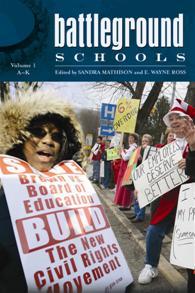
Battleground Schools

Please pardon this tooting-my-own-horn moment, but I’m very proud that Battleground: Schools, which I co-edited with Sandra Mathison, has won the 2010 Critics Choice Book Award from the American Educational Studies Association.

Battleground: Schools, which is published by Greenwood Press, was truly a collaborative effort as Sandra and I worked with—and learned a great deal from—the 118 contributors who produced 93 essays, which provide historically situated descriptions of the most salient controversies in schooling during the past century. Never before has such a pre-eminent and diverse group of scholarly perspectives been combined in one collection. The authors each have demonstrated through their publications and research their prominence in their particular area. Many are award-winning scholars. Some are practitioners. No single ideology prevails.

The essays are arranged alphabetically by topic. Each essay summarizes the nature of the controversy, including major players and events relevant to the topic. In a number of cases, timelines of critical events are included. And each essay concludes with readings for further investigation of the topic. The volume concludes with a general bibliography of works that address the topics covered.

You can download a PDF of the front matter of the book here, which includes the Contents, Guide to Related Topics, Preface, and Introduction to the book.

Rouge Forum News #17: Call for submissions (articles, poetry, art)

The Rouge Forum is a group of educators, students, and parents seeking a democratic society. We are concerned about questions like these: How can we teach against racism, national chauvinism and sexism in an increasingly authoritarian and undemocratic society? How can we gain enough real power to keep our ideals and still teach—or learn? Whose interests shall school serve in a society that is ever more unequal? We are both research and action oriented. We want to learn about equality, democracy and social justice as we simultaneously struggle to bring into practice our present understanding of what that is. We seek to build a caring inclusive community which understands that an injury to one is an injury to all. At the same time, our caring community is going to need to deal decisively with an opposition that is sometimes ruthless.

For the next issue of the Rouge Forum News, we invite essays, poetry and art from students from kindergarten through graduate school. Grad students, looking for an outlet for a working paper that you would eventually like to turn into a peer-reviewed article? Send it to us for publication and feedback in the Rouge Forum News. High school students, have a piece of poetry or drawing or comic strip that you’d like to get out to 4000 readers? Send it to us for publication in the Rouge Forum News. K-12 teachers and professors, received a good paper at the end of the spring term? Encourage your students to submit it to the Rouge Forum News.

Please send your submissions via a Microsoft word attachment to adamrenner70@gmail.com . Deadline is September 1.

Issue 17 will be published in the fall 2010. Visit www.rougeforum.org for past issues of the Rouge Forum News and other information about the Rouge Forum.