Category Archives: Uncategorized

New article in Critical Education: Global Pedagogy and the Question of Palestine

Global Pedagogy and the Question of Palestine: A Dialogue

Linda Herrera
University of Illinois at Urbana Champaign

Michael A. Peters
Beijing Normal University / University of Illinois Urbana Champaign


DOI: https://doi.org/10.14288/ce.v16i4.187433 

Keywords: Palestine in Critical Pedagogy, Paulo Freire, critical pedagogy, popular education, empowerment, grassroots, global citizenship, genocide, Anti-colonial pedagogy

Abstract

Global pedagogy refers to a broad, ethically grounded approach to education that extends beyond national boundaries and emphasizes the collective responsibility to teach and learn about interconnected global crises and historical injustices. The question of Palestine and the ongoing genocide in Gaza serve as the “canary in the coalmine”. Its suppression is not an isolated phenomenon but a diagnostic for a wider authoritarian turn that seeks to foreclose the very possibility of critical, transnational solidarity. In this dialogue, Michel Peters, a philosopher of education, and Linda Herrera, a critical anthropologist of education in the Middle East, engage in a dialogue about how educators can keep critical thought and solidarity alive by partaking in practices that are resilient, resourceful, and relentlessly focused on building counter-publics. These requires embracing a “fugitive” pedagogy, curating and archiving counter-memories, and building transnational literacies of solidarity.

Author Biographies

Linda Herrera, University of Illinois at Urbana Champaign
Linda Herrera is Professor in the Department of Education Policy, Organization and Leadership at University of Illinois, Urbana-Champaign. She has researched, written about, and taught courses on education and power in the MENA region, qualitative research methods (with a focus on critical ethnography and oral history), international development policy, youth and generations, childhood in global context, the social effects of technological change, and critical democracy and citizenship education. Her books include, Education 2.0: Chronicles of Technological and Cultural Change in Egypt (OUP, 2025), Educating Egypt: Civic Values and Ideological Struggles (American University in Cairo Press, 2022), Global Middle East: Into the Twenty-first Century (University of California Press, 2021), Revolution in the Age of Social Media: The Egyptian Popular Insurrection and the Internet (Verso, 2014), Wired Citizenship: Youth Learning and Activism in the Middle East (Routledge, 2014), Being young and Muslim: New Cultural Politics in the Global South and North (Oxford University Press, 2010), and Cultures of Arab Schooling: Critical Ethnographies from Egypt (State University of New York Press, 2006).

Michael A. Peters, Beijing Normal University / University of Illinois Urbana Champaign
Michael A. Peters is Distinguished Professor of Education at Beijing Normal University Faculty of Education PRC, and Emeritus Professor in Educational Policy, Organization, and Leadership at the University of Illinois at Urbana–Champaign. He is the executive editor of the journal, Educational Philosophy and Theory, and founding editor of five international journals, Policy Futures in Education, E-Learning and Digital Media (SAGE), and Knowledge Cultures (Addleton), The Video Journal of Education and Pedagogy (Springer), Open Review of Education Research (T&F). His interests are in philosophy, education and social policy and he has written over eighty books, including most recently: Wittgenstein and Education: Pedagogical Investigations, (2017) with Jeff Stickney, The Global Financial Crisis and the Restructuring of Education (2015), Paulo Freire: The Global Legacy (2015) both with Tina Besley, Education Philosophy and Politics: Selected Works (2011); Education, Cognitive Capitalism and Digital Labour (2011), with Ergin Bulut; and Neoliberalism and After? Education, Social Policy and the Crisis of Capitalism (2011). He has acted as an advisor to governments and UNESCO on these and related matters in the USA, Scotland, New Zealand, South Africa and the European Union. He was made an Honorary Fellow of the Royal Society of NZ in 2010, a Fellow in 2018, and awarded honorary doctorates by State University of New York (SUNY) in 2012 and University of Aalborg in 2015.
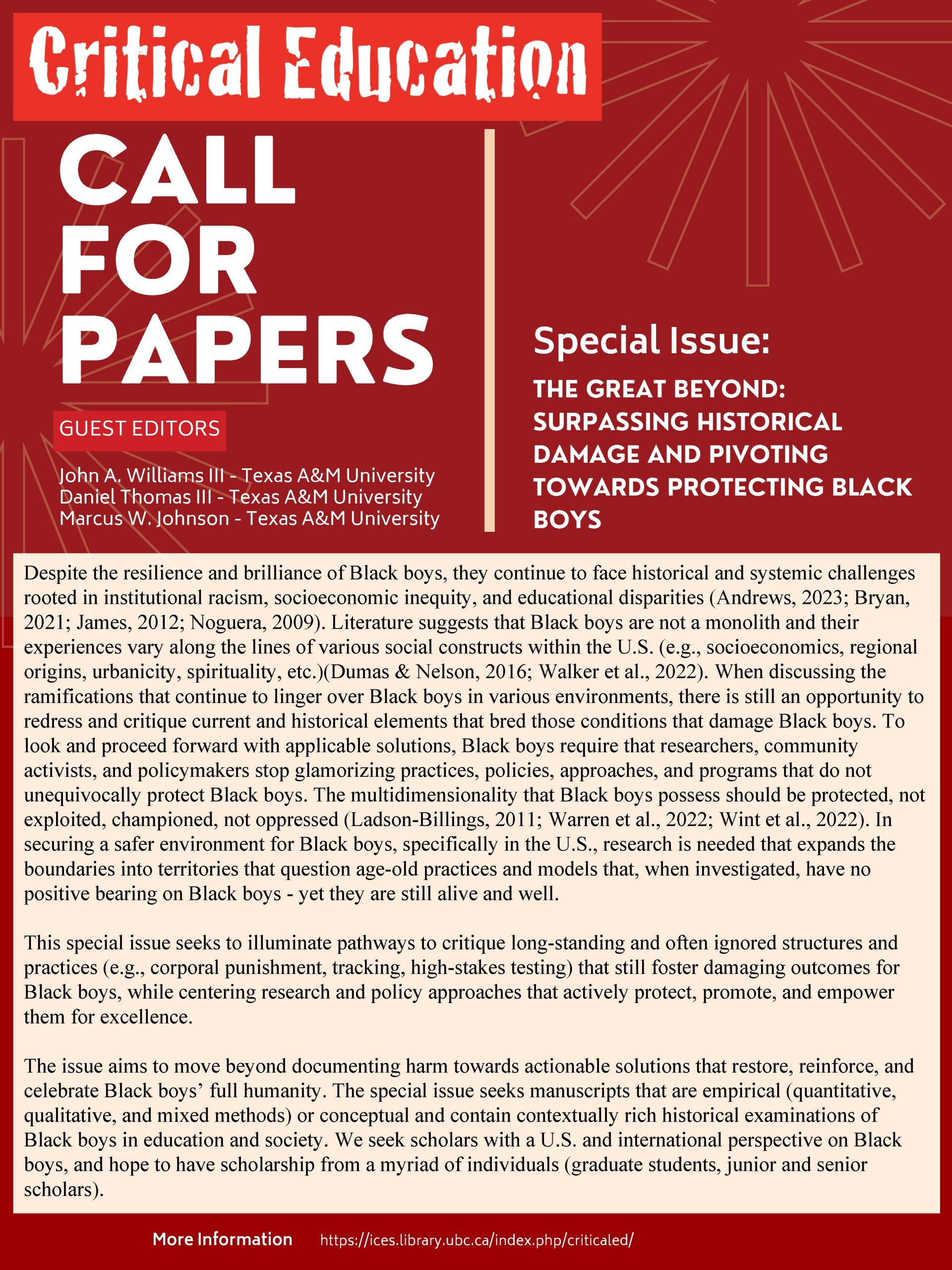
Special Issue Call for Papers — THE GREAT BEYOND: SURPASSING HISTORICAL DAMAGE AND PIVOTING TOWARDS PROTECTING BLACK BOYS

Special Issue Call for Papers — THE GREAT BEYOND: SURPASSING HISTORICAL DAMAGE AND PIVOTING TOWARDS PROTECTING BLACK BOYS

Guest Editors:

John A. Williams III – Texas A&M University
Daniel Thomas III – Texas A&M University
Marcus W. Johnson – Texas A&M University

Despite the resilience and brilliance of Black boys, they continue to face historical and systemic challenges rooted in institutional racism, socioeconomic inequity, and educational disparities (Andrews, 2023; Bryan, 2021; James, 2012; Noguera, 2009). Literature suggests that Black boys are not a monolith and their experiences vary along the lines of various social constructs within the U.S. (e.g., socioeconomics, regional origins, urbanicity, spirituality, etc.) (Dumas & Nelson, 2016; Walker et al., 2022). When discussing the ramifications that continue to linger over Black boys in various environments, there is still an opportunity to redress and critique current and historical elements that bred those conditions that damage Black boys. To look and proceed forward with applicable solutions, Black boys require that researchers, community activists, and policymakers stop glamorizing practices, policies, approaches, and programs that do not unequivocally protect Black boys. The multidimensionality that Black boys possess should be protected, not exploited, championed, not oppressed (Ladson-Billings, 2011; Warren et al., 2022; Wint et al., 2022). In securing a safer environment for Black boys, specifically in the U.S., research is needed that expands the boundaries into territories that question age-old practices and models that, when investigated, have no positive bearing on Black boys – yet they are still alive and well.

This special issue seeks to illuminate pathways to critique long-standing and often ignored structures and practices (e.g., corporal punishment, tracking, high-stakes testing) that still foster damaging outcomes for Black boys, while centering research and policy approaches that actively protect, promote, and empower them for excellence.

The issue aims to move beyond documenting harm towards actionable solutions that restore, reinforce, and celebrate Black boys’ full humanity. The special issue seeks manuscripts that are empirical (quantitative, qualitative, and mixed methods) or conceptual and contain contextually rich historical examinations of Black boys in education and society. We seek scholars with a U.S. and international perspective on Black boys and hope to have scholarship from a myriad of individuals (graduate students, junior and senior scholars).

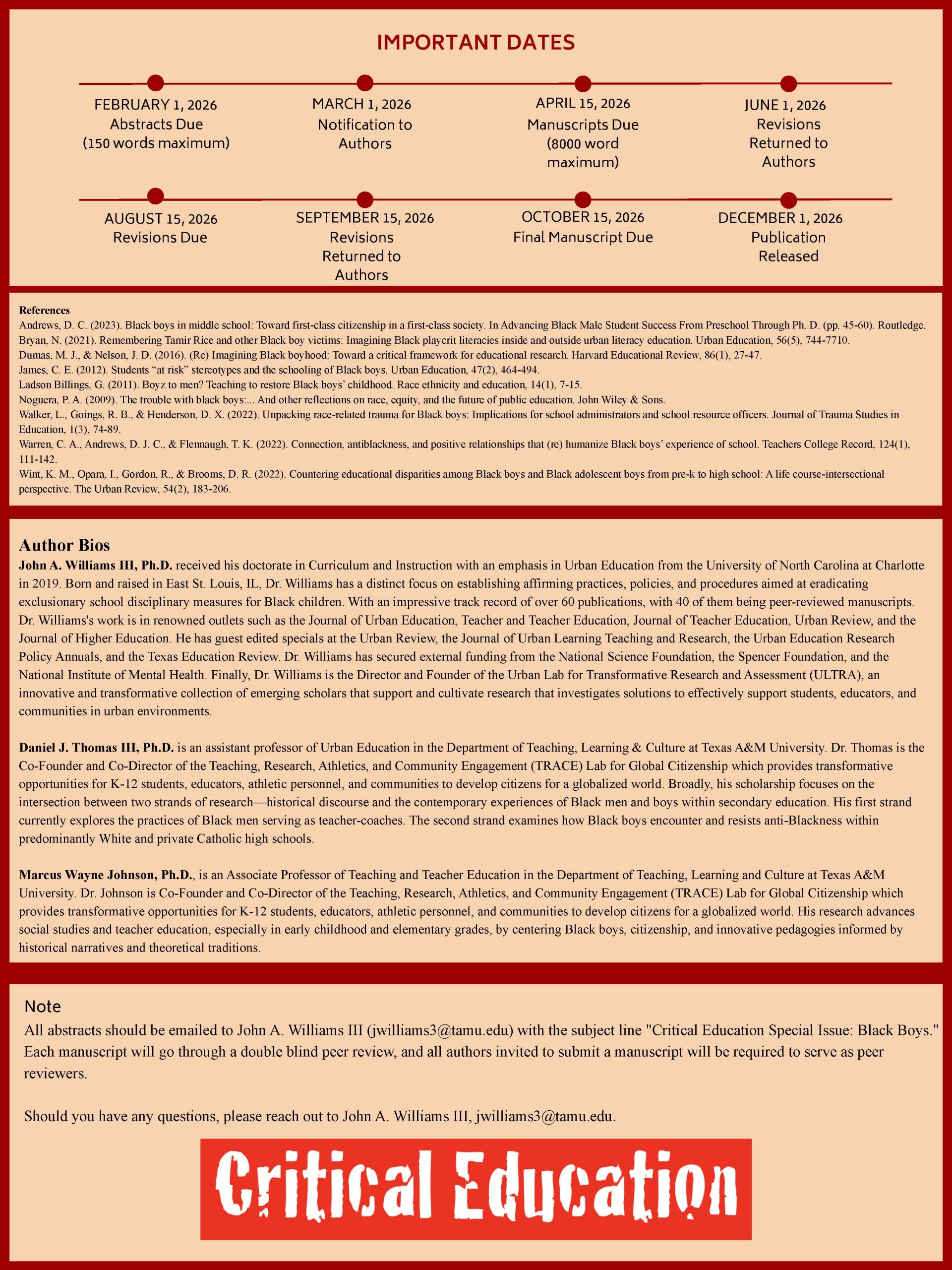
All abstracts should be emailed to John A. Williams III (jwilliams3@tamu.edu) with the subject line “Critical Education Special Issue: Black Boys.” Abstracts due: February 1, 2016.

 Each manuscript will go through a double blind peer review, and all authors invited to submit a manuscript will be required to serve as peer reviewers.

 Should you have any questions, please reach out to John A. Williams III, jwilliams3@tamu.edu.

 References

Andrews, D. C. (2023). Black boys in middle school: Toward first-class citizenship in a first-class society. In Advancing Black Male Student Success from Preschool Through Ph.D. (pp. 45-60). Routledge.

Bryan, N. (2021). Remembering Tamir Rice and other Black boy victims: Imagining Black playcrit literacies inside and outside urban literacy education. Urban Education, 56(5), 744-7710.

Dumas, M. J., & Nelson, J. D. (2016). (Re) Imagining Black boyhood: Toward a critical framework for educational research. Harvard Educational Review, 86(1), 27-47.

James, C. E. (2012). Students “at risk” stereotypes and the schooling of Black boys. Urban Education, 47(2), 464-494.

Ladson Billings, G. (2011). Boyz to men? Teaching to restore Black boys’ childhood. Race ethnicity and education, 14(1), 7-15.

Noguera, P. A. (2009). The trouble with black boys:… And other reflections on race, equity, and the future of public education. John Wiley & Sons.

Walker, L., Goings, R. B., & Henderson, D. X. (2022). Unpacking race-related trauma for Black boys: Implications for school administrators and school resource officers. Journal of Trauma Studies in Education, 1(3), 74-89.

Warren, C. A., Andrews, D. J. C., & Flennaugh, T. K. (2022). Connection, antiblackness, and positive relationships that (re) humanize Black boys’ experience of school. Teachers College Record, 124(1),111-142.

Wint, K. M., Opara, I., Gordon, R., & Brooms, D. R. (2022). Countering educational disparities among Black boys and Black adolescent boys from pre-k to high school: A life course-intersectional perspective. The Urban Review, 54(2), 183-206.

Call for Submissions: Heed the Call of the Dreamers! Imagination and the Frontiers of Critical Scholarship

Heed the Call of the Dreamers! Imagination and the Frontiers of Critical Scholarship

Guest Editor
Abraham P. DeLeon
University of Texas at San Antonio

What happens when critical scholarship takes seriously, the potentials imbued within a collective social imagination? What occurs when radical ways of knowing and doing activate the imagination that points to a different kind of past, present, and future? These kinds of questions are what I hope will inspire the papers I am seeking for this special issue in Critical Education. The empiricism that dominates much of academic scholarship, especially within the social sciences and education in particular, casts aside the transformative potentials of the imagination. Concerned too much with measurement, validity, replicability, and fundable projects that reify a particular kind of reality, mainstream scholarship does not engage with an imaginary that animates humanity’s potentials that is radical, creative, imaginative, and weird. The imagination runs through our social body like connective tissue, capillaries of radical potentiality. Our history is imbued with the imaginary, crossing not only fictional works that appear in film or literature for just two examples, but also that have animated a utopian impulse of a radical kind of difference: a different future, a different world, a different way of being with each other.

The imagination cannot be reduced to simply cognition or a neuro-functionality that activates a purely Western, scientific understanding. A radical social imagination can begin from a place of nowhere (Ricoeur, 2024), a non-space that allows a new kind of freedom of form to materialize that exists beyond scientific discourses that try to ensure its capture. Like Sartre’s (1948) work that the imagination has the potentials for negation, freedom, and engagement with nowhere, this special issue wants to explore the limits and potentials for the imagination for a radical and different kind of social imaginary. This space of nowhere becomes a productive frontier for larger questions about the future, the potentials for social action, and the possibilities for new epistemological, ontological, and pedagogical encounters. This special issue is a call for us to begin a new kind of radical project that attempts to break free from the current shackles of this intellectual culture, what Foucault (1998) might have called “inventing a new body”, one that is “volatile” and “diffused” (p. 226-227). We heed the call of the dreamers and allow the imagination to burst furth in new scholarly directions.

Here are some possible provocations to guide a submission, but are just meant to act as creative sparks.

I welcome any submission with a creative and imaginative vision for the past, present, and future.

 What have been past historical examples by a variety of political, creative, or other affinity groups animated by the imagination?

  • What would it mean to embody a rhetoric of the future?
  • How can the avant-garde animate scholarship in new imaginative directions?
  • Do historical or cultural myths possess a generative moment that can inform social theory in fundamentally new ways?
  • What happens when social theory engages with the imagination? What kind of transformations are possible?
  • How can the imagination inform political organizing in fundamentally new ways?
  • What happens with social theory when it embodies the fictional worlds of a social imagination?
  • What become the limits of inquiry when the imagination is activated?
  • What would it mean to decolonize the future? How do indigenous ways of knowing inform our futures?
  • What kind of alternative futures emerge when we utilize an imaginative lens?
  • What are some examples of indigenous or non-Western forms of imagination that are instructive or visionary?
  • What do specific genres of fiction (horror, science fiction, fantasy, historical fiction, romance) offer the critical scholarly project?
  • How can fiction and creative writing inform social and critical theories?

The editor is available for any inquiries or questions on ideas about potential manuscripts and encourages conversations around potential ideas. Please email him at abraham.deleon@utsa.edu.

Manuscripts will be due on May 1st, 2025. Please see the guidelines for submissions at Critical Education: https://ices.library.ubc.ca/index.php/criticaled/about/submissions#authorGuidelines

References

Foucault, M. (1998). Aesthetics, method, and epistemology: Essential works of Foucault, 1954-1984, Vol. 2. (R. Hurley and Others, ). The New Press.

Ricœur, P., Taylor, G. H., Sweeney, R. D., Amalric, J.-L., & Crosby, P. F. (2024). Lectures on imagination. The University of Chicago Press.

Sartre, J.-P. (1948). The psychology of imagination. (B. Frechtman, Trans.). Philosophical Library.

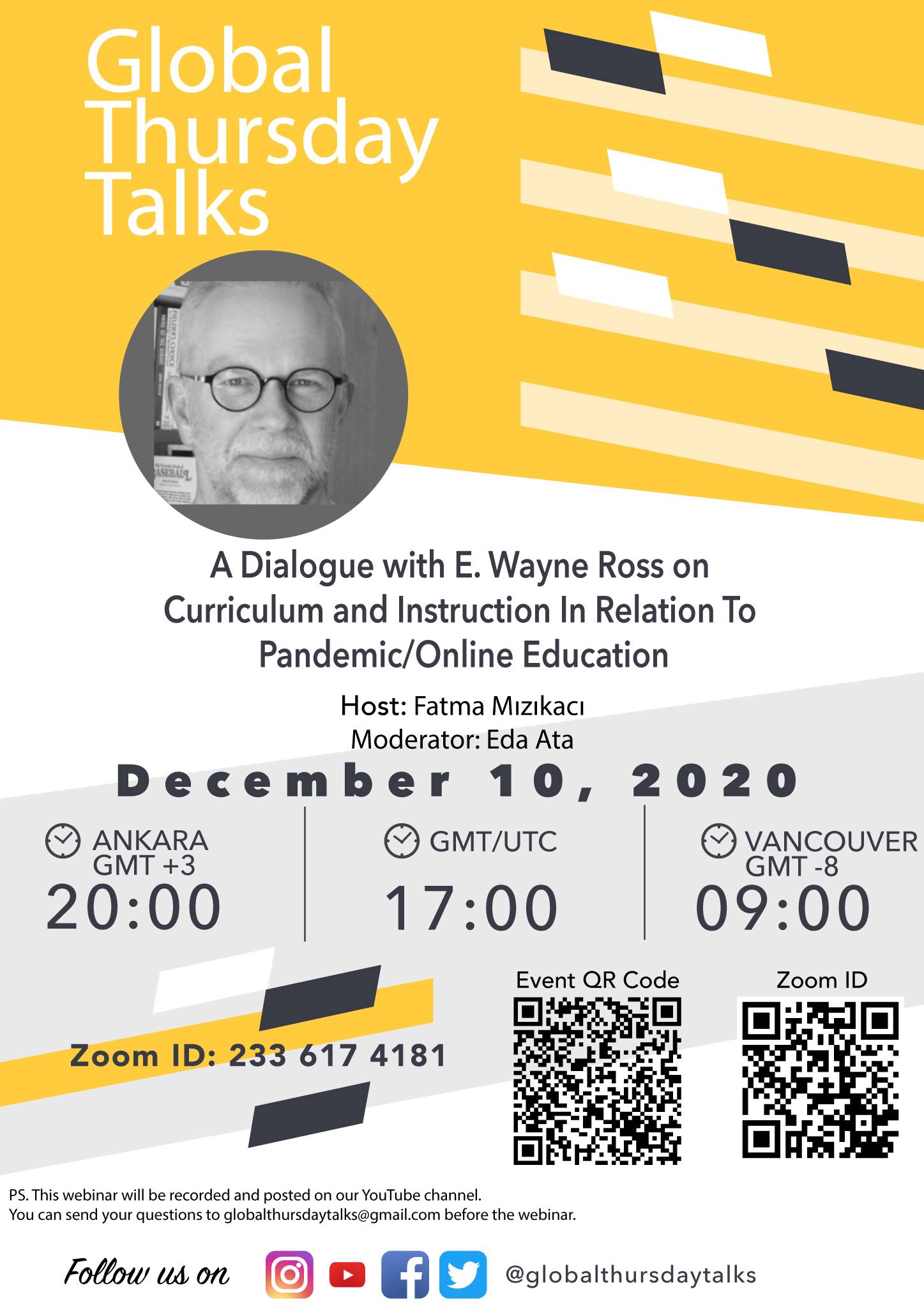
Global Talks Thursday (Dec 10, 2020): Dialogue on Curriculum and Instruction in Relations to the Pandemic/Online Education

Seminar: Challenges and Tensions in Curriculum Management: Theory and Practice

Challenges and Tensions in Curriculum Management: Theory and Practice

Public Seminar Sponsored by
Institute for Critical Education Studies

July 13, 2016
12:00pm
Scarfe 2108
2125 Main Mall
University of British Columbia

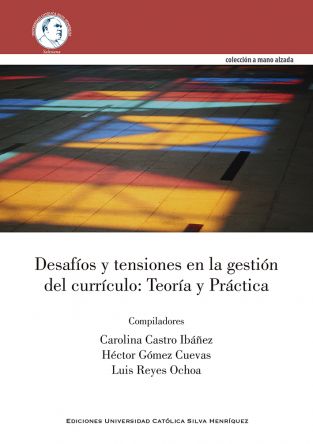
Carolina Castro, Héctor Gómez, and Fernando Murillo, co-authors in the recently published book Desafíos y Tensiones en la Gestión Curricular: Teoría y Práctica [Challenges and Tensions in Curriculum Management: Theory and Practice] in Chile, will present their contributions to the discussion of curriculum design, development and implementation in the contexts of schools and higher education.

The book, co–edited by Gómez and Castro, gives voice to a variety of perspectives and experiences in schools and higher education. In this regard the authors ask: How is curriculum managed? Who is involved in the process and how? What authority do curriculum managers have, and how is power distributed in order to influence and make decisions on the curriculum? What effective spaces for innovation exist? How are perennial and new issues considered in the management of curriculum?


Screen Shot 2016-07-04 at 6.11.50 PMCurriculum Design and the Teaching Role: An Outstanding Relationship. Reflections From Research at a Hospital-Based School
Carolina Castro

Bachelor in Education – Primary School Teacher, Master of Arts in Education and Curriculum. Head of the Curriculum Unit at Universidad Católica Silva Henríquez in Santiago, Chile.

Screen Shot 2016-07-04 at 6.12.04 PMProfessional Formation Beyond the Know-How: Considerations and Challenges for a Post-Competence Curriculum Management
Fernando M. Murillo

Bachelor in Education – TEFL, Master of Arts in Education and Curriculum, UBC PhD student in Curriculum Studies

Screen Shot 2016-07-04 at 6.12.16 PMTeacher Education in Chile: Curriculum design and its Complex Discourses.
Héctor Gómez

Bachelor in Education – Teacher of History and Social Sciences, Master of Arts in Education and Curriculum, UBC PhD Student in Curriculum Studies

DESAFIOS Y TENSIONES.jpg

Some BC and Alberta schools dump percentage grading

Should schools move away from grading students? Yes!

Of course, it’s a time “honoured” tradition to use grades as the key means of sorting students to meet the demands of business. But, if you’re more more interested in motivating students to learn and less interested in treating education like a commodity, there’s really little room to debate the point.

School boards in Ridge Meadows, BC and Battle River, AB have decided to stop giving percentage grades to their students.

The Vancouver Sun recently ran a story on the Ridge Meadows Schools (Maple Ridge and Pitt Meadows BC) that have adopted an alternative approach to student assessment in which elementary teachers are no longer required to give letter grades to students.

Rather than assigning As, Bs or Cs to kids from grades 4 to 7, teachers can instead use the conference model to assess how well children are grasping course material, as well as their learning style, readiness to progress and comprehension of overall concepts. The standard reporting system does not assign letter grades for students in kindergarten to Grade 3, but under the new system, students in all elementary grades will be invited to participate more fully in their evaluations by completing self-assessments and setting future learning goals.

The alternative system will engage students while providing more meaning to parents than a simple letter grade, said Ridge Meadows school trustee Susan Carr, who has two children in the school system.

Ridge Meadows school trustees were unanimous in their support for the new approach, which was developed over the past two years by a district committee. The Ridge Meadows News reported that “Committee members noted the feedback from parents who have been involved so far is “through-the-roof positive.”

In Alberta, the Battle River School District’s has adopted an alternative grading system that replaces percentage grades with categories.

Under the assessment model, students are marked with an achievement level that indicates they are within a percentage range. A student scoring between zero and 50 per cent would be at the “beginning” level. A “developing” student is within the 50-66 per cent range, “achieving” is between 67 and 83 per cent and “excelling” ranges from 84-100 per cent. (The Edmonton Journal)

Camrose, AB parents don’t seem to be has uniformly positive about Battle River’s decision as about 150 recently protested the move.

Today on CBC Radio’s The 180 with Jim BrownSandra Mathison, a UBC education professor and member of the Institute for Critical Education Studies discussed the issue of grading students and provided some sharp counter-point to Michael Zwaagstra, a high school teacher who is affiliated with the Frontier Centre for Public Policy (a Fraser Institute clone that is primarily funded by right-wing outfits like the Donner Foundation).

The Frontier Centre and Zwaagstra’s views on education get a lot of play on the editorial pages of Vancouver’s daily papers, both of which prominently embrace and espouse neoliberal public policy, which places the interests of corporate capital and their shareholders over the interests of people.

It was interesting to hear Zwaagstra shift to center when confronted with Mathison’s counter-point.

Get the podcast of this episode of The 180 with Jim Brown here.


New issue of Critical Education launched: Embracing Change: Reflection on Practice in Immigrant Communities

Critical Education has just published its latest issue at http://ojs.library.ubc.ca/index.php/criticaled. We invite you to review the Table of Contents here and then visit our web site to read articles and items of interest.

Thanks for the continuing interest in our work,

Sandra Mathison
Stephen Petrina
E. Wayne Ross
Co-Editors, Critical Education
Institute for Critical Education Studies
University of British Columbia

Critical Education
Vol 3, No 7 (2012)
Table of Contents
http://ojs.library.ubc.ca/index.php/criticaled/issue/view/182260

Articles
——–
Embracing Change: Reflection on Practice in Immigrant Communities
Gresilda Anne Tilley-Lubbs, Jennifer McCloud

CFP: “Teach for America and the Future of Education in the US”

Call for Submissions
Critical Education Special Series

“Teach for America and the Future of Education in the US”
Guest Editor: Philip E. Kovacs, University of Alabama, Huntsville

Founded in 1990 by Princeton graduate Wendy Kopp, Teach for America (TFA) has grown from a tiny organization with limited impact to what some supporters call the most significant force in educational reform today. Indeed the organization has recently been embraced by both the president of the National Educational Association and U.S. Secretary of Education Arnie Duncan as a force for tremendous good.

Critics argue otherwise, pointing to data that is mixed at best while questioning the almost $500 million annual operating budget of the non-profit, a significant portion of which comes from U.S. taxpayers. In light of questionable results and practices (such as using non-certified TFA recruits to work with special education students in direct violation of the Individuals with Disabilities Education Act) organizations are working to end TFA’s “highly qualified teacher” provision in 2013, an effort TFA is aggressively trying to thwart.

In an effort to provide assistance to those organizations working to maintain the integrity of the teaching profession, the Critical Education seeks research on TFA’s practices, procedures, outcomes, and impacts. We are looking for empirical and theoretical pieces written in a style that congressional staffers can easily access and understand. We are not interested in pieces that sacrifice intellectual rigor for ease of reading, but we are also wary of overly theorized pieces that alienate readers outside of the academy.

In addition to full-length manuscripts (5,000-8,000 words), we are also soliciting short accounts of TFA’s impact in specific cities to be presented as “field reports.”

Proposals of no more than 200 words due by September 15, 2012.

Notice of acceptance of proposal by October 1, 2012

Final Submission due by February 1, 2013.

For more information on submission contact Philip Kovacs at: pk0001@uah.edu

Critical Education is an international peer-reviewed journal, which seeks manuscripts that critically examine contemporary education contexts and practices. Critical Education is interested in theoretical and empirical research as well as articles that advance educational practices that challenge the existing state of affairs in society, schools, and informal education.