Critical Education Special Issue – Call for Submissions CRITICAL HUMANISM AND PROBLEMS OF CHANGE

Critical Education Special Issue – Call for Submissions

CRITICAL HUMANISM AND PROBLEMS OF CHANGE

Deadline for Submissions: December 15, 2023

Submission Types: Empirical and theoretical papers; interviews; practitioner field reports, experiential descriptions, or teaching examples

Review Process: All submissions of scholarly articles will be peer-reviewed. Interviews and field reports will be reviewed “in-house.”

Philosophical Overview/Perspective: Institutions once designed to ensure democratic participation by limiting governing power are instead used to manipulate the commons while attacking group solidarity marginalizing the most vulnerable in societies. Capitalist austerity measures and identity politics built into bad-faith legislation ensure antagonisms distract from democratic educational possibility (Ross & Vinson, 2013; Sondel, 2015). The results are populations divided, which secures worker subservience to existing structures of power or domination. Resultant social tensions keep society distracted, precluding democratizing agency. Schooling and schooling experiences reflect the acceptance of cultural narratives where societies live out the capitalist status quo and a vertically aligned social hierarchy (Rodriguez, 2008). The miseducation of students becomes a means to, at best, maintain hierarchy, but more insidiously, becomes an ideological lever for actively legitimizing dehumanization. However, critical educators fight against these alienating conditions as students and teachers direct knowledge, exchanges, and personal agency toward more democratic civic participation to secure human freedom and dignity (Freire, 2018; hooks, 2014; West, 2004).

In this special issue, we seek empirical and theoretical papers, interviews (with organic intellectuals, activist students or teachers, education workers committed to their community, and community members striving for more equitable schools and societies), practitioner field reports, and book reviews that take a critical humanist approach to education and the social world. By critical humanism, we are referring to ideas, research, and approaches that can help students and educators take pragmatic approaches toward promoting human liberation from conditions that enslave individuals and ensure the conditions for democracy. This may mean demonstrating more complex connections between the classroom to society, or ways critical educators create the conditions for a more just world. We are interested in scholarship that describes teacher and student agency within the current political climate and perspectives that serve as a counterpoint to vertical social hierarchies. Examples may include, but are not limited to social, historical, and political analyses; class relations in society, conflict resolution, dismantling censorship mechanisms that regulate human possibility and experience; teacher work within and as part of their communities; student, teacher, and community solidarity responding to oppressive conditions and/or legislation; analysis of artifacts, discourse, and culture; or research on, transformational civic practices or engagement; applications of critical or cultural frameworks to educational phenomena; anti-fascist, decolonial, and anti-oppressive approaches; innovations that help facilitate opportunities for emancipatory social transformation through critical education and praxis. Contributions related to activist communities transforming ideology, social conditions, and teaching conditions, among LGBTQ+, Indigenous, feminist, racialized, and other minorized groups are encouraged.

Submission may also relate to the different aspects of schooling as a historical activity system or the greater educational ecology which might include reimagining classroom mediation; use of disciplinary tools; equitable divisions of classroom labor; and/or classroom labor directed toward social transformation (Engeström, 2015; Sanino et. al, 2009). We would like to illuminate the many ways teachers, students, and educational and other community stakeholders work in solidarity to transform the oppressive social conditions that situate education and society (Magill & Rodriguez, 2021).

Manuscripts due: December 15, 2023

For details on manuscript submission see: Critical Education Information for Authors.

When submitting your manuscript please choose the journal section “Critical Analysis and the Problems of Change” from the drop-down menu.

Additional questions can be directed to: Kevin R. Magill (Kevin_Magill@Baylor.edu)

References

Engeström, Y. (2015). Learning by expanding. Cambridge University Press.

Evans, M. (2009). Citizenship education, pedagogy and school contexts. Education for citizenship and democracy, 519-532.

Freire, P. (2018). Pedagogy of the oppressed. Bloomsbury USA.

hooks, B. (2014). Teaching to transgress. Routledge.

Magill & Rodriguez. (Forthcoming) Structures of American Education. Roman & Littlefield.

Magill, K. R. & Rodriguez, A. (2021). Teaching as intellectual solidarity. Critical Education, 12(1), 1-21. http://ojs.library.ubc.ca/index.php/criticaled/article/view/186451

Ross, E. W. (2015). Teaching for change: Social education and critical knowledge of everyday life. The importance of teaching social issues: Our pedagogical creeds, 141-147.

Ross, E. W., & Vinson, K. D. (2013). Resisting neoliberal education reform: Insurrectionist pedagogies and the pursuit of dangerous citizenship. Cultural Logic: A Journal of       Marxist Theory & Practice20, 17-45.

Sannino, A. E., Daniels, H. E., & Gutiérrez, K. D. (2009). Learning and expanding with activity theory. Cambridge University Press.

 Sondel, B. (2015). Raising citizens or raising test scores? Teach for America, “no excuses” charters, and the development of the neoliberal citizen. Theory & Research in Social Education43(3), 289-313.

West, C. (2004). Democracy matters, winning the fight against imperialism. New York: Penguin.

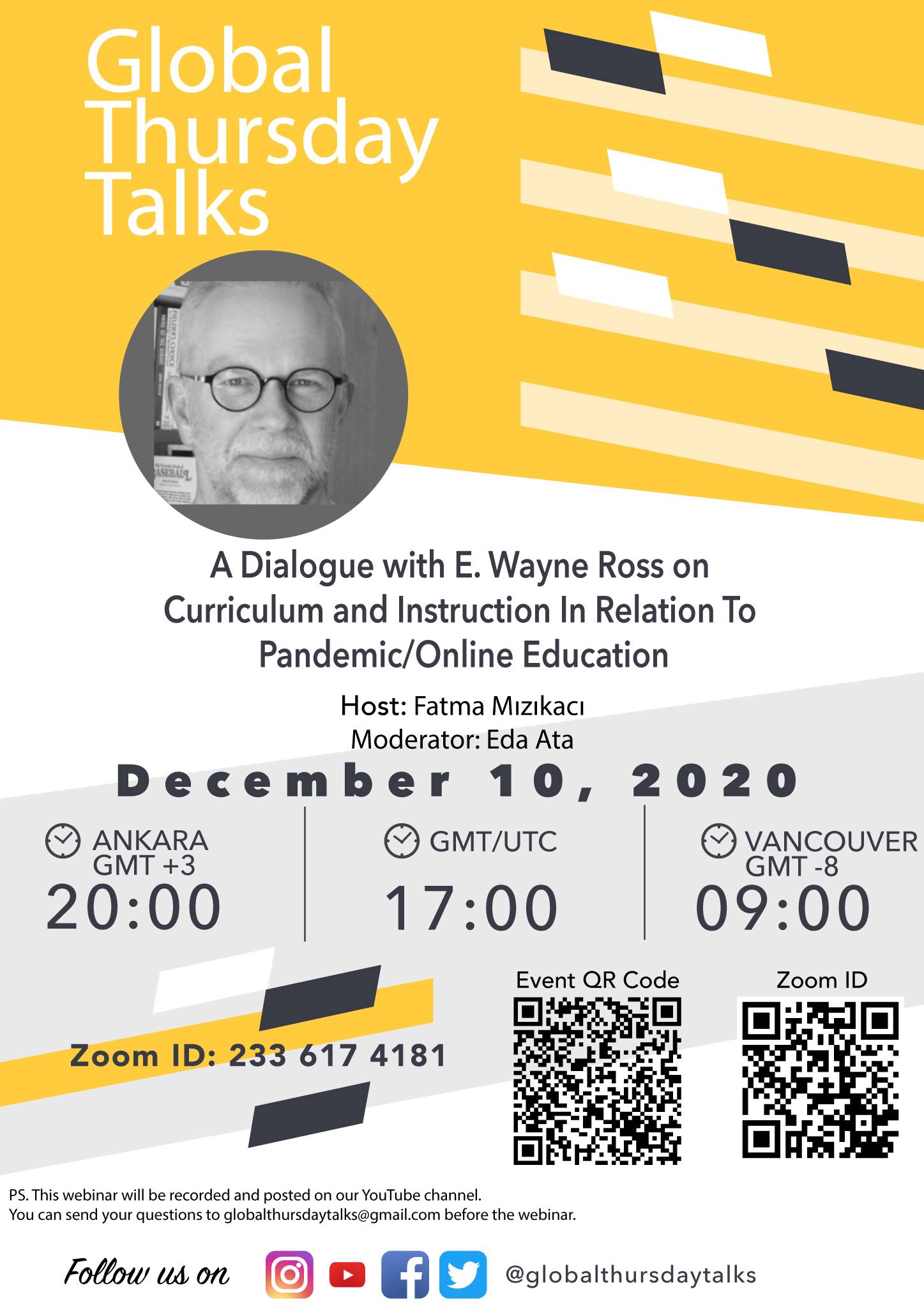
Global Talks Thursday (Dec 10, 2020): Dialogue on Curriculum and Instruction in Relations to the Pandemic/Online Education

Call for Papers: The Labour of COVID section of Workplace: A Journal for Academic Labour

Call for Papers: The Labour of COVID section of Workplace: A Journal for Academic Labour

 As instructors and students brace for a fall semester taught on-line, the effects of COVID on the labour of post-secondary learning continue to set in. Course outlines and assessment criteria are being reworked. Students wrestle with rising tuition and the prospects of prolonged periods of unemployment. As recent Canadian Association of University Teachers survey results suggest, the pandemic is making higher education even less tenable for current and prospective students. International students stuck in their home countries will be forced to participate in classes across time zones. Research programs are being put on hold. Making matters worse, the gutting of teaching and learning resources at some universities have forced administrators to piece together support for instructors and staff ill-equipped to make the transition on-line. Workloads have increased.  But in the midst of this crisis, some post-secondary institutions seek opportunity to advance particular agendas. It was only after significant backlash from students and lecturers that the UK’s Durham University halted its attempt at providing online-only degrees in its effort to significantly cut in-person teaching. In Alberta, the government has merely delayed a performance-based funding model as a result of COVID, signaling that austerity, not improving the quality of education, is driving policy decisions. Meaningful interventions by faculty associations have been limited as the collegial governance process is sidelined for the sake of emergency pandemic measures. And what of academic and support staff who face increase workloads and the prospects of limited child care when the fall semester resumes? To this concern, what are the gendered effects of COVID? What do these circumstances mean for precariously employed sessional and term instructors? This special edition of Workplace invites all academic workers to make sense of COVID through a work and employment lens. Possible themes include:

  • Faculty association responses to a shift towards on-line education
  • “Mission creep” and the lure of distant learning for post-secondary institutions: opportunities and threats
  • The gendered and racialized implications of COVID in the classroom and on campus
  • Implications for sessionals, adjuncts and the precariously employed
  • COVID and workplace accommodations: from child care to work refusals
  • Student experiences and responses
  • COVID and performance-based funding policies
  • COVID and the collective bargaining process
  • Internationalization and the COVID campus

Aim and Scope: Workplace: A Journal for Academic Labor is a refereed, electronic, open access journal published by a collective of scholars in critical higher education promoting a new dignity in academic work. Contributions are aimed primarily at higher education workplace activism and dialogue on all issues of academic labour.

Invitations: Contributions from all ranks of academic workers – from tenured and tenure stream to graduate students, sessional instructors, contract faculty, and administrative support staff – are encouraged to submit.

Deadlines: Submissions will be considered for peer review and publications on a rolling basis. The final deadline is February 28, 2021. A complete volume of The Labour of COVID will be complete and made available in the spring of 2021. Formatting and submission guidelines can be found here

https://ices.library.ubc.ca/index.php/workplace/information/authors

Please direct questions about the special issue to Dr. Andrew Stevens at Andrew.stevens@uregina.ca


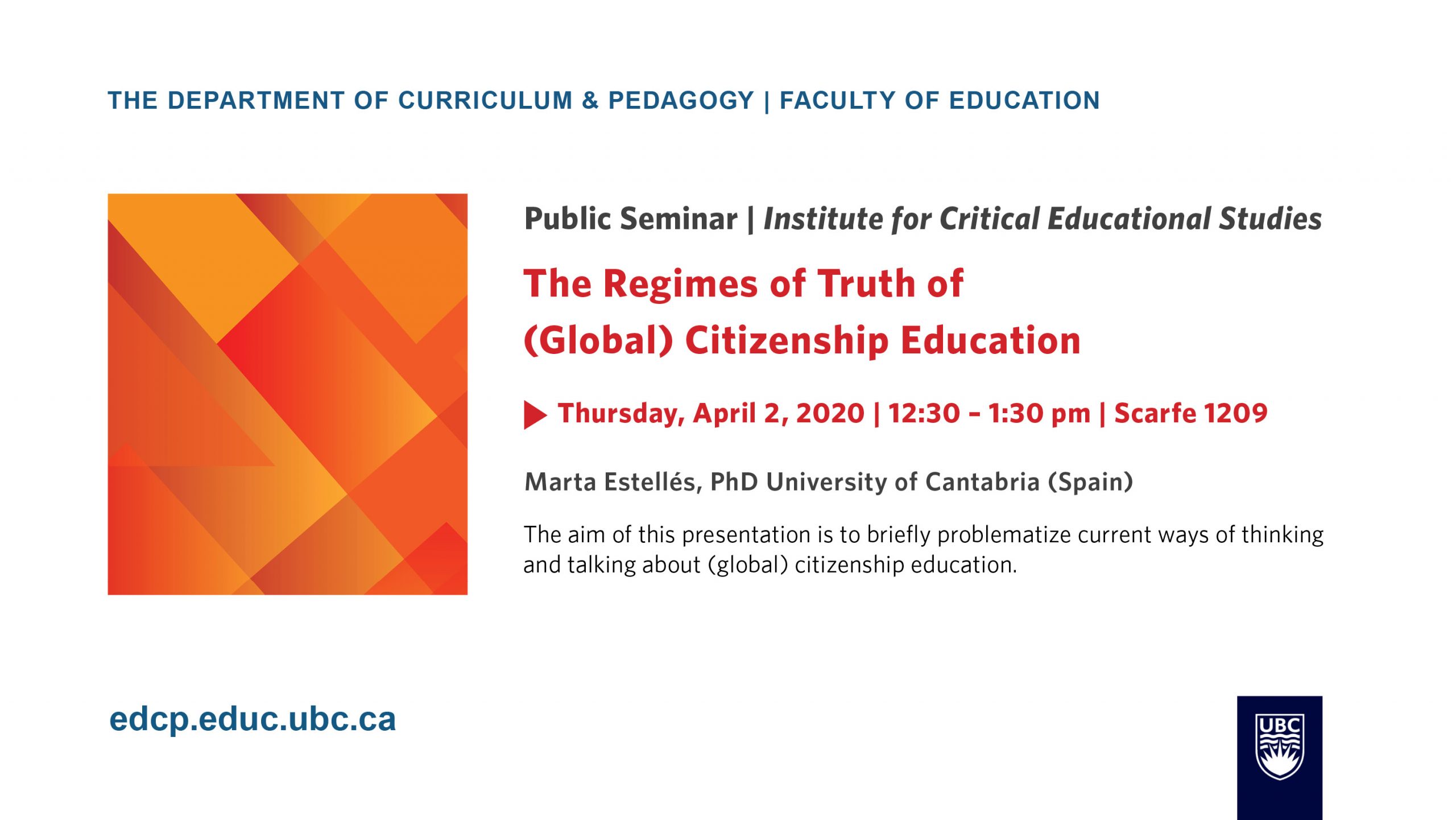
ICES Seminar: THE REGIMES OF TRUTH OF (GLOBAL) CITIZENSHIP EDUCATION

Event cancelled based on UBC recommendations regarding COVID-19.

Public Seminar
Institute for Critical Educational Studies

THE REGIMES OF TRUTH OF (GLOBAL) CITIZENSHIP EDUCATION

Marta Estellés, PhD
University of Cantabria (Spain)

Thursday, April 2, 2020
12:30 – 1:30 pm
University of British Columbia, Vancouver — Scarfe 1209

 Abstract

The aim of this presentation is to briefly problematize current ways of thinking and talking about (global) citizenship education. Citizenship is a process more than it is an attribute, since the concept has incorporated the main characteristics both of the political transformations experienced by the State and of the State’s relations with society. The successive battles for the definition of citizenship have an impact on that institution of socialization that is school. Examining the evolution of curricular prescriptions and orientations is enough to glimpse changes in the languages and frames through which certain relations between the individual, the community, and the State are naturalized.

The results of our research show that the two major cycles of socio-institutional restructuring in Western countries – from the crisis of the nineteenth-century liberal regimes to the present – have imposed different trends in relation to citizenship education in schools. The first cycle reached its culmination with the implementation of Welfare States after the Second World War. It was not a coincidence that the first major defense for democratic citizenship education appeared in this moment, with the reformist impulse that gave rise in 1916 to Social Studies in the US. The recognition of socio-economic rights and the formation of citizenship appeared inextricably linked in the texts of the reform, in an attempt to establish a new “regime of truth” that radically redefined the meaning of education for all, and not only for a privileged minority. This redefinition also implied a criticism of the patriotic and nationalistic purposes of education. This language, however, started to become blurred as neoliberal policies instituted their own frames in the 1980s with Reagan in the US and Thatcher in the UK. Citizenship education began to adopt the rhetoric of accountability with its emphasis on testing, performance levels, skills, etc. and the focus was on promoting responsible and active citizenship that clearly emphasized duties over rights. Thus, it began to be assumed that citizens should be responsible for their own well-being and not the State. Recent discourses on global citizenship education should be seen as heirs of this last redefinition. After all, global citizenship education “aims to empower learners to engage and assume active roles, both locally and globally, to face and resolve global challenges” (UNESCO, 2014, p. 15), assuming that the responsibility of solving those challenges lies with the individuals, not on governments or international organizations.

Marta Estellés, PhD, is Assistant Professor of the Department of Education at the University of Cantabria (Spain). Her research interests include citizenship education, social studies education, curriculum policies and teacher education. She has published several works on the intersectional field of democratic citizenship education and initial teacher education. She is currently working on a research project related to teachers’ political views and behaviors and their attitudes towards including controversial issues in the classroom. She is also part of the Fedicaria collective (http://www.fedicaria.org), which advocates for critical social studies education.

Download flyer

CFM Deadlined Extended: Contemporary Educator Movements: Transforming Unions, Schools, and Society in North America

DEADLINE EXTENDED:

Critical Education

Call for Manuscripts: Contemporary Educator Movements: Transforming Unions, Schools, and Society in North America

Special Series Editors:
Lauren Ware Stark, University of Virginia
Rhiannon Maton, State University of New York College at Cortland
Erin Dyke, Oklahoma State University

Call for Manuscripts:

Throughout the past two years, educators have led the most significant U.S. labor uprisings in over a quarter century, organizing alongside parents and community members for such common good demands as affordable health care, equitable school funding, and green space on school campuses (Bureau of Labor Statistics, 2019a; Bureau of Labor Statistics, 2019b). These uprisings can be seen as evidence of the growth of a new form of unionism, alternately called social justice or social movement unionism (Fletcher & Gapasin, 2008; Peterson, 1999; Rottmann, 2013; Weiner, 2012). They can also be understood as evidence of contemporary educator movements: collective struggles that have developed throughout the past decade with the goal of transforming educators’ unions, schools, and broader society (Stark, 2019; Stern, Brown, & Hussain, 2016).

These struggles share much in common with other contemporary “movements of movements” (Sen, 2017) in that they develop in networks, utilize new technologies alongside traditional organizing tools, integrate diverse groups and demands, and often organize through horizontal, democratic processes (Juris, 2008; Wolfson, Treré, Gerbaudo, & Funke, 2017). They have been led by rank-and-file educators, who in many cases have organized in solidarity with parents and community members. While some recent scholarship on contemporary educator movements has conceptualized these movements as a unified class struggle (Blanc, 2019), other scholarship has emphasized heterogeneity, intersectionality, knowledge production, learning, and tensions within these movements (Maton, 2018; Stark, 2019).

This Critical Education special series builds on the latter tradition to offer “movement-relevant” scholarship written from within contemporary educator movements (Bevington & Dixon, 2005). Our aim for the series is to offer resources for contemporary educator movement organizers and scholars to:

  • understand the links between contemporary educator labor organizing and earlier struggles,
  • study tensions within this organizing,
  • explore how educator unionists are learning from each other’s work,
  • highlight urban and statewide education labor struggles in the U.S., as well as major struggles in Canada and Mexico, and
  • connect local education labor struggles to broader power structures.

Types of Submissions:

Specifically, we seek to include interviews with organizers, movement art, and empirical studies that engage critical and engaged qualitative methodologies (for example, autoethnographic, ethnographic, oral history, and/or participatory methodologies). We especially encourage submissions with and/or from rank-and-file education organizers.

  • Empirical research (4,000-8,000 words)
  • Interviews or dialogues with organizers (2,000-4,000 words)
  • Creative writing, including poems or short prose essays (<2,000 words; maximum three poems or one essay)
  • Art, including images of banner art and photographs (minimum 300dpi for images in .jpeg file format)

Examples of Possible Topics:

  • The significance of caucuses and/or labor-community organizing within a specific local context,
  • Challenges and possibilities for radical democratic or horizontal decision-making in contemporary educator movements,
  • Possibilities and challenges in transforming teacher unions to more radical entities,
  • Political education with and for rank-and-file educators,
  • Rank-and-file educator organizing to engage issues of race, indigeneity, language, and culture in education,
  • Issues of gender and/or sexuality in contemporary educator movements,
  • In-depth studies of rank-and-file educator-led campaigns and organizing experiences,
  • Tensions and possibilities between contemporary educator movements and specific North American social movements (i.e., climate justice movements, movements for decolonization, queer and trans liberation movements, prison abolition movements),
  • Critical whiteness studies and education labor organizing/movements,
  • Among others.

Timeline:

  • April 1, 2020 – Manuscript submissions due. (Note: Manuscripts will undergo a double blind peer review process. Invitation to submit a manuscript does not ensure publication.)
  • August 1, 2020 – Authors receive reviewer feedback and notification of publication decision (accept, accept with revisions, or reject for this particular series.)
  • September 1, 2020 – Manuscript revisions due.

Submission Instructions:

All submissions must follow the guidelines described here. Submissions should be maximum 8,000 words and use APA format (6th edition). All work must be submitted via the Critical Education submission platform.

Use this link to submit papers: http://ices.library.ubc.ca/index.php/criticaled/about/submissions#onlineSubmissions)

References:

Bevington, D., & Dixon, C. (2005). Movement-relevant theory. Social Movement Studies, 4(3), 185-208.Bureau of Labor Statistics (2019a, February 15). Major Work Stoppages (Annual) News Release. Retrieved from https://www.bls.gov/news.release/archives/wkstp_02082019.htm

Blanc, E. (2019b). Red State Revolt: The Teachers’ Strike Wave and Working-Class Politics. London & New York: Verso Books.

Bureau of Labor Statistics. (2019b, March 07). Eight major work stoppages in educational services in 2018. Retrieved from https://www.bls.gov/opub/ted/2019/eight-major-work-stoppages-in-educational-services-in-2018.htm

Fletcher, B., & Gapasin, F. (2008). Solidarity divided: The crisis in organized labor and a new path toward social justice. Los Angeles: University of California Press.

Juris, J. (2008). Networking Futures: The Movements Against Corporate Globalisation. Durham, NC: Duke University Press.

Maton, R. (2018.) From Neoliberalism to Structural Racism: Problem Framing in a Teacher Activist Organization. Curriculum Inquiry, 48 (3): 1–23.

Peterson, B. (1999). Survival and justice: Rethinking teacher union strategy. In B. Peterson & M. Charney (Eds.) Transforming teacher unions: Fighting for better schools and social justice (pp. 11-19). Milwaukie, WI: Rethinking Schools.

Rottmann, C. (2013, Fall). Social justice teacher activism. Our Schools / Our Selves, 23 (1), 73-81.

Sen, J. (2017). The movements of movements: Part 1. Oakland, CA: PM Press; New Delhi: Open Word.

Stark, L. (2019). “We’re trying to create a different world”: Educator organizing in social justice caucuses (Doctoral dissertation).

Stern, M., Brown, A. E. & Hussain, K. (2016). Educate. Agitate. Organize: New and Not-So-New Teacher Movements. Workplace, 26, 1-4.

Weiner, L. (2012). The future of our schools: Teachers unions and social justice. Chicago, Illinois: Haymarket Books.

Wolfson, T., Treré, E., Gerbaudo, P., & Funke, P. N. (2017). From Global Justice to Occupy and Podemos: Mapping Three Stages of Contemporary Activism. TripleC: Communication, Capitalism & Critique, 15(2), 390 – 542.

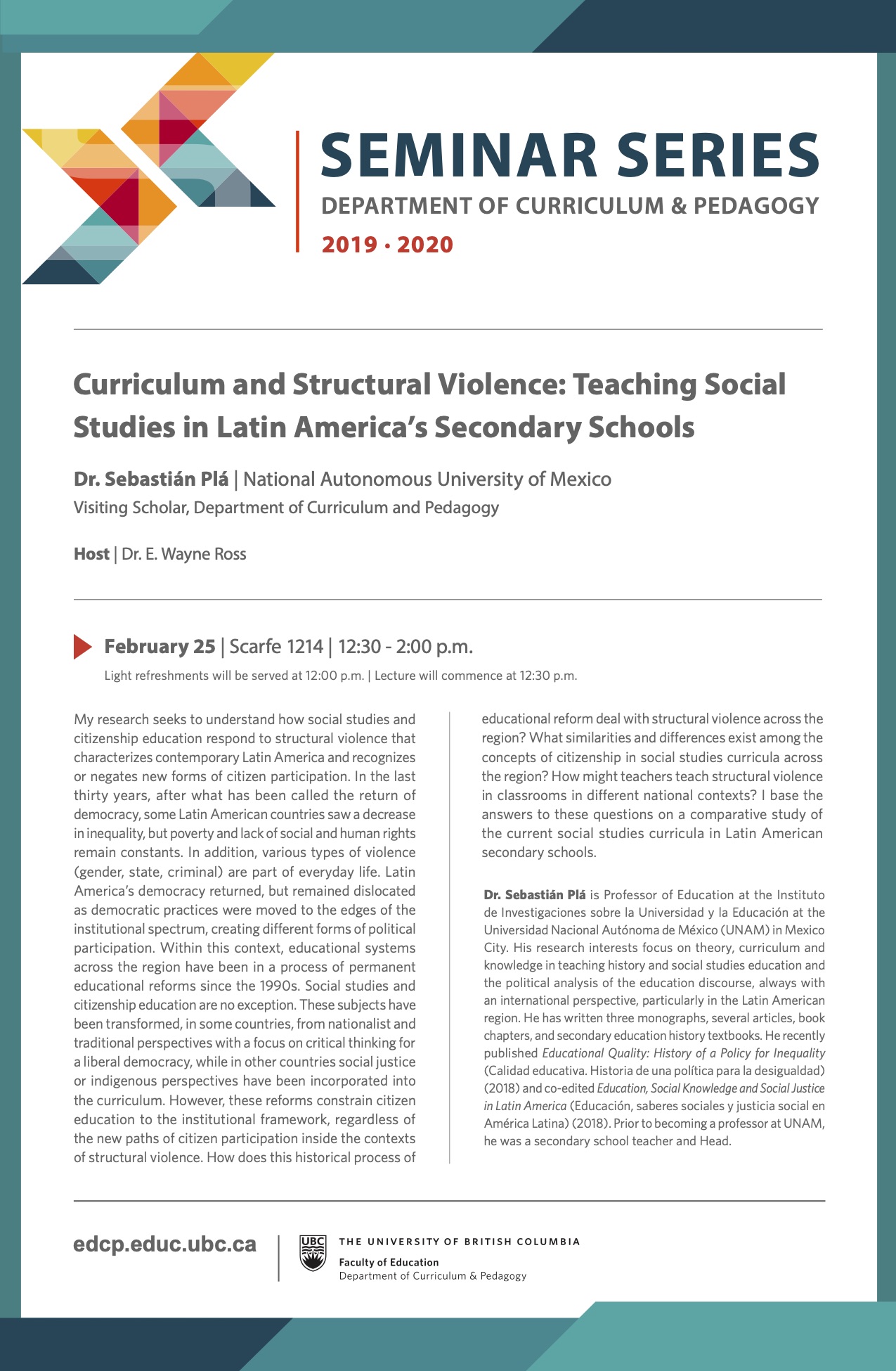
Dr. Sebastián Plá | “Curriculum and Structural Violence: Teaching Social Studies in Latin America’s Secondary Schools”

The Fear Created by Precarious Existence in The Neoliberal World Discourages Critical Thinking / La peur créée par l’existence précaire dans le monde néolibéral décourage la pensée critique

E. Wayne Ross, co-editor of Critical Education,  was recently interviewed about the impact of neoliberal capitalism on schools, universities, and education in general by Mohsen Abdelmoumen, an Algerian-based journalist.

Over the course of the interview he discussed a wide-range of issues, including: the fundamental conflict between neoliberalism and participatory democracy; the Global Education Reform Movement (GERM) and the possibilities of transforming schools and universities into forces for progressive change and, in particular, academic freedom and free speech on campus, schools as illusion factories, curriculum as propaganda; what it means to be a dangerous citizen; and the role of intellectuals/teachers as activists.

The interview has been published in English and French, links below.

The Fear Created by Precarious Existence in The Neoliberal World Discourages Critical Thinking –  American Herald Tribune

La peur créée par l’existence précaire dans le monde néolibéral décourage la pensée critique – Algérie Résistance II

La peur créée par l’existence précaire dans le monde néolibéral décourage la pensée critique – Palestine Solidarité


The New Teachers’ Roundtable: A Case Study of Collective Resistance

New issue of Critical Education launched:

Critical Education
Volume 8, Number 4
March 1, 2017

The New Teachers’ Roundtable: A Case Study of Collective Resistance
Beth Leah Sondel

Abstract
The New Teachers’ Roundtable (NTRT) is a democratically run collective of new teachers who have become critical of neoliberal reform since relocating to New Orleans, with organizations including Teach For America, as a part of the post-Katrina overhaul of public schools. Through interviews and observations, this study examines the ways in which collective members support each other in attempts to navigate experiences they perceive as dehumanizing to themselves, their students, and their students’ communities. By developing relationships amongst themselves and with other stakeholders affected by and resisting privatization, they are able to challenge their own privilege and begin shifting their perspective and pedagogy. This study aims to contribute to our understanding of how teachers who have been affiliated with market-based movements can be galvanized to work in service of movements that are democratic, anti-racist, and accountable to communities.

Keywords
Neoliberalism; Teacher Resistance; Critical Pedagogy; Social Movements

Public forum: How School Funding Matters

The Legacy of Ferguson: A Referendum on Citizenship Denied

Critical Education has just published its latest issue at
 
This special issue of Critical Education, entitled “The Legacy of
Ferguson: A Referendum on Citizenship Denied,” presents papers about Ferguson, several of which were presented as part of a panel on Ferguson held at the College and University Faculty Assembly (CUFA) conference of the National Council for the Social Studies in 2015. Anthony J. Castro and Alexander Cuenca are the issue editors and have added additional articles to
address issues in Baltimore and to reflect back on Ferguson two years later.
 
As Castro notes in his introduction to this issue “as we arranged these pieces, we felt struck with an overwhelming sense of purpose. We have to keep this conversation real and alive. So with hope in our hearts and hands ready to toil with patience and persistence, we invite you to join the struggle, because Black Lives Matter.”
 
Thanks for the continuing interest in our work,
 
Sandra Mathison
Stephen Petrina
E Wayne Ross
Co-Editors, Critical Education
Institute for Critical Education Studies
University of British Columbia
 
Critical Education
Vol 8, No 2 (2017)
Table of Contents
 
The Legacy of Ferguson: A Referendum on Citizenship Denied
——–
 
Hope and Persistence: The Legacy of Ferguson Introduction to the Special Issue of Critical Education
Anthony J. Castro
 
Ferguson and the Violence of Indifference in Our Classrooms
Alexander Cuenca
 
Black Lives Matter: Reflections on Ferguson and Creating Safe Spaces for Black Students
Mariah Bender
 
Same As It Ever Was: Ferguson, Two Years Later
Lauren Arend
 
My Reasonable Response: Activating Research, MeSearch, and WeSearch to Build Systems of Healing
Ty-Ron Douglas
 
The Media and Black Masculinity: Looking at the Media Through Race[d] Lenses
LaGarrett King
 
Turning a Moment into a Movement: Responding to Racism in the Classroom
Terrie Epstein