Categories
Module 2 Module 3

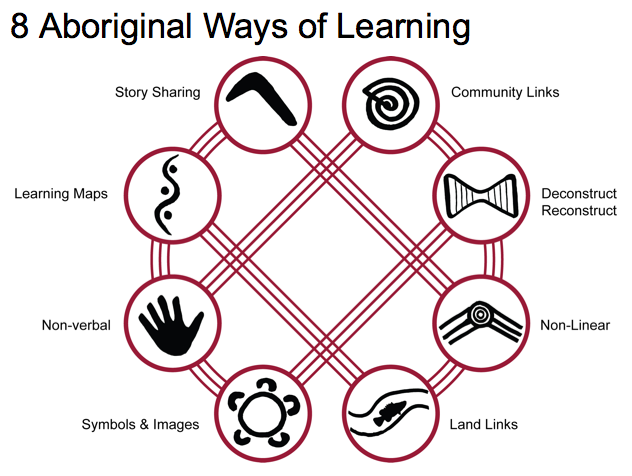
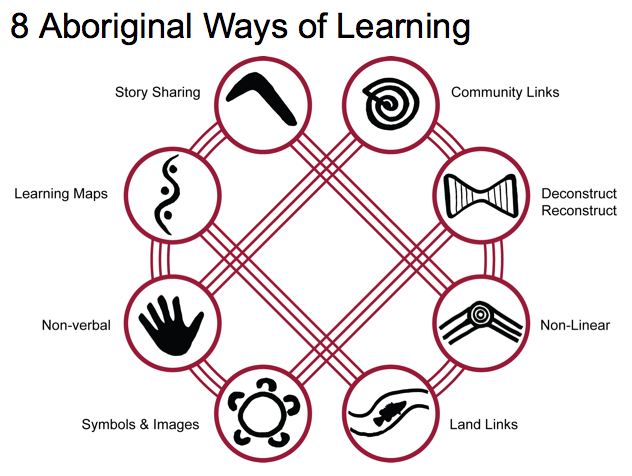
8 Aboriginal Ways of Learning

This is a VERY short visual look at ways that allow teachers to include Aboriginal perspectives by using Aboriginal learning techniques.  It is presented by “Australian Policy Online”.  I liked the visual.


http://apo.org.au/website/8-aboriginal-ways-learning


Categories
Module 2 Module 3

eLearning in Small Remote Aboriginal Communities

This online presentation looks at ways to enhance success for high school students engaged in web-based learning in Canada.  It looks at areas identified that need improving (organizational, communications, motivation, and contextual).  Key issues are addressed, and then strategies for improvement are given.

Categories
Module 2

Signs of Safety

Faculty and students in my department (community college) have been invited to participate in a “Signs of Safety” workshop next month.  This program is “an innovative strengths-based, safety-organised approach to child protection casework”.  While not First Nations based, leaders of our local Ktunaxa Nation have embraced the program and have become community leaders in its advocacy.

While it may not directly pertain to this course, I am excited that my students have the opportunity to be involved in this program!

http://www.signsofsafety.net/signsofsafety

Categories
Module 2

Aboriginal Adult Literacy: Nourturing Their Learning Spirits

This report report (2008) was prepared for the Canadian Council on Learning’s Aboriginal Learning Knowledge Centre by Ningwakwe Priscilla George.  It is a literature review on Aboriginal literacy.  Some of the emerging themes include community-based (one-on-one, small group), institutional, workplace,
family, health/well-being, oral history, working with Elders and seniors, and Aboriginal language programming.  While focusing on adult literacy, the report emphasizes the importance of family literacy and lifelong

learning.www.nald.ca/library/research/ccl/nourishing/nourishing.pdf

Categories
Module 2

Online Learning Environments for Indigenous Cultural Inclusivenss

Laurel Dyson published “Constructing Shared Online Learning Environments for Indigenous Cultural Inclusiveness” (2003).  It looks at some of the challenges for online learning for Aboriginal students and identifies several conditions for effective delivery.  Some of the key conditions include:

  • Flexibility
  • Interactivity
  • Minimal text
  • Cultural appropriateness
  • Indigenous-specific virtual space
  • Optional customization for individual learners

The paper looks at several previously completed studies to support these conditions.

Categories
Module 2

Checklist for Developing Indigineous eLearning Resources

Presented by the Australian Flexible Learning Framework, this document is a great resources for preparing eLearning resources for Aboriginal students.  Some of the topics included are:

  • Cultural Protocols
  • Indigenous Partnerships
  • Technology
  • Cultural Inclusively
  • Delivery
  • Other Useful Resources

I liked the documents preface:

“It is important that the developers of Indigenous online learning resources acknowledge that Indigenous Australians are part of diverse nations. There are approximately 90 surviving languages and 20 of these with distinct associated cultures. Because of this diversity, any resources that are developed for Indigenous users should be developed in partnership with local Indigenous communities to ensure that the resources have been tailored for the specific community in which they are based as well as being able to be used by Indigenous communities in other areas. Cyberspace itself has a culture and is not a neutral or value-free platform for exchange.”

Categories
Module 2

Aboriginal Post-Secondary Education

A colleague of mine emailed me a report titled “Aboriginal Postsecondary Education – Formal Instruction for the Adult Aboriginal Population“, written by Bob Cowin from Douglas College (2011).  The focus of the report is on British Columbia institutions (public and private) who deliver formal education which is intended to enroll adult Aboriginal students.  Services and programs are discussed (not individual courses).  It identifies different approaches taken in Aboriginal education, including assimilative, integrative, affiliated, and independent.  The report gives a history of the practices, focusing mainly on BC.

Categories
Connection to Research Topic Module 2

Contemporary Aboriginal art in Cyberspace

This is a link to the YouTube channel of contemporary Aboriginal artist sistagrlo. https://www.youtube.com/user/sistagrlro and this is her blog http://www.arohagroves.com/

I hope to speak with her about how she uses her presence in cyberspace to further her goals of Aboriginal identity and education about Aboriginal ideals and life in Australia.

Sometimes it is hard to get a hold of people in SecondLife, but I will post if I am able to speak with her.

Part of my research is to look at what value to education Aboriginal and Indigenous artists and creators see in their existences in cyberspace, so I want to speak with them directly as well as look at their work. Who do they see themselves as online?

Categories
Connection to Research Topic Module 2

TimeTraveller TM

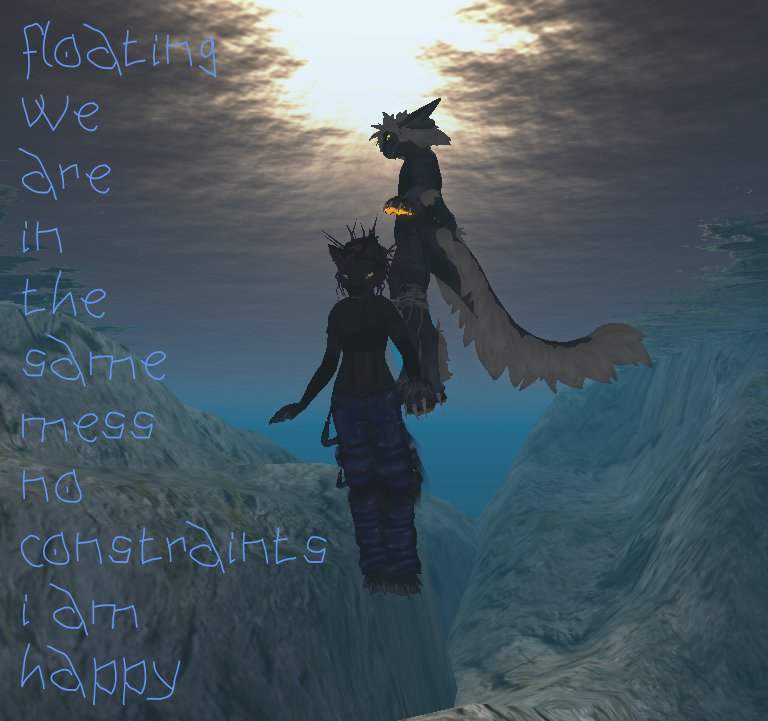
My partner and I underwater at my virtual land
My friend and I existing together in the virtual space of my cyber land.

One of the interesting developments in virtual worlds it the ability to create machinima, or films using the virtual world as the subject, setting, and actors. Using the virtual world means the director can create anything, in any space, in any time.

The link below is to a machinima created by An Aboriginal Territories in Cyberspace Project
www.AbTeC.org. A young man uses a fictional technology called TimeTraveller TM to visit places and spaces of his ancestors, and the colonization of his ancestral lands.

This machinima series seems to have two purposes. One, to provide some education to the rest of us about aboriginal history in North America; and two to provide some glimpse of a future man connecting with his deep past.

I would be interested to hear what you think of this concept, and whether or not this is a positive thing or a further erosion of tribal values and identity.

My own presence in virtual worlds biases me into thinking that this is a positive expression of identity.

https://www.youtube.com/watch?v=C1RNGFkzcyY


Categories
Module 1

Five Module 1 Links

1. David Bouchard,  (Author, Educator, Presenter)

“An acclaimed author of children’s books”.  Many of David’s books could be used as mentor texts to introduce the theme of First Nations people and provide background knowledge to the students.   David is Metis and admits he grew up not knowing of his heritage.  He has produced more than fifty books for readers of all ages.  In 2010, David was named to the Order of Canada.

2. Dr. Daniel Paul – Author, We Were Not the Savages – First Nation History

Mi’kmaq Elder, Dr. Daniel Paul has created a comprehensive website of information to help readers develop a better understanding of the history, hopes, and aspirations of First Nations People.   Dr. Paul was named to the Order of Canada in 2005.  He is an advocate for social justice and the eradication of racial discrimination.  He is an author and journalist who has received numerous awards.

3. Aboriginal Peoples Channel – National Film Board of Canada

28 films (from clips, to documentaries) providing an in-depth look at important issues in Aboriginal communities.   The videos within the NFB website have been licensed for use in all publicly funded Ontario schools.  The license grants performance rights for use in classrooms, libraries, and auditoriums.  Teachers and students can view 24/7.  I plan to review specific films for inclusion in my research.

4. Aboriginal Perspectives – Teachers’ Toolkit – Teaching Resources and Strategies for Elementary and Secondary Classrooms,  Ontario Ministry of Education, 2009

The Teacher’s Toolkit has been developed to provide Ontario teachers with the support they need to bring Aboriginal perspectives to life in the classroom.   The kit consists of two parts:  great ideas for teaching and learning and practical teaching strategies.  Part 1 helps teachers bring First Nation, Métis and Inuit histories, cultures and perspectives into the classroom.   Part 2 provides teachers with professionally developed teaching strategies created by experts from across Ontario.

5. Theytus Books 

Theytus Books is First Nation owned and operated and a leading North American publisher of indigenous voices.   K-12 resources include a diverse collection of books.   Goodbye Buffalo Bay by Larry Loyie is the story of Lawrence who has just made it through his final year of residential school.    Despite his best efforts, he finds himself in a few predicaments.   When he returns home, he is not yet a man but no longer a boy.  He struggles to find acceptance in a community that seems to have forgotten him.


Spam prevention powered by Akismet