In this podcast, Siming, Eira, and Aubrey explore whether Gen AI should be considered a creative medium and whether it suppresses or improves creativity. Through different examples in video editing, 3D modeling, and design, we explore what AI mediates and reflect on how these technologies reshape both creativity and authorship in contemporary media.
Van Den Eede, Yi. (2014). “Extending ‘Extension’: A Reappraisal of the Technology-as-Extension Idea through the Case of Self-Tracking Technologies.” Design, Mediation, and the Posthuman, edited by Pieter Vermaas et al., Lexington Books.
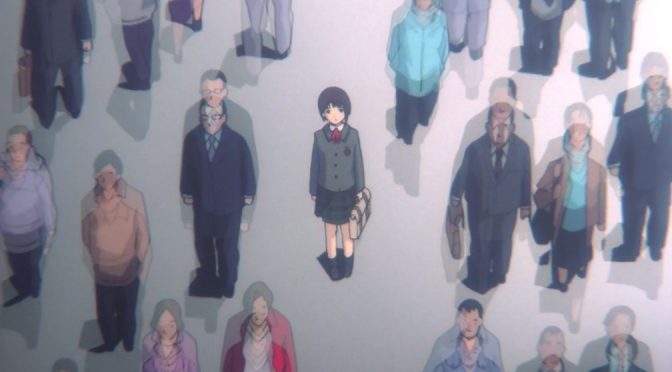
Serial Experiments Lain is a 1998 cyberpunk anime which follows a girl called Lain in a world where the boundary between the physical realm and the Wired – a fictionalized version of what we know as the Internet – progressively becomes more blurred. Lain grapples with confronting her digital alter egos and trying to make sense of her ever-shifting reality. While the series quickly spirals into surreality and confusion, the themes of memory, identity and mass media ring clear. The specific concept of prosthetic memories comes into view when it is revealed that the world’s chaos can be traced back to a digitally-omnipresent antagonist named Eiri, whose ability to manipulate collective memory can shape reality.
Hence, I found that this series resonates heavily with Alison Landsberg’s 1995 paper Prosthetic Memories, in which she defines such memories as ones that are implanted instead of coming from lived experiences. While her discussion focuses on prosthetic memories as experienced through film and mass media, my blog post explores how Serial Experiments Lain extends her ideas to the modern age of the internet and social media. I go further to argue that the late-90s series prophetically illustrates how the internet is used as a powerful tool for systems of power to manipulate memory, alter reality and reshape history to the detriment of society.
Prosthetic memories through social media
Landsberg explains that the mass media is a site for the production of prosthetic memories, with cinema in particular. As a medium that makes images available for mass consumption, it creates experiences and implants memories “which become experiences that film consumers both possess and feel possessed by” (176). Spectators witness memories depicted on screen that they have not actually lived through, prosthetically experiencing the histories of a collective past. Landsberg suggests that this complicates identity formation and results in the creation of “partial identities” (179).
Similarly, Lain is a figure whose identity is fragmented and shaped by prosthetic memories. Midway through the series, a mind-bending twist reveals that Lain is a digital entity entirely constructed by Eiri with the purpose of bridging the gap between the real world and the Wired. She grows to become a figure whose identity is shaped by the human collective unconscious present in the Wired, resulting in different “Lains” who are constructed by various people’s experiences and memories. While the Wired presents an exaggerated, more advanced version of how the Internet functions in real life, Lain’s experiences with partial identities is reflective of how our identities are shaped online. Beyond the images depicted in films as discussed by Landsberg, social media has made it so that users can easily upload documentations of their memories to the digital realm, readily accessible for others to prosthetically experience these histories and internalize them as their own.
Perception becomes reality
Landsberg explains that what is real and what is not becomes blurred when an individual’s identity is affected by prosthetic memories. She asks the question “What might it mean to say that those memories are ‘just’ from a movie?”, arguing against any attempt to distinguish between prosthetic memories and “real” ones, since anything that we experience to be real becomes our reality regardless of the source. Serial Experiments Lain echoes this point by positing that perception becomes reality, and extends this discussion to the realm of collective memories and the act of memory erasure.
“A memory is only a record. You just have to rewrite that record.” – Lain
While the series explores Landsberg’s ideas of experiencing additional memories outside of one’s own lived experience, it also explores what happens when memory is erased. As Lain becomes a powerful, God-like being that crosses between planes of reality, she grows to realize the detrimental impacts of her abilities, and uses memory manipulation as a positive force to remove herself from society’s collective memory. She continues to live on, but in a peaceful world where she was never remembered, and thus the impacts of her existence are no longer present. This bittersweet ending highlights a central idea that ripples throughout the episodes: that people only have substance within the memories of other people.
Memory as shaped by power
Following this idea that people only have substance within memories of others, could this also apply to global issues or events? Our collective memory and experience of reality is largely shaped by our engagement with social media and the images that we see online. If something is documented less or hidden from public view, society becomes prone to forgetting it, which essentially removes it from our perception, and thus our reality.
Adriaansen and Smit explain how platformization reshapes the act of remembering and forgetting through algorithmic curation. They define platformization as the way in which our pasts are actively and continuously reshaped by the infrastructures of digital platforms. They use the example of Facebook and Apple’s “Memory” features that algorithmically select old posts to surface as memories based on engagement metrics and positive content. These features strategically reconstructs individual’s memories into tailored narratives that highlight certain moments while erasing those deemed less desirable. Adriaansen and Smit also explain how, on a collective scale, algorithms aid in the dissemination of content throughout social networks, with algorithmic bias playing a part in determining which narratives gain visibility and credibility. This proliferates the spread of “fake news”, leading to collective yet false memories about public events that become part of our perceived reality and experiences (2).
Serial Experiments Lain extends Landsberg concept of prosthetic memories to the modern age of the Internet, and illustrates how social media is a prominent site for memory construction and the shaping of our collective reality. The power of memory manipulation that Eiri, and consequently Lain, hold, make them figures that are allegorical of these systems of power and regimes that enforce censorship in attempts to make us remember and forget. While there is no God-like entity that can literally extract and implant memories into the minds of individuals (hopefully), the erasure and fabrication of narratives happen all the time, subtly but surely. Hence, it remains important for us to look through the cracks and think critically about the information we engage with online so that we don’t fall into a perception of reality that blinds us from truth.
By: Adela Lynge
References
Adriaansen, Robbert-Jan, and Rik Smit. “Collective memory and social media.” Current Opinion in Psychology, vol. 65, Oct. 2025, pp. 1–4,
Landsberg, Alison. “Prosthetic Memory: Total Recall and Blade Runner.” Body & Society, 1995. pp. 175-189.
When trying to make sense of the oppressive systems and structures in place, video games may not be the first to come to mind when it comes to examining the system in place. Yet, the video game Papers, Please, provides an interesting insight and commentary on what it means to put in a position of performing that status quo. The concepts in Grant Bollmer’s book Materialist Media Theory provided foundational groundwork with relevant ideas in this game. As a result, it brought attention to the following: what kind of context do video games provide for us when it comes to understanding the representation of bodies as well as the inscription of such bodies? As much as Papers, Please exaggerates and parodizes the border control and immigration systems, it simultaneously reveals the biases of the immigration system as well as the player themselves.
Papers, Please, is an indie game where you play as an immigration inspector for the fictional country “Arstotzka.” Throughout the game, you make decisions to let them cross the border based on people’s “validity” of their documentation, which determines whether they are permitted to enter the country. The laws that determine what counts as a valid document continue to grow more and more convoluted as the game progresses, which makes detecting discrepancies even more difficult. Depending on if their documentations are all correct, their passports get stamped with “approved” or “denied” accordingly. The premise itself already highlights how we, as bodies living under the legal institutions that define us, have forced us into the inscription of legal documents that indicate our right to exist as well as our subscription to performing such practices.
Inscription Using Documents
As the immigration inspector, you are already assigned to the act of inscribing into each entrant’s document via stamping in their passports. However, each body and the inscriptions that represent said body (i.e. the passports, entry permits, etc.) have much more than what is inscribed (or is not inscribed) in their documents. For whatever reason each entrant was unable to provide the correct details in their documents, they each had their own lives that brought them to the border—details which cannot be inscribed within their very legal documents. It makes Bollmer’s argument about analyzing the “margins,” a space in which we can find “traces of a history that this barbarism worked to exclude from existence,” all the more relevant in contextualizing their presence at the border (54). You, the player, can make the decision on whether you do perform that very duty that this authoritarian institution has tasked you with through the institutional practices of inscribing. Doing so, however, means that you have made the inherent decision to push these people into the “margins.”
Performativity in Papers, Please
The game’s mechanic of finding “discrepancies” in the information in the documentation also happens to be one of the ways that illustrates how “legible bodies”—bodies that are “produced by legal, medical, and psychological practices of writing and documentation”—are rendered illegible by the immigration system (Bollmer, 67). The game appears to task the player with a relatively simple task: to carry out, or rather, “perform,” the laws that govern our bodies. As a result, the bodies perform the act of being a legal entrant to Arstotzka by carrying and presenting with valid documentation—or at least attempt to. Failing to find the discrepancy results in citations for violating protocol—get three of these, and it will be deducted from your salary. Even with the presence of the repressive state apparatus—the agreement to obey the laws due to the “threat of police violence, or in this case, the government representatives—the game incites as well as punishes the player for acting against them (Bollmer, 27). Throughout the gameplay, there will be several characters that ask you to approve the entry of those who do not carry valid documents and deny the entry of those who do, citing reasons such as wanting to stay with their family or the fear for their safety if certain individuals are let in. This is how the game presents the player with the agency of whether they want to perform within the legal and governmental practices or perform outside of them, even if that results in a protocol violation.
Game-sensing Systemic Marginalization of Bodies
But why analyze the legibility of bodies and the inscription of documentation through a video game? When trying to understand the systemic challenges that arise from the documentation of our very being, one helpful framework to understand it is through the perspective of “game-sensing.” “Game-sensing” refers to how gamers “attune to a game system” which often takes form in navigating through the game’s mechanics and environments (Guillermo 156-157). Kawika Guillermo, in their book Of Floating Isles, described how video games are able to show the ways in which we game-sense the racialized systems that we co-exist in (157). The game-sensing of Papers, Please, as stated by Guillermo, “attunes us to the violences of nationalist othering by revealing the overlapping practices of border security with state-enforced racism” (162). Despite the seemingly immateriality of the bodies in digital video games, Papers, Please exemplified how studying these media objects through the media theoretical lens.
The notion that video games, as media that are viewed as inherently self-serving and pleasure-seeking, are unable to delve deeper into the real-world oppression that are inscribed within society, has been frequently countered with the recent emergence of indie games such as Papers, Please. It shows us how games can in fact materialize the immateriality of systemic marginalization of immigrants. In the game, the laws behind who gets to enter Arstotzka quickly change following a terrorist attack at the border. We see this parallel real-life events, such as the formation of the Transportation Security Administration (TSA) as a response to the terrorist attack that occurred on September 11th, 2001 throughout the United States (“TSA History”). Games such as these can illuminate on how the TSA operates has been racialized by using the actions of extremist groups as reason to further marginalize racial groups. By contextualizing these games to the media theories that we continue to study, we can do more than just game-sense the systemic racialized injustices: we can challenge the existing hegemony in place and maybe eventually, see it lead to political change (Bollmer, 32).
Works Cited
Bollmer, Grant. Materialist Media Theory An Introduction Grant Bollmer. Zed Books, 2021.
Guillermo, Kawika. Of Floating Isles: On Growing Pains and Video Games. Arsenal Pulp Press, 2025.
Papers, Please. Directed by Lucas Pope, 3909, 2013.
The Night Face Up (1956) is a short story included in the third section of Argentine writer Julio Cortázar’s book, End of the Game. It was a book that I read in high school and I still think about to this day for its incredible language and usage of perception as it explores the various themes of magical realism that marked Latin American literature during the epoch. More than a story that I enjoyed as a teenager, it is a story that has come up in thought various times while exploring concepts of media theory and memory.
In summary, the story starts with a man riding down the streets of a modern town in his motorcycle. As he crosses an intersection he is distracted by the sudden appearance of a girl in the middle of the road. The rider breaks, collapsing his vehicle resulting in a visit to the hospital. The general progression of the story then becomes a parallelism between two alternating realities. The man as he is taken down the hallways of the hospital begins to hallucinate himself as an indigenous Moteca man in the middle of persecution during the Florida war in the period of the Incas. The Moteca runs through the jungle, fearing his life as the patient gets rolled through the hallways of a hospital. The patient lays face up in a dimly lit room on a hospital bed as his fever brings him to and from a past reality. As the patient continuously falls asleep he imagines himself as the Moteca, tied face up on the floor of a dimly lit cave. The elements of sounds and sensations continuously shift from experience and perspective. Elements like the knife of the Moteca, used for protection or the Inca’s sacrificial knife used for death, mirror the syringes and operating knives used for life and salvation that are used on the sick rider. As the story progresses, and in a sadly spoiling fashion for the benefit of this post, the Moteca finds himself face up on a sacrificial stone as the Inca warriors slice a knife through his heart. As the rider’s consciousness shifts he soon realizes that he was not a man feverly imagining a historic past, but a man of the past imagining himself in a future where he is free. The Moteca’s experience is reality and the creation of the future, coherent with the reader’s perspective, is a figment of imagination.
Before examining aspects of truth, perspective and memory, I want to dive into the story’s unexpected twist. In a preliminary view the ending comes to quite a shock to the reader’s perspective and constructed rationality of what constitutes as truth. As readers we connect to the reality of the rider imagining the past as a probability of coherence to repetition and myths to what is more practical to our personal reality of truth. It is unfathomable to imagine a historical man imagining a reality that so closely resembles our present since we ourselves cannot possibly comprehend a future that resembles our current speculation. The effect works so well because of the textual mediation of time. The interpretant understands historical context as the object and can only refer to the sign as the past because of the logical chronology of time. If we reimagined the story with the rider imagining a far future where he is escaping an intergalactic war, then the effect and meaning of the story is lost. It is a shift in Eco’s pact of pretending, where we accept the reality that we are given as an irrefutable truth to later understand that our rational misconceptions can be malleable.
Now if one analyses the text in depth one can figure out that the story itself has been revealing the twist all along. Throughout the text Cortázar is able to hint towards the story’s end through what I would constitute as a rendition of a sensorial unconscious. By sensorial I am alluding to what we have learned during the course as the Benjaminian conception of the optical unconscious and MacArthur’s adaptation to the auditory unconscious in her text The Siri Erfharung. Whether it is the ability for photography to unveil aspects of reality unseen by the human conscious or the ability for the auditory experience to reject conscious reflection and create an embodiment of internalisation in the unconscious, the senses have the ability for individuals to experience something beyond what is in the surface level. This text is highly elaborate in the creation of a sensorial environment. It dives deep into the emotions and associations of sight, touch and hearing with the key difference of smell. The text only associates smell with the experiences of the Moteca. It is a key aspect of understanding the true reality as humans do not have the ability of smelling inside our dreams. Smell reveals the hidden reality not through the sensorial experience but lack thereof. His consciousness is guarded by sensorial hallucinations that create an escape to reality and only penetrated by the disregarded sense that divides reality from dream.
Now understanding the sensory unconscious that comes into play, one can shift gears to the story as evidence of the embodiment of prosthetic memory. Clearly the Moteca does not have any way of acquiring a futuristic prosthetic memory, but the means by which the consumption of mass media create these experiences, and the effect they have on individuals clearly mimic the ways in which the Moteca escapes his reality. For Landsberg while quoting Blumer, prosthetic memories through their emotional possessive effect create a decentering of lived experience. They intertwine reality with the emotional connection of fiction to construct a sense of identity. In the case of the Moteca, his consciousness creates a world fiction to forge an identity and a reality based heavily in the emotional and sensorial environment to protect his subconscious as he deals with his dooming reality. This connects to Mitchell’s idea of the mind as a medium for reproduction where individuals internalize imagery as subjective mental processes. The creation of a better reality by means of prosthetic memory production in the protection of his psyche is internalized by the individual as objective truth since it resembles his reality in symbol form through parallelism, but resembles it to the point where it removes the hardship of his reality. This is again much like Mitchell’s conception of the image as having the power of resemblance.
We can push another interpretation of the text connecting to ideas from the Frankfurt School. The idealisation of a future of freedom or a misinterpretation of a Utopia lies heavily on the reliance of progress. In this case we could refer to the progression of technological advancements as a false means to escape a devastating reality. But in the moment it is these technological advancements that hinder our existence. The reality of the Moteca is not particularly technological but the parallelism between the tools of salvation versus the tools of death reveal a basis of the idealisation of a future while the current reality hinders us. The knife of sacrifice and the hope of a knife for salvation. It is much like Benjamin’s Angel of History where progress leaves behind devastation or Horkheimer and Adorno’s criticism of enlightenment and progress as forms of domination.
To conclude I want to shift gears to the genre of the text. Magical realism takes historical moments or established, mundane realities that resemble our own and places them through a fantastical, surreal scope. It in a sense mediates reality to process a sense of memory and tragedy in a way that is accessible without the continuation of trauma. In this same way, prosthetic memory creates and is created by the emotive responses in our memories to place experiences foreign to our own, to shift our realities, in an attempt to protect ourselves from ourselves. Magical realism becomes a prosthetic fiction to the realities and histories that are hard to experience or reflect upon.
I was about forty minutes into watching Hirokazu Kore-eda’s 2023 film, Monster, when my understanding of the film completely altered. The pieces seemed to fit together so seamlessly, so inevitably. I was certain I had a grasp of who the monster was in the film until the film restarted and the same scenes were depicted through different lenses. The feelings I felt while the tone of the narrative shifted encapsulate why this film is now one of my all-time favourites. The uncomfortable, almost physical sensation of a memory changing was beautifully illustrated once the first part of the film closed out and began again with a new perspective. Not just my understanding, but my actual recollection of what I had witnessed had completely changed—the scenes I had experienced as sinister now carried entirely different emotional weight.
This unsettling experience is precisely what media theorist Alison Landsberg describes as “prosthetic memory,” where the memories we acquire do not come from lived experiences, but rather through cinema and mass media while still feeling deeply personal and emotionally resonant with our physical bodies. Landsberg argues that prosthetic memories allow us experiential access to the lives and perspectives that we haven’t lived through cinema.
Cinema has the powerful capability of building empathy across social, cultural, and historical divides. Following Benjamin and Kracauer, Landsberg claims that the cinematic experience “has an individual, bodily component at the same time that it is circumscribed by its collectivity.” (Landsberg, 180) The publicity of cinema allows individual bodies to form new means of collectivity through prostheses and prosthetic memories. Oftentimes, what we witness on film actually becomes part of one’s “personal archive of experience,” (Landsberg, 179) and can alter our overall sentiments towards the film and the movie-watching experience altogether. Monster take advantage of our memory. It doesn’t just give access to unfamiliar experiences, but forces us in participating in the very stigmatization the film ultimately condemns. What if the real power of Kore-eda’s film lies not in revealing who the “monster” actually is, but in making us feel what it’s like to have named one?
Landsberg discusses the concept of ‘emotional possession,’ where an individual identifies with the plot so much that they are carried away from the usual trend of conduct (Landsberg, 179) to describe the potential cinema has in emotionally resonating with individuals. Monster’s three part structure reveals different perspectives of the same event, first from the perspective of mother, Saori, then from teacher, Mr. Hori, and finally from the perspective of her son and his friend, Minato and Yori. The film takes advantage of traditional film technique, the Rashomon Effect, to reveal different aspects of the truth as the film progresses. This technique takes advantage of the idea of the unreliable narrator, where notions of memory and the truth are blurred based on differing perspectives and subjective views of one central event (Prince). By following one character per act, each section allows audiences to emotionally connect with the section’s protagonist, investing their emotional possession on that one character as that is the narrative they are initially exposed to. It is easy for movie-watchers to immediately assume what they first watch is true, thanks to imaginative identification, where audiences often project themselves on to the film’s protagonist (Landsberg, 179). The initial emotional investment in the first character, Saori, in the first act weighs more as the movie progresses and more perspectives and truths unravel. Further more, it makes the tone switch as the perspectives change more impactful, as it brings tension and surprise when it is revealed that nothing is really what it seems. Each retelling of the event doesn’t just add information, but it overwrites our experiential memory of what truly happened. What we first see from the perspective of Saori now becomes completely different in the eyes of Mr. Hori. We don’t understand the truth until we follow the children’s lenses, which even ends ambiguously. Because of the realism in Monster’s narrative, it becomes even more difficult for audiences to distinguish between truth and fiction, between the cinematic world and our society. The film deals with topics of intimacy, self-discovery, and innocence through perspective and memories. Upon my first screening of this film, it was compelling to see how the initial mystery of a teacher hitting a schoolboy unravelled into an exploration of two young children’s relationship with themselves, each other, and their surroundings. It was something I could have anticipated, when looking through the narrative from only one set of memories.
This form of prosthesis extends viewers’ relationship to the film itself, rather than just the content and the watcher. As Landsberg emphasises, the nature of cinema gives us access to experiential knowledge and perspectives that we would otherwise not have access to. Unlike traditional flashback scenes, Kore-eda forces us to relive these moments through multiple different characters. By forcing us to “remember” the same scenes with different emotional contexts, audiences are given a bodily, highly sensory experience of having the wrong assumption about someone. What we knew at the end of the first act is never the lasting impression we have once the film ends. Oftentimes, the ‘truth’ lies within adults, those who are mature and of sound mind and children’s perspectives are ignored or seen through a childish lens. Monster plays with the idea of children as the truth and as critics. As children are more capable of being influenced by the world around us, and have little to no filters at a young age, this critique comes from innocence and wonder. Kore-eda gives us prosthetic access to these children’s perspectives, which are the very perspectives that the past two acts have misinterpreted.
As director Kore-eda explains, the poster features the two children ‘looking our way and they’re evaluating us adults and they’re saying, “Hey you’re creating this world with monsters everywhere and that’s our world.”‘ (Fernandes) This is the political power of prosthetic memory that Landsberg describes: by literally making us experience what we’ve been missing. By witnessing the third and final act, we are able to feel the consequences of that exclusion. We carry the prosthetic memory of having participated in a world that creates monsters by refusing to see through children’s eyes.
The prosthetic memory that Monster implants in us is not just the children’s stories of what they witness, but the experiential knowledge of what we dismiss, damage, and mislabel as ‘monstrous.’ It forces us to use this movie and apply it to our own society and how we are so quick to critique others based on one perspective—but more than that, we now carry a memory of having done exactly that, of having gotten it wrong, that feels as real and uncomfortable as our own lived mistakes.
Sources
Fernandes, Marriska. “Monster’s Hirokazu Kore-Eda on the Two Entities in His Films: ‘Children and Dead People.’” Toronto Film Critics Association, 25 Sept. 2023, torontofilmcritics.com/features/monsters-hirokazu-kore-eda-on-the-two-entities-in-his-films-children-and-dead-people/.
Landsberg, Alison. Prosthetic Memory: Total Recall and Blade Runner.
Prince, Stephen. The Rashomon Effect | Current | The Criterion Collection, 6 Nov. 2012, www.criterion.com/current/posts/195-the-rashomon-effect.
Sometimes I think human thoughts and patterns are strange — sometimes even blatantly strange and intellectually-defunct. My mind often circles back to this wild statement after much observation as a new generation person breed by perpetual online content.
Quite recently, Oxford University Press has chosen the term "rage bait" as the Word of the Year of 2025. The term "rage bait" is "online content deliberately designed to elicit anger or outrage by being frustrating, provocative, or offensive, typically posted in order to increase traffic to or engagement with a particular web page or social media content" as defined by their given explanation. Their presented graphic showed that the usage of the term has been sharply rising since around June of 2024.
This wasn’t the first time that Oxford UP decided to bring in significant attention to rapidly developing internet jargons. Last year, the term "brain rot" was selected as the Word of the Year in 2024. A technical definition for this term would be about meaningless pieces of low-effort content circulating on the internet, yet a figurative definition would be an alarming symbolism that marks the downfall of communications and record-keeping of the humanity.
My growth as a 2005-born Millennial defined my intertwining love-hate relationship with the internet, and now my current identity as a media studies student is adding a touch of sour taste to recognizing the reality. My early days of internet exploration around 2016 opened myself up to the massive culmination of mankind knowledge (whether it’s good or bad); the sense of novelty was lingering among the majority of good-faith online communities (I missed the days watching DanTDM as a child). Yet now coming to the end of 2025 as a (questionable) self-functioning adult after learning three years of formal media jargons, this sense of novelty was eventually replaced with subtle nausea on overwhelming effects of emotions transmitting throughout the internet.
On a deeper reflective level, this feeling now feels more like a side effect of internet or mass communication as expected from media richness theory, which was developed by Richard L. Daft and Robert H. Lengel in the 1980s. The theory developed a framework to assess different means of communications depending on their "richness" — the ability to accurately convey information with as minimum misintepretations as possible.
A core of the internet relies on mass communication and digitization of traditional humanistic experiences, and the concepts within the media richness theory seem to alarm us of a possible outcome. Concepts mentioned in the media richness theory, such as paralanguage, social cues, and social presence — which are all heavily present in in-person communications — are mostly-to-always compressed and distorted during the transformation to digitized spaces. A simple "I love you" to a person could be reprinted and reproduced numerous times on language-prevalent platforms like Twitter and Facebook; the cues brought by tone, body languages, and facial expressions were, however, obliterated by the digital presence, despite the fact that they’re heavily influential on conveying deep meanings.
Rage bait could be pretty much interpreted as the direct result of phenomenon. The social media’s lessening capacity to hold long-form discussions is leading to a tendency of encouraging primal flirts to trigger simple emotions, yet ironically speaking, keeping content forms simple for social media seems like a popular solution for a social media platform to thrive. It might seems just easy for us to randomly post anything on Twitter within a 140-word limit, preferably with some pictures to spice up your content. The ultimate outcome we often hope for from posting would be engagement and acknowledgements, whether it could be simple as a like or retweet or as complex as a well-written and formatted reply. But the mediation of language itself is inevitable (and I would personally call it as the curse of language); it’s almost impossible to mirror a specific segment of your personal, in-real-life experience onto a short amount of text and expect other people can feel your same experience through the text. On topics such as debates over ideas and opinions that would often take an insurmountable effort form proper engagements and arguments, the text itself on those topics over social media doesn’t just represent a description, but rather a much dwindled tag of primal humanistic emotions.
What lies the real danger here is that the delivery format of social media is driving such engagements — exchanges of primal humanistic emotions. The root of conflicts inside mankind could be just coming from a small misunderstanding. If one day the boundaries between online and real-life interactions blurred, I must say that I’m not highly optimistic of what might be the outcome.
Sure, you can say it’s primal humanistic emotions again. ("We’re just humans, right?") Just don’t think that I’ll take all those norms in peace.
Works Consulted
Heaton, Benedict. “‘Brain Rot’ Named Oxford Word of the Year 2024.” Oxford University Press, 2 Dec. 2024, corp.oup.com/news/brain-rot-named-oxford-word-of-the-year-2024.
Heaton, Benedict. “The Oxford Word of the Year 2025 Is Rage Bait.” Oxford University Press, 1 Dec. 2025, corp.oup.com/news/the-oxford-word-of-the-year-2025-is-rage-bait.
The more deeply I engage with media—especially while studying in a program centered on media itself—the more I notice how easily it shapes my perception, attention, and even my habits of thought. This course has made me confront something I never really questioned before: what does it mean to maintain a healthy distance from the media systems that structure so much of our daily life? And what happens when we don’t? Will constantly scrolling through short videos or fragmented content make us less intelligent? If so, how?
Since middle school, teachers told me that I used too many vague pronouns in my writing, which affects my precision. They frequently remind me to avoid using “this” or “that” in my writing. “If you can’t find suitable words, it means your language isn’t keeping up with your thinking.” This indicates that you lack language as a tool to deeply form your own understanding and thoughts. If medium shapes cognition (McLuhan), how is constant scrolling reorganizing our ability to think? Many people intuitively think that short videos make us “dumber”, but the reasons are often misinterpreted. The issue isn’t that watching TikTok directly lowers intelligence. Instead, these platforms cultivate a discourse environment that is extremely homogeneous and structurally limited (Loupessis and Intahchomphoo). You may seem to be exposed to a lot of content every day, but in reality, it’s all just a repetitive corpus of viral phrases.
According to the article “What the Sigma?: The Sociolinguistic Applications of Gen Alpha Slang in the Digital Era,” scholars, based on Generation Alpha’s own digital slang research, cataloged 46 different examples of Gen Alpha slang and grouped them into five categories: Fresh & Creative, Flippant, Imitative, Acronym/Clipping, and more (Rodriguez). Most of those slang terms fall under the “Fresh & Creative” category — that is, they are newly coined, playful, and often tied to visual-media or short-form video contexts like “Skibidi,” “rizz,” “fanum tax,” etc. This suggests that the linguistic repertoire of Gen Alpha is not being recycled from older generations but is instead expanding—producing new vocabulary at a very fast pace and restructuring how younger people communicate.
In contrast with the more stable, formal language, this dynamic and rapidly shifting slang ecosystem emphasizes my concern: as everyday expression is increasingly shaped by fleeting memes and platform-specific references, so the linguistic resource on which thoughtfully reflective, precise expression diminishes, limiting how wide or deep our conceptual world can become.
“The limits of my language mean the limits of my world” – Ludwig Wittgenstein
In light of our course discussions, this feels connected to Wittgenstein’s insight that language structures the world we can inhabit conceptually. If, as McLuhan suggests, media environments reshape attention and cognition, then a restricted linguistic repertoire not only reflects that shift. It reinforces it, narrowing the range of ideas we are capable of forming in the first place. The convenient yet biased categorization of things, the crude grouping of people and events, the choosing of sides, and the imposition of stereotypes are often caused by the inertia of language. When language divides the world, it limits how our brains organize knowledge.
This brings me back to our discussions of Bollmer and materiality: the problem isn’t just what content says, but how platforms structure the kinds of expression that feel natural. TikTok discourse often feels “vast,” but structurally it’s incredibly limited. We scroll through thousands of videos that appear diverse but repeat the same linguistic templates, emotional beats, and forms of reaction. The result is what Adorno might call pseudo-individuality: a sense of originality inside a fundamentally homogenized system (Theodore Adorno). So my emerging argument is this: Homogenized media environments don’t just limit what we see—they limit the language we have available to describe our own experiences. And when language narrows, thought narrows.
The topic of how language shapes thought is a well-worn one, and it’s also a frequently discussed binary proposition in philosophy. A comparable concern arises in George Orwell’s notion of “Newspeak” in 1984, wherein the state deliberately reduces vocabulary so that citizens become literally incapable of forming rebellious or complex thoughts (“Language in 1984 and the Concept of Newspeak”). While our contemporary situation is not governed by authoritarian language control, the basic mechanism is similar in a way that is almost unbelievable: when available vocabulary shrinks, so shrinks the range of imaginable ideas. Neil Postman extends this argument in Amusing Ourselves to Death, contending that societies dominated by entertainment-centered media lose the capacity for sustained, rational discourse (Postman). For Postman, the danger is not censorship through force, but through distraction—when a culture becomes saturated with quick, shallow, emotionally stimulating content, people lose the cognitive habits required for critique. Both Orwell and Postman offer useful parallels to what we have discussed in class: media environments shape not only what we think about, but the very conditions under which thinking is possible. When we combine their insights with McLuhan’s “the medium is the message” and Bollmer’s claim on media materiality, a clearer pattern emerges–media forms that privilege speed, simplification, and entertainment tend to produce linguistic environments where nuance atrophies, and with it, the capacity for deeper political, ethical, and intellectual reflection.
How can we improve our expression and critical thinking skills? Read more serious books and works, or listen to insights that aren’t mass-produced. Strive for greater precision in word choice, try to describe feelings more specifically, find a precise word for vague thoughts, and then replace it with more of these words to expand your vocabulary. The vastness of our thinking is only limited by our limited language. In reality, our thoughts are incredibly vast; given better language tools, we can go much further.
Reference:
Loupessis, Iliana, and Channarong Intahchomphoo. “Framing the climate: How Tiktok’s algorithm shapes environmental discourse.” Telematics and Informatics, vol. 102, Oct. 2025, p. 102329, https://doi.org/10.1016/j.tele.2025.102329.
“Language in 1984 and the Concept of Newspeak.” Teddybarbier.Com, www.llceranglais.fr/language-in-1984-and-the-concept-of-newspeak.html#:~:text=What%20is%20Newspeak%20?,in%20totalitarian%20countries%20and%20organisations. Accessed 5 Dec. 2025.
Postman, Neil. Amusing Ourselves to Death. Pearson Education, 2007
Rodriguez, Sophia Marie. What the Sigma?: The Sociolinguistic Applications of Gen Alpha Slang in the Digital Era | by Sophia Marie Rodriguez | Medium, medium.com/@sophiamarie.rodriguez/what-the-sigma-the-sociolinguistic-applications-of-gen-alpha-slang-in-the-digital-era-b7ef7e489af0. Accessed 5 Dec. 2025.
Theodor Adorno and Max Horkheimer, mariabuszek.com/mariabuszek/kcai/PoMoSeminar/Readings/AdornoHork.pdf. Accessed 5 Dec. 2025.
Have you ever dreamt of a better version of yourself?
The Substance (2024) is a body horror film directed by Coralie Fargeat. This cautionary tale follows Elisabeth Sparkle, a film star past her prime who undergoes a de-aging drug called The Substance: an injectable serum that produces a younger, more “beautiful” clone named Sue. Although both bodies don’t outwardly appear the same, genetically they are one.
You must alternate through both bodies no more than seven days each. Only by following the rules will the process work, but for Elisabeth/Sue, the disrespect of the balance only produces grotesque results
The concept of the body will act as the vessel for this post in tandem with the film, commenting on the violence that occurs when the contemporary projection of what looks beautiful overtakes the body and embodied experience. While the film hyperbolizes this destructive process, the nature of Fargeat’s metaphor still rings true: the abuse of beauty never ends well, only in the degradation of self and body. I will primarily extract ideas from the perspective of Body, Bernadette Wegenstein’s chapter in Critical Terms for Media Studies, in conjunction with Mikhail Bakhtin’s concept of the Grotesque Body.
Body by Bernadette Wegenstein
Wegenstein primes the chapter by establishing the body as a medium of experience, a site that is not merely a static object but a dynamic process (19). This point of the body as a process introduces the difference between “having” a body versus “being” a body, the latter of which becomes reframed as embodiment.
Embodiment is the first person perspective of living in a body, it is the process of how we experience it (Wegenstein 20). Elisabeth’s body, and women in entertainment at large, becomes spotlighted as an “object of aesthetic interest” that, once a certain age is reached, becomes “undesirable” for general audiences (Wegenstein 20). She gets terminated on her 50th birthday from her fitness TV show, thus eliciting an embodied experience of self-loathing after having a career built upon society’s beauty standards. The scene of Elisabeth getting ready for a date captures her physical, tormented embodiment as she aggressively wipes away at her makeup and literally tries to get out of her own skin.
Wegenstein also affirms that “when interacting in chat rooms, dating platforms, or massive multiplayer role playing games… we can take on personas that differ from our own mundane embodied selves” (28). In a way, Sue is Elisabeth’s mask that similarly ties to the digital platforms that Wegenstein lists. Through all of that bodily trauma of taking the Substance does Elisabeth find happiness in Sue, but only when she is living in Sue’s body. Sue’s embodiment is night and day from Elisabeth’s — she feels confident and respected whereas, in her own original body, she hides away in self-contempt. Elisabeth, as Sue, gets her old life on the TV show back from the same older, male producers.
“Whether in private or for the mass audiences of reality TV, people are undergoing surgical intervention… in the hopes of altering their bodies to… match their “inner body” expectations to the exterior body images circulated by the media. This cultural obsession with bodily perfection now transcends the actual procedures of surgical modification, shaping a “cosmetic gaze” through which we look at our own… bodies with an awareness of how they could be changed” (Wegenstein 29).
With the cosmetic gaze in mind, Elisabeth’s body becomes the very site of transformation from Elisabeth to Sue. Elisabeth’s cells split and mutate through a very graphic sequence in the film of her body convulsing in her bathroom after taking the Substance. The process concludes by splitting open a spine-length slit across her back to essentially “birth” Sue. Elisabeth has become a shell of herself to make way for Sue’s body. Elisabeth’s body lays dormant on the floor with the gaping tear on her back, symbolizing the drastic lengths that people will take to achieve the perfect appearance.
Grotesque Realism & Grotesque Body by Mikhail Bakhtin
Mikhail Bakhtin was a Russian philosopher who authored Rabelais and His World, a book about the Renaissance and French writer, François Rabelais. The idea originates from folk culture, specifically from the carnivalesque and its everchanging, temporal nature. It’s expressed through a focus on the (grotesque) body, making this concept and Wegenstein’s text on body one in the same. It’s a process.
Within the text, Bakhtin coins the grotesque style (and by extension, grotesque body) as their own terms with their own fundamentals.
Metamorphosis: “The grotesque image reflects a phenomenon in transformation, an as yet unfinished metamorphosis, of death and birth, growth and becoming” (Bakhtin 24). Once again, the film presents Elisabeth’s transformation into Sue as the young, hot counterpart — only this is a short-lived high for Elisabeth/Sue by the end of the film. Another fundamental is showing two bodies in one, “the one giving birth and dying, the other conceived, generated, and born” (Bakhtin 26). The story features numerous processes of rebirth (Elisabeth to Sue) and self-death (Sue killing the part of herself she hates, Elisabeth).
Degradation: “The essential principle of grotesque realism is degradation, that is, lowering of all that is high, spiritual, ideal, abstract; it is a transfer to the material level, to the sphere of earth and body in their indissoluble unity” (Bakhtin 19). Going against the seven day rule, Elisabeth’s body, once reinhabited, deteriorates into a severely aged version of herself. A desperate Sue, fresh from now killing Elisabeth, is also falling apart and resorts to creating an entirely new clone: Monstro Elisasue, a fusion of the two. She presents herself live in front of an audience showing the degradation occurred, a callback to the carnival origins. The film ends in a bloodbath that hoses down the audience as a true scene of horror, to Elisabeth/Sue’s final form: a fleshy blob that finally gets wiped out of existence.
Exaggeration: “Exaggeration, hyperbolism, and excessiveness are generally considered fundamental attributes of grotesque style” (Bakhtin 303). Even aside from the exaggerated nature of Monstro Elisasue, there are portions in the film that feel extremely heightened, especially scenes concerning food. There’s Dennis Quaid’s shrimp eating scene using up-close visual and disturbing use of audio. Or when Sue pulls out a chicken leg out of her butt. These parts make up for a squeamishly exaggerated art style.
To age is an impending beast. But looking to the future we’re headed down, a future where bodies are easily modifiable and youthfulness is commodified, it makes us reconsider what it means to get older. Wegenstein’s Body and Bakhtin’s Grotesque Realism reveal how The Substance anticipates the risks. In the end, the film suggests that the journey forward lies not in transcending the limits of our bodies, but in reframing how we live with it.
Works Cited:
Mikhail Bakhtin. Rabelais and His World. Indiana University Press, 1984.
Mitchell, W. J. T., and Mark B. N. Hansen. Critical Terms for Media Studies. The University Of Chicago Press, 2010.
In this MDIA 300 course, we continuously learned that media is not a tool we use unilaterally, but rather an environment in which we co-generate meaning. Tim Ingold’s “Making” offered a completely new perspective. It reminded us that academic research should not merely be about “analyzing objects,” but about understanding the world through interaction, action, reflection, and creation.”Making” made us realize for the first time that knowledge itself is a “generation,” not an “extraction,” and that research is a practice of co-participation with the world.
When we reread Ingold’s other works with this perspective, we find that they continue to deepen the same line of thought in different directions: the relationship between humanity and the world is not static, but constantly woven together through perception, movement, and response. “The Perception of the Environment” makes us realize that “living” itself is a collaboration with the environment; “Lines” re-describes the generation of life using “lines” and “network structures”; and “Being Alive” combines movement, knowledge, and description, pointing out that understanding the world is itself a form of participation.
Therefore, in this blog post, we hope to draw inspiration from “Making” and rethink, through these works, the role of the media in the co-creation of meaning with the world, and how we can form new paths, relationships, and understandings through our interaction with the media.
The Perception of the Environment: Essays on Livelihood, Dwelling and Skill
To understand how Ingold’s thinking begins to take shape, this book offers one of the clearest entry points.
Published in 2000, this book comprises 20 chapters and a compilation of essays published in the 1980s and 1990s, and it is often seen as marking the early formation of Ingold’s larger intellectual project. In this work, Ingold criticizes the worldview that separates humans from the environment. Instead, he explores the meaning of “being alive” through the daily lives of hunter-gatherers and pastoralists, arguing that the act of living is an interaction with the environment.
He reconsiders the modern human attitude of simply utilizing resources, emphasizes the importance of environmental perception, and underlines that humans (e.g., bodies and knowledge) are woven together in response to nature (e.g., environment). Furthermore, he adds a perspective that overlaps with Heidegger’s “Building, Dwelling, Thinking,” recognizing the world as “a place to dwell,” that is, a place where humans “live together.”
Ingold also suggests that skills are created in response to nature. Skilled practice is a concept proposed by Ingold, which clearly states that knowledge and the environment mutually generate a dynamic relationship. For example, the process by which hunters predict the movements of animals is not based on theory but is sensory knowledge experienced physically.
Lines: A Brief History / The Life of Lines
If The Perception of the Environment focuses on dwelling, this next shift toward “lines” shows how Ingold starts thinking through movement, pathways, and the forms that shape culture.
“Lines: A Brief History” is a six-chapter book by Ingold, published by Routledge in 2007. Ingold attempted to understand human lifestyles, ways of thinking, and culture as connected to “lines.” Ingold argued for two types of lines: traces and threads.
Traces refer to fixed signs such as maps, borders, and letters, and Ingold criticized modern society for placing too much emphasis on them. This is because fixation leads to a way of thinking that divides the world and severs dynamic relationships. Alternatively, Ingold advocated the concept of a living thread, woven fluidly. This idea opens up a different way of thinking: that thought and artistic practice begin not as fixed objects but as lines in motion.
In 2015, a philosophical sequel, “The Life of Lines,” was published, expanding on the theory of “Lines.” In this book, he proposed the concept of a meshwork, in which the world is made up of a dynamic network of lines, and life is a mesh of countless intertwining “threads.” Ingold emphasized that the entities in the world interact with each other based on this theory, creating a meshwork.
Being Alive: Essays on Movement, Knowledge and Description
By the time we reach Being Alive, Ingold’s ideas begin to converge, weaving together the themes of dwelling, lines, and everyday practice.
Published in 2011, this book explores life from a philosophical perspective through three major themes: movement, knowledge, and description.
Movement, as argued in The Perception of the Environment, refers to the constant movement required to live in the world. Knowledge, as argued in Lines, refers to practical knowledge that emerges through interaction with the world. Third, description implies that anthropology and science are not objective descriptions but rather the act of participating in and describing the world.
In this way, Being Alive brings together all of Ingold’s theories. It reads almost like a synthesis, a moment where his threads of thought come together. This book has had a profound impact on many fields, including anthropology, education, and art theory, and it offers an accessible way for us to think about how life and meaning emerge through interaction and movement.
Inviting Further Reflection: What Do We Notice When We Look Again at the Media?
In summary, Ingold’s work constantly reminds us that understanding the world is not about analyzing it from the outside, but about co-creating meaning with the world through action, perception, and participation. Putting these ideas back into MDIA 300, we begin to rethink: should media also not be seen as a fixed “object,” but rather as a line, environment, or path in a relationship with our continuous growth and development? If skills stem from our ongoing interaction with the environment, then do our daily media practices such as watching videos, searching, publishing content, forwarding, and clicking also constitute a kind of “skill”? If life itself is a process of many interwoven relationships, then what new connections and influences does media create within it?
In this blog post, we don’t aim to provide a definitive conclusion, but rather to open up more questions: In your daily media use, what content becomes fixed, like “traces”? And what is constantly changing, leading you on a journey of exploration? Are there moments when you feel that media is not just a tool, but something that truly influences you and accompanies you in understanding the world?
We hope to invite everyone to continue sharing their observations through this article. Whether it was surprise, confusion, interest, or frustration, these all allowed Ingold’s reflections to continue to extend in our classroom conversations.
Rai Yanagisawa, Mio Hashimoto, Saber Wang
Works Cited
Ingold, Tim. The Perception of the Environment: Essays on Livelihood, Dwelling and Skill. Routledge, 2000.
Ingold, Tim. Lines: A Brief History. Routledge, 2007.
Ingold, Tim. Being Alive: Essays on Movement, Knowledge and Description. Routledge, 2011.