06/9/26

UBC Students Shine at Nursing History Conference

A group of UBC students, alumni, and faculty traveled to Toronto at the end of May for the annual conference of the Canadian Association for the History of Nursing (CAHN) conference. The conference, “Nursing Humanities and Historical Imaginations: Exploring the Context and Politics of Nursing Across Time, Place and Medium,” was co-organized by Dr. Lydia Wytenbroek (Assistant Professor, UBC Nursing and President of CAHN) and Dr. Kathryn (Kate) McPherson (Interim Dean, Faculty of Liberal Arts and Professional Studies, York University). 

UBC attendees included: Mohadeseh Saki (PhD Nursing student), Jessica Casey (UBC MA graduate), Alistair White (UBC MSN graduate), Kyra Philbert (UBC MSN graduate), Sarina Abedi Cham Heidari (UBC MSN graduate), Crystal Point (UBC MSN graduate), Sara Daigle-Stevens (UBC MSN student), SherylMarie Zentner (BSN Student Career and Academic Advisor), Lydia Wytenbroek (UBC Nursing) and Geertje Boschma (UBC Nursing).

Below you can learn more about the students’ presentations, their reflections on the conference and photos from the event!

(L to R: Kyra Philbert, Mohadeseh Saki, Crystal Point, Dr. Geertje Boschma, Sarina Abedi Cham Heidari, Alistair White, Jessica Casey, Dr. Lydia Wytenbroek)


Sarina Abedi Cham Heidari (MSN ’26)
A New Beat: Cardiac Care Nursing at Vancouver General Hospital, 1955-1959
Supervisor: Dr. Lydia Wytenbroek

The history of specialty nursing care in Canada is understudied. Scholars have explored the histories of intensive care nursing and cancer care nursing in Canada, but there are no studies that explore the history of cardiac care as a nursing specialty. My project explores the history of cardiac care nursing at Vancouver General Hospital (VGH) from 1955 to 1959. During this period, specialized cardiac nursing training programs were established, and cardiac nursing emerged as a distinct specialty. I draw on extensive primary sources from Vancouver City Archives and the VGH School of Nursing Alumnae Association Archives. In addition, I reviewed publications in The Canadian Nurse between 1955 and 1959. In 1957, the heart-lung machine made open-heart surgery possible, creating a demand for nurses who had specialized knowledge in ECG measurement and cardiac monitoring. This led to the development of specialized training programs for nurses. My work highlights how nurses at Vancouver General Hospital played a vital role in advancing cardiac care. It fills a gap in history by emphasizing nurses’ vital role, often overlooked in literature focused mainly on physicians, in improving heart surgery outcomes and patient recovery.

Sarina Abedi Cham Heidari:

“I had the opportunity to present my recent project and receive feedback from faculty members and students. I was impressed by their thoughtful comments and suggestions, which encouraged me to become more involved in research projects in the future. I was very nervous about presenting in front of an audience. However, I wanted to challenge myself, face my fear, and gain experience presenting my work. As I practiced and presented a few times beforehand, I became more comfortable and confident. On the day of the presentation, everything went according to plan, and I received encouraging feedback from the audience. I was able to answer their questions and engage in meaningful discussions. In the end, I overcame my fear and felt proud of myself. I am very grateful for the opportunity to present my project to fellow historians. One of the highlights of the conference was listening to the research projects presented by other faculty members and students. It gave me new perspectives, helped me build connections, and inspired ideas for future research projects. The conference strengthened my interest in research and motivated me to continue exploring opportunities in this area.”


Alistair White (MSN ’25)
Public Health Nursing in the Yukon, 1945-1967
Supervisor: Dr. Lydia Wytenbroek

This paper explores the development of public health nursing in the Yukon Territory between 1945 and 1967. This period was marked by significant social and political changes in the Yukon, including a rapid increase of the white settler population, the expansion of the modern Canadian welfare state, and the continued colonization of Northern Indigenous communities. Public health nurses played a pivotal role in these processes, but their contributions are underrepresented in the history of nursing. Drawing on archival records, government reports, autobiographies, and oral histories, this study examines the evolution of public health nursing within this historical moment. I will argue that public health nurses inhabited a complex position in the development of Yukon health services. Nurses were essential in public health efforts to control communicable diseases and reduce infant mortality, but in doing so contributed to a deepening of colonialism. Public health nurses sought professional independence and autonomy through northern practice yet were heavily scrutinized by their employers who routinely dismissed nurses’ concerns. By situating nurses within the broader context of northern development, this study offers a nuanced understanding of the ambiguities of public health nursing in the Yukon.

Alistair White:

“A highlight of the conference for me was seeing presentations from international researchers, including one on pediatric nursing in Germany, which definitely stood out.  I didn’t realize how diverse the nursing experience could be, and it was a unique opportunity to connect with scholars I would otherwise never meet.”


Jessica Casey (MA ’26)
Inventing “Arctic Hysteria”
Supervisor: Dr. Lydia Wytenbroek

My study explores the evolution of “arctic hysteria” from 1894, when the term was first used by a white settler to describe the “erratic” behavior of Indigenous Peoples in the Arctic, to the 1990s, when the American Psychological Association and World Health Organization designated “arctic hysteria” as an official diagnostic classification. Throughout the twentieth century, American and Canadian academics allied with colonizing state authorities to compile indirect observations from settler explorers, perform unethical studies, and publish their conclusions. This research included physician-ethnographer Edward Foulks’ fieldwork in Alaska in 1969. These cross-disciplinary efforts to invent a disorder exclusive to Arctic Indigenous Peoples were successful, and the classification persisted in mainstream literature until the 2010s. In this presentation, I will offer a critical review of the research supporting the formal medicalization of “arctic hysteria.” Drawing on writings and field reports from settler scientists from 1969-1972, I will argue that these scientists constructed “natural” racial and cultural hierarchies that acted as an organizing principle across their research. Though their conclusions lack scientific merit, “arctic hysteria” offers a valuable historical case study on the impacts of race science on scientific rigor in medical research.

Jessica won the Vicky Bach Award for the best student paper presented at the conference!


Mohadeseh Saki (MSN ’25, current PhD Nursing student)
From Fellowship to Leadership: Iranian Nurses on the Move
Supervisor: Dr. Lydia Wytenbroek

This presentation examines the professional journeys of four Iranian nurses who received Rockefeller Foundation (RF) fellowships to pursue advanced nursing training in the United States in the 1950s and 1960s. I analyze how these nurses used international education to develop new forms of professional authority and leadership within Iran’s nursing sector. Upon returning to Iran, two of the RF nurse fellows, Taliah Agah and Parichehr Parvaresh, assumed nursing leadership positions, and Fatemeh Salsali became the Chief Nurse of the newly established nursing division within the Ministry of Health. She was the first nurse and the first woman to hold a position in government. Despite their significant contributions to the establishment of nursing infrastructure in Iran, these nurses have largely remained absent from Iranian and global historiography, reflecting the broader marginalization of Middle Eastern nurses in transnational health histories. Drawing on individual fellowship files from the Rockefeller Foundation Archives, this presentation considers the professional journeys of these nurses in relation to the broader sociopolitical context of postwar modernization in Iran and the country’s relationship with the United States. I argue that RF fellowships were pivotal to the development of nursing leadership in Iran. These fellowships enabled Iranian nurses to assume administrative positions that were previously dominated by American nurses. Simultaneously, the RF’s philanthropic activities exemplified broader United States soft-power strategies, serving to extend American influence while strategically countering the spread of communist ideologies throughout Iran during the Cold War.


Mohadeseh Saki:

“One of the highlights of the conference was the opportunity to learn about the history of nursing from different parts of the world. Hearing presentations on Germany, Brazil, and the Middle East offered unique perspectives on how nursing developed within different cultural, social, and political contexts. I found it fascinating to see both the common challenges and the distinct experiences that have shaped the profession across different regions. It was inspiring to see how these different stories contribute to our understanding of the profession today. Another highlight was seeing the creative and innovative ways historians conduct research, including the diverse methods and sources they use to explore and tell nursing histories.”


Sara Daigle-Stevens (current MSN student)
What Does Cultural Safety Mean Now?

This abstract leaves me asking how Ramsden defined “cultural safety,” because the rest of the abstract flows from that and the definition given is limited. I would also ask what “using a reflexive and historical approach” means, since it seems very general. However, this presentation focuses on an issue of importance to Indigenous peoples and I would like to hear more. Cultural safety, developed by Māori nurse Irihapeti Ramsden, emerged as a response to the witnessed imbalance of colonial power and inequity in healthcare in Aotearoa. Ramsden asked nurses to reflect on how history, racism, and power shape care [1]. Today, cultural safety appears in nursing education, policy, and professional standards, but its meaning is not always clear. This paper asks: what does cultural safety mean now? Using a reflexive and historical approach, this presentation aims to examine how cultural safety has changed as it has become more widely embedded within healthcare systems, and the tension between cultural safety as an ethical practice and its application as a standardized requirement. This presentation intends to reflect on what cultural safety ask of nurses now. Indigenous people and other equity-deserving groups continue to experience racism and discrimination, respectively, in healthcare. At times, cultural safety is reduced to a one-time training and a checkbox, potentially eroding meaning and purpose. By approaching cultural safety as a practice, an ongoing responsibility, rather than an endpoint, this presentation aims to inspire nurses to reflect on their power, their role, and their accountability in care today.

Sara Daigle-Stevens:

“Attending this conference for the first time was a wonderful knowledge exchange opportunity. I didn’t realize that we would have colleagues coming from the United States and I felt very inspired listening to their stories and experiences as it relates to nursing history. This could be my own ignorance showing, but I was surprised to learn so much about nursing history that has occurred so far across the globe. There was so much going on, but I was particularly inspired to hear about Christine Fiddler’s doctoral work (she is exploring Indigenous understandings of health and healing as practiced by the Nehiyaw (Cree) peoples living in northwest central Saskatchewan from 1921 to the 1970s), the history of a North Korean nurse, as well as learning more about the history of healthcare as it relates to the Philippines, Palestine and Brazil. I would be remiss not to include my interest regarding “arctic hysteria.” I appreciate how warm and welcoming the environment of this conference was – it was an intimate gathering of passionate nursing historians. In addition to what I’ve already shared, I shared these words in a journal posting recently regarding the conference: “I was inspired and uplifted to document my experiences so far, and continue to do so. We have so much to learn from our histories, and through that knowledge, we can learn how to improve things especially through iterative processes. I am inspired by all the people I met at the conference this past weekend. I was fortunate to also make connections with some kindred spirits. Really hoping to foster these sparks of inspiration and joy and continue on my thesis onwards.” It was really such an honour and privilege to be able to attend this conference as I begin to dive into my master’s thesis, and to join on my birthday! It was a gift to be able to learn from others and to leave inspired and energized. Thank you CAHN and everyone who made it possible to join, and including Lydia!”


Dr. Lydia Wytenbroek & Kyra Philbert (MSN’23)
Nurses and Pageantry: Performing the Past, Performing Profession

In the twentieth century, historical pageants were a common spectacle at nursing ceremonies and conferences. Student and graduate nurses enacted the history of the nursing profession by dressing-up as historical characters from nursing’s past. Nursing leaders utilized these pageants to construct and perpetuate an interpretation of the past that was intended to uphold ideas about the “ideal” nurse as white, feminine and heterosexual. Although these pageants were designed to entertain the audience, they had a propagandist dimension. Using articles in the Canadian Nurse, along with nursing school records, this paper will consider the use of nursing pageants in upholding white privilege. We argue that these pageants were used to celebrate a particular version of nursing’s past, inculcate professional identity and uphold white privilege within the nursing profession.

Kyra Philbert: Third time’s a charm!

“I really enjoyed CAHN this year, since I have attended twice before, I appreciated seeing some friendly faces and meeting some new ones. I particular enjoyed spending time with my condisciples and hearing more about their exciting work. CAHN is a fun conference because it is a mix of historians, nurses and the elusive nurse-historian. Dr. Lydia Wytenbroek, one such nurse-historian (and my former MSN supervisor), and I did a presentation about pageants in nursing. Today, pageants gives “toddlers and tiaras” but a century ago, they were a popular form of public entertainment about history. So popular indeed that newspapers warned of ”pageantitis”. So be warned: history is gripping and contagious!
CAHN you join us next year?
I hope so!”


They keynote panel, sponsored by Associated Medical Services (AMS), addressed Indigenous history, nursing and health. It featured panelists Christine Fiddler and Crystal Point

Crystal Point (MSN ’26)
Supervisor: Dr. Helen Brown

Crystal played the video she narrated on Indigenous Nursing Leaders: https://youtu.be/V7lNpPvQGRo?si=vzBaWdIN8au3hwH_

Crystal reflected on participating in the creation of the film and her own journey as an Indigenous nurse leader.


Crystal Point:


SherylMarie Zentner & Michelle Danda
Migrant Histories, Colonial Legacies: Filipino Nurses, Canadian Health Care, and Imagining Anti-Racist Futures

This presentation examines the history of Filipino nursing as a transnational, colonial, and racialized project, and considers how these histories shape contemporary imaginaries of nursing, justice, and responsibility in Canada, with a particular focus on Filipino nurses in British Columbia from 1970–2010. Drawing on the origins of Filipino nursing education under United States colonial rule, the paper traces how curricula, language, and ideals of “good” nursing were designed to produce mobile, exportable workers for imperial and later global labour markets, and how these dynamics informed migration streams to British Columbia’s hospitals and long-term care sectors.

The analysis will be grounded in a range of historical sources, including newspaper and popular media accounts, community and ethnic press, union and hospital newsletters, policy and immigration documents, archival photographs, and, where available, oral histories and community-based narratives. Focus will be placed to how Filipino nurses’ work and lives in British Columbia were represented, remembered, or rendered invisible across these media between 1970 and 2010. Themes of deskilling, credentialing barriers, racialized division of labour, care chain economies, and everyday acts of resistance and solidarity within workplaces and communities will be explored.

Situated within nursing humanities and historical imaginations, the presentation invites reflection on how colonial and migratory histories unsettle dominant narratives of Canadian nursing, and how historical consciousness can open space for imagining anti-racist, justice-oriented futures in nursing practice, education, and collective memory.


Photos

UBC students and conference attendees navigate the TTC!


UBC students and conference attendees enjoy dinner out in Toronto!


Dr. Kate McPherson & Dr. Sioban Nelson discuss the history of nursing


Sarina Abedi Cham Heidari discusses her research with Dr. Alice Baumgart

03/19/25

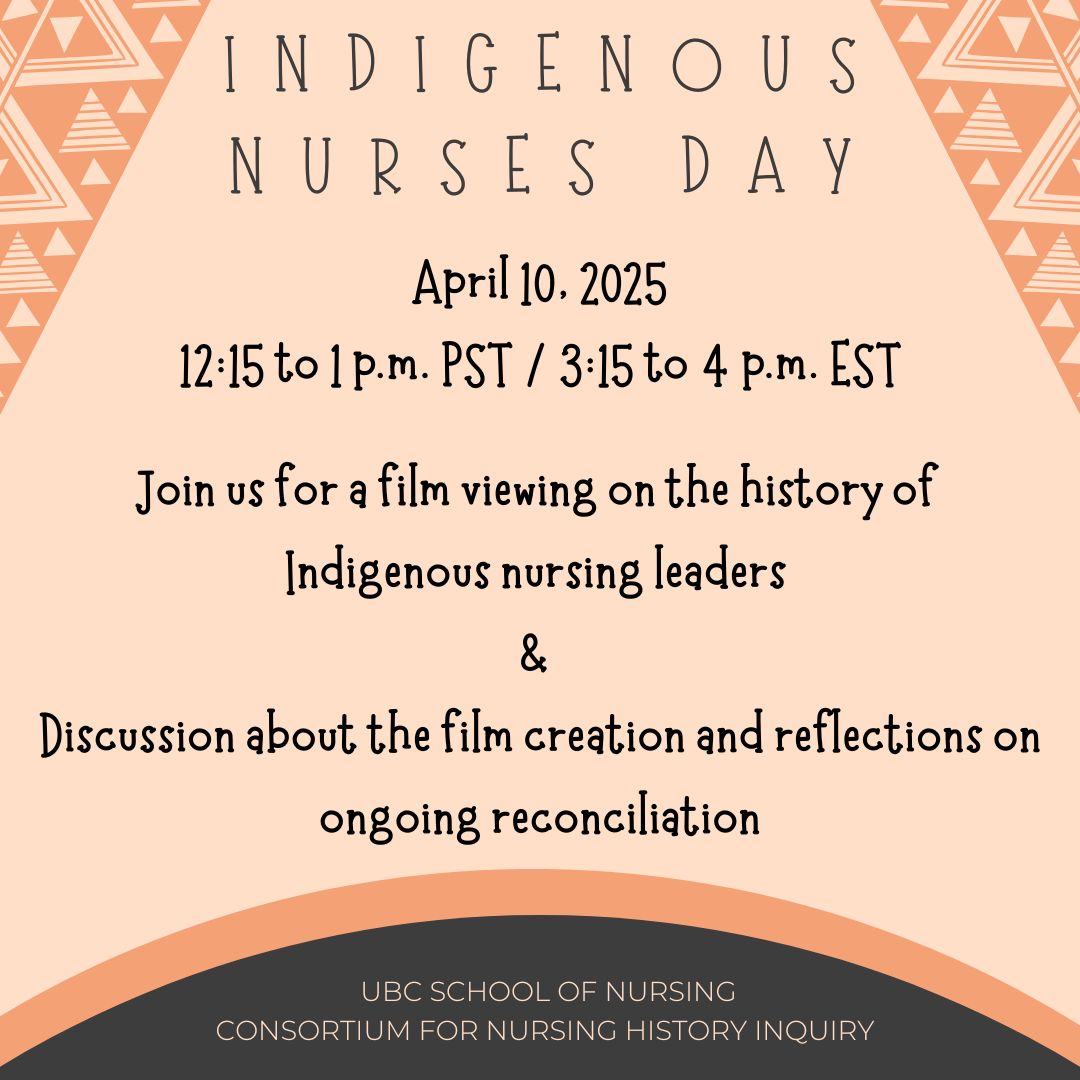
Indigenous Nurses Day 2025 (April 10): Indigenous Nursing Leadership: History and Ongoing Reconciliation


Indigenous Nursing Leadership: History & Ongoing Reconciliation
Hosted by The Consortium for Nursing History Inquiry at UBC-Vancouver

The Consortium for Nursing History Inquiry at UBC-Vancouver is hosting a 45-minute event, Indigenous Nursing Leadership: History & Ongoing Reconciliation, which includes a film viewing and discussion. We will show a film we created in consultation with Indigenous nursing leader and Elder Madeleine Dion Stout, a founding member of the Indigenous Nursing Association in Canada. Then we will discuss the process of co-creating the film and the impact of the film on ongoing reconciliation efforts. Please join Dr. Lydia Wytenbroek, Cates Bayabay and Crystal Point for this event celebrating Indigenous Nurses Day on April 10 from 12:15-1:00 p.m. PST/3:15-4:00 p.m. EST.

Join Zoom Meeting:

Meeting ID: 655 2994 3353
Passcode: 759293
One tap mobile:
+17789072071,,65529943353#,,,,,,0#,,759293#
Dial by your location:
+1 438 809 7799 (Vancouver)
+1 613 209 3054 (Montreal)
+1 647 374 4685 (Alberta)
+1 778 907 2071 (Ottawa)
+1 204 272 7920 (Toronto)
+1 587 328 1099 (Manitoba)
02/15/25

Nursing History Symposia 2025

2025 Nursing History Symposium

April 14, 2025


The recording of the 2025 Nursing History Symposium is now posted in the UBC Open Collection and available for viewing.

Key note lecture by Megan Davies | Panel on 35 years of preserving nursing history in BC by the BCHNS

The permanent URI link listed below includes the symposium program for reference.

Item URI: http://hdl.handle.net/2429/91134


REGISTRATION IS NOW CLOSED: https://nursing.ubc.ca/community/events/2025/2025-nursing-history-symposium-save-date


BC NURSING HISTORY

Celebrating 35 Years Dedicated to Preserving the 

History of Nursing in BC

1990 to 2025 

Keynote speaker: Dr. MEGAN DAVIES 

The nurses of Hornby Island: Post-career Pathways

===

Panel by BC HISTORY OF NURSING SOCIETY members to follow: ‘Sharing experiences of preserving our history’

Location: Cecil Green Park House

Cecil Green Park House 6251 Green Park Road: Google Maps

Time: 9:30 am – 2:00 pm 
ONLINE and IN PERSON

Registration and program info


Megan Davies: The nurses of Hornby Island: Post-career Pathways

Megan’s presentation explores the work of a group of nurses pivotal to the establishment of an early home support society on BC’s Hornby Island in the late 1970s. The Hornby Island nurses – many of them retirees – served as volunteer members of the society’s board, transcending their professional practice by engaging with a new provincial “social health” program, sometimes as health activists representing elders from their remote rural community. Yet they remained definitively nurses. Themes of nursing leadership, nursing identity, nursing practices of organization and management and shared nursing knowledge and ways of seeing shaped their work, and also this study.


Bio
Megan J. Davies is a Professor (Emerita), Faculty of Liberal Arts & Professional Studies, York University, Toronto, Canada. She is a historian of health with a regional focus on BC. She currently works on old age, madness, and everyday medicine. As part of the MadnessCanada.com community, Megan has participated in a number of academic-community collaborations, most notably the 2013 documentary, The Inmates Are Running the Asylum. In January 2022, with the support of a Shadbolt Fellowship, Megan launched COVID in the House of Old, a public exhibit, website and podcast. She has numerous publications on health history.

09/25/24

Untelling Nursing History: Centering the Voices of IBPOC Nurses

This interactive digital experience allows you to explore a series of videos about nursing history from an anti-racist, anti-colonial feminist perspective. This project was created by a group of students and faculty at UBC School of Nursing (Vancouver) over a two year period. Funded by the UBC Nursing Anti-Racism Committee (ARC), this work shares decolonizing and inclusive representations of the history of nursing. Click on the button “Play on itchio.io” to access the experience.


Dr. Lydia Wytenbroek
Kyra Philbert
Shams M.F. Al-Anzi
Cates Bayabay
Ismalia De Sousa
Atussa Shabahang
Kerry Marshall


APA Citation
Wytenbroek, L., Philbert, K., Al-Anzi, S., Bayabay,C., De Sousa, I., Shabahang, A., Marshall, K. (2024, September 26). Untelling nursing history: Centering the voices of IBPOC nurses. The Consortium for Nursing History Inquiry. https://blogs.ubc.ca/nursinghistory/2024/09/25/untelling-nursing-history-centering-the-voices-of-ibpoc-nurses/

08/1/23

Black History Month 2023: Histories in Focus

by Maria Adique, Caitlin Patterson, & Dr. Lydia Wytenbroek

As part of our Black History Month 2023 project, a team of 21 undergraduates students and myself created daily content to highlight the histories and experiences of Black nurses & to showcase Black scholars books & research. This content was then posted on Twitter (@NursingHistory) and Instagram (@ubcnursingconsortium) by students Zahra Rajan and Michele LeBlanc. Two of the students – Maria Adique & Caitlin Patterson – wrote such extensive histories as part of this project, that we wanted to also showcase their work here on the blog. You can find the link to our Black History Month 2023 project, and the full list of student participants, here: Black History Month 2023 : Historical Considerations on Nursing Education Across Canada – UBC Library Open Collections
Dr. Lydia Wytenbroek


Susie King Taylor: American Civil War Nurse
By BSN Student Maria Adique


TW: We include direct quotes from Susie King Taylor’s book in this post which deal with racism, and some viewers may find these difficult to read. Please do not advance to the images of quotes if so.

Susie King Taylor (b. 1848, d. 1912) is known for accomplishing many firsts which include being the first African American nurse to serve in the first African American regiment in the US Army during the American Civil War. She is also known to be the only African American woman to write and self-publish a memoir in 1902 detailing her experiences during the war, called the “Reminiscences of My Life in Camp with the 33d United States Colored Troops, Late 1st S. C. Volunteers” (link below). 
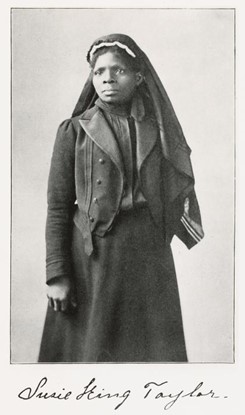
Introducing Susie King Taylor. Souce: Schomburg Center for Research in Black Culture, Photographs and Prints Division, The New York Public Library. (1970 – 1989). Susie King Taylor Retrieved from https://digitalcollections.nypl.org/items/bc284939-ebcf-beb0-e040-e00a18065af6

Taylor learned how to read and write in secret schools. She passed on her literacy to many African American children and adults. In fact, she taught the aforementioned regiment during the war. She married Sergeant Edward King in 1862. Her duties to the troops included supporting them through their suffering, helping bind wounds, getting them water, and cooking them custard which the men “enjoyed … very much” (Taylor, 1902, p.34). She was there to assist whenever needed, and was employed to be the company laundress. Taylor (1902) “did very little of it because [she] was very busy doing other things through camp” (p. 35).

After the war, she and her husband moved back to Savannah, Georgia, along with their comrades at the same time. There, she opened her own private school where she taught 20 children, and a few adults who studied at night. She taught for almost a year until a public school opened, which took her students. At the same time, Sergeant King passed away. By the end of the year 1866, she gave up teaching and prepared to welcome her child. In the spring of 1867, she opened another private school in Liberty County, Georgia. However, she did not like the country and decided to move back to the city. She left the school to Mrs. Susie Carrier. 

On her return to Savannah, Georgia, she opened a private night school where she taught adults. She taught at this school until 1868, when a public night school opened and took her students once again. She placed her baby with her mother, and worked as a domestic servant to a family. However, the work was too hard on her so she ultimately moved on.

In 1872, she worked as a laundress to Mrs. Charles Green. Mrs. Green, however, would eventually go to Europe, leaving Taylor to go back to Boston. Taylor soon found herself in the service of Mr. Thomas Smith where she remained until the death of Mrs. Smith. In 1879, she met her second husband, Mr. Russell L. Taylor. She visited Louisiana in 1898 to see her very ill son. She would find that African Americans in Louisiana “have no rights here” (Taylor, 1902, p. 71). She tried but failed to purchase a berth for her son on a sleeper because he doesn’t have the strength to travel far. Taylor (1902) remarked: “It seemed very hard, when his father fought to protect the Union and our flag, and yet his boy was denied, under this same flag, a berth to carry him home to die, because he was a negro” (pp. 71-72). While in Louisiana, she encountered numerous atrocities and stories about how African Americans were treated. She went back to Boston after the passing of her son.

Near the end of her memoir, she presented her thoughts on “justice”. She wondered “if our white fellow men realize the true sense or meaning of brotherhood?” (Taylor, 1902, pg. 61). She was a staunch believer of liberty and justice that is “equal for the black as for the white”, citing that the “Southland laws are all on the side of the white” while praising Massachusetts for upholding “liberty in the full sense of the word” (Taylor, 1902, pp. 62-63). Taylor (1902) was hopeful for the future, that a time would come when her people would “attain the full standard of all other races” (p. 75).

References

National Park Service. (n.d.). Susie King Taylor. https://www.nps.gov/people/susie-king-taylor.htm

Schomburg Center for Research in Black Culture, Photographs and Prints Division, The New York Public Library. (1970 – 1989). Susie King Taylor Retrieved from https://digitalcollections.nypl.org/items/bc284939-ebcf-beb0-e040-e00a18065af6

Taylor, Susie King. (1902). Reminiscences of my life in camp with the 33d United States Colored Troops, late 1st S. C. volunteers (Electronic ed.). Retrieved from https://docsouth.unc.edu/neh/taylorsu/taylorsu.html


Frances Davis: American Red Cross Nurse
By BSN Student Caitlin Patterson


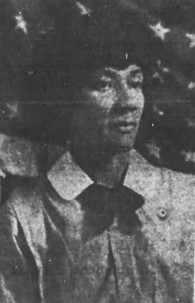
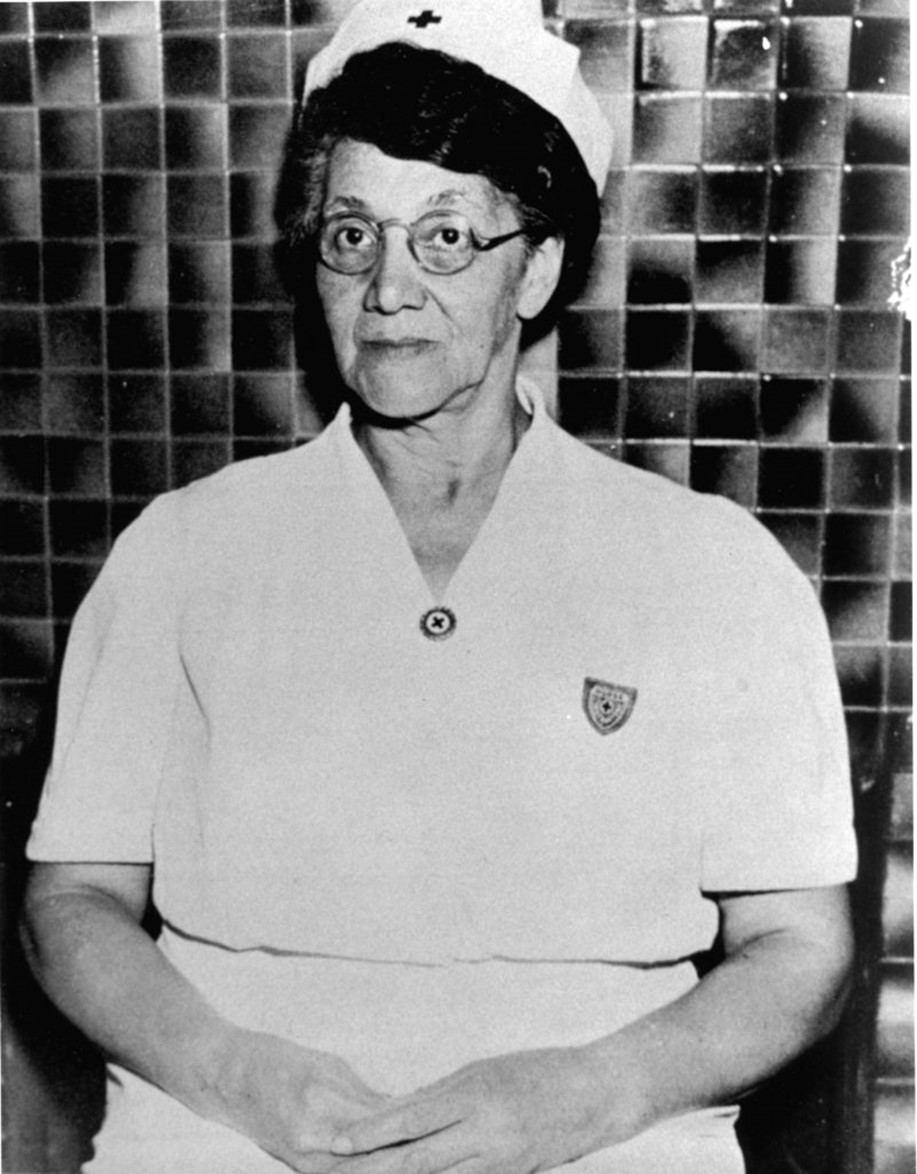
Frances Reed Elliott Davis became the first African American nurse accepted into the American Red Cross, but her contributions extended far past this. 

Frances was born in 1883 in North Carolina to Emma Elliott (the white daughter of a Methodist plantation owner/enslaver) and Darryl Elliott (a Black-Cherokee man, whose mother had been enslaved on the Elliotts’ plantation). Her parents’ union was one of controversy, as interracial relations were illegal at the time, and resulted in her father leaving when she was very young. By the time she was 5, both parents had died, and Frances passed through foster homes until settling as a teen with a minister and his wife in Raleigh, NC, where she hoped to further pursue education. Instead, she was withdrawn from school and served as the family’s nanny. Later, she found work with a supportive family, the Reeds, who helped her leave her foster family and finance her further educational pursuits. 
https://www.ncdcr.gov/blog/2017/08/03/world-war-i-nurse-frances-reed-elliott-davis

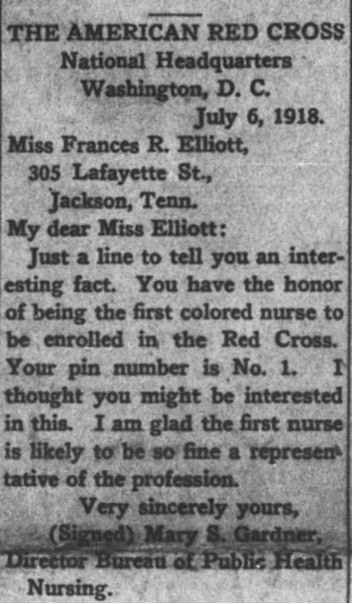
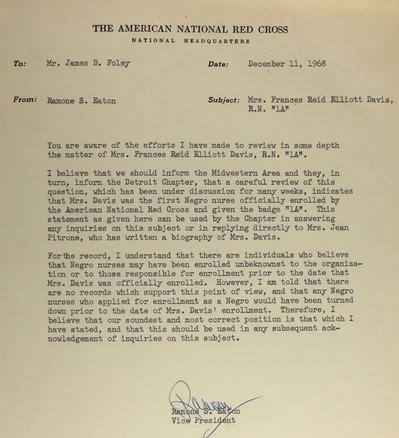
After initially working as a teacher, Frances made her way through training at the Freedman School of Nursing in Washington, DC, as nursing was her heart’s calling. Graduation examinations were stratified based on race at the time, with the exam for white nurses deemed more challenging. Frances demanded this be the test she would write, and she successfully did so, becoming the first Black person to pass the board exam in DC. She attempted to join the American Red Cross in 1916, but was rejected based on her race; she was eventually permitted entry in 1918, but was given the designation “1A” to indicate she was the first African American. The Red Cross continued to identify Black nurses with the “A” label until 1949, when the practice was finally ended.
https://www.ncdcr.gov/blog/2017/08/03/world-war-i-nurse-frances-reed-elliott-davis

https://www.ncdcr.gov/blog/2017/08/03/world-war-i-nurse-frances-reed-elliott-davis
When WWI began, Frances signed up for the Army Nurse Corps with a goal of tending to soldiers overseas. Red Cross nurses were permitted to transfer to the Corps during the war without issue – however, Black nurses were not granted this right. Despite her efforts, Frances was never able to serve overseas, but instead tended to soldiers in Tennessee. When the 1918 pandemic hit, Frances learned to drive so she could care for those homebound with the flu, and nursed both Black and white patients alike before contracting influenza herself and developing cardiac complications. This didn’t stop her from her work, though. 

She became the director of nurses training at the John A Memorial Hospital in Tuskegee, Alabama, for the Red Cross, helped organise the first training school for Black nurses in Michigan, and managed prenatal, maternal, and child health clinics in Detroit in the subsequent years.  
https://redcrosschat.org/2022/02/01/black-history-month-honoring-frances-reed-elliott-davis/

During the Great Depression, she ran a commissary at the Ford Motor plant in Inkster, a predominantly Black community outside of Detroit, to distribute now-unemployed town residents with food. She successfully petitioned Henry Ford to help provide funds and supplies for its operations. She was on the Inkster school board in the 1930s, and subsequently established a nursery in the town, the Carver School. This nursery garnered public attention, and caught the interest of First Lady Eleanor Roosevelt, who helped raise funds to support the centre’s operations. 

At the age of 69, Frances finally retired. The American Red Cross organised a ceremony in 1965 intended to honour her lifelong contributions; unfortunately, Frances passed away mere days before this was to take place. She is buried in Michigan beside her husband, William Davis.