Let them scream for cake

Harry loves cake

A father-son milestone — our first airplay on WFMU.

Last week Kenny G. (featured in my recent WFMU marathon plug) challenged listeners to submit their covers and remixes of Todd Colby’s Cake (MP3 1.3 MB), a long-time staple of his weekly show, with hopes of filling an entire three hour show.

My boy Harry has a long-standing passion for cake, dating back to a memorable full-body cake orgy at his first birthday party (archive photo above). So it was natural I would shamelessly exploit enlist his skills in an attempt to answer the call. Unsurprisingly, he effortlessly delivered the goods, nailing a superb version on his first take.

I had hoped to do more than basic editing, maybe coax another vocal track or two (Harry hates to repeat performances), and add some backing tracks. I intended to get heavy-handed with the post-production, but got knocked by a virus and had no choice but to submit an unadorned version of Harry’s vocal. Which is just as well, as I think the strength of Harry’s performance lies in his simple identification with the character of the cake fiend. No need to clutter it all up with gimmicks.

I suppose it is unsound parenting to encourage your child for saying “I’d punch somebody in the head for some cake” with great conviction, but we had fun. You can download and hear the result (794 KB MP3). Here’s a clip of subsequent DJ banter with Station Manager Ken.

The resulting show is a pretty solid example of participatory media creation and complementary use of radio and the web. Kenny G not only solicited and received tracks via the WFMU weblog, he periodically updated an ongoing list of all the submitted MP3s. The updates provided a sense of momentum and I suspect it stoked participant creativity.

Not only did Kenny G get his three hours of wildly diverse cake covers, he’s got enough material to fill most of next week’s show as well. The cakeathon may go on for weeks and weeks.

Some of the submissions were amazing. This cross-sampling of a vast number of tracks by Health Food gives a pretty good sense of the wild variety of approaches. A few of my favorites:

* So Cakey Inside by Gurber
* Cake Cover (Death Metal) by Listener norelpref
* You Can Call Me Cake by Scott Puhl
* In the Merry Month of Cake (1608) by Listeners Berit, Henry Youll & Listener Ian
* Grandpa Cake on the Phone by Scott Williams

Posted in Uncategorized | 5 Comments

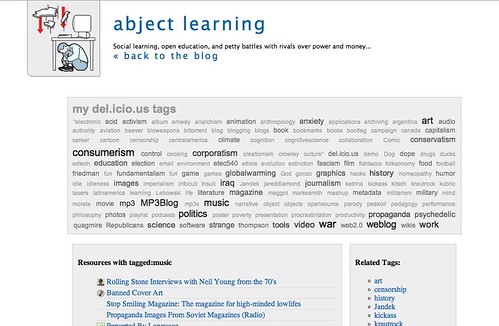
Navigate your del.icio.us tags without leaving your site

Nifty del.icio.us to javascript application

Thanks to one of our UBC whiz kids, Enej Bajgoric, for developing and sharing some code that lets me render not only my del.ico.us tagcloud, but to navigate it for resources and related tags — all within my site, maintaining my own look and feel.

I’ve added a link to my blog’s del.icio.us page on the sidebar. I should note that I’ve only dabbled with del.icio.us in the past. I was an early adopter of Furl, and stuck with it for its file caching and full-text search of bookmarked items. But the momentum is clear, and I am finally prepared to make the move to del.icio.us. I’m loathe to give up the superior archival features of the old service, so for a while I’m going to try using OnlyWire, which allows me to submit bookmarks to multiple services, with tags, from a single interface.

So my del.icio.us bookmarks and tagset are nothing too impressive at the moment. There’s some goofy stuff flagged in there — consider yourself warned.

Does anyone know a good application or approach for importing Furl bookmarks into del.icio.us? My explorations left me all aghast and agog. (It appears I am not alone in this.)

Enej has graciously agreed to share the code he developed for this feature. (Note to self: buy this gifted fellow a beer, or perhaps several.) I’m hoping to tap some of the work he and others in the office are doing on this stuff for an EduGlu (or whatever it’s called) prototype of some kind — hopefully something good will be in place for spring semester.

Download this RTF textfile for the code.

Posted in Uncategorized | 14 Comments

Presentation @ UBC: “The Structure of Collaborative Tagging Systems”

Thanks to Philip Jeffrey for alerting me to this talk by Scott Golder tomorrow:

Scott Golder, a researcher at the Information Dynamics Laboratory at HP Labs in Palo Alto, CA will be visiting our Human Communications Lab on Wednesday, March 22nd. He will be giving a presentation on Collaborative Tagging Systems at 1pm in ICICS X736 (7th floor meeting room) about his quantitative research on del.icio.us, a site for tagging URLs. This HP paper, which will be a journal article later this year is one of the first quantitative studies on del.icio.us.

Map: http://www.maps.ubc.ca/PROD/index_detail.php?bldg1ID=165

Posted in Uncategorized | Comments Off on Presentation @ UBC: “The Structure of Collaborative Tagging Systems”

Weblog-based Tronti symposium: train-wreck a comin’

Lured by an intriguing post on Posthegemony, I rashly offered to join in to the just-launched Symposium on Mario Tronti’s The Strategy of the Refusal hosted over on Long Sunday

A perusal of the participant list will quickly reveal I have strayed well clear of my usual subject matter and support network. I’ve dabbled with Antonio Negri, but never read Tronti before this. So why am I participating? I’m compelled by the notion of a weblog-based symposium, and keen to see how this process plays out. And rather than simply cheerlead and observe, thought it only sporting to take a few swings as a participant, however inept. And Bartleby may be tangential to the subject at hand, but he’s undeniably there. Melville’s story has always fascinated me for a number of reasons.

I have no doubt I am out of my depth, but pushing myself out of my comfort zone is a good way to learn. I’ve already read a lot of stuff I would not have read otherwise, and the prospect of impending humiliation does focus the mind. At least I’m hoping it does.

I doubt I will tread too heavily on the theory path, but I hereby vow not to revert to knee-jerk meta-blog discourse commentary either. That would be too easy. In any event, my contribution to the party is set for Saturday. Hopefully I won’t drink too much and break the furniture.

Posted in Abject Learning | 5 Comments

Anatomy of a blogfunk…

Please forgive one of my periodic self-concerned posts. It’s not like Downes’s hiatus, but I have been quiet here. There have been a few kind souls who have sent me messages of the ‘are you OK?’ variety. Not to dwell on it, but my recent near-silence has in part resulted from:

* The meltdown of my hard-drive, and the apparent futility of recovering the data. There were some irreplaceable items there (three or four months of photos, some amazing audio I recorded at and around Northern Voice), and just thinking about it sends me into a self-destructive spiral. I did do some backups, but the damage is considerable. The process has dragged on for weeks.

* While my machine was out of commission, I learned it was pretty much impossible to handle and respond to the volume of email I receive in the course of my job with a web-based interface (especially when I was getting an extra 400-500 spams a day via our Movable Type installation). I’m still digging myself out from under — and if I owe you email, please feel free to follow-up.

* The plumbing quagmire at home is nearing resolution, and it’s been a nice refresher of my plumbing and reno skills, but it has absorbed lots of evenings and free weekend time, and contributed to a general unsettled vibe — I’m looking forward to having a proper shower again soon.

* The super-secret mission alluded to in posts just before my self-imposed exile was a speaking gig at an “iPods in Education” event hosted by Apple. I really tied myself in knots over that one, as I did not want to be a total hypocrite in how I presented at the event. The tension was complicated by an interview I did for the Chronicle of Higher Education expressing concerns about iTunes U, which was set to appear at the same time. I’m such a wimp when it comes to confrontation. Anyhow, things went OK — I managed to get my points across tactfully (and the audience asked some very pointed questions, bless ’em), and my presentation (with some nice audio clips from the UBC community) seemed to go over well.

* I was very stressed about an impending deadline for the Social Learning project, but right now things are looking better (more on that anon).

* There’s been some other stuff that really isn’t bloggable.

I’ve gotten better at pushing through these episodes, but obviously I’ve still got a lot to learn.

Posted in Uncategorized | 6 Comments

Whatever you call it, it’s yummy

I tend to agree with D’Arcy, and exhibit a similar gag-reflex when someone drops the term “Web 2.0” on me. But as Darren points out in the ensuing comments, it can be hard to resist when you are trying to conceptualise a broad range of applications, interoperations and behaviours to a newcomer.

I might start up something like a buzzword swear jar, put a couple bucks away every time I use that damn phrase (and a few choice others) and at the end of the year give it to some worthy open source initiative.

Whatever — I still grooved big-time on Bryan Alexander’s Web 2.0: A New Wave of Innovation for Teaching and Learning?, and right up front he notes “the label ‘Web 2.0’ is far less important than the concepts, projects, and practices included in its scope.”

I’m so pleased Dr. Alexander was tapped to write this for the EDUCAUSE Review, as he lays down nifty riffs like this one:

Amid this flurry of Web services, what are the pedagogical possibilities? Like many computer-mediated techniques for teaching and learning, some of these possibilities start from pre-Web practices. For example, we have long taught and learned from news articles. Indeed, a popular metaphor for describing RSS reading is the clipping service of old. Since blogs, most social bookmarking tools, and other services are organized in reverse chronological order, their very architecture orients them, or at least their front pages, toward the present moment. Web 2.0 therefore supports queries for information and reflections on current events of all sorts. Given bloggers’ propensity for linking, not to mention some services’ ability to search links, blogs and other platforms readily lead the searcher to further sources. Students can search the blogosphere for political commentary, current cultural items, public developments in science, business news, and so on.

The ability to save and share a search, and in the case of PubSub, to literally search the future, lets students and faculty follow a search over time, perhaps across a span of weeks in a semester. As the live content changes, tools like Waypath’s topic stream, BlogPulse’s trend visualizations, or DayPop’s word generator let a student analyze how a story, topic, idea, or discussion changes over time. Furthermore, the social nature of these tools means that collaboration between classes, departments, campuses, or regions is easily supported. One could imagine faculty and students across the United States following, for example, the career of an Islamic feminist or the outcome of a genomic patent and discussing the issue through these and other Web 2.0 tools. Such a collaboration could, in turn, be discovered, followed, and perhaps joined by students and faculty around the world. Extending the image, one can imagine such a social research object becoming a learning object or an alternative to courseware.

And as Scott adds, there are a few surprises (another here) in this comprehensive overview.

Posted in Uncategorized | 2 Comments

From the Mothership: Big News and Strange News

The headline and photo filled up half of my morning paper’s front-page, above the fold:

UBC scores coup by luring Nobel physicist

The University of British Columbia has scored a major academic coup, snagging an American Nobel Prize winner with a promise to pump $12-million over the next five years toward the professor’s passion to improve the teaching of science.

The departure of Nobel laureate Carl Wieman from the University of Colorado at Boulder was front-page news in the state and considered a significant blow to the U.S. university, where his superstar academic status helped attract millions in research funding over the years.

It’s the professor’s fascination with teaching that is bringing him to Canada. The University of Colorado offered Prof. Wieman just $5-million (U.S.) to fund his research into science education, about half of what UBC was putting up.

“This is quite significant, to have someone of his stature in the science community,” UBC president Martha Piper said yesterday in an interview. “It’s incredibly exciting, and it fits right in with our strategic vision for UBC.”

Prof. Wieman, 54, was awarded a Nobel Prize in physics in 2001 as part of a team that proved the existence of a form of matter predicted by Albert Einstein, called the Bose-Einstein condensate. He has also been recognized as an exceptional teacher, receiving the highest award from the National Science Foundation in the United States for distinguished scholars. He has been at the U.S. university for 22 years and reportedly attracts about $3.5 million (U.S.) a year in research grants to the university.

His appointment, effective January, 2007, will give UBC international bragging rights and enable the Vancouver university to promote itself as one of only two in Canada with a Nobel laureate on its faculty. (Nobel laureate John Polanyi is at the University of Toronto.)

Prof. Wieman was not available for an interview yesterday. However, he told the Denver Post that he is currently more interested in promoting education reform than continuing research at his atomic physics lab. “I wasn’t really able to do the atomic physics research at a level that I was very happy with any more,” he said. “I’ve never wanted to be one of those doddering old scientists who are 30 years behind the times.”

Note that Prof. Wieman is not coming to UBC to spearhead some major research into high-level physics. The announcement clearly indicates he is here to teach and to promote change in how science is taught. That in itself is of immense significance.

And who says that teaching doesn’t pay? Prof Wieman can expect to at least maintain the $300,000 (US?) he’s currently paid annually at the University of Colorado.

FYI, Dr. Wieman gave a talk here last November (in what we now know was a recruitment trip) entitled “Science Education in the 21st Century: Using the Tools of Science to Teach Science” and you can snag UBC’s podcast of the session here.

Huge news, and with campus-wide effects. But the message implied is somewhat at odds with another story I read in my morning paper this past Saturday:

Faculty at UBC win legal victory

The faculty association at the University of British Columbia has won a significant legal victory that bolsters its right to grieve and reverse the UBC president’s decisions on whether a professor is promoted.

A B.C. Supreme Court judge has ruled that a framework agreement between the faculty association and the university permits an independent arbitrator to reverse a decision of the president if he or she is found to have acted unreasonably.

The four-year-long dispute between the faculty association and the administration involves the status of Lance Rucker, an associate professor in the faculty of dentistry.

“The Rucker case is extremely significant,” said James Turk, the executive director of the Canadian Association of University Teachers. “It sends a message that university presidents must exercise their authority in a reasonable manner or they will be held accountable.”

A senior appointments committee at UBC recommended unanimously in 2002 that Dr. Rucker be promoted to full professor. He also had the support of the dean of dentistry and the department head.

Dr. Rucker has been at UBC for more than 20 years and was named its dental educator of the year in 1992. He has published a series of mystery novels and also performed as an actor. In 1999, a UBC publication detailed his accomplishments in dentistry and said it would “flirt dangerously with understatement” to describe him as a renaissance man.

Despite the recommendation of the appointments committee, UBC president Martha Piper sent Dr. Rucker a letter in July, 2002, to say he had been denied a promotion because he did not have enough publications in academic journals.

“The number of publications is not appropriate in this case. The record is that he is an exceptional professor,” said UBC faculty association president Eliott Burnell.

Dr. Piper was serious about her objection to Dr. Rucker’s promotion. UBC lost an April 2004 decision by an independent arbitrator, then appealed the ruling to the provincial Labour Relations Board (they lost), and appealed that one to the B.C. Supreme Court where they have just lost again. UBC is considering further appeals.

There is undoubtedly much more to both of these stories than is reported, so I’m in no position to pass judgment. But these messages don’t fit well together. This is undoubtedly a banner day for teaching and learning at UBC, and it appears that the publish or perish mentality is alive and well.

Tagged | 2 Comments

Coolest fundraising imaginable

Regular readers of this weblog are undoubtedly tired of my repeated references to WFMU, but the station remains my most vital cultural touchstone (they run one of my favorite weblogs too).

The station (freeform legends since the 1960’s) is a model of how to adapt and thrive in the web era. Every show is archived, and the site has search features that allow you to find shows that have played any of the station’s very eclectic range of artists and bands. They do podcasts too. The cumulative amount of great music and talk on this site is astonishing, and the station’s live feed and archives probably make up half of my listening fodder.

100% free of advertising or underwriting. Its sole means of support is a two-week listener marathon, nearing completion (and nearing its goal). This is as unlike the spirit of the traditional fundraiser as you can imagine — check out this video clip (.avi 12 MB) to get a flavour.

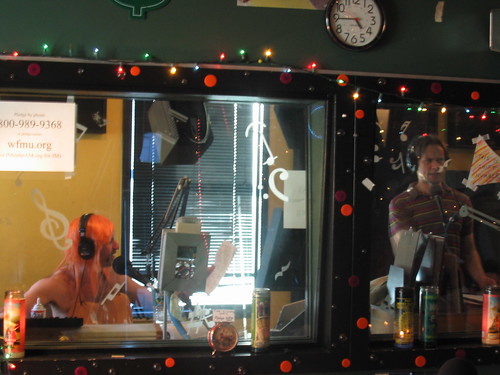
The toughest part for me is deciding which show should get my donation (there is an element of internal competition). This year I decided to throw my money down with Kenny G (pictured above in orange wig) — because his show is so audacious it borders on unlistenable, because he is the driving force behind the awe-inspiring UbuWeb, because I have appropriated his image in the past, and because his premium (singing the hits of theory: Wittgenstein, Adorno, Deleuze, Derrida, etc., all ramped up to a rocking beat) sounds like it could be useful for clearing the house of unwanted guests.

Only two more days of the marathon remain — the finale is the Hoof and Mouth Sinfonia, a five-hour plus jam in which WFMU’s DJ’s sing their favorite tracks backed by a rotating band of other DJs (led by Scott Williams (show, photo), who may well be the coolest man alive). Webcast via a shaky Windows Media stream, the Sinfonia finale is great fun and a huge event at our house — kind of like Super Bowl Sunday for indie radio geeks.

If you want to strike a blow against bland corporate media, you could do worse than chip in a few bucks. If you want to support brilliant, untamed and idiosyncratic radio, you couldn’t do better.

Posted in Uncategorized | 8 Comments

Helen Chen @ UBC

One wonderful perk to working at UBC is the calibre of guest speakers the University is able to bring on for talks and workshops. This Friday is yet another humdinger, as Helen Chen from Stanford pays a visit:

Opportunities for Reflection and Community-Building Using Emerging Technologies

How can we identify and build opportunities for students to effectively reflect upon and integrate formal and informal learning experiences in a language and format that is relevant to how today’s students understand and live their lives? Drawing from examples from Stanford’s Folio Thinking research program and the work of the National Coalition on Electronic Portfolio Research, this session will engage participants in an interactive discussion about theoretical models for framing ePortfolio design and research, the potential contributions of the ePortfolio model to assessment and scholarship of teaching and learning efforts, and scaffolding and facilitating reflective thinking using wikis, blogs, and other social software technologies.

More info and registration here

I’ve had the pleasure of talking with Helen at a couple of conferences, and I really like the way she approaches these issues. Yet another great session I will miss due to my scary supersecret mission, on which I embark tomorrow.

Posted in Uncategorized | 15 Comments

MySpace gets the Danah Boyd treatment

I don’t use MySpace myself, and having only looked at it quickly had always wondered what the buzz was about.

A couple months back, I did have something of an ‘a-ha’ moment when I followed this link to the MySpace entry for a fictional private eye who occasionally phones in to a funny WFMU show I quite enjoy (performed by this guy, or should I say this guy). The first comment on Scag’s space was by this other guy, who is something of an underground Republic of East Van cut-up of renown — perhaps best known as half of Canned Hamm (who must be seen live to be believed). To see two such relatively obscure and seemingly unconnected personas (linked only by comic sensibilities) connect so directly, and then following the other network paths and finding many more similar linkages convinced me that there was indeed some there there, even if I couldn’t articulate it.

Josie pointed out Danah Boyd’s research on MySpace, which was posted today as Identity Production in a Networked Culture:

Adults often worry about the amount of time that youth spend online, arguing that the digital does not replace the physical. Most teens would agree. It is not the technology that encourages youth to spend time online – it’s the lack of mobility and access to youth space where they can hang out uninterrupted.

In this context, there are three important classes of space: public, private and controlled. For adults, the home is the private sphere where they relax amidst family and close friends. The public sphere is the world amongst strangers and people of all statuses where one must put forward one’s best face. For most adults, work is a controlled space where bosses dictate the norms and acceptable behavior.

Teenager’s space segmentation is slightly different. Most of their space is controlled space. Adults with authority control the home, the school, and most activity spaces. Teens are told where to be, what to do and how to do it. Because teens feel a lack of control at home, many don’t see it as their private space.

To them, private space is youth space and it is primarily found in the interstices of controlled space. These are the places where youth gather to hang out amongst friends and make public or controlled spaces their own. Bedrooms with closed doors, for example.

Adult public spaces are typically controlled spaces for teens. Their public space is where peers gather en masse; this is where presentation of self really matters. It may be viewable to adults, but it is really peers that matter.

Teens have increasingly less access to public space. Classic 1950s hang out locations like the roller rink and burger joint are disappearing while malls and 7/11s are banning teens unaccompanied by parents. Hanging out around the neighborhood or in the woods has been deemed unsafe for fear of predators, drug dealers and abductors. Teens who go home after school while their parents are still working are expected to stay home and teens are mostly allowed to only gather at friends’ homes when their parents are present.

The whole paper is worth a look.

Posted in Emergence | 6 Comments