Categories
Uncategorized

In Support of Aboriginal Students

Is my district similar to others? My school district encompasses land that has no reserve, no band school, and for that matter no “officially” recognized nation. I live and work in the Kootenay Columbia (Kutenai) area of British Columbia. Slightly to the north of us, the Ktunaxa Nation is recognized but here, just north of the border, the people of the Sinixit continue to struggle for recognition.

Ten percent of our student population (four hundred) are of aboriginal ancestry. One percent of our teaching population are of aboriginal ancestry (two). The numbers of aboriginal students who are successful in our school communities is unacceptably low. To that end, targeted aboriginal education funds help provide our aboriginal students access to aboriginal support workers (all of whom, I believe, are of aboriginal ancestry).

It is here that the problems begin. With what should the workers be supporting our students? Cultural support? Academic support? In the  past clear beliefs have been identified between cultural and aboriginal but lately I see a blurring of the line.

As I first began to investigate cultural vs academic support for our students, my first findings took me to websites where support for both culture and academics is provided for university students. UNBC (University of Northern British Columbia) website was an excellent location for my first visit. It did not answer the question academic vs culture, it provide a unique perspective re supporting both and access to further research.
 

Categories
Connection to Research Topic Module 1

Self-Expression and Education

As was stated in the introduction to this course, there is no way to adequately answer all the questions of whether, what and how electronic technology should be incorporated into childhood education in FN communities. What I want to look at, is how this is happening now, and in the adult education context.

I want to look at the FN presence in cyberspace as it exists today, and how and why that contributes to both the continued education of FN adults and also adults and children in the dominant culture. Is this presence a positive or negative thing? Why do FN persons with a presence on the internet and in virtual worlds feel this is a) necessary and b) a safe thing to do?

Below are some links to some spaces set up to create aboriginal and indigenous places online.

Aboriginal Territories in Cyberspace http://www.abtec.org/blog/?p=109 and http://magazine.concordia.ca/2009/spring/features/second_life.shtml

One of their projects on creating games with FN youth http://www.rit.edu/gccis/gameeducationjournal/skins-designing-games-first-nations-youth and http://www.abtec.org/blog/?p=219

A report of an award granted to a project which created a FN interactive story in the virtual world of SecondLife http://www.canadianexpatnetwork.com/public/891.cfm

My research paper/project will look at aboriginal spaces online, and I will hopefully be able to discuss interactions I have with their creators as well as look at the research that has been done on the subject, as well as how this connects to the concept of educaton.

Although I will not be soley focusing on SecondLife I will post the SLURLs (the links to places in SecondLife) that are relevant to what I am looking at; but those will only be available to people who are already residents in that world, so I am hoping to film some of the places and people I will visit (with permission of course). This is the environment with which I am most familiar, so I am hoping to find other virtual spaces to connect with and broaden both my horizons and the scope of my project.

Categories
Connection to Research Topic

Experiential and Context Driven Learning

My limited background and experience with indigenous education, and education in general, makes it a little difficult to choose a topic this early in the semester, so I will pursue a tiny obsession of mine that we all refer to as ‘context’. The question of context, and its influence on how and what people learn, has been a mystery to me prior to getting involved in the MET program, and now that I am close to the finish line I would like to at least attempt to solve this mystery. I see contextual learning, as a form of experiential learning, which can further take the form of service learning, internships, study abroad programs, co-ops and practicums, and so forth. Putting learning into ‘context’ does not only strengthen but also ensures long lasting cognitive connections. The fascinating aspect (for me!) of experiential or contextual learning is the opportunity it allows for learners to interact with knowledge, a knowledge that (in my mind) transforms from a theoretical state to a practical, hands on and interactive one. In applying this concept to indigenous education I would like to answer some of the following questions throughout my research:

1. How does indigenous culture view the concept of ‘context’?
2. Do current indigenous education practices rely on methods that allow for experiential learning?
3. How does technology play a role in indigenous education and is it enough to compensate for the lack of context in education?
4. How do indigenous people learn and what learning methods are best suited in the process of knowledge transfer? Is context important?

There are probably better questions to ask, but I will figure out what they are along the way.

Below, is a list of the first five websites that will help me focus my research.

Categories
Module 1

Resources for reaching out to the Aboriginal Children

http://www.aboriginalcanada.gc.ca/acp/site.nsf/eng/index.html

A collaborative site by the Canadian Government and many FN associations, this site provides information on the FN history, culture, and traditions. Besides information it provides the FN elders, women, youth, and children many activities and resources. I particularly found the links for younger children appealing where the web is used efficiently to teach the children their history, language, and the traditional way of living. Many concepts are presented in game format.

http://www.collectionscanada.gc.ca/stories/index-e.html

This site is “an exhibition celebrating stories from the oral tradition of the Inuit, Métis and First Nations peoples, from the past to the present.” It is a documentation of their oral traditional that bear witness to the cultural diversity, living history and collective knowledge from which they came.

http://www.education.gov.sk.ca/aboriginal-resource-list

This site has an exhaustive list of aboriginal resources to link with all aspects of the curriculum. Very useful guide for educators

http://www.civilization.ca/cmc/exhibitions/tresors/ethno/ety0000e.shtml

This Gateway to Aboriginal Heritage has interesting activities for children and teachers. It has rich Canadian content about traditional people and their life style. It also has lesson ideas that help students learn about aboriginal history and culture.

Indigenous Knowledge and Pedagogy
This is a very detailed paper that aims to describe and evaluate work done on indigenous knowledge and pedagogy in the First Nations education. It also explains the ethics and criteria for understanding and integrating indigenous knowledge in the classroom.

Categories
Connection to Research Topic

Enriching Young Lives

Last year, for the first time in my entire teaching career, I saw pride and confidence in my two aboriginal students. It was refreshing to hear them sing their cultural song in front of the entire school in their regalia to kick of the Harmony Week, to have them bring artifacts from grandma to share during our First Nations studies, to see them ecstatic about going to a powwow, and to see their impatience while grandma made their drums. But their cultural abundance also made me realize that this was a rare occurrence. Most of the other aboriginal students at my school do not exhibit such pride, excitement, or even curiosity. They view their cultural activities with their First Nation Advocate as fun and a way to be out of the class. I discussed this with the First Nations Advocate and we both want to look at ways to enrich the cultural experience of aboriginal students at elementary school level and instill pride in them about their culture. For my assignment I will examine authentic and meaningful technological resources and tools available for the aboriginal children and look at ways to incorporated them into my school culture and the prescribed curriculum.

Categories
Module 1

Bringing Technology and Tradition Together

LIVING SMART IN TWO WORLDS: Maintaining and Protecting First Nation Culture for Future Generations
(http://smart.knet.ca/Library/GlobalCN-paper.pdf)


Description:

In searching for articles and websites that focus on Aboriginal Youth and Technology I came across this article.  This is a paper/presentation presented in 2002 by K-Net (an IT company that worked with 6 different First Nations in the Province of Ontario).  Essentially, they looked at ways in bridging the two worlds of technology and tradition.  Most importantly, they were successful in doing so.  The paper outlines ways in which they were successful and also gives testimonials from various First Nation leaders on its effectiveness.

~ Ryan

Categories
Module 1

The Role of Technology in Globalization for Indigenous Youth

UNESCO (The Role of Technology in Globalisation for Indigenous Youth)
(http://www.unesco.org/ccivs/New-SiteCCSVI/institutions/jpc-youth/youth-open-forum/Section_for_Youth/Resources_and_tools/Other_documents_on_youth/OXFAM_INTERNATIONAL_YOUTH_PARLIAMENT/Chapter3_Indigenous_Youth.pdf)

Description:

UNESCO (United Nations Educational, Scientific and Cultural Organization) is undoubtedly known by all. But just in case, UNESCO has several goals which include (but are not limited to) ending poverty, building world peace, creating life-long learners, and embracing cultural diversity.

Exploring UNESCO’s website I located a report prepared by OXFAM International.  Chapter 5 of this report focuses on the effects of Globalization on Indigenous Youth.  There is a section that deals with the ‘Role of Technology in Globalization For Indigenous Youth’ (page 87) that I found particularly appealing because it discusses many things that we have dealt with on our course thus far.  Specifically, technology can have both positive and negative effects on Indigenous people and their communities.

~ Ryan

Categories
Module 1

ETHNOS PROJECT

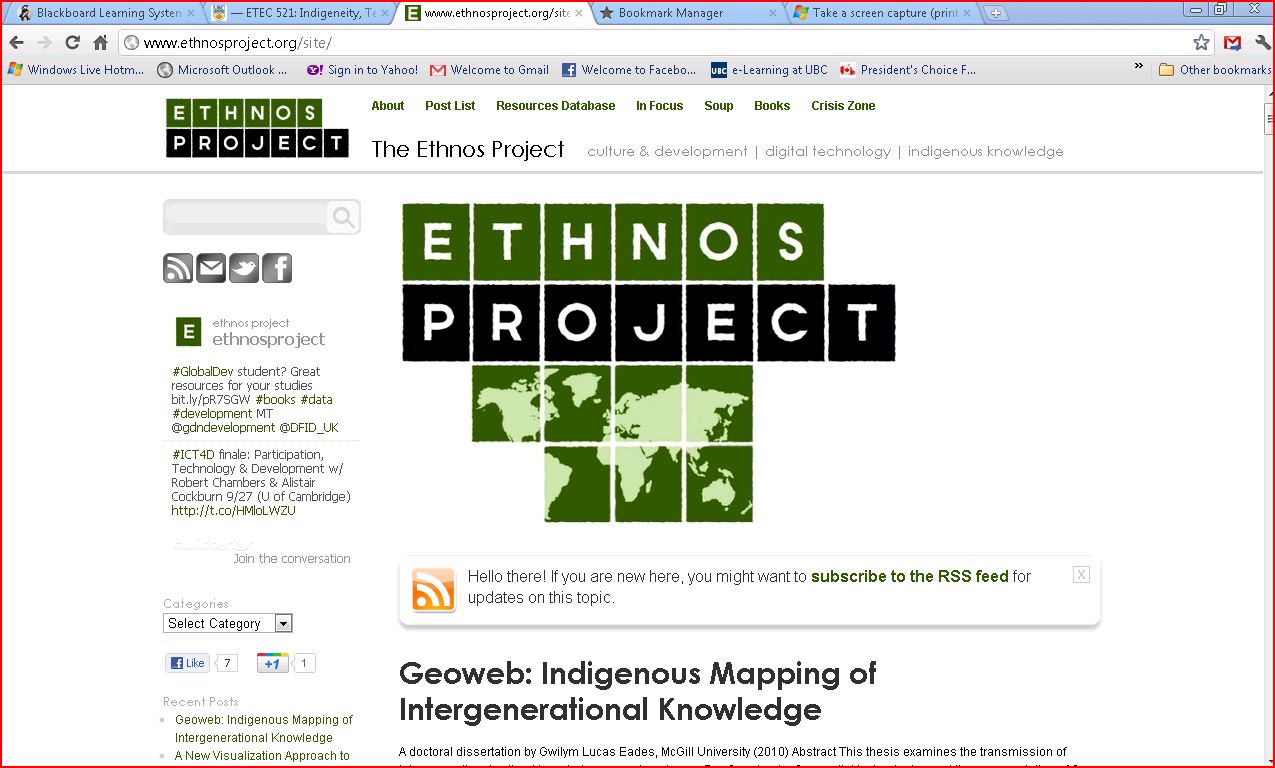
Ethnos project is a Blog dedicated to providing and highlighting information in relation to communications technology and how it is being used around the world. This website not only focuses on how technology is impacting society and how it causes change but it also has links to resources that talk about preserving Indigenous culture. This site’s focus is on the use and development of ICT to help with Indigenous Knowledge Management and to help find ways to be more mindful of Indigenous cultures in order to bring about or deal with societal change.

http://www.ethnosproject.org/site/

Categories
Module 1

Red River College’s HAWK Camp for Aboriginal Youth

Red River College’s H.A.W.K. Camp for Aboriginal Youth
(http://redblog.typepad.com/blog/2011/08/aboriginal-youth-soar-at-rrcs-hawk-camp.html)

H.A.W.K. Camp Slideshow

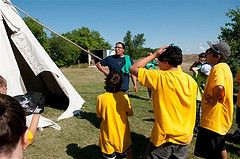
For the past two summers, Red River College has offered its Hands-On Activity Week for Kids (H.A.W.K.) which is a camp geared towards Aboriginal Youth aged 11-13.  The week-long camp introduces Aboriginal Youth to the Construction Trades, Electronics, Mechanical Engineering Technology/Manufacturing, Aviation and Civil Engineering.  Many students are getting their first introductions to these fields of study.  Besides the hands-on experiences with the trades and technologies, camp-goers also took part in many team building activities, story-telling and drumming, all aimed at bolstering each individual.  The camp is free of charge and is available on a first-come-first-serve basis. Participants also receive a free t-shirt as well as lunch and snacks each day.

~ Ryan

Categories
Module 1

Aboriginal Youth – Actua

ACTUA   (http://www.actua.ca/en/aboriginal-youth)

Description:

Actua is a Canadian organization that provides youth the opportunity to learn about Science and Technology in an informal, practical environment.  One of Actua’s outreach programs is geared directly towards Aboriginal youth.   Aboriginal role models within the community aim to inspire the youth to become life-long learners through “hands-on” experiences.  It is expected that these positive encounters will have a lasting impact on the youth that will in turn help build and maintain strong Aboriginal communities.

~ Ryan

Spam prevention powered by Akismet