Class size and composition most important public policy issue in BC teachers dispute

Class size and composition is arguably the single most important public policy issue in the current dispute between BC teachers and government.

The educational and economic implications of class size and composition policies are huge, but in the context of collective bargaining and related court cases public discussion of the costs and benefits of class size reduction has been cut short.

Class size is one of the most rigorously studied issues in education. Educational researchers and economists have produced a vast amount of research and policy studies examining the effects of class size reduction (CSR).

What is the research evidence on CSR?

Since the late 1970s, the empirical evidence shows that students in early grades perform better in small classes and these effects are magnified for low-income and disadvantaged students. Most studies have focused on primary grades, but the relatively small number of studies of later grades also shows positive results of CSR.

Randomized experiments are the “gold standard” in social science research. One such study, known as Project STAR, involved 11,500 students and 1,300 teachers in 79 Tennessee schools produced unequivocal results that CSR significantly increased student achievement in math and reading.

A CSR experiment in Wisconsin illustrated student gains in math, reading, and language arts. In Israel, which has high, but strict maximum class size rules, a rigorous study of CSR produced results nearly identical to Project STAR. Studies in Sweden, Denmark, and Bolivia find similar results.

Do all studies of CSR produce unequivocal positive results? No, but the vast majority of research, including the most rigorous studies, leave no doubt about the positive effects of CSR.

The research evidence on CSR led to class-size caps in California, Texas, Florida, and British Columbia, before the BC government stripped them from the teachers’ contract in 2002.

Why are smaller classes better?

Observational research in reduced size classes finds that students are more highly engaged with what they are learning. That is, students have higher participation rates, spend more time on task, and demonstrate more initiative.

In turn, teachers in smaller classes spend more time on instruction and less time managing misbehavior. They also have more time to reteach lessons when necessary and to adapt their teaching to the individual needs of the students.

One, perhaps counter-intuitive, finding from the research is experienced teachers are better able to capitalize on the advantages of smaller classes than more novice teachers.

How small is small enough?

Project STAR reduced class size from an average of 22 students to 15. Previous research found significant positive effects of CSR at below 20.

Based on these findings some have argued that CSR is not effective unless these levels are attainable. But, the broad pattern of evidence indicates a positive impact of CSR across a range of class sizes.

What about the costs?

There are demonstrable costs involved in reducing class size. As with all public policy questions both benefits and costs must be considered. The potential future costs of not creating smaller classes in public schools also must be taken into account.

Reduced class size boosts not only educational achievement, but has a positive impact on variety of life outcomes after students leave school.

Results from a number of studies show that students assigned to small classes have more positive educational outcomes than their peers in regular-sized classes including rates of high school graduation, post-secondary enrolment and completion, and quality of post-secondary institution attended.

Additionally, students from small classes have lower rates of juvenile criminal behavior and teen pregnancy; and better savings behavior and higher rates of homeownership than peers from regular-size classes.

What are the policy implications of CSR research?

Class size in an important determinant of a broad range of educational and life outcomes, which means policy decisions in this area will have a significant impact on future quality of life in the province.

The money saved today by not reducing class size will be offset by more substantial social and educational costs in the future, making class size reduction the most cost-effective policy.

Sample of CSR Research Articles:

Angrist, J.D., & Lavy, V. (1999). Using Maimonides’ rule to estimate the effect of class size on scholastic achievement. Quarterly Journal of Economics, 114(2), 533-575.

Browning, M., & Heinesen, E. (2007). Class Size, teacher hours and educational attainment. The Scandinavian Journal of Economics, 109(2), 415-438.

Chetty, R., Friedman, J.N., Hilger, N., Saez, E., Schanzenbach, D.W., & Yagan D. (2011). How does your kindergarten classroom affect your earnings? Evidence from Project STAR. Quarterly Journal of Economics, 126(4), 1593-1660.

Dynarski, S., Hyman, J., & Schanzenbach, D.W. (2013). Experimental evidence on the effect of childhood investments on postsecondary attainment and degree completion. Journal of Policy Analysis and Management, 32(4), 692-717.

Finn, J., Gerber, S., & Boyd-Zaharias, J. (2005). Small classes in the early grades, academic achievement, and graduating from high school. Journal of Educational Psychology, 97(2), 214-223.

Fredriksson, P., Öckert, B., & Oosterbeek, H. (2013). Long-term effects of class size. The Quarterly Journal of Economics, 128(1), 249-285.

Krueger, A.B. (1999). Experimental estimates of education production functions. Quarterly Journal of Economics, 115(2), 497-532.

Krueger, A.B., & Whitmore, D. (2001). The effect of attending a small class in the early grades on college test taking and middle school test results: Evidence from Project STAR. Economic Journal, 111, 1-28.

Krueger, A.B., & Whitmore, D. (2002). Would smaller classes help close the black-white achievement gap? In J.Chubb & T. Loveless (Eds.), Bridging the Achievement Gap (pp. 11-46). Washington, DC: Brookings Institution Press.

Molnar, A., Smith, P., Zahorik, J., Palmer, A., Halbach, A., & Ehrle, K. (1999). Evaluating the SAGE program: A pilot program in targeted pupil-teacher reduction in Wisconsin. Educational Evaluation and Policy Analysis, 21(2), 165-77.

Word, E., Johnston, J., Bain, H.P., et al. (1990). Student/Teacher Achievement Ratio (STAR): Tennessee’s K-3 class size study. Final summary report 1985-1990. Nashville: Tennessee State Department of Education.

Urquiola, M. (2006). Identifying class size effects in developing countries: Evidence from rural Bolivia. Review of Economics and Statistics, 88(1), 171-177.

Metaphors We Bargain By: Labor-Management as Marriage

Lakoff and Johnson’s Metaphors We Live By changed forever complacency about the structure of language by showing how deeply rooted metaphors are constitutive of the way we think and act rather than simply flowery poetic forms of language use. These metaphors are deeply embedded and can be simple (up is good) or multi-faceted (love is a journey; argument is war). Metaphors simplify what is complex or new and they are never neutral but communicate values and ideologies, often shifting or diverting attention in their use.

There is no doubt in British Columbian’s minds the BCTF and the BC government do not have a warm fuzzy relationship. Indeed the working relationship between the two has seriously deteriorated over the past 10+ years. The current labor conflict between the British Columbia Teacher Federation (BCTF) and the British Columbia government has politicians, pundits, students, and others saying labor and management is a marriage. The marriage metaphor now crops up to offer ‘a way forward’ in labor-management in BC public education.

Let’s be clear about one thing to start. This metaphor is not meant to be a universal metaphor for labor-management… would anyone think the locked out IKEA workers and IKEA or the teamsters and the Port Authority are married to one another? Not likely. Here are a few illustrations of the marriage metaphor being used to (re)construct labor-management in BC public education. Note that the inclusion of students as off-spring of the BCTF-BCEd marriage is the core idea upon which the metaphor turns.

Like any troubled marriage, it is ultimately the children who are hurt in the bickering and squabbling. But unlike a family breakup, there are 558,985 public school students affected. Divorce is simply not an option. (Andrew Weaver, MLA)

But unlike a constantly quarreling couple that should just split up and go their separate ways, the provincial government and the teachers’ union can’t get a divorce — not now, not ever. The sour marriage desperately needs counselling, especially if we don’t want the relationship to affect the kids, in this case B.C. students. (Bill Tieleman, The Tyee)

To say a dysfunctional relationship between two parents doesn’t affect the children would be an outrageous lie. The relationship between the BCTF and the province is very much the same and the effects are mostly felt by the students. (Jacob Smith, 12th grade student)

The marriage metaphor, as it is used in these cases, draws on a few key ideas: there is a couple (BCTF and BCEd), they have children (all students in BC schools), and the parents have common goals and whatever differences they have in achieving those goals must be sorted out for the sake of the children (students) because divorce is out of the question (hmmm, what kind of marriage is this?), and if needs be counseling (BC Labor Relations Board Relationship Enhancement Program) should be sought to overcome differences between parents.

Does the Marriage Metaphor Work?

Paranthetically, the marriage metaphor at least gives us a respite from the education as market with children/families as consumers metaphor that is even more ubiquitous in discussions of public education.

So BCTF and BCEd as a troubled married couple with children works if the marriage reflects an abusive relationship, where one partner (BCEd) has forced and bent the other (BCTF) to its will. The fact that twice the BC Supreme Court has ruled that the government acted illegally is plenty of evidence of abuse, and the government’s unwillingness to make things right suggests the abuse is ongoing. (So court rulings as a marital counseling strategy don’t appear effective.)

The marriage metaphor may be more tenuous in assuming that both partners share the same goals, in this case doing right by the kids. Let’s assume that this is a common goal, but what each partner means by doing right by the kids may be fundamentally different. For example, one need not be too cynical to suggest BCEd’s doing right by the kids is to encourage individualism, focus on vocational, jobs oriented education, get those kids out on their own as soon as possible and contribute to the economy. And, although maybe a bit generous, BCTF’s doing right by the kids is in creating a more comfy, tenable, child-friendly workplace for themselves which will in turn make for happy children. These are not trivial, just humorous differences.

And the success of the metaphor hinges on the possibility that counseling will not just be helpful, but will be THE means for overcoming differences. In this counseling BCEd will face up to the fact its been abusive and learn new strategies for being a fair and equitable partner. BCTF will learn new and less disruptive strategies for asserting itself (no more strikes!). (We’ve seen already that legal rulings haven’t been an effective couples therapy, and it’s an open question whether the LRB programs would be.) Meanwhile, the kids are alright (well not really, because this metaphor silences students and strips their agency, in and out of school). I’m no expert on marital counseling, but I’m thinking this remedy has limited potential for success; optimistically, maybe 50-50 for a kiss and make-up and ‘moving forward.’

The labor-management as marriage metaphor diverts attention from fundamental and healthy conflict over the purposes and interests served by public education. The current BC neo-liberal oriented government interests are not the same interests of the poor and working class, First Nations communities, rural and inner city communities, education workers, many parents.

Other Metaphors to Ponder

How ever we think about public education and the relationship between the BCTF and BCEd we will be thinking metaphorically. It’s important for us to use our metaphors wisely and mine them for understanding and taking action. Maybe the marriage metaphor has some traction in finding ‘a way forward’, although I doubt it. Perhaps we should be finding ‘our way home’ or ‘destroying the system’ or ‘moving on,’ but those are metaphors for another day.

Now that we are on to the power of metaphor, let’s think about Labor-Management as…

  • war
  • argument
  • ladder
  • contest
  • duel

Over to you.

#BCed teachers strike #soldaritylookslikethis @FassbenderMLA #bcpoli # yteubc

BCTFstrike2014

Solidarity Looks Like This

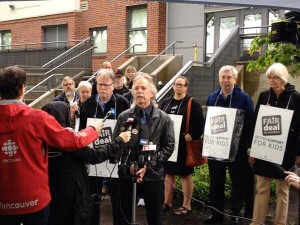
British Columbia Teachers’ Federation President Jim Iker and BC Federation of Labour President Jim Sinclair are on the picket line this morning in Vancouver as teachers, parents and students stand together. Yes, Minister Fassbender and BC Liberals, solidarity looks like this. BCTF teachers deserve a fair deal and fair bargaining practices. Minister Fassbender, the BC Federation stands for and with the BCTF teachers, solidarity looks like this.

BCFedBCTFstrike2014

BCTF President Jim Iker and BC Fed President Jim Sinclair on the picket line this morning in Vancouver

#BCed teachers begin rolling strikes #bcpoli #edstudies #yteubc

fair-deal

VESTA, May 24, 2014 /CNW/ – All schools across School District #39 Vancouver will be behind picket lines [today] on Monday May 26th, as local teachers join their colleagues across the province in taking a stand for smaller classes, better support for students, and a fair and reasonable salary increase.

“Teachers in our community, like teachers across BC, don’t take this job action lightly,” said Gerry Kent, President of the Vancouver Elementary School Teachers’ Association. “As teachers, we care deeply about our students and we empathize with parents who have to rework their schedules. Many of us are parents too, and that is one of the reasons we are taking this action. Parents and all citizens should be dismayed by a decade of annual budget and service cuts made by underfunded school districts across the province. These cuts affect the education of our children and grandchildren.”

Teachers are being forced to step up job action because they have been at the bargaining table for 16 months and the provincial government and the BC Public School Employers’ Association still refuse to offer any improvements to class size, class composition, and other important learning conditions for students. On top of that, the employer’s wage offer is unfair especially considering that the last time teachers got a raise was July 2010.

BC’s per student funding is $1,000 per student less than the national average, a level of underfunding that has had serious consequences across the province. Provincial government underfunding has affected a generation of students since 2002. Supports for students with special needs and English language learners, and other services provided by specialist teachers such as counsellors, librarians, and speech and language pathologists have been eroded because of staffing cuts caused by underfunding.

The rotating closures are part of a two-stage strike plan that teachers approved in March, with an 89% yes vote. Any extension of the rotating job action will depend on developments at the bargaining table.

“Teachers remain committed to reaching a fair deal at the negotiating table.” Kent said. “This government must make education a priority, show respect for the work of teachers and come to the bargaining table with the funds needed to improve supports for students. Premier Clark and Minister Fassbender need to stop the rhetoric and show real leadership. Putting families first requires a strong and well funded public education system.

For more details, please visit www.AFairDeal.ca

SOURCE VESTA: Vancouver Elementary School Teachers’ Association

Embarrassing recent events in Canadian higher education #cdnpse #GeorgeRammell #RobertBuckingham @usask

I’ll admit to a quaint hope that universities are still places where dialogue and dissent are both possible and desirable, but two incidents in the last week leave me scratching my head. The first is the theft of professor George Rammell’s sculpture by the Capilano University administration, and the second is the firing of Robert Buckingham, Dean of the School of Public Health at the University of Saskatchewan. The issues in the two cases are not the same, but what both share is an unbelievable authoritarianism on the part of the upper administration, a willingness to trample on academic freedom and the absolute intolerance of resistance or disagreement about program cuts and restructuring. The point is not whether each of these universities plans for budget cutting and trimming are appropriate (that would be a different post), but the response to faculty and middle management who DARE to disagree with the upper administration. If this doesn’t have a chilling effect on everyone in Canadian higher education, well we are all being just too polite.

THE CASE OF THE MISSING SCULPTURE

At Capilano University there have been severe program cuts. One program area in which cuts are deep is the arts. George Rammell, sculpture instructor, used his scholarly form of expression to comment on those cuts ~ he created Blathering on in Krisendom, a work in progress  depicting Capilano University president Kris Bulcroft wrapped in a U.S. flag with a poodle. The sculpture went missing last week:

“I immediately called security and the guard told me that orders were given by the top level of the Administration to seize it. I could hardly believe my ears. The Administration had ordered my piece removed off campus to an undisclosed location, without any consultation or prior discussion. I was shocked and not sure if this was Canada,” Rammell stated (as reported in the Georgia Straight).

Jane Shackell, chair of the Board of Governors, released a statement saying that Capilano was “committed to the open and vigorous discourse that is essential in an academic community.” But she had the sculpture removed because it was “workplace harassment of an individual employee, intended to belittle and humiliate the president.” A post for another time, but this might well be the most egregious, inappropriate use of respectful workplace rhetoric to create a workplace where dialogue, dissent, and discourse are not allowed.

Of course, Rammell’s work is easy for the University to steal, but the parallel for some of us might be an administration that comes to your office and wipes all of the files for that critical analysis of higher education book you are working on from your computer. After being AWOL for a week, Capilano University has agreed to return Rammell’s work, but has banned the sculpture from campus and Rammell calls that censorship. It is and it isn’t harassment either. So much for academic freedom.

THE SILENCE OF THE DEANS

Then comes the news, Robert Buckingham, Dean of the School of Public Health at the University of Saskatchewan was fired, relieved of his professorial appointment and tenure, and escorted of the campus ~ for disagreeing publicly with the administration’s restructuring and budget cutting plan, TransformUS.

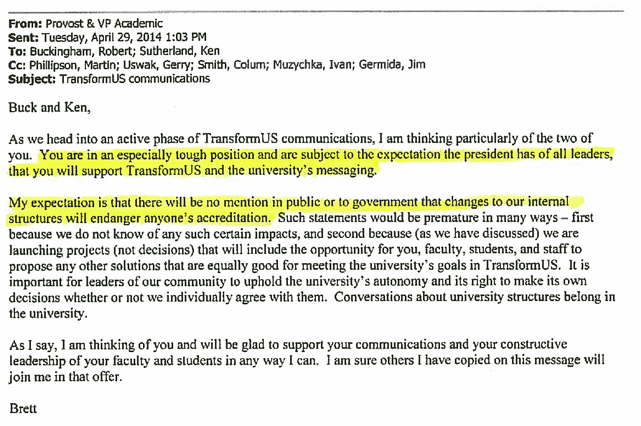
In discussions of TransformUS, middle managers were ordered to get in line and on board with the plan, and threatened if they spoke publicly against it. Here’s the email from the provost:


That a University would want deans who are lackeys and submissive to the upper administration’s “messaging” says a great deal about that administration. Unlike the CapU incident, this is less about academic freedom and all about the importance of maintaining an openness to dialogue and disagreement within the University. Such a heavy handed administrative approach assaults our sensibilities about how even the modern, corporatized U operates. On top of all that, the termination of Buckingham comes a mere five weeks from his retirement and is amazingly mean-spirited.

CAUT director, Jim Turk said:

What the president of the University of Saskatchewan has done is an embarrassment to the traditions and history of the University of Saskatchewan and it’s an embarrassment to post-secondary education across Canada. It’s inexcusable.

He’s right about that!

#BCed teachers may move to rotating strikes #bcpoli #yteubc #edstudies

CBC News, May 12, 2014–Parents in B.C. are being prepared for an escalation in teacher job action should current contract negotiations fail.

Vancouver School Board superintendent of schools, Steve Cardwell hasissued a letter to all parents and guardians warning of potential rotating school closures across the province should a settlement not be reached.

“We understand that the BCTF may choose to escalate their job action to a second phase which could include ‘rotating’ school closures,” the letter states.

“If this were to occur, the union would be providing us 48 hours of notice and we would, of course, advise parents of this action.”

The letter was not intended to alarm parents, says VSB spokesperson Kurt Heinrich. Rather it was intended to keep them in the loop.

“A big part of that is just to make sure that parents aren’t going to be caught unaware of the situation,” he said.

“As soon as we would receive that notice, we would immediately be communicating it to our parent population so they would know what to expect. And then we would go from there “

A  B.C. Teachers’ Federation spokesperson said that while escalating job action is a possibility, there are no plans at the moment to move to stage 2 job action.

During stage 1 action, teachers are refusing to supervise students outside the classroom or communicate in writing with principals and other administrators.

Teachers are still taking attendance, marking and assessing students, completing report cards, communicating with parents and participating in volunteer extracurricular activities.

Their contracts expired last June, and the federation says it’s being forced to take action because negotiations are slow.

Read More: CBC News

Vancouver schools reject $475k in Chevron funding #bced #bcpoli #yteubc #edstudies

Paula Baker, Global BC, May 9, 2014– It’s been a tough time recently for the Vancouver School District. Trustees need to find $12 million in savings to deal with a budget deficit, last month the district’s band program was almost eliminated until one-time funding was found to keep it going for another year, and in September,teachers will have to pay for their own parking.

Considering the budget challenges the Vancouver district is facing, many are surprised to learn that the school board turned down $475,000 from Chevron Canada – even though other districts have accepted the money.

According to Chevron spokesperson, Adrien Byrne, they were turned down by the Vancouver School District in a matter of about 24 hours.

Chevron’s Fuel your School program allows teachers to directly apply for grants with a specific focus on math, science, and technology. Chevron has 24 retail outlets in Vancouver and beginning in October,  $1 from each fill-up would go the program.

Chevron says there was to be no advertising at schools, the only corporate representation will be a Fuel your School decal, which would be seen at the gas pumps.

“Our view is we’re happy to take your funds, give it to us with no strings attached, no logo as other corporations do that,” said Mike Lombardi, Vancouver School Trustee.

“They don’t want to do it that way, that’s fine. We’ll look for other corporate sponsors who are happy to donate to our education program.”

Read More & Video: Global BC

The Amazing E. Wayne divines, predicts and bends #bced Ministry’s back-pedal #bcpoli #whystopatfinland

E. Wayne Ross, WTBHNN, May 8, 2014– On Tuesday May 6, 2014, the “Amazing E. Wayne”—renowned mystic, soothsayer, prophet, knower of things about BC politics—wrote the following about BC Minister of Education Peter Fassbender’s announcement of an investigation into the bizarre story of Rick Davis, the BC Ministry of Education official who commissioned a $16,000 report on Finnish teacher education from a 19-year-old high school graduate he met when she as deejaying at a wedding:

I’m doubtful we’ll get any real insights into this bizarre episode, at least in the short term, because Education Minister Peter Fassbender indicated that the investigation would focus on contract “procedures” rather than substance of the decision making process.

As predicted the Fassbender investigation found that everything is hunky-dory in the Ministry. Read all about it here.

Fassbender’s, technical investigation into procedures of doling out single-source contracts, misses the larger point, which is the misguided judgment of education ministry staff in this case, particularly Rick Davis. Opting to CYA politically reinforces the point I have been hammering on since this imbroglio came to light last September, that is, the BC Ministry of Education actions demonstrate a profound lack of respect for the teaching profession, teacher education, and educational research in general.

#BCed schools cut budgets, struggle with shortfalls, layoff teachers #bcpoli #yteubc

Tracy Sherlock, Vancouver Sun–

• [Vancouver Budget reductions] will result in more than 26 full-time positions being eliminated, on top of the 24 positions already slated to be cut due to declining enrolment or previous decisions, such as a plan to close an adult education centre…. The school board is forecasting a $26.6-million shortfall for the 2015-16 school year and a $3.76-million shortfall for the 2016-17 year, when enrolment is projected to increase. School board elections will be held this fall.

• Coquitlam trustees passed a balanced budget this week that included cuts to make up for a $13.4-million shortfall. Those cuts included 163 positions, including teachers, support staff, special education assistants and school administrators. Parents in the district are planning a rally against the cuts on Friday at MLA Linda Reimer’s office in Port Moody.

• In Langley, the school district’s budget is short by $3 million, and the district will look at program changes, staffing cuts, reductions in supplies and possibly school closures, the Langley Advance reported.

• In North Vancouver, after cost cutting last year, the budget for next year includes a $2.6-million surplus that will be used to maintain staff levels next year and pay for increased costs like the CUPE wage increases and BC Hydro rate hikes, according to the North Shore News.

• The Chilliwack school district is facing a $3.1-million shortfall, but hopes to balance its budget through attrition and reorganization rather than job cuts, the Chilliwack Progress reported.

• The Burnaby school district passed a balanced budget earlier this month that included the elimination of 27 positions to cover a $3.1-million shortfall. The changes include larger class sizes to eliminate 11 teachers and cuts to custodial staff at many schools.

• The Maple Ridge-Pitt Meadows school district passed a balanced operating budget on Wednesday night, including cuts to cover a $5.02-million shortfall. The cuts included classroom teachers, English language learning staff, clerical staff, information technology staff, the elimination of a summer reading program, changes to student transportation and other cuts.

• Trustees in New Westminster passed a balanced budget this week, making up a $2.69-million shortfall by cutting night school, increasing class sizes, and laying off more than 25 employees, the Royal City Record reported. Some of those layoffs may be avoided if enrolment is higher than anticipated.

• The Surrey school district is expected to have budget information available at its May 15 public board meeting, but the district has said it is facing a shortfall.

• West Vancouver has presented preliminary budget proposals calling for the use of $1.5 million in surplus funds to balance the budget, which will be voted on May 20.

Read more: Vancouver Sun

Vancouver schools dip into contingency funds, layoff teachers #bced #bcpoli #yteubc

Tracy Sherlock, Vancouver Sun, May 1, 2014– Vancouver School Board trustees have saved their band and strings programs, decided not to close for three extra days in November, and will keep the district’s athletic director, but will be using up nearly all of their capital reserve fund to do so.

The reserve fund is made up of income the district makes from leasing out property and is normally kept as a contingency at about one per cent of the nearly $500-million total budget. A budget passed by the board on Wednesday night reduces that $5-million fund to just $500,000.

Budget reductions in other areas will result in more than 26 full-time positions being eliminated, on top of the 24 positions already slated to be cut due to declining enrolment or previous decisions, such as a plan to close an adult education centre.

“We didn’t save the day. We deferred the inevitable,” said school board chairwoman Patti Bacchus on Thursday. “We were very clear last night that we’re taking a big risk and we’re putting whoever is elected next year in a tough spot. This will make next year’s budget even harder.”

The school board is forecasting a $26.6-million shortfall for the 2015-16 school year and a $3.76-million shortfall for the 2016-17 year, when enrolment is projected to increase. School board elections will be held this fall.

Read More: Vancouver Sun

Read more: http://www.vancouversun.com/business/Vancouver+School+Board+balances+budget+dipping+into+contingency+funds/9797740/story.html#ixzz31HmyS3MB

67 Vancouver adult educators laid off #bced #bcpoli #yteubc

VESTA, May 8, 2014– On Friday, May 2, 2014, the Vancouver School Board issued layoff notices to 67 employees working in Adult Education. These layoffs affect dedicated employees hired as far back as July 1998.  This is the second year of layoffs in a row affecting Adult Educators in Vancouver. These layoffs are the direct result of detrimental changes in Adult Education funding policy initiated by the provincial government. The BC government established an “Education Guarantee” in 2008 that allowed graduated adult learners to access a wide range of courses leading to the completion of education programs as part of career transitions. In the spring of 2012, the BC Government continued their pattern of reducing funding to public education by restricting courses available to adults under the “Education Guarantee”.  The definition of a graduated adult was altered which had the effect of further reducing the number of students eligible to study in adult education. According to Chris Murphy, President of the Vancouver Adult Educators’ sublocal, “The net consequence of these two measures created a manufactured decline in student enrolment. This has devastated our system and reduced accessibility to adult education programs.”

Additionally, the increasing numbers of school-aged students in Vancouver’s downtown core without the provincial government authorizing the construction of needed schools has resulted in the Vancouver School Board’s decision to close the Roberts’ Adult Education Centre and to reallocate the classroom space to elementary students. Second, the Board relocated and downsized the Main St. Adult Education Centre to Gladstone Secondary. In combination, this will result in fewer classes available, and a reduced ability for adult learners to attend easily accessible schools.

According to Gerry Kent, President of VESTA, “The Vancouver School Board was aware, in February 2013, of the need for more space downtown to accommodate Roberts Education Centre, but failed to plan for this eventuality. Now many adult learners will be left with reduced options for attaining their educational goals.”

632 Coquitlam #bced teachers getting layoff notices #bcpoli #yteubc

CBC, May 8, 2014– The Coquitlam School District says it is laying off 632 teachers effective June 30 to help cover a $13 million dollar shortfall and nearly 100 of them may not be recalled as has been the usual practise in previous years.

Large annual layoff notices are common in Coquitlam as the district meets contractual obligations to provide notice when it’s reorganizing, but Superintendent Thomas Grant says this year’s layoffs are larger than normal and not as many teachers will be recalled.

Last year he said 400 teachers received layoff notices, but all but two were recalled. This year he says it’s likely the district will not be recalling 90 to 100 teachers.

“The numbers of layoff this year are extremely high. it’s devastatingly high,” Grant said.

“Most years, a lot of this was accounted for through retirements. Unfortunately for us this year, it looks like we’re not going to get the large numbers of retirements that we normally get, in part because we are a very young district.”

Grant says there are also fewer secondary students registered for September which means fewer secondary school teachers although that is in part made up by an increase in elementary school enrolments.

Click here to read the teacher layoff notice

BC Ministry @FassbenderMLA may allocate $864m for #bced grad research projects #16kpergrad #bcpoli #whystopatfinland

In all fairness to the balance of BC grads overlooked in research allocations last year, the BC Ministry of Education will do the right thing: Allocate $16,000 for each grade 12 student to conduct a comparative education research project of their choice. This could help those seniors who may not graduate actually complete. Yes, in the face of budget cuts and bad faith bargaining in provisioning fair contracts for BC teachers, allocating $864m to grads may seem a bit frivolous. Or not.

But fair is fair. Guaranteed, BC high school seniors should be knocking on the Ministry’s door for their allocations.

In this developing scenario, the BC Ministry of Education will continue its comparative education research agenda. Why stop at Finland?

Grads could hit the pavement, traveling to each and every country– no, not just country (there are only about 200), but every province and state in the world– to compare the educational system with that of BC. But are there 54,000 provinces and states? No, so expand the comparative ed research agenda to cities– there are about 37,000 cities. Obviously, some will have to go to small towns.

OK, theres the math. The ministry will allocate $864m to send 54k grads to cities and towns around the world the compare their ed systems with BC.

It’s not easy to get reports from grads so make that $900m. But then you might ask, why stop at grade 12? Isn’t that ageist?

Canada Conservatives defer First Nations education bill #idlenomore #bced #yteubc

Gloria Galloway, Globe & Mail, May 5, 2014– The federal Conservative government has shelved the centrepiece of its aboriginal policy after proposals for improving on-reserve education were widely rejected by native leaders, and prompted the resignation of the national chief who had supported them.

Aboriginal Affairs Minister Bernard Valcourt put a hold Monday on the legislation known as the First Nations Control of First Nations Education Act, three days after Shawn Atleo stepped down as leader of the Assembly of First Nations, saying his endorsement of the bill was becoming a distraction.

Mr. Valcourt had relied on the support of the AFN and its leader to justify passage of the bill – which would have boosted spending by $1.9-billion over multiple years – over the objection of other chiefs. So, when Mr. Atleo resigned, he backed down. “Given the recent resignation of the national chief,” his spokeswoman said in a statement on Monday, “following today’s second reading vote, any further consideration of this legislation will be put on hold until the AFN clarifies its position.”

The decision was greeted with relief by those chiefs who had spoken out against it, particularly provisions that would have tied new funding to standards set and monitored by Ottawa. But even those opponents said efforts to reform a system that is failing so many young indigenous people must continue.

“There is no time to kick and scream for joy here because we’ve got a lot of work to do,” said Isadore Day, the chief of the Serpent River First Nation in Northern Ontario, who was one of the more outspoken critics.

“I think we achieved what we needed to,” Mr. Day said of the news that the legislation would not be moving forward, at least in the short term. “Now the work begins to refine the position – from being reactionary and on the defence to putting forward what the plan ought to be for First Nations education.”

Read More: Globe & Mail

E. Wayne Ross on the #bced govt research agenda #bcpoli #criticaled #edstudies #yteubc

E. Wayne Ross, WTBHNN, May 5-7, 2014

PAGE FOUR: BC MINISTRY OF EDUCATION TO INVESTIGATE TEACHER ED RESEARCH DEBACLE

The British Columbia Minister of Education has announced an investigation into the research contracts that funded a teenager’s “study” of teacher education programs at the University of Victoria and University of Helsinki.

This story has been floating around since last fall, but the Ministry has had nothing to say about these sole-source research contracts until the Canadian Taxpayers Federation of BC obtained and published the final report. A story by Times Colonist reporter Amy Smart about the research contracts and the student’s report, was also a big nudge (see below).

[Following the initial story about the government funded teen researcher by Tracy Sherlock in theVancouver Sun last September, I’ve written about the situation on WTBHNN and Janet Steffenhagen has covered it on her blog for the BC Confederation of Parent Advisory Councils. But it was Jordan Bateman and the CTF‘s FOI activity that finally forced the Ministry to acknowledge there is at least the appearance of problem here.]

CBC News Vancouver ran the story this evening, watch their report here:

I’m doubtful we’ll get any real insights into this bizarre episode, at least in the short term, because Education Minister Peter Fassbender indicated that the investigation would focus on contract “procedures” rather than substance of the decision making process. Rick Davis, the Ministry’s “superintendent of achievement,” is the official who gave the contracts to Anjali Vyas, who at the time was a recent high school grad and deejay, she is now an undergraduate student at UBC.

Can there be a rational explanation for funding a high school grad to travel to Finland to study teacher education? I’m interested to know what it was Rick Davis and the BC Ministry of Education were expecting? Did they really believe that funding a 10 month “study” of teacher education conducted by a recent high school grad would produce insights into the professional preparation of teachers?

Read More: WTBHNN

PAGE THREE: MOVE ALONG, THERE’S NOTHING TO SEE HERE. OR, HOW SERIOUSLY DOES THE BC MINISTRY OF EDUCATION TAKE RESEARCH ON TEACHER EDUCATION?

Jordan Bateman of the Canadian Taxpayers Federation of British Columbia, has been exploring the question of why the BC Ministry of Education would finance a teenager to conduct research on teacher education in Finland. Through Freedom of Information requests the CFA collected and published 115 pages of communications among Rick Davis, Anjali Vyas, the high school grad who was funded to travel to Finland and write a report on teacher education, and other Ministry employees.

These documents raise a number of questions about how the Ministry, and particularly “superintendent of achievement” Rick Davis makes decisions about doling out single source research contracts. These documents also represent events in ways that are inconsistency with the initial media reports about genesis of this project. (Read my previous posts on the subject herehere, andhere.

One thing that has been missing is Vyas’ final report to the Ministry. Bateman posted the report on the CTF website today.

Read the report if you like.

Or not, because as you might expect given the circumstances, there are no insights to be found in the report. Not even the “through a student’s eyes” perspective that Davis said was the point of the project. Instead, the report is a collection of general statements, with little or no data to illustrate or support the claims made. For example, there is exactly one quote from interviews conducted in Finland to go with one quote from a UVic student. There are a few references to and quotes from published works, but no reference list. But I’m not really interested in picking apart the report or judging the author.

Rather, my question is what was Rick Davis and the BC Ministry of Education expecting? Did Davis really believe that funding a 10 month “study” of teacher education conducted by a high school grad would produce insights into the professional preparation of teachers?

I’m at a loss to understand the rationale behind this debacle. Ignorance? Disrespect? A combo platter, with arrogance on the side?

If it’s the first—that is, if the person in the role of “superintendent of achievement” for the province really did believe this was a good use of public funds and could produce useful insights into teacher education—then I respectfully suggest he shouldn’t have that job.

There’s no arguing that Davis and the BC Ministry of Education have, by their actions in this case, illustrated a profound disrespect for teacher education and educational research in general. Perhaps merely an extension of the BC Liberals ongoing disrespect for professional educators.

Read More: WTBHNN

Everything you need to know about #bced bargaining (a history) #bcpoli #yteubc

Katie Hyslop, The Tyee, May 4, 2014– It’s been almost a year since British Columbian teachers saw their contracts expire, but the union and its employer couldn’t be further apart at the bargaining table.

The B.C. Teachers’ Federation has demanded a four-year teacher contract with a 10.75 per cent wage increase, plus 2.75 cost of living increase, a return to the class size and composition rules last seen in 2001, and an increase in the number of specialty teachers like counsellors and teacher librarians hired in B.C. districts. The employer has calculated the union’s wage proposal at 15.9 per cent, assuming the national cost of living index will be 1.5 per cent every year until 2017.*

In contrast, the B.C. Public School Employers’ Association is proposing a 10-year deal, with a 1.75 per cent wage increase on ratification. It includes a total 6.5 per cent wage increase over the first six years, with contract negotiations reopened in the sixth year to determine further, if any, wage increases. Class size and composition levels, as imposed by the government through 2012’s Education Improvement Act, would remain the same under the employer’s terms.

Efforts to pressure each other into making concessions have had little effect. Now, over 40,000 members of the teachers’ union are currently in stage one of a three-stage “job action,” after 89 per cent of them voted in favour of a gradual strike last month.

Their employer responded to the action last week by presenting the union with an estimated $5-million bill to cover teachers’ health and welfare benefits premiums in June, unless a negotiated deal is reached before the school year ends — a move the union called illegal.

Current negotiations, ongoing for 15 months, are further complicated by a B.C. Supreme Court decision in January that found the government’s response to an earlier ruling, preventing teachers from bargaining class size and composition levels until after current contract negotiations are settled, was also unconstitutional.

The government appealed the January decision, which is expected to be heard in court in October.

Collective bargaining between the B.C. government and the union has a dizzying, yet important history. The troubles began under the Social Credit government of the 1980s and continued under the New Democratic Party government of the 1990s, but the issue has become much more heated since the current BC Liberal government came to power in 2001. Teachers haven’t forgotten any of it.

Looking back at 13 years of quarrelling, one may find hints to where the current bargaining dispute is headed. If you don’t remember every strike vote or court case, this refresher is for you.

Keep reading: The Tyee

Alberta Teachers’ Association rejects plan for competency reviews #bced #criticaled #yteubc

ATA News release, May 5, 2014–Alberta Teachers’ Association President Mark Ramsankar is calling today’s report of the Task Force for Teaching Excellence an assault on teachers and is raising serious concerns about direct ministerial interference in the work of the task force.

From the beginning, Johnson’s task force has lacked transparency and legitimacy. The politically driven recommendations have the potential to seriously undermine the culture of education in Alberta, a global leader in education. This seriously undermines teachers’ trust in and relationship with this Progressive Conservative government. Mark Ramsankar, ATA President

The ATA has identified changes that are offensive to teachers and will undermine the culture of education in Alberta, including recommendations that

  • strip teachers of fundamental employment protections,
  • force recertification every 5 years,
  • grant teaching certificates to individuals who do not have a teaching degree,
  • fail to recognize fundamental differences between policing conduct and reviewing teacher professional practice,
  • turn principals from collaborative school leaders into factory bosses, and
  • attempt to extort compliance from the Association by threatening to remove principals from membership and/or break it up.

Ramsankar says the Association has received information from many very well-placed sources that indicate that Minister Johnson and his bureaucrats have been very active in directing the work of the task force, including the drafting of recommendations.

Ramsankar is calling on Premier Hancock to immediately and clearly outline the position of the government on the task force recommendations attacking the profession.

The Alberta Teachers’ Association, as the professional organization of teachers, promotes and advances public education, safeguards standards of professional practice and serves as the advocate for its 35,000 members.

Read more: ATA

CFP: Academic Mobbing (Special Issue of Workplace) #education #criticaled #ubc

LAST Call for Papers

Academic Mobbing
Special Issue
Workplace: A Journal for Academic Labor

Editors: Stephen Petrina & E. Wayne Ross

Editors of Workplace are accepting manuscripts for a theme issue on Academic Mobbing.  Academic mobbing is defined by the Chronicle of Higher Education (11 June 2009) as: “a form of bullying in which members of a department gang up to isolate or humiliate a colleague.” The Chronicle continues:

If rumors are circulating about the target’s supposed misdeeds, if the target is excluded from meetings or not named to committees, or if people are saying the target needs to be punished formally “to be taught a lesson,” it’s likely that mobbing is under way.

As Joan Friedenberg eloquently notes in The Anatomy of an Academic Mobbing, the toll taken is excessive.  Building on a long history of both analysis and neglect in academia, Workplace is interested in a range of scholarship on this practice, including theoretical frameworks, legal analyses, resistance narratives, reports from the trenches, and labor policy reviews.  We invite manuscripts that address, among other foci:

  • Effects of academic mobbing
  • History of academic mobbing
  • Sociology and ethnography of the practices of an academic mob
  • Social psychology of the academic mob leader or boss
  • Academic mobbing factions (facts & fictions) or short stories
  • Legal defense for academic mob victims and threats (e.g., Protectable political affiliation, race, religion)
  • Gender norms of an academic mob
  • Neo-McCarthyism and academic mobbing
  • Your story…

Contributions for Workplace should be 4000-6000 words in length and should conform to APA, Chicago, or MLA style.

FINAL Date for Papers: May 30, 2014

CFP: Educate, Agitate, Organize! Teacher Resistance Against Neoliberal Reforms (Special Issue of Workplace)

Educate, Agitate, Organize! Teacher Resistance Against Neoliberal Reforms

Call for Papers

Special Issue
Workplace: A Journal for Academic Labor

Guest Editors:
Mark Stern, Colgate University
Amy Brown, University of Pennsylvania
Khuram Hussain, Hobart and William Smith Colleges

I can tell you with confidence, one year later [from the Measure of Progress test boycott in Seattle schools], I know where our actions will lead: to the formation of a truly mass civil rights movement composed of parents, teachers, educational support staff, students, administrators, and community members who want to end high-stakes standardized testing and reclaim public education from corporate reformers.—Jesse Hagopian, History Teacher and Black Student Union Adviser at Garfield High School, Seattle

As many of us have documented in our scholarly work, the past five years have witnessed a full-fledged attack on public school teachers and their unions. With backing from Wall Street and venture philanthropists, the public imaginary has been saturated with images and rhetoric decrying teachers as the impediments to ‘real’ change in K-12 education. Docu-dramas like Waiting For ‘Superman,’ news stories like Steve Brill’s, “The Teachers’ Unions’ Last Stand,” in The New York Times Magazineand high profile rhetoric like Michelle Rhee’s mantra that students, not adults, need to be “put first” in education reform, all point to this reality: teachers face an orchestrated, billion dollar assault on their professional status, their knowledge, and their abilities to facilitate dialogical spaces in classrooms. This assault has materialized and been compounded by an austerity environment that is characterized by waning federal support and a narrow corporate agenda. Tens of thousands of teachers have suffered job loss, while thousands more fear the same.

Far from being silent, teachers are putting up a fight. From the strike in Chicago, to grassroots mobilizing to wrest control of the United Federation of Teachers in New York, to public messaging campaigns in Philadelphia, from boycotts in Seattle to job action and strikes in British Columbia, teachers and their local allies are organizing, agitating and confronting school reform in the name of saving public education. In collaboration with parents, community activists, school staff, students, and administrators, teacher are naming various structures of oppression and working to reclaim the conversation and restore a sense of self-determination to their personal, professional, and civic lives.

This special issue of Workplace calls for proposals to document the resistance of teachers in the United States, Canada, and globally. Though much has been written about the plight of teachers under neoliberal draconianism, the reparative scholarship on teachers’ educating, organizing, and agitating is less abundant. This special issue is solely dedicated to mapping instances of resistance in hopes of serving as both resource and inspiration for the growing movement.

This issue will have three sections, with three different formats for scholarship/media. Examples might include:

I. Critical Research Papers (4000-6000 words)

  • Qualitative/ethnographic work documenting the process of teachers coming to critical consciousness.
  • Critical historiographies linking trajectories of political activism of teachers/unions across time and place.
  • Documenting and theorizing teacher praxis—protests, community education campaigns, critical agency in the classroom.
  • Critical examinations of how teachers, in specific locales, are drawing on and enacting critical theories of resistance (Feminist, Politics of Love/Caring/Cariño, Black Radical Traditions, Mother’s Movements, and so on).

II. Portraits of Resistance

  • Autobiographical sketches from the ground. (~2000 words)
  • Alternative/Artistic representations/Documentations of Refusal (poetry, visual art, photography, soundscapes)

III. Analysis and Synthesis of Various Media

  • Critical book, blog, art, periodical, music, movie reviews. (1500-2000 words)

400-word abstracts should be sent to Mark Stern (mstern@colgate.edu) by May 15, 2014. Please include name, affiliation, and a very brief (3-4 sentences) professional biography.

Notifications of acceptance will be sent out by June 15. Final drafts will be due October 1, 2014. Please note that having your proposal accepted does not guarantee publication. All final drafts will go through peer-review process. Authors will be notified of acceptance for publication by November 1.

Please direct all questions to Mark Stern (mstern@colgate.edu).

#BCed negotiator confirms BC #Liberals bargained in bad faith with teachers #bcpoli #ubc # yteubc #ubced

Katie Hyslop, The Tyee, March 6, 2014– In a letter to the editor sent to the Creston Valley Advance on March 5, Melanie Joy, a trustee for the Kootenay Lake School District and former chair of the BC Public School Employers Association, said the provincial government bargained in bad faith during the 2011-12 teacher collective agreement negotiations.

Joy, who chaired the negotiating team charged with reaching a deal with the teachers union from 2011 to 2013, said she appreciates current Education Minister Peter Fassbender was not involved in negotiations at the time, but said his assertions that government was fully committed to bargaining a collective agreement with the union are “inconsistent with my experience.”

“By my firsthand recollection, government tactics concerning the Bill 28 reconciliation sessions, and collective bargaining between the BCTF and BCPSEA, were accurately described in Justice Griffin’s BC Supreme Court ruling when she concluded, “Government thought that a teachers strike would give the government a political advantage in imposing legislation that the public might otherwise not support.

This strategy was pursued, in part, by the restrictive bargaining mandate set by government in addition to the net-zero monetary directive. No other part of the public sector was asked to seek so many concessions from a union with no increase in compensation.”

In 2012, the provincial government introduced the Education Improvement Act, which prevented teachers from negotiating class size and composition limits until after an agreement had been signed, instead setting government’s own class size limits. It also installed a mediator — Charles Jago, a BC Liberal Party donor and author of a 2006 BC Progress Board report that said the province’s education system was “constrained by legislated processes and provisions as well as by labour agreements” — to help reach an agreement between the teachers’ union and its employers.

Joy said the employers’ association and Jago tried their best, and succeeded, in reaching a negotiated deal. But government was disappointed with the effort.

“Although the negotiated agreement met the monetary mandate, government representatives informed us of their dissatisfaction with the agreement, including the lost opportunity, now identified in the recent judgment, to “impose concessions which advance education initiatives” through legislation triggered by the failure of collective bargaining.”

Minister Fassbender’s public statements about wanting to reach a long-term negotiated collective agreement in the current round of bargaining is undermined by government’s actions in this area, said Joy, referring specifically to government’s replacement of the employers’ association’s negotiating team this past summer with one government negotiator.

“Despite how pleased the minister now claims to be with the negotiated agreement, the facts that this government 1) moved swiftly after the election to replace elected school trustees on the [association’s] board with its own public administrator, 2) appoint a government negotiator in the midstream of current [union] bargaining, and 3) replace the senior staff at [the association], tell a very different story.”

Given the ongoing teachers strike action vote, Joy concluded her letter by advising the government to heed Justice Susan Griffin’s recent decision on the unconstitutionality of the Education Improvement Act.

“In the future, it might be wise to follow Griffin’s reflection that perhaps, “This affirms the wisdom of the Korbin labour relations model: government is removed from the direct bargaining relationship with public sector employees and bargaining takes place with the employer association, which has a more direct interest in reaching agreement.”

Read her entire letter here. Results of the union’s strike action vote will be announced at a BC Teachers’ Federation press conference tonight at 9:30 p.m.

Read More: The Tyee