Categories
Uncategorized

GSS Council Overwhelming Overturns President's Ban on Student Handbooks

After about an hour and a half of an often sloppy debate, GSS Council decided near unanimously to reject GSS President Mona Maghsoodi’s ban on distribution of the already printed and controversial GSS Handbook. Out of approximately 34 Councilors present, only 4 voted in favour of banning distribution.

I went to attend the meeting and was greeted by about 20 students standing outside the GSS Ballroom and a hired security guard blocking non-graduate students from entering the meeting, citing that Mona had invoked one of the GSS’ bylaws. Mona informed me that I would not be allowed to enter, but that the Ubyssey would, even though I was reporting for UBC Insiders. She later came back and notified the students waiting outside that “after talking with a couple of Councilors, I decided that it would be best to let you in.”

It was a bit of a ridiculous scene. Half of the Councilors there thought the entire emergency meeting charade was a joke and the other half waited patiently for Mona to give a convincing argument to prevent distribution of the Handbook. I’ll present here Mona’s two primary problems with the Handbook and you can judge for yourself.

1) The tone of the Handbook would disturb the “really, really helpful UBC Administration”. Mona felt that it would compromise this relationship. UBC has commented that it doesn’t really care about this issue.
2) The book contained “inappropriate hypocritical slurs would disturb our political advertisers – ie. Gordon Campbell”. She added that since Campbell paid to be an advertiser, the GSS “must protect him”. This comment was met by enormous laughter.

Mona was also concerned about the claim on page 95 of the Handbook that childcare is not a priority on this campus. She said that this was factually incorrect and that “UBC is crazy dedicated to helping us with childcare”.

In response, honorary council member Joshua Caulkins claimed that the Handbook was a bit controversial, but that it’s important to “shake things up” and it would not jeopardize the GSS’ relationship with the UBC Administration or the Handbook’s sponsors. He added that the issue “should have been dealt with months ago”. Josh said that “the Society’s reputation is at stake” and the Handbooks should be distributed to “avoid further embarrassment.”

Council ultimately decided to distribute the Handbooks on the condition that they contain a disclaimer insert stating that the views expressed in the Handbook are not necessarily those of the GSS, its Council, or the advertisers. The Handbooks are expected to be released to students once this insert is added.

Categories
Uncategorized

GSS Council Overwhelming Overturns President's Ban on Student Handbooks

After about an hour and a half of an often sloppy debate, GSS Council decided near unanimously to reject GSS President Mona Maghsoodi’s ban on distribution of the already printed and controversial GSS Handbook. Out of approximately 34 Councilors present, only 4 voted in favour of banning distribution.

I went to attend the meeting and was greeted by about 20 students standing outside the GSS Ballroom and a hired security guard blocking non-graduate students from entering the meeting, citing that Mona had invoked one of the GSS’ bylaws. Mona informed me that I would not be allowed to enter, but that the Ubyssey would, even though I was reporting for UBC Insiders. She later came back and notified the students waiting outside that “after talking with a couple of Councilors, I decided that it would be best to let you in.”

It was a bit of a ridiculous scene. Half of the Councilors there thought the entire emergency meeting charade was a joke and the other half waited patiently for Mona to give a convincing argument to prevent distribution of the Handbook. I’ll present here Mona’s two primary problems with the Handbook and you can judge for yourself.

1) The tone of the Handbook would disturb the “really, really helpful UBC Administration”. Mona felt that it would compromise this relationship. UBC has commented that it doesn’t really care about this issue.
2) The book contained “inappropriate hypocritical slurs would disturb our political advertisers – ie. Gordon Campbell”. She added that since Campbell paid to be an advertiser, the GSS “must protect him”. This comment was met by enormous laughter.

Mona was also concerned about the claim on page 95 of the Handbook that childcare is not a priority on this campus. She said that this was factually incorrect and that “UBC is crazy dedicated to helping us with childcare”.

In response, honorary council member Joshua Caulkins claimed that the Handbook was a bit controversial, but that it’s important to “shake things up” and it would not jeopardize the GSS’ relationship with the UBC Administration or the Handbook’s sponsors. He added that the issue “should have been dealt with months ago”. Josh said that “the Society’s reputation is at stake” and the Handbooks should be distributed to “avoid further embarrassment.”

Council ultimately decided to distribute the Handbooks on the condition that they contain a disclaimer insert stating that the views expressed in the Handbook are not necessarily those of the GSS, its Council, or the advertisers. The Handbooks are expected to be released to students once this insert is added.

Categories
Uncategorized

Difficulties Imagine-ing

As you all know, each year UBC relies on student volunteers to help run Imagine by signing up to be MUG/Squad leaders and managers. So it would seem, with hundreds of volunteers, that the university would be better able to accommodate these student volunteers that it relies so much on- perhaps by doing things like canceling labs for all students in 2nd year and up, or by letting the professors know that they shouldn’t deliver actual lectures on the first day of school. And for the most part, this hasn’t been a problem that I’ve really encountered until this year.

Some of this general disgruntledness comes from the fact that I’m a science student (I think). Most Arts classes I’ve taken are quite good about not doing anything more than a brief introduction in the first class. And to be fair, most of the time, UBC Science does a pretty good job of ensuring that there are no lab check-ins on the first week of school- which is why I was suprised to find out that my lab section did, in fact, have a check-in session on Tuesday- and that it was quite important to attend, as it involved things like finding lab partners and checking equipment and things.

I was then further surprised (it was a fairly suprising day, but not in the wonderful way) to learn that my biochemistry 302 class (whose size I don’t quite know, but it must be large, seeing as it’s in Wood 2) actually received a 1.5 hour lecture on the very first day. It struck me as being fairly inconsiderate of students who were volunteering on behalf of the university, and who were being thanked by the administration for helping out with Imagine. After all, the first day of orientations could not run without the help of students. Covering actual information during the first class on Imagine day only discourages students from participating in orientations, as it creates inconveniences for when you come to the next class and spend another 1.5 hours being confused about what the prof is saying because you weren’t there last time. Perhaps it’s my biassed sampling, but students I know/have asked about the matter have all talked about not wanting to fall behind during the very first day of school. Of course, it’s only one class, and it’s not all that hard to catch up, but creating barriers to involvement certainly isn’t helpful in recruiting students to participate in things like Imagine.

So what is my proposed solution? I would advocate that the University should cancel classes on the first day for all students in 2nd year and up (at least in undergraduate programs). I envision this dealing with several issues at once. First of all, it would mean that Imagine volunteers wouldn’t have to worry about missing any important information presented in the first class. Secondly, I see it actually easing the work of Imagine coordinators. I know there’s always a big fuss about trying to find classrooms and spaces in which to run the student success workshops, and there’s sometimes a bit of a problem when it comes to showing first years their class locations. Not to mention trying to get through crowds of students on campus without losing doe-eyed (or not) some of your MUG group. And for those of you who couldn’t care less- you get an extra day of vacation! So while I understand that some professors are worried about getting through all of the curriculum, and the tight schedules, and so on, I don’t think that one day makes all that big of a difference- so I think that everyone (or at least all students) wins.

Categories
Uncategorized

UBC Student, SDS Activist Banned from Canada

UBC student and activist Brian Gehring has been banned from entering Canada. Brian was one of the 19 people arrested in the Knoll Aid 2.0 protest that happened on campus last spring in response to the widely opposed construction of the underground bus loop and destruction of the Grassy Knoll.

Brian, an American citizen, had been spending the summer in Bellingham and was attempting to return to UBC to inquire about outstanding academic issues and find information on applying to grad school. Canadian immigration officials detained him at the border and interrogated him at length about his involvement with SDS and Knoll Aid. Officials searched his car and confiscated his cell phone and downloaded its contents. Brian does not have a criminal record and has not even gone to trial yet regarding his involvement with Knoll Aid.

The RCMP cited that he had broken the law by trying to enter Canada without a study permit. Brian mentioned that this reason was superficial and contrived as his interrogation focussed solely on his student activism. In addition, American citizens are normally permitted to enter Canada for up to 6 months without a permit. Officials often deny entry to people with criminal records (which Brian does not have), but they went beyond this measure in Brian’s case. They outright banned him from Canada for a year and told him that he would never be eligible to receive a study permit to study in Canada again. He has not yet graduated from UBC.

There was no word on Brian’s plans to appeal this decision.

Categories
Campus Life Student Politics

GSS Handbook Upheld

Nothing like a little controversy to start the fresh school year off! The Graduate Student Society (GSS), like the AMS, releases an agenda and handbook that’s distributed to students for free every year. This year they asked a well-known campus activist, Nathan Crompton, to put it together. Supervising it was the GSS Handbook Committee chaired by GSS VP Student Services, Rodrigo Ferrari-Nunes.

The Handbook has been printed at a cost of at least $20,000. In addition to normal stuff like an intro to student services and an agenda, the handbook features a critical, cynical and satirical history of UBC and numerous assertions about the university’s profit-mongering raison d’etre. The content proved to be too “inappropriate” for GSS President Mona Maghsoodi though. In response, three members of the Executive decided to suspend distribution of the Handbooks and lock them in an unknown location. Although Mona would not return my calls and it has been noted in other publications that she declined to say which elements of the handbook are contentious, but said it’s not necessarily the “activist stuff.”

In response to the nature of the content, Nathan Crompton said that “there’s a certain level of satire. I don’t think it’s over the top.” He also expressed his views on the purpose of the handbook. “A lot of people see the handbook as a way to impress the president. We didn’t make that kind of handbook.”

Some people think the radical political content of the handbook is fine, and withholding it is “censorship”. Others find the content inappropriate for the handbook and objectionable in general. For me, the more interesting question is: How was this thing massively produced before being checked over? Presumably the president of a student society would weigh in on such a massively important publication before sending it to the printers. According to Nate, the editors did their work in the plain view of the GSS Executive. Editors held ‘Open House’ meetings, where executives were invited to review Handbook material, in addition to several Handbook presentations to the GSS Executive in which Executive members were informed that the Handbook would feature the activist history of UBC.

Since the the Handbook is the responsibility of the Handbook Committee and GSS Council, not the Executive, the final decision on whether or not to distribute the handbook lies with GSS Council. See the debate play out at tomorrow’s GSS Council meeting! Free beer!

Happily, we’ve got an electronic copy. You can download and take a look a the contraband handbook itself HERE .

What do you think? Good political critique of the university’s past and present, or overly negative and editorialized introduction for new grad students? What reflection does this fiasco have on the GSS as a whole?

Categories
News

Introducing Maria and Blake!

We’re very happy to have Maria Jogova and Blake Frederick on board for this year of the blog. I’m really excited about the year to come with both of them. Now for a brief introduction to the next generation of UBC Insiders bloggers:

Blake is a fourth year philosophy student and now works in the AMS as the assistant VP external. Maria is a third year physiology student who is also this year’s president of the UBC Debate Club. Intrigue and subterfuge of the Devil’s Advocate’s stronghold, I know. Incidentally, both Maria and Blake were in Science one (as was I). Hmm.

These two are very plugged into the student life and discourse here at UBC in ways that I never was, and they’ve got some amazing ideas for the blog. In addition to these two fresh faces, we’re having a website makeover too. I know I know, we’ve been promising it for ages, but I’m serious! It’s coming I swear.

As for me, I’ll be around, but joining Tim and Gina in the backseat. Look out for my new column in the Ubyssey by-weekly (starting tomorrow)!

Categories
Academic Life

What can the endowment do for us? The Berea college example.

UBC Student Senator Alfie Lee posted this New York Times article on facebook a few days ago. I think it’s worth thinking pretty hard about. Berea College, which outwardly looks like a typical New England private school, uses it’s 1.1 billion dollar endowment for students. From the Berea website:/

Berea continues to build upon a distinctive history of 150 years of learning, labor and service, and find new ways to apply our mission (the Great Commitments) to contemporary times by promoting kinship among all people, serving communities in Appalachia and beyond and living sustainably to conserve limited natural resources….
Berea continues to build upon a distinctive history of 150 years of learning, labor and service, and find new ways to apply our mission (the Great Commitments) to contemporary times by promoting kinship among all people, serving communities in Appalachia and beyond and living sustainably to conserve limited natural resources

Now true, this college is different from UBC in a lot of ways. It’s much smaller, not a research institution, has a bigger endowment (UBC’s is about 700 million) and only accepts low-income students. Students work 10 hours a week on campus and pay no tuition. Food comes from the on-campus farm, furniture in the workshops, and crafts are produced for sale. Still though, this school is an example of what it looks like to actually live up to the high aspirations of lofty mission statements (like UBC’s Trek 2010), and using an endowment fund for this purpose. UBC’s endowment fund definitely has potential benefits to students and research. But the debates about how much to use now, how much to save, and to what lengths to go to enrich the endowment (by leasing out our land for development, for instance) are hugely important.

Categories
Development

The Underground Bus Loop – analyzed to death

This is a guest post by Dr. Darren Peets, who just completed both his Phd in physics, and his term as a student represetitive to the UBC Board of Governors.

One issue at UBC that’s particularly bothered me, and which wasn’t resolved to my satisfaction during my Board term, is the proposed underground bus terminal at University Boulevard and East Mall. The University Boulevard Neighbourhood Plan, from which the terminal sprung, was the reason I got involved on campus — up until then, I’d assumed that common sense would prevail. The Plan disproved that resoundingly for me. While there has been no shortage of opposition to the terminal, there hasn’t been a great deal of in-depth analysis of its shortcomings, how they might be fixed, or what the alternatives might be.

Now that I’m on the verge of graduating, I feel a need to share what I still see as problematic about the bus terminal as currently designed. This will not be short.

The concerns can be categorized as financial, technical, aesthetic, convenience, safety, and process-related.

Process

Having one central bus terminal emerged as the preferred option from the 2003 Campus Transit Plan (based on finances that do not resemble the current model). It was believed at the time that the terminal would cost $17M to build, and my recollection is that the above-ground housing and commercial were going to pay for it. It’s now closer to $50M, and the above-ground program (aside from the new SUB) has been struggling to find a way to break even.

I personally like the idea of a central transit terminal. The ideal place for it would be the centre of campus, University at Main Mall (notwithstanding that there’s a pedestrian zone there), but it needs quite a lot of land, and the nearest location that might be large enough is the proposed site, bounded by University Boulevard, East Mall, the grid of trees, SUB, and the Aquatic centre.

However, the decision to build entirely below grade and the plans for the development atop it were made prior to consultation, and the public consultation followed UBC’s then-standard model of design-display-defend. They drew consistent, vociferous criticism, to little avail. It wasn’t until 2007 that these concerns were listened to, and the area atop the terminal has now been basically fixed. The bus terminal was framed as being off the table in this discussion, and in May 2007, Board approved $15.5M to move utilities out of the way and construct a tunnel, which would become quite useful if we were to build a bus terminal that happened to connect to it. That terminal would be a completely separate and unrelated project, however — possibly because the terminal would exceed $20M and would therefore be a public-private partnership (P3) by default. Without the terminal, the tunnel would make for a handy forklift-accessible storage area. The utilites have been moved, but the tunnel is not under construction.

Safety

Many people simply will not feel safe in a largely closed-in below-ground waiting area with a single exit stairway, even if that stairway is 40′ (12m) wide. There will be good lighting and internal sightlines and security will be present at all times, but actual and perceived safety are very different matters. There are ways of improving this somewhat, for instance by taking part of the lid off so the terminal is open to the square or the atrium of a building, but there’s only so much you can do with an enclosed space below ground. At present, the terminal is being compared to Burrard SkyTrain station, but the part that does not have a concrete lid on top of it is quite small, and will itself be covered, likely about 15′ (5m) above ground level (this cover could potentially involve some limited use of glass). However, I doubt there’s any way that such a terminal could be built underground and feel safe for all patrons.
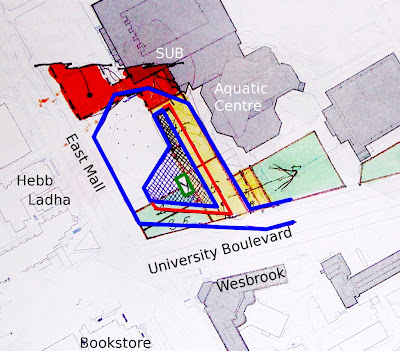
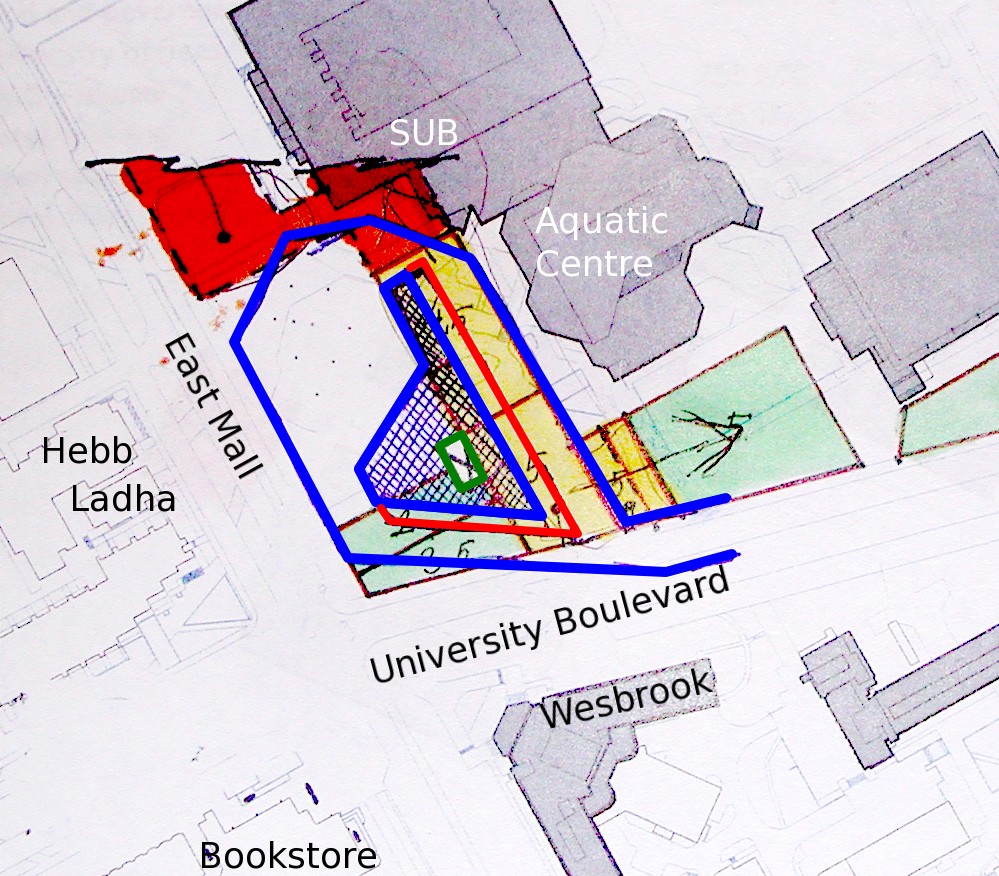
The image shows the approximate outline of the bus terminal (blue) and its waiting area (blue with cross-hatching), the platforms where people get onto and off of buses (red), and the part of the waiting area that’s open to the outside world (dark green), which is basically all stairway. (The shaded areas represent one scheme under consideration for buildings that could go in the area, including a new SUB.)

Convenience

The point of having a central terminal is convenience, and the current design has shortcomings in that regard. The electric trolley buses get a separate loop on the street half a block away, because the terminal is not large enough for them. If the trolleys shared the terminal, riders could decide on the fly which bus to take, based on lineups and timing. If the trolleys instead looped around campus, we’d have a convenient and frequent campus shuttle network. Neither opportunity is being taken.

A wide variety of explanations have been given for why trolleys can’t be accommodated within the terminal, and some have been quite imaginative. The current line is that they require additional depth for the trolley poles and would cause delays. I understand that both of these reasons are incorrect (and note that they’d be fairly easily solved). It’s actually quite simple — the terminal as currently designed isn’t large enough to hold all the buses, and making it larger would cost money. Particularly if it were expanded under the East Mall sidewalk, where the main campus IT spine is, or downward to allow a second floor. While cost increases from $17M to $50M aren’t enough to trigger a rethink, tossing an extra $5-10M into the hole to accommodate the rest of the buses would apparently be outrageous. The trolleys’ overhead wiring and the possibility of their poles coming off got them kicked out first (note that the new trolleys automatically retract their poles if they come off the wires).

Putting campus shuttle buses in the terminal has never been seriously considered — a more sensible place for them is on the street near the top of the stairs, particularly if they’re on loops that involve East Mall. This means that we’ll have a shuttle bus loop, a bus terminal, and a trolley loop, all hopefully within a block of each other.

Aesthetics

More than half of all students get around by bus, and transit is the single most popular means for getting to campus. The grand entrance to campus will be a diesel-soot-blackened tunnel, followed by a well-lit and possibly well-finished crowded concrete basement. The original reasoning was to free up the surface for shopping, parking and a plaza.

The only groups who want cars in this area are the Aquatic Centre, who have a legitimate need for drop-off access, the Alumni Association, who would like drop-off access and short-term (15 minute) parking if possible, and the Bookstore, who believe that their ability to stay solvent relies upon people being able to park immediately outside their door. If the Bookstore’s business model is inconsistent with their location on campus, the solution is to change their business model or location, not campus.

In my opinion, this is not a suitable main entrance for the campus.

Technical Issues: Capacity

The biggest problem with the terminal is capacity.

If you ask UBC’s planning department “who looked into whether the capacity would be adequate to meet the demand?”, they’ll tell you TransLink spent $250 000 on studies looking to this and other issues. If you ask Tr
ansLink’s planning department where they got the ridership demand and bus numbers required for these studies, they’ll tell you the bus numbers were based on 2005 service levels plus 2% annual inflation, and the ridership demand was based on UBC’s projections.

This circular logic means that ridership estimates are, to this day, based on pre-U-Pass estimates that badly misjudged the effect of U-Pass, while TransLink’s bus numbers assume that the level of bus service in 2005 was adequate, and service levels should increase by 2% per year thereafter with inflation.

In UBC’s 2003 Campus Transit Plan, projections indicated that the student U-Pass would increase ridership by 28% initially, settling out at 38% by 2011. I recall a modified projection that assumed the first four years of U-Pass to have 130%, 140%, 150%, and 160% of the baseline ridership respectively, as drivers graduated and transit riders came in, but I can’t find a reference to this. Regardless, the increase in transit ridership in just the first year of U-Pass was 53% — significantly larger than projected. This past fall’s ridership counts put the increase over 2002/2003 (the year before U-Pass) at 82%.

Our ridership projections have been updated to reflect what has happened so far, by assuming that ridership will hold dead flat for half a decade then resume its previously-calculated inflationary increases (calculations based on faculty/staff U-Passes before 2011). While I do not have access to a ridership projection graph, I do have bus projections calculated by the same method. Pay close attention to the horizontal axis:

So TransLink believes UBC’s demand projections because they don’t have anything better (UBC knows the ridership and can give them surveys), and UBC believes their own projections because TransLink presumably spent a quarter of a million dollars confirming them. UBC trusts TransLink to look into this sort of thing because they’d need the terminal to work, and TransLink assumes UBC must have, because UBC is paying for the terminal and any required fixes to it, and would have a strong interest in it working.

Based on my experience with the UBC routes, I’d say that there’s a significant latent demand. There are a lot of people who have to get on a bus very early or can’t get on a bus because the buses are too crowded, have switched to driving in frustration, or have adjusted their schedules to avoid rush hour. If we had adequate bus service, there would be more trips on transit and inbound trips would be concentrated about 10 minutes before classes start. The distribution of buses around the hour is important, because the design can only handle so many buses — it fails based on peak demand, not the demand averaged over two hours.

A further driver of demand will be fuel prices. As gasoline prices continue to rise, more people can be expected to consider transit. The gas price assumptions used to date have not proven particularly realistic.

A reasonable question might be whether TransLink anticipates improving service to UBC beyond the 2% per year that the terminal can accommodate through to 2018 or 2021. Well, the service improvements for 2008 are outlined in TransLink’s 2008 Transportation and Financial Plan

  • Improvements to U-Pass service, primarily on the 17, 25, 41, 49, 84, and 145 routes.
  • A new #33 route along 16th Avenue to UBC (this was originally planned for 16 buses per two-hour peak period, but the numbers for this year suggest to me about 12).
  • A new community shuttle route linking UBC with Broadway at Alma via Spanish Banks (this shouldn’t require space in the terminal).

On top of this, TransLink plans to upgrade the #43 to a #91 B-Line in the fall of 2009 when the Canada Line opens, and I’ve heard rumours that the 480 will likely be replaced at the same time by routes from Bridgeport Station and Steveston. I don’t have enough information to calculate how many buses per two-hour peak period all these improvements would come to, and I don’t even know how many we had this spring, but we’re exceeding 2% inflation by a pretty substantial margin regardless.

A few words must also be said on what “capacity” means, because the report from TransLink’s consultants suggested the terminal would not be at capacity if the trolleys were removed. Amongst other metrics, the terminal is not considered to be at capacity if the line-up to get into it in peak periods does not extend into the intersection at Wesbrook, 19 bus-lengths back, more than 5% of the time. The simulations assumed that buses arriving Not in Service would be held at Blanca Loop or on 16th Avenue to mitigate a lack of storage capacity in the terminal, and several other parameters had to be fine-tuned for efficiency, such as stoplight cycles at two separate lights. “Capacity” is the absolute breaking point for the terminal under the best possible conditions. Capacity was found to be 218-221 buses per 2-hour PM peak period (this might be a good time to refer back to UBC’s bus estimates bar graph). It’s not clear to me whether the simulations took account of such rare occurences as wheelchairs, bikes, school groups, or people asking for directions, but it has been indicated to me that bikes would likely be barred from the terminal during peak times to save space and time.

On the passenger side, capacity is defined more arbitrarily, based on crowding (and there is an assumption that many people will wait upstairs in the plaza). With the trolleys removed, the crowding is projected to fall to more-or-less acceptable levels. I’m fairly certain bikes weren’t included in these simulations, and I’m not sure about wheelchairs.

Even if the likely-incorrect demand numbers and bus projections are to be believed, the terminal is designed to run near the breaking point basically from day one, and must be bailed out by SkyTrain after about a decade. Its design does not otherwise anticipate rail, and leaves no room on University Boulevard between Wesbrook and East Malls for trenches or foundations if grade-separated rail (e.g. SkyTrain) were to be added.

Solving this would need to involve a ridership demand study, preferably including a user survey. If my suspicions are correct and the terminal as designed is too small, new design options would need to be looked at. I’d much rather risk being proven wrong by a $20 000 study than proven right and having a good “I told you so” a few years from now.

Technical Issues: Driving on the Left
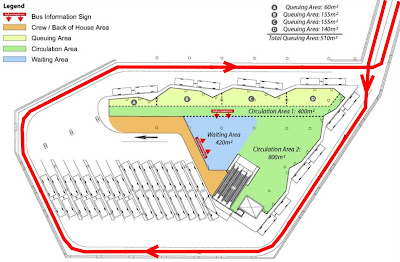
Another amusing aspect of the design is that, for the sake of space-efficiency, there is one central pedestrian platform, which the buses drive around. This means the buses are effectively driving on the left, and they have to cross over. I’ve tossed in an image tracing out the path of a bus that does a loop through the terminal without stopping, and you’ll note that this path crosses itself where the ramp meets the terminal. This is handled with a stoplight, and one of its stop lines is at the front of a pick-up bay. Several interesting problems can arise from this, including blocking access to that bus bay, delays, crashes, and light cycles wasted because a bus stopped too far forward and blocked traffic in the other direction. I can even imagine a scenario where one bus tries to go around another bus that’s too far forward, but can’t make it, requiring several other buses to back up. Regardless, I’d expect this
part of the design to be a serious problem. TransLink’s consultants’ simulation suggested other things would limit capacity first. In any case, it doesn’t need to be there.

The ramp in the tunnel is designed to have a fairly shallow slope, giving outbound buses a good run at Wesbrook. Coming into the terminal, I see no reason for a gentle grade. The buses should be able to pass over each other instead of through, and this should be cheaper and more space-efficient to build. Nobody has thought about this problem in three dimensions.

It’s not just the ramp — so far, nobody has thought about the terminal design itself in three dimensions. The pedestrian area could be on the surface with storage below, the storage could be multi-level, or loading and unloading of passengers could happen at different levels (loading on top, for safety and to give the buses a better run at Wesbrook). If the capacity turned out to be an issue, I’d hope that options such as these would be considered in any rethink.

Other Technical Issues

I should point out that the entire terminal relies upon a computer system that manages all buses to the second, requires an operator at peak times to fine-tune it on the fly, and which is so specialized that it will take two years to design and purchase. Buses are notoriously bad at exact timing around here.

For a fun exercise, try coming up with a list of everything involved that runs on electricity (e.g. stoplights, electric doors, the massive ventilation fans feeding an exhaust flue with a 200 square foot cross-section, etc.). Now, what on that list has to be on emergency backup power so the terminal can operate in a blackout? I haven’t seen an emergency generator in the plans so far, but they’re not very detailed yet. The generator would be the size of a small moving van, would need to vent fumes, and would require a fuel tank buried somewhere where it can be excavated.

Finally, if there is a bus terminal resembling this anywhere in the world, none of the army of consultants has found it. This design has 1/3 the bus bays and 3-4 times the passenger flow of any comparator. While I like being leading-edge, getting this far out in front of the rest of the world means we need to pay a great deal of attention to every possible detail — everything’s new and untested. Very few systems work exactly as planned from the very first prototype, and this is definitely the first prototype.

Funding

UBC is paying 80% of the capital costs for a TransLink bus terminal, mainly from infrastructure charges on market housing developments. This piece is $31M that would otherwise either be in the endowment, building childcare, beautifying campus, or creating social space. A bus terminal may be nice to have, but $31M nice? Is a student more likely to drop out of school from lack of childcare, or from an extra block’s walk in the rain? So far as I can tell, nobody has looked into the possibility of getting government money for this project. Oh, and who’s on the hook for cost overruns or repairs due to shortcomings in the design? UBC. If the terminal’s too small and an extra third or fourth bus loop has to be built elsewhere for the rest of the demand, who pays? UBC. If it has to be replaced within 40 years, who pays? UBC. I find this mind-boggling.

The bus terminal must be done right. If it feels unsafe, doesn’t function, isn’t what students want, or breaks the bank, it will be a very expensive mistake. Given that we’re putting buildings on top of it, it can’t be expanded or repaired. We only have one shot at this.

Categories
Academic Life Government

Welcome to the University club

News and analysis by Tariq Ahmed, UBC law graduate and former Senator.

Depending on how deeply buried in the library you’ve been for the last few weeks, you may have heard about Premier Campbell’s trip around the province waving his magic wand and turning everything short of a high school into a “university”. If you want to play catch-up, check out the premier’s media gallery for confetti-filled photos and cut-and-paste news releases that go beyond the recommendations of Campus 2020 report, which included only three new teaching intensive “regional universities”.

Pretty well any media coverage that’s done more than simply reprint part of the government press release has done a good job of going behind the photo-op to look at what (if anything) these changes mean. Of note are The Vancouver Sun, the always great Vaughn Palmer, the Victoria Times Colonist (bonus points for referencing Spinal Tap), the Georgia Straight, and Macleans On Campus.

I don’t really have much I can add to the pieces, but the idea of studying welding or hair-dressing at a university seems counterintuitive to me. I have a great respect for trades and colleges in general, but don’t know that these are programs reflect the culture of research and inquiry typically associated with universities in this part of the world. I’d be interested to know what kind of support these announcements have from students at these institutions since there seems to have been little mention of that so far. A few quick and cursory Google searches yielded little beside a supportive statement) from the UCFV student union and a letter from a student at Malaspina who is against the new name complaining that “VIU sounds like a serious infection”.

What’s also a little distressing is the degree to which these universities to-be have allowed themselves to become pre-writ publicity for the Premier. The current Emily Carr, Kwantlen College and Capilano College webpages have even more beaming Gordon Campbell that the BC Liberal website. The University College of the Fraser Valley and Malaspina deserve props for doing things in a much more non-partisan manner. Though perhaps the former group is just getting a head start on the buttering-up since they’ve come to realize how desperate they’ll be for more money!

Despite what Facebook says (apparently there’s already a University of the Fraser Valley network – cart, what are you doing there in front of the horse?), these new universities have yet to come into existence. Last week Bill 34, the University Amendment Act, 2008 was introduced in the legislature and is at first reading, release here. There are few things in here that are probably of little interest to anyone but a nerd like me, but I’ll mention them anyway, behind the jump:

  • The creation of a new tier for the renamed schools: “special purpose, teaching university” (“SPTU”).
  • What’s interesting is that these amendments will give the government the authority to designate other schools as SPTUs by Order in Council, so other such sprees could occur on a whim (hello University of Spuzzum!). This is different from the “Old Four” (UBC, SFU, UVic and UNBC; but not TRU which has its own act) whose existence is specifically enshrined in the University Act (“the Act”), meaning changes are tougher to make.
  • Chancellors at all universities (including UBC) will no longer be elected by the convocation (which is mainly made up of alumni), but rather “appointed by the board on nomination by the alumni association and after consultation with the senate or, in the case of the University of British Columbia, after consultation with the council [of senates]”. This may allow for some administrative convenience (UBC has been without a Chancellor for months), but seems to send the message that alumni have little place in guiding their alma matter (well except for phone calls at dinner time asking you to donate money).

    [extremely nerdy Peets-esque side note: Section 17 of the current Act says that “[t]he chancellor is to confer all degrees”. Ms. Morgan-Silvester’s term doesn’t start until July. Section 13 sets out that “[t]he president of the university holds the office of vice chancellor”, but doesn’t set out what duties (if any) a vice chancellor is to perform, while explicitly saying what the chancellor is to do. I could see arguments going both ways, but I’m left wondering if the degrees that are to be granted at this Spring’s congregation are even valid by law…]

  • Composition of the SPTU senates will be significantly different than at the “Old Four” (though they share the same BoG structure). Among the changes, SPTU senates will have fewer faculty members, far fewer students, far fewer alumni, but the addition of support staff and a non-voting board-appointed member seats. Seems a little surprising that given the mandate of a “teaching university” there’d be a desire for less input from teachers and students in deciding academic matters!
  • There are also some differences in the responsibilities given to SPTU senates. I won’t list them all, but the general theme is a shift to less senate power and more board control. I think there’s room for relief that the “traditional” university senates were not reformed in such a way.
  • The differences between the intended functions of the “old four” and “special purpose, teaching” universities becomes clear. Traditional universities currently have a wide mandate under the Act to “provide instruction in all branches of knowledge”, to “establish facilities for the pursuit of original research in all branches of knowledge”, to “provide a program of continuing education in all academic and cultural fields throughout British Columbia” and so on. SPTUs, on the other hand, have no such freedom or mandate. They are to teach only what and where the government tells them, and again this can be changed on a whim.
  • There are consequential and related changes to other acts, the most noteworthy of which is the renaming of the TRU (which is governed by a separate Thompson Rivers University Act) university council to a senate. Unfortunately for TRU students, the re-christened senate won’t have any expanded student representation. Like the SPTUs its senate will have a limited student voice with four elected students.

It will certainly be interesting to see what these changes will bring in the coming months and years and whether the government will approach the other recommendations in the Campus 2020 report with the same enthusiasm. Achieving parity of Aboriginal post-secondary outcomes by 2020, for example, will require more than a name change and some confetti.

Categories
Site News

Question Period!

Hey gang!

I’m working on the new version of the site, and I’m wondering what you want to see out of it. Final decisions will rest with the editorial board but we’re open to suggestions.

Spam prevention powered by Akismet