Categories
AMS

AMS Council Agenda: July 8, 2009

Since the AMS has not yet mastered the art of putting meeting dates and agendas online yet, the next one is:

Wednesday, July 8, 2009. 6 PM. SUB 206.

Agenda

The most interesting thing will be a presentation from Michelle Aucoin, Director of the UBC 2010 Olympic and Paralympic Secretariat about what to expect when the Olympics happen on campus. If you or anyone you know is curious or concerned about the impacts of the Olympics at UBC, I encourage you show up, and to spread the word! TIP: there’s also free food. If you spread the word about that as well, you may have more success.

For example, UBC released a memo outlining how fields in Thunderbird Park are getting paved over for the duration of the Games. The fields will be handed over to VANOC July 17, 2009.

Categories
AMS

AMS Council: June 17, 2009

AMS council tonight. Highlights:

  • Provincial Elections campaign budget revealed
  • Executive quarterly reports released
  • Student Court appointments


It’s a proxy party tonight. Low turnout, lots of substitutes. Leftover food also means a weird dinner combination: Pi-R-Squared with smoked salmon appetizers.

CASA Conference Recap

First up was a presentation to recap the recent CASA policy conference in Calgary. However, the presentation by Blake and Tim, which lasted just shy of forever, spent a lot of time outlining a laundry list of complaints about CASA, all of which have been brought up before. Less time was devoted to what actually occurred at the conference. Summary: Tim and Blake don’t like CASA. I would also suspect CASA doesn’t like Tim and Blake.

Some division within the executive was made apparent immediately when Tom Dvorak stated that CASA sent a letter addressing the AMS’s concerns in late April and that this letter was not shared with other executives or council. Hmmm.

Plenty of boring discussion (if you really care, I can send you notes), but the quote of the night came from Bijan:

“When students go to conferences, they like to have sex. There’s something about having sex with someone you’ll never see again that’s exciting.”

I could put it in context, but it’s so much better without it. Another great quote came from Jeremy McElroy, who noticed Blake’s constant negativity about CASA and asked: Did you have any fun in Ottawa?

In a show of more executive division, Johannes questioned where the numbers came from which outlined the cost of being CASA members, saying that the actual cost is much lower than claimed by Blake and Tim.

Lots of discussion; not much concrete came out of it, other than that documents need to be made available to everyone, and not hoarded. Also, this will continue to be an issue this year.

Provincial Election Campaign Presentation

Tim got up and gave a recap of the provincial election campaign that he ran. While there were successes including lot of work put into awareness and over 500 voters registered by the AMS, the most hotly anticipated part of this presentation was the budget for this campaign.

For background, I’ll refer you again to this Ubyssey editorial as well as a related radical beer tribune post. You can also read the recap from two council meetings ago about how part of this campaign was botched. And, as was confirmed tonight, it was at no small expense.

Without further ado, here is the budget breakdown:

[no idea why the huge gap is here]

Banners 616.85
Printing Costs 3,652.92
Ads in 24 Hrs 18,484.28
Bus Ads 3, 715.25
Website 2,627.29
Buttons 1,220.80
Design Services 445.70
Stickers 195.36
Hand Stamps 33.89
T-shirts 440.99
Videos 1,500.00
Campaigners 3,340.00
TOTAL 36.273.22

The ads in 24 Hrs (the newspaper) are absolutely mind-blowing. Geoff Costeloe was particularly enraged over this, calling it a crazy waste of money. I… concur.

Personally I also took issue with the fact that it took $2,600 to build this webiste. Andrew Carne pointed out that it was based on WordPress. I just buried my head in my hands at that point. Still, nothing compared to the money wasted on ads in 24 Hrs.

The budget is the subject of a Ubyssey article, but here’s the bottom line: it was a waste of money.

Executive Remarks

  • Blake’s Broadcast: 1st Quarterly Report available here; everything is in there.
  • VP External: 1st Quarterly Report available here; went to CASA conference; over 300 applications received for U-Pass subsidy; Translink is running “Be Part of the Plan”, encourage everyone to participate; looking forward to external policy committee meeting
  • VP Academic: 1st Quarterly Report available here; met with residence coordinator at UWaterloo, want to not only increase residence space but also its relevance; met with Michelle Aucoin about Olympics issues; hired student court; remodeled offices; working on TA training, university has allocated funding for it; met with fraternity and sorority representatives; reinstated University Commission
  • VP Finance: 1st Quarterly Report available here; AVP Catherine Metrycki did a lot of work to get a lot of stuff online; orientation for clubs with how to navigate AMS finance; looking at marketing for the upcoming year; attended alumni association retreat regarding alumni centre; looking at online payment systems to enable clubs to process credit card payments for memberships or events; Business Operations Committee is looking at Point-Of-Sale options, and AMS businesses contributed $1,114,981 to the AMS last year; preliminary budget prepped, found deficit, looking at budget reductions; budget will be presented next council meeting.
  • VP Admin: 1st Quarterly Report available here; met with student development about proposed renovations to Brock Hall; hired assistant
  • ECSS: missed this, but 1st Quarterly Report available here

Some Appointments-review stuff about salaries passed

Student Court Appointments

  • Emmanuelle Frederic – Chief Justice
  • Sara Askari – Judge
  • Feruza Abdajalieva – Judge
  • Alexander Cooke – Judge
  • Wilfred Chan – Judge
  • Adam Flanders – Alternate Judge
  • Jordan Snel – Alternate Judge
  • Constance Chan – Clerk

Conflict of Interest Motion

A motion came to council which would have required any member of council who also serves as a director of an organization which the AMS conducts business with to remove themselves from any In Camera sessions of council dealing with the other organization.

The goal appears to be the exclusion of UBC BoG reps, specifically Bijan, from In Camera sessions. However, while BoG is the most obvious example, there are probably other people on council who would also be affected by this and would also be required to sit out of In Camera sessions from time to time.

This was a Matt Naylor motion, who was not present tonight. His proxy, Alex Lougheed, did not feel comfortable motivating the motion since it was not his. I
t was eventually sent to Code and Policy. Should be interesting to see if this comes back to council sometime in the future.

Olympics Motion

Bijan brought a motion to invite Michelle Aucoin, who is in charge of Olympics stuff at UBC to present at the next council meeting for an hour. There should have been no discussion about this, but there was some. This also should have never been a motion in the first place, but it was. (Council doesn’t need to pass motions to invite people to present to council.) Anyways, next meeting, look forward to an hour of Olympics presentation/discussion.

Committee Appointments

  • Fundraising and Sponsorship Committee: John MacLean

Dave Tompkins: “Like the guy from Die Hard?” (Different speling, unfortunately. Dave looked it up on IMDB as a distraction from council.)

  • External Policy Committee: Dusty C.

Next meeting: July 8.

Categories
AMS

AMS Council: May 6, 2009

After a month-long break for exams, AMS council met tonight. Highlights:

1. AMS to reimburse AUS $35,062.04 for accumulated Arts County Fair debt.
2. Azim Wazeer, Joel Mertens and Josh Sealey recommended as new student senators
3. Lots of committee appointments
4. Whistler Lodge improvements
5. External Office to stop distributing some provincial election campaign materials deemed partisan, must remove some already-posted campaign materials deemed out of line with lobbying priorities

Since this is the start of a new year, in a way, there were many new faces and lots of introductions to be made. Dave Tompkins is speaker for another year. Sheldon proudly mentions that he and Dave are the only ones in the room who have been with the AMS since since the last century (last millennium actually, as someone else astutely pointed out.)

Executive Remarks:

Blake’s Broadcast: Lots of meetings with UBC admin; Block Party and Great Farm Trek; Hired a new assistant; Held student-staff appreciation lunch; New SUB negotiations with university are progressing, albeit slower than hoped for.

VP Finance: Looking at some renos to get some more office space; Block Party brought in ~$100,000 in revenues, but expenses were a bit higher than that; recently resolved a student fee issue that resulted in AMS getting ~$500k they were due; Blue Chip will be getting renovations to be fully equipped to do chilled drinks over the summer.

VP Admin: New SUB survey completed and results will be posted online soon in condensed, more readable form; new water fountains coming this month and will encompass both drinking fountains and bottle-filling stations; AMS will try to phase out bottled water at their outlets and sell AMS re-useable water bottles.

VP Academic/UA: Has been liaising with RCMP regarding olympic security and liquor policy issues; Sgt. Dan Wendland is gone with replacement coming this month; UNA and RCMP are working on a noise by-law to bring to the province; has been talking to provost and CUPE about TA training issues; NSSE founder will be making presentation tomorrow; who wants ice cream?

VP External: Lots of work on provincial election campaign; Translink AGM is coming up; looked into applicability of residential tenancy act on campus.

ECSS: mostly has been doing a whole lot of hiring for the upcoming year.

Code and Policy: Will look into why Code places restrictions on holding more than one AMS position at a time.

Senate Appointments: Student Senate Caucus went through a number of applications, did some interviews and ended up picking Azim Wazeer, Joel Mertens and Josh Sealy. There was some concern about whether the advertisement for this position was done, but given that way more people applied for the appointments than for the elections seems to indicate something was done right. Motion passed unanimously. Joel Mertens returns to council as Senate rep. Awkward moment: Guillaume Houle tried to get Geoff Costeloe to say that the meeting to pick the new senators took place during a hockey game, to no avail.

SUS Referendum Results: SUS recently had passed a referendum to index their student fee to CCPI (Canadian Consumer Price Index) and needs AMS to rubber stamp this. There are multiple versions of the CCPI; some debate over which one to use since it was not specified in the referendum question. Although SUS finances were admittedly fine, they feel is more sustainable and hopefully saves them from going to referendum every few years to raise it. SUS is the first constituency to index their fee to inflation. Motion passed.

Arts County Fair Debt Repayment: As expected, discussion on this item was quite lengthy. I won’t summarize it right now and the arguments for and against are already known, I hope. Before I give myself carpal tunnel typing it all out, let’s see what the Ubyssey comes up with. End result: 23-7 in favour of repaying $35,062.04 to the AUS for accumulated Arts County Fair debt.

Commitee Appointments: Sorry for the lack of last names, but Dave generally doesn’t put them up, so if I don’t already know it, it won’t be there. Also, I apologize in advance since I’m certain there is a mistake or two in here.

CiTR: Duncan McHugh, Aaron Nakama, Tahara Bhate, Bijan Ahmadian
Irving K. Barber Library Stewardship Committee: Crystal Hon, Kyle Warwick
LEAD: Tahara Bhate, Bijan Ahmadian, Lin Watt
Oversight: Jimmy Yan, Joel Mertens, Laura Silvester, Kyle Warwick, Tony Yang
Budget Committee: Kyle Warwick, “Ben”, “K”
Appointments Review: Kat, Aaron Sihota, Tim Chu
Business Operations Committee: Guillaume Houle, Laura Silvester, Aaron Sihota, Joel Mertens, Hafiz Dossa
Impacts: Hannes Dempewolf, Madeleine Schaefer, Kyle Warwick
Sexual Assault Support Services Fund: Elena Kusaka, Pavani
Code and Policy: Andrew Carne, Tahara Bhate, Matt Naylor, Blake Frederick, Jeremy Wood, Emily Griffiths
Campus events committee: Fraser, Carolee Changfoot, Tony Yang, Lin Watt
Fundraising and sponsorship committee: Madeleine Schaefer, Tony Yang, Tagg Jefferson
Campus Planning and Development: Jeremy McElroy, Andrew carne, “Pierce”
Renovations Planning: Andrew Carne, Jimmy Yan, Carolee Changfoot
Sub Renew: Luke(GSS), Jeremy McElroy
AMS/GSS Health and Dental Plan Committee: Matt Naylor
Equity: Geoff Costeloe, Tim Chu, Kat
Executive Renumeration: Aaron Sihota, Jimmy Yan
External Policy Committee: Matt Naylor, Kat, Tahara Bhate, Kyle Warwick, Elena Kusaka, Kiran, Iggy Rodriguez

SAC Appointments:

SAC Member: Elin Tayyar
Bookings Commissioner: David Le
Buildings Commissioner: Kyle Lai
Special Projects Commissioner: Cindy Zhan
Art Gallery Commissioner: Jeremy Jaud
Club Commissioner: Elaine Chin
Administrative Commissioner: Sima Shoker

AMS Preliminary 2009/10 Budget: 2008/09 highlights include higher than expected business operations revenue ($1.165M) contributing to an extra $440k which is to be allocated to other funds. However, with the food-housing merger, the AMS expects to lose some of its conference catering business to UBC Housing and Food next year. 08/09 ended with a small surplus.
09/10 forecasts $13.8M of revenue, with another small surplus at the end of the year. Point of interest: Rogers will no longer be providing free Blackberrys to AMS executives.

AMS Whistler Lodge/ AMS Office Renovations:

1. $21,900 for the Whistler Lodge, including: $1,800 for bunk bed improvements to combat bed lice; $6,600 for painting and patching walls; $9,000 for carpeting; $3,000 to build a boot storage area near the lodge entrance.
2. $16,000 to move, divide and create some new offices in the SUB for some of their employees.

Code Changes 2009: VP Admin Assistant: Crystal gets to hire an assistant to maintain her sanity.

Appointments Review Committee: Concern expressed that $8/h is too low; how wages are set and hours calculated; differentiation between wage and salary positions; whether some positions are necessary. Mostly however, I was going through a post-11pm zone out for the majority of the discussion. Wages set for the following positions:

  1. Equity and Diversity Coordinator – $9.62/hr
  2. Assistant to VP Admin – $8/hr
  3. Executive Projects Assistant –$8/hr
  4. Internship Coordinator (AMS Connect Assistant Coordinator) – $10.23/hr
  5. Campus Development Commissioner –$8/hr
  6. First Year Seminar Commissioner – $8/hr
  7. International Students Commissioner – $8/hr
  8. Childcare Commissioner – $8/hr
  9. Olympics Commissioner – $8/hr
  10. AVP External – $10,380
    per annum”

Blake ceasing and desisting: You should probably just read the motion for yourself:

BIRT AMS Council direct the President to cease and desist any imposition of deadlines regarding the submission of motions above and beyond what is specifically enumerated in the AMS Code of Procedures, Bylaws and Constitution

This motion came from Matt Naylor. Background: AMS council meetings are always Wednesday evenings. Sometimes, motions would come up and councilors would claim that they were previously unaware of the motion or had not received supporting documentation. At Blake Frederick’s first meeting as president, he asked that agenda items be in by the previous Friday.

This was misinterpreted as being a hard deadline imposed unilaterally, when Code actually says agenda items must be in 72h prior to the meeting, which would be Sunday 6 pm. Blake stated that he was merely trying to give councilors the courtesy of extra time to look things over; he has never rejected motions that come in after Friday but meet the 72h timeline; he will gladly follow council’s wishes on this topic; felt a bit slighted that the motion came the way it was, he thought it would have been more appropriate as an informal discussion period.

Matt simply felt that sometimes committees need a bit more time to work on items and Friday was too early; he also didn’t intend the motion to sound as confrontational as it does; also felt that if the deadline needed to be changed it should come from Code and Policy, not the president.

A lot of councilors appreciated having the weekend to go over agenda items and the extra time available to consult with constituents, if necessary. Andrew Carne advocated for the pragmatic solution: send out preliminary agendas on Friday with as much as possible included (especially the more involved motions) with the final agenda sent out Monday. Sounds like a good plan. Motion failed 15-3.

External Lobbying: So maybe that $30,000 was not spent so well. This entry is too long already, so for background I will direct you to this Ubyssey editorial as well as a related radical beer tribune post. There was quite an in depth discussion, but I will kept it shallow cause I’m tired.

The AMS external office recently released a report card on the parties’ platforms in this election which was up on the AMS website. It has now been removed, but I’ve uploaded it here. Rating the parties? That makes the AMS look partisan when they are not supposed to be; extremely partisan since the BC liberals got a big fat F. Council decided to pull the report card off their website, and not distribute it anymore.

Also, have you seen ads like this around campus?
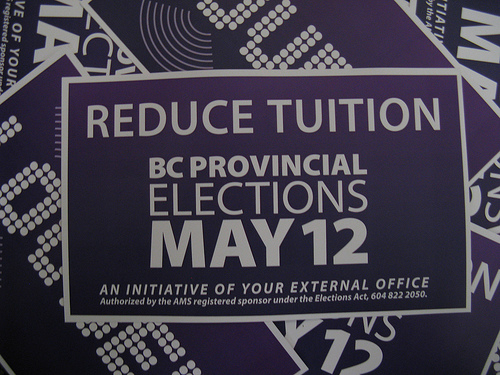
Banned!!!

Well, AMS council never said that lowering tuition fees was one of the principles they were lobbying on in this provincial election, so these posters are misrepresenting the AMS’s priorities. Not to mention only the Greens are promising tuition reduction so it could also be considered partisan. All of these posters are to be taken down.

Essentially, this boondoggle was all due to the fact that the external office didn’t follow proper procedures when putting together the campaign. It made a campaign based on the VPX’s priorities and judgement, not council’s or the External Policy Committee’s. So, the $30,000 spent on the provincial election campaign? A waste of resources on a partially botched campaign and the AMS admits it.

Class dismissed. Next Meeting May 27.

Categories
AMS CASA

CASA Membership Downgrade was the Right Move

In the post below, Maayan expressed shock that AMS Council would change it’s position in CASA “without due diligence”. I think that Council should be praised for its prudent political decision, not accused of haphazardly voting without thinking.

The concerns expressed by the AMS in the letter sent to CASA cannot be swept aside merely as minor. They are indicative of ongoing issues that AMS has had with CASA, which have yet to be resolved. The tone of discussions, language used, social activities, and unfair treatment of delegates at conferences are not problems that are easily reformable. They are part of the culture of CASA and require a serious and concerted introspection by the organization. More serious issues such as the AMS’s alignment of CASA’s policies and strategy, as well as concerns over CASA staff setting the political agenda of the organization rather than the delegates have been raised by the AMS in the past.

One of the major concerns with CASA not expressed in the letter is their decision to not run a federal election awareness campaign. Contrary to Maayan’s suggestion, the AMS did not vote in support of this move. Rather, former AMS representative to CASA Matt Naylor voiced his concern over the poor quality of CASA’s campaigns. The solution he suggested was to make the campaigns better, not eliminate them. This year the AMS had to run its own federal election campaign costing $12,000 without help from CASA, a reality that is particularly disturbing given that they are the AMS’s federal lobbying organization.

The AMS is also evaluating the benefit of being a part of a federal lobbying organization. No one has suggested that CASA should turn its attention to provincial matters, but with limited resources, the AMS has to make a choice whether to focus more extensively on federal lobbying or provincial lobbying. Plus, it’s quite possible that the AMS can do what CASA does, but better and more reflective of the AMS’s principles.

What’s the benefit of being in CASA? The argument that more students united together means more resources and more influence doesn’t apply so well here. As mentioned above, CASA isn’t acting as a useful resource for the AMS – certainly not to the tune of $60,000 per year of student money. The influence has been lacking too. It might be asserted that CASA is more adept at getting in meetings with decision makers in the federal government. While this might be true when the Liberals are in power, the AMS is just as adept as scheduling meetings with the government. During the recent federal election, the AMS met with and lobbied nearly every federal candidate in the Vancouver area. We are the largest student union in the country and that carries a lot of weight. The most significant benefit that the AMS receives from CASA is the ability to network with other student unions across the country. This benefit should not be underestimated, but being a part of CASA is not the only way to meet with other student politicians. There are conferences every year that student unions attend (including the AMS) to network with one another.

Let’s be clear about this though – the AMS is not leaving CASA, it’s stepping down to associate member status. What does this mean? It means we pay half the fees. It also means we lose our vote, which many will argue was virtually non-existent in the first place since the Eastern Block of CASA tends to band together and shut out the AMS. Most importantly, it sends a strong message to CASA that the AMS is serious about its concerns. CASA’s response will largely dictate whether the AMS decides to stay or go – it’s really up to them. CASA’s national director, Zach Churchill, will get his chance to respond to the AMS this Wednesday.

Disclosure: Blake is employed by the AMS as Stef Ratjen’s assistant.

Categories
AMS CASA

AMS Council Votes to Change CASA Membership

In an apparent unanimous decision, AMS Council voted tonight to change its membership in CASA from full member to associate member. (View the AMS’s press release here.)

The AMS is one of the five founding members of CASA, the Canadian Alliance of Student Associations, a student federal lobby organization that is predicated on four main principles: 1) member driven policy setting 2) exclusive focus on post-secondary issues 3) fair membership regulations 4) exclusive focus on matters under federal jurisdiction.

The issues that the AMS has with CASA were expressed in a recent letter sent to the organization’s national director. The letter as well as CASA’s response can be found here:

AMS Letter to CASA (Aug 13 08)
CASA Response Letter to AMS (Sep 22 08)

Among the issues discussed in the letter as well as in an ensuing AMS working group are: staff setting the political agenda, respect for all delegates, troublesome bias in information documents, cost of membership vs. benefits received, the prioritization of federal lobbying over provincial lobbying, the decision by CASA to not run campaigns, and the AMS’s opposition to CASA’s new constitution.

The change in membership effectively means that the AMS will pay half of the regular membership fees, not receive a vote, but still be invited as a delegate to conferences. The move was designed to send a clear message to CASA that the AMS is serious about the concerns it has voiced with the student lobby organization, which have been largely ignored thus far.

Dropping to associate member allows the AMS to proceed with dropping out of CASA entirely next year, going back to full member status, or remain at associate member status.

Categories
AMS Student Movement Student Politics

An Open Letter to the AMS

Sometimes in times of crisis it’s important to look at the big picture. So that’s what I’m going to attempt here. Make no mistake – the AMS has as fundamental a crisis as it can realistically expect to face. Since it has mandatory membership its very existence is not at stake, but its ability to make a positive change for students, either by lobbying or by campus presence, is very much at risk.

The AMS’ credibility is shot. The Lougheed and Bonfire Affairs have pretty much turned the AMS into as much of a joke as possible. Students generally used to be fairly ambivalent; it’s safe to say that the tide has turned. Students on all sides of the political spectrum have some serious grievance or other against the Society, and students in the middle are completely and entirely alienated by the insane and fractious factionalism that makes the U.S. House of Representatives look downright civil by comparison. Indeed, the only unifying belief is that the AMS isn’t worth students’ time. Not only has the AMS lost respect of students, it’s also lost the respect of those with whom it needs to have a productive relationship – the media, the University, various authorities, and the community at large. And so much time will have been spent on damage control, diverting energies from worthwhile reforms.

The root cause is the unnecessarily bitter factionalism that’s driven a wedge within the society. What began as an ideological cleavage has rapidly descended into the poisonous, petty politics of personal vendettas. While tempting, there’s no need to blame anything else.

There’s an upside – the AMS is still a relatively healthy society, and students have many reasons to appreciate it. It’s still in good financial shape, just passed a transformative referendum, and was on its way to becoming the centre of campus discourse once again. Moreover, the AMS has an opportunity this week, with a Council meeting and the Block Party, to take the first steps to make it right.

There are some relatively easy steps to take. My rules:

  1. A joint statement, signed by all the AMS execs. State what you agree on, and the areas that you can work on together to improve students’ lives.
  2. Don’t suppress debate – you’re not going to agree on everything. But, when there’s a disagreement, and it’s intractable, put it aside for a couple weeks. A month. Take a cooling-off period, and spend this Council meeting looking for common ground. If people are disagreeing on something fundamental – move on.
  3. Let the exec do its job. That’s hugely critical at this time. And let the exec speak for the AMS.
  4. Circle the wagons. You don’t have to become mindless cheerleaders, but make it known when you support each other. Again, find common ground.
  5. Pay attention to words. No ad hominem remarks about who’s sleeping with whom, or that people don’t respect democracy, or are reckless. If a word gets a negative reaction from someone – drop it. Antagonizing people gets us nowhere.
  6. No gossip. Scandal and gossip are fun and as “fun” as things get for student politicians, but right now, they’re adding fuel to the fire.
  7. Run a kick-ass Block Party. Channel your energy there, and give students an amazing send-off to the year. Be relevant!

But first, it’ll require one side to “blink.” In every intractable dispute, some party needs to be the first to stand down. Or at least take a step towards it. Please – do it. I’m not calling for a homogeneity of ideas, just a cooling-off period, and a focusing of the ideological cleavage in a productive way. Diversity of ideas breeds good policy and debate, but that can only happen if you find common ground to channel it. Mark my words – nothing constructive will happen this (exec) year without some consensus. The next few years of the AMS, and the student movement at UBC for the near future, depend on you.

Categories
AMS News

March 2008 AMS Referendum results

Due to a hole in WordPress, this post’s author is misattributed. The follow was written by former Insiders editor Maayan Kreitzman.

Don’t forget the below posts. It’s a busy week!

Well, unoficial results are in, and all the questions have been approved with a majority ‘yes’ vote. Here are the numbers:

Overall turnout: 44%
Total votes: 18,446

U-Pass renewal NO: 500 YES: 17,945 ; 97.2% in favour
Bylaw reforms NO: 1284 YES: 4357 ; 77.3% in favour
WUSC (student refugee subsidy) NO: 2162 YES: 8363 ; 79.4% in favour
SUB renewal fee NO: 6228 YES: 7342; 54% in favour

Good overall turnout – the quorum of 10% of daytime students was met in every question easily. SUB renewal fee passed by a very thin margin. I suspect the AMS will have to do a helluva good consultation to create the level of buy-in that’s really needed. 54% isn’t great – particularly considering that all the students that voted will be paying $40/year max towards the building (not much compared to the cost to future cycles of students). More discussion of SUB renew to come.

Categories
AMS

Re-thinking referenda

Today is the last day to vote in this year’s AMS referendum. The results of the four questions will determine if we continue to have a U-pass program, if we’ll start subsidizing refugee students, if we’ll build a new SUB, and if we’ll make some by-law changes. The reason you need to we cajoled, marketed, and advertised into voting in this referendum by everything from t-shirts to 99 B-line ads is that according to the AMS’s bylaws, certain things cannot be enacted by a simple vote of council, but need to get a mandate from students directly through a referendum. These things are any fee increases, and any changes to the bylaws themselves. Since referenda are expensive to run, inherently risky results-wise, and have a high quorum level (10% of students), they often fail.

Referenda used to be run more often (about once a year) before the advent of the U-pass. They failed quite often due to lack of quorum, or lack of support (I’ll update with numbers as soon as I find out). Now, the AMS is running referenda less often, to coincide with the U-pass renewals every three years, which draw large numbers of voters. That means that other question can piggy-back on the U-pass and basically ensure quorum.

Now that’s fine as far as it goes, but here’s a different idea for how referenda can be used. Instead of once every while, and only when absolutely necessary for a fee or by-law change, a new type of referendum system could be invented to help with the democratic deficit in the AMS. As we all know, the AMS isn’t especially representative because of low voter turnout, ignorance, and apathy. And this ultimately erodes the AMS’s efficacy and power as a democratic organization. Imagine a real direct democracy system that asked students about issues. Regular yearly or bi-yearly referenda on issues would certainly draw lower voter turnout than a U-pass renewal for instance, but they would give the AMS clear mandates to address various types of topics in a certain way. The results of such referenda need not even be technically binding – they could be “consultative referenda” of sorts. A win could result in automatic placement on AMS council’s agenda. If a question on such a consultative referendum had a lot of support, there would be political pressure in council to enact whatever it is. The point is to get ideas and issues to filter up from the grassroots student towards the AMS through a more populist issues-focused process than elections, which tend to be more about personality and networks. For this to work, many details would have to be thought out: how to qualify for placement on the ballot, how to administer/fund regular referenda, how much clout the results should be given, and so on.

Essentially though, direct democracy may have benefits to the AMS in terms of political engagement. Right now, I wouldn’t say that it’s impossible to get something onto council’s agenda as a normal student (if you go through an executive), but there’s certainly no established process for doing so. And even if something does get on the agenda, councilors are often unsure of what the popular opinion toward it would be. A regular consultative referendum system would provide both a mechanism to filter ideas up through the organization, and provide political consensus behind them. Some countries (New Zealand, Switzerland) have frequent policy referenda. Perhaps we can learn from them.

Categories
AMS AMS Elections 2008 VP Academic

What to learn from the Crompton Lougheed affair

Due to a hole in WordPress, this post’s author is misattributed. The follow was written by Maayan Kreitzman.

The world has gone mad. I don’t check comments for one day while working on a paper, and when I return there’s a frenzy! Anyway. There’s plenty of discussion in the below post about any and all aspects of this controversy. I want to zoom out and offer a few things we can take away from this episode.

1. Elections code needs to be tightened up: get rid of the ambiguity about 1 person 1 vote. Is the onus on the elections committee to ensure this, or is every person only allowed to cast one ballot, or both? Is there a functional difference between a cast ballot, and a counted vote? These are extremely easy to clarify.

2. Student Court should have its own appeals process, and its ruling should not have to be approved by council automatically, unless council specifically wants to call something in in order to overrule it (akin to a notwithstanding clause). AMS council should have a more defined role vis-a-vis the court – is it just an “advisory body” as some say, or is a real “independent judiciary“?

3. The AMS is vulnerable to cronyism, terrible PR, and political/personal motivations. Fact of life that ain’t going away

4. On the other hand, AMS council will, (maybe even when they technically should not) make decisions that best serve students – in this way, councilors are actually fairly enlightened. This decision is an example: a lot of councilors I talked to made their decisions on the basis of what would make the AMS most functional and best for students this year. Though you can make legalistic arguments for either side here, I defy anyone to claim that disqualifying Alex over this and then running a by-election in the middle of exams, or in September would best serve students. Or worse, that running a petition (as Nathan Crompton is currently doing) to get Alex impeached will ultimately serve students best.

5. Code is important. Procedure is important. Communication and honesty is important. When process falls down, the real issue is that much harder to tease apart and evaluate. An example here is that while the case was actually “Crompton vs. Elections Administrator,” Alex Lougheed was the one being essentially judged. All sorts of bad communication and confusing processes occurred as a result.

    Now, lets all move on, shall we?

    Categories
    AMS Student Politics

    Point: focus on the Knolligarchy

    An opinion piece by Jesse Ferreras, M.J. Candidate, UBC School of Journalism. Counterpoint coming next week.

    There’s a war on truth at this University, and a resurgent movement of leftist radicals is fighting on its front line. I’m speaking, of course, about the Knolligarchy, formerly a joke name that now encompasses UBC’s newly-visible activist front. It’s a group of people affiliated with the AMS Resource Groups that is hot off a “Resisting the University” conference, which culminated today with a march of about a dozen people and an invasion of a meeting in the Board of Governors chambers (to the amusement of all those present.)

    First off, let’s give credit where it’s due. The activist well had run dry at this university – it’s been years since a decent protest has been held anywhere on the Point Grey campus, at least since the quiet, passive protests that came in advance of the Iraq War. In this context, the Knolligarchy is a breath of fresh air. They’ve managed to inject just a little bit of excitement into campus life with events such as Trek Park and Trek Park 2.0, as well as the recent conference. It was music to my ears to hear an activist yelling into a megaphone and leading a march across campus last Friday. It at least gave me the impression something was happening.

    But that’s enough credit. Let’s cut to the facts.

    The Knolligarchy gets its namesake from The Knoll, a partisan campus publication that seems to avoid editing and facts as a matter of editorial policy. Describing itself as a “Weekly” (a “Monthly” might be more accurate) it is published through the AMS Resource Groups. The groups collectively receive $1.50 per student per annum, according to outgoing VP Finance Brittany Tyson. This year the I can’t be sure of the amount of money that goes specifically to publishing the Knoll, but it must come from somewhere within that $1.50.

    This money is put towards a publication that advertises itself as partisan news coverage and thereafter sets out on espousing what can be more accurately called revolutionary fervour than news, more anonymous articles than journalistic agency. They don’t, however, get their message out solely through the publication – they also do it through public appearances and direct action techniques.

    An example is a little episode in the Ubyssey office in early January. Stefanie Ratjen, Jasmine Ramze Rezaee and Nate Crompton, three of the Knolligarchy’s most prominent members, came into the office to complain about the front page of its first issue in 2008. The top story, splashed across the top of the paper, was “Activists vandalize Ponderosa complex,” accompanied by pictures of broken glass. Beneath it, to the left, was “Trek Park bulldozed,” a story about the mysterious razing of the Trek Park installation.

    Crompton, Ratjen and Ramze Rezaee, despite having a story on the front page, complained that the Ubyssey hadn’t put the Trek Park story at the top. They were unhappy about the association given to activists by placing the story at the top (a fair complaint) but also that the Trek Park story, despite being devoid of a good photo to accompany it, was not placed at the top. Crompton went on to complain that “I said all these interesting things,” going so far as to call the issue a “fraud.” Nate argued that the University had “declared war” on Trek Park, notably ignoring the fact that their protest had devolved into a trash heap after the elements caught up with it over the course of several months. The three of them left the office clearly dissatisfied with the dialogue they had with me and a few Ubyssey editors, with Ramze Rezaee remarking, “I hoped to get more out of this conversation.”

    The campaign of misinformation began in earnest MKduring the AMS elections. Language is always subjective and contentious, but this group of students has taken misleading rhetoric at UBC to embarrassing new heights.

    Stefanie Ratjen made grand overtures to students, spreading falsehoods like “Translink is a private corporation” until I called her on it on my blog. Ramze Rezaee was at her side throughout the campaign, at one point asking VP Academic candidates what they felt about military funding for the International Relations program. IRSA president Gordon Hawkins saved students the trouble of swallowing this tripe when he corrected her publicly, saying that the Liu Institute for the Study of Global Issues receives funding from the Department of National Defence, and not the IR program. Ramze Rezaee exclaimed, “It’s the same thing!”

    The lies propagated by members of the Knolligarchy reached their peak when Ramze Rezaee created “Freeman Poritz Watch,” a Facebook group devoted to ruining his campaign for VP External, and had a curious similarity with the anti-Semitic “Jew Watch” website that Poritz himself noted. The group was registered under the name “Sandra Davidson” but the fact of its creation showed up in Ramze Rezaee’s Facebook mini-feed when she started it. In the group’s description she castigated Freeman as “anti-woman,” “militaristic,” a “frat boy” and “xenophobic,” with nothing credible to support the latter claim (the reason, if I remember correctly, was his unfortunate comment about feeling cheated that international students get their degrees and then leave – an impulsive comment, to be sure, but hardly xenophobic.) Its members eventually included Nate Crompton and others involved in the Knolligarchy. At some point the site was taken down, but Freeman was undoubtedly hurt by its claims, notably its unwarranted accusation of xenophobia and its similarity to “Jew Watch” – an antisemitic website.

    Today we find the Knolligarchy in an unfettered quest for power at UBC – and they’re not afraid to get their hands dirty. Tristan Markle, your new VP Administration, got them covered with ink when he was caught on camera February 27 defacing posters near the Pit that read “I support Alex Lougheed!” with the added slogan “Right to Cheat.” The posters themselves have come in response to a complaint from Nate Crompton, who alleges that Lougheed voted for himself 12 times in the AMS elections for the position of VP Academic. The votes weren’t counted and the complaint came more than 72 hours after the election results were announced, thus nullifying the complaint according to AMS Code Section IX, Article 8 (1). Markle, however, is living on the hope that he can help put three members of the Knolligarchy on the AMS Executive, even though another election would likely have to be held if Lougheed was impeached, the only way he can be removed from his position at this point.

    The scariest thing about this is his tactics may be effective. If there is another byelection, I have little doubt that Nate will run again. And given the pathetic turnout of voters to byelections, as in the VP Admin campaign, he could very well win.

    The Knolligarchy’s strength resides in caring about the things that most students don’t. They rallied to Tristan Markle’s side for his election to be VP Admin and succeeded in putting him in office. I hadn’t previously believed it when Patrick Meehan told me the Knolligarchy could count for approximately 400 votes for any candidate – these days I’m more inclined to agree with him.

    In short, the Knolligarchy is a force to be reckoned with, and its publication, The Knoll, is a great avenue for them to get their message out. You’re helping it get out there by paying your AMS fees. A small amount of those fees are being placed towards the AMS Resource Groups, and a portion of that amount is ensuring that the Knolligarchy has a publication through which to advocate their leftist political leanings. It’s starting to succeed to the same degree that Conrad Black did in making Canada a more conservative place when he started the National Post – of cour
    se, he wasn’t funded out of the public purse. It won’t stop until someone reviews how funds are being allocated to the AMS Resource Groups – and specifically, the Knoll.

    In any other governmental system, it’s deeply unethical to put public funds towards a partisan cause. Here, purely by paying your AMS fees on top of your tuition, that’s exactly what’s happening. Those fees are being towards the AMS Resource Groups and subsequently the Knoll, which is in turn publishing reasons why its friends and close acquaintances should hold public office at UBC. It’s like the Government of Canada, rather than the Conservative Party, using a pamphlet to campaign for Stephen Harper. Why should students get away with it?

    Activism certainly has a place on this campus – without the Great Trek, we wouldn’t be studying or living in the buildings that we’re in today. But truth deserves a place here too – and the Knolligarchy doesn’t seem too keen to let it stand in the way of its actions.

    Spam prevention powered by Akismet