Categories
Campus Life Student Politics

GSS Handbook Upheld

Nothing like a little controversy to start the fresh school year off! The Graduate Student Society (GSS), like the AMS, releases an agenda and handbook that’s distributed to students for free every year. This year they asked a well-known campus activist, Nathan Crompton, to put it together. Supervising it was the GSS Handbook Committee chaired by GSS VP Student Services, Rodrigo Ferrari-Nunes.

The Handbook has been printed at a cost of at least $20,000. In addition to normal stuff like an intro to student services and an agenda, the handbook features a critical, cynical and satirical history of UBC and numerous assertions about the university’s profit-mongering raison d’etre. The content proved to be too “inappropriate” for GSS President Mona Maghsoodi though. In response, three members of the Executive decided to suspend distribution of the Handbooks and lock them in an unknown location. Although Mona would not return my calls and it has been noted in other publications that she declined to say which elements of the handbook are contentious, but said it’s not necessarily the “activist stuff.”

In response to the nature of the content, Nathan Crompton said that “there’s a certain level of satire. I don’t think it’s over the top.” He also expressed his views on the purpose of the handbook. “A lot of people see the handbook as a way to impress the president. We didn’t make that kind of handbook.”

Some people think the radical political content of the handbook is fine, and withholding it is “censorship”. Others find the content inappropriate for the handbook and objectionable in general. For me, the more interesting question is: How was this thing massively produced before being checked over? Presumably the president of a student society would weigh in on such a massively important publication before sending it to the printers. According to Nate, the editors did their work in the plain view of the GSS Executive. Editors held ‘Open House’ meetings, where executives were invited to review Handbook material, in addition to several Handbook presentations to the GSS Executive in which Executive members were informed that the Handbook would feature the activist history of UBC.

Since the the Handbook is the responsibility of the Handbook Committee and GSS Council, not the Executive, the final decision on whether or not to distribute the handbook lies with GSS Council. See the debate play out at tomorrow’s GSS Council meeting! Free beer!

Happily, we’ve got an electronic copy. You can download and take a look a the contraband handbook itself HERE .

What do you think? Good political critique of the university’s past and present, or overly negative and editorialized introduction for new grad students? What reflection does this fiasco have on the GSS as a whole?

Categories
Campus Life

UBC school of music takes a stand against CBC Radio 2 butchering

I admit, this is a topic that I would have written about regardless of the UBC angle. I’m that angry over it. And you should be too. Our wonderful public broadcaster needs to listen to its listeners, for once.

CBC management, with the wisdom of it’s lobotomized-gerbil brain trust, decided last Thursday to disband the CBC Radio Orchestra, the last remaining radio orchestra in North America. This move follows closely on the heels of a major overhaul of the Corp’s Radio 2 programming away from its core classical programs towards more “diverse” music. Basically, all the best classical programs from the morning and evening primetime slots have been axed, to be replaced with poppy “easy-listening” largely Canadian content. Classical programming will be relegated to daytime hours when most people are at school and work.

This morning around 10:00, 150 people gathered outside the CBC to protest these changes. Among them were UBC students and faculty from the school of music, who had their classes cancelled this morning in order to attend. Read about the protest HERE, and see a couple photos on Tod Maffin’s CBC blog HERE.

The “Save Classical Music at the CBC” facebook group summarizes the changes announced for Radio 2:

Gone are Music & Company – Tom Allen’s morning show, Here’s to You – Catherine Belyea’s (Formerly Shelley Solmes’) all-request show, Studio Sparks – due to the venerable Eric Friesen’s “retirement”, and Disc Drive – Jurgen Gothe’s popular drive-home show after almost 30 years. These changes come on the heels of last years round of cuts to vital programs such as Danielle Charbonneau’s much-loved Music for Awhile; Larry Lake’s new composer showcase Two New Hours; Symphony Hall – Canada’s live orchestra recording showcase; The Singer and the Song – Catherine Belyea’s excellent Classical vocal program; Northern Lights – the overnight Classical program beloved by Night Owls everywhere; The reformatting of In Performance- a primarily classical live performance show into the much-reviled Canada Live – a uniformly non-classical and completely unfocused hodge-podge of World music, soft pop, and sort-of Jazz; and the controversial replacement of veteran Howard Dyck from Saturday Afternoon at the Opera after many years of great service.12. The CBC axing the Radio Orchestra one day citing lack of resources, and the next day buying hugely expensive full-page ad in the Globe and Mail to convince us how wonderful everything is going to be in their Brave New World.

This isn’t including changes that have already occured, including the cancellation of Rick Philips’s wonderful Sound Advice, Two New Hours, the axing of the classical division of the CBC record label, and plenty more. You can get the full list of the denuded classical programs HERE.

All this is to snare elusive and desirable “demographics” and convert them to CBC listeners. Apparently, classical music is only enjoyed and appreciated by retired grandmas, and the rest of us “key demographics” are just way too cool for it. Instead, we would like to listen to Leslie Fiest and Joni Mitchel ad infinitum. Eugh. Jeffery Simpson and Russel Smith had a good articles about all this in last week’s Globe. The McGill Daily also reported on it. I agree with Mr. Simpson that CBC is only relevant and worth the investment as long as it caters to Canadians’ intelligence and high culture. Diluting Radio 2’s classical offerings in a race to the bottom with commercial radio is a lack of foresight of the worst kind. I think it’s undeniable that CBC needs another national FM frequency for a wider variety of popular and world music – and that’s originally what CBC Radio 3 was envisioned to be. Unfortunately, that idea was also demolished by another foresight-deficient president (Rabinovitch) only leaving a sort of internet residue – and we’re paying for it now. It’s sad to see Radio 2 being re-directed to straddle both missions – because it won’t do a good quality job at either.

If you want classical music to stay, make your voice heard. I’ve written a letter to my MP, and various members of the CBC brass. Find contact details on the facebook group.

Categories
Academic Life Campus Life Development

UBC Farm politics, elaboration of.

If you’ve voted in the current student referendum, you may have noticed that there is no question about the UBC Farm. Most people of course, wouldn’t have expected one, but it is a surprise to some. The Friends of the Farm started a campaign to get a question on the referendum ballot which would see students providing permanent funding for the Farm. A big step for sure. But this, and why it was ultimately abandoned as a funding/advocacy strategy is only one piece in the puzzle of convoluted politics that the UBC Farm is in the middle of.

Brendon wrote a good post about some of this earlier,HERE. I encourage you to read his post. There’s more back story, and some more recent developments, however.

The Farm, since its existence in its current form as a multi-use education/academic/community resource has had a tough fight for institutional legitimacy and enough funding. That’s not for lack of support from its home faculty, Land and Food Systems, but because first, it’s a strange and hard-to-define space, and second, its land is a 250 million dollar cash cow waiting to be sold. These facts produce a climate in which the Farm’s very productive, vibrant, ambiguity can be exploited in order to manipulate decisions and planning processes toward institutionally desirable outcomes. This attitude, which seeks to dissect out various “uses” and what fraction of land each occupies so that the rest can be cashed in to real estate development is patently against the desire of most students, faculty, and community members. Let alone against the spirit of UBC’s much-vaunted mission statement, Trek 2010.

So what’s going on? There’s a few levels of really important people in this political scene. There’s the very convincing folks in the UBC treasury office that have converted UBC’s brass that a large-endowment strategy is the best direction for the institution. Thank Byron Braley and Terry Sumner for that. They in turn have influence over people like Nancy Knight, UBC’s VP Planning, who have alot of power in determining the planning processes and baselines from which consultations are formulated. She in turn informs by the Board of Governors, which, being populated by business-type appointees, is disposed to like alot of money. Then there’s president Toope, who seems genuinely well-meaning, but either doesn’t know too much about it or doesn’t have too much real leadership. On the other hand, there’s some folks at Vancouver City Hall and the GVRD who have some ideas about local food systems and see the UBC farm as a boon. In the same type of vein are the residents of the University Neighbourhoods who see the farm as a community amenity and green space. Then there’s the academic and student community, whose support will be the most important ultimately.

UBC’s desire to sell off the Farm land is no secret. But here’s a few incidents to put you on your guard about the manner in which it’s trying to manage this:

  • Way back in 2005 the VP Academic & Provost and the UBC treasury office paid for a report to be written about how much land would be necessary for the UBC Farm to function. This study, which was thought to be a positive step in solidifying the Farm’s uses of the land, has never materialized. It was researched and written long ago by Erik Lees, but since its completion, has been suppressed. Very good sources tell me that this report was revised more than seven times (rewrite #7 was due in July 06, and hasn’t been seen since), and looks very different now than it did originally. If I can say “now” at all – it doesn’t technically exist. It doesn’t take a political scientists to realize that the UBC administration is suppressing this document, even though (or especially because?) they themselves commissioned it, since it does not jive with their vision.
  • UBC a few months ago the Campus and Community Planning office released some Requests for Proposals (RFPs). These are basically calls for consultants of various kinds to carry out a technical study. One of the RFPs was to do land-use planning in the “academic precinct” in South Campus, which includes the Botanical Gardens nursery, animal care facility, TRIUMF, BC Research, etc. In the terms of reference for the RFP, the UBC Farm’s land was not included in this precinct. While this may seem like a low-level technical item, it’s important, and it’s nefarious. Technical studies and reports are what decisions are typically based on. When a political decision (like determining that RFP ‘s peopgraphic scope for the “academic precinct” in Sounth Campus should exclude the farm) is made by some anonymous person in the CC&P office, it’s almost impossible to be accountable. In this case, it was too “low level” for the Provost or the Dean of LFS to know anything about, but such a thing could turn out to be tremendously important. Deligitimizing the Farm as an academic learning space is a strategy that is being used here.
  • Communication dissonance. Last year, when the results of the Campus Plan’s extensive online survey was published, the UBC Farm was the single most mentioned topic. This month, when I attended an all-day campus planning design workshop, one of the instructions in the booklet was to retain a couple acres for a teaching and research farm. The base-line set for these creative workshops will materially guide their results, and the resulting options we’re left with. And there’s a clear dissonance. While data can be clear from consultation, it is up to Nancy Knight and the C&CP office to summarize and present it. I’ve heard considerable spin in these summaries before. The level of reasonable baselines can only be really established through popular sentiment, which some of the planners hope to slyly ignore.

As my good friend Rona says, I’ll support the endowment next time it lowers someone’s tuition. In the meantime, I’d like to see one of the best places at UBC continue to thrive. The next few months of consultation in the Campus Plan process will be critical to send a clear message about this. Please participate with your eyes open. Here’s the campus plan website, which will tell you how to do so.

Categories
Athletics Campus Life

UBC and the NCAA

[I’d meant to write this sooner, but work commitments sapped my time and writing energies. As well, there’s a very good Ubyssey article on the subject; read it here. I also note that there has been some discussion at AMS Exec about the Athletics fee; I’m not sure what it is, and I’m not sure on the latest developments.]

The annual NCAA men’s Division I basketball championship is coming up in a couple weeks. I’m excited. But did you know that UBC could compete in it as soon as a decade from now? More importantly, did you know that, even if you don’t give a rat’s ass about sports or athletics, you should still care?

The NCAA is the US collegiate sports authority. It’s big. There are no non-US members. They recently voted to allow non-US members into Division II (their second tier) on a provisional basis. UBC harbours an intense desire to join the NCAA. Why? Better competition, more exposure, better development opportunities, and fewer restrictions on offering scholarships. In short, Athletics wants to be bigger.

But here’s the thing about joining the NCAA. It’ll cost a ton. Initially, only a few sports would join, which would only require an internal budgetary re-allocation within Athletics. But UBC’s athletics facilities generally are far below the requirements for NCAA competition. They need upgrading. And that’s where students come in.

Right now, students pay a levy of nearly $200 to Athletics and Recreation. There’s long been a simmering undercurrent of resentment about it, as students still have to pay for gym memberships and intramural events. Indeed, UBC is among the only universities in Canada whose students still have to pay for gym passes. UBC Athletics has also long desired to upgrade the SRC, which contains the Bird Coop. But they can’t do it without student support. Nor can they get through any of the other development they need to do in the face of student opposition. Indeed, there’s a chance that an attempt to raise funds could trigger a backlash and threaten their existing mandatory student funding.

Heck, everybody is a being cautious about joining the NCAA, including the NCAA itself. If students opposed it outright, that could easily scuttle the project.

What a smart student leader should see here is leverage. There are many ways in which Athletics can enrich the student experience. They could provide free gym passes to people other than varsity athletes, reduce Storm the Wall fees, co-operate with a renewed SUB to include free student fitness components (see Mike Duncan’s campaign platform). Because right now we have an Athletics department that can’t afford to provide free exercise equipment or affordable intramurals to students, yet is seeking to spend more on performance athletics. And that’s a tension that students can profit from. Indeed, it’s a no-lose proposition. Yes, there have been conversations about a new Athletics fee, but I’m not sure if the NCAA application has, on the student side, played a role in the negotiation. And it should.

I have no idea what the progress of the NCAA decision is. But the deadline to apply for 2009 membership is June 1 – very very soon. Students should demand to know what’s happening, and demand to play a role in the process before it’s too late.

Categories
Academic Life Campus Life Development

UBC Farm: Why they aren't taking a referendum question to students this March

Due to a hole in WordPress, this post’s author is misattributed. The follow was written by AMS VP Academic ’07-’08 Brendon Goodmurphy.
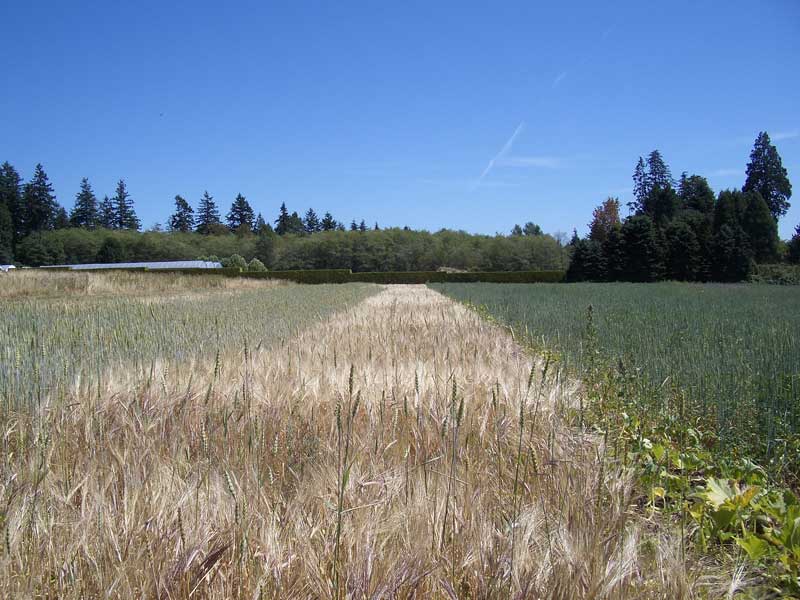
Most students know by now that the future of the UBC Farm is shrouded in uncertainty and controversy. This year strong student supporters of the Farm (particularly Friends of the Farm), wanted to hold a referendum question asking students to increase their student fees to support the farm’s programs and development. The hope was that a passed referendum would show UBC just how much the community supports the farm, and would help secure the farm’s future. But the current political situation within UBC and the region has made some supporters of the referendum question if now is really the right time.

Find out why behind the jump…

A brief history of the UBC Farm:

When UBC first decided to build market housing on campus, they ran into some concerns and push-back from the community (students, faculty, staff, residents in Vancouver and the UEL). So, the GVRD stepped in and said that there would be some regulations and guidelines for how UBC could develop that market housing community. Those rules were all outlined in the Official Community Plan (OCP). Of course, the Farm sits in the middle of prime land that the University ultimately wants to sell to developers. After public outcry over the farm in the development of the OCP, the farm was slated for “future housing reserves” – meaning that they weren’t going to develop housing there right away, but it would be set aside, and we would come back to it later to make a decision (that date is supposed to be 2012).

Of course, this stamp of “future housing reserves” also gave UBC an excuse to not invest in the Farm, and refuse to help build its research capacity and refuse to see its value as a community amenity. In fact, when some market housing residents worked with the farm to create a community garden, UBC denied the proposal and said it wasn’t allowed! UBC has been actively impeding any development of the farm for many years, so that they can more easily deny the farm’s importance in 2012 when the issue is up for consideration.

The current situation:

To understand the current situation, you have to understand some local politics. UBC would like to make changes to the South Campus Neighbourhood Plan – they would like to densify the neighbourhood (add more units, make more money). This requires a change to the OCP, which requires approval from the GVRD.

However, the community has some allies in the GVRD who have an interest in a) preserving the farm, and b) seeing UBC become part of the City of Vancouver. Both of these fit into policies that the GVRD already has (for the farm, they are worried about food security and how quickly farmland in the region is being depleted, for governance, they GVRD would like all electoral areas to become part of a municipality). Therefore, some elected officials at the GVRD were saying to UBC: “We’ll let you densify the South Campus Neighbourhood, if you promise to deal with the farm issue and do a governance review.”

Well, UBC doesn’t really like the prospect of being told what to do by the GVRD when it comes to the Farm or governance, so at the most recent Board of Governors meeting, UBC decided not to pursue the South Campus Neighbourhood densification – for now…

But to appease the GVRD, UBC also said that they are going to deal with the farm issue and the governance review right now. I told the GVRD at a recent meeting that I didn’t really believe UBC’s commitment to dealing with the governance issue – I genuinely believe they are dragging their feet, they have no interest . And the farm issue is going to be dealt with through the Vancouver Campus Plan…this is where the concerns from Friends of the Farm comes from.

Hidden motives:

Nancy Knight, UBC’s Associate VP Campus & Community Planning, has decided to ‘deal with the farm issue’ through the Vancouver Campus Planning process. That may sound like a good idea at first, but its much more complex than it seems.

The Campus Plan process is an institutional planning process, meaning UBC has complete control over that process, meaning the GVRD has no say in what decisions are made. Thus, when the farm gets addressed through the Campus Plan, we lose some really powerful allies in the GVRD who could put a lot more public pressure on UBC to “do the right thing.” For now, we as students and as members of the University community have to flood the Campus Planning process in order to save the farm. Of course, we all know that UBC isn’t that great at listening to students, and is quite selective about what it hears in consultation processes.

The point is that if the farm review is part of any OCP changes, then the broader community, including the GVRD, and the UNA residents have some sort of say in what happens to the farm. If it’s a Campus Plan process, then UBC gets the ultimate say, and the GVRD really has power to interfere. The Campus Plan is about institutional spaces – aka, learning and research spaces. Taking care of the farm through the campus plan process conveniently means that UBC can look at it primarily for its research value, and thus it’s easier justifying that it move to the bio sciences research area – the same amount of research can occur no matter where its located.

Now add to this the fact that Nancy Knight and the team at Campus & Community Planning have gotten external consultants to come in and review the “potential” of the farm. These consultants were chosen without letting the farm or the faculty of Land and Food Systems know, and it has mostly been all behind closed doors. Nancy Knight wants to have these consultants come back and say: “the Farm is very valuable, but they only need half the land and could probably move to the Bio-Sciences research area and still do the same great work.” Perhaps she sees this as some sort of compromise between the Board’s agenda to maximize the $250 million that can be made off of that area, while still preserving some sense of a farm for the community.

As long as the Farm issue is dealt with through the Campus Plan, the result is going to be cutting the area by at least half, or moving it way down to the bottom of campus in a very remote and inconvenient location, or both.

The other thing to consider, is this process to deal with the farm through the Campus Plan is only looking at the farm from a research-value standpoint, and not from a community amenity standpoint. The Farm is so much more than a research facility, it’s a place that brings students and residents and researchers and learning all together in one place. This is more than just an institutional facility, it’s a community facility, and the community should have a much greater say about its future.

Canceling the Farm Referendum

I told the Friends of the Farm that it was a big mistake to back down from the referendum now. The concern is that the political situation is too tense right now to take the risk. I say that a referendum is always going to be extremely risky. The only reason there are more backroom deals being made about the farm right now is because UBC is facing a lot of pressure from the GVRD, students and the community-at-large to save the farm. As long as UBC is facing pressure on the Farm, they are going to push back, and push back hard. The farm lands are worth over $250 million dollars in Endowment revenue. We’re up against a huge beast, and that is never going to change.

But, if we as students could come to the table and say “students care about the farm so much that we are willing
to pay out of our own pockets to develop the farm’s capacity” then we’re in a really strong negotiating position. Don’t forget, it’s UBC who has been financially neglecting and starving the farm for years, and its students who are stepping up and footing the bill.

If the referendum were to fail, then it would be a tragedy. But, as far as I’m concerned, certain people within the University are always going to misconstrue the evidence and use any referendum outcome against us. But there are also a significant number of people in the University who will take a passed referendum seriously, and that will be way more powerful than the few who discredit it.

The Farm needs a student movement behind it right now, and there is nothing better to get a student movement started than through a “Save the Farm referendum campaign.” Getting hundreds of students around campus, handing out pamphlets and saying “UBC is trying to take away our farm, we can’t let that happen” – what better way to start a genuine student-movement. That’s something almost all students can say yes to.
Categories
Campus Life

Right To Be Cold – Sheila Watt-Cloutier at UBC

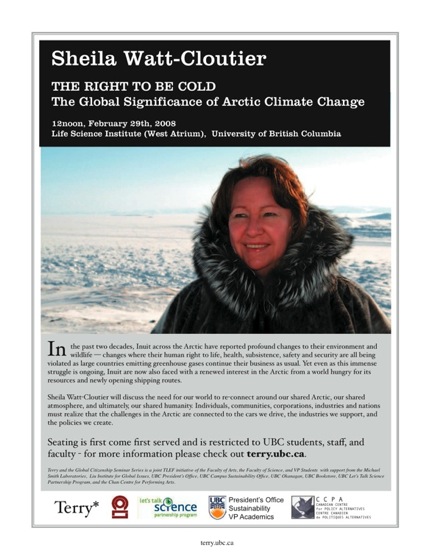
Terry* presents the latest in our Global Citizenship Lecture Series: Sheila Watt-Cloutier’s talk, “Right to Be Cold” will take place this Friday, February 29th, at 12 noon in the West Atrium of the Life Science Centre. Map.

In the past two decades, Inuit across the Arctic have reported profound changes to their environment and wildlife — changes where their human right to life, health, subsistence, safety and security are all being violated as large countries emitting greenhouse gases continue their business as usual. Yet even as this immense struggle is ongoing, Inuit are now also faced with a renewed interest in the Arctic from a world hungry for its resources and newly opening shipping routes.

Sheila Watt-Cloutier will discuss the need for our world to re-connect around our shared Arctic, our shared atmosphere, and ultimately, our shared humanity. Individuals, communities, corporations, industries and nations must realize that the challenges in the Arctic are connected to the cars we drive, the industries we support, and the policies we create.

More info at the fabulous Terry* website: terry.ubc.ca

Terry Limerick:
(with feeling!)
“There once was a project named Terry
That wanted to make people wary
Of things going on
In the world that are wrong
Without making it all seem too scary.”

Categories
Campus Life

A place to sprout?

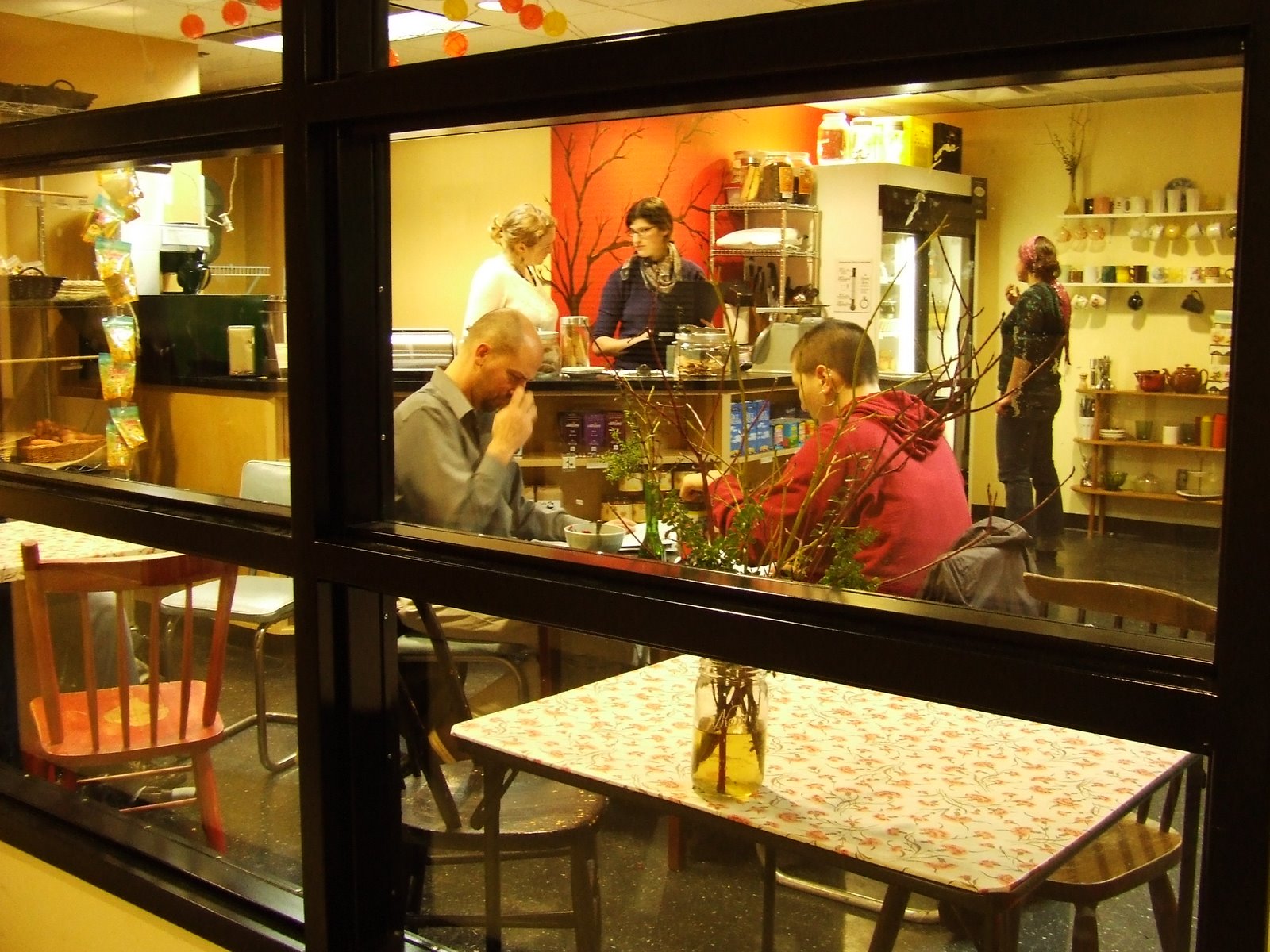
About 20 students crowd sociably around tables cradling bowls of vegetable soup and mugs of coffee in mismatched dishes. Others wander in empty handed and leave munching apples or organic chocolate. Two people behind the counter cut thick slices of bread and open jars full of brownies and muffins which they hand over on plates, taking coins in return. Some music plays in the background and people read campus newspapers or talk to their table-mate (who they probably just met) while they eat. This is Sprouts, the cafe/grocery which is run by the Natural Food Coop, an AMS club, at a typical lunch-time. Sprouts, located in the corner of the SUB basement (across from the health and dental plan office and AMS food bank) is bustling with volunteers, great local and organic food, customers, and community this term. Just look in any noon-hour of the week to see for yourself. But it hasn’t always been this way, and it has been a challenging and sometimes turbulent road to get to the yummy, warm and fun space I’ve described. The store, which opened in 2004, at one point lost nearly all of its student involvement, is in 30 000 dollars of debt with the AMS, and came within inches of collapsing, and the club being de-constituted. But as the Natural Food Co-op’s president, Caroline Walker says, this was a project that just was not allowed to fail.

Yesterday I sat down with Caroline, and Martin, the store coordinator (and baker of amazing bread), to learn about the road Sprouts and the Natural Food Co-op club have traversed, and what the outlook is for Sprouts and the club. First, a little history: The Natural Food Co-op started as a group of students that got together to buy organic and local food straight from distributors, to avoid paying boutique prices in ’97. The space they had, in a random nook in the McMillan building (near where the bike coop used to have a space) was slated for renovation in 2003, and they got kicked out. So, the club had to re-envision itself. The idea of having a store came to fruition with the new space the AMS offered them in the SUB. As an AMS club, the space was free, though of course money was spent initially to renovate and prepare the space as a full-service grocery store. Several grants supplied the capital to do this. But, the renovations were over-budget, and so Sprouts started out about 15000 dollars in the red. Nonetheless, the store was launched, selling a wide variety of products from packaged goods and bulk grains to produce. Initially it was run by volunteers who were members of the club, but eventually the club hired staff to run Sprouts most of the time. The store never really made any money, and in fact, continued to go further into debt, as staff costs increased. As this was happening, many of the original natural food coop members graduated, and the club became less and less active. The buying collective stopped, and Sprouts, which was by this time mostly run by staff (and some volunteers), was the only manifestation of the club’s existence. This being the case, maintaining an accountable relationship between the natural food coop board (ie. the club executive), and their hired staff became problematic. By the end of last year things got a bit out of hand. The financial situation was not getting better, with the debt mounting in order to pay staff wages. To compound this, Sprouts was broken into and had a thousand dollars stolen. By last spring, involvement had plummeted, and only two people showed up to the AGM. So, with the board of two, no membership, and a few store staff, an mounting debt, something obviously had to change. Katerina, the store manager at the time, came up with a new business plan that would see Sprouts turning from a grocery store into more of a cafe-style space with lunch items as well as fruits, vegetables, and bulk food. Unfortunately, there was no real plan to implement this, and so few people involved that come September, the store feebly re-opened and then closed again within the first few weeks of the term.

The story takes various more twists and turns (including a deportation, crazy personality conflicts, a change in vision, and a change in leadership), until things started looking up. Over the fall term, the AMS executive and staff helped Caroline and the few involved people put together weekly implementation plans, start understanding the finances of the situation, apply for grants to re-organize the space again, figure out a new menu, and learn all the mechanistic details of running a cafe from foodsafe certification to accounting. A club board was scraped together, and over the winter break, they re-wrote and updated the club constitution to contain concrete position descriptions, learned about volunteer coordination from the sustainability office, and completely overhauled the space to put in seating, new paint, different kitchen equipment, and a new flow. During the process of restructuring and rebuilding, it became obvious that it was financially impossible to have paid staff. Sprouts is now a 100% volunteer-run initiative.

When they opened up again this term, things started looking up. First, Sprouts is busy again. The buying co-op is up and running again for club members. Volunteers started materializing out of the ether to help with the daily baking and soup-cooking. The AMS executive and staff continued to be unrelentingly supportive. Community Eats partnered with Sprouts to bring students a free vegan lunch bi-weekly. The club has a functional executive board, and their new constitution recently passed through SAC. Also, without the cost of staff, and the higher turnover in sales, Sprouts is making money now. They’re working on a memorandum of understanding with the AMS containing a re-payment plan which will see it get out of debt over the course of several years. There’s even music jam sessions at Sprouts once in a while, coordinated with the club’s new social coordinator and the indefatigable JAM superstar Rodrigo Ferrari Nunes. And most importantly, it’s just an awesome spot to hang out and feel at home. The tastiness, affordability (1.50 for a perfect breakfast of coffee and thick slice of home-baked bread and butter?? amazing!) and social aspect of Sprouts are all things that only come about from the connectedness and ownership that comes along with a group of dedicated students creating a place they themselves really like and really believe in.

Caroline: “we’ve been really sensitive to how people use the space – the space is now more engaging. You usually have to sit with someone, since there’s only a few tables, and no to-go containers… the outreach isn’t as explicit now, but it’s more effective. Being volunteer run, we also feel like we can be more idealistic with what we’re doing, and fulfill our mandate better, with minimally packaged, locally sourced food.”

To me the story of Sprouts (it’s fall and rise) shows that student-run business is possible and incredibly valuable, when done right. Few other things can be so exciting and fulfilling and trully meet the needs of students so well. This example also proves how the AMS can be incredibly supportive to actually make such initiatives work – this project would have been impossible without the almost ridiculous support the AMS has given – financially, with its leadership, with its staff, space, and expertise. All for a good idea – which is of course, how it should be. The AMS sould look at incorporating more space for student-run business into the SUB renew program. The kind of support shown for Sprouts is a one-off in a way, due to the extreme screw-uppedness the place had gone through, but it can also serve as a model for many more businesses. Student businesses, supported by the AMS, could end up being an incredible service for students. So anyway, go take a peek, if you haven
‘t already. Slip into the yellow diner nook with a brownie, strike up a conversation, and life is good.

Sprouts web page

Categories
AMS Elections 2008 Campus Life Issues

Issue of the day: Campus life

Boy, it’s hard to write “Issue” posts when there’s no candidate platforms four days before voting. Oh wait, the campaign just started today. Never mind that, then.

Last year I spent a lot of time harping on what I see as the slow and steady decline since I first came to UBC in the good old days (read: 2001). Then, it got worse: ACF died this term. In an unexpected decision in November, the ACF executive decided to disconitnue the event indefinitely in the face of declining ticket sales and mounting debt. (See our coverage here, and here.) At first, I chalked it up to external pressures (external to the event, not the University {like See our coverage RCMP, unsupportive faculty, recalcitrant sponsors}) trying to kill the fun. But then I realised that just as important were the internal, student based pressures, too. So that seems as good a framework as any to discuss student life and events.

For reference, I adopt “generally loud, slightly beer-y” as a general definition of student event. I fully understand that not all students events fit this description, but there’s just something wonderful about the communities that develop, the memories that are created. I owe a lot of my student politics success to beer gardens, and the fact that they’re dying is sad.

External Pressures
These are well-documented. They tend to fall into the following categories:

  • UNA and noise complaints about the residents
  • Safety and alcohol abuse
  • Fewer students engaged on campus generally
  • Enhanced RCMP and university enforcement of alcohol rules
  • Reduced liquor licenses

There’s a place for student reps to address these issues. By starting a constructive dialogue with residents and the University, by teaching clubs how to run responsible events that don’t attract unwanted enforcement attention, and good old-fashioned lobbying.

Internal Pressures
I’ve never seen an outpouring of student outrage like the ACF cancellation. There’s massive support for the event. But that wasn’t enough to save it. Why? Mostly because those responsible for the event didn’t want to continue it. It had gone on for a remarkably long time, they said, and it was getting too tiresome to run.

But an interesting thought occurred to me. The AUS Council didn’t want to end ACF; the ACF exec did. And there’s an interesting point there. Which is that it’s the same people who’ve been running it from year to year. And while the event is tired, so were they. The event was losing money, and these people were losing the energy to fight.

In short, the event was unsustainable.

Now it’s not easy for student clubs to have a sustainable existence when there’s constant turnover. People come, people go. A great person can be hard to replace, and when a person’s involvement takes a year to gestate, they only have a couple years in a leadership role before they move on, to be replaced by a relatively unknown quantity. Similarly, student groups rarely have financial or budgetary expertise; they have to learn the way most of us do, by failing. Unfortunately, they’re not usually around the next year to apply their hard-earned knowledge. And finally, they’re often more susceptible to pressure mostly because they’re often new at the game. And hell, they’re students, not full-time event planners.

So why is it relevant? Because the AMS can help. There’s a potential positive role for them to play, in terms of facilitating clubs and groups. Some financing options, maybe some financial planning. Ready access to event planning staff. Perhaps a central co-ordinating body for events or a way to leverage networks for publicity. And of course, ye olde lobbying. There are oodles of options. And it’s not all bad either: beer gardens, despite the tougher social climate on campus, are persisting. Bzzrgardens.com has made a succesful return under the brew-mastership of SUS councilor Alex Lougheed, and is a great resource.

I imagine some of the candidates or readers might have some ideas. Anybody?

(Then again, maybe this is just on the brain because I’m writing this while watching Old School. Seriously.)

Categories
Campus Life

The townie theory of social engagement, or lack thereof.

ACF is one of the only UBC events I attend. I’m lazy and antisocial, so I don’t prioritize things like beer gardens and storm the wall and pit night and whatever else. When I do socialize on campus, I’m getting drunk with a few friends at Koerner’s or the Gallery.

I really have trouble believing that the u-pass and bad financial aid policies are the reason people don’t party on campus. Personally, I blame townies such as myself, who can go home after school to unwind. When you know the city real well, there’s less reliance on the campus scene as far as finding fun goes.

There’s the simple matter of competition – I’d like to state for the record that I think rational choice theory is overrated, overused, and oppressive as it obfuscates the role of systemic discrimination and power in things. As we are discussing something as minor as ‘where Ainge gets sloshed and why’, I’m going to apply it, as this is its place. If anyone wants to chime in with some critical theoretical analysis of my drinking habits, please, feel free. I’d also like to state that this is purely anecdotal, as is most of the stuff you’ll read on the internets.

I drink where I drink because I appreciate a good beer on tap, and a nice booth or patio. Standing around Buchanan D holding a dixie cup with a bunch of strangers I may have seen in class or on the bus just ain’t my thing. I make a little money, and I want to maximize the enjoyment. See, it’s simple.

Being a townie has definitely influenced my indifference towards campus events. Spending twenty years in this hamlet means I get that sense of community elsewhere. I coach debate at my old high school, I involve myself in local politics, I hang with my ridiculous Italian family, and I stay in touch with people I’ve known for ages.

My experience is not universal – some townies do throw themselves into campus life. The thing is, UBC events compete with everything else the city has to offer, and the sentimental ties that should be keeping us on campus to party just aren’t there. We don’t mythologize our college experience that much here in Canada. It’s seen less as a life-changing experience and more as gettin that there diploma thing whut helps ya get a job . When I was applying for university, 80% of my grad class ended up staying in Vancouver. By virtue of its lower mainland location, UBC complements my life as it already is. I’m here for the courses.

Categories
AMS Campus Life News

Three green-tinted notes

A few notes of interest that come to mind for the environmentalist-lite on campus:

  • UBC Farm Fee referendum: Yesterday I was at the farm. Getting there was a bit of a hazard due to the South Campus construction bedlam, and I ended up getting tangled in a barbed wire fence while attempting a shortcut, and shredding my favorite pants. Not that it wasn’t worth it. In between sorting butternut squashes and bunching kale and collard greens, I checked in with Mark Bomford, the director of the UBC farm, about recent farm developments. As you may have noticed, the UBC farm is collecting signatures to introduce a 4-dollar student fee. Two of these dollars would turn into sustainable yearly funding for the UBC farm’s programming. Two of the dollars would be put in a fund to be allocated to students engaged in climate-action related projects. More accurately, they are actually collecting signatures to place a question about the student fee hike on this year’s referendum ballot. All new AMS fees need to be approved by referendum. 1000 signatures are needed for referendum questions to be put on the ballot without the approval of AMS council. They’re a few hundred signatures short so far, but it’s expected to reach the goal. The money would mean that students, not the university, are the ones supporting the Farm in the most substantial and sustainable way. Currently, the farm functions from a combination of temporary grants (chielfy a TLEF grant that expires this year). It has no core institutional funding, though it does receive support from the faculty of land and Food Systems. If the fee is approved in referendum, the governance structure of the Farm would change to include AMS representation. This would probably take the form of AMS representatives on the current farm advisory committee. This committee reports to the dean of the faculty of Land and Food systems, and makes the major steering decision about the farm. Eventually though, says Bomford, the goal is to have the farm acknowledged as an official unit of the LAFS faculty in the Senate. This new funding, he continued, will allow the farm to meet its goals in sustainability, student services, and outreach. These will be student dollars for students, he said. I’ve had reservations about students saddling the financing of the Farm. Too me, this is an example of a program that should have core university funding – it meets the University’s trek 2010 vision perfectly. Does students taking up the cause of the farm send the wrong signal? Bomford and Jeff Friedrich, the AMS president don’t think so. They think that if students approve this fee, it will put pressure on the university to match funding. This will be interesting to watch.
  • Elizabeth May at UBC: The leader of the federal Green Party was at UBC to speak today. This is the second time I’ve heard Ms. May speak, and I have to say, I’ve just been floored both times. She is incredible. First, she really is a talented speaker. She’s very sharp, very insightful, and a wonderful aura of leadership surrounds her. Even in a dingy physics lecture hall, she was both comfortable, and respectable. And the content! oh the content! I haven’t heard so much actual content out of a politician…hm…ever. Seriously. She was full of information, science, and points of view. She talked about policy solutions in a very concrete, non-hand-wavy way. She summarized, explained, and illustrated with a near-perfect balance of vision and detail. There were absolutely no platitudes. If this is what Elizabeth May can deliver in Hennings 200, I cannot wait to see her in the official debates, not to menetion the House of Commons.
  • Terry speaker series: 100 mile diet authors: Today, Friday the 23, is the kickoff of the Terry Project’s high-profile speaker series. For the uninitiated, Terry is an innovative project at UBC whose aim is to address big global issues (environmental and social) from a multidisciplinary perspective. There are several branches of the project, including a brand-new undergraduate course (ASIC 200), a very cool website (http://terry.ubc.ca/), a writing contest, lots of neat collaborations, and, of course, the speaker series. Among previous participants are notables like Stephen Lewis, David Suzuki, and Vandana Shiva. Tomorrow it’s going to be James MacKinnon and Alisa Smith. From the terry website:

    These are the authors of “The 100-Mile Diet,” a bestseller and buzz worthy book that uses a social experiment (can we subsist on only eating things produced within a 100 mile radius?) to look into the world of food politics, economics, and culture. Extra bonus is that James and Alisa also happen to be Vancouverites, so their story has this wonderful local angle to it.

    The talk is tomorrow at the Chan at 12:00, and there’s still some (free) tickets available.

Spam prevention powered by Akismet