Categories
Athletics BoG Campus Life Development Government Issues News President Student Movement Student Politics Uncategorized

Summer News Recap

Happy First Week all. Here’s what happened while you were out.

On Campus

The Student Board of Governors representatives turned over. Tim Blair bids farewell, as Michael Duncan takes his place. Bijan Ahmadian and Alexandra Caldwell (UBC-O) were re-elected for their respective second terms.

The University approved a plan to in-fill Totem residence. This was met with surprise and glee from at least one editor of this blog. (Board item front page, 60-megabyte board presentation .pdf)

Categories
Campus Life Development

St. John Hospice

Last September, in partnership with the Vancouver Hospice Society, the Order of St. John and Vancouver Coastal Health, the Board of Governors passed a partial Board 1 to build a hospice. The building will only cost UBC marginal maintenance costs, the management will be undertaken by VCH, and the building is forfeited to UBC in at least fifty years. A good deal for all parties. The Board approved the plan, and sent the planning department off to come up with a site and to contract out the design.

hospice-front

Categories
Development News

Freedom of Information Applies to UBC's Corporate Entities

UBC just got a little more transparent.

A very recent ruling from the Office of the Infomation and Privacy Commissioner for BC has ruled that UBC must release records requested under the Freedom of Information and Protection of Privacy Act (FIPPA) for three of its subsidiaries: UBC Properties Investment Ltd., UBC Research Enterprises Inc. and UBC Investment Management Trust.


The FIPPA request was initiated by Stanley Tromp, a former UBC student and Ubyssey reporter who, in 2001, also managed to force the release of Coca-Cola’s 12-year exclusivity contract with UBC and the AMS.

The initial request asked for the annual report, salary of the highest ranking employee and meeting minutes from 7 organizations associated with UBC:

  • UBC Properties Investments Ltd., and UBC Properties Trust
  • Discovery Parks Inc.
  • UBC Foundation
  • University Golf Club, and University Golf Course
  • UBC Research Enterprises Inc.
  • BC Research Inc.
  • UBC Investment Management Trust

UBC denied the requests, asserting that these organizations are private organizations, and therefore FIPPA does not apply. Mr. Tromp then requested a review by the Office of the Infomation and Privacy Commissioner for BC resulting in the ruling linked above.

In the end, it was found that UBC Properties Investment Ltd., UBC Research Enterprises Inc. and UBC Investment Management Trust are “under the control of a public body” and therefore must fulfill FIPPA requests. While UBC tried to pull out all the stops in arguing why the records of these bodies were not under their control, the adjudicator seemed distinctly unimpressed with their arguments and rejected all of them as being irrelevant, contrary to the spirit of the law, or inconsistent with precedent.

The adjudicator pointed out that the three organizations were incorporated by UBC, 100% owned by UBC, must report to UBC administration and/or BoG, and most if not all of their directors are UBC employees or BoG members. That constitutes “control”.

The other four organizations were found not to be under UBC’s control and not required to disclose the requested documents. UBC has thirty days to appeal the ruling.

Update April 27: UBC does intend to appeal.

Categories
Development

The Underground Bus Loop – analyzed to death

This is a guest post by Dr. Darren Peets, who just completed both his Phd in physics, and his term as a student represetitive to the UBC Board of Governors.

One issue at UBC that’s particularly bothered me, and which wasn’t resolved to my satisfaction during my Board term, is the proposed underground bus terminal at University Boulevard and East Mall. The University Boulevard Neighbourhood Plan, from which the terminal sprung, was the reason I got involved on campus — up until then, I’d assumed that common sense would prevail. The Plan disproved that resoundingly for me. While there has been no shortage of opposition to the terminal, there hasn’t been a great deal of in-depth analysis of its shortcomings, how they might be fixed, or what the alternatives might be.

Now that I’m on the verge of graduating, I feel a need to share what I still see as problematic about the bus terminal as currently designed. This will not be short.

The concerns can be categorized as financial, technical, aesthetic, convenience, safety, and process-related.

Process

Having one central bus terminal emerged as the preferred option from the 2003 Campus Transit Plan (based on finances that do not resemble the current model). It was believed at the time that the terminal would cost $17M to build, and my recollection is that the above-ground housing and commercial were going to pay for it. It’s now closer to $50M, and the above-ground program (aside from the new SUB) has been struggling to find a way to break even.

I personally like the idea of a central transit terminal. The ideal place for it would be the centre of campus, University at Main Mall (notwithstanding that there’s a pedestrian zone there), but it needs quite a lot of land, and the nearest location that might be large enough is the proposed site, bounded by University Boulevard, East Mall, the grid of trees, SUB, and the Aquatic centre.

However, the decision to build entirely below grade and the plans for the development atop it were made prior to consultation, and the public consultation followed UBC’s then-standard model of design-display-defend. They drew consistent, vociferous criticism, to little avail. It wasn’t until 2007 that these concerns were listened to, and the area atop the terminal has now been basically fixed. The bus terminal was framed as being off the table in this discussion, and in May 2007, Board approved $15.5M to move utilities out of the way and construct a tunnel, which would become quite useful if we were to build a bus terminal that happened to connect to it. That terminal would be a completely separate and unrelated project, however — possibly because the terminal would exceed $20M and would therefore be a public-private partnership (P3) by default. Without the terminal, the tunnel would make for a handy forklift-accessible storage area. The utilites have been moved, but the tunnel is not under construction.

Safety

Many people simply will not feel safe in a largely closed-in below-ground waiting area with a single exit stairway, even if that stairway is 40′ (12m) wide. There will be good lighting and internal sightlines and security will be present at all times, but actual and perceived safety are very different matters. There are ways of improving this somewhat, for instance by taking part of the lid off so the terminal is open to the square or the atrium of a building, but there’s only so much you can do with an enclosed space below ground. At present, the terminal is being compared to Burrard SkyTrain station, but the part that does not have a concrete lid on top of it is quite small, and will itself be covered, likely about 15′ (5m) above ground level (this cover could potentially involve some limited use of glass). However, I doubt there’s any way that such a terminal could be built underground and feel safe for all patrons.
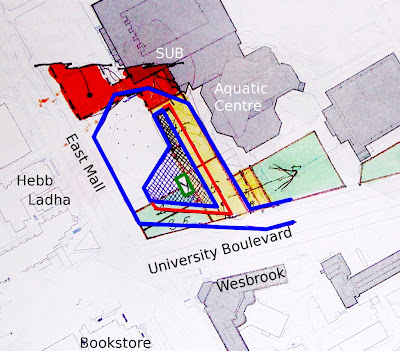
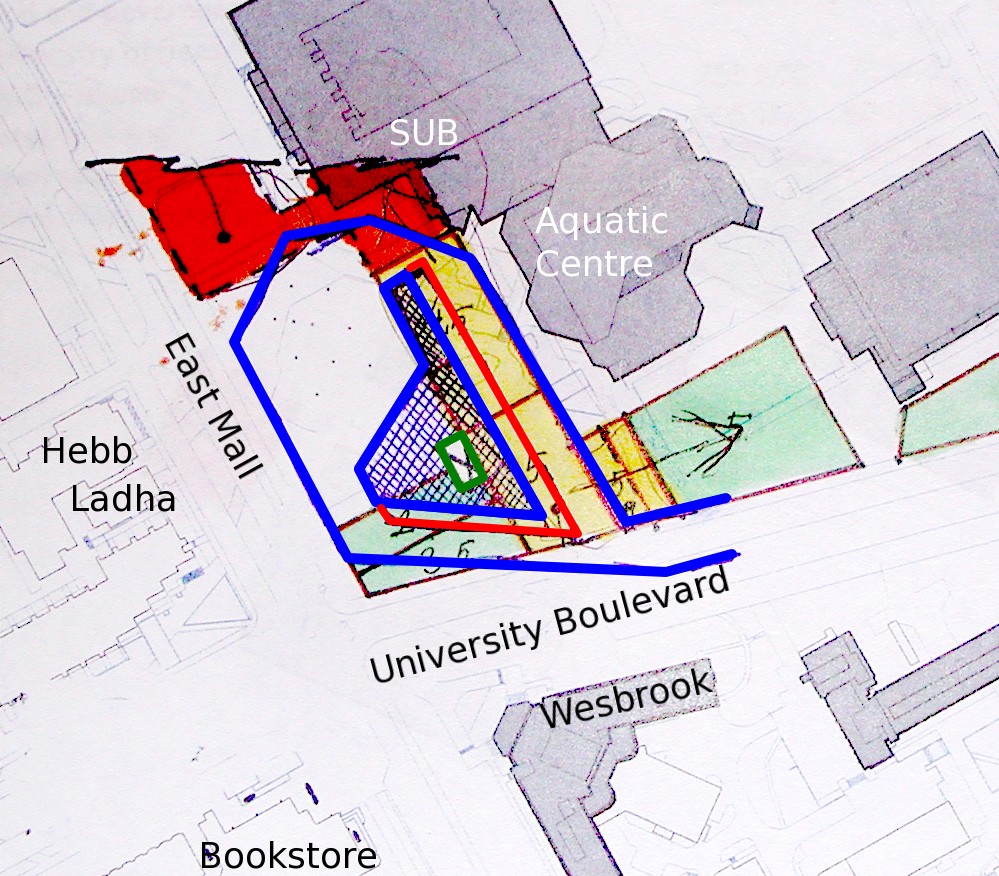
The image shows the approximate outline of the bus terminal (blue) and its waiting area (blue with cross-hatching), the platforms where people get onto and off of buses (red), and the part of the waiting area that’s open to the outside world (dark green), which is basically all stairway. (The shaded areas represent one scheme under consideration for buildings that could go in the area, including a new SUB.)

Convenience

The point of having a central terminal is convenience, and the current design has shortcomings in that regard. The electric trolley buses get a separate loop on the street half a block away, because the terminal is not large enough for them. If the trolleys shared the terminal, riders could decide on the fly which bus to take, based on lineups and timing. If the trolleys instead looped around campus, we’d have a convenient and frequent campus shuttle network. Neither opportunity is being taken.

A wide variety of explanations have been given for why trolleys can’t be accommodated within the terminal, and some have been quite imaginative. The current line is that they require additional depth for the trolley poles and would cause delays. I understand that both of these reasons are incorrect (and note that they’d be fairly easily solved). It’s actually quite simple — the terminal as currently designed isn’t large enough to hold all the buses, and making it larger would cost money. Particularly if it were expanded under the East Mall sidewalk, where the main campus IT spine is, or downward to allow a second floor. While cost increases from $17M to $50M aren’t enough to trigger a rethink, tossing an extra $5-10M into the hole to accommodate the rest of the buses would apparently be outrageous. The trolleys’ overhead wiring and the possibility of their poles coming off got them kicked out first (note that the new trolleys automatically retract their poles if they come off the wires).

Putting campus shuttle buses in the terminal has never been seriously considered — a more sensible place for them is on the street near the top of the stairs, particularly if they’re on loops that involve East Mall. This means that we’ll have a shuttle bus loop, a bus terminal, and a trolley loop, all hopefully within a block of each other.

Aesthetics

More than half of all students get around by bus, and transit is the single most popular means for getting to campus. The grand entrance to campus will be a diesel-soot-blackened tunnel, followed by a well-lit and possibly well-finished crowded concrete basement. The original reasoning was to free up the surface for shopping, parking and a plaza.

The only groups who want cars in this area are the Aquatic Centre, who have a legitimate need for drop-off access, the Alumni Association, who would like drop-off access and short-term (15 minute) parking if possible, and the Bookstore, who believe that their ability to stay solvent relies upon people being able to park immediately outside their door. If the Bookstore’s business model is inconsistent with their location on campus, the solution is to change their business model or location, not campus.

In my opinion, this is not a suitable main entrance for the campus.

Technical Issues: Capacity

The biggest problem with the terminal is capacity.

If you ask UBC’s planning department “who looked into whether the capacity would be adequate to meet the demand?”, they’ll tell you TransLink spent $250 000 on studies looking to this and other issues. If you ask Tr
ansLink’s planning department where they got the ridership demand and bus numbers required for these studies, they’ll tell you the bus numbers were based on 2005 service levels plus 2% annual inflation, and the ridership demand was based on UBC’s projections.

This circular logic means that ridership estimates are, to this day, based on pre-U-Pass estimates that badly misjudged the effect of U-Pass, while TransLink’s bus numbers assume that the level of bus service in 2005 was adequate, and service levels should increase by 2% per year thereafter with inflation.

In UBC’s 2003 Campus Transit Plan, projections indicated that the student U-Pass would increase ridership by 28% initially, settling out at 38% by 2011. I recall a modified projection that assumed the first four years of U-Pass to have 130%, 140%, 150%, and 160% of the baseline ridership respectively, as drivers graduated and transit riders came in, but I can’t find a reference to this. Regardless, the increase in transit ridership in just the first year of U-Pass was 53% — significantly larger than projected. This past fall’s ridership counts put the increase over 2002/2003 (the year before U-Pass) at 82%.

Our ridership projections have been updated to reflect what has happened so far, by assuming that ridership will hold dead flat for half a decade then resume its previously-calculated inflationary increases (calculations based on faculty/staff U-Passes before 2011). While I do not have access to a ridership projection graph, I do have bus projections calculated by the same method. Pay close attention to the horizontal axis:

So TransLink believes UBC’s demand projections because they don’t have anything better (UBC knows the ridership and can give them surveys), and UBC believes their own projections because TransLink presumably spent a quarter of a million dollars confirming them. UBC trusts TransLink to look into this sort of thing because they’d need the terminal to work, and TransLink assumes UBC must have, because UBC is paying for the terminal and any required fixes to it, and would have a strong interest in it working.

Based on my experience with the UBC routes, I’d say that there’s a significant latent demand. There are a lot of people who have to get on a bus very early or can’t get on a bus because the buses are too crowded, have switched to driving in frustration, or have adjusted their schedules to avoid rush hour. If we had adequate bus service, there would be more trips on transit and inbound trips would be concentrated about 10 minutes before classes start. The distribution of buses around the hour is important, because the design can only handle so many buses — it fails based on peak demand, not the demand averaged over two hours.

A further driver of demand will be fuel prices. As gasoline prices continue to rise, more people can be expected to consider transit. The gas price assumptions used to date have not proven particularly realistic.

A reasonable question might be whether TransLink anticipates improving service to UBC beyond the 2% per year that the terminal can accommodate through to 2018 or 2021. Well, the service improvements for 2008 are outlined in TransLink’s 2008 Transportation and Financial Plan

  • Improvements to U-Pass service, primarily on the 17, 25, 41, 49, 84, and 145 routes.
  • A new #33 route along 16th Avenue to UBC (this was originally planned for 16 buses per two-hour peak period, but the numbers for this year suggest to me about 12).
  • A new community shuttle route linking UBC with Broadway at Alma via Spanish Banks (this shouldn’t require space in the terminal).

On top of this, TransLink plans to upgrade the #43 to a #91 B-Line in the fall of 2009 when the Canada Line opens, and I’ve heard rumours that the 480 will likely be replaced at the same time by routes from Bridgeport Station and Steveston. I don’t have enough information to calculate how many buses per two-hour peak period all these improvements would come to, and I don’t even know how many we had this spring, but we’re exceeding 2% inflation by a pretty substantial margin regardless.

A few words must also be said on what “capacity” means, because the report from TransLink’s consultants suggested the terminal would not be at capacity if the trolleys were removed. Amongst other metrics, the terminal is not considered to be at capacity if the line-up to get into it in peak periods does not extend into the intersection at Wesbrook, 19 bus-lengths back, more than 5% of the time. The simulations assumed that buses arriving Not in Service would be held at Blanca Loop or on 16th Avenue to mitigate a lack of storage capacity in the terminal, and several other parameters had to be fine-tuned for efficiency, such as stoplight cycles at two separate lights. “Capacity” is the absolute breaking point for the terminal under the best possible conditions. Capacity was found to be 218-221 buses per 2-hour PM peak period (this might be a good time to refer back to UBC’s bus estimates bar graph). It’s not clear to me whether the simulations took account of such rare occurences as wheelchairs, bikes, school groups, or people asking for directions, but it has been indicated to me that bikes would likely be barred from the terminal during peak times to save space and time.

On the passenger side, capacity is defined more arbitrarily, based on crowding (and there is an assumption that many people will wait upstairs in the plaza). With the trolleys removed, the crowding is projected to fall to more-or-less acceptable levels. I’m fairly certain bikes weren’t included in these simulations, and I’m not sure about wheelchairs.

Even if the likely-incorrect demand numbers and bus projections are to be believed, the terminal is designed to run near the breaking point basically from day one, and must be bailed out by SkyTrain after about a decade. Its design does not otherwise anticipate rail, and leaves no room on University Boulevard between Wesbrook and East Malls for trenches or foundations if grade-separated rail (e.g. SkyTrain) were to be added.

Solving this would need to involve a ridership demand study, preferably including a user survey. If my suspicions are correct and the terminal as designed is too small, new design options would need to be looked at. I’d much rather risk being proven wrong by a $20 000 study than proven right and having a good “I told you so” a few years from now.

Technical Issues: Driving on the Left
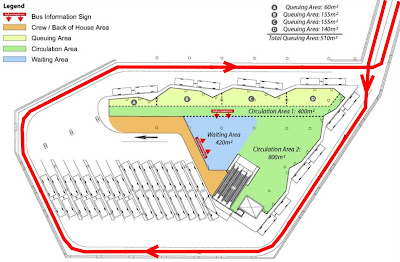
Another amusing aspect of the design is that, for the sake of space-efficiency, there is one central pedestrian platform, which the buses drive around. This means the buses are effectively driving on the left, and they have to cross over. I’ve tossed in an image tracing out the path of a bus that does a loop through the terminal without stopping, and you’ll note that this path crosses itself where the ramp meets the terminal. This is handled with a stoplight, and one of its stop lines is at the front of a pick-up bay. Several interesting problems can arise from this, including blocking access to that bus bay, delays, crashes, and light cycles wasted because a bus stopped too far forward and blocked traffic in the other direction. I can even imagine a scenario where one bus tries to go around another bus that’s too far forward, but can’t make it, requiring several other buses to back up. Regardless, I’d expect this
part of the design to be a serious problem. TransLink’s consultants’ simulation suggested other things would limit capacity first. In any case, it doesn’t need to be there.

The ramp in the tunnel is designed to have a fairly shallow slope, giving outbound buses a good run at Wesbrook. Coming into the terminal, I see no reason for a gentle grade. The buses should be able to pass over each other instead of through, and this should be cheaper and more space-efficient to build. Nobody has thought about this problem in three dimensions.

It’s not just the ramp — so far, nobody has thought about the terminal design itself in three dimensions. The pedestrian area could be on the surface with storage below, the storage could be multi-level, or loading and unloading of passengers could happen at different levels (loading on top, for safety and to give the buses a better run at Wesbrook). If the capacity turned out to be an issue, I’d hope that options such as these would be considered in any rethink.

Other Technical Issues

I should point out that the entire terminal relies upon a computer system that manages all buses to the second, requires an operator at peak times to fine-tune it on the fly, and which is so specialized that it will take two years to design and purchase. Buses are notoriously bad at exact timing around here.

For a fun exercise, try coming up with a list of everything involved that runs on electricity (e.g. stoplights, electric doors, the massive ventilation fans feeding an exhaust flue with a 200 square foot cross-section, etc.). Now, what on that list has to be on emergency backup power so the terminal can operate in a blackout? I haven’t seen an emergency generator in the plans so far, but they’re not very detailed yet. The generator would be the size of a small moving van, would need to vent fumes, and would require a fuel tank buried somewhere where it can be excavated.

Finally, if there is a bus terminal resembling this anywhere in the world, none of the army of consultants has found it. This design has 1/3 the bus bays and 3-4 times the passenger flow of any comparator. While I like being leading-edge, getting this far out in front of the rest of the world means we need to pay a great deal of attention to every possible detail — everything’s new and untested. Very few systems work exactly as planned from the very first prototype, and this is definitely the first prototype.

Funding

UBC is paying 80% of the capital costs for a TransLink bus terminal, mainly from infrastructure charges on market housing developments. This piece is $31M that would otherwise either be in the endowment, building childcare, beautifying campus, or creating social space. A bus terminal may be nice to have, but $31M nice? Is a student more likely to drop out of school from lack of childcare, or from an extra block’s walk in the rain? So far as I can tell, nobody has looked into the possibility of getting government money for this project. Oh, and who’s on the hook for cost overruns or repairs due to shortcomings in the design? UBC. If the terminal’s too small and an extra third or fourth bus loop has to be built elsewhere for the rest of the demand, who pays? UBC. If it has to be replaced within 40 years, who pays? UBC. I find this mind-boggling.

The bus terminal must be done right. If it feels unsafe, doesn’t function, isn’t what students want, or breaks the bank, it will be a very expensive mistake. Given that we’re putting buildings on top of it, it can’t be expanded or repaired. We only have one shot at this.

Categories
Development Student Movement

Historical review of SDS

A historical polemic by UBC alum Mike Thike

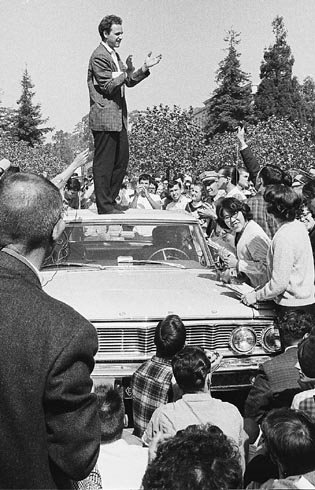
Do you know who the man in this picture is? If not, you probably lack a lot of knowledge that would be helpful in understanding the current activist climate at UBC. With Trek Park, the “Lougheed Affair”, and the recent Knoll Aid 2.0 RCMP confrontation, tension within the AMS has risen beyond reason. I think much of this tension is due to radically different perceptions of politics, history, and the role of student activists in society. While I can’t expect to convince SDS-UBC and The Knoll’s most strident critics of their value, I do hope that history can help us to find some common understanding and lead to more constructive dialogue.

The man in the above picture is Mario Savio, the most prominent student leader at UC Berkeley (and in America) during the 1960s. He is standing on a police car. Inside the police car is Jack Weinberg, an activist and former Berkeley graduate student. In September 1964 the Berkeley administration had decreed that students on campus would not be allowed to promote political or civil rights causes through fundraising, passing out pamphlets, tabling, or other means. At the beginning of October, Weinberg was tabling for a civil rights organization, the Congress of Racial Equity. The police asked him for I.D., he refused, and they arrested him. A host of sympathetic students then surrounded the police car with Weinberg inside it, and did not move for over a day, at one point repelling an attempt by police to reach the vehicle. By the following evening, the students had negotiated with the university administration an accommodation for political activity on a portion of the campus, and the waiving of charges against Weinberg.

This incident sparked the birth of the Berkeley Free Speech Movement, and propelled Mario Savio onto the national stage. His is now one of Berkeley’s most honored alumni.

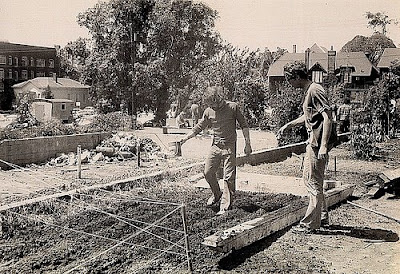
How about this picture? This is a community garden being planted in Berkeley’s People’s Park in 1969. People’s Park was built on land owned by the university originally intended for student housing but left to deteriorate after development plans changed. In April 1969 a number of community members began constructing a park on the land, without the university’s blessing. The park lasted for a month before police moved in to dismantle it under the direction of newly elected governor Ronald Reagan. The ensuing conflict resulted in the death of James Rector, shot by police while sitting on the roof of a nearby cinema. Today People’s Park is a Berkeley landmark.

The parallels with recent history at UBC are obvious, and these iconic moments of the 60s are close to the hearts of SDS-UBC’s founders. Students for a Democratic Society was, after all, the largest student organization of its time. The Port Huron Statement, written in 1962, was the founding document of the SDS. It is a comprehensive manifesto, spurred by continuing racial inequity, social inequity, the wealth disparity between the United States and much of the world, the threat of nuclear holocaust, and the Vietnam War. The document called for a renewed participatory democracy and a redirection for universities. Some paragraphs from the section on students are worth quoting:

If student movements for change are rarities still on the campus scene, what is commonplace there? The real campus, the familiar campus, is a place of private people, engaged in their notorious “inner emigration.” It is a place of commitment to business-as-usual, getting ahead, playing it cool. It is a place of mass affirmation of the Twist, but mass reluctance toward the controversial public stance. Rules are accepted as “inevitable”, bureaucracy as “just circumstances”, irrelevance as “scholarship”, selflessness as “martyrdom”, politics as “just another way to make people, and an unprofitable one, too.”….

Tragically, the university could serve as a significant source of social criticism and an initiator of new modes and molders of attitudes. But the actual intellectual effect of the college experience is hardly distinguishable from that of any other communications channel — say, a television set — passing on the stock truths of the day. Students leave college somewhat more “tolerant” than when they arrived, but basically unchallenged in their values and political orientations. With administrators ordering the institutions, and faculty the curriculum, the student learns by his isolation to accept elite rule within the university, which prepares him to accept later forms of minority control. The real function of the educational system — as opposed to its more rhetorical function of “searching for truth” — is to impart the key information and styles that will help the student get by, modestly but comfortably, in the big society beyond.

These are paragraphs that I feel are even more apt today (maybe substituting “Guitar Hero” for “the Twist”) than they were fifty years ago.

It would be easy to look at the current SDS movement as playacting at activism, blindly aping its predecessors, but that would be doing a great injustice to the students who have devoted great portions of their lives to causes they see as vitally important. While the 60s is a source of inspiration for activists today, and a source of ideas on how to build a movement, there are many reasons to believe that the political situation today calls for a renewed student movement.
As the Vietnam was a catalyst for many far-ranging social changes in the 60s, the Iraq and Afghanistan wars have given new life to activist movements around the world. Students across the US have formed the “new SDS”, declaring

As Students for a Democratic Society, we want to remake a movement – a young left where our struggles can build and sustain a society of justice-making, solidarity, equality, peace and freedom. This demands a broad-based, deep-rooted, and revolutionary transformation of our society. It demands that we build on movements that have come before, and alongside other people’s struggles and movements for liberation.

Together, we affirm that another world is possible: A world beyond oppression, beyond domination, beyond war and empire. A world where people have power over their own lives. We believe we stand on the cusp of something new in our generation. We have the potential to take action, organize, and relate to other movements in ways that many of us have never seen before. Something new is also happening in our society: the organized Left, after decades of decline and crisis, is reinventing itself. People in many places and communities are building movements committed to long-haul, revolutionary change.

SDS-UBC was formed out of discussions last year about how to recover from the bitter decline of the Social Justice Centre. We felt that a new direction under a new banner was necessary, and the resurgent SDS offered both an inspiring legacy and strong allies. Members of SDS-UBC traveled this spring to an SDS conference in Washington State.

The Knoll is older than SDS-UBC, but it has and continues to be the platform for activists at UBC to communicate and discuss current and core issues. Although never perfect, The Knoll has, I think, given substance to the activist work on campus, attempting to explain and justify our actions, among its other functions. In as much as this is successful, it demonstrates the intellectual autonomy of its authors. Nobody is blindly acting out a script from Berkeley in the 60s.
So what are
we to make of the events at Knoll Aid 2.0? On the one hand, the activities around the bonfire seem more reminiscent of Lord of the Flies than a Berkeley student rally, and the attitude displayed by many towards the police and fire department seems at least disturbing. On the other, SDS-UBC is claiming police misconduct. Many claim that the attempt by students to negotiate with police was without merit. When the police instruct you to do something, you do it, especially if moments before you had been breaking the law by setting a huge bonfire in a parking lot. We can see two reasons for this group of students attempting to negotiate, however. First, it appeared to have been successful in the case of Stef Ratjen. Second, perhaps subconsciously, there was that Berkeley precedent.
It also needs to be stressed that the police invoke a different set of associations for activists than for much of society. While many would associate “to serve and protect” with the police, when many activists think police, they think “police state”. Police were the immediate antagonists in both of the Berkeley tales I related. Police and protestors regularly clash, with the police often protecting the politically powerful, not society as a while. The RCMP famously pepper sprayed activists at the 1997 APEC protests. Vancouver’s Anti Poverty Committee and the Downtown Residents’ Coalition have both had numerous encounters with police, and the Vancouver Police Department has had more than one case of brutality towards Vancouver’s homeless. The French chant, “Police partout, justice nulle part,” resonates strongly with many of us.
The actions of some students at Knoll Aid 2.0 are perhaps not to be admired or imitated, but they are also not incomprehensible and not reason to denounce the state of campus activism, or those who found themselves in conflict with the authorities. Lighting a bonfire was probably not a wise decision, and I’d be surprised if a lot of alcohol had not been consumed by many of those involved, but that does not excuse the actions of the police if SDS’s allegations are true. I hope people can step back from these recent events and grant a little sympathy to those involved.


Categories
Development News

Updates on the Arrests

Edit/Update: Here are some more details from the CBC website, a video and an eyewitness account from Blake Frederick, elected Senator and student. We will write a more thorough analysis as more details become available.

Update 2: A judge will determine around 1pm today (Saturday April 5) at the DTES Criminal Court whether the five or more arrested students will be criminally charged or if they will be released. More updates to come.

Update 3: Youtube clip (anonymously submitted), and another Youtube clip of the bonfire and VP External Stef Ratjen being detained . Here you can keep yourself updated on the rest of the media’s coverage.

Update 4: Another Youtube clip of the students being arrested. There is an individual on a bicycle who seems to have been plugged from the crowd and arrested. What did he do to be arrested?

Categories
Development News

25 students detained during peaceful protest

(restructured post for new readers)


Students peacefully protest the arrest of a fellow student Photocredit: Geoff Dunbrack

On April 4th students lit a bonfire and held a music and dance night in support of the grassy knoll on campus. The Fire Department arrived to put out the large bonfire, and this escalated into a number of confrontations and students being arrested.

The press release below was sent to me before there was anything to be found on the RCMP media website or any other news source, but from the limited information I can’t help but wonder if the police used unnecessary force if its intentions were to put out a bonfire. While I don’t think the police needs to act differently in a student space from anywhere else (as the press release suggests), the police conduct makes me think of 1968 Germany.

I ask that anonymous comments be at least signed with initials.

Press release from Students for a Democratic Society as well as more photos behind the jump.

PRESS RELEASE: POLICE BRUTALITY AT KNOLL AID

Today a peaceful celebration in defence of public space at UBC was violently quashed by the RCMP. This press release was written on April 5th at 1 a.m. with limited available information. All the events discussed herein have been either captured by camera or can be corroborated by multiple eyewitness accounts.

On Friday, April 4th, UBC students loosely associated with Trek Park and SDS held “Knoll Aid 2.0,” a musical celebration of public space on campus. Knoll Aid 2.0 was part of a larger campaign against the commercialization of campus, the demolition of the grassy knoll, and the development of a $40 underground bus-loop. Knoll Aid 2.0 was an overwhelmingly peaceful event and featured local musicians, free food, and three simultaneous petition drives. It was attended by primarily UBC students.

Though Knoll Aid 2.0 began at noon on Friday, at around 8:00/8:30 RCMP and the Fire department arrived at the area known as “Trek Park” (a liberated space near the grassy knoll) because some students had created a small bonfire. Citing a bylaw violation, the RCMP approached one student, Stefanie Ratjen, in a rather aggressive manner and began speaking with her. After a dialogue, the contents of which are still unknown, Stefanie was grabbed by an RCMP officer and thrown to the ground, pinned, and handcuffed. Her face was literally shoved in a puddle of mud while an RCMP officer sat on top of her. After this uncalled act of police aggression, fellow students came to her aid. One musician was immediately arrested for questioning the RCMP officer’s treatment of Stefanie. For approx. two hours students formed a chain to protest RCMP action and several students attempted to peacefully negotiate the release of Stefanie and the musician (whose name at this point is unknown). During this time approx. 30 RCMP cars with officers from across Vancouver and the lower mainland including Richmond came to UBC. Campus security was also present and threatened to discipline students if they did not cooperate with the RCMP. Police officers systematically attempted to break the human chain students had formed by pushing, shoving and kicking. RCMP officers randomly arrested any student present at the scene including Bahram Norouzi who was arrested in the middle of a CTV interview. At around 10:30 p.m. on approx. 25 students were arrested and detained. They were brought to a Main and Hastings detention center where they presently still remain.

This press release would like to draw attention to the conduct of the RCMP. A university is intended for students, not the police. Upon entering student space, the police should have had the decency, at the very least, to deal with students in a respectful and dignified manner. Instead, RCMP officers were highly aggressive and belligerent. RCMP officers committed gross abuses of power by, for example, threatening to release dogs on students and pointing taser guns at students that were already pinned down to the floor. The actions of RCMP officers are testament of police misconduct, if not brutality. We demand the release of all students arrested and demand that all charges be dropped. Furthermore, we demand an inquiry of the RCMP’s actions in relation to this event and the treatment of students. Lastly, we demand that UBC administration defends student’s rights to a peaceful protest.

To repeat, this was a peaceful celebration/concert in defence of public space. The RCMP had no right to violently quash a peaceful student protest.

Signed,

Trek Park for the People

Students for a Democratic Society

Student Environment Center

Social Justice Center

Here are some photos taken by students on the scene.


Photocredit: Geoff Dunbrack

Categories
Academic Life Campus Life Development

UBC Farm politics, elaboration of.

If you’ve voted in the current student referendum, you may have noticed that there is no question about the UBC Farm. Most people of course, wouldn’t have expected one, but it is a surprise to some. The Friends of the Farm started a campaign to get a question on the referendum ballot which would see students providing permanent funding for the Farm. A big step for sure. But this, and why it was ultimately abandoned as a funding/advocacy strategy is only one piece in the puzzle of convoluted politics that the UBC Farm is in the middle of.

Brendon wrote a good post about some of this earlier,HERE. I encourage you to read his post. There’s more back story, and some more recent developments, however.

The Farm, since its existence in its current form as a multi-use education/academic/community resource has had a tough fight for institutional legitimacy and enough funding. That’s not for lack of support from its home faculty, Land and Food Systems, but because first, it’s a strange and hard-to-define space, and second, its land is a 250 million dollar cash cow waiting to be sold. These facts produce a climate in which the Farm’s very productive, vibrant, ambiguity can be exploited in order to manipulate decisions and planning processes toward institutionally desirable outcomes. This attitude, which seeks to dissect out various “uses” and what fraction of land each occupies so that the rest can be cashed in to real estate development is patently against the desire of most students, faculty, and community members. Let alone against the spirit of UBC’s much-vaunted mission statement, Trek 2010.

So what’s going on? There’s a few levels of really important people in this political scene. There’s the very convincing folks in the UBC treasury office that have converted UBC’s brass that a large-endowment strategy is the best direction for the institution. Thank Byron Braley and Terry Sumner for that. They in turn have influence over people like Nancy Knight, UBC’s VP Planning, who have alot of power in determining the planning processes and baselines from which consultations are formulated. She in turn informs by the Board of Governors, which, being populated by business-type appointees, is disposed to like alot of money. Then there’s president Toope, who seems genuinely well-meaning, but either doesn’t know too much about it or doesn’t have too much real leadership. On the other hand, there’s some folks at Vancouver City Hall and the GVRD who have some ideas about local food systems and see the UBC farm as a boon. In the same type of vein are the residents of the University Neighbourhoods who see the farm as a community amenity and green space. Then there’s the academic and student community, whose support will be the most important ultimately.

UBC’s desire to sell off the Farm land is no secret. But here’s a few incidents to put you on your guard about the manner in which it’s trying to manage this:

  • Way back in 2005 the VP Academic & Provost and the UBC treasury office paid for a report to be written about how much land would be necessary for the UBC Farm to function. This study, which was thought to be a positive step in solidifying the Farm’s uses of the land, has never materialized. It was researched and written long ago by Erik Lees, but since its completion, has been suppressed. Very good sources tell me that this report was revised more than seven times (rewrite #7 was due in July 06, and hasn’t been seen since), and looks very different now than it did originally. If I can say “now” at all – it doesn’t technically exist. It doesn’t take a political scientists to realize that the UBC administration is suppressing this document, even though (or especially because?) they themselves commissioned it, since it does not jive with their vision.
  • UBC a few months ago the Campus and Community Planning office released some Requests for Proposals (RFPs). These are basically calls for consultants of various kinds to carry out a technical study. One of the RFPs was to do land-use planning in the “academic precinct” in South Campus, which includes the Botanical Gardens nursery, animal care facility, TRIUMF, BC Research, etc. In the terms of reference for the RFP, the UBC Farm’s land was not included in this precinct. While this may seem like a low-level technical item, it’s important, and it’s nefarious. Technical studies and reports are what decisions are typically based on. When a political decision (like determining that RFP ‘s peopgraphic scope for the “academic precinct” in Sounth Campus should exclude the farm) is made by some anonymous person in the CC&P office, it’s almost impossible to be accountable. In this case, it was too “low level” for the Provost or the Dean of LFS to know anything about, but such a thing could turn out to be tremendously important. Deligitimizing the Farm as an academic learning space is a strategy that is being used here.
  • Communication dissonance. Last year, when the results of the Campus Plan’s extensive online survey was published, the UBC Farm was the single most mentioned topic. This month, when I attended an all-day campus planning design workshop, one of the instructions in the booklet was to retain a couple acres for a teaching and research farm. The base-line set for these creative workshops will materially guide their results, and the resulting options we’re left with. And there’s a clear dissonance. While data can be clear from consultation, it is up to Nancy Knight and the C&CP office to summarize and present it. I’ve heard considerable spin in these summaries before. The level of reasonable baselines can only be really established through popular sentiment, which some of the planners hope to slyly ignore.

As my good friend Rona says, I’ll support the endowment next time it lowers someone’s tuition. In the meantime, I’d like to see one of the best places at UBC continue to thrive. The next few months of consultation in the Campus Plan process will be critical to send a clear message about this. Please participate with your eyes open. Here’s the campus plan website, which will tell you how to do so.

Categories
Academic Life Campus Life Development

UBC Farm: Why they aren't taking a referendum question to students this March

Due to a hole in WordPress, this post’s author is misattributed. The follow was written by AMS VP Academic ’07-’08 Brendon Goodmurphy.

Most students know by now that the future of the UBC Farm is shrouded in uncertainty and controversy. This year strong student supporters of the Farm (particularly Friends of the Farm), wanted to hold a referendum question asking students to increase their student fees to support the farm’s programs and development. The hope was that a passed referendum would show UBC just how much the community supports the farm, and would help secure the farm’s future. But the current political situation within UBC and the region has made some supporters of the referendum question if now is really the right time.

Find out why behind the jump…

A brief history of the UBC Farm:

When UBC first decided to build market housing on campus, they ran into some concerns and push-back from the community (students, faculty, staff, residents in Vancouver and the UEL). So, the GVRD stepped in and said that there would be some regulations and guidelines for how UBC could develop that market housing community. Those rules were all outlined in the Official Community Plan (OCP). Of course, the Farm sits in the middle of prime land that the University ultimately wants to sell to developers. After public outcry over the farm in the development of the OCP, the farm was slated for “future housing reserves” – meaning that they weren’t going to develop housing there right away, but it would be set aside, and we would come back to it later to make a decision (that date is supposed to be 2012).

Of course, this stamp of “future housing reserves” also gave UBC an excuse to not invest in the Farm, and refuse to help build its research capacity and refuse to see its value as a community amenity. In fact, when some market housing residents worked with the farm to create a community garden, UBC denied the proposal and said it wasn’t allowed! UBC has been actively impeding any development of the farm for many years, so that they can more easily deny the farm’s importance in 2012 when the issue is up for consideration.

The current situation:

To understand the current situation, you have to understand some local politics. UBC would like to make changes to the South Campus Neighbourhood Plan – they would like to densify the neighbourhood (add more units, make more money). This requires a change to the OCP, which requires approval from the GVRD.

However, the community has some allies in the GVRD who have an interest in a) preserving the farm, and b) seeing UBC become part of the City of Vancouver. Both of these fit into policies that the GVRD already has (for the farm, they are worried about food security and how quickly farmland in the region is being depleted, for governance, they GVRD would like all electoral areas to become part of a municipality). Therefore, some elected officials at the GVRD were saying to UBC: “We’ll let you densify the South Campus Neighbourhood, if you promise to deal with the farm issue and do a governance review.”

Well, UBC doesn’t really like the prospect of being told what to do by the GVRD when it comes to the Farm or governance, so at the most recent Board of Governors meeting, UBC decided not to pursue the South Campus Neighbourhood densification – for now…

But to appease the GVRD, UBC also said that they are going to deal with the farm issue and the governance review right now. I told the GVRD at a recent meeting that I didn’t really believe UBC’s commitment to dealing with the governance issue – I genuinely believe they are dragging their feet, they have no interest . And the farm issue is going to be dealt with through the Vancouver Campus Plan…this is where the concerns from Friends of the Farm comes from.

Hidden motives:

Nancy Knight, UBC’s Associate VP Campus & Community Planning, has decided to ‘deal with the farm issue’ through the Vancouver Campus Planning process. That may sound like a good idea at first, but its much more complex than it seems.

The Campus Plan process is an institutional planning process, meaning UBC has complete control over that process, meaning the GVRD has no say in what decisions are made. Thus, when the farm gets addressed through the Campus Plan, we lose some really powerful allies in the GVRD who could put a lot more public pressure on UBC to “do the right thing.” For now, we as students and as members of the University community have to flood the Campus Planning process in order to save the farm. Of course, we all know that UBC isn’t that great at listening to students, and is quite selective about what it hears in consultation processes.

The point is that if the farm review is part of any OCP changes, then the broader community, including the GVRD, and the UNA residents have some sort of say in what happens to the farm. If it’s a Campus Plan process, then UBC gets the ultimate say, and the GVRD really has power to interfere. The Campus Plan is about institutional spaces – aka, learning and research spaces. Taking care of the farm through the campus plan process conveniently means that UBC can look at it primarily for its research value, and thus it’s easier justifying that it move to the bio sciences research area – the same amount of research can occur no matter where its located.

Now add to this the fact that Nancy Knight and the team at Campus & Community Planning have gotten external consultants to come in and review the “potential” of the farm. These consultants were chosen without letting the farm or the faculty of Land and Food Systems know, and it has mostly been all behind closed doors. Nancy Knight wants to have these consultants come back and say: “the Farm is very valuable, but they only need half the land and could probably move to the Bio-Sciences research area and still do the same great work.” Perhaps she sees this as some sort of compromise between the Board’s agenda to maximize the $250 million that can be made off of that area, while still preserving some sense of a farm for the community.

As long as the Farm issue is dealt with through the Campus Plan, the result is going to be cutting the area by at least half, or moving it way down to the bottom of campus in a very remote and inconvenient location, or both.

The other thing to consider, is this process to deal with the farm through the Campus Plan is only looking at the farm from a research-value standpoint, and not from a community amenity standpoint. The Farm is so much more than a research facility, it’s a place that brings students and residents and researchers and learning all together in one place. This is more than just an institutional facility, it’s a community facility, and the community should have a much greater say about its future.

Canceling the Farm Referendum

I told the Friends of the Farm that it was a big mistake to back down from the referendum now. The concern is that the political situation is too tense right now to take the risk. I say that a referendum is always going to be extremely risky. The only reason there are more backroom deals being made about the farm right now is because UBC is facing a lot of pressure from the GVRD, students and the community-at-large to save the farm. As long as UBC is facing pressure on the Farm, they are going to push back, and push back hard. The farm lands are worth over $250 million dollars in Endowment revenue. We’re up against a huge beast, and that is never going to change.

But, if we as students could come to the table and say “students care about the farm so much that we are willing
to pay out of our own pockets to develop the farm’s capacity” then we’re in a really strong negotiating position. Don’t forget, it’s UBC who has been financially neglecting and starving the farm for years, and its students who are stepping up and footing the bill.

If the referendum were to fail, then it would be a tragedy. But, as far as I’m concerned, certain people within the University are always going to misconstrue the evidence and use any referendum outcome against us. But there are also a significant number of people in the University who will take a passed referendum seriously, and that will be way more powerful than the few who discredit it.

The Farm needs a student movement behind it right now, and there is nothing better to get a student movement started than through a “Save the Farm referendum campaign.” Getting hundreds of students around campus, handing out pamphlets and saying “UBC is trying to take away our farm, we can’t let that happen” – what better way to start a genuine student-movement. That’s something almost all students can say yes to.

Categories
AMS Elections 2008 Development Government Issues

Issue of the Day: The Musqueam Issue

Now for something a little more controversial. Somebody who I work fairly close with recently questioned my leftist politics. That’s fair – I feel quite comfortable in the bureaucracy of the AMS, and I feel quite comfortable trying to balance the 42 000 different opinions of AMS members, and I even support many CASA policies. But after reading Jesse Ferrara’s post on the Musqueam issue, I agreed that it was something that should get some more discussion in this year’s election. And frankly, at the most recent BoG debates, there are a few things that should be clarified.

More behind the jump…

A History of First Nations Oppression:

There is a certain camp of people, in which I identify, who might describe the history of First Nations people in BC like this:

There were no “signed” treaties in BC that handed the land over to the Crown – in fact, the conditions under which these other “treaties” were signed across Canada are sketchy at best. There was also no war that was won that legitimizes the Queen of England‘s right to let the Canadian government oversee this land. The only thing that did happen was that a lot of Europeans came to this land with racist, imperialist assumptions that the people who lived here were “backwards and uncivilized” and that was some sort of justification for why we could take it over.

Over the years, those racist assumptions permeated into the minds and hearts of almost every Canadian, excusing policies that forced children to leave their homes, renounce their Native identity and stop speaking their Native language. What followed were decades of white people actively destroying Native culture and history, and any of its power and meaning. Families fell apart, survivors of the Residential Schools were taught to hate themselves and histories were not just being lost, but violently rewritten. We built entire institutions that systematically destroyed Native culture and kept the First Nations people down through a reinforcing cycle of economic and social poverty.

Now, people think that we should just forget all that: “I didn’t take over their land, its not my fault.” Well, that’s nice. But I for one feel perfectly capable of taking responsibility for the incomprehensibly terrible things that my ancestors did, and I feel perfectly comfortable doing whatever it takes to rectify the situation, whatever it will take for First Nations communities to heal and rebuild.
Systemic oppression is about systems, structures and societies that are built on keeping certain people down, certain perspectives out, and certain power-structures in place. Accepting the First Nations issue as an oppression issue is about acknowledging the decades of violence that has been launched at Aboriginal communities.

Land Claims issues:

The basic principles to rectifying the relationship between Canada and the First Nations communities are outlined in the Royal Commission on Aboriginal Peoples (RCAP): recognition, respect, sharing and responsibility. We must recognize that the Aboriginal people are the original inhabitants of this land, and no matter how you want to look at it, that grants them certain rights, and we must recognize them as nations, on par with the nation of Canada. We must respect their tradition, their history, their culture and their wishes, the way they define themselves and the future that they define for themselves. We must share this land. And lastly, we must take responsibility for the years of violent oppression, it is our responsibility for the current relationship and state of affairs.

Understanding current First Nations issues, like current land claims, requires a deep appreciation for these basic tenants. Land claims in BC are about negotiating use of this land on equal terms, land which has never been negotiated fairly up until this time. It is not necessarily about “living off the land” – although most Indigenous cultures have a strong cultural tradition that is linked to particular land. To assume that all Native people want to return back to some sort of pre-Settler lifestyle is racist. Thus, if the Musqueam nation wants to build condos on the Golf Course – by all means, who are we to say what they should do? Land claims are about reconciliation of past injustices – and we need to respect the terms of reconciliation that they define.

The Musqueam Nation and UBC:

We have to recognize the First Nations people as legitimate nations, with legitimate governments. In this sense, why would the Musqueam nation negotiate with UBC? The Musqueam Nation negotiates with the nation of Canada. UBC just happens to be the governmental institution that sits on their land. The notion of putting a Musqueam leader on the Board of Governors is absurd because it is tokenistic. It doesn’t address the heart of the issue at all. It is a false gesture. Until UBC is willing to address Indigenous issues head on, with a serious commitment to change things and rectify things, then a BoG seat is entirely meaningless. A serious approach would question how we perpetuate racist and anti-indigenous assumptions in our institution. It would question how we, as an institution of higher learning that is representative of advances in human society, continue to oppress and colonize First Nations people.

UBC’s current approach is to increase access of First Nations people to the ‘incredible education of UBC’ – aka bringing more FN students into UBC. Education can be one of the greatest tools for empowerment and freedom. It also can be one of the greatest tools for domination and repression. Unless UBC’s educational experience is willing to take on this question, and change to be anti-oppressive, then again, this solution is tokenistic, and side-steps the real issues, and even perpetuates the colonial relationship. What would an empowering education look like for an Aboriginal student? Well, it would be an Aboriginal education, taught from an Aboriginal perspective by Aboriginal people. It would not be a Western interpretation of Aboriginal history. It would force white students to engage in that Aboriginal history from an Aboriginal perspective. It wouldn’t just be a pathetic attempt at being more “welcoming” and “supportive” of First Nations students. UBC’s approach doesn’t critically ask, how does the white institution of UBC needs to change in order to end the oppression of Aboriginal people within its doors, and in society as a whole.

The Issue as it relates to the AMS:

You may have read in a recent issue of the Ubyssey that the AMS failed a motion to support a negotiated settlement for the Musqueam Nation in the recent golf course issue. I think it was a very sad day, and a missed opportunity to publicly support the Musqueam nation. The AMS, like UBC, really has no role in “building relationships” with a nation – would any true representative of the United States come deal with the AMS? But there are things that the AMS can do. Firstly, the AMS can do a better job of publicly supporting the Musqueam nation in their struggle. The other thing the AMS can do is better represent its First Nations students – this would require more Aboriginal representation within the various facets of the AMS, better resources and services for FN students, outreach and relevance. Of course, its a bit of a Catch-22, because there aren’t many reasons currently for First Nations students to get involved in the AMS, which makes it difficult to build in those relevant resources and programs. For example, there should be an Aboriginal Student Centre in the Resource Groups. But again, until the AMS is willing to take a critical look at how we actively perpetuate an oppressive relationship, then we aren’t doing much better than UBC. The AMS will ha
ve to engage in the issue head-on, work with Aboriginal students to define what their needs are and how the AMS can support that, and then help Aboriginal students to make it happen.

Spam prevention powered by Akismet