
My government doesn’t like open source, loves arms manufacturers…


My census profits landmine makers


Man, I must be denser than I feared. I had no idea about any of this census stuff until I saw this item on Boing Boing.

Actually I did know that our governmental web services were not kind to free and open source software. I learned that when recently submitting my taxes online. “… accessibility is limited to Windows 98, NT, ME, or XP, and Mac users with Safari 1.2.4 with webkit 125.5.7. In addition, users must have at least version 1.4.2_3 of a Java Virtual Machine on Windows, or version 1.4.2_5 on the Mac.” No Firefox nor Linux users need apply.

For me, that’s a small inconvenience — though when I switched to Safari before filing my return, the site insisted I was still using the wrong browser for some time, before inexplicably granting me access.

But it’s this related tidbit that is both surprising and disturbing. Apparently significant portions of the Canadian census process have been contracted out to Lockheed-Martin. The world’s largest arms manufacturer. Makers of weapons of mass destruction, space-based weapon boondogglers, landmine profiteers and interrogators-for-hire in Afghanistan and Iraq (including nifty work at Abu Ghraib).

Apparently Lockheed has been branching out for some time. From a 2004 article in the New York Times:

Over the last decade, Lockheed, the nation’s largest military contractor, has built a formidable information-technology empire that now stretches from the Pentagon to the post office. It sorts your mail and totals your taxes. It cuts Social Security checks and counts the United States census. It runs space flights and monitors air traffic. To make all that happen, Lockheed writes more computer code than Microsoft.

… “It used to be just an airplane company,” said John Pike, a longtime military analyst and director of GlobalSecurity.org, a research organization in Alexandria, Va. “Now it’s a warfare company. It’s an integrated solution provider. It’s a one-stop shop. Anything you need to kill the enemy, they will sell you.”

As its influence grows, Lockheed is not just seeking to solve the problems of national security. It is framing the questions as well:

Are there too few soldiers to secure the farthest reaches of Iraq? Lockheed is creating robot soldiers and neural software – “intelligent agents” – to do their work. “We’ve now created policy options where you can elect to put a human in or you can elect to put an intelligent agent in place,” Mr. Stevens said.

Are thousands of C.I.A. and Pentagon analysts drowning under a flood of data, incapable of seeing patterns? Lockheed’s “intelligence information factory” will do their thinking for them. Mining and sifting categories of facts – for example, linking an adversary’s movements and telephone calls – would “offload the mental work by making connections,” said Stanton D. Sloane, executive vice president for integrated systems and solutions at Lockheed.

Canadians are assured that “At no point does any contractor collect, handle, or possess confidential census responses.” That settles that, then…
Posted in Uncategorized | 5 Comments

“Studying which is miserable”…

…is how the title of this weblog came out when I ran a vanity test of my URL on the Really Magazine 2Xlation facility, a roundtrip translator that takes a webpage into Korean and back again.

Via Darren Barefoot.

Posted in Uncategorized | 5 Comments

Akismet A-OK

The spam wars had gotten ugly here at Weblogs@UBC lately — what was especiallly frustrating was that we were being feasted on by the same set of spammers, and the existing SpamLookup plugins were apparently powerless to repel their attacks.

Thanks to Joe for turning up and installing the Movable Type plugin for Akismet.

I had come to accommodate myself to the hundreds of notification emails clogging up my inbox every day. (I could have turned off the notifications, but this problem was not one to ignore.) The levels of spam getting through now are miniscule (I hope that legit comments are making it through OK). The current lightening of that load has been a boon to my flagging spirit — it’s been a palpable opening in the darkness.

My gratitude to all concerned.

Posted in Webloggia | 1 Comment

Symposium Blogweave – via del.icio.us, RSS, javascript…

Irregular readers of this cozy lovenest of ed tech subversion may recall my participation in the recent Tronti weblog symposium. As expected, my own submission was more than a bit goofy, and barely relevant, but it was fun to do.

Soon after, activity started to crank up around a similar symposium concerning Gayatri Spivak. This time, I wisely stayed clear of the writing, instead limiting my participation to working with Jon to develop a framework for aggregating the postings of the various participants. I had liked the Tronti Blogweave that emerged from the previous symposium, and wondered if we might create a similar effect in real time, with a few added goodies.

Ultimately, my role was to get Jon and Enej talking with one another, and letting the wunderkind work his magic.

I am quite pleased with how the Carnival of Gayatri Chakravorty Spivak turned out. The page mimics the Long Sunday weblog design. We set up a designated del.icio.us account, which we used to flag all relevant web documents. Formal contributions to the symposium from the various weblogs were marked with the tag “posts” to be featured in the main page section. Background readings were flagged with “texts” and given their own section on the sidebar. Below that, “The Wire” is a set of feeds remixed by aggRSSive displaying other relevant items, as well as any del.icio.us bookmarks from outside the symposium that were tagged with “spivakfest”. We had intended to cast a wider net for items on The Wire (with Technorati or del.icio.us items tagged with terms such as “postcolonialism”) but there were issues with redundancy and noise. Finally, Enej inserted code for the in-site del.icio.us tagcloud so there is a pretty nifty tag-based index on the bottom-left sidebar (try it out).

There were a few hiccups, in part due to some issues with the aggRSSive server. But it wasn’t a bad experiment overall. I haven’t been able to follow the symposium nearly as closely as I would like, but Jon’s summary provides a fine overview, and some interesting thoughts on this emergent form of scholarly discourse:

…the solution to whatever impasse that had existed turned out to be not some kind of consensus, a search for agreement or to set others “straight” in reading the same text. Rather, what has been most interesting has been the ways what’s been dynamic and productive about the symposium has been its heterogeneity, the fact that we might be rather unexpectedly faced with arguments about matters culinary at one moment, cat-blogging the next; bicycles at speed colliding with observations on heteronormativity; libidinal speculation alongside anecdotage.

I’m hoping to revamp and reuse this presentation format for future weblog-based courses in the future. I’d also love to see what the edu-blogger community might do with a weblog symposium of our own. Consider yourselves warned…

Posted in Webloggia | Comments Off on Symposium Blogweave – via del.icio.us, RSS, javascript…

Perhaps unnecessary — UnKeynote wrapup…

I’ll keep this short, as both D’Arcy (great discussion in the comments) and Stephen have posted substantive follow-ups to the UnKeynote.

As with my collaborators, my feelings on the whole thing were mixed. It was a worthy experiment, but I’m not sure it really took flight, though it did get better as it went along. I know that I have little desire to listen to the recorded audio (posted on Stephen’s site) and relive the experience.

The unstructured approach was less effective here than at the Salon and the Hootenanny at Northern Voice. I can think of three reasons why… The crowd and room was bigger, obviously, but actually I think this was a minor factor. Second, the audience had no idea what was coming, so they had no way of preparing themselves for something other than a standard keynote. You could tell some people were freaked, and the minor technical problems at the beginning fed into a sense of things going off the rails. Finally, I think we left the range of topics too open. If we had tried a little harder to steer discussion to the suggested topics on the UnKeynote wiki (still quite a broad range) I think it would have worked better. As it turned out, for the first 20 minutes the group talked about distance ed funding models for K-12 in BC — a worthy topic, but politically loaded, and neither Stephen, D’Arcy, nor myself had much to add on the subject. It’s one thing to be a “guide on the side,” but even that more open approach implies some degree of expertise for the facillitator.

Having said that, it was big time fun and a genuine honour to be able to share time and space with Stephen, D’Arcy and the other attendees. The beer session afterward was a great pleasure. And this event was a lot more enjoyable to prepare for than the usual PowerPoint shuffle via email that apparently is standard procedure.

On a related note, I was having a discussion with some colleagues today about clickers, contrasting their effectiveness with something less structured like the chat tool that D’Arcy set up for the session. I’ve always had a knee-jerk aversion to clickers, in part due to a bad experience ten years ago — I associate them with the worst qualities of large scale lecture halls. (I recognise I’m mostly ignorant of contemporary practice.) But at the very least, with clickers there is some mechanism in place to account for all of the student feedback. The chat, on the other hand, was mostly not referenced during the discussion. I did note that some familiar names (like Scott and Darren) were taking part in the session remotely. I found their presence oddly reassuring at the time, even though I felt unable to engage them properly given what was going on in the room. I gave the chat log a quick read later on, and was pleasantly surprised at how good some of the comments were. If I use live chat during a session again in the future, and I think I will, some additional thought will be required on how to channel it into the F2F discussion.

Posted in Uncategorized | 6 Comments

We should be preparing our session…

Ed tech battle royale

…instead of goofing off, which is what we are doing right now. But it’s an UnKeynote, so a certain absence of structure need not be a fatal flaw.

I feel better knowing Stephen and D’Arcy got my back. I think this is going to be fun. Let’s hope the other attendees agree.

Update: We will have an open iChat/AIM window going, if you happen to be around your computer between 2:45-3:45 PST today. Open your iChat/AIM client, from the file menu select “Go to Chat”, and enter “unkeynote” to enter the stream.

Update 2:D’Arcy has set up a dedicated chat room at http://apollo.ucalgary.ca/chat/ – swing on by between 2:45-3:45 PST, we’ll keep a chair open for ya…

Posted in Uncategorized | 2 Comments

Talk, talk, talk… how do we make the big small?

Three days, three events.

Today, I’m speaking at a panel co-sponsored by UBC Career Services and the Faculty of Graduate Studies entitled “Connecting to Careers Beyond the Ivory Tower.” Perhaps I was asked to serve as some sort of cautionary horror story, as one year after completing my Master’s I was living in genteel squalor, making about $500 a month digging holes, clearing tables and doing other crap jobs for crap wages. In any event, here I am — and one trick pony that I am, my angle today is Networked Networking.

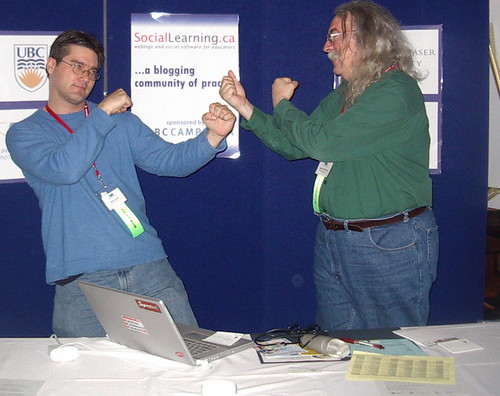
Tomorrow I’m going to be manning a booth promoting Social Learning, a collaborative weblog/resource bank that is initiating a very gentle launch countdown, for the BCEd Online Conference. Not sure how that’s going to play out — perhaps with me slumped at a display table alone for hours on end…

And on Thursday, Stephen Downes emerges from seclusion to deliver the closing keynote at this same conference. As D’Arcy Norman has already noted, Stephen is sharing his time and stage with us. We are hoping to break open the standard structure for a keynote, create a vibe that is more conversational and participatory.

How we do that remains to be seen. Our plans remain fuzzy. I’m not worried about dead air — the three of us never have trouble gabbing about ed tech on our own, much less together. But I’m told we can expect an intimate gathering of anywhere between 200-500 people. A little bigger than a salon or a hootenanny. If anyone has ideas on how we can make this behemoth dance, please don’t hold back. We’ll be equipped with wireless mics, so we can move around if we wish. And D’Arcy has started up a wiki for people to add suggested topics.

Posted in Abject Learning | 6 Comments

Gardner’s remarkable notes

Gardner Campbell has just written a real corker… I’m at a loss to add much of value, other than to reproduce a couple passages (leaving out the incidents that provoked them) and a suggestion that you read the thing yourself:

I don’t mean the routine stuff. The usual kerfuffles and complaints are tired and predictable -– the papers to grade, the disengaged yawners and watch-checkers, and worst of all, the days when I feel empty and flat and uninspired, indeed a bear of very little brain and no fresh ideas to catalyze the students into following the traces of their own engagement. No, I mean those days when the magic happens. When the big bell rings and a sudden, wild surmise seizes half the class, and me, with an idea or insight or epiphany that leaves us breathless. I assure you I do not exaggerate. Nor do I boast: I have some part to play in all this, but my experience is that great classes achieve greatness because of the students. When they come off the blocks from the first challenging or puzzling thing I say, when they fill the discussion forums with a burning intensity, passionate curiosity, and even a committed playfulness (Lewis’s phrase “solemn romp” comes to mind), when they work and work and work at an idea until they have not only understood it but extended it and taught me things I never suspected, then that’s a great class.

… If I can see the cognition happening, I can have a much more powerful and sophisticated understanding of what I can contribute as an advanced learner (i.e., as a teacher). If I were a music teacher, or a golf pro, I could watch the fingering, or the swing, and say “ah, I see that you’re doing this, or that, or forgetting this, or that.” But as a professor, I have a hard time seeing the fingering or the swing. Instead, I see bits of cognition happening in class, and some more-or-less ossified traces of cognition in papers. Often, I see the cognition happening in discussion forums, and those moments are crucial to me. But to see an essay — for that’s what it was -– that really was an essay -– an attempt -– was particularly valuable to me as I consider the shape and needs of this learner’s quest. And the serendipity of it all made it feel more authentic, more like what happens when the mind begins to understand the scope of the question, the contours of the problem space. Those beginnings are rarely the result of connecting dots. They’re more in the way of a wild surmise.

Can these moments be scaled? Can they be assessed? I am haunted by these questions. All I know is that both these moments, and the others like them that make teaching such an addictive profession, are at the heart of what I call education. Real school. Any answers or theories of education that don’t at some level speak to this heart will not satisfy me.

Readiness is all.

Man, if only I could write like that…

Tagged | Comments Off on Gardner’s remarkable notes

HigherEd BlogCon

HEBCscreenshot.jpg

April may be the cruelest month but it promises to be chock-a-block full of rich-media chocolatey edu-blogger goodness thanks to HigherEd BlogCon, “a conversation on the use of blogs, wikis, RSS, audio and video podcasts, social networks, and other digital tools in a range of areas in academe.”

Lots of good screencasts a-coming. Giving the students what they want: Short, to-the-point e-lectures by Mark E. Ott (screenshot above) is worth a look, and I eagerly anticipate the contributions by Stewart Mader and James Farmer, among others.

Nifty model for a conference — no fees, no sign-ups, and lots of reusable, Creative Commons-licensed materials…

Posted in Uncategorized | 3 Comments

RSS for the UBC Library Catalogue!

My long-time love for librarians (and for RSS) grows stronger over time.

My heart goes all a-flutter at the introduction of RSS feeds for new items in the UBC Library.

I could quibble — it would certainly be nice if custom feeds could be generated by a search. But the feeds seem to render fine in my newsreader, and in aggRSSive (which means it will be a snap for instructors to incorporate these feeds into course pages).

I demo an aggRSSive javascript rendering of the American literature feed after the jump. I see that one of the recently added items is a book by Karin Cope on Gertrude Stein. I remember Dr. Cope from grad school — looks like she’s ditched academia for the life of a Nova Scotian writer.

View RSS feed

Posted in XML/RSS | Comments Off on RSS for the UBC Library Catalogue!