Categories
AMS Elections 2008 Development Government Issues

Issue of the Day: The Musqueam Issue

Now for something a little more controversial. Somebody who I work fairly close with recently questioned my leftist politics. That’s fair – I feel quite comfortable in the bureaucracy of the AMS, and I feel quite comfortable trying to balance the 42 000 different opinions of AMS members, and I even support many CASA policies. But after reading Jesse Ferrara’s post on the Musqueam issue, I agreed that it was something that should get some more discussion in this year’s election. And frankly, at the most recent BoG debates, there are a few things that should be clarified.

More behind the jump…

A History of First Nations Oppression:

There is a certain camp of people, in which I identify, who might describe the history of First Nations people in BC like this:

There were no “signed” treaties in BC that handed the land over to the Crown – in fact, the conditions under which these other “treaties” were signed across Canada are sketchy at best. There was also no war that was won that legitimizes the Queen of England‘s right to let the Canadian government oversee this land. The only thing that did happen was that a lot of Europeans came to this land with racist, imperialist assumptions that the people who lived here were “backwards and uncivilized” and that was some sort of justification for why we could take it over.

Over the years, those racist assumptions permeated into the minds and hearts of almost every Canadian, excusing policies that forced children to leave their homes, renounce their Native identity and stop speaking their Native language. What followed were decades of white people actively destroying Native culture and history, and any of its power and meaning. Families fell apart, survivors of the Residential Schools were taught to hate themselves and histories were not just being lost, but violently rewritten. We built entire institutions that systematically destroyed Native culture and kept the First Nations people down through a reinforcing cycle of economic and social poverty.

Now, people think that we should just forget all that: “I didn’t take over their land, its not my fault.” Well, that’s nice. But I for one feel perfectly capable of taking responsibility for the incomprehensibly terrible things that my ancestors did, and I feel perfectly comfortable doing whatever it takes to rectify the situation, whatever it will take for First Nations communities to heal and rebuild.
Systemic oppression is about systems, structures and societies that are built on keeping certain people down, certain perspectives out, and certain power-structures in place. Accepting the First Nations issue as an oppression issue is about acknowledging the decades of violence that has been launched at Aboriginal communities.

Land Claims issues:

The basic principles to rectifying the relationship between Canada and the First Nations communities are outlined in the Royal Commission on Aboriginal Peoples (RCAP): recognition, respect, sharing and responsibility. We must recognize that the Aboriginal people are the original inhabitants of this land, and no matter how you want to look at it, that grants them certain rights, and we must recognize them as nations, on par with the nation of Canada. We must respect their tradition, their history, their culture and their wishes, the way they define themselves and the future that they define for themselves. We must share this land. And lastly, we must take responsibility for the years of violent oppression, it is our responsibility for the current relationship and state of affairs.

Understanding current First Nations issues, like current land claims, requires a deep appreciation for these basic tenants. Land claims in BC are about negotiating use of this land on equal terms, land which has never been negotiated fairly up until this time. It is not necessarily about “living off the land” – although most Indigenous cultures have a strong cultural tradition that is linked to particular land. To assume that all Native people want to return back to some sort of pre-Settler lifestyle is racist. Thus, if the Musqueam nation wants to build condos on the Golf Course – by all means, who are we to say what they should do? Land claims are about reconciliation of past injustices – and we need to respect the terms of reconciliation that they define.

The Musqueam Nation and UBC:

We have to recognize the First Nations people as legitimate nations, with legitimate governments. In this sense, why would the Musqueam nation negotiate with UBC? The Musqueam Nation negotiates with the nation of Canada. UBC just happens to be the governmental institution that sits on their land. The notion of putting a Musqueam leader on the Board of Governors is absurd because it is tokenistic. It doesn’t address the heart of the issue at all. It is a false gesture. Until UBC is willing to address Indigenous issues head on, with a serious commitment to change things and rectify things, then a BoG seat is entirely meaningless. A serious approach would question how we perpetuate racist and anti-indigenous assumptions in our institution. It would question how we, as an institution of higher learning that is representative of advances in human society, continue to oppress and colonize First Nations people.

UBC’s current approach is to increase access of First Nations people to the ‘incredible education of UBC’ – aka bringing more FN students into UBC. Education can be one of the greatest tools for empowerment and freedom. It also can be one of the greatest tools for domination and repression. Unless UBC’s educational experience is willing to take on this question, and change to be anti-oppressive, then again, this solution is tokenistic, and side-steps the real issues, and even perpetuates the colonial relationship. What would an empowering education look like for an Aboriginal student? Well, it would be an Aboriginal education, taught from an Aboriginal perspective by Aboriginal people. It would not be a Western interpretation of Aboriginal history. It would force white students to engage in that Aboriginal history from an Aboriginal perspective. It wouldn’t just be a pathetic attempt at being more “welcoming” and “supportive” of First Nations students. UBC’s approach doesn’t critically ask, how does the white institution of UBC needs to change in order to end the oppression of Aboriginal people within its doors, and in society as a whole.

The Issue as it relates to the AMS:

You may have read in a recent issue of the Ubyssey that the AMS failed a motion to support a negotiated settlement for the Musqueam Nation in the recent golf course issue. I think it was a very sad day, and a missed opportunity to publicly support the Musqueam nation. The AMS, like UBC, really has no role in “building relationships” with a nation – would any true representative of the United States come deal with the AMS? But there are things that the AMS can do. Firstly, the AMS can do a better job of publicly supporting the Musqueam nation in their struggle. The other thing the AMS can do is better represent its First Nations students – this would require more Aboriginal representation within the various facets of the AMS, better resources and services for FN students, outreach and relevance. Of course, its a bit of a Catch-22, because there aren’t many reasons currently for First Nations students to get involved in the AMS, which makes it difficult to build in those relevant resources and programs. For example, there should be an Aboriginal Student Centre in the Resource Groups. But again, until the AMS is willing to take a critical look at how we actively perpetuate an oppressive relationship, then we aren’t doing much better than UBC. The AMS will ha
ve to engage in the issue head-on, work with Aboriginal students to define what their needs are and how the AMS can support that, and then help Aboriginal students to make it happen.
Categories
AMS Elections 2008 Issues

Issue of the Day: Sustainability

I like to think of myself as an environmentalist, and its definitely how I got my start in student politics – co-chairing the Student Environment Centre for two years. Those two years were spent feeling frustrated and overwhelmed – partly because of the generally poor organizational structure of the SEC (and other Resource Groups), and partly because I was too idealistic and didn’t know a thing about campus politics, the AMS, coalition-building, strategic planning, and well, activism.

I still feel like I don’t really have a handle on environmental issues at UBC. So, what is it all about? Is it just PR or are we making a difference? Is UBC really leading the way in sustainability? And where does the AMS fit in all of this…

Some answers to these rhetorical questions… behind the jump…

A History of Sustainability:

In 1997, the University passed its Sustainability policy, committing to creating a Sustainability Office and creating a strategy that would guide its sustainability efforts. In 1997, this was huge, and still something to be proud of – a lot of very organized student groups across the country are still fighting with their University’s to develop a recycling program, let alone a sustainability office. Then Director of Sustainability Frida Pagani along with Geoff Atkins (AVP Land & Building Services) and I’m sure others convinced UBC that they could save millions of dollars in energy costs by retrofitting buildings (making buildings on campus more energy-efficient), which could fund the sustainability office’s operations. UBC agreed, and there you have the lasting marriage between UBC and Sustainability.
But that was really all the sustainability office had to offer save for a few educational and administrative programs which have mostly been, in my opinion, ineffective. UBC also likes taking a lot of credit for the U-Pass, and the associated increase in transit ridership – all too often forgetting the role that the AMS played in securing that program for students.

Recently, a new Director was appointed to the Sustainability Office, Charlene Easton. She comes from the corporate sustainability sector, and brings a very different flavor, but I think one that is setting the Sustainability office in much bolder new directions. We’ll have to wait and see, she’s only been in the position for less than a year. But, Charlene is very interested in building partnerships with students, particularly the AMS. Some of the new initiatives: creating something comparable to LEED standards for the market housing being built in U-Town; creating a coalition of student groups on campus called the Climate Action Partnership, coming together to create a framework that will get UBC to climate neutrality (also known as carbon neutrality).

What’s the problem?

Well, technically you could say there isn’t one. UBC has an incredible compost and recycling program, we boast the amazing educational and food security efforts of the UBC Farm (although it took a lot of lobbying to get UBC to recognize its value, which isn’t quite done), and we get a lot of international recognition for our efforts. The reality is, we could be doing a LOT better, and the push should be coming from students. The problem, in my opinion, is with us, the students.

We should be producing reports on various environmental issues, we should be writing letters, lobbying and building coalitions. We should be planting gardens in the middle of main mall. We should be demanding that no more trees are cut down for market housing, that more green space is preserved, and that all buildings are LEED platinum.

It takes all the energy we can muster to put on the Student Environment Centre conference – this year it was great too… but it didn’t create any larger dialogue about what the next big things that should be happening in campus sustainability. When I was co-chair, I was an idealist who didn’t know a thing about the science behind anything I was talking about, and I thought that “awareness campaigns” had meaning. We tried to hold stuff swap events that mostly just highlight the incredible amounts of junk that people collect over the years. I definitely wasn’t knocking on administrator’s doors. I definitely wasn’t mobilizing students to do demonstrations, and I wasn’t putting much effort into finding out what was really going on.

What should we do?

If student leaders want to be effective in making a difference in the environment, there are three things we need to do… 1) Get really informed – know everything that the Sustainability Office is working on, know all the new and innovative ideas that are being implemented around the world, etc. 2) Get more organized – let’s not be afraid to have structure if it makes us more effective, pay people for the work they do, have goals and plans, pick one issue and address it from every angle. We’re getting had because we, as environmentalists are too flakey. 3) Get political – lets stop wasting our time on frivolous events where we’re the only ones attending our own events, usually out of pity, and lets start changing the mind’s of the big-wigs at the top.

And a little plug for the AMS’ Sustainability Strategy:

Currently I’m working on developing a sustainability strategy for the AMS. I want it to be big. I want it to be bold. There are a lot of focus groups happening over the next two weeks, so make sure you come and participate and get your ideas to us – get more info on the AMS website.

Categories
AMS Elections 2008 Media

Letter to the Editor, re: VFM

This was sent to us as an anonymous letter to the editor, and we would like to run it as continued discourse on the VFM:

How to Drink the VFM’s Milkshake
name withheld upon request

The VFM contest would have very easy to hack this year. The main problem with VFM is that it is extremely easy to enter. For a measly $150 and five minutes filling out a form, any publication can appear on the ballot. The entry fee was raised from $100 to $150 this year as an attempt to filter out the ‘noise’. As Matt Naylor put it, “the idea is to limit the number in the contest; otherwise it would collapse under its own weight.” Great idea Matt! Too bad you went about it
entirely the wrong way. The voter media website explains the choice of using an entry fee: “It’s better to charge an entry fee than to require media entrants to collect signatures, because an entry fee has far lower social cost.” That last part seems to about sum it up: an entry fee has a low social cost. With a $2000 cash prize on the line, an entry fee with a low social cost and a high return on investment, it is almost like the contest was inviting fly-by night publications to enter just for the money. Matt Naylor’s mistake was focusing on the number of entrants and not the quality of the publications.

So, how could one hack the contest to assure themselves the top prize. The easiest way would be to pull a James Green. James Green, a relatively unknown, ran for mayor of Vancouver in the 2005 civic elections. He received an impressive 4,273 votes, but many think that the majority of James’ votes were actually intended for the similarly named and far more well known candidate, Jim Green. Voters, when scanning the ballot, just voted for the first J. Green they saw. So if
one were to enter the contest with a name similar to another a publication, it can be reasonably assumed that some of the voters would mistakenly vote for it. So which publication’s name would one mimic to generate the most accidental votes? It might be tempting to riff off the The Underground, the top finisher from last year, but as that publication is likely to enter the contest, one would more likely split the vote than win the prize. Luckily for the would-be hacker, the most well known newspaper on campus, The Ubyssey, doesn’t enter the competition. Mark Latham did something called a “multifactor analysis” of last years results, and concluded that had The Ubyssey entered it would have won by a landslide. And thus, The Ubussy is
born.

So unless the election code is changed next year, I am going to drink the VFM’s milkshake. I’LL DRINK IT UP!

Categories
AMS Elections 2008

Disconnected sundry thoughts

VFM Hasn’t Failed
Last year we (the VFMs, collectively) created a discourse around issues in the election, and there was a meaningful campaign for the first time in a long while. This year has been less successful, but the media are still influencing how candidates comport themselves and, heck, we even convinced a joke candidate to “go serious.”

Voter turnout shouldn’t be the end goal, nor should it be the yardstick by which VFM success is measured. Voters will only vote when they care; people only care when the people around them care. The VFM project is about building an information base and enlarging the AMS’ critical mass. Even though, last year, the same number of people cast votes as in previous, I’d wager that they were more informed than the year before. At a minimum, it’s creating a new class of informed students. And I’d want to see four years’ worth of results before judging it a failure.

Knoll Slate
My first rule of student politics: never underestimate the left at UBC. No matter the electoral system, there will always be a viable “left-wing” element at UBC. (I hate the term but I use it because people know what I mean.) Since the SPAN days it has been given life by The Knoll which, last year, ran a de facto slate. This year the slate is less pronounced, but still there.

The reason the left can never be discounted is because they have a powerful built-in voter base. First, there will always be a activist core on campuses, and they’re politically engaged. Second, there will be students who, because they’re young, gravitate to the left-wingers because it feels right and appeals to their sensibilities. No matter the merits of the candidates, they’ll get those votes. And that can be enough.

That leads me to two conclusions about this year. First, they’re getting better at abandoning the revolutionary zeal during election time. Check out Nate Crompton’s web page. It’s not only slick and worth of Students for Students at its finest, but it’s downright educational. And a very interesting read. And only uses the word “capitalism” once. And, most importantly, it’s good. (That’s not meant as a backhanded compliment. It’s really very good and insightful.) Second, watch out for Rodrigo. In a year with two Presidential candidates with broad appeal, and a third “wild card” with an interesting cross-section of elite and popular support, that solid voter base might be enough for Rodrigo to win. Especially since I suspect that voter turnout might hit a new low, he could easily get enough support to win.

“Hacks”
What’s wrong with being a “hack”? I’m pretty sure it’s a pejorative term, isn’t it? Of course that’s the very question – how to define “hack”? Often people tend to use it as a synonym for someone who’s hyper-involved, likes to fancy themselves on the “inside.” I have a hard time seeing that as necessarily negative. Just because someone gets involved in student politics and devotes their energies to boosting the campus doesn’t make them a “hack.”

See being a “hack” use to be unequivocally a bad thing. Then, during the halcyon days Wahid, McKechnie, Keys et al., the term was appropriate. Reclaimed, if you will, to mean something more positive.

I always resisted it, as I see the term far more negative implications. I see a hack as someone who’s in politics for ambition’s sake, who derives pleasure from being close to power, from the illusion that they themselves have any whatsoever. It’s someone whose self-esteem is riding on their election result, and for whom the pursuit of power, and the attention it entails, is just as important as eventually getting it. And that’s bad. There are people who fit this description in the AMS, and there are a great many involved people who don’t. Don’t confuse them.

(For a good example of hackery, see the comment on the post below signed by “#96.” That’s Spencer Keys, feeling the need to remind the world that he was the 96th AMS President. Although I’m sure Spencer has enough self-awareness that the irony was intentional. Or was it?)

Endorsements
Since when did it become a pissing contest about endorsements? From my understanding, it’s become an issue that some candidates have more/better endorsements than others. All the lack of endorsements proves is that the candidate didn’t solicit them from someone – it doesn’t prove that nobody supports his/her campaign. Think logically – the absence of something doesn’t prove that it doesn’t exist.

Moreover, an endorsement can come from many places. From a “I think they’re the best” to a sense of duty to a personality clash with an opponent. They’re really worth nothing more than face value, and it bothers me to see people making any noise about them beyond that.

(Also, kudos to the Devil’s Advocate. Dis-endorsing is probably one of the most brilliant ideas ever.)

“Insiders”
Finally, I can’t help but notice that this little blog has started a bit of a trend. I find it entertaining that “insider” has become a part of the discourse in a funny new way – people trying to define themselves negatively vis-a-vis us. The Thunderbird’s blog is entitled “UBC Outsiders,” the Devil’s Advocate prides themselves on being “Insider-free.”

Yet their controlling minds read our site daily. This amuses me.

True story: Gina and I came up with the name on the couch one afternoon last January. “We need something like UBC Insiders, only better.” And lo, it was born.

(Edited to add a shout-out to VPF candidate Andrew, who wants to “make everyone a UBC Insider”!)

Categories
AMS Elections 2008

Maayan's Endorsements

Well, I figure there’s no point waiting any longer. If you care, here’s who I’ll be voting for, and briefly why. I haven’t included a scientific dissection of each candidate’s pros and cons, though I’m happy to discuss this in more detail in the comments.

President: Erin Rennie – I talked about this in an earlier post. Notwithstanding Jeff’s rebuke of Tim and I for endorsing her, Erin is the best person for the job. As posted on the Devil’s Advocate, she sent out a release today assuring students that she’s perfectly serious about taking the job and doing her best, if elected. She’s qualified, she’s a leader. Vote for your first choice – or else democracy’s a sham. My first choice is Erin.

(And by the way – if this situation (“this situation” being the one where people are afraid of voting Rennie for fear of “splitting the vote” for their second-favorite candidate) drives you crazy, make sure to support a sensible voting system that prevents vote-splitting next time someone suggests one. This will be occuring in a month or so. So don’t forget.)
The rest behind the jump.

VP Academic: Alex Lougheed – Alex’s platform is solid. He’s matured a lot in the last year. He’s shown that he can work as a team player, he’s conscientious, knowledgeable, and quite creative in his own way. I hope that Alex will continue to develop his internal sense of values, so that he can make decisions that are not only practical and beneficial for students, but also personally meaningful.

VP External: Stefanie Ratjen – Stef’s experience in the UBC community with grassroots activism will help her connect her the VPX portfolio with students. She has strong opinions, but it looks like she’ll ultimately be willing to take direction and be open. Stef’s commitment to lobby on a provincial level is a good thing; her unclear overtures about using CFS in some way to do so need to be clarified.

VP Academic: Sarah Naiman – Sarah has been working very hard this year on the SUB renew project. She planned a successful consultation strategy, and successfully renovated the Pit with VP Finance Brittany Tyson. Watching Sarah speak to the Board of Governors this fall about SUB Renew made me feel proud of the AMS, and proud to be a UBC student. She’s that convincing. Sarah will continue to do a good job on SUB renew, and she’s promised to devote more time to restructure SAC, which I look forward to seeing.

VP Finance: Andrew Forshner – I’ve had the pleasure of working with Andrew this year. He’s clever, practical, has financial experience, and is truly one of the best listeners I know. His commitment to sustainability in the businesses is appreciated.

BoG:
Andrew Carne – Andrew has demonstrated his knowledge of campus development issues. His commitment to communicating with students is important. This year, students have demonstrated an increased interest in BoG decisions – it’ll be great to capitalize on that momentum. I don’t know him personally, but I have it on several good authorities that he impressed in the debates and can be trusted.

Tim Blair – Tim will bring a level of maturity to the Board. As an experienced naturalist, community activist, and professional engineer, Tim has both the right priorities and the necessary credibility to be an effective Board member. He knows alot about sustainability, and a lot about UBC planning issues. He’ll be a credible champion of our open spaces and the Farm.

Senate: As others have mentioned, there’s a great calibre of candidates this year.
Blake Frederick – Blake knows the issues inside out, having worked as the AVP academic for the AMS this year. He’s already got important relationships that will be useful this year. He’s truly thoughtful, and won’t be a fair-weather senator.
Alex Lougheed – I agree with Brendon here. Alex is meticulous and detail oriented. He has some specific ideas about making student senators more effective and cohesive. While these might be a bit hard to achieve, the thought is a good one, and Alex himself will be a great senator.
Philip Edgcumbe – I am very impressed by Philip’s platform. His two main ideas – recording lectures, and allowing students to challege the exam for a course – are both good and practical. The rest of his platform reads like a what’s what of important academic issues. Philip has clearly done his homework, and done it well. He’s young and keen, and will hopefully get the ball rolling on his ideas early.
Alfie Lee – Alfie has woked hard this year both on AMS and senate. His enthusiasm is appreciated. His platform points are all right-on. Study space, timely exam schedules, library hours, teacher training – damn slow senate processes!!
Azim Wazeer – Azim’s platform looks good. The issue of the LPI and TOEFL is a new one, but the annoyance of having to take gazillions of standardized tests is not small for international students. I’m sceptical of Azim’s recommendation about having grad students study at UBC for a year before letting them TA. Many grad students need TA positions to finance their graduate work, especially in their first year.

Categories
AMS Elections 2008 Development

Issue of the day: The UNA – Interveiw with Mike Feeley

The UNA aren’t the fat-cats we students like to imagine. The University Town Neighbourhoods are the five outlying areas of UBC’s campus that have been leased out to private developers for the purpose of building high-end residential neighbourhoods, and thereby growing UBC’s financial endowment. The university has envisioned these neighbourhoods as part of making UBC a “complete community” in which people live and work sustainably. They’ve set (and met) ambitious goals to have 50% (I think) of the neighbourhoods inhabited by people that teach and work at UBC. Students on the other hand, see the neighbourhoods and their inhabitants as a manifestation of the privatization and selling-out of our land to build a suburb completely separate from the University’s academic mission. There’s truth in both perspectives.

The University Neighbourhoods Association (UNA) is the pseudo-municipal council for people living in the University Town neighbourhoods. It is often the target of student ire, being stereotypically branded by students as one of the reasons UBC is “selling out,” screwing over students, and generally going to the dogs. Now I know it’s a shocker, but stay with me: the residents of the University Town neighbourhoods don’t necessarily represent competing interests to those of students; in fact, they experience many of the same problems we as students have with the governance structure of UBC.

I sat down with UNA board member and UBC engineering prof Mike Feeley a month ago to try and dig down and find the kernel of truth behind the hyped-up animosity between students and U-town residents. And what I found was that it shouldn’t even be there. One of the first things Mike said to me was that U town residents themselves are not the people that decided to develop that land. “Once the development happens, the relationship changes to one between people,” he said. The UNA, though it approximates some functions of a municipal government (like garbage and noise regulation, running its own community centres and gardens, allocating the tax and levy for U Town residents) is in fact an opt-in society constituted under the Society Act of BC, and completely subject to the jurisdiction of the UBC Board of Governors, much like the AMS.

Therefore, there is a formal problem of “taxation without representation” – the UBC BoG collects the property tax and services levy from the U Town residents, and then hands it to the UNA to spend. But, not all residents are members of the UNA due to voluntary membership, and the UNA itself is not formally represented on the BoG. It has always played a role as an “advisory board” to the BoG. There’s a debate within the UNA as to whether formal representation, or the current role is in fact more effective in advocating for residents interests. So it’s not completely cut and dry.

Some of the biggest issues the UNA looks at are

  • Running the Old Barn Community Centre (and the new community centre being built in South Campus)
  • Having control over “public” areas like gardens so that they are taken care of and planted with things that are appropriate for children and the community – not necessarily the way developers plan them.
  • Access to recreation facilities like the pool, rinks, and gyms, at cut-rate prices. (the UNA makes a contribution to the ancillary that runs them, UBC athletics, to the tune of 1/4 million a year)
  • Promoting community and volunteerism in the community.

There are some interesting dynamics at play in the UNA, I found out. On the UNA board, there are three appointed members – two from the university (AVP Planning, and AVP finance/business), and one from the AMS (the VP Academic). These members are controversial, since true municipal councils don’t have appointed members. “Why students are there is a bit hard to understand,” said Mike, “but they’ve brought a bit of energy to the board, and been tremendously helpful to our shared interests with students. The relationship with the AMS is tremendously important.” The elected seats on the UNA board, (which will increase in number as the neighbourhoods grow) are dominated by members of the U Town community that are work at UBC – and by talking to Mike, these people are hardly emblems of capitalist treachery.

Hawthorne Place, the neighbourhood that was built over the old parking lot across from Totem Park, has proven to be quite a surprise in many ways. The university expected the type of people that would purchase there to be wealthy empty nesters. In fact, 70% of the residents in Hawthorne are faculty and Staff and UBC and from 700 families that live there, there are 650 children. Three main community dichotomies exist in the community: university connected/not; new immigrants/not; and families with kids/no kids, older. In Hawthorne, anyway, it seems that the younger university-connected set is the most involved, and thus has most of the political influence in the UNA. The character of Hampton place is quite different though, and it remains to be seen what sort of community emerges in the South Campus neighbourhoods.

It has to be noted, that though UBC has been successful in ensuring that many faculty and staff are able to live in the U Town developments, the same cannot be extended to students. Mike Feeley: “If you’re a faculty member, you can barely afford to live here. If you’re a student, you can’t. If you’re a labourer, work for plant-ops, a secretary – you’re living in Surrey. I happen to think that’s wrong, and it’s a problem we need to address.” There are three buildings in Hawthorne that were actually co-developments reserved for faculty and staff only, and built without some of the fancier fixtures to allow for more affordable price points. Mike lives in one of these. He added that this problem is not one that just exists at UBC; it’s the same problem Vancouver as a whole faces as land values increase and the city become less and less affordable.

To me this is something UBC needs to address pro-actively. These communities are now being constructed from scratch, and there’s no reason not to do it right. By ensuring that affordable housing exists in the Neighbourhoods alongside the more expensive developments, UBC will go a long way to ensuring that U town is truly a complete, sustainable community. If students can participate in the community by living in it, you’ll see all the animosity and us/them dissipating. As for the UNA, it’s not clear if they’re interested in lobbying for political advancements like affordable housing, forwarding the Governance Review, above their work on recreation, sustainability and community events – that’ll be up to the leadership in the community. Here’s hoping they will.

What the candidates say:

President
Erin Rennie: “Forge a fair relationship with the RCMP, the UNA, and the UBC Admin.Demand more legitimate governance at UBC.”
Matt Naylor: “This past year we have been struggling with the continued alignment of student [sic] by the RCMP and others, such as the University Neighbourhoods Association. They need to learn that to be on a university campus means that, on occasion, students are going to be around.”
Mike Duncan: Couldn’t find anything.
Rodrigo Ferrari Nunes: Couldn’t find anything.

Academic
Alex Lougheed: “The UNA has a new board chair this year. This means its a good time to make new relationships with them. However I question their position in the current governance model of UBC, and many of their attitudes towards students. I hope to change our relationship with them, and their perceptions of us so we have more common understandings, and can work together. If we were to lobby together, there is no way the administration could ever say no.”
Nathan
Crompton:
Couldn’t find anything.
Rob McLean: “The goal of 25% of students being able to be housed on campus is far too modest given our diversity. As a student who has lived in low-cost housing on campus for the last three years, I can attest to the need for more Fraser Halls and less Chaucers. In my opinion, if it isn’t for students of people related to the university (faculty or support staff), it does not belong near campus (especially on Wesbrook)!”

Categories
AMS Elections 2008 Media

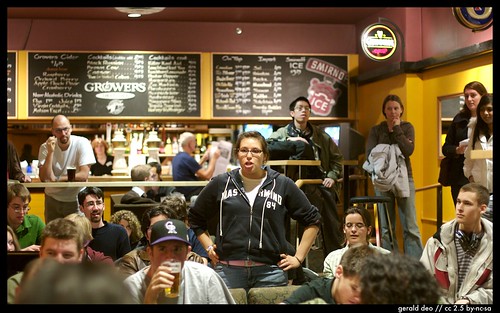
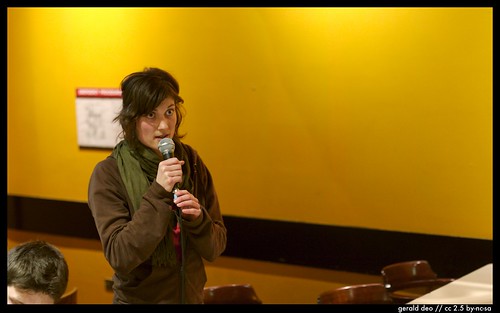
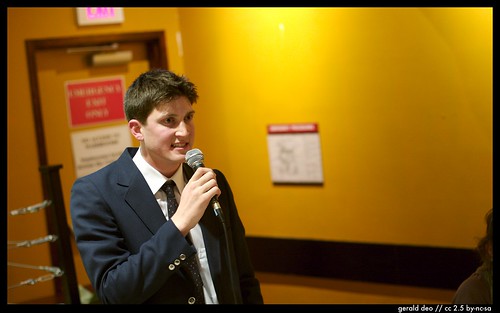
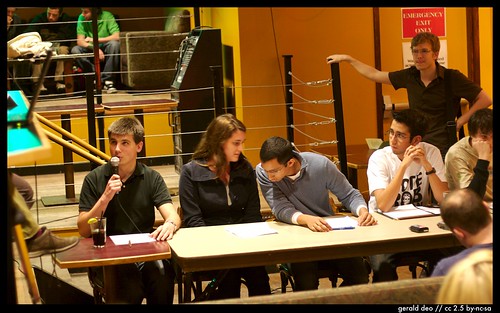
January 17th: Debate photos and commentary.

One of the things people most frequently mention about UBC Insiders is that the posts are often wordy, and lacking in sass. This should remediate both of those.

photos and comments behind the cut (warning, there’s lots!)

debates jan 17 2
Ubyssey staff Brandon Adams and Jesse Ferreras, huddling before the debates start. Or exchanging sweet nothings. Not that there’s anything wrong with that.

debates jan 17 3
Michael Duncan secretly wishes that the Presidential election was, in fact, a big hair competition.

debates jan 17 4
confidential to DP: telling girls about the size of your hydrant is a bad idea.

debates jan 17 5
Che Allison’s Head of Police forcibly ejects AUS President Stephanie Ryan.
I support the intention and the action and hope to see Stephanie more frequently bodily removed from things.

debates jan 17 6
Mike hones his “monkey see, monkey do” skills as Erin promises to fight the War on Fun.

debates jan 17 7
There was a point being made here, but I’ve forgotten it. Also, it’s not a very good photo. I’m sorry.

debates jan 17 8
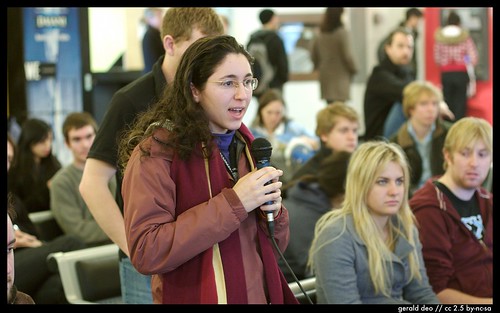
Maayan asks a question, as Shawn from Eat Cake erroneously thinks that he looks better in maroon.

debates jan 17 9
Brittany promised violence upon my person if I said anything mean about her, and I figure she’d be at least as thorough at that as she was as VPF…

debates jan 17 10
Brendon watches the debates as Jeff watches us. Because Jeff is watching us all.

debates jan 17 11
Paging Dr. Freud!

debates jan 17 12
I don’t want his lucky charms.

debates jan 17 13
Chris Diplock, throwing down fresh rhymes and phat beats during the VPF debate.

debates jan 17 14
Sarah Naiman watches the debates while enjoying a “baby roll”, one of the items on the Honor Roll’s secret menu. It’s made out of babies.

debates jan 17 15
Enraged at being caught in the act of eating a baby, Sarah goes after the wrong member of the media. Luckily, Brandon survived.

debates jan 17 16
Tough questions. Reasonably priced drinks. What more could you want in a debate?

debates jan 17 17
Stef Ratjen, VPX candidate that Jesse Ferreras has neatly disassembled.

debates jan 17 18
Freeman Poritz, VPX candidate that Jesse Ferreras has neatly disassembled.

debates jan 17 19
Some of the Senate candidates look away as Colin Simkus tries to serenade the moderator. Alex Lougheed is definitely taking mental notes.

debates jan 17 21
Being on the elections committee Listening to would-be senators read their resumes would also drive me to drinking. I hope Tariq comes out of this with an intact liver.

Categories
AMS Elections 2008 Media

VFM and other media-themed updates.

Voting started yesterday (Friday). As you may have noticed, the system being used is the archaic and inflexible WebVote hosted on the UBC Student Services site, not the new AMSLink system purchased by the AMS this year, which is still not functioning. If you tried to vote, you may also have noticed that the VFM entrants are not yet on the ballot. The VFM administrator, Paul Gibson-Tigh to explains:

VFMs are not on the online ballot as of yet, because the deadline for entering the contest was today at 4pm. We didn’t want to disadvantage the last minute entrants (of which there were a few) so we couldn’t complete the list until the registration period had closed. I would call it a coordination error that I guess arose because the entry form was created before the election period was determined. People will still be able to vote in the contest, even if they have voted for candidates already, so I dont think there will be any problems. I’ll keep you and the other 10 entrants posted on whats coming up if this causes any problems.

So don’t worry – everyone will still be able to vote for their favorite VFMs. Still, this timing is highly unfortunate. Media cannot themselves be publicized and marketed to a campus of 50 000 people in a timespan of days. In turn, I doubt VFM will succeed in fuelling increased voter turnout this year. We’ve learned that some last-minute entries has been submitted however. True to form though, the VFM website has yet to be updated. Another point to note is that the new voting system (Interpolated Consensus Voting) that AMS council introduced for the media contest this year can’t be administered on WebVote. The system is a little hard to understand, and I was planning a fabulous explanatory post, but don’t worry, you don’t need to know anything about it anymore. As Matthew Naylor amusingly noted last week (in a totally different context, but still) “democracy was narrowly averted”. Too bad.

Some other media notes:
The Ubyssey printed an extensive elections supplement yesterday, with profiles of all the candidates. This is great. They’ve barely published any analysis or real campaign coverage. This is sad. To summarize our official student newspaper’s coverage: 1. an article on joke candidate names; 2. an article on one specific joke candidate (the hydrant); 3. an “analysis”/opinion piece running one presidential candidate down.

This last piece is truly unfortunate. While it’s nice that the Ubyssey is trying to make it’s Friday magazine more dynamic by introducing articles that are not striclty news, but have some opinion mixed in, this patricular piece was NOT labeled as such. It’s a bit jarring to read a heavily angled and editorialized article you think is supposed to be news, and to suddenly encounter the first person “I”. Obviously, these shouldn’t take the place of actual serious reporting, which has been totally absent in the Ubyssey’s pages this campaign. The Ubyssey has formed a veritable gallery of photographers and news staff at every debate – so where’s the coverage? Given the mismanagement of the VFM contest, most voters that have read anything at all will probably be going to the polls on the basis of the Ubyssey’s inadequate and downright skewed coverage.

Categories
AMS Elections 2008 President

How the President is voting – Jeff Friedrich's ballot


Jeff Friedrich is the current AMS president. These are his words. (Cartoon by JJ McCullough):

Ok… not to add fuel to the endorsement fire- but endorsing joke candidates? Maayan and Timmy, I think you two can step up and make a real choice here. And nothing against Erin, but being a joke candidate affords you a lot of advantages in a campaign. I think Erin is great, but I’ve never been that convinced that she actually likes or understands the AMS very well. Saying that an AMS run version of ACF is unfortunate because it won’t be student run is false, on the first hand; and a real candidate would present a plan to make it’s management involve more students- a perfectly reasonable platform point.

Also- elections aren’t fun. The type of people who should probably win them aren’t often the same type of people who thrive on the shameless self promotion necessary in campaigns. The one reflection I had about them is that they can be incredibly educational. I learned a lot about the AMS from my campaign- about student’s perceptions of it’s relevance and about how your ideas and vision resonate with membership.

So aside from congratulating all of the candidates for the bravery it takes to put your name forward, one message I’d have to all candidates is to hang in there, miss a few more days of class, and to learn what you can. And to the rest of you- cut them a bit of slack. It’s absolutely brutal to go home at the end of the day and read anonymous comments that are rude and unproductive.

President (this one is longer- I felt I owed it to Matt and Mike, both people I respect for their commitment to the AMS)

The most important job a President has is building a team that respects each other and their relationship with council. Finding shared priorities, particularly within staff and the exec team, and ideally with council, leverages the contacts, abilities, and momentum of many students and makes projects happen.

The reality is that the President portfolio is awkwardly defined- you get everything (internal, external, political, and management) and nothing. You’re not a CEO, and you can’t necessarily demand action from independently elected VP’s. You have a relationship with a council that is likely too large, has clumsy structure, grandiose debate, and whose members have to balance the political interests of their respective constituencies with their fiduciary obligations to everyone’s student union- the AMS.

That means the strength and effectiveness of your leadership is fundamentally dependant on how well you build consensus and use the governance structure of the AMS to build energy and commitment to projects. Just because it’s called “President” doesn’t necessarily mean there is an overly rigid hierarchy. I’m not sure everyone appreciates that.

[Endorsements behind the jump – Ed]
Quite frankly, I do not have confidence that Matt’s leadership style, ability to receive feedback, and judgment are well developed enough to lead an exec team or a large and complex organization like the AMS. If Matt had more ability as a team player, that would be demonstrated as support and endorsements from members of his exec team or from previous exec who have worked with him. Matt might be a future AMS President, but I don’t think he’s ready yet.

Matt’s ideas are also underdeveloped. It’s mostly status quo and the things he added as priorities don’t sit well with me. Liquor law lobbying might sound nice, but I doubt we’d gain much from ABLE membership, and most of the other ideas seem like they haven’t received feedback from people who might understand the practical challenges. It’s surprising to me that liquor would get a similar quantity of platform ink as discussions around student access, debt, and academic quality.

I have a hard time believing the message about empowering council. That’s a very hard thing to do- something we need to do, but nonetheless very difficult. It means more than working with the allies you have on council, which I think is how Matt has conceptualized the issue to himself.
Please appreciate how difficult it is for me to say that, and please don’t interpret my comments as being overly critical of Matt as a person.

Matt campaigns well. So far he has done this better than Mike. Which is disconcerting, because one of the reasons I support Mike is that I believe he has an ability to motivate student attention towards a referendum campaign for SUB that could be transformative for the organization, the U-Blvd project, and for the needs of a largely commuter based and disengaged student population. The groundwork is there but the route to referendum is challenging, and someone will need to build a very effective case to convince students. Mike needs to show through his campaigning that he is that person.

So pick it up Mike. Find a passion that is about ideas rather than “the next natural step” in student leadership. It’s there. Your ideas on athletics and involvement are important. I’ve worked with you on projects and know you’ve got an ability to motivate passion in others, and you’re organized in how you delegate tasks and manage projects. Mike is approachable and amenable to changing tack when decisions go astray. He has strong relationships with, and respect from, the university administration and the staff in our organization.

For those concerned readers of The Knoll and other members of the fledgling yet always inspired activist community at UBC (much love)- Mike has more political depth than you’re likely to give him credit for: I met Mike 4 years ago when he was helping organize Farmade, a cause I know he’s committed to. My guess is that he’ll have an approach with a VP External/Academic that is largely hands-off- meaning the political ambitions of the AMS will largely be guided by these portfolios in the coming year.
Mike Duncan is absolutely the person for the job.

The rest:

Alex Lougheed– VP Academic
Chris Diplock– VP Finance
Sarah Naiman– VP Admin (Sarah is exceptional)
Stef Ratjen– VP External

Senate – outstanding caliber of candidates this year…

I’m excited by, and you should vote for….

  • Blake Frederick (is qualified to be VP Academic)
  • Alfie Lee
  • Azim Wazeer (great focus on LPI- an issue which hasn’t gotten as much discussion as it should)

Can do the job, but I honestly don’t know enough about their platforms…

  • Aidha Shaikh
  • Colin Simkus

You should vote for one of these if you’re voting for them for VP Academic (it will help build a better relationship between the Caucus and AMS council)…

  • Alex Lougheed or Rob Maclean

I don’t know them, but their material looks professional and/or I’ve heard positive things about them…

  • Eileen Harder
  • Phillip Edgecumb

Board of Governors

Andrew Carne (good answers at the debate)
Tim Blair
Bijan is a close third for me.

Categories
AMS Elections 2008 President

Endorsement: Erin Rennie for the win!

Erin Rennie. The posture of a winner! Photo Gerald Deo

Tim beat me to the punch, but I swear my draft was here first. I decided to vote for Erin Rennie yesterday at around 12:15. Tim’s got good reasons to choose her; I feel similarly. She’s got council experience, reams of brains, and a far better personality for leadership and engagement than either Matt or Mike. It doesn’t take much to see through some of her more humorous polemics to realize that Erin actually gets politics, and gets students. She wont be beset by her adversaries’ respective problems. Problems which to me, are a fair bit too serious to just hold your nose and vote for. She’s the best for the job. Simple enough. Other people have told me that while Erin Rennie is the best candidate, there’s no point endorsing her because she can’t win. To this I call bullshit. Look to the sidebar poll – yeah it’s utterly unscientific, but I don’t think people were joking when they chose Erin in the poll. Erin for the Win!!

My other endorsements coming soon.

Spam prevention powered by Akismet