Categories
Student Movement

Lobbying: by Tim

You can tell it’s exam time (and, in my case, hockey playoffs – Go Sens!) by the vastly decreased post count. And readership too, no doubt. Meh. I should be sleeping. But since I found the (remarkably poorly) hidden jelly bean stash in my living room I’m a little hopped up on sugar. So decided to write something on this sorely neglected blog. Something interesting? Naaah. But a rambling treatise on lobbying? I can do that.

See I haven’t spent that long at the lobbying game. Really, I only spent 2 years of my life trying to get University officials to listen to me. (I’ll note, however, that I spent a year trying to get things from University officials in non-political capacities. That experience helped.) I also get the feeling that, relative to some, I’ve had a fair amount of success. But at a minimum, I’ve learned a few tricks about successfully bending the ear of University administrators.

  1. They used to be students, too. Here’s my overarching theory – who’s still in a University by the age of 45? People who never left. They never left either because they’re unemployable anywhere else or, more likely (if they’re senior), they really like University environments. Moreover, most peoples’ university environments were shaped by their student experiences; it follows that University administrators liked being students. Tap into that, into their memories, and you’re one step closer.
  2. They like hearing from students. This flows from the above. They were probably young keen-eyed students back in the day. Chances are, in some way, you appeal to some part of what they love about Universities. I’ll bet most of them were involved in a “sit-in” of some variety. Probably some anti-Vietnam protesters in there, as well. These administrators are normal people with University experiences; unfortunately, their perceptions of the University experiences are skewed by their 250k salaries (in the case of VPs) and their distance from the experience.
  3. Provide a unique voice – tell them something they don’t know. Put another way, tell them things only students know. There’s no point in re-hashing tired old arguments – they’ve heard them before, no matter how persuasive you find them. And no, your rhetorical brilliance will not change their mind. Additionally, they’re probably more knowledgeable than you are. They do this every day. So question things where they can’t pull rank or authority, provide value in an area they don’t. I once went into a meeting with the Director of Financial Assistance and she was most interested in the dearth of campus community. She just shot down all my numbers and arguments, but was genuinely concerned about the impact that loans might have on student life. And that perspective was valuable.
  4. Engage them! Invite them! One BoG meeting, as we were preparing the terms of reference for the search committee for Martha’s replacement, I made the point that Martha rarely showed up at events where students were there. A member snapped back at me: “that’s because she’s never invited.” He had a point. When Prof. Toope came to AMS Council the day they announced the visit, a councillor quietly whispered “when was the last time Martha visited?” The answer: “when was the last time she was invited?” In my experience, people will just as happily take a meeting, or show up… just ask.
  5. Don’t tell them they’re wrong. Okay, tell them they’re wrong. But think about how you do it. Nobody likes being told they’re wrong. What happens when that happens? People get defensive. On BoG, I was struck by how human these administrators are. And it’s a basic human trait – when challenged, we rarely back down. When pushed into a corner, people fight back. It’s very important to challenge authority. But challenge in a constructive way that allows the authority to say “you’re right” without losing face.
  6. Speak their language. Nobody wants to hear ideological ranting. The most effective student presentations have had measurable benchmarks, clear strategic thought, and clearly articulated outcomes. That’s a fancy way of saying constructive engagement. Don’t communicate in a way that allows them to easily dismiss you, and it’ll all be fine.

Apologies for the “us-them” dichotomy. And for the perspective. But this is just my approach to lobbying. It is possible to get things done in the University’s bureaucratic maze, it just takes patience and a willingness to play the game.

Categories
News

Virginia Tech Shootings

I’m sure you’ve all heard about the campus shootings at Virginia Tech. Tragic, sad, shocking… all barely begin to describe it.

It raises thoughts. Like when there’s a shooting at 7am and a murderer known to be at large, why don’t you lock down the campus and cancel classes to avoid exactly what happened two hours later? And how important campus health and wellness programs, initiatives, and people can be. Mostly, it’s important that every member of a campus community feel at home. And don’t forget about the important college/university experience that’s been shattered for thousands of students.

It’s one thing to murder someone; it’s quite another to mindlessly slaughter. My own personal reaction, is that I was in the same grade as Reena Virk in Victoria, a year behind Harris/Klebold, and the same age as the Dawson college gunman. What is it about this age cohort that makes us more likely to act out like this? I find that element of it really striking. Is there some disconnect? I have no idea.

(I’m presuming right now that the shooter was a student. I have no idea if that’s the case or not.)

Categories
Uncategorized

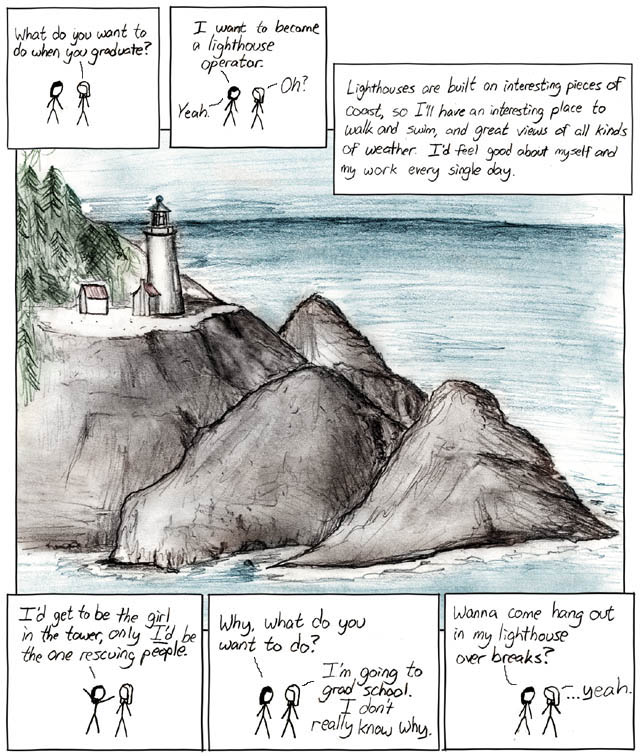
From xkcd.

Good luck with exams everyone.
Categories
Academic Life

Dr. Carl Wieman Speaks!

On Friday I sat down with Nobel-laureate in physics, Dr. Carl Wieman to ask about the 12 million dollar science education initiative he’s heading up at UBC to improve undergraduate courses for the science masses. I wrote a post about the basics of the initiative earlier, so I won’t repeat them now. You can find that post, and some relevant links here (click!).

Listen to the interview here (click!)

The main thing to notice is this: The funding and implementation is through the departments. This means that departments have the key power to organize and prioritize the money as they wish, with guidance from Dr. Weiman and education experts they may decide to hire, which he would train and reference with. Neither Wieman, nor individual instructors are the heroes of this initiative, but the departments themselves (or whatever their consensus or leadership decides) will be determining the direction of the spending.

I had some thoughts about Dr. Wieman and the initiative after our interview, which I’d like to put out there:

The man is assiduously, zealously, diplomatic. You may notice in the interview that Dr. Wieman doesn’t give a straight answer to whether there’s an education quality problem at UBC. He often defers to the Departments, instead of asserting his experiences or ideas. He answered several of my questions with vague observations like, “we must first ask what we want and then…”. These responses are quite practical, when you get down to it: he shouldn’t tax the sensetivities of the VP academic, he cannot force the hand of departments, and yes, setting goals and research questions is crucial. Indeed, Dr. Wieman knows that he must work within the department structure of the University, and he’s embracing that. Fashioning himself as a revolutionary with all the answers will not help his vision come about, and he knows it. But don’t be fooled. For all the hedging, Dr. Wieman has a vision – it’s just tempered by familiarity of university realpolitik. This vision stems from the realization that the democratization of higher education, and the reality of larger classes and reduced teacher-student interaction implicit in it, create unique challenges. Dr. Wieman’s thesis is that with this reality, the only realistic way to cultivate the meaningful interactions and problem-solving challenges which are tied to “expert-like” learning results is through the adoption of researched, proven information technology.

I simply hope, that when the department implementation process gets to the nitty-gritty, that Dr. Weiman will be there. His austere replies in the interview may almost have convinced you that he actually doesn’t have specific ideas, or any over-arching vision. He does. I’m confident that he has the political gumption to bust these out when it matters the most, in each departmental decision-making conversation.

All that said, personally, I’m not sold on the technology fetish. Yes, Dr. Wieman is highly conservative, and very careful about his uses of these technologies. He stresses that they should only be used if they’ve been tested to work, in the correct context in the courses. Still, I keep going back to the OWL example: OWL is an interactive program used in Chem 233 that has animation-based organic chemistry teaching modules, problem sets, and quizzes that allow you to manipulate chemical compounds using shockwave software. OWL is meant to be a significant part of this course, and is even worth a toothsome morsel of the course grade. Nonetheless, the division is clear: some people loved OWL (either because it’s easy marks, or because they actually got something out of it) and some people (me) hated it, and preferred loosing marks than wasting their time doing detestable tasks that didn’t help them learn at all. The thing is, there will always be that issue. There will always be students that don’t get along with staring at a screen to learn, preferring to hit the books, and there will be those that will. That’s why I’m just not sure that out-of-classroom software is the be-all end-all of making students learn better.

I’d like more of of a focus on improving the quality of lectures themselves. Lectures are still important, and they CAN be done well. The lecture has taken a lot of flak as an inherently awful format, but this really needn’t be the case. A well-structured lecture can be very effective in ordering, prioritizing, and explaining material, even if it’s not the best at imparting problem-solving ability or deep conceptual understanding.

For an interesting read, check out Dr. Wieman’s report on “The Optimized University” that he prepared for the BC government’s Campus 2020 post-secondary education review here (click!).


This is the picture I took on my walk home the moment after I realized that I’d forgotten to take a picture of my handsome interviewee. Vancouver city-hall for you, therefore.

Categories
BoG Development

Governance Part II: UBC Properties Trust

Once again, this is inspired by Tristan Markle’s excellent letter to the Ubyssey. He identifies UBC Properties Trust as a key driving force in the U.Blvd decision. He’s quite right. But the UBCPT question is one that’s far more broad than UBlvd; in fact, I’d argue it’s a fundamental threat to the University’s governance.

So, what is UBC Properties Trust (UBCPT)? It’s a private corporation, legally separate from the University; however, it is entirely owned by UBC. When any building goes up on UBC land, both institutional and non-institutional, it goes through Properties. In short, it’s a property development firm that hires all the contractors, does all the project management, and leases and services the UNA land. When a project is going to happen (classroom, housing, or anything else), it always goes through UBCPT, whose staff figure out how much it will cost, arrange the people who will do everything, and make it happen.

Basically, the University doesn’t build things – Properties does so on their behalf.

This causes a few significant problems. They can be divided into two areas: Project-specific, and related to governance. These two areas are very closely related.

Governance

  • Two members of UBC’s Board are on the UBCPT Board. Three members of UBC’s senior leadership are on the PT Board as well. Why is this a problem? Well, it removes any effective oversight of what PT is doing. The work of PT is rarely criticised at Board. Why? Largely because the most powerful BoG members are essentially responsible. As a direct consequence, institutional decisions about academic priorities and buildings needs are essentially made at the PT stage, which is outside the University.
  • There is also no true accountability. UBCPT is only accountable to a) its Board, and b) UBC’s BoG. But neither is the true client, nor is either in a realistic position to actually exercise any real oversight over the other.
  • Neither the VP Academic nor the VP Students are directly involved with PT. Which I find odd, as they are the true clients and end users.
  • The VP External sits on the Board of Properties. The Campus and Community Planning office reports to the VP External. There’s functionally no independence between the two groups. It’s a sham.
  • The real problem is that the University’s mission is to be a University, and all that entails. Properties’ mission is to contribute to the endowment. That’s financial. Which means they have no direct responsibility to make the University a better place; it’s indirect. In theory the BoG should provide some oversight, but it doesn’t (see above).

Project Management

  • PT’s job is to keep price down. They call it “value engineering.” Their job isn’t to make a great classroom, it’s to make a passable classroom at value. This, while not necessarily bad, can produce some results that are less than friendly to students. The best demonstration of this? UBlvd itself. As many know, the architects who originally won the design competition quit. Why? Because they couldn’t work within UBCPT’s price constraints.
  • Related to the above, UBCPT is driven by dollars in the door. This tends towards long-term thinking. A classic example is LEED construction; it comes at a few million dollar premium during the process, but over the life cycle of the building, it earns its money back many times over. PT is notoriously resistant to LEED building. Why? It makes buildings more expensive in the short term, and PT isn’t the one responsible for long-term costs. The University is. PT is only concerned with short-term (construction) costs, and has no incentive to produce sustainable buildings.
  • The dollars in the door phenomenon lends itself to revenue-generating projects. Which brings more value to students? The knoll, or a Starbucks? It depends on how you define value. And that definition of “value,” to the PT Board, is framed in terms of the endowment. That means money. This means social space and mixed use is so much more likely to be retail; the kind of social space where the price of admission is a latte.

In short, there is no oversight, no way to pressure this powerful Board. It’s insulated from the University when convenient. And while it may produce more efficient development, it comes at significant cost.

Categories
AUS Campus Life

UBC Student falls off roof top, now in serious condition

This is taken from the RCMP website. Whoever the person in serious condition is, we wish them a speedy recovery.

UBC student falls off roof top, now in serious condition at VHG

Vancouver, UBC: Charges are pending against another student.

On April 12th, 2007 at approximately 02:20 pm, RCMP members of the University of British-Columbia Detachment attended a Fraternity House located in the 2800 block of Westbrook Mall after receiving word that a young man had fallen off the patio roof top.

After a preliminary investigation, witnesses say the young man who was standing on top of the patio roof top, reached down to another man who was standing on the ground. Police investigators are trying to determine what took place at that time. What we do know is that the young man fell down approximately 20 feet onto concrete injuring his head.

The victim was transported to Vancouver General Hospital where he is currently in serious but stable condition.

During the course of their investigation, police arrested the18-year-old man who standing on the ground during the incident. He was released on a Promise to Appear and is facing charges of Criminal Negligence Causing Bodily Harm.

Both young men are UBC students and alcohol appears to have been a factor in this incident. Students were celebrating Arts County Fair which is an annual event which symbolizes the end of classes.

This incident serves as a grim reminder that alcohol often lessens inhibitions and can lead to poor decisions.

Released by:

Cst. Annie Linteau
“E” Division Strategic Communications
Phone#: (604)264-2929


Source: http://www.rcmp-bcmedia.ca/ (under “Today’s News”)

Categories
Uncategorized

Boycott Mahony&Sons

oops, I think the image is by Greg Stegeman

Categories
Academic Life Student Politics

Executive Interview Series, Part I: Jeff Friedrich, AMS President

Yesterday, Wednesday the 11th, I had the pleasure of invading the presidential office to talk to our own Jeff Friedrich. The interview is 51 minutes long, but well worth it – Jeff talks about all the big issues in impressive depth. So click the link, and let Jeff’s dulcet American accent soothe you while you nurse that ACF hangover.

Click here to listen.

Highlights include posssible creation of an AMS communication budget, rumniations on the future of AMS buisnesses, the Friedrich take on the farm, compliments to UBC-i, and excessive alcohol at prestigious events.

Much thanks to David Brandman for hosting a rather large audio file.

Categories
Campus Life

Justice for the Social Justice Centre.

In lieu of recent events surrounding the Social Justice Centre, one of the AMS Resource Groups, I solicited comments from some of its involved members. The following has been written by Mike Thicke, co-editor of The Knoll and an active member of the SJC. It reflects his own personal views.

The Resource Groups were created by the AMS to allow student funds to be
devoted to social and political causes while having the council itself
able to remain mostly divorced from these issues. Most of the groups
have multiple roles as support centres for victims of discrimination,
political advocates, and educational resources.


All of the resource groups were founded on very idealistic principles, valuing
consensus-based decision making and maximum inclusiveness. When they are
working well, they are one of the best parts of our university. For
example, the Student Environment Centre’s “Seeds for Change” conference
attracted over 150 participants from UBC, other universities and the
community for two days of lectures and other activities centered around
the environment. Colour Connected is the primary source of funding for
the Realities of Race week, which focuses on the continuing problems
surrounding race in our society, and particularly the reality of
systemic racism on campus. Both of these events are models of what can
be achieved by dedicated students working for what they believe in.

The Social Justice Centre (SJC) was birthed from the 1997 protests of
the APEC conference. The APEC protests, followed shortly by the “Battle
in Seattle” two years later protesting the WTO, helped push the
“anti-globalization” movement onto the world stage. The SJC was planned
to be a way to build on that momentum, and its extremely broad and
ambitious constitution spoke to the great hopes invested in the centre
by its founders.

The SJC’s mandate is extremely broad, and unlike most of the resource
groups, it is not focused on one specific aspect of oppression. Rather,
it is devoted to preventing all forms of oppression. If any can be
identified, the two focuses of the SJC are anti-war, and anti-poverty.
One consequence of this broad focus is that the SJC has more potential
for contentious political debate and infighting than the other resource
groups. Revolutionary-leaning left-wing groups have historically been
divided along what seem to be outsiders rather trivial lines. While to
most people the distinction between a Marxist-Leninist and a Trotskyist
may seem murky and unimportant even after a good deal of research, to
people who identify strongly with one of these camps the distinction is
very clear and important.

The Vancouver anti-war movement has been divided in recent years into
two main groups. StopWar.ca is a large, fairly mainstream group that
puts on large but infrequent events (you may have seen stickers for
their March 17th rally). Mobilization Against War and Occupation (MAWO)
is an extremely active group that puts on events almost weekly, on a
much smaller scale. MAWO was formed after internal strife within
StopWar.ca caused the majority to expel a group from the coalition that
they felt was overly disruptive to their operation. The expelled group,
and another that left with them, formed MAWO. (Notably, before joining
StopWar, some of these individuals were also expelled from the
Anti-Poverty Committee, a direct-action focused group which is much more
radical than StopWar, and has been very active recently in protesting
the loss of affordable housing downtown because of the Olympics.)

As a group that participates in events outside of UBC, often gives
donation to Vancouver groups, and has membership with involvements
around the city, the SJC inevitably attracted members that had strong
feelings about these two groups. The SJC also frequently went to these
groups as sources of potential speakers for UBC events, which had the
potential for trouble if potentially antagonistic speakers from either
side of the divide spoke at the same event.

At the beginning of this school year the SJC had planned several events
to encourage interest in the student body, always a nearly impossible
task. One of our first events was focused on the occupation of
Palestine. The SJC has traditionally been a very strong supporter of
Palestinians, and has worked closely with the UBC Palestinian Solidarity
Committee on many events. Although this is always a contentious topic,
it is not one we want to shy away from. The event was a
panel-discussion, with four speakers and a long time left for questions
and discussion from the audience. We were initially very happy to have a
large room filled with students listening to the panelists speak, but
the situation rapidly deteriorated. One speaker expressed unequivocal
support for Hezzbolah, another made comments that resulted in a formal
complaint of anti-semitism to the AMS, and another became very combative
with some members of the audience who he believed were attempting to ask
intentionally misleading and time-wasting questions. Overall, I at least
felt that oppressed Palestinians were not well-represented by our event,
and if anything their cause was dealt damage, rather than supported. At
the next meeting of the SJC, similar concerns were voiced, though not by
any means unanimously, but it was generally agreed that we should be
more cautious with our events in the future.

Our next major event was entitled “Canada in Afghanistan: A Roundtable
Discussion”. When we initially discussed speakers, one speaker was
suggested as someone who had been involved in activist work in Iran
and very knowledgeable about the region. He was approved by the members,
including myself. Immediately afterwards I learned that he was actually
one of the people expelled by StopWar.ca, and one of the founders of
MAWO. Further, there was a widely-circulated accusation of assault
against him by a person who attempted to leave the Fire This Time (FTT)
newspaper, of which this individual is the head editor. Although this
was an accusation without any particular evidence, it raised concerns
for me, and a few people I spoke to suggested that this speaker might be
problematic. I emailed another member of the SJC who was very involved
with FTT and MAWO, seeking another side of the story, and expressing
concern that we make every effort to ensure that our Afghanistan event
not be a repeat of our Palestine event. In response, this person
publicly accused me of racism of the highest order, as the speaker I was
concerned about happened to be Iranian. This accusation would be
shocking to anyone, but it was especially so given the nature of the
group we both belonged to.

Partly due to concerns over the speaker, and partly as a reaction to the
email accusation against myself, we held an emergency meeting a few days
later to “uninvite” this speaker, against the vehement protest of some
members of the SJC.

We knew that the internal tensions of the SJC were coming to a head at
this point, but we were not prepared for what was to happen at our next
meeting. Two days before the Afghanistan event was to take place we held
a meeting to finalize our plans and confirm our replacement speakers.
The people who objected to our cancelation of the original speaker
showed up with several new people to the
SJC, and posters for an event
entitled, curiously, “Canada in Afghanistan: A Roundtable Discussion”.
Although it had the same title, and took place at the same time, this
was not the SJC’s event! It was an event put on by CAWOPI, featuring the
speaker we had canceled as their headliner. As we found out later, the
room they had advertised for their event was not even booked for its
duration. Their goal was to convince us to abandon our event and replace
it with theirs, and to use the room we had booked.

The extra people who showed up were there in hopes of forming a majority
within the SJC to vote for this to take place. One of the interesting
features of the resource groups is that all UBC students are, by
default, members of the resource groups, and any student who shows up to
a meeting has equal powers to students who have been coming to meetings
for months or years. As every student has part of her fees go towards
the operation of the groups, this rule makes sense. However, one of the
consequences of this is that the groups always have the possibility of
being ambushed. This time it didn’t work – they did not form a majority
– but we still decided to cancel our event as we did not wish to run
openly confrontational events. I think this would have just further
discredited our cause, especially coming on the heels of the Palestine
event.

Over the course of the next several weeks, from about early October to
late November, the SJC meetings turned into a firestorm of emotion,
lasting several hours each week, as the majority within the SJC sought
ways to prevent these past events from reoccurring. We felt that the SJC
could not continue with members who would sabotage our events whenever
they were not to their liking, especially when one of those who did the
sabotaging was one of our executives. We attempted to remove this exec,
to change the constitution, and to have SAC prevent CAWOPI from
interfering with our events in the future. None of these measures were
successful, partly because the SJC constitution was built with the
ideals of consensus in mind, making forcing through decisions a very
arduous task, and partly because we did not see any clear solutions to
our problems.

At the heart of the matter, I am convinced, is the SJC’s approximately
$8000 per year budget. Unsurprisingly, activism around Vancouver is
ubiquitously starved for funding. A good portion of the budget has often
been devoted to donations to other groups in Vancouver in need of
support. It also, of course, goes towards promotional material for the
SJC and other campus groups, rental of sound and video equipment, and
other expenses. One of my core fears was that abandoning the SJC would
result in a good deal of these funds being devoted to MAWO and
associated groups. It was unacceptable to me that sabotaging our events
and creating a hostile environment in the group should result in such a
large reward for the perpetrators. Similarly, I expect the other side of
the conflict would have left and concentrated their activities within
other groups such as CAWOPI if not for the SJC budget.

In late November we passed a motion suspending the SJC’s operations
until the February, as most of us were extremely burned out and fearing
for our academic futures. The break, we hoped, would also diffuse
tension and allow for a possible mediation period.

In late February we began a series of meetings, now moderated by a
member of the AMS Ombuds office, aimed at revamping our constitution.
The aim of these negotiations, for us, was to create a structure which
would allow the two factions within the SJC to operate somewhat
autonomously. We also hoped to fix lingering problems with the
constitution that would help the group to function more smoothly in the
future. Our proposed changes, which would have the SJC move to a more
committee-based system where people would work in smaller groups funded
by a larger “board of directors” met with quite a bit of resistance,
from all segments of the SJC, especially because it allowed these
committees to vote to exclude people from their meetings if they felt
that were necessary. Many people understandingly felt this was against
the spirit of the SJC, and possibly the AMS bylaws governing the
resource groups. Nevertheless, we were able to come to something of a
compromise solution that most seemed somewhat at peace with.

This Tuesday, April 10th, we met for our final meeting of the year to
finish off the constitution and elect a new executive for September.
Given that many people in the SJC had papers to write and exams coming
up, we had several absences. We had also grown complacent due to our
recent successes in reforming the constitution. Yesterday, however, was
another terrible surprise. Many of the same people who showed up out of
the blue in October returned, along with many faces we had never seen
before. For the first time in months, the balance of power within the
group shifted dramatically. We handled this quite poorly, as we
proceeded to go along with, and even suggest, some final changes to the
constitution that gave too much power to the executive. In the elections
three out of the four executive positions were taken by people I had
been battling for months. We were naive in our constitutional changes,
giving the executive discretion to override many of the safety measures
we had put into place to allow the SJC to function, and now it looks
like the worst result has come to pass.

The SJC and the resource groups as a whole are a fantastic part of the
AMS. However, they are vulnerable to takeover by small groups that have
policies markedly in opposition to what many students at UBC would feel
comfortable with. I am very concerned now that the SJC will not be a
positive force at the university, and will instead serve as a conduit
for funds passing to groups in Vancouver that do not serve the student
interest. I am hopeful, however, that this might spur those concerned
with social justice, anti-war, and anti-poverty activities to come out
in force next September to rescue the SJC from its uncertain future. I
will not be here in the fall, and for my part in this mess I apologize
to all the students who inherit it, but I think it is of tremendous
importance for everyone to invest their efforts in ensuring that the SJC
can regain its positive function.
Categories
BoG

Corporate Governance I: BoG

Since my time on the Board, I’ve taken an interest in governance best practices. And if not that, at least been more keenly aware of the relationships that build at Board levels, how the selection of a key few political appointees can really make a difference.

To that end I was particularly intrigued by the most recent provincial appointee to UBC BoG: Ross S. Smith. There are two interesting affiliations of note. The first is that he is a corporate Director (presumably external) of HSBC Canada. Veteran UBC Board-watchers will recall former Board member Martin Glynn is the former President and COO of HSBC Canada, and is now a senior executive with the bank in New York. A few years ago, when MBA students (unsuccessfully) sued the University for raising their tuitions, Mr. Glynn was accused of being in a conflict of interest. Why? Because HSBC was very active in commercial student loan financing, and the increase in tuition would certainly have been a boon to a commercial loan business. He was found to not be in a legal conflict of interest. Nevertheless, having bank Directors on UBC’s Board at a time of loan dependency and increased student credit card debt does raise the issue of the role of commercial loan providers.

His second interesting affiliation is as Director of the Quest University Canada Foundation. For those who don’t know, Quest University is a non-profit private university founded and championed by former UBC President David Strangway. Quest, for obvious reasons, is a significant challenge to the public education system in BC. As a private university, it is seeking to provide a different experience than in the large(er), public universities in the province. Now there are already private universities operating in BC. There are the sketchy, below-board, for-profit ones, and there is Trinity Western, a religious university that also provides a good education. But Quest is unique, in that it’s a private secular university in the model of a small, U.S. private liberal arts college. There are some who suggest that it’s a direct threat to the public character of BC Universities. I personally happen to disagree, but even I find it very questionable that the province would seem to be so strongly endorsing Quest by appointing one of its Board members to that of its largest post-secondary institution.

Tonight, when my paper is done, Part II of my corporate governance mini-series: How UBC Properties Trust is the dominant threat to UBC governance.

Spam prevention powered by Akismet