I was born in Saskatchewan but moved to Alberta at a young age. I graduated from UBC with a B.Ed. I have been teaching or working in the literacy field for a long time. I began my teaching career in Nigeria and am now employed by Palliser Regional School in Alberta where I teach Math in a small rural jr-sr high school. I am currently on leave this year so I can complete my degree.
My husband and I have three children, the last of which has just flown the nest. This will be a year of major changes!! We have a passion for travelling. We have lived in Africa for several years, and have also wandered around the world for a year. We also love to ski, hike, read and spend time with family and friends.
I have thoroughly enjoy ETEC 540 I wish I had more time to mull over some of the ideas- but taking 3 courses don’t allow for that pleasure.
For my connections I decided to look at different postings, commentaries, projects and papers on images and how these are changing the way we think. .
In the discussion forum people have lamented the decline in the prominence of text and the rise of the image. Comments like “ images tend not to promote higher level cognitive functioning”, or communication is suffering as a result of the rise in images reflect many people’s fears of the rise of the image. Bolter says that images lack “narrative power”. .
Personally I think we should celebrate the rise of the image and what an exciting dimension it will bring to our understanding of the world. .
Tracy Gidinski in her final project “The Holocaust and Points of View” begins with an image taken during the holocaust because it “allows for students to connect with the past with people who where roughly their own age.” The students could have read text written by students the same age- for example The Diary of Anne Frank, but I doubt it would provide the same impact this photo has. She goes on to say that it will also allow for students to see different points of view. This is interesting because often text does not allow for various points of view- only the one the author presents. Kress (2005) says that images are far less open to interpretation. Rich Biel says, “I would argue that images can be manipulated to highlight different aspects of the images and downplay others and thus lead viewers to interpret the images in a particular way. This requires viewers to interpret- a higher level thinking skill.!.
In a post supporting the image Maureen Coyne quotes Driscoll,” Graphic representations have been particularly effective in facilitating encoding and memory storage of information” (Driscoll, 2000, p.106). .
In addition, graphics help learners acquire “structural knowledge, which represents relationships between concepts in a content domain” (Driscoll, 2000, p.106). As a result, I think a decline in textual modes of representation is not such a bad thing considering graphics help learners learn easier..
Sarah Wood in her research project Photography :History and Cultural Impact says “Photography (image) is a more powerful medium than written or oral discourse to communicate messages of social importance. The visual stimulus forces people to look and decide for themselves what the truth is. I think this makes a very important point-even if text allows for more thoughtful consideration-it does little good if it doesn’t attract peoples attention. .
In the book On Photography Susan Sontag (2001)makes a valid point about the rise of the image or more what she perceives as the decline in print literacy. She says at one time reading and writing were activities for the elite. In order to democratize the world, the goal for universal literacy has been pursued. She feels that the only ones who consider traditional literacy to be superior are academics and so once again they will become a medium only for the elite. While I think there is truth in this, I believe that while traditional literacy is democratizing, I think visual literacy is even more so. Sarah Wood says “ Photography reduces language barriers and no longer requires the audience to be literate to decipher the message.” .
While I agree that the image is becoming more powerful that text I don’t think we need to worry. Just as we teach people to read and think critically about what they read, we need to teach people how to read images. I appreciate Caroline Faber’s post ,”While I do appreciate that there are times when the exclusive use of either photos or text is appropriate, it seems more that the coupling of the two results in the greatest degree of understanding.”.
Through the weeks we have explored the changes in communication from orality to hypertext. There is no doubt that each one has changed our culture significantly and so to will the next ones. And we will always have those who react to the change with criticism (which is not a bad thing). Change is what humans do best. We will perhaps stumble and make errors but ultimately we will adjust to the changes until the next one comes along.
I have spend the evening playing with Dump’r- looking at a variety of different slide-show tools, cartooning sites, loading my pictures of Peru to Flick’r and then plotting them on a Google.map. This is going to take a while to complete so won’t post the results here- but it has been fun. I thought I should try something I had never done before- well I’ve never used Dump’r before either but I thought I should learn a little more about widgets. Robin Good has 6 very imformative videos about them on YouTube So just to try it I created one in Pol-Daddy- Here is my widget.
Gutenberg’s printing press, invented in 1440 has been heralded by some as one of the most important inventions of all time. “The invention and development of printing with movable type brought about the most radical transformation in the conditions of intellectual life in the history of western civilization. It opened new horizons in education, and in the communication of ideas. Its effects were sooner or later felt in every department of human activity.”(Gilmore, p. 186) Whether it deserves this status is debatable, but it certainly is what Elizabeth Eisenstein (1979) calls “an agent of change. “ Many including Eisenstein credit the ability to mass produce printed text as being an effective agent of change in the Reformation, the European Renaissance, European nationalism, education, and the advance of science and technology. Francis Bacon said, “ We should note the force, effect, and consequences of inventions which are nowhere more conspicuous than those three which were unknown to the ancients, namely: printing, gunpowder, and the compass. For these three have changed the appearance and state of the world.” (P. 43)
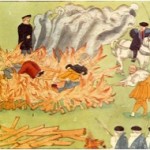
It is not the intent of this paper to look at all the consequences of the printing press, but rather to look specifically at one unintended consequence; the European witch hunts which occurred from the 1400’s to the 1700’s. These witch hunts resulted in the murder of somewhere between 60,000 and 100, 000 people, primarily women who were brutally tortured and then hung or burned at the stake. Although little research on the causes of the witch-hunts has been completed both Eisenstein (1979) and Schlain (1998) contend that although the printing press didn’t cause the witch hunts, it was certainly a major catalyst.
A Brief History of the Witch Hunts
Prior to the 14th century, witches were not a major concern. There were good witches and bad ones, depending on the type of magic they performed. The users of magic did so to meet mundane human needs with things such as love potions, and fertility rituals. Witches, or more often known as healers, were capable of special actions through the use of spells and potions. These people were viewed at the most as having special powers, but were not considered in a negative light. (Ben- Yehuda, 1980) The official belief of the Catholic Church up and into the 13th century was that witchcraft was an illusion. In 1326 Pope John XXII took the papal seat. He believed in the presence of witches and issued Super illus specular, which acknowledged that magic was real, and a heresy. This gave the inquisitors the power they needed to hunt out and punish witches. Punishment for practicing witchcraft at this time was mild – perhaps a day in the stocks. By the end of the 15th century and for the next 200 years witchcraft would become an “elaborate demonological theology” (Ben- Yehuda, 1980) that captured the interest of not only the clergy and the law, but the general public as well. The last official execution for witchcraft was in 1782.
Factors Influencing the Witch hunts.
In his concluding discussion, Ben-Yehuda (1980) credits the new goals set by the Dominicans to extend the inquisition to witchcraft, and the massive social upheaval that Europe was experiencing as a result of the both the Reformation, and the renaissance for creating the conditions for the witch craze. Although these are factors that led to and helped sustain the witch craze, I believe he is omitting one of most important factors; the printing press.
Thirty years after the invention of the printing press by Johannes Gutenberg in 1440, two Dominican order inquisitors, James Sprenger, and Henry Kramer wrote Melleus maleficarum or The Witch’s Hammer in order to refute claims that witches didn’t exist. Although this wasn’t the only book about witchcraft published (at least fifteen different books were written (Ben- Yehuda, 1980)) it was certainly the most influential. This book was divided into three parts. The first section provided arguments about the existence of witches, the second was a detailed description on how to identify them and the final section provided information of the legalities of witchcraft and how to sentence witches. Its popularity was almost immediate and was reprinted at least 20 times between 1574 and 1669. (Schlain, 1998) At one point it was only second to the bible in popularity. (Lovelace).
How is it possible that one printed book could be the purveyor of the horrors of the witch-hunts? Ben-Yehuda states “Its enormous influence was practically guaranteed, owing not only to its authoritative appearance but also to its extremely wide distribution.”(p. 11) With-out the printing press the distribution and multiple printings would not have been possible. He also raises another important point-the fact that the book had an authoritative appearance, which was critical for the success of this text.
Europe was in the midst of great social change at this time. The Reformation brought about a challenge to the moral authority of the church. Scientific and technological innovations where changing the way people lived, thought, and worked. People were moving into urban areas, which changed the traditional feudal order and hierarchy. All this change led to social instability and confusion. In a state of upheaval people look for moral guidance and authority to explain what is happening and what can be done about it. Melleus maleficarum offered this moral guidance and authority. Because of its contents, structure and printed form Melleus maleficarum provided a powerful new ideology that people were seeking.
An ideology has several features. It provides an authoritative explanation of events. It contains “suasive images” that have the power to arouse emotions, direct mass action, and a promise that this course will restore the pre-existing situation. (Geertz 1964) Lovelace reminds us that understanding the world according to scientific principal was in its infancy. In an attempt to understand the world, people often accredited unexplainable events to magic. “The Malleus drew upon those beliefs, and, by its very existence, reinforced them and brought them into the codified belief system of the Catholic Church. “ (Lovelace)
It was not just the contents of the book that made it so powerful, but the fact that it was a book was also key. Eisenstien (1979) says “the deep penetration of new controls to all departments of life becomes more explicable when we note that printed books are more portable than pulpits, more numerous than priests, and the messages they contain more easily internalized.” (p. 428) Much of what had been passed down orally was now being recorded in books. Ong (1982) tells us that in an oral culture, information passed along did not have the same permanence as printed text. The information was provided in the here and now and was subject to revision according to the situation. Printed text offered the same information but it was being presented in a new way- one that made it very difficult to ignore or alter. As Eisenstein(1979) tells us, it offered precise rules or codes about how things were to be done. Malleus offered clues to identification of witches. For example the printed texts informed that witches were often older single women with cats. Perhaps before this book was printed, you could choose to ignore this type of gossip, but once it was published, it presented an authoritative voice that one could not ignore. Neighbours and even family members reported one another.
Although the printing press was not the cause of the European witch craze of the 1400 through 1700’s, it was a technology that allowed for the mass production of material that was instrumental in the dissemination of information that fed the witch-hunt craze. The rapidly changing social order, the pressure to control ones behavior, and the major changes that were happening with-in the church were certainly critical factors. Without the printed texts, the witch-hunts would never have been as devastating as they were.
The witch-hunts do not directly affect literacy or education today, but there is a lesson to be learned. Dewar (1998) warns us that many developments have unintended consequences which often dominate the intended ones. Although the Catholic Church may have seen the benefits of the printing of intentions and the bible, it surely didn’t see the unintended consequence; that being the protestant reformation. The witch-hunts are another example of unintended consequences. “ If the future is to be dominated by unintended consequences, it would be a good idea to get to those consequences as quickly as possible….. or you will be overrun.” (p. 25) He goes on to say that if large institutions such as schools and governments choose to deal with inappropriate use through bans and firewalls, they may well find they have a reformation (or witch-hunt)on their hands. One that may have results of which they have no control. It is critical that we stay on top of these things and deal with them quickly in a creative way- not by pretending they don’t exist.
For more information about the witch-hunts view the following video.
Resources
Ben- Yehuda, N. (1980). The european witch craze of the 14th to 17th centuries: A sociologist’s perspective. The American Journal of Sociology , 86 (1), 1-31.
Dewar, J. (1998). The Information Age and the Printing Press:Looking Backwards to See Ahead. US: RAND Publications
Eisenstien, E. (1979). The Printing Press as an Agent of Change (Vol. 1). West Hanover, US: Cambridge University Press.
Gilmore, M. P. (1952). The World of Humanism 1453-1517. In E. Langer (Ed.), The Rise of Modern Europe. New York.
Lovelace, W. (n.d.). Malleus Maleficarum Introduction. Retrieved October 2009, from Wicasta’s Writing: http://www.wicasta.com/writing /?p=61
Mullins, W. (1972). On the Concept of Ideology in Political Science. The American Political Science Review.
Ong, W. (2002). Orality and Literacy. Great Britain: Routeledge.
Russell, J. (1972). Witchcraft in the Middle Ages. Cornell University Press.
Schlain, L. (1998). The Alphabet Versus the Goddess. US: Penguin Compass.
The Burning Times Documentary Part 5, https://www.youtube.com/watch?v=TR2dHbA-orw&feature=related
Take any classroom in a large urban center in Canada and it is possible to find a first nations learner sitting next to someone from Africa, who is sitting behind someone from India, who is across from someone who is from England. Although this class is rich in cultural diversity, it presents challenges meeting the needs of all the learners. One of the differences that teachers may find in their classes is one of oral-literate cultures. Understanding these differences and knowing how to build on their strengths will help educators to provide relevant and meaningful experiences for their students.
The understanding of the differences between the non-literate and literate cultures has long been of interest to many scholars. In his essay “Biases of the Ear and the Eye” David Chandler (2009) defines the “Great Divide” theories as theories that “tend to suggest radical, deep and basic differences between modes of thinking in non-literate and literate societies.” Read ‘simple versus advanced.’ Chandler goes on to explain that alternatives to the Great Divide theories are the “Continuity” theories. These theories hold that there is not a radical difference in the modes of thinking in non-literate and literate societies, but rather a continuum of thinking. It is recognized that differences in expression and behavior exist, but not to the extremes that great divide theorists would have one believe. Chandler refers to Peter Denny’s comment that “ all human beings are capable of rationality, logic, generalization, abstraction, theorizing, intentionality, causal thinking, classification, explanation and originality.” He goes on to say that we can find greater cultural differences between two literate cultures or two non-literate cultures. He cautions that it is dangerous to presume that non-literate societies are all the same as there can be great variations from society to society or even with-in a single society. One of the books that Chandler recommends reading “which offer(s) excellent correctives to the wild generalizations “ is Literacy and orality, by Ruth Finnegan (1988) who says that it is important to look closely at the uses of orality and literacy, to look for patterns and differences and through this we will avoid making generalizations about poorly understood uses of orality and literacy.
Chandler’s ‘continuum’ of orality and literacy can be found in many of our classrooms today. In order to meet the needs of our different learners we must incorporate cultural sensitivity in the class. Teaching from a culturally sensitive perspective is not just about teaching different cultural holidays, foods and dress. It is about understanding, and honoring the ways of learning and knowing of these different perspectives along the continuum. In his address “How to eradicate illiteracy without eradicating illiterates “to UNESCO, Munir Fasheh tells the story of his illiterate mother who was a seamstress. One day after many years of believing that he should “fix” her, making her literate, he saw her take many pieces of cloth and form it into “ a new and beautiful whole”. It was through the act of creating clothing for her customers that he saw her as a wise and knowing person. He recognized that she knew math, maybe in a different way than he knew math, but she knew it. Fasheh says that we need to “ become aware of the diversity of ways of learning, knowing, living, perceiving, and expressing – and that such ways cannot be compared along linear measures.” (Fasheh, 2002)
Fasheh shares his fear that our world places too much emphasis on reading and writing. This fear is supported by Havelock (1991) who says that our education system places primary importance on quickly learning to read and write. He challenges us to consider our “oral inheritance” as well. Fasheh cautions “ We need to look not only at what literacy adds … but also at what it subtracts or makes invisible.” (Fasheh, 2002)
Constructivism is a current and popular learning theory that holds that learners generate knowledge and meaning through their life experiences. This theory recognizes that the cultural background of the learner plays a significant role in the learners understanding of the world. Wertch (1997) tells us that it is crucial that we recognize and honour the learner’s cultural background as this background will help to shape and create the understanding that the learner constructs. If we recognize that some learners come from an oral culture we can use that information and the strengths of learning in an oral culture to provide more appropriate learning opportunities. Croft (2002) in her article Singing under a tree: does oral culture help lower primary teachers be learner-centered? suggests that learner-centered strategies (an important feature of constructivist teaching) that are developed in literate cultures may not be relevant in teaching in an oral based culture. She suggests that the pedagogies used should be developed from the local context. If the learners come from a primarily oral-based culture, use the strengths of that oral culture. Havelock (1991) even suggests that orality is really a part of all of us. “Oral inheritance is as much a part of us as the ability to walk upright.” (p.21) and that all class rooms should encourage singing, dancing and recitations.
Understanding the differences between oral and literate cultures is important, not to compare, but to build on that understanding. Chandler reminds us that that social context with which we use the specific medium is really what is most important, not that one is better than the other. Honoring and celebrating both mediums will make our classrooms places of tolerance where no one is invisible.
References
Chandler, D. (2009). Biases of the Ear and the Eye. Retrieved from http://www.aber.ac.uk/media/Documents/litoral/litoral1.html retrieved Oct.4, 2009
Croft, A. (2002). Singing under a tree: does oral culture help lower primary teachers be learner-centred? Internatinal Journal of Educational Development , 22, 321-337.
Fasheh, M. (2002). How to iradicate Illiteracy without iradicating Illiterates. For the UNESCO round table on “Literacy As Freedom.” On the occasion of The International Literacy Day 9-10 September 2002, UNESCO, Paris. Paris.
Havelock, E. (1991). The oral-literature equation : a formula for the modern mind. In D. &. Olson, Literacy and Orality (pp. 11-27). Cambridge: Cambridge University Press.
Wertsch, J. (1988). Vygotsky and the Social Formation of Mind. Harvard University Press.
Here is a link to a really interesting site where they use words to create some very powerful pictures. http://designm.ag/inspiration/text-art/. Text can literally be used to create pictures, which is what text does in a more abstract sense. It is through text whether it is a poem, instructions, a narrative, or just a name- the reader creates a picture from interacting with the text.
Hi: My name is Bev. I am currently on leave from my job teaching math in a jr/sr high in a small rural school in southern Alberta. This is one of my 5th , 6th and 7th courses. I am fascinated by the topic- so expect this will be a rewarding course. I have been travelling in Peru for the last month as so am a bit behind!! I look forward to working with you all.
Initially I thought technology was all about tools- things to digs holes with- write things with- it was all about things. I believe that technology is all about creating. We use technology to create and display our ideas. Man develops technology to help solve problems sometimes, but not always. Sometimes technology is developed for the sheer purpose of creating something- afterall who really needs an electric back scratcher!! Technology is tools for digging holes, but it is also text for displaying thoughts and feelings, it is music, and it is art. Martin Heidegger ( 1977) suggests that technology is the revealing as art is revealing- I think he is posing the question -” Is art and technology one and the same?” and I think the answer to this is yes.