Categories
Government

Campus 2020

The Campus 2020 report was released today. Click here to see the site. Warning – it’s 114 pages long. You’ll recall this is the province’s exercise in “re-thinking” the post-secondary education system and providing a vision for the future.

It’s long. I’d read it but it’s hockey night and I’m packing up and leaving my humble abode. *sniff* If I have time I’ll update tomorrow.

Categories
Academic Life

Grad School

Sigh.. since I’m graduating and looking at 10 more years of school (I wish I was kidding) here are a few links for your amusement:


On being a graduate student (Simpson Style)


Take 2


www.toothpastefordinner.com

Categories
Uncategorized

Spotted on campus yesterday

So I attended two events on campus yesterday, and rubbed shoulders with a some IMPORTANT PEOPLE as a result. And we all love to hear about important people, and their doings. Moreover, serious journalism inevitably gives way to tabloidy filler, (at least during exams when actually doing research is impossible).

S0, event #1 was a focus group to ask students about the new Alumni Centre that is going to be built as part of the U-boulevard plan. It’s going to be situated on the corner of U-boulevard and the stairwell coming up from the underground bus-loop. If U-boulevard goes through, that is. Funnily enough, nobody mentioned that. In any event, Barney, the fellow from the Alum Association was super keen about getting student ideas for the centre. They plan to make the centre a relaxed place for current students to hang out as well as for making the connection between alumni and current university and student life. Since the building will literally be the first thing you see when you arrive on campus, it’s a pretty exciting opportunity. Look for a post about the doings of the Alumni Association after exams – they’re up to some neat stuff. For the building, there’s five floors to play with. The Alum association figures they need 1.5 floors for their offices and volunteers, and another whole floor is taken up by a large bookable conference centre. There will be some professor emeritus offices in there too. That leaves about 2.5 floors of program space for us to play with. Brian Sullivan, the university’s VP students was in attendance (wearing a jaunty bow-tie to boot), as well as a slew of AMS execs (Brittany, Sarah, and Brendon), Tim Louman-Gardiner (who needs no introduction), Jamil Rhajiak of SUS, Marlisse Silver Sweeny, plus two other rez advisers whose names I forget, and a couple people from SAC. A lot of the discussion centred around creating a space and setting a tone that’s relevant and attractive to current students, while making it welcoming and useful to visiting alumni, faculty, grad students, and others. How can this building be a real meeting place between groups that don’t usually interact in a relaxed social setting?Here were some of the ideas:

  • Relaxed lounge/rec room space (foosball, couches, TV, etc) – ladha-esque.
  • more formal quiet study space, with smaller meeting rooms, some of which are bookable
  • inspiring space, to reflect on students’ connections to University, positive and negative
  • display space to create a sense of history and campus life: photos, artwork, cool projects, newsworthy items, and so forth.
  • ability to hold in/formal networking and mentoring events
  • usable by campus groups and clubs, at little/no cost
  • cafe or restaurant with mature adult food
  • welcome desk with comprehensive campus events calendar, archive resources (like e-yearbook), and all sorts of other campus information. Like a concierge.
  • computer terminals with access to library resources for alum
  • possible outlet for AMS business
  • index/database to connect Alumni in certain fields with students for mentorship
  • green roof

The other event I went to was a talk about drugs and gene doping in sports. Since it was pretty standard stuff, we wont’ get into the debate. It’s wrong, ok? here’s the whose who:

  • Gina Eom (also needs no introduction)
  • David Yuen (former VP admin)
  • Clark Funnell (AMS rep for SUS)
  • Aminollah Sabzevari (Safewalk assistant coordinator)

then I spotted former AMS president Kevin Keystone chatting on the grass on Student Union Boulevard. [/creepy]

Categories
Student Movement

Lobbying: by Tim

You can tell it’s exam time (and, in my case, hockey playoffs – Go Sens!) by the vastly decreased post count. And readership too, no doubt. Meh. I should be sleeping. But since I found the (remarkably poorly) hidden jelly bean stash in my living room I’m a little hopped up on sugar. So decided to write something on this sorely neglected blog. Something interesting? Naaah. But a rambling treatise on lobbying? I can do that.

See I haven’t spent that long at the lobbying game. Really, I only spent 2 years of my life trying to get University officials to listen to me. (I’ll note, however, that I spent a year trying to get things from University officials in non-political capacities. That experience helped.) I also get the feeling that, relative to some, I’ve had a fair amount of success. But at a minimum, I’ve learned a few tricks about successfully bending the ear of University administrators.

  1. They used to be students, too. Here’s my overarching theory – who’s still in a University by the age of 45? People who never left. They never left either because they’re unemployable anywhere else or, more likely (if they’re senior), they really like University environments. Moreover, most peoples’ university environments were shaped by their student experiences; it follows that University administrators liked being students. Tap into that, into their memories, and you’re one step closer.
  2. They like hearing from students. This flows from the above. They were probably young keen-eyed students back in the day. Chances are, in some way, you appeal to some part of what they love about Universities. I’ll bet most of them were involved in a “sit-in” of some variety. Probably some anti-Vietnam protesters in there, as well. These administrators are normal people with University experiences; unfortunately, their perceptions of the University experiences are skewed by their 250k salaries (in the case of VPs) and their distance from the experience.
  3. Provide a unique voice – tell them something they don’t know. Put another way, tell them things only students know. There’s no point in re-hashing tired old arguments – they’ve heard them before, no matter how persuasive you find them. And no, your rhetorical brilliance will not change their mind. Additionally, they’re probably more knowledgeable than you are. They do this every day. So question things where they can’t pull rank or authority, provide value in an area they don’t. I once went into a meeting with the Director of Financial Assistance and she was most interested in the dearth of campus community. She just shot down all my numbers and arguments, but was genuinely concerned about the impact that loans might have on student life. And that perspective was valuable.
  4. Engage them! Invite them! One BoG meeting, as we were preparing the terms of reference for the search committee for Martha’s replacement, I made the point that Martha rarely showed up at events where students were there. A member snapped back at me: “that’s because she’s never invited.” He had a point. When Prof. Toope came to AMS Council the day they announced the visit, a councillor quietly whispered “when was the last time Martha visited?” The answer: “when was the last time she was invited?” In my experience, people will just as happily take a meeting, or show up… just ask.
  5. Don’t tell them they’re wrong. Okay, tell them they’re wrong. But think about how you do it. Nobody likes being told they’re wrong. What happens when that happens? People get defensive. On BoG, I was struck by how human these administrators are. And it’s a basic human trait – when challenged, we rarely back down. When pushed into a corner, people fight back. It’s very important to challenge authority. But challenge in a constructive way that allows the authority to say “you’re right” without losing face.
  6. Speak their language. Nobody wants to hear ideological ranting. The most effective student presentations have had measurable benchmarks, clear strategic thought, and clearly articulated outcomes. That’s a fancy way of saying constructive engagement. Don’t communicate in a way that allows them to easily dismiss you, and it’ll all be fine.

Apologies for the “us-them” dichotomy. And for the perspective. But this is just my approach to lobbying. It is possible to get things done in the University’s bureaucratic maze, it just takes patience and a willingness to play the game.

Categories
News

Virginia Tech Shootings

I’m sure you’ve all heard about the campus shootings at Virginia Tech. Tragic, sad, shocking… all barely begin to describe it.

It raises thoughts. Like when there’s a shooting at 7am and a murderer known to be at large, why don’t you lock down the campus and cancel classes to avoid exactly what happened two hours later? And how important campus health and wellness programs, initiatives, and people can be. Mostly, it’s important that every member of a campus community feel at home. And don’t forget about the important college/university experience that’s been shattered for thousands of students.

It’s one thing to murder someone; it’s quite another to mindlessly slaughter. My own personal reaction, is that I was in the same grade as Reena Virk in Victoria, a year behind Harris/Klebold, and the same age as the Dawson college gunman. What is it about this age cohort that makes us more likely to act out like this? I find that element of it really striking. Is there some disconnect? I have no idea.

(I’m presuming right now that the shooter was a student. I have no idea if that’s the case or not.)

Categories
Uncategorized

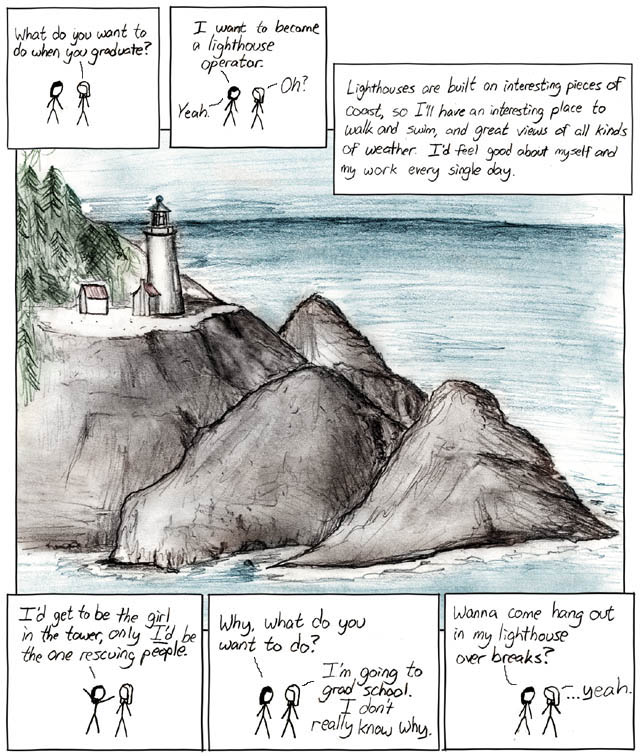
From xkcd.

Good luck with exams everyone.
Categories
Academic Life

Dr. Carl Wieman Speaks!

On Friday I sat down with Nobel-laureate in physics, Dr. Carl Wieman to ask about the 12 million dollar science education initiative he’s heading up at UBC to improve undergraduate courses for the science masses. I wrote a post about the basics of the initiative earlier, so I won’t repeat them now. You can find that post, and some relevant links here (click!).

Listen to the interview here (click!)

The main thing to notice is this: The funding and implementation is through the departments. This means that departments have the key power to organize and prioritize the money as they wish, with guidance from Dr. Weiman and education experts they may decide to hire, which he would train and reference with. Neither Wieman, nor individual instructors are the heroes of this initiative, but the departments themselves (or whatever their consensus or leadership decides) will be determining the direction of the spending.

I had some thoughts about Dr. Wieman and the initiative after our interview, which I’d like to put out there:

The man is assiduously, zealously, diplomatic. You may notice in the interview that Dr. Wieman doesn’t give a straight answer to whether there’s an education quality problem at UBC. He often defers to the Departments, instead of asserting his experiences or ideas. He answered several of my questions with vague observations like, “we must first ask what we want and then…”. These responses are quite practical, when you get down to it: he shouldn’t tax the sensetivities of the VP academic, he cannot force the hand of departments, and yes, setting goals and research questions is crucial. Indeed, Dr. Wieman knows that he must work within the department structure of the University, and he’s embracing that. Fashioning himself as a revolutionary with all the answers will not help his vision come about, and he knows it. But don’t be fooled. For all the hedging, Dr. Wieman has a vision – it’s just tempered by familiarity of university realpolitik. This vision stems from the realization that the democratization of higher education, and the reality of larger classes and reduced teacher-student interaction implicit in it, create unique challenges. Dr. Wieman’s thesis is that with this reality, the only realistic way to cultivate the meaningful interactions and problem-solving challenges which are tied to “expert-like” learning results is through the adoption of researched, proven information technology.

I simply hope, that when the department implementation process gets to the nitty-gritty, that Dr. Weiman will be there. His austere replies in the interview may almost have convinced you that he actually doesn’t have specific ideas, or any over-arching vision. He does. I’m confident that he has the political gumption to bust these out when it matters the most, in each departmental decision-making conversation.

All that said, personally, I’m not sold on the technology fetish. Yes, Dr. Wieman is highly conservative, and very careful about his uses of these technologies. He stresses that they should only be used if they’ve been tested to work, in the correct context in the courses. Still, I keep going back to the OWL example: OWL is an interactive program used in Chem 233 that has animation-based organic chemistry teaching modules, problem sets, and quizzes that allow you to manipulate chemical compounds using shockwave software. OWL is meant to be a significant part of this course, and is even worth a toothsome morsel of the course grade. Nonetheless, the division is clear: some people loved OWL (either because it’s easy marks, or because they actually got something out of it) and some people (me) hated it, and preferred loosing marks than wasting their time doing detestable tasks that didn’t help them learn at all. The thing is, there will always be that issue. There will always be students that don’t get along with staring at a screen to learn, preferring to hit the books, and there will be those that will. That’s why I’m just not sure that out-of-classroom software is the be-all end-all of making students learn better.

I’d like more of of a focus on improving the quality of lectures themselves. Lectures are still important, and they CAN be done well. The lecture has taken a lot of flak as an inherently awful format, but this really needn’t be the case. A well-structured lecture can be very effective in ordering, prioritizing, and explaining material, even if it’s not the best at imparting problem-solving ability or deep conceptual understanding.

For an interesting read, check out Dr. Wieman’s report on “The Optimized University” that he prepared for the BC government’s Campus 2020 post-secondary education review here (click!).


This is the picture I took on my walk home the moment after I realized that I’d forgotten to take a picture of my handsome interviewee. Vancouver city-hall for you, therefore.

Categories
BoG Development

Governance Part II: UBC Properties Trust

Once again, this is inspired by Tristan Markle’s excellent letter to the Ubyssey. He identifies UBC Properties Trust as a key driving force in the U.Blvd decision. He’s quite right. But the UBCPT question is one that’s far more broad than UBlvd; in fact, I’d argue it’s a fundamental threat to the University’s governance.

So, what is UBC Properties Trust (UBCPT)? It’s a private corporation, legally separate from the University; however, it is entirely owned by UBC. When any building goes up on UBC land, both institutional and non-institutional, it goes through Properties. In short, it’s a property development firm that hires all the contractors, does all the project management, and leases and services the UNA land. When a project is going to happen (classroom, housing, or anything else), it always goes through UBCPT, whose staff figure out how much it will cost, arrange the people who will do everything, and make it happen.

Basically, the University doesn’t build things – Properties does so on their behalf.

This causes a few significant problems. They can be divided into two areas: Project-specific, and related to governance. These two areas are very closely related.

Governance

  • Two members of UBC’s Board are on the UBCPT Board. Three members of UBC’s senior leadership are on the PT Board as well. Why is this a problem? Well, it removes any effective oversight of what PT is doing. The work of PT is rarely criticised at Board. Why? Largely because the most powerful BoG members are essentially responsible. As a direct consequence, institutional decisions about academic priorities and buildings needs are essentially made at the PT stage, which is outside the University.
  • There is also no true accountability. UBCPT is only accountable to a) its Board, and b) UBC’s BoG. But neither is the true client, nor is either in a realistic position to actually exercise any real oversight over the other.
  • Neither the VP Academic nor the VP Students are directly involved with PT. Which I find odd, as they are the true clients and end users.
  • The VP External sits on the Board of Properties. The Campus and Community Planning office reports to the VP External. There’s functionally no independence between the two groups. It’s a sham.
  • The real problem is that the University’s mission is to be a University, and all that entails. Properties’ mission is to contribute to the endowment. That’s financial. Which means they have no direct responsibility to make the University a better place; it’s indirect. In theory the BoG should provide some oversight, but it doesn’t (see above).

Project Management

  • PT’s job is to keep price down. They call it “value engineering.” Their job isn’t to make a great classroom, it’s to make a passable classroom at value. This, while not necessarily bad, can produce some results that are less than friendly to students. The best demonstration of this? UBlvd itself. As many know, the architects who originally won the design competition quit. Why? Because they couldn’t work within UBCPT’s price constraints.
  • Related to the above, UBCPT is driven by dollars in the door. This tends towards long-term thinking. A classic example is LEED construction; it comes at a few million dollar premium during the process, but over the life cycle of the building, it earns its money back many times over. PT is notoriously resistant to LEED building. Why? It makes buildings more expensive in the short term, and PT isn’t the one responsible for long-term costs. The University is. PT is only concerned with short-term (construction) costs, and has no incentive to produce sustainable buildings.
  • The dollars in the door phenomenon lends itself to revenue-generating projects. Which brings more value to students? The knoll, or a Starbucks? It depends on how you define value. And that definition of “value,” to the PT Board, is framed in terms of the endowment. That means money. This means social space and mixed use is so much more likely to be retail; the kind of social space where the price of admission is a latte.

In short, there is no oversight, no way to pressure this powerful Board. It’s insulated from the University when convenient. And while it may produce more efficient development, it comes at significant cost.

Categories
AUS Campus Life

UBC Student falls off roof top, now in serious condition

This is taken from the RCMP website. Whoever the person in serious condition is, we wish them a speedy recovery.

UBC student falls off roof top, now in serious condition at VHG

Vancouver, UBC: Charges are pending against another student.

On April 12th, 2007 at approximately 02:20 pm, RCMP members of the University of British-Columbia Detachment attended a Fraternity House located in the 2800 block of Westbrook Mall after receiving word that a young man had fallen off the patio roof top.

After a preliminary investigation, witnesses say the young man who was standing on top of the patio roof top, reached down to another man who was standing on the ground. Police investigators are trying to determine what took place at that time. What we do know is that the young man fell down approximately 20 feet onto concrete injuring his head.

The victim was transported to Vancouver General Hospital where he is currently in serious but stable condition.

During the course of their investigation, police arrested the18-year-old man who standing on the ground during the incident. He was released on a Promise to Appear and is facing charges of Criminal Negligence Causing Bodily Harm.

Both young men are UBC students and alcohol appears to have been a factor in this incident. Students were celebrating Arts County Fair which is an annual event which symbolizes the end of classes.

This incident serves as a grim reminder that alcohol often lessens inhibitions and can lead to poor decisions.

Released by:

Cst. Annie Linteau
“E” Division Strategic Communications
Phone#: (604)264-2929


Source: http://www.rcmp-bcmedia.ca/ (under “Today’s News”)

Categories
Uncategorized

Boycott Mahony&Sons

oops, I think the image is by Greg Stegeman

Spam prevention powered by Akismet