Categories
AMS Elections 2008

Brendon's Endorsements

Here are my endorsements, for what they’re worth. I tried to give justification behind my decisions – both why I am supporting certain candidates, and why I’m not supporting others.

Please note: These are not necessarily Maayan’s endorsements, or any one else’s from the UBC Insiders, those will come later in the week. I am publishing these now because I’m getting a lot of pressure from candidates to give endorsements, so I thought I would rather publish my thoughts, rather than just showing up on people’s websites without justifying why.

My experience over the past year as the VP Academic has given me a lot of insight and knowledge into the AMS and campus politics. I think I can lend some insight into the nuances of the job, but I still have biases and opinions, and you may not agree, so make sure you figure out what you’re priorities are, and who represents them the best.

Read my endorsements behind the jump…

President: Mike Duncan
Mike is going to bring something different to the position than Jeff did – and that’s not necessarily a bad thing. The AMS could use someone who can get students excited, involved and proud of the AMS. Mike will have to ensure that that involvement in the AMS is meaningful – that students take ownership over the AMS, not just participate in it. Also, Mike has a lot to learn about how to manage a critical but respectful relationship with the administration. But he’ll be able to build a good executive team, get Council participation, run a successful referendum, and bring some new perspectives into the AMS’ mandate. I have trouble seeing Rodrigo’s vision, and I think that’s mostly because he has trouble articulating it. And Matt just can’t handle the leadership role, in my opinion – he has some learning to do about being a team player, and could handle growing into his leadership style more.

VP Academic: No One
Since this is my portfolio, I’m sure it seems pretty weak to not choose a candidate. I have hesitations about all three, and I’m not ready to endorse any of them at this point. I think Nate could bring a lot of much-needed critique of the AMS and the administration, and challenge Council’s assumptions and values. The problem is, there’s a lot more to an Executive position, and I don’t fully think he buys into the non-lobbying side of the AMS. He wants a lot to change about the AMS, and a lot needs to change, and he has a strong vision for it, but being able to create that change will require Nate to work within the structure of Council, and the bureaucratic structures of the AMS. Alex is detail-oriented, critical of the University, hard-working, and gets a lot of the issues. However, he tends to be uncompromising in his opinions. I also find his platform to be thin – I need to see how he will engage students in the governance issue, and how he plans to “organize” the student senate – it’s a relationship that requires careful treading, the AMS can’t overstep its boundaries. Also, it would be nice to see some continuity in my efforts to lobby for more student housing, not just internal issues that residents face (not that that isn’t important) – but I guess that’s kind of selfish. Rob’s platform is interesting, and he seems to understand some of the issues, but he hasn’t shown me what he’s capable of. He doesn’t give us much on HOW he’s going to meet his goals, and I really don’t think there’s room in the portfolio for student life issues, that has to stay in the VP Admin portfolio. None of the candidates have addressed the safety/ equity/diversity/social justice issues in their platforms – Nate gets the closest, but only in terms of “power for the students.” Although I don’t doubt Nate’s passion for social justice one bit, I would like to see some ideas for how he’s going to bring that into the structure of the organization effectively.

VP Finance: Chris Diplock
Chris did his homework, he knows the issues, the portfolio, and the AMS. He has a lot to learn, also, as he hasn’t had that much experience with the AMS until September – but you always have a lot to learn coming into an Executive position, and Chris has shown that he is smart and capable of learning the intricacies of the AMS and campus politics. He is dedicated to the AMS, as he has shown this in his dedication in AMS committees, and coming to AMS Council all the time (even though he isn’t on Council!), and he’s working the hardest that I’ve seen on campaigning. I know Andrew from Council, and he’s been a hardworking, dedicated Councilor, and his platform is pretty good, but he hasn’t shown me that he knows the portfolio well enough, and how he’s going to reach his goals.

VP External: Stef Ratjen
Stef has some great new ideas to bring to the portfolio. She has strong goals and a clear vision for how she’s going to reach them. I know that Stef is really hardworking, she’s passionate, and she’s shown a willingness to learn and be challenged. She will have to learn a lot more about CASA/CFS politics, and learn how to navigate them effectively, but as long as she hones her passion and frustration effectively, she could bring some new perspectives to federal lobbying. I also think Stef could get students involved in the lobbying effort. Freeman’s platform doesn’t give concrete ideas for how to do what he wants to do, and I don’t think he has the experience for the position.

VP Admin: Sarah Naiman
Is there anything to say? She has more than proven herself this year as VP Admin, and she is obviously more than qualified. We are at a pivotal stage in the SUB Renew process, and she will be integral for ensuring continuity of this year’s exec. And besides, who is that other guy?

Senate:

Blake Frederick – has been my Associate VP, University Affairs for the past year, and has done an incredible job. He gets the issues, he’s a passionate advocate for students, and he has a clear vision and a lot of experience for how to get stuff done.

Alfie Lee – has been a dedicated and hardworking senator over the past year. He is eager to learn, puts a lot of effort working with AMS Council and Exec, and another year in the position will only make him more effective.

Azim Wazeer – Azim has a lot of experience working with AMS Exec, so he will be able to keep up a strong relationship with the AMS. He is detail-oriented, passionate and competent. He has strong values, and good ideas, and I’m sure he’ll be an engaged student senator.

Philip Edgcumbe – I don’t know Philip that well, but that doesn’t mean I doubt his ability to do the job well. The first time he came into my office to talk, I was impressed by how well he got the issues. His experiences on campus, particularly with Carl Wieman will be greatly beneficial for bringing good ideas to Senate. He is smart and will take the role seriously.

Alex Lougheed – I think Alex would be a great senator. He is hardworking and detail-oriented, he won’t be afraid to ask tough questions, and he won’t be afraid to meet with an administrator or sit down with another senator to hash through something further.

BOG:

Timothy Blair – Tim knows wh
at’s going on with campus development. He has a very mature, intelligent approach, and I think he would be effective at getting the Board to listen, while still standing strong on students’ concerns.

AND EITHER

Andrew Carne – Andrew surprised me in this race. I don’t know him very well or his work in the EUS, but he has the right priorities, and he is very detail-oriented. He understands how important it is to know everything that is coming to Board, and I think he would be capable of doing the leg work to learn about issues he doesn’t fully understand. I have concerns about not being experienced enough, and not being able to ask tough questions and put some pressure on the Board.

OR

Bijan Ahmadian – Bijan will be able to get the respect of the Board. I believe that he could do a good job, and would be able to communicate the activities of Board to students. He would take the role seriously, and would work hard. I haven’t seen concrete examples of HOW he will be an effective BoG rep, or his stance/opinion on student issues (I want a BoG rep who has strong opinions), and I’d also need some reassurance that he can put on the pressure when the situation calls for it.
Categories
AMS Elections 2008 President VP Finance

Second round of AMS debates show an improving trend.

Today saw two additional rounds of debates – one at noon for the President, VP Academic, and VP finance races, and an additional one in the evening over beers at The Gallery for the VP Administration, VP External, and Senate races. All but the BoG candidates had their chance in the hotseat. These are my personal observations – even having read platforms and listened to candidates, it’s hard to reflect in a completely “objective” manner.

The Races:

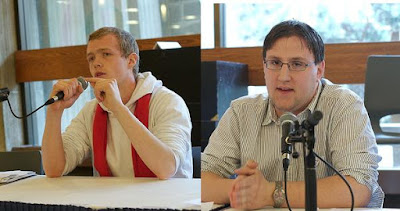
Chris Diplock and Andrew Forshner – evenly matched Photo Gerald Deo
VP Finance – This is a tough one to differentiate. The truth is that both Andrew Forshner and Chris Diplock offer excellent skills and attitude. They both emphsize the link between AMS Businesses and Services: healthy businesses mean more money for services. Both talk about appreciating employees that stick around, pay raises for students working at AMS food outlets, and modernization of the cash systems. Okay, so Chris wants to concentrate on sponsorphip opportunities, and Andrew emphasizes renewing some businesses (like the Gallery). Chris talks about ethical business practices and Andrew talks about sustainability. Andrew has more exprience running budgets through his activity with national debating; Chris has spent considerable time learning the issues of FinCom and BOC this term. From a poll conducted by the Cavalier in AMS council yesterday, most councilors support Andrew. Chris had the endorsement of the current VP finance, Brittany Tyson. It’s a tough race, and one that I’m confidant will give us a very capable VP finance whichever direction it goes. Take a look at their platforms and make up your own mind.

VPX and President behind the jump.

VP External – Freeman Poritz and Stefanie Ratjen offer a much clearer contrast. Freeman is a friendly, personable, open guy. He seems to be genuinely interested in learning and taking direction from students. Problem is, he really is quite new to this whole thing – both the AMS and the issues around post secondary education policy in general. Not that that’s a fatal flaw, but he doesn’t seem to have developed opinions on much of anything yet – many of his answers today centred on taking policy direction from council on lobbying positions regarding post-secondary funding. To me, that’s ok. But he’s running more on who he is than what he knows or what he plans – and that might not be enough. Stefanie offers a more experienced, and opinionated voice. She’s been extensively involved in various progressive and radical groups on campus (Femenist collective, Trek Park, the Knoll), and she’s thought about her politics and priorities. I don’t think Stefanie is a “scary” radical though. While she insists that education is a “right, not a privelage” (an assertion I find absurd), she’s not dogmatic or ridiculous about it. I know this because today in the debate when she was asked if international students should pay the same as Canadians, she said that she was against discrimination but would have to look at the issue more carefully. She also placed great emphasis on continuing in the effort to create a provincial lobby coalition with other schools in order to influence the most important level of government when it comes to PSE. I think that guided by council, Stefanie would do a good job.

President – Today was an improvement for the presidential candidates. They took my public speaking advice to great effect! Sweet!

“Che” continued to amuse today, and professed his resolve to dispense with all media, if elected. This corner dis-endorses him, therefore. Erin Rennie was a show of strength, humour, and intelligence. More on her soon. Rodrigo continued to be nutty, and added additional dose of hubris and self-satisfaction (if possible).

The two alleged frontrunners, Matthew Naylor and Mike Duncan (who worked with each other on the SUS executive last year) improved on Wednesday’s performace and played to their strengths. I worry for both of them that this position is more of a scalp on the belt, “the next natuaral step” (hateful phrase), than something they would actually excel at or contribute to.

Mike is shaping up as the more “populist” candidate. He’s had experience with a wide variety of student clubs and groups on campus, as well as his role as SUS president, and is very personally popular. He doesn’t have much of a mind for issues (I’ve rarely heard him materially contribute to council discussion), drinks too much, and his presidancy of SUS has been much more controversial than competent, and nowhere near inspiring. Mike’s SUS executive team has had some issues too. Mike’s platform focuses on making recreation at UBC accesible to students for cheap, and making the AMS more far-reaching through a round table (much like an opt-in stakeholders’ assembly). I like both these focuses quite a bit – they get to the heart of student’s experiences at UBC, which Mike gets.

Matt is more of a ‘policy’ candidate. He seems to know issues, and certainly speaks the language of politics, though tends to change his mind about them alot. He’s promising to implement the long-awaited commitee reform in 30 days of taking office, though sources say that he opposed the idea as late as this summer. His platform is packed with goodies: campaigning for more liquor rights on campus, forgiving ACF debt, and focus on sustainibility in the new SUB. But, there are serious questions about whether he can work well with others and lead a team – Matt is easily frustrated and sometimes expresses himself too strongly. None of the execs this year are supportng him, and he’s not (apparently) altogether loved at the CASA (our national student lobby) table either. But he is ambitious, and he’s got some good priorities – at least on paper.

Categories
AMS Elections 2008 BoG

BoG rep Darren Peets's Words of Wisdom

Darren Peets, by the incomparable JJ McCullough (don’t sue me JJ!)
Governor Peets’s priceless pearls of wisdom. Listen up BoG candidates!!

Can a bog rep actually make a difference?

Yes, absolutely, but it may not always be obvious to more than ~50 people, very few of whom are students. The turnaround time may also be very slow.

How much time does it take to know enough for each meeting?
“Enough”? Arguably infinite. To do a good job, reading the docket will take a full day or three, and following up on items in it may eat up another day or two. It depends on how much you already know, to what depth you’re inclined to dig on an issue, and how good you are at sifting out the issues that most require attention.

What’s the fastest/best way to make BoG members respect and listen to you?
Have a number of valid, thoughtful points, and not waste their time with minor issues or technicalities you could have asked or suggested to staff. Shmoozing ability is highly overrated in this regard.

what’s the most important issue that’ll be facing this year’s BoG reps?
I have a campus development bias, so I’m going to say one of U Blvd, South Campus “ecodensity”, municipal governance, or the Vancouver Campus Plan.

what would you do differently if you could try again?
Try to get introduced to, talk with, and be known to all the appointees well before turnover. The first meeting would have gone significantly better.

how many free meals did you get this year?
Not many in 2008 yet. In the Board term so far? I have no idea, and it would not be easy to count.

Categories
AMS Elections 2008 Issues

Issue of the Day: Governance, Pt. 2 – Internal Issues

At the end of the day, UBC is an academic institution. The Board of Governors should be responsive to students’ concerns, needs and priorities. Creating a University Town has changed the campus community (read about the ramifications in Tim’s article about on campus events, alcohol licensing, ACF), and has created many new pressures and responsibilities to balance that are not purely institutional. The question really is, how appropriate is it for the Board of Governors to be playing the role of a municipality? Don’t forget that over half of the BoG reps are appointed by the Province, and are very indirectly accountable to students’ needs or UNA residents’ needs for that matter (though for BoG, there’s a lot more at stake if they don’t get the relationship right with the UNA residents). The reality is, a lot more time, energy, resources and money have gone into the developments of U-Town, and getting this right is a pretty high priority for them. Meanwhile, students are asking a lot of questions…

The Endowment:

Let’s NOT underestimate the importance and benefits that we as students receive from the Endowment – to do otherwise would be premature. The University tries to call us on this all the time. And I always have to quietly explain that the issue isn’t that we don’t understand how the Endowment works, and the benefits we receive. I always say that its really about accountability – students should have a say in how the Endowment is spent on our education, and even how it is invested (from an ethical standpoint), the Endowment should be made much more public and transparent, and we should have a say in how much we’re willing to have our campus change for the sake of the Endowment.

Consultation:

Well, I wasn’t around back in the early nineties when someone came up with the brilliant idea of developing fancy houses on every inch of unused land. But, if the consultation process that I have seen over the past five years are any indication, one can only imagine what the consultation process was like when UBC was developing the Official Community Plan, and designing all the Neighbourhood Plans (Darren was around for a lot of these, and he has some interesting stories to tell).

The point is: how much say did students really have when they were making all these decisions about how the University community was going to change. And hey, maybe now that its been a couple years, and we have seen some of the ramifications of these developments, we want to see a few things change from the original agreements.

Consultation with students has improved over the year, in my opinion. After many years of sustained pressure on the University to conduct meaningful consultations, not just handing a design to students and asking them to approve it, but asking us from the beginning what we want. I also think its important that we as students don’t wear out the meaning of this word consultation. The AMS has a definition of what meaningful consultation is all about, and we need to communicate those expectations clearly and consistently to the University and we need to judge consultations on that criteria. It’s not about always getting what we want, its about the intentions of the consultation from the get-go.

Meaningful Representation

Students have seats on a lot of committees and other decision-making bodies at the University. A lot of these committees, however, are advisory in nature. Even at the Board of Governors, the student reps have to work very hard at the beginning to prove themselves, or they will be dismissed and not taken seriously for the rest of the year. A good example of this is the University Town Committee. This was the community advisory committee for all things University Boulevard related before the petition in May. All through last year the committee was giving feedback that the plans were terrible, the designs weren’t working, and the community was not really approving. Of course, the feedback was taken, and the plans went full steam ahead. What more do we need to do? Get 3500 signatures on a petition? Well, I guess so…

We as students need to be careful about the role committees play – are they taking the place of real community consultation? Are they a decision-making body (meaning, the committee has to come to some sort of consensus), or are they advisory? The worst things we can do as students is assume that a committee is just one part of the consultation process, and then realize that that was it! And the AMS is doing a lot of lobbying to get more representation (a GSS seat on BoG, for example), and more institutionalized processes for consultation and decision-making. We need student reps on all levels (Senate, Executive, BoG, AMS Council) to continue this work, and sending out this message to the University.

Categories
AMS Elections 2008 President

Speech therapists, writers, needed.

The three “serious” presidential candidates. Foot-in-mouth disease?

So I was only at about the first 20 minutes of yesterday’s candidate debate in the SUB conversation pit. That means I got to hear the presidential candidates answer a few questions. It was a little painful. Not to be a hater, but I don’ think it’s too much to ask that the President of the AMS – who will have to do media, negotiate with government, and lobby administrators – be able to string a few compelling words together. Of the five candidates, the three “serious” contenders seemed to struggle the most. While jokesters Che and Rennie acquitted themselves with fluidity, hilarity, and points, Mike Duncan, Matt Naylor, and Rodrigo Ferrari-Nunes all struggled in their own unfortunate ways.

Mike has always had trouble with this: even though he’s an easygoing and extroverted guy, he gets tongue-tied, stutters, and loses his place. The result is that even if he had something to say worth listening to (a questionable point itself), he’d have trouble actually saying it. Duncan needs to practice speaking clearly, in detail, and step it up a notch.

Naylor seems to have the opposite problem: He’s got plenty to say, and a good understanding of what’s important, and how issues relate. But lay off on the big words, man. I like big words as much as the next person, but you sound like you’re imitating what you imagine a politician should sound like, not letting your personality shine through. We want to hear you talk naturally, unaffectedly, and clearly. Fancy phrases won’t convince anybody.

Rodrigo is a case all his own. First, he doesn’t seem to respect time limits, which is just rude. Second, he seems to barely address the point, preferring to ramble in social-science-speak about his favorite pet topics: music, connectedness, voices, and on and on. Tighten it up Rodrigo – you’re running for a political position, not applying for grad school.

Take Jeff Freidrich, the current President (since I’m on a run, why stop?): Jeff is incredibly thorough, unaffected, honest, and genuine when he speaks. You always feel like he’s saying what he means, including questions and ideas. All the candidates should strive to emulate that great down-to-earth, look-you-in-the-eye quality he has. But build on it: get some enthusiasm in your voice and body language! Don’t ramble! Try to inspire a bit! Speaking well can be a great leadership tool.

Photo Peter Rizov

Categories
AMS Elections 2008

Issue of the Day: Governance Issues Pt. 1 – Municipal Governance

This is an important issue, and a big topic. It came up in the VP Academic debate yesterday, and could use some explanation. There are two important background points to understanding this issue: 1. When UBC was created, the Province endowed the University with a lot of land – 175 acres; 2. That land is not part of the municipality of Vancouver, or any other municipality for that matter. UBC is, instead, part of “Electoral area A” (which also includes some islands around the Lower Mainland, and an expansive area above North and West Van).

It was in 1920 when the Endowment Act was amended to allow for residential development which would help fund the University’s activities – these are the residential areas now known as the UEL (University Endowment Lands), which have been returned to governmental control and are no longer part of UBC. In 1989, the Province created Pacific Spirit Park, leaving 1000 acres for what is the UBC campus as we know it today. In 1988, UBC Properties Trust was established to manage the development of certain areas of that land into market housing to increase the University’s endowment further. The first developments of Hampton Place set into motion a series of agreements between the GVRD and UBC on the terms in which UBC can develop these market neighbourhoods (see the Official Community Plan, which defines the guidelines of development, and establishes the various “Neighbourhoods”). These Neighbourhoods together are what make up “University Town,” and include Hampton Place, Hawthorn Place, Wesbrook Place (south of 16th, just starting development), Chancellor Place, and University Blvd.

This is how it works: the land is leased by Properties Trust to developers for 99 years. That money from the lease goes into the University’s Endowment (a financial endowment). Developers build big, expensive condos, pocket a lot, and get ‘taxed’ a certain amount (called Infrastructure Impact Charges – that $30 million helping to fund the underground bus loop that you always hear about). The money in the Endowment is invested, and the interest from those investments each year helps fund academic life at UBC (getting top researchers, funding academic programs, etc).

We could talk forever about the issues with this, but there are two ways to look at it: municipal governance issues mostly arising from University Town – which I will address in the rest of this article – and internal governance issues mostly arising from students’ concerns.

Read the juicy details about municipal governance, behind the jump…

Municipal governance issues:

The University Neighbourhoods Association (UNA) was established as the body to represent U-Town residents and administer services and funds. This body could be described as the AMS for U-Town residents, but it is only a fair comparison in its representative function – the UNA has much larger and different responsibilities, such as administering municipal-like services (for example garbage collection and recycling). Because UBC does not fall into a municipality, any conflicts that may arise between U-Town residents and UBC (or in other recent examples, between community groups like the Wreck Beach Preservation Society and UBC over the development of Marine Drive Residences) that cannot be resolved, must go to the GVRD to be moderated. The GVRD does not like this responsibility, and has been applying some pressure on UBC to conduct a governance review to find better ways to resolve our own issues. UBC is fairly slow to respond to this governance review, as you can imagine they would like to maintain the status quo because they have a lot of power and leeway.

But you can also imagine that there will come a point when the people living in U-Town will feel the effects of not having municipal representation and a municipal government. What’s the difference between the UNA and a municipal government? A lot – membership in the UNA is volunteer, they don’t have any way of enforcing bylaws (Darren always gives the dog poop example), they have an elected Board of Directors rather than a City Council, and the whole operation is on a much smaller scale.

Thus, several options would arise from a governance review: the status quo, UBC becomes a municipality of its own, or UBC merges with the City of Vancouver. I think Vancouver likes the last option, UBC likes the first option, and students and UNA members are still not sure. There would be a number of factors for students to consider (I won’t get into that here, but please do take the time to creatively think about what those might be), but the AMS is going to have to take a position in the not-so-distant future, and we’re going to have to be ready to do a lot of consultation, and in my opinion get outside consultants to help us with this.

Stay tuned for Governance, Part 2: Internal Issues

Categories
AMS Elections 2008 Issues Senate

Issue of the day: Student Senate Caucus, efficacy of.

I admit that I cannot comment on the senate proceedings this past year, as I am now living on another continent. However, if history is an indicator of the present and future, I will allow myself to write a short excerpt on student senator’s and their caucus’ effectiveness.

The Continuity Harp

The majority of the Senate’s members are faculty members and deans, so by virtue of tenure they can be elected to three year terms successively with no limit (life permitting). This contrasts with student senators rather starkly, whose university career often gallantly flickers away after four or five years, and for this reason serve a term which lasts only one year. By no means is it shocking to see a faculty member serve the senate for over a decade, whereas the rare student will stick around for three terms (three years).

Continuity in the student caucus of senate is painful at best, due to the sheer nature of the electoral process: you get elected onto the senate based on experience of university/academic matters (in theory at least), which by definition requires you to have completed a minimum of one year of university, often more.

It has been the case that most student senators happen to be senior students, graduating the next year to go on to other things in other places. Since the Senate meets once a month at best, and its committees meet anywhere between twice a month to not at all, often the most focussed, well prepared items brought forth by student senators require more than one year’s worth of effort. Even with the least amount of cynicism do I dare say that in order to achieve any change, one needs to sit on the senate for more than one term. Often, this does not happen.
We have been lucky in the past to have incredibly thorough senators, who have created, revised, and passed down a monstrous volume of a senate transition package (now probably exceeding 70 pages). The upside of it is that each student senator for the past four years has left their advice and insight. The downside of it is that the incoming senators have to read it, and very few of them actually do for whatever reason.

Quite often, the same cycle is repeated: the first few meetings, no matter how integral the timing of them, receive very little student-driven items on their agenda.

Internal Dynamics

The efficacy of a caucus is determined by the leadership and drive of the group itself. There may be concrete goals a caucus wishes to achieve, and there may be key developments in which students need to take a solid stance. In both cases it is up to the individual senators, under the guidance of the chair, to put in many hours to be well prepared by digging up institutional memory and history to present a clear argument effectively and eloquently.

There are thousands of students in some faculties, and only one designated representative to the senate. Not all senators are elected based on key platform points which they want to see through. Some senators are simply elected on a promise to show up to every meeting and contribute to discussion as well as they can. If this senator happens to find a birthday party more appealing than a senate meeting, she or he may have failed to present a valuable, unique perspective (and vote) on behalf of these students. It is a pet peeve of mine to see some student senators lose interest in a seemingly tame agenda, and subsequently fail to attend a valuable discussion where their presence could have turned the outcome of the vote.

Coherence with the AMS

The relationship with the AMS is murky at best. Why two senators have voting power at AMS council is mysterious to me, their presence at council less so. According to the AMS, it is recommended that their VP External attend the student senate caucus meetings. However, it would make more sense if the (already overworked) VP Academic and University Affairs took on this role. Unfortunately, AMS Council meeting and caucus meeting often overlap, and Senate meetings are scheduled seven years in advance.

There is room for greater coherence between the student council and the senators. Oftentimes it simply requires greater communication, as tiny nuances from one body is lost in a quick report to the other, and vice versa. I see this issue to be prescribed for those rare senators and councillors who go above and beyond their duties, but it can be done over a beer or three.

Overall, I believe a caucus is effective if each member wants to be there, instead of feeling they are obliged to be there. Being a student senator can be intimidating, boring, thankless (no we do not get paid), stressful and exhilarating. If any of those emotions have not been felt, then chances are the individual elected ran for the title and fancy-looking business cards.

Categories
AMS Elections 2008 Issues Student Politics

Buzzwords: "Council Empowerment"

This post is by Spencer Keys, the AMS President of 05/06. We thank him for his participation. I will be blogging more about the basics of both committee reform and the Strategic Framework later in the week for the new readers out there.

Maayan has politely asked me on a number of occasions to write a guest post for UBC Insiders and while I have normally been content to make snarky comments or longwinded rants when something interesting pops onto my RSS feed, there are two topics that still interest me a great deal and need to be continually reinforced as important; the first is keeping slates out of the AMS (a topic that others are perfectly well equipped to argue but occasionally needs some context from somebody who worked in a slate system) and the second is what I call the “Modernization Project.” Brendan already spoke about a component of this project to modernize the way the AMS is run (portfolio reform) and I would like to talk a bit about a topic that has popped up in the comments section – council empowerment.
(More behind the jump)

The History:
“Council empowerment” has been an issue for as long as I can remember but the nature
of the debate has substantially shifted between the slate-period and the independentperiod. In the past advocates of more Council power were largely doing so in reaction to perceived abuses by the Executive; those advocates were almost entirely composed of people that had run in opposing slates in the previous election or were allied with them. As a former loser I was a vocal member of this group.

Then two things happened. The attempted firing of AMS General Manager Bernie Peets created a consensus that Council should be more active in oversight and the activities of the society, rather than a rubber stamp body. That was followed a month later by the first election without slates, resulting in the first Council in decades without clear party lines dividing the Executive and the Constituency representatives. Council empowerment was no longer something to fear as a witch-hunt in disguise (as it admittedly was when there were slates) but an opportunity to achieve a number of positive organizational goals – Council could now be a training ground for future executives, the forum for long-term goal-setting (preventing lost momentum from executive turnover), and a place of real oversight and review, no longer assumed to be partisan maneuvering.

The Proposals:
In our first year we played around with a lot of ideas – some were adopted, some were rejected, and others were integrated into our long-term recommendations for the future. The AMS Lobby Day is one project that went forward because it was felt that giving councillors meaningful insight into what the Executive does when it lobbies would be good for a host of issues. Having a non-Executive councillor sit on the Executive Committee in an oversight capacity was one we rejected, largely because those meetings happen too frequently and at inconvenient times for a councillor that may have a summer job. However, two long-term projects were to form the basis of future devolution of power: the Strategic Framework and Committee Reform.

The Strategic Framework empowers Council by giving it a standard to measure the activity of the Executive. Specifically it maps four areas – long-term resource planning, creating community at UBC, establishing a transparent and responsive system of governance in the AMS, and engaging constituents (ie. students) in the decisions of the AMS. This means that Council neither has to reinvent the wheel every year and figure out what the AMS should focus on, or have to look to the Executive for leadership on long-term goals.

The committee system was going to be the way to empower Council to act without needing the Executive to lead it by the nose. Without getting into all of the details the idea is as follows: 1) where a given Executive clearly has responsibility for a subject, disband the committee and create an Executive Working Group that reports to that Executive (Safety Committee, Impacts (Sustainability) Committee, Campus Planning and Development Committee), 2) Council has corporate responsibilities as a board of directors so Committees of Council should focus on those responsibilities as well as the long-term goals outlined in the Strategic Plan, 3) Council members should be committee chairs instead of Executives (who will still be busy with their Working Groups), and 4) the entire system should be coordinated through an Agenda Committee that makes sure the committees are working and advises the President on the Council agenda.

It’s an ambitious project, to say the least. While it has been in development for over three years, there are still things to show for the effort, such as the new Oversight Committee. The benefits could be substantial when the project is fully realized – work being done on long-term projects, committee chairs that can be leaders in Council and be groomed for future Executive work, an Executive that is not overburdened with committee administrative work, and a committee system that Councillors feel is valuable and worth their effort, which could lead to them speaking positively about the AMS to others.

Thoughts About the Future:
When today’s candidates speak of council empowerment, is this what they’re talking about? Not all of them, certainly. Some have told me specifically that they think Executive power should stay centralized. And I’m sure that committee reform is not the only way to continue the implementation of the Modernization Project. However, I think the values that exist within the proposal are vital to the development of an effective, professional Council. Council is not empowered by giving them supreme authority, nor are they empowered by preventing them from guiding the agenda. A balance has to be struck where they are given a clear mandate to work on important issues for the AMS and students, and also the support to bring that work to completion. I fear that in some senses the pendulum has swung too far the other way and Council has moved from a role of knee-jerk opposition to one of no discernable role whatsoever. Are they just there to be a sounding board for the Executive or something more? That’s the question at the heart of a phrase like “council empowerment.” A clear path has been set for how to achieve that balance but the AMS has been moving down it very slowly. The words of my dear dad ring true in my head, “Shit or get off the pot.” While former AMS Frosh President Kim
Campbell said an election is no time to debate policy, I disagree. Thoughts?

Categories
AMS Elections 2008 Issues VP Finance

Issue of the Day: AMS Businesses

The AMS businesses are an important way for the AMS to make money so that we can keep student fees lower. And we do have some of the lowest student union fees in the country (when you take out athletics fees, health & dental, U-Pass, etc, and you’re left with the AMS’ actual operating budget). The businesses last year brought in over $800 000, that’s almost one third of our general operating budget! This money helps to subsidize most of the student services (Safewalk, Speakeasy, Tutoring, etc), and many of the other integral aspects of the student government branch of the AMS. And we have an amazing and competent team of senior managers, business managers and support staff who ensure that our businesses will thrive from year to year.

There are 14 AMS businesses: the Pit, the Pendulum, PieR Squared, Blue Chip, Bernoulli’s Bagels, the Outpost, the Honour Roll, Burger Bar, the Gallery, the Moon, Copyright, Whistler Lodge, AMS Catering and AMS Conferences. There are also spaces throughout the SUB that we lease to other, non-AMS businesses, such as the Deli, the Tea Shop, Travelcuts, the UBC Health and Wellness Centre, and various fairs (like the markets in the concourse, or the Imaginus poster fair). All of these are integral to our business model, and bring in large sources of income and revenue for the AMS.

These businesses also provide services to students – good, cheap meals at lunch, parties and dancing in the evening, lounge space throughout the day, catering for clubs’ events, etc – they service the needs of students. They also provide jobs – hundreds of part-time employees work in our businesses.

But not everyone agrees that our businesses are always a positive thing. Think about lunch time when the concourse is flooded with vendors at the AMS Marketplace. We rent out tables and space in the SUB to vendors for profit. But this takes away from clubs’ ability to use the space, not to mention the fact that it makes the concourse very crowded.

The future of AMS businesses behind the jump

Throughout the recent consultations on SUB Renew, we have come to realize just how much space in our building has been compromised for our businesses over the years – we’ve lost almost 33% of what was once open space, lounge space, and social space. And many people would criticize the SUB for being a strange food court bizarre, and not really an ideal place to be the social hub of student life.

And there have been times when we’ve had to make tough decisions about our businesses. For example, just this year, Council made the decision to close Snack Attack – the revenues made it hard to justify keeping it, and to boot, we were having great difficulty finding a competent, experienced business manager to replace Robbie, who was moving up to PieR.

Throughout the SUB Renew process, the AMS has also been lobbying the University very actively to ensure that the U-Square developments (located over the old bus loop) meet students’ needs, prioritize student social space, and work closely with the SUB Renew process. The resulting conversation has brought forward a strong proposal to bring some of the AMS businesses out into the Square. The benefits are that they free up space in the SUB, and it safeguards from large, unethical corporations being placed on the Square. One of the challenge is that it is risky, we don’t know how well the space will work for our businesses.

Over the year, our members have told us that they not only want us to be entrepreneurial, but they expect us to be. The question becomes, how do we balance this integral part of our organization with the higher level goals and strategies of the organization, and the needs and wants of students. What kinds of changes to our businesses would be seen as acceptable to our students? At what cost do we make these changes? And ultimately, if we want to see the AMS putting less emphasis and resources into either running our own businesses or renting to vendors, then are we willing to increase our student fees?

Categories
AMS Elections 2008 Campus Life Issues

Issue of the day: Campus life

Boy, it’s hard to write “Issue” posts when there’s no candidate platforms four days before voting. Oh wait, the campaign just started today. Never mind that, then.

Last year I spent a lot of time harping on what I see as the slow and steady decline since I first came to UBC in the good old days (read: 2001). Then, it got worse: ACF died this term. In an unexpected decision in November, the ACF executive decided to disconitnue the event indefinitely in the face of declining ticket sales and mounting debt. (See our coverage here, and here.) At first, I chalked it up to external pressures (external to the event, not the University {like See our coverage RCMP, unsupportive faculty, recalcitrant sponsors}) trying to kill the fun. But then I realised that just as important were the internal, student based pressures, too. So that seems as good a framework as any to discuss student life and events.

For reference, I adopt “generally loud, slightly beer-y” as a general definition of student event. I fully understand that not all students events fit this description, but there’s just something wonderful about the communities that develop, the memories that are created. I owe a lot of my student politics success to beer gardens, and the fact that they’re dying is sad.

External Pressures
These are well-documented. They tend to fall into the following categories:

  • UNA and noise complaints about the residents
  • Safety and alcohol abuse
  • Fewer students engaged on campus generally
  • Enhanced RCMP and university enforcement of alcohol rules
  • Reduced liquor licenses

There’s a place for student reps to address these issues. By starting a constructive dialogue with residents and the University, by teaching clubs how to run responsible events that don’t attract unwanted enforcement attention, and good old-fashioned lobbying.

Internal Pressures
I’ve never seen an outpouring of student outrage like the ACF cancellation. There’s massive support for the event. But that wasn’t enough to save it. Why? Mostly because those responsible for the event didn’t want to continue it. It had gone on for a remarkably long time, they said, and it was getting too tiresome to run.

But an interesting thought occurred to me. The AUS Council didn’t want to end ACF; the ACF exec did. And there’s an interesting point there. Which is that it’s the same people who’ve been running it from year to year. And while the event is tired, so were they. The event was losing money, and these people were losing the energy to fight.

In short, the event was unsustainable.

Now it’s not easy for student clubs to have a sustainable existence when there’s constant turnover. People come, people go. A great person can be hard to replace, and when a person’s involvement takes a year to gestate, they only have a couple years in a leadership role before they move on, to be replaced by a relatively unknown quantity. Similarly, student groups rarely have financial or budgetary expertise; they have to learn the way most of us do, by failing. Unfortunately, they’re not usually around the next year to apply their hard-earned knowledge. And finally, they’re often more susceptible to pressure mostly because they’re often new at the game. And hell, they’re students, not full-time event planners.

So why is it relevant? Because the AMS can help. There’s a potential positive role for them to play, in terms of facilitating clubs and groups. Some financing options, maybe some financial planning. Ready access to event planning staff. Perhaps a central co-ordinating body for events or a way to leverage networks for publicity. And of course, ye olde lobbying. There are oodles of options. And it’s not all bad either: beer gardens, despite the tougher social climate on campus, are persisting. Bzzrgardens.com has made a succesful return under the brew-mastership of SUS councilor Alex Lougheed, and is a great resource.

I imagine some of the candidates or readers might have some ideas. Anybody?

(Then again, maybe this is just on the brain because I’m writing this while watching Old School. Seriously.)

Spam prevention powered by Akismet