Categories
AMS

Why can't we all just get along? the executive dynamics post.

Once upon a time amidst the tacky coloured walls of the Almar Mater Society’s student union building, executive council was dominated by slates (basically political parties). Back then, elections were in some ways more colourful (in both the literal and figurative sense). Brand names were recognizable from miles away – the extreme conservative “The Right Choice” in navy blue, the centrist “Students for Students” in a lighter hue, and a communist resembling “SPAN”, not to be confused, though understandably often mocked, as SPAM. I need to insert here right away that I am a political product of the latter, though my political career took me past the great era of formal slates. Anyhow.

I have seen my share of executives interact with one another over the years, since 2002 until 2007, both before and after slates existed. By being a peripheral nuisance around the office, and having inherited some institutional gossip, I find myself unable to feel the same degree of outrage over recent events as the visitors who comment on this and other blogs

The reason I bring in slates into the picture is because they were a key vehicle through which politics was driven at the executive and council level. And I also include petty bickering into the term ‘politics’.

When I was running with SPAN, I experienced for the first time the true viciousness that is brought out of individuals during the electoral process. For instance, a colleague who I had previously considered a friendly acquaintance, sprayed me intentionally with water in order to get to a key postering spot before me. At another instance, physical threats had been posed. By the time the elections were over, the atmosphere was so tense that it was difficult to separate the personal from the professional. I personally got over it. And because my slate had swept the election that year, I did not experience the tensions that threaded through the year before.

Apparently (and this is a one sided claim) within executive council, it was an iron rule that each member of one slate would vote one way, and the other slate would oppose. Frequently the minority slate was voted down in their endeavours to the point where it was suggested that it was purely for the sake of sabotage. How valid this claim is I cannot assess, but I am willing to entertain the notion.

Enter the banning of slates. Former AMS president Spencer Keys championed this project primarily from an inclusiveness standpoint –individuals, no matter how qualified, who do not gain access to slates are severely disadvantaged in an election. This is true in “real life” as well, and in the AMS especially so.

Others would claim that there were other reasons why they supported this motion. For one, they found the blind loyalty towards a strict party line excessive and tiring. They may have felt like a footsoldier than a free thinking individual. There was enormous peer pressure within one slate to oppose the other parties.

Whether slates should in some way or form be reinstalled is a debate I would like to see on a different post. If I have one last comment on this, it would be that emotional baggage is an unfortunate part of continuity of a slate and its agenda. It’s the nature of the beast. It happens in the real world too.

And it’s this emotional baggage inherited from all these previous years which may have culminated into bitter executive dynamics, which is more the topic I would like to focus on. From the comments seen in previous posts, there seems to be a romanticized ideal of ‘executive cohesion’ floating around, the purpose or exact definition of which has not been elaborated by anyone so far. My guess would be that the executive should achieve a certain amount of reliability and trust among one another, as well as the ability to collaborate on joint executive projects. Personal squabbles should not sabotage the job they are elected to do, as in “I hate A so I am going to vote against anything A wants to do”. I don’t think anyone expects AMS execs to be best friends, or wear the same T shirts, or have brunch together every Sunday, or engage in a communal brainwashing program such that they become the same person (although I wouldn’t be surprised if these things have been done before).

This idea of ‘cohesion’ has been brought into conflict with an individual’s political agenda. The question here, then, is if there is a degree to which an executive (and I would argue council member) should limit her/his own politics in order to achieve cohesion with their (potential) colleague(s). This question has become especially pertinent in this particular case regarding the photo we published, where the political agenda antagonizes the very position of their colleague. I suppose it is a sticky situation. I can see how it could be taken personally by the individual affected. But should it? And will it?

Is it too naïve to believe that in our post-slate era, we should still be allowed to charge with political valence while allowing others to do the same? Removal of official slates did not equate political lobotomy. In the past few years we happened to experience little slate-like activity and consequently, a relatively quiet year. However, political assembly is a right everyone can exercise, and it is inevitable and arguably necessary at times. Kudos to A-Lo fans who mobilized to launch a poster campaign. Kudos to Knolligarch(s?) for mobilizing to deface them. I suppose I expect a sort of cordial professionalism once in office, which allows for a working rapport while their own individual politics still manifests into defacing each other’s posters.

In the end, and from the practical perspective of a former councillor, I would sprinkle enough of this “cohesion” ingredient into the executive bunch in order to achieve productivity from them – as individual executives fulfilling their elected portfolio, and as the group that is at times required to present some sort of unified front. It seems to me like the latter point is threatened for some readers here. From a very systematic point of view, the people have picked their representatives and all the strings that come with these individuals. The political passion which I see in both team Lougheed and team “Knollarchy” does not have to be squashed just yet for the sake of executive cohesion, or pleasantries, or platitudes. Not yet at least. It will be the role of AMS council to watch the progress of the executives and decide if some or all of the executives are unable to splice out the personal from professional well enough to meet council’s standard. I have a feeling it will become obvious soon enough.
Categories
AMS AMS Elections 2008

AMS Council Meeting, Jan 30, or how much we care about committee reform, deep down inside.

Today’s council meeting was both disappointing and heartening. Disappointing because the anticipated public lynching of EA Brendan Piovesan failed to materialize. Heartening because it turns out that deep down inside, we really care about committee reform. And there were several other important (University Ombuds Office!) and thoughtful (Systemic discrimination in the AMS?) decisions.

We got to find this out when an apparently simple motion about changing the chair of the Impacts committee (which looks at sustainability) from the VP Admin to VP finance. This motion was predicated by conversations in the impacts committee and executive committee about where sustainability issues fit best in the structure of the organization. Since the many of the sustainability and impacts issues have to do with businesses, and implementing the budgets of the sustainability strategy, they seemed to agree that the chairmanship would be best supported by the Finance portfolio. Basically, this was about finding a permanent home in the organization for a committee that has traditionally had… issues.

Seems simple enough. Makes sense. Consultation with the committee in question took place. Both the VP Finance and Admin already sit on the impacts committee anyway. Interestingly, this motion met with resistance. Councillors wanted to refer it to the Code & Policies committee (sometimes a bad idea in my opinion). Throughout the debate, it became clear that it wasn’t just this committee, and the trivial switch in chairmanship that was bugging councillors. It was the “top-down” nature of the proposal, the fact that it was still an executive committee member that was being proposed to chair it, and that it hadn’t gone through a committee process – essentially, it turns out that council really cares about the ideas behind Spencer’s committee reform, and the fact that this change in committee structure wasn’t integrated holistically into the whole committee reform conversation, was very bothersome! Wow!

For whatever reason, momentum is building behind committee reform. Somebody even called the phrase a buzzword today, which I had to chuckle about, considering that it’s been in negative buzz territory for numerous seasons of sitting on the backburner. But I’m very happy that people are thinking about it, even to the extent that they’re dragging it into irrelevant debates. yay!

In other notable meeting news, the long-awaited University-level Ombudsperson Office is one step closer to reality with hiring proposed for April 2008. The Ombuds Office will be an independent and confidential service for students to voice complaints against the University and to serve as a central body where students can go to seek referrals to all other campus resources. AMS Council voted unanimously in favour of a 3-year funding package in support of the initiative with the GSS and the University providing joint funding. This office has been 16 years in coming; a previous AMS attempt in 1991 failed at the Senate level. Attempts under Martha Piper were emphatically refused by that president. When Stephen Toope came on board in 2006, students saw an opportunity to try again and found encouragement from the new President. An ad hoc committee with members from the VP Student’s office, University counsel, equity office, faculty association, AMS Ombuds, AMS Advocacy, GSS Advocacy was struck, generating terms of reference, which were reviewed and passed by the University Administration. The Ombuds Office will be housed in the Student Union Building, a nod to the independent and student focused nature of the service. [This paragraph kindly written by Joshua Caulkins, Geography Ph.D. student and Chair of the Ombuds Committee]

Ross Horton has been hired as the new General Manager of the AMS. The GM is a hugely important position which oversees all the business and service operations of the AMS. The GM sits on the Executive committee, reports to the president, and is basically the boss of everyone that the AMS employs. He/she suplies important turnover for executives. Another complete post on the new GM is forthcoming. This is big for the AMS.

Other interesting motions that were carried:

  • Oversight committee (which usually evaluates the performance of executives) is to seek submissions and make recommendations about this year’s election process, in hopes of improving it for the future. This research and report will be totally separate from the process of resolving current elections irregularities, which is taking place through elections appeals committees and student court.
  • An “appropriate external body” (whatever that may be) is to be employed to look at systemic discrimination in the AMS. In the last three years (maybe since the abolishment of slates? term paper anyone? (asks Jeff Friedrich)) there has been a decrease in the proportion of women politically active in the AMS. Council seems to be disproportionately low in visible minority representation as well. This ties into the commuter/non commuter dichotomy also. This is to make a professional determination about whether there is a problem, and how to address it.

The last thing on the agenda was a discussion topic about the elections period that has just concluded. The discussion topic was added to the agenda by AUS president Stephanie Ryan, in order to discuss a submission she had received from a constituent. But immediately as the agenda item came up, it immediately went in camera (ie. nobody except councillors (and anyone specifically invited)) allowed. “I came specifically for this though!” said “Che” Allison, a candidate in the President race, as he waited outside the council chambers for the in camera session to conclude,” I can understand where they’re coming from, but there are people that have personal experience about the HR issues they’re going to discuss. Don’t get me wrong, I love sitting through AMS meetings [dripping sarcasm] … They invited Chris and Stef [the VPs finance and external elect], but not two other candidates, one of whose election is still unresolved! And they should have invited the VFMs – since that was a shitshow too”. In any event, it seems that some councillors have vowed to move to discount any and all elections results that include the results from paper ballots, which were not conducted in sectret on Jan 25th, when the elections results come to council for approval. This won’t happen until the various sundry official complaints are resolved.

The whole question of in camera session when you’re talking about employees’ performance is a little mysterious to me. All students are members of the society, and should be able to participate in a conversation about HR issues in something as important as an election. Anyone care to enlighten about what libel/lawsuit worries drive council into in camera sessions? Particularly when the agenda item is just a discussion period as opposed to a deicsion-making topic?

Categories
AMS AMS Elections 2008

Student Court challenges, election 2008

The period for the 2008 AM elections was punctuated by numerous irregularities of various sorts. When problems arise in elections, or in other matters of stuff that goes against the AMS Bylaws or Code, complaints can be brought to a group of people called the “student court”. These are seven people, typically law students, that interpret the code, and make rulings based on it in whatever dispute is going on. The Student Court is comprised of one Chief Justice (who has to be in third year law) and six other students. They’ve got the ultimate say on interpreting AMS bylaws and code. AMS council can overrule Student Court rulings, but usually doesn’t. Elections-related complaints first go to the election appeal committee. This committee consists of the Elections Administrator, Chief Justice, and a representative of the person with the complaint (other than themselves). If this committee can’t decide what to do, or if the person appeals their decision, the issue goes to all of the Student Court.

Current challenges/complaints that I’m aware of (there may well be more):

VP Academic race: A complaint pertaining to this race has been submitted. I don’t know by whom, or any details. The VP academic race was particularly close, with only 30 votes separating the winning candidate, Alex Lougheed, from the runner-up, Nate Crompton.

VP Admin race: Mike Kushnir, the candidate that ran as “scary” Mike “the rabbi” in the VP admin race, is filing a complaint about the cancellation of this race, in opposition to code. Specifically, he wants the results from WebVote released. To quote the formal complaint he submitted to the elections committee a few days ago:

I am not looking to have the VP-Admin election declared valid. I am simply looking to have the election results released. I would like to have Stephanie Ryan appointed as my representative to the Elections Appeal Committee.

BoG race/ general: According to sources, one of the winners of the BoG race sent out an email to members of the Greek system, stating that he was the only fraternity member running for BoG. This turns out to be factually incorrect, since Andrew Carne is also a fraternity member. Omid Javadi, the EUS VP external, who is filing a complaint about this and more general matters pertaining to the conduct of the Elections Administrator is on the record saying the following:

Brendan does not deserve a penny of the honorarium he is supposed to get. The election results should be invalidated, simply because democracy was not achieved with this election. He provided no services to this society, and as such, should not be paid. This sort of ineptitude should never be seen again.

Details are still fuzzy, since I can’t find a list of current Student Court members, and the Election Administrator isn’t answering my emails. Speaking of the EA, rumors are flying that council is going to try and fire Brendan Piovesan, this year’s EA, at tomorrow’s council meeting.

In any event, elections results are only official after council approves them. As long as there are unresolved Student Court challenges pending, this won’t happen, so the elections results are still very much in question. Hopefully this won’t spell a huge delay for Executive turnover.

Categories
AMS AMS Elections 2008 Media

VFM 2008 has already failed.

Dissillusioned VFM sponsor Mark Latham and I chatting yesterday. I’m not picking my nose, I swear! Photo Peter Rizov.

Poor Mark Latham. Well, actually he’s not on the street yet, but the AMS is definitely living in the doghouse.

Yup, this is a media on media story, so have your cringe and be over with it. Voter-Funded Media (VFM) is the media contest that ran in parallel with last year’s AMS elections and prompted the birth of this blog and other student media groups. The contest’s sponsor, Mark Latham, in his quest for a worldwide media revolution, chose UBC and the AMS as a testing ground for his idea. Theoretically, publicly rewarded media would increase quality of information, inform more people, and thus improve the health of democracy. He gave the AMS 8 grand for a prize pool, spent months discussing and planning with the VFM committee and then-VP external Ian Pattillo, and finally saw the launch and conclusion of the contest. The first VFM, though it was fraught with issues, (late start, lack of “non-insider” entrants, non-serious entrants in it for the money, lack of publicity), seemed promising. It didn’t increase voter turnout, but it was a great resource, a hell of a lot of fun, and probably increased the level of knowledge for the people that did vote. It could have worked. It could have grown.

This year, there was no excuse for making the same mistakes again.

(the rest behind the jump).
Yet, if possible, this years’ contest has been worse organized than last year. The VFM committee completed its code changes in October, when they were passed at AMS council. Since then, a bureaucratic lapse on the part of Matthew Naylor, who’s the VP responsible for the project, seems to have doomed the project to another year of middling results and poor participation. “He just became totally unresponsive,” said a VFM committee member of Naylor. The VFM coordinator, Paul Gibson-Tigh was only hired in mid-December. As of today, TODAY, not a shred of publicity for the contest has been seen, though it officially opened (unbeknonst to me) near the end of exams. Nothing on the AMS website. No ad in the Ubyssey. No attempt to reach out to parts of the writing and journalism communities. The VFM page on the elections site still has last year’s entries. How are media groups supposed to get organized and cover elections if they have no idea themselves? Currently, I know of three media groups, including this one, all of which are snugly within the circle of “AMS insiders”. The lack of media voices paired with the sham of contest organization will be sure to spell poor results.

The intent of voter-funded media was never to have a perfunctory cash-grab over the course of a desperate two-week campaign. It was always meant to start earlier, end later, and eventually become a sustained and continuous media reward system. This vision is clearly giving way to something entirely less useful, and much more brief. Mark Latham, for one, is not amused. “What the hell was that? I don’t get it,” he interjected when I asked him about the contest’s lack of any outward vital signs. He made it clear to me last night that he would not be sponsoring the contest again unless a change in approach occurred soon. “To me, this is water under the bridge already … I’m game to sponsor VFM again, starting next month.” Not next December. “I wrote the check today. I could have said I wouldn’t write it, but I follow through. I didn’t want to be the bad guy.” The AMS has the check, but that won’t save the remarkable opportunity the AMS has had from being wasted. It’s a crying shame.

Categories
AMS AMS Elections 2008 Student Politics

AMS All-Candidates meeting! And the nominees are:

The nominees for this years’ AMS elections are:

President:

Matthew Naylor
Michael Duncan
“Che” Allison
Erin Rennie
Rodrigo Ferrari-Nunes

VP Academic:

Rob McLean
Alex Lougheed
Nathan Crompton
Fire Hydrant Peets

VP External:

Freeman Poritz
Stefanie Ratjen

VP Finance:

Stash “Irish Courage” Bylicki
Andrew Forshner
Tim Monachello – Dropped out
Chris Diplock

VP Administration:

“scary” Mike “the rabbi” Kushnir
Sarah Naiman
Jonathan Yiannis Messoloras

Senate:

Colin Simkus
Rob McLean
Blake Frederick
Aidha Shaikh
Eileen Harder
Philip Edgcumbe
Azim Wazeer
Alex Lougheed
Alfie Lee

Board of Governors:

Timothy Blair
Andrew Carne
Bijan Ahmadian
Genevieve “Malt Likkah” Sweigard
Cris Marincat
Rodrigo Ferrari-Nunes

read how it all went down, behind the jump

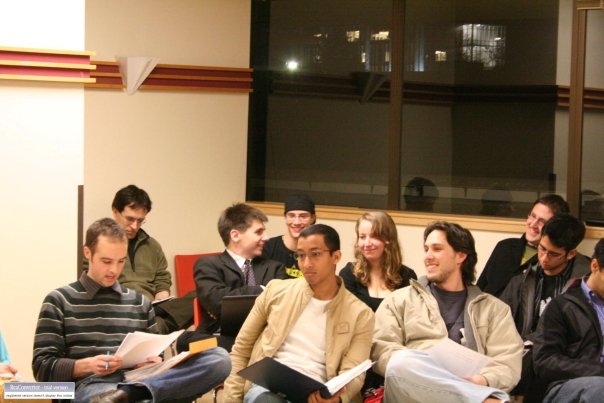
Yesterday at 5:00, fifty or so people gathered for the Elections All-Candidates’ Meeting to find out just who they were running against in this year’s AMS elections race. They were almost disappointed. Contested in this elections race are all five AMS executive positions, two positions on the Board of Governors, and five positions on the UBC Senate.

Elections Administrator Brendan Piovesan presided shakily over the meeting (if it could really be called that). While a typical meeting of this sort marks the firm end of nominations, and consists of a formal introduction of the candidates to each other, followed by a thorough brief on elections rules and procedures, such formalities are evidently not Piovesan’s way. He essentially collected some candidates’ nomination forms, then opened the floor up to questions, then called the meeting to a close. Restlessness and confusion in the room visibly increased until a few people voiced their concern that the candidate lists had not been read out, and declared their willingness to wait until they were announced. The miffed elections administrator seemed surprised at these declarations, but obligingly went on to list the candidates off very quickly, (and with notably careless pronunciation).

People to note in (or not in) the list:

  • Colin Simkus, who withdrew his nomination from the VP finance race at the meeting, noting that commerce students had been concerned about a lack of selection for the finance position and asked him to run, but since “there was more selection than anticipated,” he no longer felt the necessity to do so. He remains in the race for Senate.
  • Sarah Naiman, the incumbant VP Admin, is also absent due to apparent technicalities, but likely to re-appear in the VP Admin race.
  • Fire Hydrant Peets, making a triumphant return
  • The five solitary women in this elections campaign, three of which fall into the “joke candidate” category.

Unlike last year, when inebriated CiTR DJ Maxwell Maxwell staggered into the room dressed as a pirate and decided to contest the presidential race on the spot, this year’s meeting was less exciting, though considerably more irate. Everyone seemed to be dressed normally, though certain candidates, like “Che” Allison (who wants his fist platform point to be noted as “fuck democracy”), Genevieve “Malt Likkah” Sweigard, and Stash “Irish Courage” Bylicki may be a note or two removed from utter seriousness.

Despite the slightly weird start to the elections campaign, it looks like several races will be interesting. I’m very happy to note the presence of numerous new and unfamiliar names. As students get to know the candidates, and they get to know the AMS, I hope what they find will be mutually worthy. Good luck to all the candidates, and campaign hard!

(photos courtesy of Peter Rizov)

Categories
AMS Campus Life News

Three green-tinted notes

A few notes of interest that come to mind for the environmentalist-lite on campus:

  • UBC Farm Fee referendum: Yesterday I was at the farm. Getting there was a bit of a hazard due to the South Campus construction bedlam, and I ended up getting tangled in a barbed wire fence while attempting a shortcut, and shredding my favorite pants. Not that it wasn’t worth it. In between sorting butternut squashes and bunching kale and collard greens, I checked in with Mark Bomford, the director of the UBC farm, about recent farm developments. As you may have noticed, the UBC farm is collecting signatures to introduce a 4-dollar student fee. Two of these dollars would turn into sustainable yearly funding for the UBC farm’s programming. Two of the dollars would be put in a fund to be allocated to students engaged in climate-action related projects. More accurately, they are actually collecting signatures to place a question about the student fee hike on this year’s referendum ballot. All new AMS fees need to be approved by referendum. 1000 signatures are needed for referendum questions to be put on the ballot without the approval of AMS council. They’re a few hundred signatures short so far, but it’s expected to reach the goal. The money would mean that students, not the university, are the ones supporting the Farm in the most substantial and sustainable way. Currently, the farm functions from a combination of temporary grants (chielfy a TLEF grant that expires this year). It has no core institutional funding, though it does receive support from the faculty of land and Food Systems. If the fee is approved in referendum, the governance structure of the Farm would change to include AMS representation. This would probably take the form of AMS representatives on the current farm advisory committee. This committee reports to the dean of the faculty of Land and Food systems, and makes the major steering decision about the farm. Eventually though, says Bomford, the goal is to have the farm acknowledged as an official unit of the LAFS faculty in the Senate. This new funding, he continued, will allow the farm to meet its goals in sustainability, student services, and outreach. These will be student dollars for students, he said. I’ve had reservations about students saddling the financing of the Farm. Too me, this is an example of a program that should have core university funding – it meets the University’s trek 2010 vision perfectly. Does students taking up the cause of the farm send the wrong signal? Bomford and Jeff Friedrich, the AMS president don’t think so. They think that if students approve this fee, it will put pressure on the university to match funding. This will be interesting to watch.
  • Elizabeth May at UBC: The leader of the federal Green Party was at UBC to speak today. This is the second time I’ve heard Ms. May speak, and I have to say, I’ve just been floored both times. She is incredible. First, she really is a talented speaker. She’s very sharp, very insightful, and a wonderful aura of leadership surrounds her. Even in a dingy physics lecture hall, she was both comfortable, and respectable. And the content! oh the content! I haven’t heard so much actual content out of a politician…hm…ever. Seriously. She was full of information, science, and points of view. She talked about policy solutions in a very concrete, non-hand-wavy way. She summarized, explained, and illustrated with a near-perfect balance of vision and detail. There were absolutely no platitudes. If this is what Elizabeth May can deliver in Hennings 200, I cannot wait to see her in the official debates, not to menetion the House of Commons.
  • Terry speaker series: 100 mile diet authors: Today, Friday the 23, is the kickoff of the Terry Project’s high-profile speaker series. For the uninitiated, Terry is an innovative project at UBC whose aim is to address big global issues (environmental and social) from a multidisciplinary perspective. There are several branches of the project, including a brand-new undergraduate course (ASIC 200), a very cool website (http://terry.ubc.ca/), a writing contest, lots of neat collaborations, and, of course, the speaker series. Among previous participants are notables like Stephen Lewis, David Suzuki, and Vandana Shiva. Tomorrow it’s going to be James MacKinnon and Alisa Smith. From the terry website:

    These are the authors of “The 100-Mile Diet,” a bestseller and buzz worthy book that uses a social experiment (can we subsist on only eating things produced within a 100 mile radius?) to look into the world of food politics, economics, and culture. Extra bonus is that James and Alisa also happen to be Vancouverites, so their story has this wonderful local angle to it.

    The talk is tomorrow at the Chan at 12:00, and there’s still some (free) tickets available.

Categories
AMS

AMS meeting Nov. 21- Frustrations

An excruciatingly long agenda was set for this last meeting before the winter break. After sitting on their laurels for a whole term, the Arts caucus decided to put everything they ever wanted in the AMS into this one meeting and throw it at us like a brick. Items of interest included re-establishing “unofficial” slates (whatever that means), a default role-call vote for all non-procedural motions, and code changes to try and make people submit documents earlier. The first one failed, the second carried, and the others I forget about. Whatever.

I want to spend this post talking about something else though. Now, journalism in general, and blogging in particular is the ultimate form of political passive-aggression. One can critique, bitch, call people out, and watch. One doesn’t have to do anything, or be accountable to anyone – and that’s what makes it fun to write (and presumably to read). Well, dear readers, right now I’m going to commit the tacky act of trying to both do, and blog at the same time.

I haven’t talked much about this on the blog (if at all) but I’ve been chairing an AMS committee for a few months now. This committee was originally envisioned to look at the idea of a randomly selected student’s assembly to supplement the AMS democracy and make it more representative of all students. Its mandate was broadened to include any form of improving political representation and engagement in the AMS democracy, and the committee was accordingly christened “the ad-hoc representation and engagement reform committee”. We’ve been looking at a variety of ideas to improve political representation over the last six months, ranging from changes to elections systems, to council composition, to the creation of new populist bodies like a student’s assembly or wisdom council, to more internal issues like committee reform and executive office hours.

Some of these ideas are pretty substantial, and have the potential for inconclusive philosophical debate. Some would take a fair amount of money and effort to implement. Others, we thought, were fairly straightforward and non-controversial. One such idea was a change in the voting system for AMS executives from First Past the Post (a terrible system) to Condorcet (an empirically better one). The basic idea of Condorcet voting is that it selects a “consensus” candidate to win. That is, the person that most people prefer over most other people will win. If that sounds vague, think of it this way: strategic voting is impossible. Vote splitting is impossible. The candidate that would win against all other candidates in 1-on-1 matchups is declared the winner. Condorcet offers substantial differences from FPTP, and also from the more widely known instant runoff voting, particularly in campaigns with three or more strong candidates.

This voting system is carried out by a ranked ballot (you mark candidates according to preference 1,2,3), and a fairly straightforward counting procedure which bases the winner off of a hierarchy formed by one-on-one matchups. For more information, see the wiki article on the method HERE.

Our committee learned about this system over the course of about four weeks. As soon as members of our committee understood the system, they agreed that it was superior. It was not controversial in our committee discussions, unlike other ideas that had been much more divisive. A few of us tried our hand at writing up the necessary code, since the researcher/archivist who normally would help with this task wasn’t up to it. So here we were, with code all drafted up (albeit a bit hurriedly, but with at least 5 revisions), unanimous approval within our committee, and the honest opinion that this is a really good, if small, change to the AMS democracy. We invited an expert on voting systems to give a presentation to council about the benefits of the Condorcet method. A member of the committee took council through a detailed simulation of how the counting procedure works, covering even unlikely scenarios of concern. We did a little demostration of the method and carried out the procedure on the spot. Then there was debate.

In this debate, several things began to dawn on me.

The quality of this debate was one of the poorest I’ve seen at AMS (though there’s probably been worse – I’ve only been around for less than a year). AMS council is often capable of really insightful, careful, and interesting debate. And when that’s the case, good decisions tend to follow. Here, there was clouded, misguided, and wrongheaded debate – and quite obviously, the results were less than ideal. What really disturbs me is the apparent incapability of most councilors to pay CLOSE attention, understand, and reach a decision on a slightly involved piece of code in the council chambers. It is well acknowledged that the council chambers is more or less the worst place to grasp code, improve wording, and micromanage technicalities. What disturbs me even more though is that given this (well-known) fact, council still doesn’t trust its committees – the working groups of the society – enough to take their advice! So given this mistrust, council needs to truly grasp ideas before they vote on them. Unfortunately, they get paralyzed and confused whenever they’re asked to understand and really concentrate on something a bit involved (like say, a voting system). Then they need only cry ignorance and confusion as a basis for turning that thing away, and before we know it, all technical and structural changes are nearly impossible.

I don’t take a pessimistic view on this: I think that nine out of ten moderately intelligent people have the intellectual wherewithal to listen, understand, and respond to a clear presentation. After all, we’re in university. But people emailing, facebooking, and dreaming when slightly involved material is being presented really doesn’t help. Closed minds don’t help either – and I saw some of that tonight.

In our committee we spent considerable time trying to decide what level of detail would be the most convincing to AMS council in regards to this particular motion. Our initial tendency was to keep it general and hope that council would believe and trust our unanimous judgement as a committee of council. Then we got cold feet and decided it would be a good idea to include the detailed simulations so that each councilor could make a informed, down-to-the-mechanism, decision for him/herself. Both these objectives failed abjectly. Not only did many councilors and an executive seem to distrust our motives (by making ludicrous conjectures about Condorcet favoring certain political stripes), but the greater proportion of councilors had absolutely no grasp of the system we were proposing and its very real benefits – as was made depressingly clear by strings of irrelevant comments, inapplicable criticisms, and illogical questions.

There were a few fair criticisms. Precious few. One was the “non-standard” code language we had chosen, which described a protocol in more mathematical language than usual. A few others regarding the breaking of ties and vote thresholds for candidate re-reimbursement were fair, and certainly worth a few more clauses. The significant one was how such a system would be implemented given the dire reality of an inflexible, expensive, and apparently non-functional computer system the AMS has purchased. Other comments ranged from the old standby of “it would cost to many resources,” at the most benign, to “but it won’t increase voter turnout!!!111” at the most irrelelvant, to “why would we elect the second best person form some random thing with vote-splitting,” and “what is the success rate of this system?” at the most bewildering. (paraphrases).

So, zooming back out again, here’s a generalized question. Given this example, (of a fairly small change that should be a no-brainer, but due to it’s slightly involved technical nature, turns out to be a quagmire of misunderstanding), how do we as s
tudents expect the AMS to function at a level that reflects a degree of intellectualism? Especially when it come to structure and administration changes of a slightly involved nature? AMS has passed, and I hope it will continue to pass initiatives far more over-arching, radical, and serious than this trivial example. The thing is that some cool and necessary good ideas can be explained by expressive words and hand-waving, and some cool and necessary good ideas cannot. They simply require detailed, painstaking, sequential procedures. Unfortunately, most structural reforms fall into the latter category- and this is the category that our current structure handles so very poorly. I’m sure the irony of this catch 22 isn’t lost on you.

That’s my frustration for today. I’ll probably regret it in the morning.

Categories
AMS AUS Development

AMS meeting Nov. 7th – Nancy and Arts

Lowdown on yesterday’s meeting: it was exhausting, and sort of charged up for some weird reason. I think order was poorer than usual somehow. Maybe it’s the pressure of the end of the year building up.

Anyway. The meeting began with Nancy Knight, the Administration’s AVP campus & Community Planning. Nancy always puts on a good show, and her presentations to AMS council always bring about some interesting discussion. She was presenting about the re-consultation results and new recommendations she’s put together for U-Blvd. Or rather, the subset of the University Boulevard Neighborhood known as “University Square”. As outlined a couple posts ago, the consultation and revised plans have been going on in collaboration with students over the past several months. Nancy summarized the results from both the July and September consultations, and then went on to describe a preliminary revised plan for the square area. You can see the “before and after” diagrams for the building plan below. Outlined in yellow is the university-boulevard neighborhood, as specified in the Official Community Plan. Outlined in red is the University square subset of that plan.

Above, is the diagram for the plan before last May’s Board meeting. note the buildings on both sides of the proposed plaza, and the lack of a knoll, and the boxed-in entrance to the SUB.

Here is what Nancy showed us yesterday. The blue building footprints on the west side (ie. over top of Hennings, Hebb and Ladha) aren’t new buildings – they’re just there to indicate that the border of the square precinct is being pushed back and integrated with the academic buildings. Note the re-appearance of the knoll. The U-shaped building is the only one that would have residential of the upper levels. It’s left tip is meant to be some sort of alumni/welcome centre/ community hall/SUB expansion concept. The ladder-like thing is a prospective covered walkway from the opening of the underground loop to the SUB. The Square in the trees is supposed to be some sort of student lounge or social space.

for more riveting details, check behind the jump

Nancy talked about four elements in the revised open space plan:

  • Knoll (re-created green space)
  • Plazas (with green elements)
  • Walkways (with green elements)
  • Patios and seating areas

Also five elements in the revised building program (130000-160000 sq ft, depending on SUB renew plans)

  • Offices/Classrooms/meeting rooms
  • Student lounge/social spaces
  • Food outlets/ student businesses
  • Student housing
  • Community hall (ie. alum, welcome centre, etc)

She emphasized the importance of having a “mixed use” space in the square: that is, one with both daytime uses (shops, offices) and 24-hour ones (residential, study spaces). Clearly, in some ways this vision of a complete cocktail of uses doesn’t always jive with what people want. For example, in the cases of offices, most commercial, and residential, the results from the surveys were very negative. I asked Nancy yesterday what she does as a planner in instances like these when feedback tells you something that you disagree with. She replied that you try to deal wit the underlying qualitative worries. For instance, with the housing, a lot of the qualitative concern surrounded the ideas of unnaffordability, market housing, non-student residents, and so on. So even though residential is still included in the new plan, it’s half as much, she’s guaranteed that it will be only for students, and it will be in the price range of the residences, run by a non-profit. I found this fairly convincing. I still haven’t heard a great case for office and classroom space to be included though.

That said, this thing is a vast improvement to me. The aren’t buildings boxing the square, and the knoll is the central green feature. It feels more open, and the shift in emphasis from commercial uses to community and student-focused uses are quite good. Also, this isn’t final. A lot depends on what the AMS depends to do regarding SUB renewal. Expanding SUB into the square could mean AMS administered social space, and more AMS businesses in the square area. I think that’s pretty cool.

In other council business, the Arts caucus had a bit of a show of strength yesterday. They came decked out in faculty colours, wielding purple pom-poms, sporting a minty-fresh representative (AJ Johal), and ready with THREE motions (in varying degrees of silliness and obsolescence) from the floor (much to Jeff’s frustration {and much to my rage, when a notably trivial issue was referred to code and policies}). A feisty AUS Pres Stephanie Ryan put it this way: “we’ve decided to be more effective. We do this by wearing purple, and reading documents before council”. And indeed, read documents they had. SAC minutes, which are usually ignored, and rubber-stamped, were dissected by Arts councilor Sam Heppell before they were finally approved. Recent questions about SAC (specifically the rules governing how they constitute and de-constitute clubs) have potentiated their forthcoming presentation to council.

Other stuff on the agenda was approval of policies coming out of Blake Frederick’s housing document. These were deferred to the next meeting, since they had only been sent out half an hour before council. The document itself had been sent out way before, and the policies didn’t differ in content from the document, but, the arts caucus, in a self-righteous tizzy, (and ironically having just proffered three motions from the floor) said it was not enough time. As a result, the document can’t be used to lobby administrators until the new year. I guess there always has to be a balance between good “process,” and common sense. Having read the document, and discussed it with Blake, I’m think it was as ready as it’s going to be.

Time is a pretty sensitive issue all around. Not enough time, people wasting each other’s time, and so on. I happened to be sitting next to one of the new Education reps (I think her name was Dana). It was her first council meeting. When asked how she liked it, she said something like “Very interesting…but I think some people should be more careful with how they use other’s time”. Amen to that.

Categories
AMS

AMS meeting October 24th, or boo to code & policies.

Yesterday there was an AMS council meeting. I missed it, but since everyone loves hearing about the machinations of democracy, or better yet, themselves, here’s a summary written up by Blake Frederick, the AVP Academic and University Affairs (otherwise known as Brendon’s minion), on his brand-new blog: http://universityaffairs.blogspot.com/. I also have word that a certain illustrious blog was featured to encourage more people to run for office! woot!

Reading Blake’s summary over, it strikes me that the code and policies committee is a bit ridiculous. Yesterday they brought forward a policy restricting sound recording and video recording at AMS council and committee meetings. This is a topic that when you really think about it, might actually be important a couple times a year. Whatever. But code & policies has pro-actively taken it on! It almost instantaneously devoted attention to this (in my opinion silly) topic, to introduce (in my opinion silly) code amendments, when at the same time, code & policies has been sitting on some big items that have literally been waiting for attention for years. Big items like committee reform, and a students’ assembly. These are initiatives that actually had council support, and partial approval, but were sent to the committee for some more work and expertise. Hah – the committee is basically a junkyard of abandoned policy. Apparently, committee chair Scott Bernstein’s personal aversion to the gaze of video lenses (the horror!) is more important than council’s priorities.

This actually brings up some bigger topics:

  • Council tends to bundle things off to code & policies when anything of a slightly technical nature comes up, or when they can’t seem to agree. This means that any complex or controversial policies end up being delayed indefinitely, and council can conveniently forget about them. This is also symptomatic of the fact that other working groups in the society don’t seem to draft policies at all. There isn’t a great venue for policy consultation other than the committee, and the whole council itself. Both have proved agonizingly inefficient in different ways.
  • In the terms of reference for the committee (code section V article 6), it is clear that the body is to be used by council as an expert group. If the code & policies committee doesn’t follow council’s priorities, in favour of (in this year’s case) bylaw changes and the chair’s personal initiatives, there’s a problem.
Categories
AMS Media

VFM intro, or, how complicated can counting be?

Voter Funded Media, the contest that saw the birth of this and other (now defunct) charming student publications, is soon to be re-launched for this year. Yay! The media-reform project is meant to improve media culture, and by extension democracy in general. This is theoretically accomplished by making media into a public good: you reward media by votes, from a public fund, that voters pay into. In our case, that means that when you vote in AMS elections, you’ll also have a ballot for your favorite elections-media group, and prizes will be allocated accordingly. Also, our “voter funding” is actually being proffered (to the tune of $8000) by VFM-originator Mark Latham, not a public fee.

Last year the contest had many successes and some failures. This year there are some changes afoot. Here’s an intro to a few features of the contest:

  • Contestants – VFM is open to both established media, and new media. So, for example, last year the established Arts undergrad paper, The Underground, entered the contest and won. Tim and Gina started this blog from scratch, and also did a great job. As the contest matures, and more “new” media sources stick around and get established, the name-recognition advantage for established groups will decrease. The Ubyssey, our official student newspaper, didn’t enter last year, to leave the field more open for new groups. They even paid the entrance fee for a bunch of new media groups.
  • Start time – This year, the contest will be launching several months before the AMS election campaign begins. The ultimate intent of VFM is to establish permanent, healthy media choices, not just during elections time. This will give media that start early a chance to establish credibility and a reader base. Last year, the contest was pretty rushed, due to last-minute planning and approval at the AMS.
  • Formats – Contestants can use a wide range of media formats: internet-based, paper-based, magazine-based, whatever. The mix is pretty fun.
  • Media strategies – Last year, a fair number of styles surfaced through the contest. There were some joke entries, ranging from great (Radical Beer tribune) to lame (Cameron Funnell). There were more serious, issue-focused entries like The Knoll and this blog. There were some informative, but unenlightening elections newspapers like Election Erection and The Underground. And there was of course, the Duncan-Kearny group that did no media coverage whatsoever, but got people to vote for them based purely on personal popularity.
  • Allocating prizes – At the simplest level, prizes are allocated on the basis of voter’s preference. Theoretically, they reward the media that best served them. It gets more complicated though: this year’s VFM committee has decided upon a rather complex, unintuitive voting system for the contest, which they claim will minimize the impact of “strategic” votes and narrow-appeal media groups. The system involves each voter weighing the contestants by giving them more or less theoretical money. Then some percentile (not the mean) of the allocations determines how the prize pot is “sliced”. Don’t worry, a primer on this later.

Last year, VFM sparked some really decent debate. The candidates had to learn alot, and know the issues. It established a lively discourse during election time that was great to be part of. The new media that popped up was exciting and fresh. However, VFM didn’t increase overall voter turnout, which is still mired at about 10%. Arguably, the best media contestants did not win. And FVM took up alot of candidates’ time, preventing them from pursuing more traditional campaigning methods and getting out the vote. The good thing about VFM though, is that it improves with maturity: with more years, the contest will have more momentum to begin with, and the quality of contestants will be progressively pushed up leaving little room of get-rich-quick punks and deadbeat hacks.

We’ll see how things go this year. UBC Insiders’ awesome VFM roster is being established as we speak, so stay tuned. Here’s to media! *clink*

FYI: The VFM contest is hiring an administrator. This person would be reporting to the AMS Elections Administrator, Brian Peiovesan, and they’re offering 750 bucks. The job posting is found HERE, for those interested.

A chat I had with Mark Latham, and revelations thereof, can be found HERE

Spam prevention powered by Akismet