Categories
AMS AMS Elections 2010 Media Site News Student Politics

Final AMS Electoral Fraud Reports and Revised Results

We’ve uploaded and posted links to all of the reports arising from the AMS Electoral Fraud investigation on our Twitter feed but since not everyone is twitter-savvy just yet, here are the links to:

Final Report from Isabel Ferreras (Elections Administrator)

Report from Forensic Data Recovery (Independent Auditing Firm)

Revised Elections Results presented in a somewhat awkward format.

Final cost to the AMS: currently estimated at $42,000-43,000.

Categories
Media News

UBC in the news

I definitely don’t want to turn into a news aggregator blog, but there have been a number of UBC news items lately that I thought were interesting and wanted to share. And trust me, I think it’s totally lame when I read something that is just a recap of other stories I’ve already read or heard about. So hopefully there is something in here you didn’t know about yet…

  1. The NDP wants to give $200,000 per year to the UBC Farm.

    But only if they form a government. That’s a rather large ‘if’. Hooray for pandering!

  2. Hwi Lee, the student who sent email threats resulting in a lockdown of the BioSciences building, was given a conditional sentence of one year, as well as a six month curfew. In addition, he has to stay away from UBC, will have two years of probation and has to write a letter to the Ubyssey explaining the incident.

    I guess the judge doesn’t read UBC Insiders – too bad.

  3. The family of Karol Jaholkowski, a man who fell off a fraternity house roof at Arts County Fair 2007, is suing UBC and a fellow fraternity brother for the injury.

    I guess they don’t read UBC Insiders either. Otherwise they’d know lawsuits like that don’t work.

    Incidents like this no doubt contributed to the RCMP crackdown on alcohol. However, I am 99.9999999% sure this did not occur at a licenced event, so if incidents like this are used to justify the stricter rules, it’s a red herring.

    A Vancouver Sun story with more details from right after the accident can be found here.

  4. Metro Vancouver won’t be getting compensated for land in Pacific Spirit Park that was expropriated by the province. The two parcels of land in PSP, and the University Golf Course were to be given to the Musqueam First Nation in a land deal reached in 2007.

    There is still hope that one day Hampton Place can be expropriated and turned into student residences.

  5. It costs >$200K to rent the arena for a weekend. That’s according to a lawsuit UBC launched, claiming they were not paid for an Anthony Robbins appearance on campus last fall.

    I’m not sure The Power Within will be welcome at UBC again. This was one of the first non-hockey events to be held at Thunderbird Arena and a test of how disruptive these types of events would be to UNA residents. Everything was going fine until, unbeknownst to UBC, they decided to set up drumming and fire-walking outside the building…

  6. On my walk towards the bus recently, I noticed someone had kindly disposed of their UBC parking ticket on the ground. If anyone is curious, they have now started writing *WARNING ONLY* tickets, with threats of towing. I’m guessing they are doing it in order to log the plate numbers so they’ll know if you are making a habit of not paying. That’s strike one for you, Mr. Silver 4-Door Nissan.

    The best part of the ticket is the last line on the back: “This Traffic Notice is issued by authority of the Board of Governors of The University of British Columbia.” Whoops.

  7. In NCAA-related news, Western Washington University (in Bellingham) folded their Div II football team last year due to financial constraints. Some of those ex-WWU players are coming to UBC to join the Thunderbirds.

    From the article: “If you can get school paid for just for playing football, that is awesome. But the whole point of college for me, is to get my degree,” says Kelly Kurisu. There was nothing stopping him from getting his degree at WWU since the university did not go under, to the best of my knowledge. I wonder what incentives Athletics offered him to come here.

Categories
Campus Life Media

RBF's triumphant return

As you were wandering about campus this week, you might have noticed people strutting about in army fatigues, bright red shirts, and megaphones shouting vaguely about fun, beer, parties, beer, campus life, beer, politics, and beer. These are not drunk Russians left over from the soviet era. Nay, these are the members of the Radical Beer Faction, UBC’s oldest political group. Back when the AMS elections ran with parties (called slates) RBF ran a full slate of joke candidates, ranging from fairies to fire hydrants. These days, RBF is an AMS club, focusing on fighting what they have termed the “war on fun” on campus. This “war,” being waged upon students by the “axis of boring” of the UNA, RCMP, and university administration, has allegedly reduced the number of parties on campus due to restricted liquor licences, and bitchier neighbours. For the RBF’s lobbying document, click here.

RBF VP politburo “Scary” Mike Kushnir recently had a nice little interview on the CBC radio drive-home show On the Coast explaining the Faction and the its activities at UBC. Have a listen.

[youtube=https://www.youtube.com/watch?v=n6ebgoX90lc]

Mike is a pretty eloquent guy. For the response from the RCMP and a shout-out from Grant Lawrence, CBC radio 3 host of awesomeness, here is part 2 of the segment.

If nothing else, RBF has built itself a kickass brand with Soviet-style iconography, enthusiastic membership, and a great message: the way we party is political. Take a look at some of Tim’s old posts here, and here to see why. The issue of beer gardens and how students party on campus actually does relate to the fundamental issue of students’ social and political engagement with fellow students. Props to the Ubyssey for harnessing the energy of this group in a by-weekly RBF column, which will be paired with a column from another active campus group, Students for a Democratic Society.

Categories
Media

Note to our readers

Hi everyone: I just recieved an email regarding the new Voter Funded Media system:

Only 15 people are registered to vote. Needless to say this is bad for democracy, because I can get my three roomates and brother to vote and sweep the contest. Now then.

As approved by AMS council, VFM is now running on a continuus model that offers smaller prizes for media on a monthly or bi-monthly cycle

From VoterMedia.org (Mark Latham’s site) here are registration and voting instructions:

Email your UBC campus-wide login ID (not password) to
mark[at]votermedia.org. I forward them to UBC staff, who usually upload them Mon
Wed & Fri mornings. You only need to register once for the whole year of
periodic contests. (Better do this by April 27 if you want to vote in this
contest period ending April 30.)

Log in at www.vista.ubc.ca.
Click on “VOTE – VoterMedia”. You vote once in each contest period.

While this registration process is a bit cumbersome, it’ll only cost you one email. Of course we’d love if you choose us, but check out all the other worthy media too. They’re listed at Votermedia.org/ubc. Any prize money we win will be chiefly dedicated over the coming months to transitioning into a new and more dynamic blogging platform.

In other news, I’ve written about 5000 words in the last 30 hours. And still one thesis to go. Sigh.

Categories
Media

VFM launches at SFU

In my life, there’s always time to kill. And now I have a fresh method of doing it. Mark Latham has begun sponsoring a Voter Funded Media contest of a slightly different stripe over at SFU. Take a look at the SFU VFM page HERE. The idea is broadly the same as VFM here at UBC, but instead of being a one-off coinciding with the student society elections period, prizes are instead being distributed on a monthly cycle of continuous voting. The prizes are $300-$500 per month, which will add up to around $5000 in a year (compare to UBC’s contest which had a prize pool of $8000 for a whole year, given out all at once). Votes are calculated using the interpolated consensus method that we used here at UBC this year.

(Note to newer readers: VFM is the media contest that birthed this blog. According to Latham whose brainchild it is, rewarding media democratically from the public purse will improve democracy. For a previous posts discussing VFM, take a look here, here, here, and here. )

Another interesting difference is that the SFU contest is administered by Latham himself, not the Simon Fraser Student Society, which is equivalent to our AMS. This is interesting to note, because though one would think that having the institutional and organizational support of the student society behind such a project would be a boon, this year’s contest at UBC was magnificently botched by the AMS, both on the political and bureaucratic side. Not surprisingly, Latham has managed to run things smoothly at SFU so far.

The continuous monthly model maps much more closely to the ultimate goals of VFM: providing long-term, in-depth media which are accountable to their readers through a democratic reward process. SFU certainly has a smorgasbord of contentious issues to deal with at this moment, with their SSFS elections and referendum to defederate from CFS, the national lobby they are a member of. Media outlets could certainly provide a valuable service to the SFU community by providing some insight on these issues, and make a buck into the bargain.

All this is to not say that the SFU contest is anywhere near effective. So far, it seems to be marginal in both content and readership. The SFU campus radio station has entered, which I think is a brainwave (hint hint, CiTR), and one or two of the blogs have some content worth reading. Nobody seems to be trying very hard at this point. But these things take time to build momentum, and it seems almost stochastic whether such an idea will catch or not.

The question is, how much of a future does VFM really have? If Mark continues to encounter tepid half-successes, how long can he be expected to fund these experiments? And if he stops before the value has been unequivocally demonstrated through a jump in voter turnout or irrefutable data (which the AMS has yet to collect through exit polls. *strangle strangle*) would student societies be inclined to fund such innovations themselves? According to Jeff Friedrich, the incumbent AMS President, probably not. He told me in a meeting last year, that to him these projects are bonuses, and not as essential as making the AMS democracy itself run well through systemic reform in the AMS structure which has yet to be achieved. To me, innovative democratic projects like VFM (or a students’ assembly) should be looked at separately from improving the AMS democratic and organizational structure. We shouldn’t shy away from investing time and money in either.

For now though, Mark is still willing to pick up the tab. And UBC may soon be transitioning to the continuous model itself. A proposal for this just went up today on the VoterMedia.org website – take a look.

Categories
Media

UBC Insider mission statement

We here on the blog have been feeling that lately we’ve been losing some focus. With more boisterous and demanding readership, an election campaign, and fewer (non-graduating) writers, the pressure (and temptation) to spit out easy personality-centered posts is hard to resist. This is an attempt to step back and re-balance. Though it may not be in your face, this blog is and has always been based on a certain type of philosophy, which goes beyond reporting news, or having a personal pulpit. By creating this mission statement, we’re laying out the values and goals we aspire to with our blog. We hope that it will give both ourselves and our readers clear(ish) expectations of our journalism, and our community here on the blog. We hope that by laying out these expectations and aspirations, we’ll help ourselves live up to them, and help you understand the place we’re coming from. Bear in mind that this exercise is somewhat platonic – this is a chair in the sky – but this is the chair we’ll be trying to approximate, though we may not always make it.

Our Mission:

  • To use our experience, networks, and knowledge base to empower UBC students to educate themselves about campus and university affairs. We will present issues, deliver background as clearly as possible, and use those issues as springboards for open discussion.
  • To be inclusive. We will strive to engage as many students as possible and invite our fellow university community members to participate in discussion that is relevant to them.
  • To thoroughly discuss the issues themselves and where people fit into them rather than the other way around.
  • To provide intelligent and insightful commentary and perspectives on issues relating to UBC and the UBC community.
  • To create a lively and respectful forum for debate and discussion of campus and higher education issues

Our Values:

  • The balance of facts in concert with perspective; the understanding that this balance is fine but adjustable.
  • Respect and trust in each other.
  • Refusing to obliterate our unique voices and positionalities (or those of our readers) in pseudo-objective conceits.
  • The assumption of the intelligence of our readers.
  • Accessibility to UBC’s complete student body
  • due diligence with facts and source checking.

Our philosophy:

Think of our blog as broccoli: it may not be the most attractive and appealing food, but damn if it’s not good for you and ultimately delicious. While we may have named ourselves the “insiders,” we do not subscribe to the duality of in/out; we recognize the value of different brands of involvement unlike our own. Relating items from the weekly news-cycle to longer term issues is a priority. Gossip will be minimal, but juicy when we do run it. The AMS is not the centre of the universe. Our posts will be accessible on several levels of previous knowledge. The spirit of investigation and depth of analysis are important to us. We write what we’re interested in, without presumptions of doing everything and satisfying everyone.

Categories
AMS Elections 2008 Media

Voter Funded Media results!

Due to a hole in WordPress, this post’s author is misattributed. The follow was written by former Insiders editor Maayan Kreitzman.

Well, here they are at long last!

The Knoll – $1600
UBC Insider – Election Edition – $1500
The Devils advocate – $1400
Cavalier – $900
Let Them Eat Cake – $725
UVote – $600
The Underground – $600
The 432 – $600
Plain title: Awesome Content – $75
The Radical Beer Tribune – $0
Maclean’s On Campus – $0

From the VFM administrator Paul Gibson-Tigh:

In the name of transparency, I am passing along the VFM results as they came to me, and then in the interpolated version (both in excel). The results were tricky to interpolate, as they made for a ‘case of discontinuity’ explained at the bottom of this page (http://www.votermedia.org/ubc/InterpolatedConsensus.html). It was all planned for in advance by Mark. I encourage you to fill in the spreadsheets and see the wonders of interpolated consensus yourselves! I could try to explain the case, but I had to have it explained to me, so keep that in mind.

A total of 249 people voted in the UBC Insiders option (ranging from $0 to $2000) – which was the highest number of votes of any media. There’s no real way of knowing how many people voted total – but lets say that 100 people voted, and didn’t vote in the UBC-i category, that’s still a pretty dire turnout for a contest that’s supposed to raise the profile of campus elecitons. The consensus percentile, p, was 61. It seems that (acording to the spreadsheet I’m looking at) the number of votes for each media were not normalized to the total number of voters, but rahter to the maximum number of voters in a particular media (249, in this case). This means that the rule in the VFM code that states that not voting is the same as voting zero wasn’t followed (I think, anyway. not sure). You can take a look at the Raw Votes spreadsheet, and the Interpolated Consensus spreadsheet for yourself – see if you can make head or tail of it!!

My major disspointment here is Plain Title: Awesome Content. I think Ian did a great job with the mini-paper. It was the one entry, to me, that actually reached out farther than the insular AMS in-croud, to target everyone else. And he did it with hilarity, opinion, and information. S0 boo-urns to that result. Also the 432 still sucks. Alot.

On a personal note, I just want to say a heartfelt thank you to all of you. It’s been a great ride, and that’s because of all the readers that have logged on, learned a bit, and maybe commented. The discourse generated here is really the thing that is wonderful to me. Pardon my moment of vanity, but it really is lovely to feel that our little blog is appreciated – so thank you!

Categories
Media

The 432 isn't worth the paper it's printed on

This is where I get mad. The 432, the Science Undergraduate Society’s official newspaper, is … euuugghh. The very idea that students are funding such a worthless, offensive, and generally craptastic rag is insane. This newspaper, apparently, used to be good. It used to be smart and hilarious, and enjoy more readership than the Ubyssey. Not that that’s exactly anything to be too proud of. For as long as I’ve read it though (about two years), the 432 has been an emblem of stupidity and needless tree-chopping – and this week it just about scraped bottom. Apart from the annoyance of its entering VFM without doing a shred of elections coverage, lets do an enumeration of this week’s journalistic offerings: Article about giving you dog a bath (…), Article about the city’s sex shops (whaa?), and to top things off with a flourish of offensive bad taste, an article about Sarah Naiman’s breasts (classy). This is not harmless fun – it’s offensive, student-fee-funded, useless crap. Though not everyone agrees, of course: according to the outgoing Director of Administration of SUS and AMS VP Academic elect Alex Lougheed, this issue represents an improvement in quality. “It’s pretty good this week, actually,” he said to me, without any redeeming hint of irony.

How about this radical thought: if you don’t have anything to write, don’t write anything at all? I even left out the “nice” from the kindergarten adage about keeping your mouth shut. There’s a balance between informative satire (think Colbert, or The Devil’s Advocate, for that matter) and pure farce. Most undergrad newspapers, including the Underground (which, to it’s credit, actually contains at least a couple laughs every other issue) seem to be publicly funded mediums for a few amateur comedians to fill space. Yuck.

It seems to be notoriously hard to get people to actually write for these things. The poor editors typically publish whatever they can get their hands on from a few nominally funny SUS councilors the night before press time. But how is this possible?? There are heaps of science students that must have something to say. Maybe a combined undergraduate newspaper from all the faculties would be more interesting and prone to publishing actual content? Maybe a hired position for editor and a committed volunteer staff appointed for a whole year would produce better results?

Anyway, just a few thoughts. It seems like I’ve been doing a ton of “media” stories lately, and I promise this is the last for a while. Scintillating topical posts about the Vancouver Quadra federal by-election, AMS elections 2.0 (including student court challenges), and other cool stuff are on the way. And it’s Science Week! Check out some of the events.

Categories
AMS Elections 2008 Media

How to vote in VFM – Interpolated Consensus,WTF?

Voter Funded Media, the contest that accompanied the AMS elections for the second year this year, is an idea that’s meant to award media public funds by the will of the people, thus fostering better journalism, more informed voters, better elected leaders, and healthier democracies. The assumption is that media, as opposed to candidates or special interest groups, are able to engage larger audiences, since they are experts in communication. This, at UBC may or may not be the case, particularly considering the contest’s mismanagement this year, but in any event, voting for this “race” of sorts is on now on WebVote until the 31st. There’s an 8 thousand dollar prize pool that will be distributed among the various media according to votes. If you’ve enjoyed reading this blog, I encourage you to login and vote for us.

Before you do that though, you should find out about the voting system: “interpolated consensus”. It’s a tad complex, so just bear with me – and by the end, you’ll know how to best allocate your votes! Alors, when you log into WebVote, you’ll notice that for each media, you have the option of allocating to them $0, $500, $1000, $1500, or $2000. Lets do a simplified scenario: after everyone has voted, the votes are counted, and the median is determined. The median is a number which 50% of the numbers in a set are below, and 50% or the numbers in a set are above. It’s the 50th percentile. The median will be one of the five amounts of money. If this is done for each media, you have an amount of money that each should receive. This is the “consensus” part of interpolated consensus. Taking the median, as opposed to the average, as a basis for awarding prizes is meant to discourage strategic voting – that is, it should encourage the voter to vote for the amount they actually believe that the contestant should receive. With averages, people are encouraged to engage in strategic voting (ie. voting above or below their real opinion) in order to “pull up” or “pull down” the average. If you use the median, on the other hand, the actual number you choose has no bearing on the amount that the media is awarded. All that matters is whether it is above, or below the median. Your vote will pull the median closer to your vote, whichever direction (up or down) that may be. You don’t know. So if both 2000 and 1500 is above the 50th percentile of votes, they will both have the same effect on the outcome – by how much they are above the median doesn’t matter.

Now, let’s abandon our simplified scenario, and look at how it actually works. First, your five voting options represents a discontinuous set. That is, you’re only allowed to award media in $500 intervals. To make the set more continuous, each vote for 500 is interpreted as 1/5 th of a vote for each 100-dollar interval between 300 and 700. Similarly, each vote for 1000 is interpreted as 1/5 of a vote for each 100 dollar interval between 800 and 1200. this is the “interpolation” part of interpolated consensus. If you didn’t get that, just ignore it – it’s a way of making the set of numbers more continuous. Second, we have to scrap thinking about the median (the 50th percentile) that we’ve been imagining. This is because taking the median of each media’s votes and giving them that amount of money may not add up to the prize pool of 8000 dollars. In order for the system to actually allocate the prize pool, the percentile which will allocate exactly 8000 dollars is used – lets call this the pth percentile. This pthe percentile arbitrarily represents the “consensus” vote, and voting above or below it will change the prize for that media.

I have a few problems with this system. It seems to me that strategic voting is still possible: if you want to be sure that you’ll have an upwards effect on a contest, always vote 2000. If you want to be sure to have a downwards effect, vote 0, or don’t vote. If you want the media to get a specific amount, you should vote for that amount. The system will bring the pth percentile closer to the amount you chose, no matter if it’s an up or down effect. The other problem I have is with using the pth percentile to determine how much money to give to each contestant, instead of using the median, scaled to $8000. It seems to me that it’s quite likely to have a highly discontinuous set of votes with some media. This makes taking some percentile and awarding it highly arbitrary. It could jump from quite high to quite low as the result of a couple people that didn’t vote (ie, voted 0) – or vice versa. If you’re going to use a consensus system I think it makes much more sense to use a weighted median. I tend to think a voucher system with averages makes more sense to begin with, but that’s just me. Thoughts?

For a more detailed explanation and simulation, go to VoterMedia.org

Categories
AMS Elections 2008 Media

Elections Results: photos and mockery.

Last night, I took photos. This morning, I mock people. You know you like it.


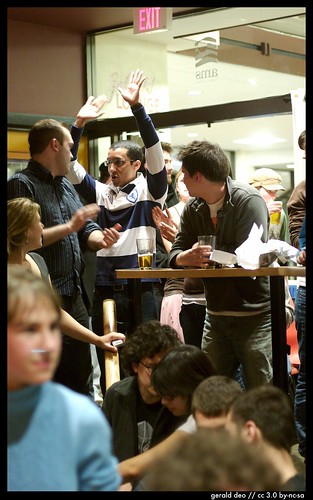
amsresults2
Aaron from UBC Devils, undoubtedly plotting.
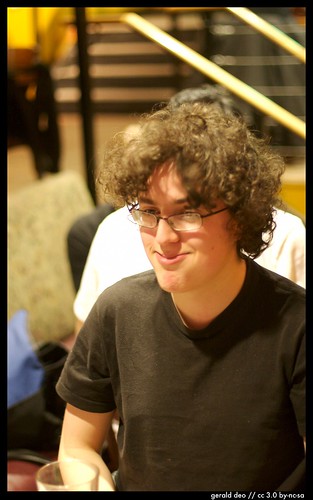
amsresults3
Austin from UBC Devils. I’m a firm believer in keeping one’s friends close and their enemies closer.

amsresults4
Andrew Forshner, of whom I cannot take a photo without it looking like he’s singing.

amsresults1
Stef Ratjen, heading out of the Gallery for some air.

amsresults5
We’ve got all sides of the competition covered…
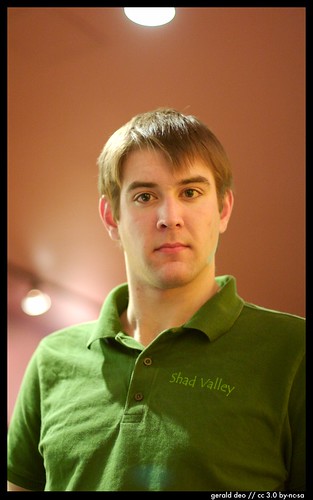
amsresults11
…especially when it comes to UBC Devil’s head dude Stephen McCarthy.
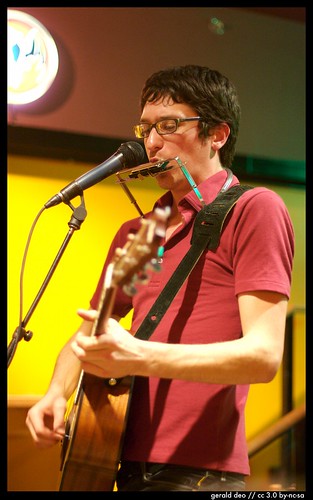
amsresults6
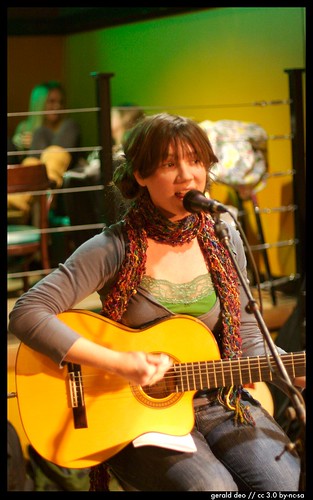
It was Open Mic night in the Gallery, and this fine gentleman serenaded the throng of politicians for a while. Sadly, I didn’t catch his name.

amsresults7
Erin Rennie ponders her picks for the elections pool.
amsresults8
Gina, another Open Mic Night entertainer.

amsresults9
Erin Rennie wanted the Presidential race to be a series of staring contests, as she is totally schooling Matt Naylor.

amsresults10
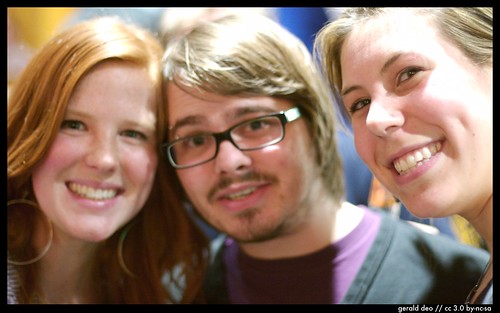
Angelina from the Devil’s Advocate, and her paper airplane.
amsresults12
It’s an Exec Sandwich!

amsresults13
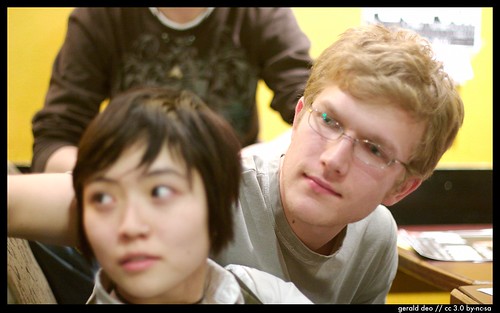
I’m not sure EA Brendan Piovesan can exactly be called the most popular man… but everyone did want to hear the results.
amsresults14
Team Flyerfuck awaits results.

amsresults15
Azim Wazeer raises the roof upon hearing he made it.

amsresults16
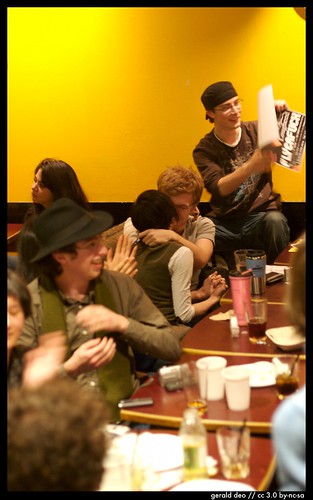
VP Finance-elect Chris Diplock was all smiles and hugs.
amsresults17
Unsurprisingly, Team Flyerfuck went straight for the makeouts upon finding out Alex had won.
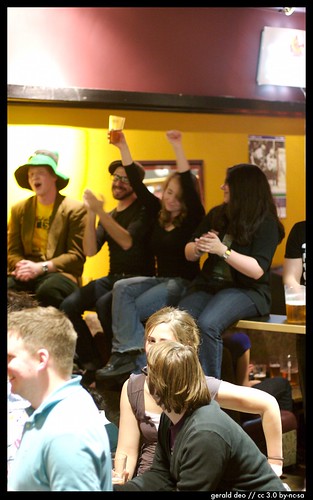
amsresults18
Erin Rennie, relieved to have gotten her 10% and also to have not won.

amsresults19
President-elect Mike Duncan and VP Admin Sarah Naiman.

amsresults20
Maybe there are pink UBC cowboy hats in our future.

amsresults21
VP Students Brian Sullivan was also in attendance.
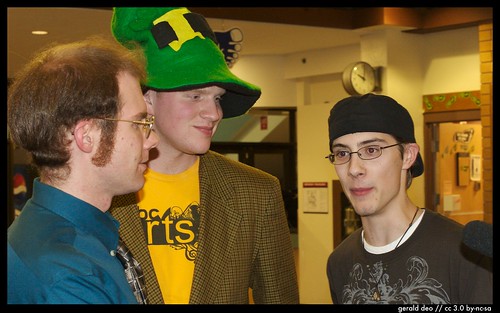
amsresults23
Tyler “Che” Allison relates the story of voting at every poll booth, his concerns about the way paper ballots were handled, and details the coming revolution for Eric Szeto (off camera, holding mic)

Congratulations to the newly elected student representatives, and condolences to those that didn’t make it; there’s still plenty of opportunity to make your mark!

It was an interesting election, and voting isn’t over – be sure to vote for the UBC Insider in the Voter Funded Media Contest!

Spam prevention powered by Akismet