Categories
AMS Student Politics

Point: focus on the Knolligarchy

An opinion piece by Jesse Ferreras, M.J. Candidate, UBC School of Journalism. Counterpoint coming next week.

There’s a war on truth at this University, and a resurgent movement of leftist radicals is fighting on its front line. I’m speaking, of course, about the Knolligarchy, formerly a joke name that now encompasses UBC’s newly-visible activist front. It’s a group of people affiliated with the AMS Resource Groups that is hot off a “Resisting the University” conference, which culminated today with a march of about a dozen people and an invasion of a meeting in the Board of Governors chambers (to the amusement of all those present.)

First off, let’s give credit where it’s due. The activist well had run dry at this university – it’s been years since a decent protest has been held anywhere on the Point Grey campus, at least since the quiet, passive protests that came in advance of the Iraq War. In this context, the Knolligarchy is a breath of fresh air. They’ve managed to inject just a little bit of excitement into campus life with events such as Trek Park and Trek Park 2.0, as well as the recent conference. It was music to my ears to hear an activist yelling into a megaphone and leading a march across campus last Friday. It at least gave me the impression something was happening.

But that’s enough credit. Let’s cut to the facts.

The Knolligarchy gets its namesake from The Knoll, a partisan campus publication that seems to avoid editing and facts as a matter of editorial policy. Describing itself as a “Weekly” (a “Monthly” might be more accurate) it is published through the AMS Resource Groups. The groups collectively receive $1.50 per student per annum, according to outgoing VP Finance Brittany Tyson. This year the I can’t be sure of the amount of money that goes specifically to publishing the Knoll, but it must come from somewhere within that $1.50.

This money is put towards a publication that advertises itself as partisan news coverage and thereafter sets out on espousing what can be more accurately called revolutionary fervour than news, more anonymous articles than journalistic agency. They don’t, however, get their message out solely through the publication – they also do it through public appearances and direct action techniques.

An example is a little episode in the Ubyssey office in early January. Stefanie Ratjen, Jasmine Ramze Rezaee and Nate Crompton, three of the Knolligarchy’s most prominent members, came into the office to complain about the front page of its first issue in 2008. The top story, splashed across the top of the paper, was “Activists vandalize Ponderosa complex,” accompanied by pictures of broken glass. Beneath it, to the left, was “Trek Park bulldozed,” a story about the mysterious razing of the Trek Park installation.

Crompton, Ratjen and Ramze Rezaee, despite having a story on the front page, complained that the Ubyssey hadn’t put the Trek Park story at the top. They were unhappy about the association given to activists by placing the story at the top (a fair complaint) but also that the Trek Park story, despite being devoid of a good photo to accompany it, was not placed at the top. Crompton went on to complain that “I said all these interesting things,” going so far as to call the issue a “fraud.” Nate argued that the University had “declared war” on Trek Park, notably ignoring the fact that their protest had devolved into a trash heap after the elements caught up with it over the course of several months. The three of them left the office clearly dissatisfied with the dialogue they had with me and a few Ubyssey editors, with Ramze Rezaee remarking, “I hoped to get more out of this conversation.”

The campaign of misinformation began in earnest MKduring the AMS elections. Language is always subjective and contentious, but this group of students has taken misleading rhetoric at UBC to embarrassing new heights.

Stefanie Ratjen made grand overtures to students, spreading falsehoods like “Translink is a private corporation” until I called her on it on my blog. Ramze Rezaee was at her side throughout the campaign, at one point asking VP Academic candidates what they felt about military funding for the International Relations program. IRSA president Gordon Hawkins saved students the trouble of swallowing this tripe when he corrected her publicly, saying that the Liu Institute for the Study of Global Issues receives funding from the Department of National Defence, and not the IR program. Ramze Rezaee exclaimed, “It’s the same thing!”

The lies propagated by members of the Knolligarchy reached their peak when Ramze Rezaee created “Freeman Poritz Watch,” a Facebook group devoted to ruining his campaign for VP External, and had a curious similarity with the anti-Semitic “Jew Watch” website that Poritz himself noted. The group was registered under the name “Sandra Davidson” but the fact of its creation showed up in Ramze Rezaee’s Facebook mini-feed when she started it. In the group’s description she castigated Freeman as “anti-woman,” “militaristic,” a “frat boy” and “xenophobic,” with nothing credible to support the latter claim (the reason, if I remember correctly, was his unfortunate comment about feeling cheated that international students get their degrees and then leave – an impulsive comment, to be sure, but hardly xenophobic.) Its members eventually included Nate Crompton and others involved in the Knolligarchy. At some point the site was taken down, but Freeman was undoubtedly hurt by its claims, notably its unwarranted accusation of xenophobia and its similarity to “Jew Watch” – an antisemitic website.

Today we find the Knolligarchy in an unfettered quest for power at UBC – and they’re not afraid to get their hands dirty. Tristan Markle, your new VP Administration, got them covered with ink when he was caught on camera February 27 defacing posters near the Pit that read “I support Alex Lougheed!” with the added slogan “Right to Cheat.” The posters themselves have come in response to a complaint from Nate Crompton, who alleges that Lougheed voted for himself 12 times in the AMS elections for the position of VP Academic. The votes weren’t counted and the complaint came more than 72 hours after the election results were announced, thus nullifying the complaint according to AMS Code Section IX, Article 8 (1). Markle, however, is living on the hope that he can help put three members of the Knolligarchy on the AMS Executive, even though another election would likely have to be held if Lougheed was impeached, the only way he can be removed from his position at this point.

The scariest thing about this is his tactics may be effective. If there is another byelection, I have little doubt that Nate will run again. And given the pathetic turnout of voters to byelections, as in the VP Admin campaign, he could very well win.

The Knolligarchy’s strength resides in caring about the things that most students don’t. They rallied to Tristan Markle’s side for his election to be VP Admin and succeeded in putting him in office. I hadn’t previously believed it when Patrick Meehan told me the Knolligarchy could count for approximately 400 votes for any candidate – these days I’m more inclined to agree with him.

In short, the Knolligarchy is a force to be reckoned with, and its publication, The Knoll, is a great avenue for them to get their message out. You’re helping it get out there by paying your AMS fees. A small amount of those fees are being placed towards the AMS Resource Groups, and a portion of that amount is ensuring that the Knolligarchy has a publication through which to advocate their leftist political leanings. It’s starting to succeed to the same degree that Conrad Black did in making Canada a more conservative place when he started the National Post – of cour
se, he wasn’t funded out of the public purse. It won’t stop until someone reviews how funds are being allocated to the AMS Resource Groups – and specifically, the Knoll.

In any other governmental system, it’s deeply unethical to put public funds towards a partisan cause. Here, purely by paying your AMS fees on top of your tuition, that’s exactly what’s happening. Those fees are being towards the AMS Resource Groups and subsequently the Knoll, which is in turn publishing reasons why its friends and close acquaintances should hold public office at UBC. It’s like the Government of Canada, rather than the Conservative Party, using a pamphlet to campaign for Stephen Harper. Why should students get away with it?

Activism certainly has a place on this campus – without the Great Trek, we wouldn’t be studying or living in the buildings that we’re in today. But truth deserves a place here too – and the Knolligarchy doesn’t seem too keen to let it stand in the way of its actions.
Categories
AMS Elections 2008 President Student Politics

TLG's Guide to Voting

Now don’t go and get your knickers in a knot – these aren’t endorsements. Far be it from me to, from the comfort of my 26th-story office, pass judgment on candidates I barely know, in an election in which I am ineligible to cast a vote. So rather than saying whom to vote for, I’ll go through questions to ask yourself when making up your own mind.

But first, a little indulgence:

Vote for Erin Rennie!
This is based on one simple principle: vote for the person who’s best for the job. I’ve worked, to varying degrees, with many of the candidates and, quite frankly, Erin’s the best. For serious. She’s got the competence, and a level of energy rivals even that of Mike Duncan, and doesn’t scream “give me attention!” She has probably achieved just as much in terms of improving students’ campus experiences as any other candidate. Most importantly, when she cares about something, she does it. She doesn’t form a committee, or make grand proclamations – she just does it. And that’s a quality we should strive for in leaders.

So, I can hear it now. “She’s running as a joke!” “She has a meagre platform!” “She doesn’t want the job!” All true (as far as I know). But I can only respond by quoting someone smarter than all of us: Plato. “The State in which the rulers are most reluctant to govern is always the best and most quietly governed, and the State in which they are most eager, the worst.” The best ruler is the reluctant ruler. You don’t want a ruler who’s in it for personal publicity or attention, or the gratification of getting love from the people that they couldn’t get from their father. Governing well and governing loudly are often incompatible; you want to elect a person who will govern well, and govern quietly. And when that person doubles as the best candidate, I happen to think the voting decision is remarkably easy.

Read my “how to make a voting decision” thoughts behind the jump.

The way this works is as a series of questions. I don’t have the answer – you do. Think of it as a filter through which to evaluate candidates, a lens through which to view them to decipher the identical Blogspot campaign sites and Facebook campaign groups.

What Have they Done?
The emphasis here is on “DONE.” They can probably list a zillion qualifications and committees and memberships – who cares? Find out what they’ve actually done with those opportunities. There’s nothing worse than a person who’s given a position of power and influence, then wastes it.

“I will change/improve AMS Council”If they were already on Council, why haven’t they done so already?
If they weren’t on Council, why not? Do they have a clue how it works? (Not to suggest that sitting on Council is a pre-requisite for executive. There can be a good answer to this question that makes them even more electable.)

“I will fight for better consultation with students”If you’ve ever seen them in a leadership role, have they personally consulted with students? Have they shown any inclination to consult themselves, or do they substitute their own views for those of “students”? It’s my experience that those who don’t consult are often useless advocates for the same.

Policy Priorities
Sure, policy priorities can be important. But this year, they’re not. There’s no significant ideological cleavage, no real debate on the merits of any particular issue or perspective. Most of the candidates are pretty much the same When they’re the same, don’t ask whether or not you agree with their opinion – instead, ask yourself if the candidate came to their opinion logically, and whether they expressed their opinion well. I don’t care if a candidate believes X over Y, I prefer if the candidate will, as they gain experience over the year, come to recognize that Y is preferable to X. And their logical reasoning is more important than their opinions.

Big Ideas
A lot of candidates have specific concrete ideas. Ignore them. Ideas fail and succeed for reasons far beyond their control, and, quite frankly, I don’t want a candidate who forces his ideas on the AMS machinery.
Instead, ask where that idea is coming from. Ask yourself why they identified this as a priority, and whether or not the fact that this is their idea illuminates a particular principle for which they stand. I call this the “Naiman Theory.” Her idea of a TV screen in the SUB showing UBC YouTube videos was rather silly, but the principle behind it, of giving students a stake in their own building and an outlet for their creativity was genius. And the principle is worth supporting, if not the idea.

Do they Play Well With Others?
No, this isn’t a popularity contest. But at the same time, some weight has to be given to their ability to work within a team. Most importantly, look at when they disagree. Do they disagree constructively, or do they go out of their way to antagonize others? Never, ever elect the latter. A year with a dysfunctional executive can have ramifications for years thereafter.

So these are the questions I tend to ask myself when voting, AMS or otherwise. They make it fun. And sometimes support prima facie absurd results – vote for Rennie!

Categories
AMS Elections 2008 Issues Student Politics

Buzzwords: "Council Empowerment"

This post is by Spencer Keys, the AMS President of 05/06. We thank him for his participation. I will be blogging more about the basics of both committee reform and the Strategic Framework later in the week for the new readers out there.

Maayan has politely asked me on a number of occasions to write a guest post for UBC Insiders and while I have normally been content to make snarky comments or longwinded rants when something interesting pops onto my RSS feed, there are two topics that still interest me a great deal and need to be continually reinforced as important; the first is keeping slates out of the AMS (a topic that others are perfectly well equipped to argue but occasionally needs some context from somebody who worked in a slate system) and the second is what I call the “Modernization Project.” Brendan already spoke about a component of this project to modernize the way the AMS is run (portfolio reform) and I would like to talk a bit about a topic that has popped up in the comments section – council empowerment.
(More behind the jump)

The History:
“Council empowerment” has been an issue for as long as I can remember but the nature
of the debate has substantially shifted between the slate-period and the independentperiod. In the past advocates of more Council power were largely doing so in reaction to perceived abuses by the Executive; those advocates were almost entirely composed of people that had run in opposing slates in the previous election or were allied with them. As a former loser I was a vocal member of this group.

Then two things happened. The attempted firing of AMS General Manager Bernie Peets created a consensus that Council should be more active in oversight and the activities of the society, rather than a rubber stamp body. That was followed a month later by the first election without slates, resulting in the first Council in decades without clear party lines dividing the Executive and the Constituency representatives. Council empowerment was no longer something to fear as a witch-hunt in disguise (as it admittedly was when there were slates) but an opportunity to achieve a number of positive organizational goals – Council could now be a training ground for future executives, the forum for long-term goal-setting (preventing lost momentum from executive turnover), and a place of real oversight and review, no longer assumed to be partisan maneuvering.

The Proposals:
In our first year we played around with a lot of ideas – some were adopted, some were rejected, and others were integrated into our long-term recommendations for the future. The AMS Lobby Day is one project that went forward because it was felt that giving councillors meaningful insight into what the Executive does when it lobbies would be good for a host of issues. Having a non-Executive councillor sit on the Executive Committee in an oversight capacity was one we rejected, largely because those meetings happen too frequently and at inconvenient times for a councillor that may have a summer job. However, two long-term projects were to form the basis of future devolution of power: the Strategic Framework and Committee Reform.

The Strategic Framework empowers Council by giving it a standard to measure the activity of the Executive. Specifically it maps four areas – long-term resource planning, creating community at UBC, establishing a transparent and responsive system of governance in the AMS, and engaging constituents (ie. students) in the decisions of the AMS. This means that Council neither has to reinvent the wheel every year and figure out what the AMS should focus on, or have to look to the Executive for leadership on long-term goals.

The committee system was going to be the way to empower Council to act without needing the Executive to lead it by the nose. Without getting into all of the details the idea is as follows: 1) where a given Executive clearly has responsibility for a subject, disband the committee and create an Executive Working Group that reports to that Executive (Safety Committee, Impacts (Sustainability) Committee, Campus Planning and Development Committee), 2) Council has corporate responsibilities as a board of directors so Committees of Council should focus on those responsibilities as well as the long-term goals outlined in the Strategic Plan, 3) Council members should be committee chairs instead of Executives (who will still be busy with their Working Groups), and 4) the entire system should be coordinated through an Agenda Committee that makes sure the committees are working and advises the President on the Council agenda.

It’s an ambitious project, to say the least. While it has been in development for over three years, there are still things to show for the effort, such as the new Oversight Committee. The benefits could be substantial when the project is fully realized – work being done on long-term projects, committee chairs that can be leaders in Council and be groomed for future Executive work, an Executive that is not overburdened with committee administrative work, and a committee system that Councillors feel is valuable and worth their effort, which could lead to them speaking positively about the AMS to others.

Thoughts About the Future:
When today’s candidates speak of council empowerment, is this what they’re talking about? Not all of them, certainly. Some have told me specifically that they think Executive power should stay centralized. And I’m sure that committee reform is not the only way to continue the implementation of the Modernization Project. However, I think the values that exist within the proposal are vital to the development of an effective, professional Council. Council is not empowered by giving them supreme authority, nor are they empowered by preventing them from guiding the agenda. A balance has to be struck where they are given a clear mandate to work on important issues for the AMS and students, and also the support to bring that work to completion. I fear that in some senses the pendulum has swung too far the other way and Council has moved from a role of knee-jerk opposition to one of no discernable role whatsoever. Are they just there to be a sounding board for the Executive or something more? That’s the question at the heart of a phrase like “council empowerment.” A clear path has been set for how to achieve that balance but the AMS has been moving down it very slowly. The words of my dear dad ring true in my head, “Shit or get off the pot.” While former AMS Frosh President Kim
Campbell said an election is no time to debate policy, I disagree. Thoughts?

Categories
AMS AMS Elections 2008 Student Politics

AMS All-Candidates meeting! And the nominees are:

The nominees for this years’ AMS elections are:

President:

Matthew Naylor
Michael Duncan
“Che” Allison
Erin Rennie
Rodrigo Ferrari-Nunes

VP Academic:

Rob McLean
Alex Lougheed
Nathan Crompton
Fire Hydrant Peets

VP External:

Freeman Poritz
Stefanie Ratjen

VP Finance:

Stash “Irish Courage” Bylicki
Andrew Forshner
Tim Monachello – Dropped out
Chris Diplock

VP Administration:

“scary” Mike “the rabbi” Kushnir
Sarah Naiman
Jonathan Yiannis Messoloras

Senate:

Colin Simkus
Rob McLean
Blake Frederick
Aidha Shaikh
Eileen Harder
Philip Edgcumbe
Azim Wazeer
Alex Lougheed
Alfie Lee

Board of Governors:

Timothy Blair
Andrew Carne
Bijan Ahmadian
Genevieve “Malt Likkah” Sweigard
Cris Marincat
Rodrigo Ferrari-Nunes

read how it all went down, behind the jump

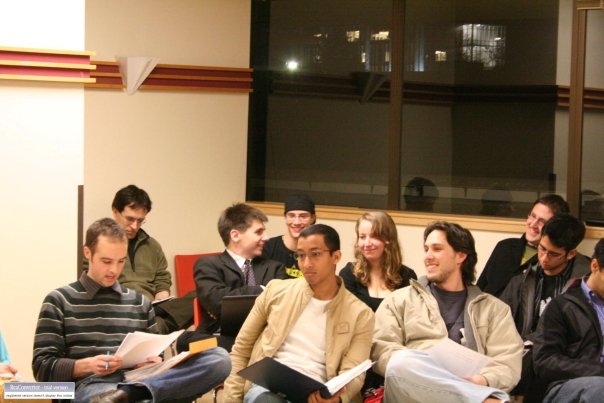
Yesterday at 5:00, fifty or so people gathered for the Elections All-Candidates’ Meeting to find out just who they were running against in this year’s AMS elections race. They were almost disappointed. Contested in this elections race are all five AMS executive positions, two positions on the Board of Governors, and five positions on the UBC Senate.

Elections Administrator Brendan Piovesan presided shakily over the meeting (if it could really be called that). While a typical meeting of this sort marks the firm end of nominations, and consists of a formal introduction of the candidates to each other, followed by a thorough brief on elections rules and procedures, such formalities are evidently not Piovesan’s way. He essentially collected some candidates’ nomination forms, then opened the floor up to questions, then called the meeting to a close. Restlessness and confusion in the room visibly increased until a few people voiced their concern that the candidate lists had not been read out, and declared their willingness to wait until they were announced. The miffed elections administrator seemed surprised at these declarations, but obligingly went on to list the candidates off very quickly, (and with notably careless pronunciation).

People to note in (or not in) the list:

  • Colin Simkus, who withdrew his nomination from the VP finance race at the meeting, noting that commerce students had been concerned about a lack of selection for the finance position and asked him to run, but since “there was more selection than anticipated,” he no longer felt the necessity to do so. He remains in the race for Senate.
  • Sarah Naiman, the incumbant VP Admin, is also absent due to apparent technicalities, but likely to re-appear in the VP Admin race.
  • Fire Hydrant Peets, making a triumphant return
  • The five solitary women in this elections campaign, three of which fall into the “joke candidate” category.

Unlike last year, when inebriated CiTR DJ Maxwell Maxwell staggered into the room dressed as a pirate and decided to contest the presidential race on the spot, this year’s meeting was less exciting, though considerably more irate. Everyone seemed to be dressed normally, though certain candidates, like “Che” Allison (who wants his fist platform point to be noted as “fuck democracy”), Genevieve “Malt Likkah” Sweigard, and Stash “Irish Courage” Bylicki may be a note or two removed from utter seriousness.

Despite the slightly weird start to the elections campaign, it looks like several races will be interesting. I’m very happy to note the presence of numerous new and unfamiliar names. As students get to know the candidates, and they get to know the AMS, I hope what they find will be mutually worthy. Good luck to all the candidates, and campaign hard!

(photos courtesy of Peter Rizov)

Categories
AMS Student Politics

AMS elections buzz

As a disclaimer: this is a list of mere speculations, which is by no means complete, accurate, or in any way official. Some of the people on it are still undecided. If only more people would dish gossip *on* the record.

It’s that time of year again!! Midterms are here and the rumors are flying.

Here’s the speculation on the grapevine, (only as far as I know, I’m sure there’s plenty more):

President: Matthew Naylor (current VP External), Michael Duncan (current SUS president). Also, joke candidates from some Arts undergrad clubs. Woo!
VP Academic: Possibly (undecided) Blake Frederick (current AVP academic)
VP Admin: re-run Sarah Naiman (current VP admin)
VP Finance: Chris Tarantino (SUS dude), Omid Javadi (current EUS VP and and engineering councilor)
VP External: no word yet!
BoG Reps: Conor Topely (current CUS president and CUS councilor), Tahara Bhate (current Science Councilor)

Alex Lougheed (current SUS secretary and science councilor) will almost certainly be running for something, not sure what. I’ve heard some talk of several people from the Resource Groups side running, but I’ll update on that when I get more sources. An arts club is purportedly putting together a joke slate of epic proportions. Costume speculation anyone?

I’m sorry to report that Stephanie Ryan and Sam Heppell of Arts are both apparently graduating. I was hoping they would run. They’re the type of councilors that bring good critical analysis to the council table, and I know they’d do the same in a campaign. Perhaps they will still reconsider?

Categories
Student Politics

UBC (AMS) Social Justice Centre executive jailed

Alison Bodine, the Financial Co-ordinator of the riven AMS resource group, the Social Justice Centre, landed in jail this week after trying to caim belongings that had been confiscated from her on re-entering Canada from her native U.S. No charges have been laid, and a hearing that was sceduled for today was cancelled. RCMP has declined comment.

http://www.cbc.ca/canada/british-columbia/story/2007/09/16/bc-arrest.html

Bodine is a well-recognized figure in certain ‘activist’ circles, being a leader in a bewildering assortment of badly named radical/lunatic groups, namely MAWO, CAWOPI and more! In a dramatic coup d’etat last spring, Bodine and some others from her group managed to grab a majority of the executive positions in the embattled AMS-funded resource group. Nobody should be jailed for trying to cross the border with pamphlets (no matter how stupid) though.

To free Alison, check out the Committee To Free Alison Bodine (no joke).

Categories
AMS Student Politics

Executive interview series, part V: Brittany Tyson, VP finance

Last, but certainly not least in our riveting executive interview series is Brittany Tyson. We sat down to chat about a month and a half ago, so don’t be surprised if that we’re talking about the PiR^2 rennovations “right now”!. I must say that Brittany is one of the most frighteningly competent people I’ve ever met. She had prepared written notes and some specific number crunching before our interview, and talked about everything in meticulous detail.

Anyway, have a listen, and learn about how budgeting works, what the various AMS budgeting categories and departments are, how to revive sprouts, Club administration, and the prospects for a unified meal card for AMS food services.

click HERE to listen!

If you missed the other executives’ luminous insights, why not catch up?
President: Jeff
VP Academic: Brendon
AP Admin: Sarah
VP External: Matthew

Categories
Student Politics

I quite enjoy "Inside Higher Ed"

First, read this article. Short version: How University administrators co-opt their student representatives. An interesting reflection on a position into which almost all student “representatives” are placed.

Then, read its follow-up: It’s about the importance of Presidential leadership when it comes to the student experience at a University.

Then go back to enjoying the long weekend.

Categories
Student Politics

Financial bullying in Commerce Faculty, or, what becomes of a bad precedent.

Dan Muzyka, Dean of the faculty of Commerce, is in the market for a sugar momma. The only reason he hasn’t posted on Craigslist yet is because he thinks he’s got a lead. Except this time she’s younger than he is, and considerably poorer – the Commerce Undergraduate Society. The affectionately self-dubbed “Dean Dan” has approached the CUS to contribute $150 000 to next years’ faculty budget. It all started last year, when UBC had the nasty surprise of finding out it was running a 36 million dollar deficit.

The UBC board of governors has begun a long process to cut its budgets through the SCAPP committee (which just completed their first report, found HERE). Sullen deans and department heads everywhere are being asked to prioritize, efficiency-ify, and strip down their program offerings to their most Trek 2010-friendly activities. The government is stingy, and tuition can only be increased by a measly 2% a year. GPOF funding is no bottomless pit. “Hard decisions” are about to be made. But Commerce? Well, why would commerce tighten its belt when there’s the untapped cash cow of student money to be had?

Dean Dan, apparently based on his close relationship with former CUS president Mike Woodward, broached the topic of increased CUS contributions last year. The $150 000 he asked for then is ostensibly to support the operations of the faculty’s Business Career Centre (BCC) – one of those “prestige and profile” building programs that the Suader school takes pride in. The CUS already funds the BCC to the tune of $150 000 per year – about 15% of the $1.1 million annual CUS budget, and likewise 15% of the approximately $1 million BCC operating budget. The additional contribution would bring CUS support up to 30% for this academic service. maybe that’s fair. Maybe students are willing to do that.

However, problems arise as soon and you get your number cruncher out. The BCC itself, according to its projected budget, is only asking for $60 000; the dean has now backtracked and asked for $100 000. This discrepancy is due to an alleged miscommunication between the two. Moreover, while the dean plans to pay $9000 less for the BCC next year, he has aked the CUS for far more than the balance ($91 000 more), giving the BCC a larger budget by far than previous years. This is in part accounted for because the BCC (bizarrely) budgeted for a 15-month period instead of the normal 12. But, even if you remove the three extra months’ worth of costs, the BCC is still being allocated more than ever before as a result of the projected CUS contribution. To be exact, if the CUS contributes $60 000, or $100 000, the inflated amount (above last years’ BCC budget) is $22 500, or $53 500, respectively. For all the details, please refer to the report prepared by CUS executives Jia Lei and Conor Topley on the topic HERE

The BCC has been unable to produce any plans for increased programming in the upcoming year. Since the student money now supporting the CUS goes throught the faculty, one might ponder about all the other faculty areas that, faced with the doleful prospect of GPOF cuts to their units (unless they become Goerge Mackie-accredited sustainable global citizens on the double), are parched for accountability-free student subsidization. On might reflect how well-pleased Dean Dan would be to benevolently water them. The truth is, we might well wonder where the extra money will end up: the dean, where approached with bald numbers, did not feel inclined to make his intentions public. More information may be provided at tomorrow’s CUS council meeting, where the dean is going to present, but he has alluded to the fact that he doesn’t want other faculties getting wind of the whole arrangement.

It may be far to late for that, however. The word on the street is that Dean of Arts Nancy Gallini has already approached the Arts Undergraduate society for some sort of bale-out. I’m not really supposed to know this, you see, so hush. Heaven forbid that we should have transparency at a public institution when there’s 36 million dollars to come up with!

Anyway, Dean Dan has communicated to CUS president Conor Topley that if the CUS does not comply with his request (or shall we call it a demand?) two options are open:

a. Reduced services from the BCC.
b. A reduction in the number of undergraduate classes offered.

Considering that “hard decisions” are being made all over the university due to the current budget climate, these two options must and should be on the table anyway. The CUS and BCC in truth, have not a thing to do with it. The dean’s request basically amounts to opportunism – the CUS has money, he needs it. There has been no honesty about the actual needs of the BCC’s operations. There has been no honesty about where the excess in that budget would go. Increasing the BCC budget on students’ dime at a time like this is preposterous. Using the excess in that budget at the dean’s discretion, with no accountability, is insanity. While some block-headed CUS councilors have amiably suggested an increase in their tuition and student fees to cover the dean’s whims, the rest of us would do well to recall that Sauder students already pay the highest student fees at the university at $266 (this was originally implemented during the 90’s tuition freeze to do things like purchase computers and get the BCC started to begin with – check out a Ubyssey article (pg 4) on the topic). They also just approved an additional $500 per year building levy on their future students to finance the mortgage on a shiny new Angus building. Should they also be saddling a greater and greater portion of institutional spending?

This business – both the process and the intent – create an absurd precedent for the rest of the university. How ironic that the commerce faculty can’t balance it’s books without extorting students.

Categories
AMS Elections 2007 Campus Life Student Politics

Chitchat with Mark Latham – he's going to take over the world!

Last year, the ex-wall street strategist, UBC alum, and ex-professor Mark Latham walked into an AMS council meeting waving around 8 thousand dollars. He wanted to use the AMS as the first testing ground for his media revolution. The result was Voter Funded Media, the contest that this blog was created for.

For those of you that have been under a rock this year, Voter Funded Media was the contest that accompanied the February AMS elections here at UBC. It was a pilot project meant to increase the information available to students about the elections, leading to more informed voting. The basic idea is that voters reward the media sources that are best for them through a public financial incentive which they award by voting. When students cast their ballots for their favorite candidate, they also voted for their favorite elections-coverage media sources. So media groups (either established, or new) were vying for eight prizes collectively worth 8 thousand dollars (amiably proffered by Mark himself).

I was surprised, but happy to be summoned by Mark for a chat last Wednesday. “I’m bored,” quoth he. “I’m waiting for the contest to start again. You’re the only one that’s still active and we hadn’t met yet.” In fact, boredom figured prominently in the short meeting’s thematic material. All the major professional milestones he cited were the results of boredom. This, combined with Mark’s idealism about his big idea resulted in a decidedly adolescent vibe. Not that that’s a bad thing at all. Mark preemptively refused to delight in the AMS meeting’s (which we were both planning to attend that evening) delicious and nutritious free food. Instead, he tucked into a substantial sandwich, courtesy of the Delly, as we talked. We chatted about some of the successes and challenges of the first year’s VFM contest. He seemed interested in whether the results of last years’ contest (whereby, the familiar campus publications did better than newer, more interesting ones) would be a deterrent to this corner participating again. I assured him that as far as I was concerned it wouldn’t.

The theoretical rational behind the project has been Mark’s work of over the last 15 years or so – basically since he quit his overpaid Wall-street job with a handsome nest egg. I got to find out a bit about the genesis of Voter Funded Media: because of his business and financial background, Mark originally conceived the idea in the context of shareholders making decisions about company executives. He recounted that during his years on Wall street he had seen a lot of waste and mismanagement in companies because of bad executives. The idea was, that if shareholders themselves decided to pay outside consultants (call them ‘media’) to advise them on who to vote into the company’s executive, better people would be chosen and improved management practices would result. Over some years, between waking up late and writing the occasional article, Mark purchased shares in companies for the express purpose of trying the idea out. He wrote up and proposed this plan to his fellow shareholders at their annual meetings. Interestingly, these proposals never got more than 20% in favour. That’s when he started thinking about the parallel opportunities in politics and public life: essentially, the premise of VFM is that as information about civics and government can be thought of as a “public good” with a collective dimension, that it should have a dedicated public reward system. This public reward system will encourage “good” reporting in civics and government, leading to better election choices and improved policy.

I’m not entirely sold on this line of reasoning. First, it’s not clear that the definition of a “public good” – that is, something that either applies to nobody or everybody, like the environment or national security – applies to information. Most people seek out the information they care about individually, and share it with a select number of people that are also interested. Mass entertainment maybe reaches a certain degree of “universality,” but the type of in depth investigative reporting Mark wants to encourage never has – only a subset of people are interested in that. Moreover, while we are forced to contribute to public goods through taxes, VFM only asks us to add another way to reward media – through voting on a public purse. It is unclear whether people would vote for media choices differently than the way they already support media – through their viewership. If everyone voted in VFM for the same networks they watch all the time, no change would take place. It is possible that the very act of conscious voting for media sources on the basis of their elections coverage would create a consciousness different from the one that informs our natural preference for entertainment – but that’s speculation.

The other interesting aspect of VFM is the creation of new media groups – ones that in theory, would slowly gain reputations and be able to compete with existing sources. Here at UBC, where there’s limited existing media in the first place, and they contain almost no political coverage on a regular basis, that seems reasonable. With time, blogs like this one or future VFM outlets could become players in the UBC information market. I’m skeptical that the same thing could be said for the real world though: large and small media organizations saturate the market already, and it would be tough to break through if all you’re doing is in depth politics.

In my view the biggest success of VFM is in its capacity to excite, reach out, and re-engage sullen or cynical voters. It’s a neat idea that people like to talk about. It makes people want to jump in. At least here at UBC, it created the most interesting campaign is years. Mark is planning to start VFM with some more student unions in BC this year, and then take it to municipalities. From there, his idea will take over the world, or that’s the plan.

Spam prevention powered by Akismet