Categories
Uncategorized

Reading Break 2010

On May 16, the Senate approved to extend the 2010 reading break from 5 days to 10 days, adding another week of jolly freedom to the schedule of an otherwise overworked undergraduate student. This, as you rightly predict, is a response to the VanOC which approached Academic Policy chair Paul Harrison with this proposal quite some time ago, and consultation to the student senate caucus was conducted during the turnover meeting (end of April) in an informal setting. To which extent the student senators consulted the rest of the student body thereafter is unbeknownst to me, due to a self-imposed temporary post-retirement retreat from anything and everything to do with this illustrious institution. Call it a refractory period.

In any case, the registrar’s office came up with a schedule of least inconvencience to students, and it’s linked here (link):

– total teaching days for term 2 will be reduced from 63 days to 62 days
– reading break will be held from February 15-26 instead of 15-19
– consequently, classes will end on April 15, instead of April 9
– exams will be held during the period of April 19-May 1, instead of April 14-28
– graduation dates will not be changed

At the caucus meeting, the following points were raised to Paul Harrison:
– there is a significant number of students living off-campus but not at home who will be affected by exams ending on May 1. Housing arrangements extend in most cases to the end of the month and there will be contractual implications for those individuals who wish to move, sublet, and otherwise make arrangements while they are still writing exam(s).
– there are several private on-campus residences (Fraser Hall, and the many more that are budding at the speed of light) which do not have to abide to the administrative orders like any residences under UBC Housing and Conferences do. We asked that the VP Students office and the UNA be approached by the Senate in order to communicate this concern.
– Transit services need to be increased on Saturday, May 1 in order to accommodate for the increased number of students who are commuting into campus

To give you some frame of reference, this is not the first time the exam period has extended into May. However, since my little project of looking into the exam schedule in 2003, it was informally agreed that spilling over into May should be avoided for reasons mentioned above. We saw the Olympics as extenuating circumstances.

This, of course, beckons considerations beyond these logistical matters, on whether or not we should accommodate to, and thereby support the principles of the Olympics, of the Olympics in this city, and of the Olympics in this city in the way it has unfolded thus far. It is well known that despite of the grand principles which infused the realization of the Olympics at the cusp of the twentieth century (the celebration of human performance, sportsmanship, friendship, “global citizenship” etc), processes leading up to the events may not necessarily have lived up to these ideals in several cities.

A prime example is VanOC’s pledge to social sustainability, in particular housing. It has been reported that already hundreds of evictions have taken place in low rent housing in the inner city, despite of a promise that this would not happen. Given this neglect, it is doubtful on whether 30% of housing built for the Olympics will be converted to social housing after (another key promise).

I have been in contact with the founder (Rob Van Wynsberghe) of the IOCC (link) (an independent community coalition which has been tracking the development of the 2010 Van Olympics from the social perspective of housing, transit, environment, social accountability, safety and civil liberty (I may have missed some). In any case, the IOCC has been giving the VanOc committee some pretty grave grades (D- in a recent 24 Hrs article) so far.

He and I both agreed that there is a certain duty of citizenship on our part to respect and foster the City’s wish to host the Olympics. While a refusal to accomodate to the Olympics through congesting traffic during those five days in February would stiffle the experience of both student and winter sport enthusiast, the degree of inconvenience may or may not have been a constructive or effective way to show concern around the development of the Olympics in this city.

Nor am I certain whether it is in the best interest of the University’s already esoteric reputation to out-right refuse to collaborate and make concessions for the community at large that it finds itself embedded in.

However, if citizenship were a virtue, I would challenge this position further. It would be complacent of us to dwell simply on cooperation – cooperation for the blind leading the blind towards detriment to already marginalized parts of the City. We have a responsibility to use our cooperation with VanOC as a leverage to raise concerns about the way in which social issues such as housing in the DTES have been utterly neglected. This is a bargaining chip with great stakes. Members of the senate and individuals on AMS council should take this to heart and act, and they need to do it now.

http://www.students.ubc.ca/senate/

Categories
Uncategorized

Stephen Owen appointed VP External and Community Relations of UBC

So, I’m still in a little bit of an awe at this, hopefully some of you sages can provide insight and calm my nerves. Stephen Owen’s website confirms that “Stephen Owen, Member of Parliament for Vancouver Quadra, announced today that he will be resigning his seat effective July 27, 2007 to join the University of British Columbia as Vice President, External and Community Relations.” (link)

While I would like to think that propriety calls for our university administrators to remain at arms’ length with federal/provincial political parties, this recent development compounds to paint the following picture:
– Stephen Toope is a founder and former chair of the Pierre Trudeau Foundation. While “non-partisan”, it’s Pierre Trudeau, Mr. Liberal posterchild from the glory days and perhaps a major reason why some individuals still support the party.
– Stephen Owen quits his Liberal MP post to join the UBC administration.

Is it just me, or is our University too close for comfort in arms with the Liberals? We have a conservative federal government, making my point that perhaps we, as a public autonomous institution, should remain appropriately outside of the realm of blatant partylines. I expect Matthew Naylor to post with vigorous defense.

Full media release from the UBC Website behind the jump:

Media Release | Jul. 5, 2007

Stephen Owen Appointed Vice President, External and Community Relations

The University of British Columbia Board of Governors today approved the appointment of Stephen Owen as Vice President, External and Community Relations.

Owen, a UBC alumnus who is the Member of Parliament for Vancouver Quadra, the Vancouver constituency that includes UBC, will resign his seat July 27 before assuming his new UBC position August 15.

“Stephen Owen brings to UBC uniquely broad insight and experience developed through a distinguished career of public service that has been a hallmark of integrity,” said UBC President Stephen Toope. “His decision to join our university underscores the paramount importance we place on effective relations with our communities as UBC, already one of the world’s 40 best universities, prepares to enter its second century of service to British Columbia, Canada and beyond.”

The position description for Owen’s responsibilities states: “The External and Community Relations Portfolio is responsible for guiding and enhancing engagement with government at all levels — municipal, provincial, national and international. It develops community relationships with civil society, neighbourhood associations and social movements; enhances cultural aspects of university life related to staff, faculty and students studying, living and working together; and builds a sense of belonging to form a vibrant and cohesive community.”

“I am thrilled to return to my alma mater as a member of Prof. Toope’s executive team,” Owen said. “UBC’s strategic plan, Trek 2010, lays out an ambitious plan for the university to become one of the world’s very best. I am thankful for the opportunity to lead the communication effort around the truly compelling story of teaching and research excellence that UBC has created in the last 100 years.”

UBC units Owen will oversee include: Ceremonies and Events, Community Affairs, Government Relations, the Learning Exchange, Public Affairs, University Counsel (legal office), and university operations at UBC Robson Square.

Owen, 58, was born in Vancouver. He and his wife, Diane, a UBC alumna and a UBC online instructor in intercultural communication, have two sons. Owen received his Law degree from UBC in 1972, his Master of Law from the University of London and his MBA from the University of Geneva.

Owen’s career has taken him from legal advocacy work in Vancouver’s Downtown Eastside, through a variety of high-profile senior provincial positions such as Ombudsman and Deputy Attorney General, and forward to the national and international stages.

Following election as MP for Quadra in 2000, he served as Secretary of State for Indian Affairs and Northern Development, Minister of Public Works and Government Services, and Minister of Western Economic Development. From 1997-2000, he was David Lam Professor of Law at the University of Victoria, and he has consulted internationally on a variety of human rights issues.

A complete CV is available at:
www.stephenowen.ca/Content/Default.aspx?pg=1004.

Owen succeeds Dennis Pavlich, who resigned in June to take on the presidency of the Great Northern Way Campus, a consortium of BCIT, Simon Fraser University, the Emily Carr Institute of Art + Design and UBC. The new institution has a focus on arts and culture, urban sustainability and digital media.

Categories
Uncategorized

Public Consultation

Most research-intensive universities have a technology transfer office which handles licensing agreements between a university’s research product and the private sector. This includes small biomolecules with therapeutic promise, and encompasses many more technologies with potential for health improvement or disease treatment.

The University Industry Liaison Office at UBC has been meeting with a group of students who are part of an international network – called Universities Allied for Essential Medicines. This past year, we met with Stephen Toope, VP Research John Hepburn, UILO Director Angus Livingstone, Hubert Lai (former University Counsel) to present the two goals of UAEM which are very much in line with Trek2010:
1. To ensure that health technology end products coming out of university research benefits regions outside of the realm of a “profitable market” – ie low and middle income countries
2. To promote neglected disease research such as leishmaniasis

Several successes have ensued so far from our (ongoing) meetings:
1. The Trek2010 annual framework to measure success now includes a clause which looks at how UBC technologies have been accessible by third world countries
2. A draft policy proposal is now posted on the UILO website for public consultation.

I ask all of you to please take a look at it. In short, it is a policy which pushes towards measure of “success” of UBC’s research not in terms of monetary profit alone, but in terms of benefit to human wellfare. The policy can be found here (link). Please leave your comments on the website up there after reading through it.

Roughly 2/3 of UBC’s research activities are health related at the moment, ranging from health care ethics to water sanitation techniques. Therefore, an equitable access clause in relevant licensing agreements has large potential to benefit low to middle income countries.

To give an example: stravudine (d4t) is an anti-HIV drug which came out of a lab in Yale, and has licensed with BMS (Bristol Myers Squibbs). After much lobbying by Doctors without Borders, BMS and Yale agreed to allow for the patent to be lifted in South Africa, resulting in the cost of treatment to drop from 1500$US/year/treatment down to 30$US/year/treatment. Generic competition dropped the cost by an additional 2/3. No black market backflow to other countries has been observed.

We are currently starting to meet with federal politicians, and have made presentations to CASA in order to lobby for more CIHR/CIDA funding in order to allow for more research activities to occur in this neglected field of science. There are several researchers (faculty members, students, staff) who express keen interest in neglected disease research, but simply do not find the funding.

If you wish to learn more, visit our local and international website.

Categories
Uncategorized

Context – The University Golf Course

Noticed UBC in the national news lately? It’s probably because of the University Golf Course. So what exactly is happening? How about an explanation – in timeline form.

1990: Developer David Ho leases the University Golf Course, on University Boulevard, from the provincial government. The land has what’s called a “restrictive covenant” attached to it, which means that it must stay as a golf course until the government says otherwise.

2003: The government decides to sell the course to UBC for $11 million. As part of the deal, UBC agrees to keep operating it as a golf course.

2004: The Musqueam First Nation sues the University as well as the provincial government. The claim the land and that the government was getting rid of it to frustrate their claim. (Note: First Nations can only claim land that’s still property of the Crown. Had the government sold the land, the Musqueam would have lost any claim they otherwise would have had.)

2005: The BC Supreme Court, applying Haida/Taku, finds that the government had a duty to consult with the Musqueam before selling the land. (However, they find no legal duty on UBC’s part to consult.) The Court puts the sale on hold for two years, while the government consults.

2007: The Globe and Mail reports that the government is planning to transfer the golf course land to the Musqueam.

As you may have noticed, it’s kind of a big deal. First Nations across Canada have been increasingly asserting their rights, and deliberately ramping up the public affairs rhetoric. Tomorrow had been claimed as a “Day of Action;” the scope of the protests will be significant. On the other hand, a variety of locals are, well, restless. Some UBC old-timers (Bob Hindmarch, Marty Zlotnik) are up in arms, and there’s threats that this could cost Gordon Campbell his Point Grey seat. There’s a self-appointed “town hall” this evening.

There are some significant long-term issues here:

  • Will the restrictive covenant bind the Musqueam? Can the Crown restrict the land once it’s been handed in a land claim settlement?
  • Will the Musqueam pull a UBC and develop the hectares of prime real estate and become a UBC-style land developer?
  • What’s UBC’s position? Do they still want the golf course?
  • How does having Musqueam land inside Endowment Lands impact UBC’s governance?

It’s a fascinating time to be watching this one.

Categories
Uncategorized

A note on how student elites keep power.

A polemic by Arts councilor Nathan Crompton

It must be considered that there is nothing more difficult to carry out, nor more doubtful of success, nor more dangerous to handle, than to initiate a new order of things. For the reformer has an enemy in all those who profit by the old order, and only lukewarm defenders in all those who would profit from the new order, this lukewarmness arising partly from fear of their adversaries, who have the laws in their favour; and partly from the incredulity of mankind, who do not believe in anything new until they have had actual experience of it.
-Machiavelli


At today’s AMS Council meeting there was a motion to create a committee that would “consider the feasibility” of a Citizen’s Assembly at UBC. A Citizen’s Assembly would be a diverse group of students funded and by the AMS to share with the student body its informed and researched positions on student elections issues and candidates. The Assembly would be made up of UBC students selected on the basis of what is called a “stratified random sample”, which is a sample drawn on the basis of various categories (i.e, gender, faculty, students with loans/students without, etc.) in order to create a “micro group” roughly reflective of the entire student body.

Even though the motion was only to create a committee – not to approve the Assembly – council reacted defensively against any proposal that would “take power away from the single voice of the AMS”, to quote one councilor. Another councilor complained against “giving power to the masses[…]especially if they are not asking for an Assembly”. One journalist was capable of noting the defensive nature of council’s reaction, which led others to reassure councilors that a “committee would not take power away from the AMS.” An executive spoke of the “dangers” of the proposal, which to many seemed real: one councilor saw the Citizen’s Assembly as a “parallel state”.

As debate drew on, councilors became impatient with the motion. The hired speaker for the AMS informed us that he wanted to go drinking and that the meeting should be expedited! The debate was becoming fragmented, like in a “chaosmos”, though in a good way, (which is why I use Deleuze’s term), since nobody had yet explored the new proposal nearly enough to take a position. If a position could have been taken at all, it would have been to vote in favor, and not because the Citizen’s Assembly is ideal, or even good, (a Citizen’s Assembly will not solve the “root problems” of democracy, as was claimed by the presenter). The motion should have been approved because it was for the creation of a committee. And it should have been approved out of a creative inspiration, as an experiment regardless of its apparent merits. We should of course recall that that in the present moment democracy is not functioning.

Things in the meeting were becoming more “out of order”, as one councilor complained. It was in this environment that the firm position of an authority – council President – was welcomed by most councilors. The president proposed an amendment to undermine the possibility for a committee that would be oriented towards an Assembly. Councilors began knocking the table in support when people spoke in favor of changing the motion wording from “a committee to explore the Citizen’s Assembly” to, “a committee to find ways to involve non-involved students”.

The rewording was of course condescending to the author of the motion, but also to the student body in general – the AMS community’s attitude toward “apathy” is incredibly facile. Councilors have a sense that, “we are involved, other people aren’t because they are not us”. Or worse: “why don’t more students pay attention to what I do that is so important?” But in fact, student non-involvement is very complicated. 6/10ths of students take a full course load while working part-time and full-time, (while collecting massive debts of course). Most of the students involved in the AMS community are from the 4/10ths of students who don’t work and who are from bourgeois and professional family backgrounds. Not only are they confident (many of them are trained to be future leaders of Canada, etc.), they emerge from a system that works well for them – this is what I mean to introduce this polemic with the quote of Machiavelli. It is fitting that the “democratic” position of many councilors is the one: “don’t bite the hand that feeds you”.

Read more behind the jump

What do they mean when they say, “don’t burn bridges with the university” and “be professional”? They mean that we must cross those bridges and settle down in that seat of power, because we deserve it – don’t ruin your chances. It is in this context that many marginal members of the community are not confident or, on principle, not interested to become involved in the AMS, or any power system. And it should be recognized – the university and student governments keep much of the institutional racism they were founded on. There are brothers and sisters in the community who do not feel like participating alongside mostly white men who mostly plan beer gardens.

These are political questions but there is a way to make an “apolitical” argument in this instance, in the way that “nonpartisanship” is so fashionable today. Simply, there was nothing in the original Assembly motion that prevented the creation of other committees. If people had other ideas in mind about how to involve the student community in the AMS, they could have made a proposal. But those alternative ideas would not have been threatened by the existence of an Assembly committee, and hopefully their ideas would add to it.

We could theorize on the fact that the motion was gutted even though its was only a motion to strike a committee to explore the possibility for an Assembly, not for an Assembly as such. History tells us that elites have not been reactive, only reactionary. In his unpublished notebooks, Marx reflected on the prospect that European ruling classes might gain class consciousness before the workers themselves. Marx’s speculation was made true, of course. Not soon after he wrote, the repressive police-state of Bismark effaced the possibility for socialism in Germany by establishing of one of the first welfare states. Bismark anticipated democracy – he was ahead of democracy qua democracy. It is a maxim: an elite’s ability to anticipate unwanted democracy is essential to liberal democracy in the first instance, that is its primary characteristic: to allow a level of formal democracy necessary for the prevention of actual democracy. Democracy is sanctioned, or “repressively desublimated” (to slightly alter a notion from Herbert Marcuse.) Democracy here is allowed only to the extent that class structures are properly preserved.

But unlike in Marx’s time, elite rule is not coordinated today, or, it is not only coordinated. It is spontaneous, since the conspiracies are not in back rooms, or, not only in back rooms – if they can even be called a conspiracies. Certainly no conspiracy even exists at the level of the AMS! But it is precisely its non-conspiratorial nature that makes liberal democracy so pernicious. For example, the mood in council today was neither sinister nor heavy. It was anticipatory like Bismark and like Marx predicted, but not coordinated in the way of Bismark. People spoke on intuition, not out of some presupposition, and not even from a conscious set of ideological commitments. Elite ideology is so well entrenched that no coercion is necessary, and neither is debate. This is liberal consensus, where ideology operates at the pure level of the political unconscious. Dissenting in t
his totalizing environment is barely optional at times. But there are many people who don’t dig the consensus, if at least because its totally boring.

Categories
Uncategorized

Intellectual boycotting – can we boycott stupid people too?

http://www.haaretz.com/hasen/pages/ShArtVty.jhtml?sw=britain+boycott&itemNo=865220

http://www.jpost.com/servlet/Satellite?cid=1180450954999&pagename=JPost%2FJPArticle%2FShowFull

Well, Britain’s academic community has once again embarrassed itself. Britain’s lecturers’ union, UCU, (numbering 120 000 members) voted Wednesday in favor of encouraging and discussing an academic boycott on Israeli universities and research institutes. The motion doesn’t impose the boycott on union members yet but rather brings the question of boycotting Israel’s academia to discussion with all the members, urging the membership to “consider the moral implications of conducting ties with Israeli academic institutions.” It calls on the EU to freeze funding of Israeli research. The UCU’s president herself is opposed to this development, and government and many British universities themselves have also reacted negatively. It will be interesting to see if this particular effort will go through after discussion with the union membership. This is approximately the third effort of this kind in the past five years in Britain’s academic community. The previous two attempts ended up failing or being revoked.

While some, (including Britain’s ambassador to Israel) say that this motion is unlikely to affect academic bilateral relations much, it is still disturbing that 158 out of 257 delegates at the UCU convention supported such a motion. The principle of academic freedom is essentially about dissociating collective administrative bodies from politics such that individual academics are uninhibited in their political and research choices. Beyond that, the concept of discouraging or restricting productive collaborative research because of unconnected political issues is incoherent to the extreme. Even forgetting the fact that the academic community is one of the most progressive and ‘peacenik’ sectors in Israeli society, what in tarnation do two cancer researchers (one at Hebrew U, and one at Cambridge) who want to collaborate, have to do with occupation and activism? Maybe what they want is merely to provide a new therapy, publish their papers, and enrich humanity’s store of knowledge. What could possibly be accomplished by stigmatizing such a working relationship?

Clearly, academics are not individuals that are miraculously free of politics, nor are academic organizations like UCU. They also have the inviolable freedom to say what they wish and carry what motions they will. But when an academic community sees fit to restrict its own intellectual opportunities, priorities have gone out of whack. Israeli research has been rich and innovative over the last 60 years – and brought into being ideas and objects of great interest and benefit, from technology for desert agriculture, to ubiquitous computer programs. Why punish one of the most interesting, international, productive, and beneficial sectors of Israeli society for an occupation that is in no way in their mandate to address? Attempting to scare British academics from collaborations, and bully Israel’s powerful intellectuals into political acquiescence is a strategy likely to alienate and anger, not build consensus or communication. It certainly won’t forward research or knowledge-making. A poisonous culture has already emerged in some British institutions whereby anything associated with the Jewish state is stigmatized, villainized, and rejected. As someone who has spent considerable time taking in both the good and the bad in Israeli society (including academics), I find myself wondering what the motivation behind this harsh profiling is – because it certainly is not warranted by reality.

So that’s where I stand, I suppose. Are collective intellectual boycotts effective, warranted, and moral in this, or other situations? I want some arguments.

Categories
Uncategorized

Labrat missives – how to find a summer job you hate

It’s seven pm and here I am at the lab, with no prospects of leaving for at least 2 hours. The summer job is no longer just an institution, it’s a necessity.
With debt burden higher than ever, and professional competition ingrained in our young but pragmatic psyches, not only do students need to make ends meet, they also feel like they need relevant, interesting, smart jobs replete with networking opportunities, prestige, and resume cred. Maybe this is a good thing. But I tell you, I’d rather be gardening or cutting someone’s lawn right now. In fact, I’d rather summarily shoot myself in the face than have another negative pcr, or one more failed extraction – and it’s only week 2. Yeah so it’s been a frustrating week of wrathful science-gods, and maybe I don’t entirely dislike biology. gah.

But basically, bring back menial labour.

and no, I have nothing more meaningful to add.

Categories
Uncategorized

AMS meeting May 2, or, concerning U Blvd.

We’ve been a little negligent of late, admittedly. Exams, Tim out of town, me just starting work, and other excuses abound. But don’t give up on us! There is some neat stuff coming up.

Yep, yesterday was summer’s first AMS council meeting. The free food was scarce, and the atmosphere tense. The order of business was mostly to do with U-boulevard, and developments thereof. As most of you probably know, the area of University Boulevard, the square between the SUB and east Mall, and the grassy knoll are to be developed into a transportation hub and “centre” for the campus. The plan has been partially approved by the BoG, meaning that construction on the “infrastructure” (transit tunnel and wiring) of the project will start this summer, while the underground bus loop and “university square” that will be built on top of it themselves will await subsequent approval at the BoG. Some students have begun a petition against the current plan, which is basically a commercial centre with a large square, an alumni centre and some green space. The long and convoluted history of the project can be reviewed on the petition’s website, which is linked on the sidebar.

Yesterday, the engine behind the petition (which has collected over 2500 signatures), Margaret Orlowski presented to council and brought forward a motion encapsulating the main points of the petition. Norman Sippert, from the campus community and planning office also presented about the most recent U-Boulevard plan. This presentation, which has been solicited by the AMS since November, though late, was quite interesting.

Unsurprisingly, Norman had a bit of a tough audience, which he handled with grace and patience. Respect for that. Some of the council’s main concerns were as follows:

  • the fundamental assumption that having a retail-based campus centre may be undesirable
  • the lack of student social space/ study space in the plan. Have to buy coffee for seating in the square
  • Main entrance to the SUB is butting right up against the end of the west building – the design does not synergize with the existing campus centre, SUB
  • removal of the popular and beautiful grassy knoll
  • market priced “university housing” – not run by housing and conferences
  • businesses not necessarily ethical or local – may not fit with university’s vision
  • no commitment to sustainable (LEED certified) construction; no green roofs
  • “meaningful consultation” has not occurred – the process has been flawed.

The basic thrust of all these concerns is essentially that the design does not seem to put what students most want for a campus centre as a priority. Instead, it is an embattled and slimmed-down ‘least worst’ option that has emerged, or pehaps merely survived, as reaction to a long series of failures. Consultation failures, budget failures, relationships failures (note: the original architects have quit, as has the VP external that spearheaded the project). The plan seems to have both changed, and lost sight of, its main goal. As a ‘neighborhood plan’ of the OCP governed University Town, its first goal was to contribute to the endowment. Now the university is desperate not to lose money off the endeavor. It was also supposed to be a centre for the new non-university affiliated residents of University town. The south campus neighborhood is now to have its own commercial centre, rendering that goal redundant. Then, it was supposed to be a campus centre for the university’s academic core and students. It seems to fail at that, according to 2500 signatures.

If it is indeed for the academic community, and largely students, the plan’s main thrust aught to be re-evaluated. What students have consistently said is that they want green space, and informal study/social space with ample seating. This plan fails in this respect. It prioritizes retail over the type of space students actually want for their hub. Particularly since two of the features that accord with these priorities, the rain-protected covering of the square, and the eco-stream, have been removed due to excessive cost, perhaps this plan no longer reflects the vision of the team that originally won the architectural competition.

Cost is another interesting point. The BoG has resolved that the project must fund itself. That is, none of the money must come out of the university’s General Purpose Operating Fund. This is the fund that runs all the university buildings, pays our professors and administrators, and so forth. Thus, over 25 years, revenue from the businesses and housing will pay for the above-ground portion of the project. The underground bus loop though, which is going to cost 40 million, will not pay for itself. The way to get around that is to take 31 million of the funding from a different bank account than the GPOF – a fund supplied by “Infrastructure Impact Charges”. These “charges” are sort of like taxes that each building, when it is built, pays to the university for purposes of maintaining and building infrastructure. The bus loop is considered infrastructure. So for example, donors or government grants that enable the university to build would have to contribute to the IIC fund, per square foot of building they are funding. The fact that there is enough money in that fund to dole out 31 million dollars, in addition to whatever infrastructure and maintenance it is normally meant for, seems to indicate that IICs are hugely inflated to fund these types of projects. Why does the university for some reason prefer the aesthetics of funding through this tax than from some other account? To elucidate this question, lets look at another spending need: the much touted childcare deficit. It is a matter of some debate whether other spending priorities, like childcare, can be funded out of this same IIC fund, or not. Some say yes, some say only the infrastructure (plumbing, wiring, etc) of such future daycare buildings would come out of that fund. Now the convenience of this scheme comes to light. By 1) funding development projects through IIC funds, and 2) selectively defining projects as “infrastructure” related, the univesity can squirm out of the situation of being in debt and neglecting essential services while investing in a costly and dubiously desireable underground loop. Moreover, they don’t have to take comparisons of large-scale spending priorites seriously, since technically, they wouldn’t be from the same funding source. Oh, and Translink is to fund 5 million of the bus loop. The remaining 4 million got lost in a mumble, when I asked Norman to give details.

In any event, this brings us to the next point: that of cost, and cost-recovery models. Some students have said that the campus centre should not be developed on a cost-recovery model at all, and should be regarded as an investment. Others have said that developing it by taking money out of the university’s budget would spell disaster (and a convenient excuse for administrators) by cutting into student services and academics. That is, taking money out of the GPOF for development instead of spending it on academics is not necessarily good for students either. Personally, I think cost-recovery makes sense, if it is longer-term, and meets the basic objectives of a campus centre for the academic and student community. Currently, the model is for a 25 year cost recovery trajectory. Making that longer would mean less retail is necessary, and that the preferred goals of a campus centre (social space, green space, ample seating) can be prioritized. Yes, the endowment won’t start profiting off the development for a longer time, but let’s face it, the university is already losing buckets of money off the underground bus loop, and the rent from a few apartments and coffee shops is peanuts compared to what they’re getting from paving the forest on south campus.

As Jeff Freidrich often says, “we need to start with what works about the space – and what works is the grassy knoll.” This isn’t to say that removing the
knoll, or replacing it in some other place (like in front of Wesbrook) is unfathomable, but simply that the project, which professes to want to be a hub for students, must be in tune with the goals of students, and what works for us.

Some of the funner quotes of the evening:

“When you can convince a capitalist pig like me that this design isn’t good for students…” – Matt Naylor, VP external.

“[in defeated tone of voice] to provide informal study space that doesn’t generate any income? … [deprecating sigh]. ” – Norman Sippert, campus community & planning

“students seem to be symptoms of the project” – Nathan Crompton, Arts rep

“the university boulevard plan is gaining momentum – down-the-toilet momentum” – Darren Peets, BoG rep (facebook’d!)

In any event, the motion echoing the petition passed, and it will be presented at the May BoG meeting as an official AMS policy. The one point in the petition that was taken out of the policy was the line about regretting competition to student run and funded business by new businesses, since it was deemed “whiny”, and possibly hypocritical, in case AMS businesses end up expanding into the space. I look forward to the reaction to that presentation.

Since this post is titled AMS Meeting May 2, I feel obliged to mention briefly some other business: the VPs are all hiring like crazy. Committee appointments that were left empty at the last meeting were filled (attempted). Orientation for staff, and the council retreat are occurring this week. A whole bunch of boring CASA procedure changes were passed. Some cool communication thing called SA link is happening. More on that when I land VP admin Sarah Naiman for a long-awaited interview.

Categories
Uncategorized

Spotted on campus yesterday

So I attended two events on campus yesterday, and rubbed shoulders with a some IMPORTANT PEOPLE as a result. And we all love to hear about important people, and their doings. Moreover, serious journalism inevitably gives way to tabloidy filler, (at least during exams when actually doing research is impossible).

S0, event #1 was a focus group to ask students about the new Alumni Centre that is going to be built as part of the U-boulevard plan. It’s going to be situated on the corner of U-boulevard and the stairwell coming up from the underground bus-loop. If U-boulevard goes through, that is. Funnily enough, nobody mentioned that. In any event, Barney, the fellow from the Alum Association was super keen about getting student ideas for the centre. They plan to make the centre a relaxed place for current students to hang out as well as for making the connection between alumni and current university and student life. Since the building will literally be the first thing you see when you arrive on campus, it’s a pretty exciting opportunity. Look for a post about the doings of the Alumni Association after exams – they’re up to some neat stuff. For the building, there’s five floors to play with. The Alum association figures they need 1.5 floors for their offices and volunteers, and another whole floor is taken up by a large bookable conference centre. There will be some professor emeritus offices in there too. That leaves about 2.5 floors of program space for us to play with. Brian Sullivan, the university’s VP students was in attendance (wearing a jaunty bow-tie to boot), as well as a slew of AMS execs (Brittany, Sarah, and Brendon), Tim Louman-Gardiner (who needs no introduction), Jamil Rhajiak of SUS, Marlisse Silver Sweeny, plus two other rez advisers whose names I forget, and a couple people from SAC. A lot of the discussion centred around creating a space and setting a tone that’s relevant and attractive to current students, while making it welcoming and useful to visiting alumni, faculty, grad students, and others. How can this building be a real meeting place between groups that don’t usually interact in a relaxed social setting?Here were some of the ideas:

  • Relaxed lounge/rec room space (foosball, couches, TV, etc) – ladha-esque.
  • more formal quiet study space, with smaller meeting rooms, some of which are bookable
  • inspiring space, to reflect on students’ connections to University, positive and negative
  • display space to create a sense of history and campus life: photos, artwork, cool projects, newsworthy items, and so forth.
  • ability to hold in/formal networking and mentoring events
  • usable by campus groups and clubs, at little/no cost
  • cafe or restaurant with mature adult food
  • welcome desk with comprehensive campus events calendar, archive resources (like e-yearbook), and all sorts of other campus information. Like a concierge.
  • computer terminals with access to library resources for alum
  • possible outlet for AMS business
  • index/database to connect Alumni in certain fields with students for mentorship
  • green roof

The other event I went to was a talk about drugs and gene doping in sports. Since it was pretty standard stuff, we wont’ get into the debate. It’s wrong, ok? here’s the whose who:

  • Gina Eom (also needs no introduction)
  • David Yuen (former VP admin)
  • Clark Funnell (AMS rep for SUS)
  • Aminollah Sabzevari (Safewalk assistant coordinator)

then I spotted former AMS president Kevin Keystone chatting on the grass on Student Union Boulevard. [/creepy]

Categories
Uncategorized

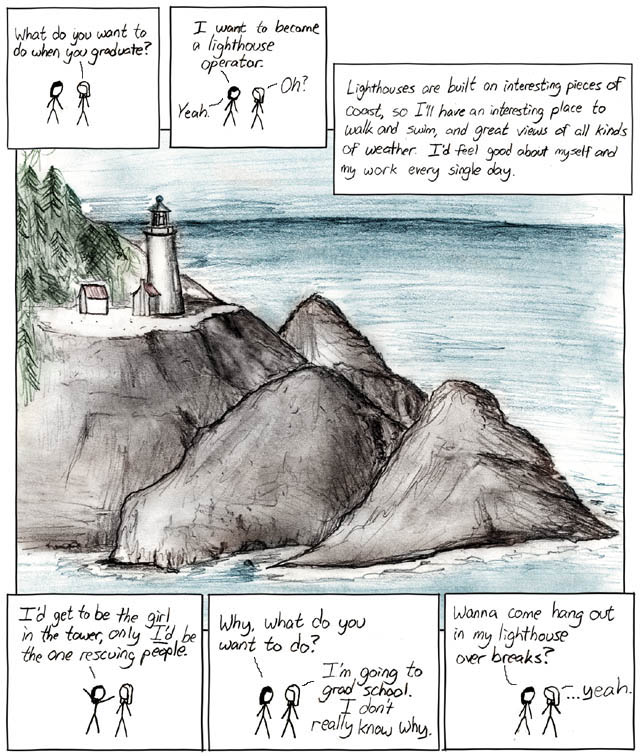
From xkcd.

Good luck with exams everyone.

Spam prevention powered by Akismet