Not (brain)dead (yet)

I’ve tried. Honestly I’ve tried.

No blogging the past month or so because of

* a day-to-day schedule that has careened wildly out of control
* a new house (and related activity) which has limited my after-hours online play
* the ongoing deterioration of my frontal lobe
* a short vacation
* one of my periodic blogger funks

Regarding the last factor — it’s not a crisis of faith so much as a failure of nerve. It all ties into personal characteristics of mine that are far too tiresome to relate.

I came back from some time away from the office anxious to get posting again, and hopefully will do so soon.

Posted in Abject Learning | 12 Comments

Is it a wiki? A floor wax? A dessert topping?

Yet another application to keep me tantalized and humbled all at once…

I’ve been spotting TiddlyWiki in my peripheral vision for some time now, but only over the past couple days have I fixed my gaze on it. So far my reaction has been a jumble of impulses ranging from “wow!” to “huh?”

As usual, someone I work with here at OLT is way ahead of me. Alison Wong was exploring the utility of TiddlyWiki as an ePortfolio tool weeks ago:

The good thing about the system is that it does not require any server side support (no database, no php and no perl scripting). The entire tool is contained in one html file using HTML, CSS and JavaScript. Which makes the wiki very portable, and can be run in any modern browser. As suggested on the website, I also installed it and PortableFirefox on my USB thumb drive. This would make updating/showing the e-portfolio very portable as well. However, to save the changes of the wiki page, it requires Firefox or Internet Explorer, plus save capabilities (write access) to a server.

Hence, I envision end-users working on a local copy of the wiki file in a folder on their computers. Then upload the final version and all associated files (contents in the folder) to a server.

You read that right: no database. That hits home when you click the DownloadSoftware link on the site, only to learn that since “TiddlyWiki is a single HTML file, you’ve actually already downloaded the entire software just by viewing this site.” See what I mean about “wow!” and “huh?”

More Wow! – the interface is very smooth and sleek, and loaded with nifty JavaScript tricks that allow the page to reshape itself without reloading. I know that in a year these JavaScript/Ajax tricks will be overused, and we’ll all be tired of them, but right now I confess I’m a total sucker for the effect.

And there’s that word microcontent again…

More Huh? – because there is no database, when you access TiddlyWiki on the web the experience is unusual. You can click “edit” or “delete” links all over the place, and make whatever changes you like. But unless you save a copy to your own machine (and maybe upload it again to the server), your changes will not stick. Nobody else will see your changes, and hitting “refresh” on the browser will take you back to the page’s original state.

So I’m inclined to agree with Alison when she suggests that “calling TiddlyWiki a wiki system could be a little misleading.” (The site’s description, “a reusable non-linear personal web notebook” is more accurate, but not so catchy.)

So after an hour or so of confused meanderings, where have I gotten with this thing? I’m definitely intrigued, even excited, but at this point I am unsure how TiddlyWiki can be properly exploited. Alison thinks it might work well as an HTML-based composition tool that newbies can use, perhaps in tandem with a CMS. I’d like to do more comprehensive reworkings of the page to see how effectively templates can be constructed. And I haven’t tested how the RSS outputs can be manipulated.

And I’ve only begun to explore the examples of TiddlyWiki in action (like this) and the adaptations (like this and this). More head-scratching to come…

Has anybody else got thoughts? Really… do you? Please?

Posted in wikis | 10 Comments

Inspirational prose from Franz Kafka

This day has been a psychic cesspool, making me all too receptive to notions such as these:

When I think it over, I must say that my education has in many ways done me great harm. This reproach falls on a number of people, namely my parents, some relatives, the occasional visitor to our house, various writers, one particular cook who drove me to school for a year, a heap of teachers (whom I must press close together in my recollection, otherwise some would escape me here and there, but since I have crowded them so close together, it all crumbles back apart piece by piece), a school inspector, slowly walking passersby; in short, this reproach winds its way like a dagger through society and no one, I repeat, unfortunately no one can be sure that the dagger’s point will not suddenly appear from before, from behind, or from the side.

From The Diaries of Franz Kafka a new addition to the emerging genre of literature blogging.

Via Infocult.

Posted in Abject Learning | Comments Off on Inspirational prose from Franz Kafka

Now, if only someone could help me to visualise the change in my frontal lobe…

Jon Udell’s latest screencast on visualizing change is the usual mind-expanding stuff. I only had a few minutes to follow through on the links, but those few minutes not only snagged me a nifty tool for viewing editorial processes in Wikipedia entries (which will be incredibly useful for demos and workshops), but also prompted me to install and use Greasemonkey (making the notion of “user scripts” tangible to me for the first time).

As ever, Udell sums it up better than I could ever hope to:

I’m not just trying to highlight Wikipedia’s collaborative revisioning or showcase another cool Greasemonkey hack. There is a larger theme. In the realm of content as in the realm of software — two domains that seem determined to merge — everything is changing all the time. We will increasingly require, and come to depend on, tools that help us visualize and manage the flux.

Posted in tech/tools/standards | Comments Off on Now, if only someone could help me to visualise the change in my frontal lobe…

An aggRSSive crash course in brain surgery

Now that I have totally botched my half-baked plans for a gentle launch, maybe I should give a quick overview of what aggRSSive actually is

I should note I am writing this post in extreme haste (I’m off work today, and about to take on childminding duties for a totall of three toddlers).

Essentially aggRSSive is a combination of the Magpie RSS Parser, Feed2JS, and Freetag. Its main features:

* It stores RSS feeds, and tags them in folksonomy fashion. Each user’s tags are stored on the sidebar so you only need to type a tag out once — after that you can click on a tag while you are entering the feed and it will be added automatically.
* It allows users to collect useful feeds in their own accounts, and can function as a rudimentary RSS reader. (This feature will hopefully be enhance in phase 2.) You can add feeds to your collection by hitting the “add” button next to existing feeds, or by adding them via the textboxes scattered about the site.
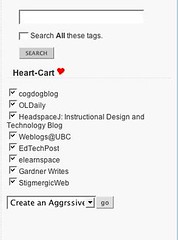
* Users can combine feeds into bundles that we call “aggRSSives”. These feed bundles are identified by the little next to the feed title. To create an aggRSSive, you need to have the feeds entered into your account. You select the feeds you wish to bundle by clicking the check-boxes next to the feed titles. These feeds are then listed in a “Heart-Cart” on the bottom of the right-hand sidebar. If you select “create an aggRSSive” from the drop menu, you will be walked through the steps to create the bundle.

Heart-Cart2

* If you click on “More Info” next to a feed title, you will see the tags you’ve added to the feed, and you can click “Feed Your Site” to generate the javascript to do so. The menu for this is more or less the same as Feed2JS.

Sorry for the lack of clarity to this post. The toddlers are getting restless. This preview is for the keeners only — things should be much tidier (and the instructions clearer) early next week. As I mentioned in the previous post, we only froze coding yesterday.

Update: I removed the link to aggRSSive for now. If you would like more information please contact me by email.

Posted in aggRSSive | 2 Comments

A learning object repository in motion (feeling a little bit aggRSSive)

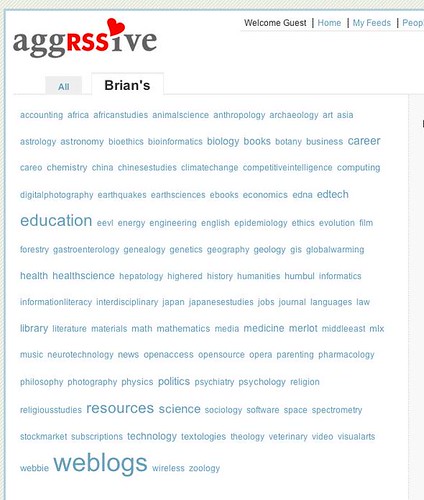
aggRSSiveFeedcloud

Update: I meant to hold off posting the link until I added more feeds to the collection and polished a couple things. I also hope to point out more features which we need to make easier to find. But I’m also easily swayed by even the slightest bit of pressure. Keep in mind this is unfinished, and please be kind.

Update 2: Should have held off posting that link. If you’d like more info please send me an email.

Since I’m blogging, I thought I’d take a moment to preview what I’ll likely be posting on for the next few weeks (or months). In a half hour or so we’ll be giving a soft launch of a new resource developed by my office (more on that process later) as a poster session for the UBC Town Hall.

Imagine that each of the tags in the image above (biology, bioinformatics, etc…) was linked to a set of RSS feeds drawn from learning resource collections, weblogs, journals, library collections, news sources, or whatever else users might find useful in an educational context. Users can add new feeds to the collection and apply existing tags or create new ones much as they do in Flickr or del.icio.us.

This is just a small piece of what aggRSSive does for feed-crazy educators. But I want to start by pointing at this functionality as it directly addresses what I find to be the biggest adoption challenge for instructors related to RSS — which is finding high-quality RSS feeds in their disciplines and areas of interest.

We just froze the coding process yesterday, and now I need to do my part — stocking the site with more feeds and slapping some initial tags on them, and beginning to write up the help documentation (which was hard to do until now, as the functionality of the site seemed to be changing on a daily basis). So I will be holding off on linking to the site just yet. But for me, at least, it’s shaping up to be a long, hot, aggRSSive summer.

Posted in Uncategorized | 6 Comments

Weblogs as a teaching and scholarship tool

Blogging in the English Department

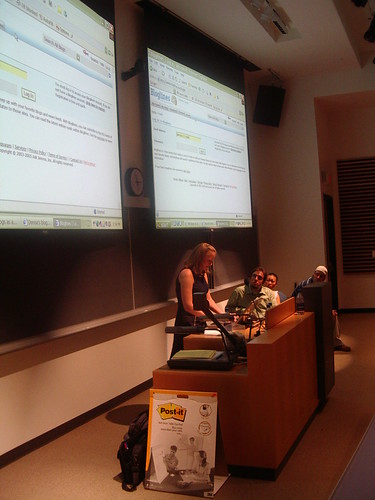
Here at the UBC Town Hall… I normally don’t blog sessions, but I’ll make an exception in this case, as this is a topic very close to my heart. A group of TAs in the Department of English (my old discipline) are talking about their experiences using weblogs to support their instruction and scholarship.

English TAs have been more or less sustaining themselves as a project for some time now. We have provided hosting and a bit of tech support (and last year did a workshop), but I can’t take the slightest bit of credit for the great work these people are doing. Which is precisely why weblogs are such a great on-campus technology. This stuff scales.

On to the presentation…

Tyson Stolte — stressed the simplicity of using the tools. He also noted that many students who are quiet in class prefer to express themselves in this medium.

Janey Lew — described the many ways a weblog can approach the teaching and learning process, suggesting that “a whole new level of discourse is added to the course”

Duffy Roberts — offers a manifesto:

We use a weblog because

(1) it asserts that thinking about text and the writing about text is not isolated to the classroom,

(2) it offers a site where accountable debate and dialogue between peers and instructors occurs,

(3) it addresses learning how to engage with a community of thinkers and allows an alternate medium for voices to be heard,

(4) it allows students to practice the writing of what they are thinking on a ongoing and regular basis,

(5) it allows and encourages the revision of writing, and authorizes a writing-as-process approach.

Denise Hubert — says “weblogging embodies my teaching philosophy. It promotes real engagement with the text. The students decide what is important, and share resources.

Denise is also doing a fine short overview of RSS and Bloglines. And used it to demonstrate how the efforts of the cohort inform each other. (Which I suppose is why they don’t need me any more — sob.)

I’m a lousy conference blogger — all these people are far more interesting and articulate than I am making them sound. Right now they are blowing the audience away with descriptions of how the open discussions bring in students from other courses (and other professors) into the discussion. Which non-bloggers in the audience are finding hard to believe.

I did a short audio interview with Denise that should be up shortly.

Posted in Webloggia | Comments Off on Weblogs as a teaching and scholarship tool

Where do you want to go today? How about a labour camp?

Microsoft Corp. is cooperating with China’s government to censor the company’s newly launched Chinese-language Web portal, a spokesman for the tech giant said.

The policy affects Web logs, or blogs, created through the MSN Spaces service, said Adam Sohn, a global sales and marketing director at MSN.

… On Monday, Agence France-Presse, the French news agency, said bloggers were not allowed to post terms to MSN Spaces such as “democracy,” “human rights” and “Taiwan independence.” Attempts to enter those words were said to generate a message saying the language was prohibited.

MSN Spaces, which offers free blog space, is connected to Microsoft’s MSN China portal. The portal was launched on May 26, and some 5 million blogs have since been created, Microsoft said.

China’s government encourages Internet use for business and education but tries to ban access to material deemed subversive.

It also recently demanded that Web site owners register with authorities by June 30 or face fines.

Chinese censors scour Internet bulletin boards and blogs for sensitive material, and block access to violators. Sites that let the public post comments are told to censor themselves or face penalties.

Sohn said heavy-handed government censorship is accepted as part of the regulatory landscape in China, and the world’s largest software firm believes its services still can foster expression in the country.

“Even with the filters, we’re helping millions of people communicate, share stories, share photographs and build relationships. For us, that is the key point here,” he said.

Google is playing the same game with its news service.

Money talks and freedom walks.

Via Dan Gillmor

Posted in Abject Learning | Comments Off on Where do you want to go today? How about a labour camp?

Let’s just ease back into this… my first Blog-Ha moment.

Well, it’s been a long time, been a long time, been a lonely lonely lonely lonely lonely time….

I don’t want to throw my back out by blogging too rigorously, so I’m going to make my first entry back an easy one — my first of what I hope will be a series of responses to Alan Levine’s noble and useful call for what he calls the Blog-Ha moment, or what “triggered the 10,000 watt light bulb going off in your head that screamed, ‘Wow! There is something really powerful about this way of expression.'”

I intend a series, because my own Blog-Ha moments extend from my very first experiences using Blogger until about two weeks ago. But I’ve got a terrifying backlog of email overflowing my inbox, so my first installment is going to recycle something I wrote for the ETUG Blogtalk online happening that Scott Leslie (who’s blogging again — yee-haw!) put togther a couple years ago. I entitled my initial foray:

Brian Lamb tells all about his first time…

I used to look longingly at all the other people with groovy websites out there. They seemed so together, as if they and that gorgeous Internet presence they had were just meant to be together. But I suppose I just thought of those people as somehow a breed apart… that I could never truly be one of them. I resigned myself to living out my life without a digital presence. I didn’t have the skills, for one — I didn’t really even know what “the skills” were, exactly.

It was a little more than [four] years ago that I started hearing about this form called weblogs. Lucky for me, I was friends with an early adopter. Lucky for all of us, she’s one of the co-facillitators of this discussion… it was Laura Trippi who showed me the ins and outs of the form, pointed me towards some of the better weblogs of the time. She offered me encouragement and honest feedback. It’s her fault that I became a weblogger, and I’ll always be grateful.

On her advice, I went to Blogger — then, as now, the place to go if you’re a newbie who wants to start blogging right away — took out a Blogspot hosting account, chose the template that looked most like Laura’s site… and minutes later I was authoring my first posting. Oh good, it’s still there… I wrote, verbatim:

Why a weblog?

Good question.

It may be a case of aimless ambition seizing upon a stray mechanism and jamming itself into the gears. Whatever violence that happens to be done to the content, and the way it ought to be presented, is secondary.

Of course, any media form impresses itself upon the ideas it transmits–and here the urge to quote McLuhan is dutifully resisted. But the question lingers like a bad smell: is this weblog an appropriate format for its purpose?

([Four] years later, and here I am writing about whether or not weblogs are worth writing. I would like to think that I have grown over that period, but the evidence appears to contradict that notion.)

I hit the publish button… and there it was. I remember genuine excitement in seeing my words rendered in a nice font on a reasonably well-designed page. I had no way of knowing that exact template would eventually be adopted by 1,675,432 websites over the next couple of years… and so I thought that the page’s appearance reflected rather well on me, that it gave me an air of street cred among the geeks.

I was seduced and enchanted. I’ve since started (and usually moved on from) about a dozen weblogs since, but you never forget your first.

Maybe you are a little bit the way I was then… Maybe you’ve reached a point in your life where you are willing to take the plunge and fall head over heels into work with a weblog. Hopefully over the next day or two we will be able to point you to a few useful resources to get you started, and answer some of your questions along the way. Most importantly, I hope that the sense of satisfaction is for you as it has been for me… the joy of finding a tool that lets me forget about the technical issues, to get on with the writing itself, and better yet publishes and distributes it to people who actually seem to enjoy reading the result.

Posted in Webloggia | 1 Comment

We interrupt this pleasant silence to make a series of tiresome excuses…

My silence is not indicative of a lack of interest in the weblog world… nah, there’s much going on worthy of attention, and some of my favorite bloggers have been on fire lately.

But ever since I got back from the trip to Virginia I’ve been in full-on scramble mode… and the rest of this week promises to be more of the same. I finally move into the new house over the next couple of days, and then it’s off to Merritt for this year’s Spring Workshop on Educational Technologies being sponsored by BCCampus. Assuming I survive the former, I’m quite looking forward to the latter… I am co-presenting on wikis and weblogs with Jeff Miller, my co-conspirator on the Text Technologies course, a mentor and a buddy. Jeff is determined to shake me out of the info-overload and fire-eating routine I usually indulge, and I’m quite excited to try some new methods to engage people with this material.

I’d show you a link, but… um… let’s say we’re working on it. Hopefully I’ll be able to post from the event, which should be a humdinger.

Posted in Abject Learning | Comments Off on We interrupt this pleasant silence to make a series of tiresome excuses…