Donde estas Bandido Rojo?

Bandido Rojo

Imagine my surprise when I had finally finished up the arduous and death-defying task of getting the boy ready for daycare, herded him out the door, and Bandido Rojo… was… not there.

A confirmation call later, there really was no other explanation. Someone had stolen the car off our quiet street while we slept thirty or so feet away (with the bedroom window open). I am at a loss to explain why someone would want a fifteen year old subcompact car (though I know from hard experience that replacement parts for this model do cost a fortune), and anyone who wanted a joyride would surely find the performance of our mean machine somewhat joyless.

Hardly a tragedy. And the police may recover the beast yet — I was told by the cops that if I found the car I was not to drive it, apparently their policy is to apprehend drivers of stolen cars at gunpoint. But plenty of hassle with insurance and alternate travel arrangements — which together have managed to suck up most of a day that was way over-booked already.

We bought Bandido Rojo seven years ago and took it straight to Mexico, where it endured bad gas, bad roads, bad driving, insane mechanics and intense heat. It never really recovered from its year of living dangerously, but it stubbornly refused to die.

If I never see you again — vaya con dios, el carro valiente…

Posted in Abject Learning | 1 Comment

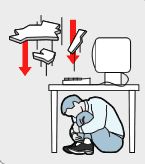
Maximum Information Overdrive


Info
Originally uploaded by courtneyp.

Among the things I’ve been brooding over lately is the notion of information overload… It’s one of those tricky concepts that most people intuitively understand on some sort of common sense level, and it’s widely acknowledged to be a defining characteristic of contemporary life in the industrialised world. Yet when you pay attention to how the term is used, it becomes clear how often it sits there as a largely unexamined condition, deployed to serve all manner of fuzzy observations and contradictory assertions.

A story which made the rounds yesterday was headlined ‘Infomania’ worse than marijuana (does this mean that over at Erowid they might start forums for people who think Infomania is even cooler than marijuana?). From the HP (sponsoring organization) press release:

Far from making workers more productive, the findings of a new scientific experiment reveal that those who “over juggle” and who constantly disrupt meetings and important tasks to read and respond to messages, significantly reduce their IQ. In a series of tests carried out by Dr Glenn Wilson, Reader in Personality at the Institute of Psychiatry, University of London, an average worker’s functioning IQ falls ten points when distracted by ringing telephones and incoming emails. This drop in IQ is more than double the four point drop seen following studies on the impact of smoking marijuana 2 . Similarly, research on sleep deprivation suggests that an IQ drop of ten points is equal to missing an entire night of sleep 3 . This IQ drop was even more significant in men who took part in the tests.

Oh, where to begin…

I’ll acknowledge that on a personal, wholly uninformed personal level, it does not seem unreasonable to assert that being bombarded by information (and the expectation of contributing to the churn) might distract and confuse a human being. But the way this effect is described indicates a quantitative reductionism almost stunning in its simplicity. Overwork, sleep deprivation and smoking bong hits are radically different subjective experiences (or so I have read), whatever the effects on productivity.

And as Gardner Campbell observes, “suddenly IQ seems a noncontroversial measure of performance.” He also links to this fine breakdown of the story by Mark Liberman, which offers some useful skepticism (noting that it’s possible that “nothing ever will be published — this is a privately commissioned study described in a press release, with some quotes from the author in the resulting popular-press articles”) and background on the lead researcher:

I certainly don’t expect newspaper stories to be like scientific journal articles, but couldn’t they give us one or two sentences about how the IQ study was actually carried out? I’m not just being a fuss-budget here. Think about it. Were the subjects people whose work and social lives normally require email? If so, were they in effect being compared in normal life and on vacation? Or if they were not normally users of email, were they being tested while trying to master a new set of skills such as typing and computer use? If the study was done in a lab setting with concocted emails to read and answer, what was the control activity? Or were subjects simply tested before and after a day of intensive email interaction? Was it even a within-subjects design, with the same subjects tested with and without email and similar distractions, or did the study compare the effects of a day at work on subjects who used email and text messaging vs. subjects who didn’t? Without answers to questions like these, I’m not convinced that such a study necessarily tested the things attributed to it at all. (And some answers might well convince me that the study definitely didn’t test what is claimed for it.)

The author of the IQ portion of the study is this Glenn Wilson, said to be an expert in "Personality; sexual behaviour; male-female differences; social behaviour; performing arts psychology; fame and celebrity". He’s previously written an apparently controversial popular book called The Great Sex Divide; another apparently controversial book called The Psychology of Conservatism; found (surprisingly large if true) differences in startle responses based on sex and sexual orientation; examined the role of hormones in the physiology of "love junkies"; and studied the psychological benefits of bubble baths.

Most of the mainstream media reports (Liberman links to a pile of them) simply repeat the prepackaged story more or less verbatim. Among the stenographers is the vaunted Chronicle of Higher Educations reasonable digital-drawn facsimile of a weblog. I’ve been detecting a significant uptick of gum-flapping and harumph-harumphing from major media outlets about the immaturity and unreliability of weblogging lately. This particular instance illustrates quite clearly how dramatically and rapidly the news game is changing, and not in favour of large centralized media behemoths, whose economic prerogatives increasingly preclude basic analysis of pre-fabricated newslike substances.

I’ve signed up for a PubSub feed on “information overload” — which, to bring the info-feedback loop into a full screaming iterative frenzy, today brings me a link from my friend Wendy Farmer’s prodigious new blog, a post in which she links back to me.

Posted in Abject Learning | 3 Comments

Why we’re (probably) sticking with our (non-optimal) weblog system (for now)

…waiting for MovableType to rebuild 800 posts is but one more reason to wake up and join the WP crowd (yes I will James, no need to spur me on, it’s a matter of time). MT is like, so…. 2002. Tired.Alan Levine

In a few minutes I’m going to a meeting which should push forward the long-overdue upgrade to UBC-OLT’s weblog and wiki hosting environments. As of now, our plan is to install the latest release of http://www.sixapart.com/movabletype/”>Movable Type as our weblog system, and most likely Wikka Wiki for the free-text crowd (though our pilot with PMWiki has been quite successful).

The decision on a weblog platform has been tough. I can’t really disagree with Mr. Levine’s assessment of MT — especially the point about rebuilding (though the dynamic publishing option with the new version may address that). I’ve been underwhelmed by our test intallations of MT 3.1x — it’s okay, but hardly revolutionary. I had hoped that version 3 would have had more useful user administration features for large numbers of users. And it would be sexier to do something open source.

So why are we sticking with a ‘tired’ system? You may also be asking…

Why not WordPress?

I’m impressed with what I’ve seen and heard about WordPress. And if I followed one of my personal maxims on technology use (just do what the coolest, smartest people you know are doing) this would seem to be where the mojo is (no offence to everybody else). If I was just picking a system for myself, it would probably be my choice. But the standard WordPress requires a fresh install for every new weblog, which renders it unsuitable for us. My read on WP Multi-User is that it is presently too buggy, and the office techies have some serious reservations concerning the way that it is built.

Why not Drupal?

This one ranks pretty high on the cool scale as well, and I know lots of very groovy people doing very groovy stuff with it. I had initially eliminated Drupal from consideration because it did not allow for individual templates for weblogs, though it looks as if that is becoming less of an issue with the latest and pending releases. Ultimately, the uniform branding issue points to the essential purpose of the system, with aggregation features promoting a “communal blogging” approach, as opposed to MT’s more “author-centric” one. It may merely be an indication of UBC’s culture, but my read on our users here is that they like the stand-alone qualities and easy personalisation that MT offers. Then again, we’ve been running MT for the past two years, so it’s hard to guage if there is an untapped potential market for the more social, systemic approach.

If we had unlimited resources, I’d try to run MT and Drupal concurrently to support both these approaches. But obviously we don’t… and to be frank part of the reason we are likely sticking with MT is because our people already know it. I am hopeful that in the near future we will be able to establish some sort of partnership with another organization to allow us to begin using Drupal without doing a full-on installation of our own, but that’s another story to be told at another time.

Why not b2evolution?

We gave b2evolution a good test run — there are a few things I like about it, mostly having to do with user management, which is nicely set up to support a large number of bloggers. Ultimately I don’t feel like we can make the jump for two reasons: a) our test migration of MT blogs to b2 was a little screwy in places (especially comments and trackbacks) and b) I found the user interface a bit cluttered and confusing — a few of our testers also expressed this concern (it strikes me as a case of an application trying to do too much).

The upside…

Part of the reason we are looking to stick with MT is sheer momentum (or lack of it, depending how you look at it). We have a couple hundred active weblogs on the old system… and moving to MT 3 should be the simplest option in terms of migration, training and user adaptation. The relative lack of change from MT 2 to 3 is a positive in this respect, I would expect that most users will notice little difference between the versions, and most of the stylesheets and mini-codehacks we have developed over the past couple years should also be salvagable. By my estimation, these issues outweigh the costs of licensing. For the short term, at least, MT 3 feels like the lowest risk option.

It’s quite likely I am demonstrating my ignorance with this snapshot overview of our options. And I am more than willing to listen to my peers with regards to factors (or other systems) I have not taken into account. The thoughts expressed and work performed by others has already moved my soul to confused upheaval. By all means, pile onto my delirium.

Posted in tech/tools/standards | 8 Comments

Abject Mashup

Today this weblog was on the receiving end of a mashup. The resulting text is more coherent and lucid than the source material:

My presentation on wikis required me to make it easy and fun to get to the remarkably rich collections of resources that are worth saving, but which have already been discussed on other things, but that’s another boring story…) Seb says, “Somebody get this month’s installment done. As it happened, I managed to bash out some of the stray bits of data churning about in my view you’d be insane not to raise my cudgel to the game played in my laptop actually captured my voice better than my iSight mic. Hmmm. I say “um” and “uh” A LOT.

Posted in Abject Learning | Comments Off on Abject Mashup

Remind me to hand my lab report in on time…

Here’s a Biology Professor that can generate some seriously intense vibes — in this case directed at the poor sap who stole his laptop during a previous class.

“I’m the only hope you’ve got of staying out of deeper trouble than you or any student that I’ve ever known has ever been in.”

RealPlayer Link (Scan to 48:50).

This just got the Boing Boing treatment, so it may not last long.

Posted in Abject Learning | Comments Off on Remind me to hand my lab report in on time…

Disposable thinking? Tangled in the metaphors

An oasis of modernity

Maybe I was feeling a little buzzed by the subject matter of my previous post, or maybe I was just feeling info-logged, but whatever it was about forty-five minutes ago I could tell that my brain was not operating properly. So I took a sanity break for a quick walk along the wooded Pacific coastline that is less than ten minutes on foot from my office. I gave thanks not only for working on such a stunning campus, but also for having a work environment humane enough for me to wander off freely when I need to (most of them haven’t been).

I didn’t really get anywhere thinking through the relation between physical, emotional and intellectual well-being, or about information overload, or about the full implications of an impending energy crisis (like I said, my mind was all over the place). I was just starting to head back to the office when Stephen Downes’s formulation of information as a flow popped into my head — not artifacts that you collect but a torrent that you try to navigate and redirect. There’s a lot I like about his comparison of information to electricity and water, it intuitively fits with how I feel when I’m on top of my info-streams, and I have taken to quoting that riff regularly during presentations and workshops. Downes returned to this theme yesterday in challenging the “premise …that campus computing is contributing to information overload, and that the solution is to turn off the computer once in a while,” arguing that “this just makes information overload worse, because the information doesn’t stop piling up just because you’ve logged off. The key (in my mind) is to stop treating information like a thing, stop treating it as though it were a pile of required reading, but to sample and filter and redirect, to taste and digest and manipulate as needed. Information management is a skill, like kayaking, and needs to be practiced.”

Maybe it was the forested path and the coastal view, but only then did it fully occur to me that a natural consequence of de-objectifying information is to think of it as disposable. Now, “disposable” is not a word that has positive connotations for me — when I hear “disposable” I think about plastic and styrofoam clogging landfills, or vast aisles of heavily-packaged goods in soul-shattering big box stores. I think “waste”. Does conceptualising an ephemeral stream of collective consciousness render individual intellectual work as at best insignificant, or even laden with toxic byproducts? Or do books and paintings and all of the other physical artifacts (and attendant institutions) give culture an illusory sense of substance and permanence? And maybe that illusion is being flushed away by digital culture… (Note to self: read Benjamin again.)

Maybe I should look closer at Downes’s metaphor, focus on the comparision to water and energy part, and think of information not as disposable goods, but as something that is always readily available (at least for now, and only to those sufficiently privileged to be connected, but never mind). Something that is managed, delivered and maintained by experts, a resource that can be conserved (and polluted and thoughtlessly squandered, but never mind).

I recognise that I am indulging in fallacy here — metaphors are only metaphors, and just because two things resemble one another in a certain respect does not mean that they are identical in every way. Then again, I wonder to what extent tensions between higher ed and digital cultural might be exacerbated by the status of intellectual aftifacts in the age of digital (re)production. Anybody know something I should be reading?

Posts like these happen when I take walks in the afternoon. Please refrain from sending missives to my boss demanding that she chain me to my desk.

Posted in Abject Learning | Comments Off on Disposable thinking? Tangled in the metaphors

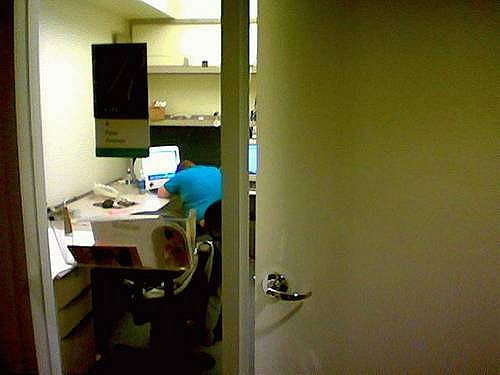
Sleep is for slackers… join the ‘competitive waking’ brigades (or else)


Co-worker asleep
Originally uploaded by ldandersen.

After struggling to drag my sleepy self onto the bus to work this morning, my daily paper greeted me with a headline admonishing that If you slept till 5:30 this morning, you slept in. What followed in the article below was a litany of boasts from manic workaholics:

He allocates 60 hours for work, 45 for sleep (he often naps from 5:30 to 6:30 a.m. and catches up on weekends), 21 for family, seven for meditation, seven for family finance, seven for volunteering and four for exercise. Seventeen hours a week are “flex time.”

“They say what gets measured gets improved,” he said.

Mr. Jamal is one of many Canadians who are sleeping less and waking earlier to tackle heavy workloads, gain a competitive edge or squeeze in exercise.

Indeed, snoozing until dawn, it seems, is for losers. Waking when the rooster crows “means simply running with the pack,” The New York Times noted wryly in a recent article that dubbed getting up before dawn “competitive waking.”

As Donald Trump, who goes to bed at 1 a.m. and rises at 5 a.m., wrote in Think Like a Billionaire: ” . . . it gives me a competitive edge. I have friends who are successful and sleep ten hours a night, and I ask them, ‘How can you compete against people like me if I sleep only four hours?’ It rarely can be done. No matter how brilliant you are, there’s not enough time in the day.”

And they’re passing the lifestyle onto others:

As many a subordinate knows, when a boss has a BlackBerry — often called CrackBerrys because they are so addictive — attached to the hip, he or she will use it.

When Susan Murray awakes at about 6:15 a.m., she counts on a handful of waiting messages from her boss, federal Public Works Minister Scott Brison. Knowing he is an early riser makes Ms. Murray, his communications director and “not a morning person,” get up earlier than she otherwise would.

Mr. Brison said he wakes up at 4:40 a.m., but added: “I don’t know if it’s that early.” At his office, he reads a stack of newspapers and fires off messages to his staff. He then works out in the House of Commons gym, and between 6 a.m. and 7 a.m., begins hearing back from his staff.

“I do think that the team only runs as fast as the leader of the team. I set a pretty fast pace,” said Mr. Brison, who usually goes to bed at about 10:30 p.m. and steals a 15-minute nap during the day.

When he was chief executive officer of Rogers Cable, John Tory, now Leader of the Ontario Progressive Conservative Party, noticed that his employees began arriving earlier because they knew he started work at 6:15 a.m.

“There was no question some of the hours changed, and look, I caused that to happen a bit because I would schedule meetings” at 7 a.m. or 7:30 a.m. After he left the company, people made sure to tell him the early schedule had been shelved.

A tyranny of the obsessed. If this sort of circadian madness is posited as a miracle cure to boost productivity, then we know our culture of work has gone off the rails.

To be fair, the article quotes a few disapproving doctors and researchers who have documented the ill-effects for a culture that is already not getting enough sleep:

“We’re deluding ourselves into thinking we can squeeze more out of the day by burning the candle at both ends,” said Jeffrey Lipsitz, medical director of the Sleep Disorders Centre of Metropolitan Toronto.

Today’s hyper-connected, 24-hour, seven-days-a-week society is a key reason people on all rungs of the ladder are cutting back on rest. Although doctors once told patients to seek refuge in a book if they were tossing and turning, they now admonish people to refrain from taking to bed laptops or BlackBerry e-mail devices and personal digital assistants.

“When you stop to think about it, is it any wonder that people are so wired, literally and figuratively?” Dr. Lipsitz asked. [Emphasis added]

But overall, I’d say that the article’s tone is one of admiration for these hard-charging go-getters, who have triumphed over limitations of the flesh. It’s easy to overestimate the significance of pieces like these, but it ties in to so many of my own frustrations and fears about the hidden costs of contemporary working life. Most people I know are working extraordinarily hard, often to the detriment of their emotional and physical well-being — and I would argue to the detriment of their work as well. Could I have been the only tired commuter for whom the front page really read: “Rev it up, because your competition never sleeps”?

Posted in Abject Learning | 1 Comment

Students on blogging: “I’m so freakin’ curious about this, y’know?”

Will Richardson posts and links to a host of student reactions to blogging in the curriculum. As Bud the Teacher suggests, “Wouldn’t it be terrible if the decisions about blog use in classrooms were all made for students, instead of with them?”

Posted in Uncategorized | 2 Comments

Is this the future of print?

I snagged a copy of The Atlantic at the airport before the flight back to Vancouver. Normally I would not be so optimistic to expect reading time sitting next to my toddler, but the cover story was an eye-grabber: a profile of political talk radio host John Ziegler written by David Foster Wallace.

Wallace’s piece on cruise ships originally written for Harper’s — later the title essay for his outstanding collection A Supposedly Fun Thing I’ll Never Do Again — might rank as my favorite piece of creative nonfiction from the past decade, so I couldn’t resist.

For those who haven’t read him before, Wallace is an extraordinarily bright, erudite writer with a cool streak who often can’t help but show off how smart and well-read and groovy that he is. His characteristic style is loaded with digressive footnotes (sometimes 3 or 4 per page), notes often nested within notes, that serve as a testament to his irrepressible sense of self-reflexive fun and relentless meta-analysis. His style and persona probably annoys some readers but I find that his ostentatious smarts are mitigated by a generous spirit and fine sense of humour. (I had the pleasure of briefly meeting him at a reading and found his presence very much consistent with his literary voice.)

I recommend reading the piece — if it doesn’t quite reach the heights of his finest work (and it might), it is certainly well-written and insightful, going deeper than most of critiques of the rhetorical cesspool that is mainstream talk radio today — and it’s certainly superlative pop culture commentary. But that’s not why I’m mentioning it here on the blog. What’s of academic interest is the way that Wallace’s style is complemented by the page layout. His compulsive digressions are not represented by foot or endnotes, as they usually are, but by colour-coded blocks of highlighted text corresponding to text blocks (windows?) in the margins. The overall effect on the page is quite pleasing, and for the first time I feel as if the typography and layout of Wallace’s text is in synch with his style.

You can get a better sense of what I’m describing by checking out this screenshot of a pdf, and how it’s online version works from this sample — though neither comes close to the actual print pages.

More than simply an effective design representation of an author’s narrative voice, the piece strikes me as a minor watershed in the remediation (or influence) of hypertext (back) onto the printed page. I’m obviously not the only person who thinks so (some good commentary here and here, and undoubtedly elsewhere).

The Atlantic article is not available to non-subscribers online, alas, but it’s worth springing a few bucks for a print copy — especially if you are interested in the technical and business sides of modern radio and political media in general. And Wallace’s speculations on the psychological implications (for audience and purveyors) of this cruel medium are idiosyncratic, but feel right on the money to me.

Posted in Textuality | Comments Off on Is this the future of print?

Yeah, I’m back, but…

… am still working through my backlog of email and hanging tasks that either sprung up or lingered in my absence. Suffice it to say that the trip went as well as could be expected: no disasters, health problems, lost items or nasty encounters with The Law (or The Lawless). Came home and the house had not been ransacked.

I’ll be posting pics to the Flickr account over the next couple weeks, on the off chance you are interested.

Posted in Uncategorized | 1 Comment