Categories
Making Connections Reflections

Connections and reflections

This course was my first with UBC and it was a (how can I describe it?!?) somewhat stressful, engaging, rich, eye-opening experience. Having taken my first 5 courses with ITESM, I must say that working with UBC is very different: from the planning and design of activities, methodology and resources used- completely opposite. This was the first course in my MET classes that I’ve worked completely alone… that was a handful to take in.

From the experience this semester taking two courses with UBC, I can honestly say I won’t do it again! LOL! There were a lot of very interesting readings and discussions going on that I sometimes wasn’t able to digest because of the massive amounts of information from both courses.

I also have to admit I wasn’t at my best this semester because of personal and work-related circumstances, and although I did read very interesting posts and comments from everyone, sometimes I couldn’t get around to responding. One thing that was very encouraging though, was to find “classmates” willing to give you a hand and share their experiences and expertise wholeheartedly.

I learned to enjoy (I didn’t at first!) browsing and reading through the Weblog, it really spices things up and changes methodologies from the very structured Vista work format. I enjoyed the folksonomic (cloud) tagging, it’s a very visual way to identify were the group was heading to.

I really enjoyed Bolter’s book since it was a very “light” reading, yet full of interesting and powerful statements and messages. I’ve also managed to make my online archive of readings and sites from this course which I’m sure I’ll use later on.

Regarding the course topics, the ones I mostly enjoyed were “Orality to Literacy” and “Literacy and new Media”. These were very engaging topics I hadn’t discussed or analyzed as we did in this class.

Thank you for commenting on my posts and for engaging in rich, motivating discussions. I hope we’ll meet again in another course!

Categories
Commentary 3 Uncategorized

Multi-literacy and assessment

Commentary # 3, Cecilia Tagliapietra

Along this course, we’ve discussed the “creation” or discovery of text and how it has transformed throughout the ages; providing mankind a way of expressing thoughts and feelings. In this third and last commentary, I’d like to discuss how we’ve become literate in different areas and how literacy, as text, has also been transformed to fit new manifestations of text. I’d also like to touch upon the challenges we face as teachers, to assess and impulse the development of these competencies or literacies.

As text has transformed spaces and human consciousness (Ong, 1982, p. 78), we’ve also changed the meaning of the term literacy, integrating not only the focus on text as the main aspect of it, but also the representations, and methods in which text is manifests, as well as the meaning given or understood according to different contexts. The New London Group (1996) has introduced the term “multiliteracies” for the “burgeoning variety of text forms associated with information and multimedia technologies” (p. 60). From this understanding and meaning, we can identify different literacy abilities or competencies. The two most important types of literacies we’ll narrow down to are: digital literacy and information literacy.

Dobson and Willinsky (2009) assertively express that “digital literacy constitutes an entirely new medium for reading and writing, it is but a further extension of what writing first made of language” (referring to the transformation of human consciousness, (Ong, 1982, p. 78)). These authors consider digital literacy an evolution that integrates and expands on previous literacy concepts and processes, as Bolter expresses “Each medium seems to follow this pattern of borrowing and refashioning other media” (Bolter, 2001, pg. 25). With digital literacy, we can clearly identify previous structures and elements shaping into new, globalized and closely related contexts.

Digital technologies have recently forced us to change and expand what we understand as literacy. Being digitally literate is being able to look for, understand, evaluate and create information within the different manifestations of text in non-physical or digital media. Information literacy is also closely linked to the concept of digital literacy. According to the American Association of School Librarians (1998), an information literate, should: access information efficiently and effectively, evaluate information critically and competently, use the information accurately and creatively. We can clearly see an interrelationship between the concepts of these literacies; they both rely on an interpretation of text and an effective use of this interpretation. The development of critical thinking skills is also closely related to these concepts and the ability to use information (and text) creatively and accurately.

The use of these new literacies has also changed (and continues to do so) the way we communicate and learn; we constantly interact with multimedia and rapidly changing information. Even relationships and authority “positions” are restructured, as consumers also become producers of knowledge and text.  With the introduction and use of these new literacies, education has somehow been “forced” to integrate these competencies into the curriculum and, most importantly, into the daily teaching and learning phenomena.

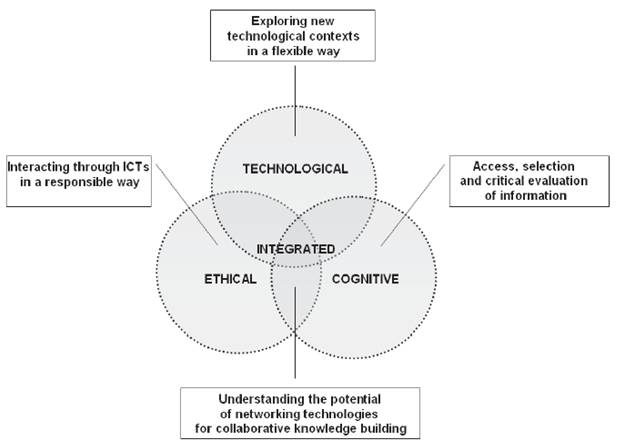
As teachers, we are not only required to facilitate learning in math, science, etc.; we are also required to facilitate and encourage the development of these literacies as well as critical thinking skills. Teaching and assessing these abilities is no easy task, as it’s not always manifested in a concrete product. Calvani and co-authors (Calvani, et.al, 2008), propose an integral assessment for these new competencies, involving the technological, cognitive and ethical aspects of the literacies (See Figure 1). In order to assess, we must initially transform our daily practices to integrate these abilities for our students and for ourselves. Being literate (in the “normal” concept) is not an option anymore. We are bombarded with and have access to massive amounts of information which we need to disseminate, analyze and choose carefully. Digital and information literacies are needed competencies to successfully understand and interpret the globalized context and be able to integrate ourselves into it.

Learning (ourselves) and teaching others to be literate or multi-literate is an important task at hand. Tapscott (1997) has mentioned that the NET generation is multitasker, digitally competent and a creative learner. As educators and learning facilitators, we also need to integrate and develop these competencies within our contexts.

Literacy has transformed and integrated different concepts and competencies, what it will mean or integrate in five years or a decade?

Figure1

 Figure 1: Digital Competence Framework (Calvani, et.al, 2008, pg. 187)


References:


American Association of School Librarians/ Association for Educational Communications and Technology. (1998) Information literacy standards for student learning. Standards and Indicators. Retrieved November 28, 2009 from: http://www.ala.org/ala/mgrps/divs/aasl/guidelinesandstandards/informationpower/InformationLiteracyStandards_final.pdf


Calvani, A. et. al (2008) Models and Instruments for Assessing Digital Competence at School. Journal of e-Learning and Knowledge Society. Vol. 4, n. 3, September 2008 (pp. 183 – 193). Retrieved November 28, 2009 from: http://je-lks.maieutiche.economia.unitn.it/en/08_03/ap_calvani.pdf


Dobson and Willinsky’s (2009) chapter “Digital Literacy.”  Submitted draft version of a chapter for The Cambridge Handbook on Literacy.


New London Group. (1996). A pedagogy of multiliteracies: Designing social futures. Harvard Educational Review, 66(1), 60-92. Retrieved, November 28, 2009, from http://newlearningonline.com/~newlearn/wp-content/uploads/2009/03/multiliteracies_her_vol_66_1996.pdf

Tapscott, Don. Growing Up Digital: The Rise of the Net Generation, Retrieved November 28, 2009 from: http://www.ncsu.edu/meridian/jan98/feat_6/digital.html  

Categories
Rip.Mix.Feed.

Rip.Mix.Feed

Hello everyone!

For this activity, I decided to browse through the different options presented in the Wiki and I Remixed an existing source.

I’ve always enjoyed watching photos inside a photo, so when I saw Dumpr had this feature; I wanted to give it a try! I uploaded my niece’s photograph for this “technique”- her name is Natalia and she’s almost 10 months old! (she was about 3-4 months in the pic).

 NataliaCollage

I also wanted to share a blog I elaborated for another course to present a activities and content. The blog is in Spanish, as the course was one ITESM was offering: http://cecitagliatec.blogspot.com/

Categories
Commentary 2

Commentary 2- Mechanization: before and after

Ancient and modern writing are technologies in the sense that they are methods for arranging verbal ideas in a visual space. (Bolter, 2001, pg. 15)

 In my previous commentary, I attempted to talk about the impact of writing as a technology on humans’ development. This second commentary, I’d like to reflect on the transition of writing to writing as a mechanized process and its impact on the way we relate to text.

            Writing, as we have read and discussed in this course, has significantly changed over time due to the necessities and complementary technologies man has created or adapted.

Scroll and papyrus

The scroll and papyrus are the precursors of books as we know today. These “portable” versions of text were the first attempts to make writing and reading a more accessible technology. During this “era”, writing was considered an art form, due to its complexity in elaboration and reproduction, as well as because of the techniques and methods used. These text versions allowed the delivery of information or text in an uninterrupted sequence, which printed books still maintain.

Hand crafted books to manual scripts

Production and reproduction of texts during this and previous eras was done only by those who were fully trained and skilled in writing and reproducing typographies. Writing a book or text and reproducing it took a lot of time, effort and people, resulting in the high cost of texts and low distribution rates; making them practically inaccessible to the general public.

            Migrating from a scrolled text to the bounded pages format, allowed the reader to easily flip through the pages to advance or return to a specific point of the reading. Although initial books were large in size and required to be laid on a high surface to read (table, desk, reading podium, etc.), this new format freed the reader’s hands to be able to write and read simultaneously. This new format also facilitated the production and reproduction of texts, allowing the writer to add ideas in between pages or correct mistakes within a single page. Bounded pages resulted in the need to organize or categorize content within the text, giving way to page numbering and table of contents or index.

The printed book

As writing progressed, the letter press was introduced in the fifteenth century, which allowed word duplication en masse (Bolter, 2001, pg. 14); then came the typography which became the first product in which text could be repeated by a machine. The printing press later became an effective “upgrade” of the letter press and typography, allowing production and reproduction of several pages in a shorter period of time. These rapid and rather radical changes in writing allowed the entire process to be mechanized, automated or “machine-produced” which, as a consequence, facilitated reproduction, reduced costs and man-made mistakes greatly.

            The printed book facilitated reading due to the typography and format used. Since printed books were smaller in size, the reader could easily transport the text. This shift in format made the book accessible to different publics and also allowed a certain sense of ownership of the reader for the book- making margin notes, highlighting or underlining, etc.

The electronic book

The electronic book (E-book) format has been around for about a decade now, but has not been fully adopted as a “mainstream” book format. Commercial E-books initially began as an alternative reading format for printed books, promoting ecological and economical “savings” as their main advantage. Currently, there are many books in electronic format which can be read on a computer screen or special electronic portable devices. According to Freda Turner (2005), “E-books have an advantage over traditional books in that they offer hypertext linking, search features, and connections to other online databases enhancing data comprehension.” Turner mentions that the current lifestyle “requires” information or texts to be interactive and convenient, allowing the reader to jump between topics and ideas, as well as to easily transport a library in a small electronic device.

A shift in the way we relate to text

Before the mechanization of writing and commercial distribution of texts, the relationship between the reader and the text was impersonal and somewhat complicated. The reader could not (or with difficulty) transport the text or have access to texts as freely and easily as today. Before mechanization, reading was usually done on foot and at select spaces, such as libraries, that could afford having a copy of the text. Manually-elaborated texts imposed certain authority over the reader due to high cost, inaccessibility, etc. impeding him to adopt and adapt the text to his necessities. As writing transformed, the reader took certain “ownership” over texts by making marks, comments and easily transporting or sharing the text in different places.

            Electronic text has not only modified the way we read, but also the way we share, write and reproduce text. Electronic readers can manipulate or tailor some texts to their needs or add direct comments to for others to see as well (Bolter, 2001, pg. 11). Both “traditional” and electronic texts encourage the development of different abilities and skills for readers and writers. Some of these competencies are: creative, critical, and associative thinking; organization of ideas and thoughts, as well as the materialization of abstractness. Regarding the production of texts, the digital or electronic era has also allowed different “authors” to cooperate or write a single text without time or geographical limitations. Nowadays, the reader can easily adopt (download, browse, consult) and adapt (edit, highlight, review) texts to tailor specific needs; resulting in a closer, more personal relation with text.

            Several authors, including Turner (2005) have stated that printed texts will become obsolete in a certain point in time. It is my belief, reinforced with discussions made within the course, that electronic books will complement printed texts, not necessarily take-over them. What both digital and printed versions of text have in common is a mechanization process or technical skill of some sort that is required in order to create the final product- the difference relies on the format and form, rather than the substance. The most important aspect to consider, in terms of text and the mechanization of its elaboration process is how the reader and writer relate to it and are able to manipulate and make it their own.


References:

Beck, N., & Fetherston, T, (2003). The effects of incorporating a word processor into a year three writing program. Information Technology in Childhood Education Annual, 139-161.   

Ong, W. (2008) Orality and Literacy. The technologizing of the word. Routledge

Turner, Freda. (November, 2005) Incorporating Digital E-books into Educational Curriculum. International Journal of Instructional Technology and Distance Learning, No. 11, Vol. 2, Pg. 47-52. (PDF File)

Categories
Research Paper

The implications for literacy and education with the development of free textbooks in Mexico’s grade schools.

Introduction

The use and distribution of free textbooks in Mexico’s grade schools stimulated the development of literacy within the country and the outreach of information to the poorest and most isolated areas in the nation. The distribution of these textbooks helped promote national values as well as the democratization of information distribution.

            In this paper, we will briefly review the historical context in which Mexico’s free textbooks were introduced to this country’s educational system as well as analyze some of the implications textbooks had in the development of education and literacy within this country.

Context and development of free textbooks in Mexico

To be able to fully understand the implications of the introduction and use of free textbooks in Mexico’s educational system, we must first understand how this system was established and what were the first steps towards the development of nation-wide textbooks.

Mexico’s educational system as we know it today was formally established in September 1921 with José Vasconcelos as the first Secretary of Public Education. Initially, the Secretary’s tasks were to organize courses, open schools in the various states and municipalities, edit books and create public libraries. All of these actions supported the successful initiation of a nationwide educational system. 

Vasconcelos’ main goals were to strengthen the system and provide education within the various developing professions and occupations in Mexico, such as: railroads, the textile industry, construction professionals, teachers, graphic arts professionals and typewriter technicians. Although Vasconcelos’ efforts were evident in the years he headed the department, the presidential electoral rebellion in 1924 endangered the newly founded department and the entire educational project.

A couple of decades after the rebellion (1944), Jaime Torres Bodet, an apprentice of Vasconcelos and newly appointed Secretary of Education in Mexico, was worried about the high cost of textbooks used in elementary education in Mexico. Although free public education was guaranteed constitutionally, textbooks were very costly and of low quality, making them inaccessible to poor families and people in rural areas in the developing country, since initially they had to be purchased by the students at a relatively high cost.

When Adolfo Lopez Mateos became president in 1958, he was faced with a poor country with high levels of illiteracy and inequity regarding access to education and information. He stated that a school could do very little for the children, if the parent didn’t have enough economic resources to buy the basic textbooks (SEP, 2009). It was at this time that the Secretary of Education Torres Bodet pushed for a nationwide literacy campaign with the idea that every student within grade school age should assist school with a textbook paid for and provided by the federal government. This is how the National Commission for Free Textbooks (Comision Nacional de Libros de Texto Gratuitos- CONALITEG for its initials in Spanish) was born and officially established in February, 1959. The idea of this commission was that the free textbook would be a social right, as well as a vehicle that facilitated dialogue and equity in school.

            Since the intention of the textbooks was to democratize information, facilitate knowledge and reach the entire country, the initial task of developing the books and deciding on their content was crucial. This titanic and critical process was designated to Martín Luis Guzmán: a member of the military, journalist and Nobel Prize winner in Literature whose efforts resulted in the creation and consolidation of CONALITEG’s mission and the production of books which supplied the nation’s educational and information demands. Several books on different topics and for different grade levels were produced and revised for students as well as for teachers.

            By 1972, CONALITEG produced 43 books for students and 24 for teachers (SEP, 2009), these books integrated the educational reforms presented by President Luis Echeverría and were constantly modified to integrate subsequent reforms and new educational content. In 1982, the CONALITEG elaborated books with specific information for each of the states which, in the early nineties were transformed into regional books with historical and geographical information for each of the 32 states.

In 1992, Mexico’s Public Educational System launched an integral reform named the Educational Modernization Program, which gave the free textbook an upgrade in content, presentation and delivery. The goal of this new program in relation to the textbooks was to reach most elementary schools before the school year began.

Discussion

Socially, historically and education-wise, free national textbooks in Mexico were introduced at the right moment in time and with the necessary support from the federal government. Mexico’s citizens, especially those in rural areas or with low incomes immediately adopted the textbooks, as they considered them a potential solution to the growing problem of illiteracy, resulting in a reduced number of people with the necessary training in the various growing professions and occupations. Having being granted free textbooks, rural families found it much easier to take their children to school to continue their educational development. The educational system, on the other hand, found an opportunity to reinforce nationalism and distribute the same information (historical, scientific, etc.) to the entire grade school population.

            One of the historical events that helped drive the founding of CONALITEG and the elaboration and distribution of textbooks in Mexico, was the institution of the Department of Public Education as it was the ultimate effort to federalize and consolidate educational efforts nationwide. Along with the creation of this Department and the founding of CONALITEG, came the centralization of information to facilitate its distribution and access. Although it might be paradoxical, centralizing these efforts, allowed democratization of education and information in the country.

            With democratization of information the education system in Mexico faced, as it currently does, an extremely difficult challenge which is to integrate and contextualize the information appropriately for these textbooks. The main questions with this issue are: What should (and should not) be included and how should “the story” be told? For many Mexicans, the textbooks provided by the Public Educational System, are the only medium of information they’ll ever have access to (Corona, 1997).  According to Corona’s research on the integration of history textbooks in Mexico: “Mexico/EUA: “guerra de razas” en los libros de texto” (1997), the educational system has modified the textbooks according to the historical, social, economical and contextual needs; pointing out or focusing on different historical events depending on the era and social needs. A clear example is the way Mexico’s textbooks portray its relationship with the United States differently within each historical era: “The USA becomes the “good neighbor”” (Corona, 1997, pg. 12) vs “The relationship between Mexico and the USA are closer to barbaric and war-like of military dominance” (Corona, 1997, pg. 11).[1] Other examples of this “issue” are the science and sexual education or health books which have modified its content to adapt the new information and scientific theories now known and approved. The integration of new knowledge in the textbooks is a polemic issue because of the levels of illiteracy and inaccessibility to knowledge and educational opportunities in Mexico. An important issue to mention in this report is the fact that the Mexican government provides “official” versions (not necessarily historically correct) of the country’s history which mold students’ ideas and value systems. A clear example of this was the way history textbooks portrayed one of the political parties (PRI) that maintained power for over sixty years in the country, always mentioning the positive aspects of the party and of the government in turn.

            We now reflect on the great responsibility the federal government has with its population: to provide the means and information necessary to help them learn on their own. A “risky”, but necessary action is to teach Mexico’s population to think and question the government, its policies, etc.

Conclusion

Textbooks and the federal education system as a whole have faced many challenges throughout the years. First, the challenge was to cover the entire country with schools in every state and municipality; next was creating the adequate resources, and finally to update and renew these materials to adapt them to the historical and changing social needs of the country.

Currently, the challenge is to elaborate digital versions of the textbooks to be able to revise and renew its information constantly and at a low cost. Information is changing ever so rapidly such that Mexico cannot afford (economically and socially) the high costs of producing the textbooks with old or obsolete information. Another challenge that the educational system has to consider is the integration of new resources of information to the elaboration of textbooks- collaborative writing and production of knowledge.

The nation-wide free textbooks that Mexico’s educational system provides to its elementary level students has been an alternative to assure that everyone has access to at least the same “official” information, although the challenge to renew and question history, as well as other relevant subjects remains pending.

References:

Corona Berkin, Sarah. (1997). MÉXICO/EUA: una “guerra de razas” en los libros de texto para niños mexicanos. Estudios Sobre las Culturas Contemporáneas, 3(6), 49-69. PDF File Retrieved on October 19, 2009 from EBSCO database, also available in: http://web.ebscohost.com/ehost/detail?vid=1&hid=111&sid=28484310-cada-4075-a0e2-165374be5b59%40sessionmgr104&bdata=JmFtcDtsYW5nPWVzJnNpdGU9ZWhvc3QtbGl2ZQ%3d%3d#db=zbh&AN=15074531

 León, Felipe. (Abril, 2006) La liberación de los libros de texto gratuitos en México. Aprender la Libertad. Retrieved on October 20, 2009, from: http://www.aprenderlalibertad.org/2006/04/16/la-liberacion-de-los-libros-de-texto-gratuito-en-mexico/

Secretaría de Educación Pública, SEP (2009) Historia De La CONALITEG (1944-1982). Retrieved on October 19, 2009, from:  http://www.conaliteg.gob.mx/index.php/historia

Secretaría de Educación Pública, SEP (2009) Historia de la SEP. Retrieved on October 20, 2009, from: http://www.sep.gob.mx/wb/sep1/sep1_Historia_de_la_SEP. The webpage was last updated on October 5, 2009.


[1] All translations in references have been made by Ana Cecilia Tagliapietra
Categories
Commentary 1

Thinking, writing and everything in between…

“Without writing, words as such have no visual presence (…). They are sounds” (Ong, 2008, pg. 31).

       Humans have forever experimented with and longed for different ways and methods to simplify life and daily processes; whether it is cleaning clothes, cooking, bathing, transporting items from one place to another, etc. Many of these efforts have accidentally or unintentionally resulted in impressive technological devices and processes. In my opinion, the (now) necessary technology we call writing, was created this way.

       Ong (2008) believes the first writing efforts began as a way to aid memory through the elaboration of lists or tallies; I believe writing began as a transmission of needs, thoughts and ideas which later became more structured and organized, giving way to general rules (grammar) and guidelines of how things should be written (spelling) and organized (syntax). The introduction and implementation of writing has had different effects on human thought processes. Ong (2008) affirms writing structures the literate mind, its oral processes and human consciousness.

       Writing is a complex dynamic mental and physical procedure which allows humans to develop more complex thought processes and it involves thinking, feeling and sometimes talking (Beck, & Fetherston, 2003). With writing, humans are allowed (and somewhat forced) to discover new and alternative vocabulary or ways of transmitting a message effectively. The writing process allows the writer to become separated from whatever he is writing about (Havelick, 1963 as referenced by Ong 2008); it truly allows the author to experience a deep reflection process as a result of reviewing what he wrote and how he wrote the message. This process allows thoughts to become “timeless”, context-free symbols that portray a message; there is no need for body language or contextual cues. Writing allows the author to “develop codes in a language different from oral codes used in the same language” (Ong, pg. 104).

       Although there are many advantages and positive aspects to the writing process, there are also “downsides” or strains that writing causes, especially on the authors. Writing sometimes brings our train of thought to a halt (writer’s block) because of the rules and guidelines we must follow to successfully and effectively deliver the message. We become so worried about the correct wording, grammatical structure and syntax; we sometimes forget to re-focus on the main topic or message to convey. On the other hand, this technology has allowed writers to “transport” readers to unknown places by using rich, descriptive text similar to the language used in oral cultures to tell stories and share reflective messages.

       Plato suggested writing destroys memory (Ong, 2008, pg. 78) and viewed the process as inhuman, yet paradoxically wrote his ideas to object on the process. In support to Plato’s idea and expanding a bit on the concept of memory, I do consider writing destroys memory; if we consider memory as the capacity to store short-term information only. Writing has facilitated the use of lists or tallies; our brain does not store “irrelevant” information when we can download it unto a piece of paper for later consultation. With the inclusion of writing to our lives, our brain is allowed to work on other more elaborate and complex processes, such as deeper analysis and comprehension of a specific topic; modification or composition of theories or statements. According to Benjamin Bloom (1956), the previous require higher order thinking skills, or the integration of various “simple” skills to develop the more complex abilities.

       Writing as a technology has changed the way humans think, express feelings and learn. The educational process has, as a result, changed dramatically, giving room for diverse activities in which the teacher isn’t always the one with all of the information; students are allowed and encouraged to look for information, question the validity and reliability of the sources and discuss their opinions on a specific topic.

       Along with great technology and resources, comes a greater responsibility of humankind to use these resources responsibly; we are now seeing a greater gap among literate and non-literate (oral) people. Nowadays, access to information in certain communities is practically impossible, impeding the democratization of technology, writing and information; while on other parts of the globe, new technological media (Wikis Blogs, etc.) facilitates and encourages the distribution and contribution of information. As always, humans have found alternative ways to distribute information and encourage writing as a skill and as a technology. A clear example is this class and this media chosen to deliver course content.

       As part of a literate culture, we must consider the implications of the differences between oral and literate cultures in the educational process and the integration of technological media to this very important mix. The writing process, as we now know it, must be an integrative, flexible process that adapts to the needs and context of the reader and writer.


References:

Beck, N., & Fetherston, T, (2003). The effects of incorporating a word processor into a year three writing program. Information Technology in Childhood Education Annual, 139-161.  

Bloom, B.S. (Ed.), Engelhart, M.D., Furst, E.J., Hill, W.H., & Krathwohl, D.R. (1956). Taxonomy of educational objectives: Handbook I: Cognitive domain. New York: David McKay.

Ong, W. (2008) Orality and Literacy. The technologizing of the word. Routledge, USA-Canada

Categories
Discussion

Reflections…

In this first Module, I think we all learned how to get acquainted with new resources. Personally, I’ve never used Vista or a Weblog, so it has taken me quite some time to try to figure out the “method”, pace or way to do the assignments.

Although Vista has a more structured format, I’ve found the Weblog to be much more user friendly. I can check others’ postings easier, and now that we have new features (authors, dates, etc.) it’s easier to look for information within the blog.

As students and teachers (most of us are active teachers), I think it is essential to get acquainted with new technological resources. This is the first course I’m taking directly with UBC and it’s my first experience using “alternative” delivery modes- we always used Blackboard at ITESM. These new resources push us to learn new things, force our brains to work a bit harder and to find the solution to technical problems we’ve all had.

One great advantage I see in the weblog over Vista, is that we’ll be able to see the postings we’ve made after the course has ended (or at least I think I do).  We probably won’t be able to sign in as users, but we’ll be able to read older posts.

Ceci

Categories
Technology

Technology

Technology- means of transmitting information and making life easier! I see technology in simple things that enhance and facilitate every-day processes and do-abouts.

abacus

Image from: www.bbc.co.uk/…/2008/05/images/abacus.jpg

Categories
Text

Text is…

The representation of ideas, feelings, concepts and meanings through symbols.

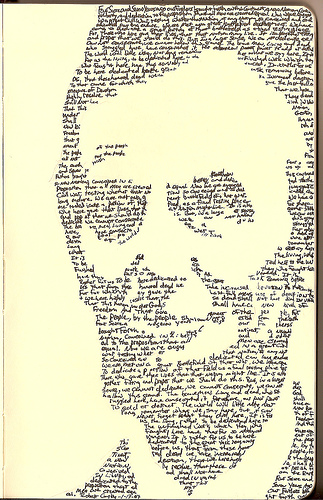
I found this interesting image on Abraham Lincoln. If you take a close look, you’ll see it’s the Gettysburg Address  pronounced by Abraham Lincoln (Pennsylvania, USA, 1863). I found this image a “metaphor” on text and the way it can send different messages and concepts depending on the way it is used and arranged.

lincoln


Image by Yelnoc: http://www.flickr.com/photos/yelnoc/361303918/

Categories
Introductions

“Obsolete”

Computer Mountain, originally uploaded by draikar.

When I saw this image of old hardware stored, the thought of how fast we run through different gadgets and fads immediately came to mind. It’s pretty amazing how “new” technology or technological artifacts become obsolete- giving in to something faster, better and simpler. I think that text has also gone through some transformations and stages, giving way to new delivery modes.
I’m Cecilia Tagliapietra; I live in a small USA-bordering town in BC, Mexico and I decided to take this course because the title and content captivated me when I first read them. This semester I’m taking my 6th and 7th courses with the double degree program with UBC and ITESM; I’ll probably ask for a lot for help, since we’ll be working with new, different tools I haven’t had the chance to try before. I honestly hope I can learn from all of your experiences and comments.
I’ll be reading you around 😉

Ceci Tagliapietra

Spam prevention powered by Akismet

Creative Commons Attribution 3.0 Unported
This work is licensed under a Creative Commons Attribution 3.0 Unported.