For this last commentary, I have selected Bolter’s chapter 9: Writing the Self. I felt this was appropriate as this course has initiated and altered my own thoughts on writing and the affects that writing technology has on the way we think and the way we interact with the actual technology.
Bolter begins the chapter with the following statement:
Writing technologies, in particular electronic writing today, do not determine how we think or how we define ourselves. Rather, they participate in our cultural redefinitions of self, knowledge and experience. (Bolter, 2001, pg.189)
As a society, we are influenced by the technologies that exist and aid in our existence. The early hunters and gathers were aided and influenced by the use of stone and stick- to which they fashioned tools to hunt and to aid in the preservation of foods. As a society in the knowledge age, we are influenced by our use of technologies that aid us in the rapid creation and transfer of knowledge. We exist through the instantaneous movement of 1s and 0s, which has transformed the very quality of our life. To imagine an existence without these technologies would be a kin to imagining what life would be like to live in a third world without food and shelter. This existence is prevalent across the world, but not an existence that many Canadians (excluding new Canadians) can identify with.
Bolter continues in his chapter by claiming “for many, electronic writing is coming to be regarded as a more authentic or appropriate space for the inscription of the self than print.” (pg. 190) I ask, is this because we truly know no other space? Just as I can not identify with the conditions of may inhabitants of this planet, I also can not identify with those ancient cultures who used ancient technologies to carve hieroglyphs and symbols onto tablets; or cultures who employed papyrus to convey the thoughts of the time. This same logic can be compared to the many seniors who can not grasp and use the computer and internet today; technologies that were not influencing factors in this existence!
Bolter furthers is chapter by stating that “writing is seen to foster analysis and reflection” (pg. 192) and “writing becomes a tool for reorganizing, for classifying, for developing and maintaining categories.” (pg. 193) Considering the vast amount of knowledge and information that is available, this statement is logical. Perhaps the question that one should ask is which came first, the changes in the use of writing as a knowledge organizer or the amount of knowledge that was available which required to be organized? Generally speaking, members of a society create or modify tools for a need and not as an accident. While much like the preverbal genesis of the chicken and egg, the answer would provide the foundations for the affects of writing technologies.
Lastly, the portion of the chapter that I was most intrigued with implicated current writing technologies and a refined experience for the author As “the technology of writing has always had a reflexive quality, allowing writers to see themselves in what they write” (Bolter, pg. 189), the desire of a writer want to “change her identity, by assuming a different name and providing a different description” (Bolter, pg. 199) allows the opportunity to create false selves in many virtual worlds including Second Life and chat rooms. While writing can be a wonderful venue to escape the world, the creation of false worlds can lead to serious repercussions if the author can separate the real from the fiction.
References
Bolter, J. (2001). Writing space: Computers, hypertext, and the remediation of print. Lawrence Erlbaum Associates. Mahwah, N.J. USA.
Literacyn.1 the ability to read and write. 2 competence is some field of knowledge, technology, etc. (computer literacy; economic literacy) (Oxford Canadian Dictionary, 1998, pg. 836)
Literacy has been discussed and will continue to be a topic of discussion far into the human future. The need to learn and to facilitate learning and the economic drivers that push technology changes will impact learning and how we view and define literacy. Ong states that “Literacy began with writing but, at a later stage of course, also involves print”. (1982, pg. 2) One would assume that literacy would and should develop to become multifaceted to include all information and communication techniques and the social factors that influence those modes. As the identified by the Oxford Canadian Dictionary, literacy should imply an understanding, along with the ability to read and write.
In the article A Pedagogy of Multiliteracies: Designing Social Futures, The New London Group presents the concept of multiliteracies – a redesigned ‘literacy’ with mutual consideration for “the multiplicity of communications channels and media, and the increasing saliency of cultural and linguistic diversity.” (1996, pg. 4) The new globalization, with ever increasing diversity, has resulted in an encroaching on the workplace, in public spaces and in our personal lives. These influences are driving a demand for a language “needed to make meaning” (1996, pg. 5) of our economic and cultural exchanges. How we perceive and how others perceive us is a factor in success. This success impacts and affects all facts of our lives. But in a global village, can we ensure that success is attained by all. It would appear to me that the requirement for multiliteracy is needed mostly in areas of economic disadvantage and disparity. Where access to even “mere literacy” (New London Group, pg. 4) is limited.
Cross-cultural communications and the negotiated dialogue of different languages and discourses can be a basis for worker participation, access, and creativity, for the formation of locally sensitive and globally extensive networks that closely relate organizations to their clients or suppliers, and structures of motivation in which people feel that there different backgrounds and experiences are genuinely valued. (New London Group, 1996, pg. 7)
To increase cross-cultural experiences within the workers’ education, the use of facilitated online study circles are excellent venues to create a dialogue for success and facilitate the “making of meaning” in workers’ participation. The International Federation of Workers’ Education Associations (IFWEA) employs study circles to attempt to close the gap in both worker education and multiliteracy in disadvantaged groups. These educational events provide an opportunity for Study Circle members to engage in the four elements of pedagogy as described including: Situated Practice; Overt Instruction; Critical Framing; and Transformed Practice. (New London Group, pg. 5)
The division of pedagogy into “the how”, places a new role and responsibility on the teacher and the school. In the articles, the teacher is described as a facilitator of cultural differences, and a developer of critical thinkers. This individual must navigate not only the knowledge of required instructional content, but also the technical and the cultural. The school, as the organization tasked to make differences out of homogeneity (The New London Group, pg. 11) must now reconfigure the classroom to include both global and local content and relationships, flavoured by diverse cultural distinctions. “Local diversity and global connectedness mean not only that there can be no standard; they also mean that the most important skill students need to learn is to negotiate regional, ethnic, or class-based dialects”. (The New London Group, pg. 8
While the New London Group article was written in 1996, it was bold to address some of the utopian ideals within education and literacy; individualized education at both a local and global level, with no standards and a high regard for cultural and linguistic differences in the classroom. Sadly, literacy is influenced by the very diversity and globalization that is forcing most of our social changes. These changes can be best described using the very words of described by the authors; “Fast Capitalism” (pg. 10); “rigorously exclusive” (pg.6); and “market driven” (pg.6). As Dobson and Willinsky states “a gender gap still persists in many parts of the world, being wider in some countries”. (2009, pg. 12) This gap may be an indicator “that in certain respects there has been very little movement in the gender gap in the last two decades”. (pg. 13) Perhaps with such disparities in our global context, the goal of our educational organizations and facilitators should be to ensure that a standard is met with regards to information literacy- “ the ability to locate, evaluate, and use effectively the needed information” (Dobson & Willinsky, 2009, pg. 18) This would ensure that a “competence is some field of knowledge, technology, etc.” (Oxford Canadian Dictionary) is achieved.
References:
Dobson, T. & Willinsky, J. (2009). Digital Literacy. Submitted to The Cambridge Handbook on Literacy
International Federation of Workers’ Educational Association. (unknown). The international programs. Retreived online 10 Nov 2009 from the World Wide Web: http://www.wea.org.uk/Education/International/
New London Group. (1996). A Pedagogy of Multiliteracies. Designing Social Futures. Harvard Educational Review, 66(1), 60-92.
Ong, Walter (1982). Orality and literacy: The Technologizing of the Word. London: Methuen.
Oxford Canadian Dictionary. (1998). Oxford, New York: Oxford University Press.
The telegraph can actually be considered the grandfather of the data superhighway – the telegraph operated on a digital format (on/off mode). (Lubrano, 1997, pg. xiv)
Ancient writings and pictograms of civilizations long gone are forms of communications that existed and provide clues to the intricate workings of a society. As a rule, these forms of communications have long been abandoned by cultures which now fill history books. These inscriptions, like most primitive dialects, were only effective in reaching those peoples that encountered and could interpret the material. The ability to distribute knowledge was limited to the geographical location of the text. Ancient writings, employed for knowledge transfer, have impacted all societies to some extent; if only as the result of cultures colliding in an increasingly smaller world. As with most messages, these writings were created to transfer the thoughts and knowledge of a society. It is this desire to “spread” the word is that is in essence the arching goal of communication; achieve a faster and more efficient means to transfer the message. Amazingly, this desire to expand knowledge was not always embraced. Much like the history of the Internet, prior desires to communicate across space and time are filled with progressive steps and changing literacy.
Literacy is defined as the ability to read and write. Reading, as described by Ong is the conversion of a text “to sound, aloud or in the imagination, syllable-by-syllable”. (Ong, 1982, pg.8) Imagine if text could exist in the form of finite signals and codes that could be “read” by a viewer and transcribed or transmitted for others to see. Imagine the origins of distance communication and the impact upon societies isolated by time and geography. Thus begins the story of telegraphy.
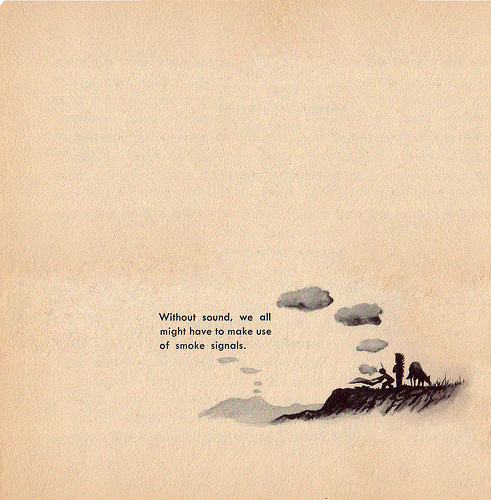
Telegraphy, as detailed by the Encyclopaedia Britannica is “derived from the Greek words tele, meaning “distant,” and graphein, meaning “to write.”” (Encycopedia Britannica, 2009). While we normally identify the telegraph to be an electromagnetic based system of transmitting dots and dashed (Morse code), this belief is flawed. Telegraphy existed long before in the simplest forms of distance communications. Early forms of telegraphy, describe in Iliad, included smoke and fire signals used to communicate during daylight and night times.
Fire signals were used extensively by watchers and scouts. Unlike other signal types, they did not normally serve to transmit orders but were instead used to convey simple messages, and they were considered to be quite valuable in this role. (Russell, 1999, pg. 146)
The earliest forms of telegraphy employed a simplistic code as a means to articulate the message. Often times, due to the geographical limitations and rudimentary technology (i.e. blanket, fire and fresh grasses) of the telegraphy, the message was pre-arranged to define only important events such as ‘danger’, ‘victory’ or a ‘summons’.
Without Sound. make Signals
Image downloaded From Flickr 28 Oct 09
Another form of visual telegraphy that impacted society was signal flags used mainly by government and mariners worldwide. The optical telegraphy or semaphore is “is an alphabet signalling system based on the waving of a pair of tower constructed or hand-held flags in a particular pattern.” (Croft, Unknown) Used extensively by the French government during the French revolution, and by naval fleets (still employed by use of hand held flags), the semaphore system provided distance communications thru a series of sequential stations that conveyed the messages. As the alphabet was the “code” of semaphore, the message could be as complex as required to effectively convey significance and importance. Given these new advances in complexity of the transmitted message through the use of the alphabet, limitations did exist including the time to record the signal and retransmit to the next station and the requirement to have a constant vigil for incoming signals. The semaphore system was eventually abandoned as a “law was enacted imposing jail sentences and stiff fines (up to 10,000 francs) on “anyone transmitting unauthorized signals from one place to another by means of the (Chappe) telegraph machine.” (Neuman, 1996). Besides fears of rising public opinion, the semaphore system “required extensive manpower and was expensive to operate. Stations were seldom more than eight miles apart and were subject to interruption due to adverse weather conditions.” (Lubrano, pg. 10)
Communications
Semaphore flags in background. Electrical Bolt symbolic of electric telegraphy.
In addition to the prehistoric visual telegraphy, audio telegraphy was used to gap distances beyond line-of-sight. In Africa, drums were (and still are) commonly used as a means to convey messages across distances to both humans and gods. Among the Ashanti people of Ghana, two styles of drumming: signal and speech exist for communications purpose. Communications by drumming employs of two drums, one high tone and one low tone, which is used to “to mimic the highs and lows of the local Twi language, a tonal language.” (Wilson, unknown)
As society’s reliance on rapid communications grew, better technologies were developed. The geographically limiting visual and audio telegraphy was remediated by the faster methods. Research and trialing of electronic signaling was wide spread. As Nonenmacher reports:
The science behind the telegraph dates back at least as far as Roger Bacon’s (1220-1292) experiments in magnetism. Numerous small steps in the science of electricity and magnetism followed. Important inventions include those of Giambattista della Porta (1558), William Gilbert (1603), Stephen Gray (1729), William Watson (1747), Pieter van Musschenbroek (1754), Luigi Galvani (1786), Alessandro Giuseppe Antonio Anastasio Volta (1800), André-Marie Ampere (1820), William Sturgeon (1825), and Joseph Henry (1829). (Nonnenmacher, 2001)
In 1884, Samual Morse, with his assistance Alfred Vail trialed a telegraph line between Washington and Baltimore, transmitting the now famous message “What hath God wrought?” (Today in History, 2007) Morse and Vail had developed the technology to allow the required break in the electrical current; pauses in electrical current which provided the foundation for the code. Remediation of visual by electronic telegraphy had begun, resulting in sweeping changes in communications methods.
The electrical telegraph transformed society by achieving the goal of increased efficiency and effectiveness in communications. Long distance communications within short timeframes reduced the size of a country and connected nations. This increased speed was not the only change; the language of telegraphy was also transformed. “Morse Code” was credited to Samuel Morse, but his assistant Alfred Vail is suspected of perfecting the code that exists still today. This code is an alphabetic language created with the use of “dots and dashes [corresponding] to letters and punctuation in the English language. This cipher, which is still widely used today can be equated as to an early form of digitization, as all words, numbers and punctuation are comprised of two “dot” and “dash” symbols.” (Kanderovskis, 2007)
Electronic telegraphy influenced society in much the same way that the Internet influences society today. From this birth of rapid, long distance communications, the foundation for standardization of journalistic style and mass communications began. Information could be gathered, reviewed, transmitted and distributed across a nation with little effort. Local papers began to focus more on national affairs and less on local opinion. This flow of information affected all aspects of society; resulting in an increased awareness to national and international affairs, within shorter timeframes. Even fiscal policies and practices were affected. Yates argues:
the telegraph encouraged the growth and efficiency of markets by reducing communication time and costs and that it encouraged the growth and vertical integration of firms by forwarding the emergence of national market areas to absorb local and regional market areas. (Unknown)
The telegraph linked businesses across a nation and across international boundaries. Through the electronic telegraph, society was provided a venue to share and prosper; but like the Internet, the venue was not accepted by all. “Russian Czar Nicholas I was likewise terrified by the telegraph’s potential to spread information. Fearing that the broad use of the telegraph would prove “subversive,”” (Neuman, 1996) Nicholas refused to conduct business with Morse to create an effective communications system across Russia. This fear of progress resulted in substandard communications for the military during World War I.
Progress in communications, specifically electric telegraph affected all institutions: political, social and governmental. “Embassies connected by telegraph to their home foreign ministries …long used to operating on their own, increasingly received instructions about pressing issues from their home office.” (Papp, Alberts, Tuyahov, 2002) Financial markets could deal in commodities and set prices at a national vice local market. Distance and time melted away first with smoke, progressively advancing technology towards each dash and dot transmitted across the vast electrical lines; the earth successively reduced in size. Access to national and international events resulted in the standardization of journalistic reporting and realization that ‘others’ existed outside or the local confines. This path towards ‘globalization’ in communications, while benefiting many, resulted in some fears concerning the spread of knowledge and public opinion. From an internet of electrical lines with dots and dashes, the desire to communicate to all people at all places would drive the next generation to find the internet of ones(1) and zeros (0) and remediate the electrical information highway.
References
Croft, J. Semaphore Flag Signalling System. Retrieved online 21 Oct 2009 from the World Wide Web: http://www.anbg.gov.au/flags/semaphore.html
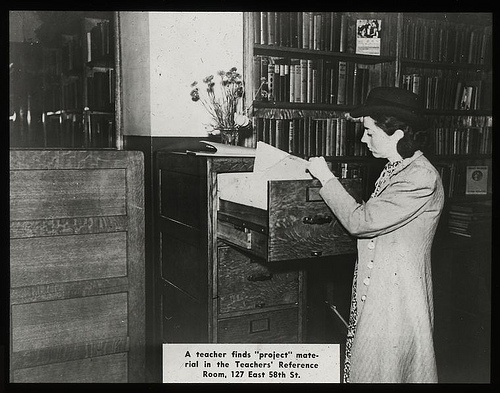
Digital ID: 465215. Work with schools, teachers' reference room : a teacher finds project materials, 1938.. 1938
As a class, we are all aware that Ong’s chapter 4 is a discussion focused on the effects of writing on consciousness, outlining some characteristics of writing within a brief history. After I had selected this chapter for the commentary, a second reading redirected my focus from the initial concepts of writing as a form of technology and the concept of writing as “contumacious” (Ong, 2002, pg.78) towards a slightly different focus on two concepts that was dispersed yet combined throughout the chapter. These topics stirred ample thought and I feel they deserve more critical attention. These ideas are identified in a continuous intertwined fashion including a passage as Ong states “One of the most startling paradoxes inherent in writing is its close association with death. This association is suggested in Plato’s charge that writing is inhuman, think-like and that it destroys memory.” (Ong, pg. 80) This statement provoked two divergent stems of thinking; the first being that ‘memory is destroyed’ and the second being the association of death to writing. While the history and the effects of writing on a society has not held a prominent point in my academic career until this moment, I would never have believed nor have imagined that writing could be associated with either death or memory loss.
Memory loss
The concept that writing destroys memory appears to be a little presumptuous as the very least. Memory, much like the scraps of paper we store in our pockets are meant to be discarded when no longer required, resulting in “customary law, trimmed of material no longer of use, which automatically always up to date and thus youthful”. (Ong, pg. 97) While it is necessary to have an appreciation regarding the lack of research into the effects of writing at the time of Plato’s statement, research today “suggests that people who will develop dementia may be able to delay memory loss by daily activities that stimulate the brain such as reading, writing and card games.” (Dementia Matters) The human mind was meant to disregard information that was considered not relevant or needed for current existence. Writing has created not memory loss, but the ability of a culture to preserve what would naturally be lost; resulting in an artificial reversing of the natural memory loss process.
Death
The second concept which Ong mentions is that of death. According to The Oxford University Press death is defined as:
1 [C] the fact of sb dying or being killed:
2 [U] the end of life; the state of being dead:
3 [U] ~ of sth the permanent end or destruction of sth:
4 (also Death) [U] (literary) the power that destroys life, imagined as human in form (Oxford University Press, 2005)
Considering the aforementioned definition, the association of death to writing is a difficult notion to digest. Writing has the ability to immortalize the writer, to transcend time and culture and to persist even when the culture that created the actual writing no longer exists. As Ong writes “most books extant today were written by persons now dead.” (Ong, pg. 101) Ancient texts such as the rongorongo from Easter Island evidence this statement. These ancient texts are a writing system in with a combination of ideographic and phonetic. (The British Museum) While these texts are not fully deciphered and may never be, the culture that created the text is long gone, but their legacy lives on in their writing and the interest that they generated.
The intertwined concepts of memory loss and death which are a result of writing create many doubts. This may be due to the fact that I belong to a culture where writing is integrated in all aspects of daily life. Just considering that we can store in artificial means, (not the mind) a wide variety of information, ensures that death can not occur. The life of the information, stories and memories will never die unless our capacity to write and learn to read those writings ceases to exist.
When I initially begin to “surf” around the community Weblog, I was getting very frustrated. It was a feeling of chaos and clutter. I was looking to find some means of scaffolding my learning and to balance where I was and where I had to go. This blog is not, in my opinion, user friendly. I do not feel that this has aided in my learning, as I was feeling frustrated with my progress and my location. Upon reading the Summary page, I understood that the blog was created in a fashion that is disorienting; rather unfair to lead the students astray J
In the Community Weblog, the pages I enjoyed the most are those that appear different. The photos are unique, the style of writing deviates from the norm. Perhaps this is because I spend the bulk of my day looking at formal documents and I want to have something catch my interest.
Text is…. Images and words….. bound together by some pattern….. that is understandable by a community…… that transcends time……. until it is discovered by another culture and then is researched and analyzed……. Text is what we create…… when we weave together thoughts…… to share ideas with others……. to create rules….. to create escapes…….. Text is not just words…… not just ideas….. not just symbols with meanings…… Text can define who we are…. where we are going…. how we got there……This is my idea of text.
The word technology is something that I struggle with often. I see technology as any tool that aids in the creation of some other object or allows work to be completed with some amount of ease. Consider a rock. If I use a rock to hit another person, it is now a weapon. If I use a rock to draw a picture on a cave wall, it is a tool. My perfered definition of technology is best described by Ursula Franklin in the CBC Massey Lectures. Franklin states “Like democracy, technology is a multifaceted entity. It includes activities as well as a body of knowledge, structures as well as the act of structuring.” (Franklin, 1999, p. 6) Franklin further defines technology as “practice…ways of doing something.” ((p.6) This ‘process of work’ can be categorized into two distinct spheres including holistic and prescriptive technologies. Holistic technologies can be equated to those events whereby the same individual envisions an idea, prepares the means to accomplish the idea, and results in an end product that was created from start to finish by one set of hands; a painting, a goblet, or writing on a cave wall. Prescriptive technologies can be best summed up by mass production, compliance to a standard and little to no deviation or creativity for the worker; Fordism or Military training
Franklin, Ursula. (1999) The Real World of Technology. (CBC Massey lectures series.) Concord, ON: House of Anansi Press Limited.
My name is Laurie Trepanier and this is my eighth class in the MET program. I am hoping to complete all degree requirements by April, but this may be difficult as I have just completed a move from Borden, Ontario to Cold Lake, Alberta. While the move was not very difficult, my new job is becoming a little more hectic each day.
For those who I have not yet had the pleasure to meet, I am a Training Development Officer in the Canadian Forces (CF). My job while in Borden was to instruct CF members on the Systems Approach to Training (SAT) used in our system and to assist tradespersons to become instructors within our schools. My new job is to advise Command on the acquisition of training technologies (simulators, software, etc) and to oversee the training of the technicians who maintain the CF-188 Fighter Jet (Hornet). The technical background that I require to be effective in my new job leads me to spend many nights reading information concerning airworthiness, safety systems, weapons, airframe structure and electronic systems and sub-systems. Thus my dream of completing two courses this semester has been placed on hold.
Being a Navy gal, the picture I have selected is very significant to both my military career and my idea of communications, text and technology. While the signal flags are considered old, it is just as effective in both military and civilian marine operations today as it was in the time of Nelson. My opinion of technology is basic; is not just a computer or a PDA. To me, it is a means of communications – regardless of the age of the tool. Text is what results when technology is used. Technology is the tool; it is the object that can transform thought into symbols that others can understand.