Categories
Making Connections

Connections between my learning and my life

This course has allowed me a unique opportunity.  As a Teacher-Librarian I am mired in questions about the future of print and often find myself challenging my colleagues to see beyond what they percieve to be their role today and to honestly look at how they may need to morph that role to meet the the changing space of reading.

As many of my classmates have stated I particularly enjoyed reading the work of Bolter.  His writing style held greater appeal for me as a learner.  I found it to be much less scholastic than that of Ong and this too may indicate a paradigm shift in how people read and gather information.  Like my Net Generation students I am moving most often in a digital world.  I expect to be engaged in the material.  I want to be hyperlinked and hypermediated.  The MET degree that I have almost completed and my Bachelor of Education degree have both been done without ever setting foot in a library.  I did not conduct a catalogue search, wander through the stacks or crack open a dusty tome. 
I, too, am experiencing a remediation of print.

Having an opportunity to question my beliefs about this “unprecedented” change in reading and writing that we are currently experiencing has been the best part of this course for me.  I truly enjoyed the chance to see that while the scale of the change may, indeed, be fantastic in the digital world it is but one of series of major remediations that has occurred as text and technology have evolved.

Additionally, I would like to thank all of my colleagues for their generosity of thoughts, ideas and observation as we have co-created the community weblog together.  I have thoroughly enjoyed reading your work and have learned more from the collective in this case than from the “published” authors. 

On a personal note, for all of you who sent messages to me as I went through this most difficult of terms, a most sincere thank you. 

Cheers,

Louise Thomson

Categories
Rip.Mix.Feed.

Reflection…


Like Kelly, I originally created this “movie” using Slide.com for ETEC 565 in the summer term.  When I saw the Rip/Mix/Feed assignment I, too, was drawn back to this project I created out of our family trip across Canada 2 summers ago.  Now it seems even more poignant to me as I realize that this trip, which seems like yesterday, was right before I started my MET journey.  Now, as I revisit it I am almost done.  With one more course to do in January the process of reflecting on this journey is very timely.

This term has been incredibly hard for me.  I got a garden variety flu right at the beginning of the term and three days after that ended I got “the” flu.  I have felt incredibly behind throughout the term.  With this term almost over I heave a great sigh of relief!

All journeys have their difficulties but are hopefully worth it in the end.

I look forward to getting back to my family who have all sacrificed something so I could pursue this goal.  They have been very patient.

Journeys

Categories
Commentary 3

The future of Professor Johnny

YouTube Preview Image


           I have a class full of the Net Generation.  They live in a hypermediated world where they can virtually dissect an owl pellet on KidWings.com, they can learn about simple machines on EdHeads.org or play math and literacy games on Starfall.com.  They expect that when they do a science unit on bats that they will be able to see bats in their natural habitat.  They know that when they don’t understand what a word means they can not only look it up online and it will usually be accompanied by a digital image of some description.  The world is at their fingertips.  They are in grade 2.

            In their article, Why Professor Johnny can’t read: Understanding the Net Generation’s texts, authors Mark Mabrito and Rebecca Medley (2008) offer an opportunity for educators to examine what they will need to do in order to make themselves more effective in educating the next generation.  Today’s students are a fundamentally different iteration of learners.  They have grown up with, “pervasive digital technology” (Mabrito & Medley, 2008).  And, according to Marc Prensky (2001) this change represents a singularity in that the effects of changes in technology are so dramatic that there can be no return to previous ways of thinking or doing.

             Key to this difference, the authors claim, is the way in which educators and the Net Generation view texts (Mabrito & Medley, 2008).  As the Net Generation has been inundated by digital technologies they have developed skills that their teachers do not necessarily have.  These savvy kids have the ability to move within the text presented to them and to create and modify information in a multi-media environment.  Most of their teachers grew up using text in a linear fashion and are used to the text itself being in control of the way in which information is presented to, and gathered by, the user (Mabrito & Medley, 2008).  Today, the presentation of information occurs not only in a non-linear format but is also multi-modal in nature in that it may also be enhanced by video, audio and digital images.   Our Net Generation students are learning to move fluidly in this environment and have come to expect that everything they experience will be presented in this fashion.  This shift in how the two generations learn suggests that culture influences both what and how a person thinks and that the actual processing of information may, “differ according to the culture in which a person matures” (Mabrito & Medley, 2008).

             For our educators, teaching to this new breed of student will be a challenge.  If our practice is truly self-reflective it will be ourselves that need to morph to work with the different set of skills that our learners need and are currently developing outside of the classroom environment.  Mabrito and Medley (2008) suggest that educators will have to embrace to concept of distributed knowledge and move away from the traditional notion of individual knowledge.  This strategy for learning is evident in many of the classrooms of today in the form of an increased emphasis on “doing” rather than “receiving” learning.  Good teachers are striving to have their students participate in learning in a more vocal and kinesthetic way but this trend in education is, most likely, not born out of cultural trends in learning.  The authors also feel that educators will need to go out to the world of their students and experience and learn from it first hand (Mabrito & Medley, 2008). 

            Looking at the criteria for this very assignment leads me to wonder what the impact of the Net Generation’s vision of reading text will be on the world of academia.  The criterion for this very assignment includes the following elements.

           “Commentaries should show evidence of considered, critical    response, and           claims should be supported through citation of relevant sources. Writing is            expected to be of a professional/scholarly standard.” (ETEC 540, 2009)

Will the definition of “formal” change when the Net Generation takes over the helm in the academic world?  Will what is considered to be “professional standard” change as professions evolve to reflect cultural changes?

            Last night, my twelve year old son sat on the couch with the laptop balanced on his knees.  His assignment was to find two words in the novel they were studying in class and to find the definition for each.  When I asked him what he was doing he said that, “Going to Dictionary.com was a lot easier than looking through that big honking book”.  I burst out laughing at how apropos his comment was to what I was currently working on.  The teacher intended the students to learn some of those dictionary skills we have spent so much time on with our students in the past but my son has always had the ability to seek out information in ways that I did not as a student.  Resistance, as they say, is futile.  Today’s educators will have to step up their involvement in the world of their students if they want to help prepare them for their world.


Resources:

Mabrito, M. & Medley, R. (2008).  Why Professor Johnny can’t read: Understanding the Net Generation’s texts.  Innovate: Journal of Online Education, Vol.4 (6).  Retrieved from https://www.vista.ubc.ca/webct/urw/lc5116011.tp0/cobaltMainFrame.dowebct?JSESSIONIDVISTA=kBjhLFFXZT2pSWVCGVKgFKy55GN1rxQFvr2bvLYLvGb0jygYcGhP!1296897521!node15.vista.ubc.ca!20001!-1!-1968798209!node16.vista.ubc.ca!20001!-1

Prensky, M. (2001).  Digital natives, digital immigrants.  On the Horizon, Vol.9, No. 5.

Categories
Commentary 2

The school library and the breakout of the visual

In Chapter 4 of his book, Writing space: Computers, hypertext, and the remediation of print, Jay David Bolter (2001) discusses the rise of the visual and its impact on text.  As a Teacher-Librarian the rise of the visual in our culture is particular interest to me.  As our post-print generation moves through the education system we are being challenged to redefine the nature of libraries and their role in education.  In this commentary I view Bolter’s work through the lens of my profession.


Of immediate interest in Bolter’s work is the notion that images on the World Wide Web dominate but images on the printed page are contained by the text that surrounds them.  There is an element of control in print culture that is not evident in web-based applications.  Specifically mentioned is the way that professional journals and other scholarly texts surround the images they permit and supervise the reading of the image.


Bolter points out that even when images dominate in scholarly text there is little doubt that the text is in a position of control.  He refers to this use of image as “textural”.  This notion gives rise to the question of whether images in web-based works don’t often provide this same function.  When I think of the way that I, my colleagues and my students use images in the products of our learning it seems that they often serve to give texture to the work.  Images are frequently included after text is written or are accompanied by explanatory text.  This may indicate that our use of image is still in its infancy to some extent.  Are those of us born of a predominantly print-based culture slow to learn how to harness the power of the visual?


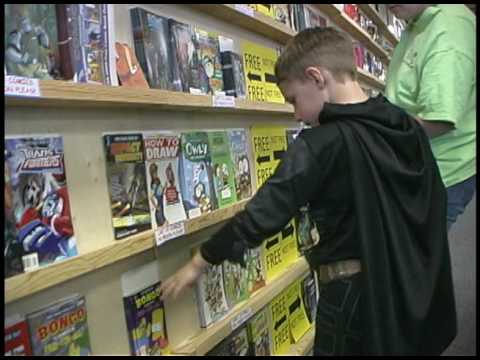
Bolter questions what is happening to print and prose in what he calls the, “late age of print” (2001) and suggests that text is morphing itself to both compete with and incorporate the proliferation of images and their inherent cultural power.  In the school library this is evident in the rise of graphic novelizations of classic children’s books such as the Hardy Boys series by Scott Lobdell and Paulo Henrique.  Text in these graphic novels is far less than in the original book versions and are accompanied by images that serve to both complement and supplement the story.  Works such as the ground-breaking, The adventure of Hugo Cabret by Brian Selznick offer a combination of text and stand-alone images to tell the story.  Additionally, many text-based works now offer web-based links to additional story features and activities based on the books.  These applications are largely visual and demonstrate the turning tide children’s literature.  An excellent example of this is the 39 Clues series, by Scholastic Press.


Interesting too is the suggestion that this remediation of print is born out of both enthusiasm and fear.  Change is generally a feared state of being and as a Teacher-Librarian I am constantly aware of the combination of these reactions to changes in our formerly print-based culture among my professional colleagues.  While some embrace and endorse the changes in literacy there are a great number who wish to stem the tide of change in order to maintain their sense of purpose.


Teacher-Librarians, in their quest to maintain the sanctity of the physical library space and all that it contains, are also uniquely challenged by the fact, as Bolter explains, that text is now competing, “for a reader’s attention with a variety of pictorial elements, any or all of which may be in motion” (2001).   This increasingly visual world with its cultural expectation of high quality images, special effects and incredible animations makes capturing the attention of today’s students very difficult.  Students are often witnessing works of text as image-based before they discover that the material existed in a print-based form long before it was released as a full-length feature movie.  There have been a number of films based on children’s literature in the last few years.  What Teacher-Librarians are commenting on is how often these movies serve as the first introduction to the material for most children.  Eragon, Cloudy with a chance of meatballs, Where the wild things are, and Hoot are some of the many movie scripts derived from books.  Many of my professional colleagues criticize these movies and what they perceive as their detrimental effects on reading.  However, I often notice in my own practice that these movies often lead my students to seek out the books that the movie plots came from.  In this way the text seems to be benefited by the image and draws a new generation of consumers of print into the fold.


The breakout of the visual will undoubtedly have significant impacts on many areas of our culture.  This impact will not escape the school library and its keepers.  Teacher-Librarians are at a cultural turning point.  They will need to find a way to adapt and manage as text changes in the wake the rise of the visual.  How well they will fare remains to be seen.


References:

Bolter, J. D. (2001). Writing space: Computers, hypertext, and the remediation of print [2nd edition]. Mahwah, NJ: Lawrence Erlbaum.

Categories
Research Paper

Comic books and graphic novels: The transformation of reading in the classrooom


 YouTube Preview Image

Introduction

            Ask many librarians or classroom teachers and they will often remark that the comic is a low form of the written word and does not denote “serious” reading on the part of their students.  Many will not count reading a comic as part of a home reading program or, at the elementary level, will not allow students to read this type of material during class silent reading periods.  Even librarians who willingly add them to their collections often dismiss their importance (Tilley, 2008).  In recent years however, the tide seems to be turning in favour of these pulpy little stories.  Innovative teachers are beginning to accept the role that comics, and their closely related cousins, the graphic novel, are capable of playing in the education of our children (Viadero, 2009).

Accessibility

      Even though there is evidence of the existence of comics dating back over 150 years they became most readily available during the 1930’s in North American news agents and drugstores (Aleixo & Norris, 2007).  This coupled with the low price of the publications made them easily accessible to the public in general and children in particular.  In addition there was little competition from other media at that time for, “the time, money, and attention of children” (Jacobs, 2007).  Jacobs explains that this ease of availability meant that comics offered a different option for the practice of literacy that was beyond the bounds of a child’s formal education (2007).  This increased literacy practice has propelled many children forward as literate members of society and despite the criticisms leveled at the comic world these little books may be better positioned to prepare today’s students for the multiple literacies required in a world where they are constantly inundated by visual images.

Modification and Multimodality

      While comics have been much maligned by educators and were even the topic of televised US Senate hearings in 1954 (Kannenburg, 2008), their potential role in literacy education in the classroom is somewhat more positive.  It is still rare for teachers to embrace their use in literacy training but it seems that regardless of how scholars define the comic form what seems constant is that in this genre the visual is an important element and, “should not be seen as subservient to the written” (Jacobs, 2007).

      It is this combination of text and image that Gunther Kress calls multimodality (Jacobs, 2007).  Jacobs maintains that this shift to thinking about comics as multimodal text rather than as a lesser form of writing is significant in the culture of text (2007).  It is also significant in terms of understanding the power of comics to teach multiliteracy skills required by today’s students.  This valuing of visual literacy has been slow to take hold.  Teachers are taught to believe that beginning readers rely on text and that good readers move beyond pictures but the inclusion of comics and graphic novels into the classroom has provided a new generation with an opportunity for layered deconstruction that may help them scrutinize the manner in which interdependent text and imagery creates what has been called, “a strong sequential narrative” (Williams, 2008).  This layered deconstruction will involve not only an examination of the text and images but will need to consider the comic author’s use of panels in the creation of the story.  These panels guide the reader’s attention and pace the reading in the same way that, “poets use line breaks and punctuation” (Tilley, 2008). 

James Bucky Carter (2007) contends that integration of graphic novels into the classrooms of today will transform the study of English.  A move away from the notion that literacy is purely text-based will help educators move beyond what he calls, “one size fits all” literacy education (Carter, 2007).   This means that the impact of this form of reading may not have had its full impact yet.  Its time may still be coming thanks to technological developments that increasingly rely on the user’s ability to process visual images.

Pathways to learning

      In many curricular areas the reading of comics affords the educator and the reader a unique opportunity to engage in concepts and ideas that would be, depending on the age of the student, unreachable or difficult in traditional text formats.  The inclusion of pictures adds a scaffolding element to learning that can be particularly advantageous in the area of social studies.   Williams (2008) argues that, “graphic novels, like a compelling work of art, or a well-crafted piece of writing have the potential to generate a sense of empathy and human connectedness among students”.  Visuals combined with text allow comic and graphic artists to ask their readers to consider a different point of view and look at a situation through the eyes of another.  In the teaching of social studies this is fundamental to real understanding of both past and current events and represents deep learning on the part of the student.

Conclusion

                  In these ways, comics and graphic novels will continue to impact and modify our views of text in education.  As innovators in the field continue to encourage children to explore this genre the idea that comics are only transitional literature may someday become a thing of the past.  Over the past 80 years the progress may have been slow and there have not been any opportunities for comic-like exclamations like “Pow” or “Ka-bam” but new technologies that require a different form of literacy just may be what the comic needs in order to legitimize itself in education.   

Resources:

 Aleixo, P., & Norris, C. (2007). Comics, Reading and Primary Aged Children. Education & Health, 25(4), 70-73. http://search.ebscohost.com

 Burton, D. (1955). COMIC BOOKS: A TEACHER’S ANALYSIS. Elementary School Journal, 56(2), 73-75. http://search.ebscohost.com

 Carter, J. (2007). Transforming English with Graphic Novels: Moving toward Our “Optimus Prime.”. English Journal, 97(2), 49-53. http://www.ncte.org/library/NCTEFiles/Resources/Journals/EJ/0972-nov07/EJ0972Transforming.pdf

 Jacobs, D. (2007). Marveling at The Man Called Nova: Comics as Sponsors of Multimodal Literacy. (pp. 180-205).  http://www.ncte.org/library/NCTEFiles/Resources/Journals/CCC/0592-dec07/CO0592Marveling.pdf

 Kannenberg Jr., G. (2008). The Not-So-Untold Story of the Great Comic-Book Scare. Chronicle of Higher Education, 54(37), B19-B20.  http://search.ebscohost.com

Tilley, C. (2008). Reading Comics. School Library Media Activities Monthly, 24(9), 23-26. http://search.ebscohost.com

 Viadero, D. (2009). Scholars See Comics as No Laughing Matter.  Education Week, 28(21), 1-11. http://search.ebscohost.com

 Williams, R. (2008). Image, Text, and Story: Comics and Graphic Novels in the Classroom. Art Education, 61(6), 13-19. http://search.ebscohost.com

 Williams, V., & Peterson, D. (2009). Graphic Novels in Libraries Supporting Teacher Education and Librarianship Programs. Library Resources & Technical Services, 53(3), 166-173. http://search.ebscohost.com

Categories
Commentary 1

New literacy and the library debate

Last year during a particularly severe round of budget cuts a parent at a School District meeting asked why we spend money on books.  She wanted to know if libraries were a thing of the past and should we be wasting money on print literature.  Having a position as a teacher-librarian and being an avid lover of literature I found myself appalled at this statement.  I was not alone.   How could someone suggest that the book was a device that would sink into obsolescence?  After all, I could never picture myself curling up with a laptop and reading The Life of Pi.  But perhaps I am in the minority.


If the reading of books is on the decline as Caleb Crain (2007) suggests then it may be so that in the near future libraries will be converted to other uses in our schools.  As a librarian I am particularly interested in how the notion of text is changing for my students and it was for this reason that rather than doing a degree in Library and Information Studies I chose to enrol in the Masters of Educational Technology program.  As text changes so too does the job of the librarian in today’s schools.  This position is increasingly becoming a technology position as more and more information is accumulated, stored and even created initially in a digital format (Grafton, 2007).  Teacher-librarians must now become experts in multiple literacies as they help to guide their students through these varied information sources.


In his article, Future reading: digitization and its discontents, Grafton (2007) addresses the rise and potential fall of the library and while the change that the modern library may not be matched in scale to the changes it has encountered before there is a great deal to be gained from examining its past in order to predict its future.  In fact the impact of the rise of the printing press on the library was so profound that an entire system of cataloguing and managing the flow of information became necessary.  As a librarian I am constantly discussing this issue with colleagues.  Will librarians be tasked out to catalogue web-based information or is its status too potentially fleeting to make it worthwhile?


            Perhaps the most intriguing idea here is that even the staunch world of academia now turns to a search engine before it enters the library’s stacks when it begins research (Grafton, 2007).  Grafton points out that journal subscriptions are on the rise and the sale of university-press books are dwindling and one only has to look at our own work in the MET program to see evidence of this.  In fact, as UBC holds subscriptions for to electronic journals for student and faculty access it is becoming rarer that students are required to purchase custom course materials in print form for their courses.


            Grafton (2007) exposits that we will still need our libraries because the physical form of the text or book impacts how it is used and this cannot be duplicated in digital form.  He speaks of historians gleaning information from notations made in family bibles and binding methods that speak to elements of social history.  Concern here though is that he is addressing the book in historical context.  It seems already relegated to a thing of the past.


            Where I think that the demarcation line may lie is between text in the form of information and that in the form of literature.  While research and information gathering is increasingly dominated by the web the digital book has met with some resistance from those of us who love the feel and portability of a good book.  Where the library must refocus itself is in dealing with text as it evolves into a digitally dominated format.  It must refocus, as it has always done, to meet the needs of a changing text-space but its role as a place where literature lives will be slower to change.


References


Crane, Caleb (2007).  Twilight of the books: What will life be like if people stop reading?  New York: The New Yorker.


Grafton, Anthony (2007).  Future reading: Digitization and its discontents.  New York: The New Yorker.

O’Donnell, James J. (1994).  The virtual library; an idea whose time has passed.  Gateways, Gatekeepers, and Roles in the Information Omniverse: Proceedings of the Third Symposium. Eds.  Ann Okerson and Dru Mogge. Washington, DC: Association of Research Libraries Office of Scientific and Academic Publishing. 19-32.

Ong, Walter, J. (1982). Orality and literacy: The technologizing of the word. London and New York: Methuen.

Categories
Introductions

Nancy Bird, London, 1939

Nancy Bird, London, 1939, originally uploaded by State Library of New South Wales collection.

Hi everyone. My name is Louise Thomson. I am currently working on courses number 8 and 9 (!) in the MET program and am working full time as a grade 2 teacher in a rural community in beautiful Vancouver Island.

I chose this picture because of the conversations I have been having with my co-workers all week about technology integration into our non-techie school. I have spent this first week of school with the grade 5’s because our class assignments have not been made and chose to teach them how to do claymation rather than some of the usual first week stuff. They have blown me away with what they created!

When I saw this picture I thought about how exciting new technology often for some and how intimidating it is for others. Like this plane, in the wrong hands it can also be dangerous!!

Cheers,
Louise

Spam prevention powered by Akismet

Creative Commons Attribution 3.0 Unported
This work is licensed under a Creative Commons Attribution 3.0 Unported.