Hey gang!
I’m working on the new version of the site, and I’m wondering what you want to see out of it. Final decisions will rest with the editorial board but we’re open to suggestions.
Hey gang!
I’m working on the new version of the site, and I’m wondering what you want to see out of it. Final decisions will rest with the editorial board but we’re open to suggestions.
Hi everyone: I just recieved an email regarding the new Voter Funded Media system:
Only 15 people are registered to vote. Needless to say this is bad for democracy, because I can get my three roomates and brother to vote and sweep the contest. Now then.
As approved by AMS council, VFM is now running on a continuus model that offers smaller prizes for media on a monthly or bi-monthly cycle
From VoterMedia.org (Mark Latham’s site) here are registration and voting instructions:
Email your UBC campus-wide login ID (not password) to
mark[at]votermedia.org. I forward them to UBC staff, who usually upload them Mon
Wed & Fri mornings. You only need to register once for the whole year of
periodic contests. (Better do this by April 27 if you want to vote in this
contest period ending April 30.)Log in at www.vista.ubc.ca.
Click on “VOTE – VoterMedia”. You vote once in each contest period.
While this registration process is a bit cumbersome, it’ll only cost you one email. Of course we’d love if you choose us, but check out all the other worthy media too. They’re listed at Votermedia.org/ubc. Any prize money we win will be chiefly dedicated over the coming months to transitioning into a new and more dynamic blogging platform.
In other news, I’ve written about 5000 words in the last 30 hours. And still one thesis to go. Sigh.
A historical polemic by UBC alum Mike Thike
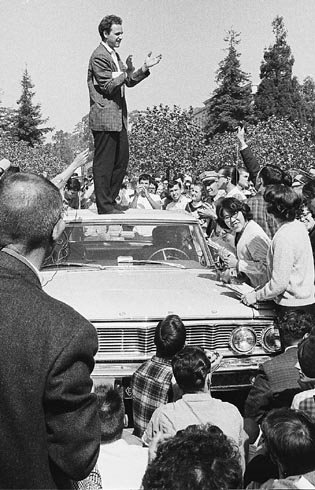 Do you know who the man in this picture is? If not, you probably lack a lot of knowledge that would be helpful in understanding the current activist climate at UBC. With Trek Park, the “Lougheed Affair”, and the recent Knoll Aid 2.0 RCMP confrontation, tension within the AMS has risen beyond reason. I think much of this tension is due to radically different perceptions of politics, history, and the role of student activists in society. While I can’t expect to convince SDS-UBC and The Knoll’s most strident critics of their value, I do hope that history can help us to find some common understanding and lead to more constructive dialogue.
 The man in the above picture is Mario Savio, the most prominent student leader at UC Berkeley (and in America) during the 1960s. He is standing on a police car. Inside the police car is Jack Weinberg, an activist and former Berkeley graduate student. In September 1964 the Berkeley administration had decreed that students on campus would not be allowed to promote political or civil rights causes through fundraising, passing out pamphlets, tabling, or other means. At the beginning of October, Weinberg was tabling for a civil rights organization, the Congress of Racial Equity. The police asked him for I.D., he refused, and they arrested him. A host of sympathetic students then surrounded the police car with Weinberg inside it, and did not move for over a day, at one point repelling an attempt by police to reach the vehicle. By the following evening, the students had negotiated with the university administration an accommodation for political activity on a portion of the campus, and the waiving of charges against Weinberg.
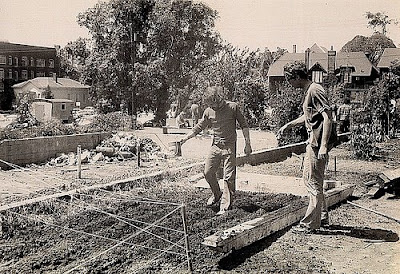 How about this picture? This is a community garden being planted in Berkeley’s People’s Park in 1969. People’s Park was built on land owned by the university originally intended for student housing but left to deteriorate after development plans changed. In April 1969 a number of community members began constructing a park on the land, without the university’s blessing. The park lasted for a month before police moved in to dismantle it under the direction of newly elected governor Ronald Reagan. The ensuing conflict resulted in the death of James Rector, shot by police while sitting on the roof of a nearby cinema. Today People’s Park is a Berkeley landmark.
If student movements for change are rarities still on the campus scene, what is commonplace there? The real campus, the familiar campus, is a place of private people, engaged in their notorious “inner emigration.” It is a place of commitment to business-as-usual, getting ahead, playing it cool. It is a place of mass affirmation of the Twist, but mass reluctance toward the controversial public stance. Rules are accepted as “inevitable”, bureaucracy as “just circumstances”, irrelevance as “scholarship”, selflessness as “martyrdom”, politics as “just another way to make people, and an unprofitable one, too.”….
Tragically, the university could serve as a significant source of social criticism and an initiator of new modes and molders of attitudes. But the actual intellectual effect of the college experience is hardly distinguishable from that of any other communications channel — say, a television set — passing on the stock truths of the day. Students leave college somewhat more “tolerant” than when they arrived, but basically unchallenged in their values and political orientations. With administrators ordering the institutions, and faculty the curriculum, the student learns by his isolation to accept elite rule within the university, which prepares him to accept later forms of minority control. The real function of the educational system — as opposed to its more rhetorical function of “searching for truth” — is to impart the key information and styles that will help the student get by, modestly but comfortably, in the big society beyond.
These are paragraphs that I feel are even more apt today (maybe substituting “Guitar Hero” for “the Twist”) than they were fifty years ago.
As Students for a Democratic Society, we want to remake a movement – a young left where our struggles can build and sustain a society of justice-making, solidarity, equality, peace and freedom. This demands a broad-based, deep-rooted, and revolutionary transformation of our society. It demands that we build on movements that have come before, and alongside other people’s struggles and movements for liberation.
Together, we affirm that another world is possible: A world beyond oppression, beyond domination, beyond war and empire. A world where people have power over their own lives. We believe we stand on the cusp of something new in our generation. We have the potential to take action, organize, and relate to other movements in ways that many of us have never seen before. Something new is also happening in our society: the organized Left, after decades of decline and crisis, is reinventing itself. People in many places and communities are building movements committed to long-haul, revolutionary change.
SDS-UBC was formed out of discussions last year about how to recover from the bitter decline of the Social Justice Centre. We felt that a new direction under a new banner was necessary, and the resurgent SDS offered both an inspiring legacy and strong allies. Members of SDS-UBC traveled this spring to an SDS conference in Washington State.
so my day started with the RBF, who had waterguns and when not hitting each other with them (or getting yelled at for getting too close to the camera) were going to defend the KNO to the Knoll folks during their counterprotest of the Knoll.
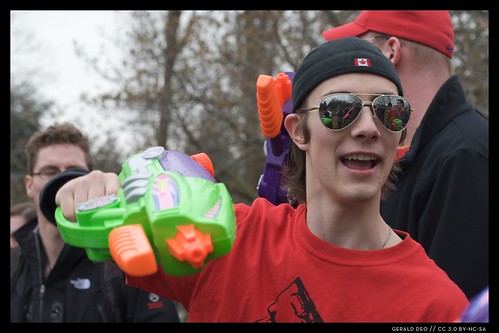
Here’s Tyler, RBF President, threatening someone.
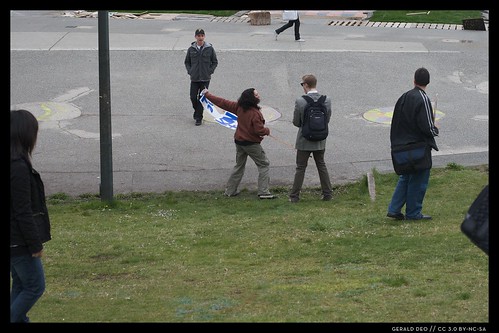
It turns out the protection was necessary: Jasmine was on the scene right quick, hurling insults and accusations and stripping signs from “protesters” and tearing them in half. 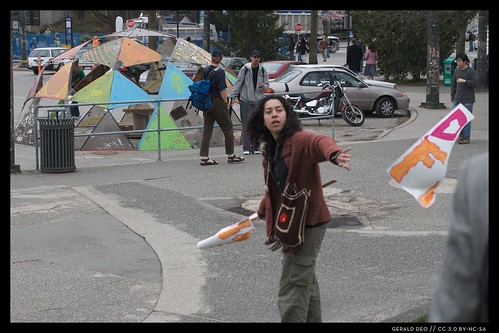
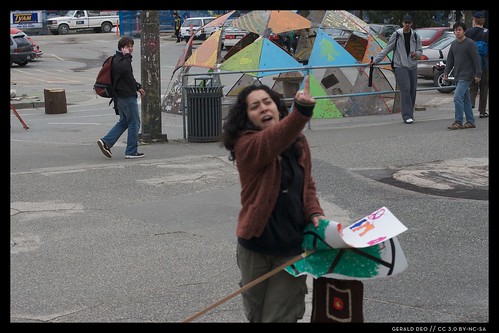
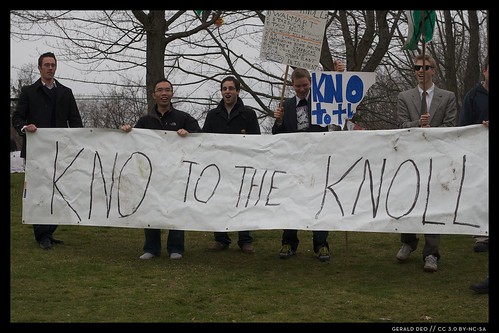
The KNO folks took this in stride, and held up their banner while chanting “Peaceful Protest” as Nate tried to calm the situation down, and Jasmine got in a shouting match.
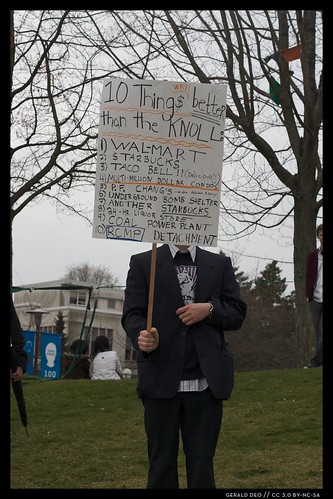
A sampling of their beliefs.
Controversy over, I wandered a bit and sampled the delights of the carnival: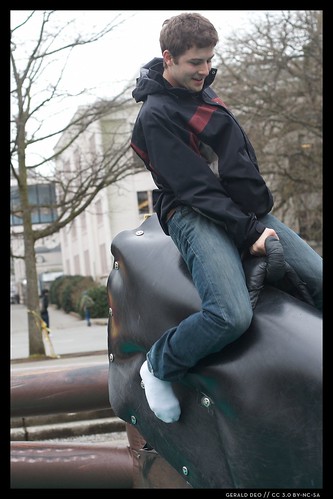
A bull rider.
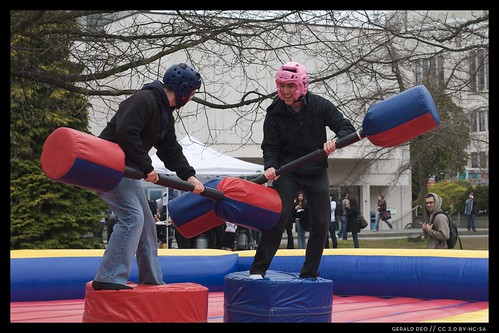
A little faux-gladiator action.
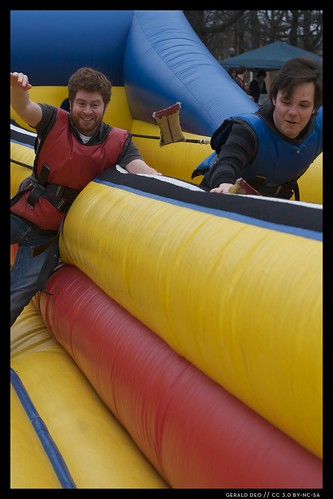
Outgoing Ubyssey Letters and Copy Editor Levi Barnett and incoming News Editor Justin McElroy square off in the Bungee Run.
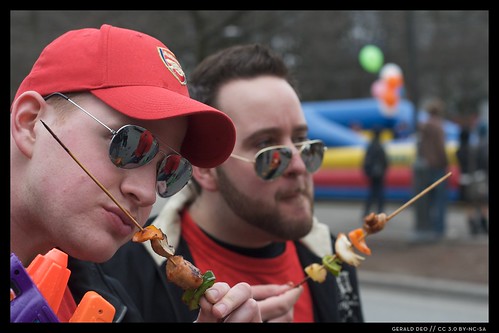
a little kebab action with the RBF.
I spent the rest of the evening either backstage (as ACF Alumni) or in the media pit, so here are some selected shots.
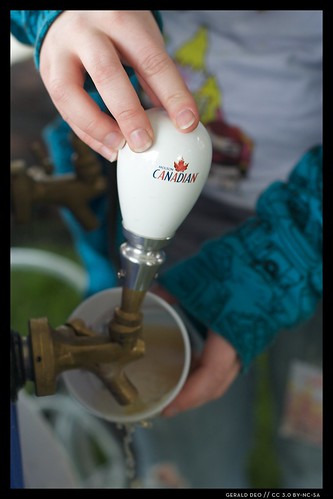
one of the sponsors of the event.
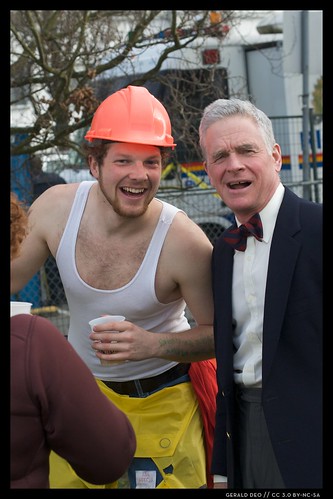
probably the worst photo ever of Brian Sullivan.
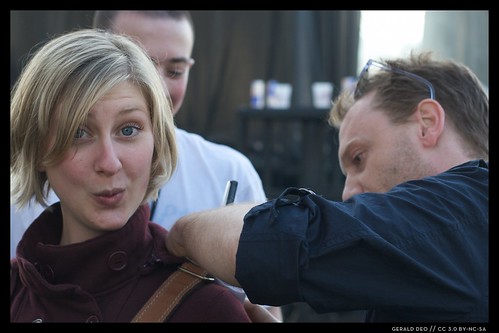
Becca Coad, getting signed by Torq from Stars
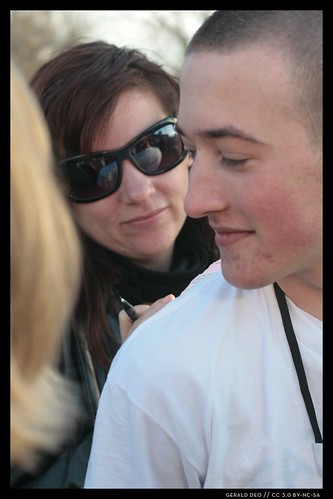
Mitch Wright, getting signed by Amy from Stars.
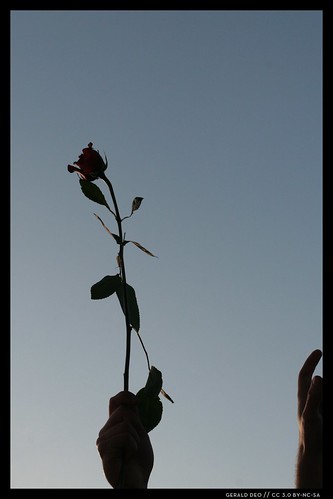
Stars threw flowers into the crowd… I caught someone after they caught one.
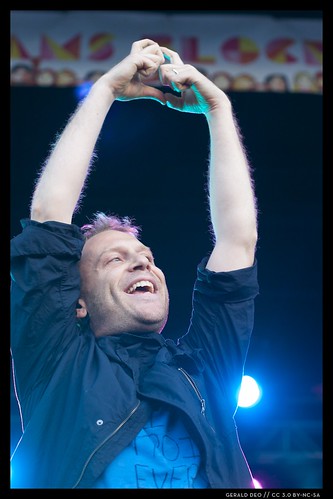
He’s making a heart with his fingers.
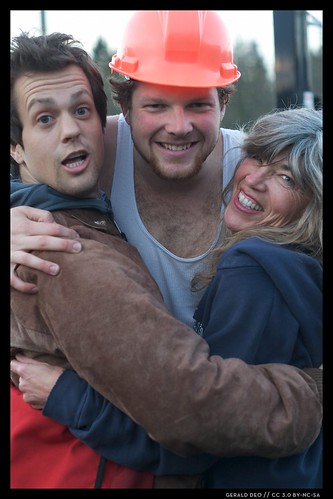
Jeff Friedrich, Mike Duncan, and the always lovely Nancy Toogood.
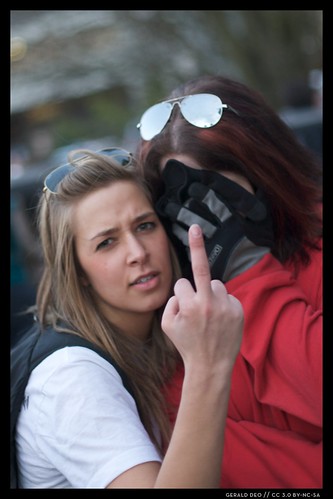
Anna and Emily from AMS Events.
As always, I’ve got more photos up here: my Flickr page.
How was your day?
Looks like Kwantlen won’t be leaving the CFS just yet.
Steve Lee, KUSA Director of Finance, had this to say (via MSN): “one major complaint was the high amount of stuff – free food, donuts, candy, isic cards, buttons – that the cfs was giving away.
when we put forward a set of rules to the judge last month it did not include a provision to ban the giving away of free food or other similar items – which we usually have banned from distribution during our regular ksa elections so that a campaign is about ideas not about who can give away more stuff.”
More information about the CFS vs Kwantlen case can be found here.

Sometimes in times of crisis it’s important to look at the big picture. So that’s what I’m going to attempt here. Make no mistake – the AMS has as fundamental a crisis as it can realistically expect to face. Since it has mandatory membership its very existence is not at stake, but its ability to make a positive change for students, either by lobbying or by campus presence, is very much at risk.
The AMS’ credibility is shot. The Lougheed and Bonfire Affairs have pretty much turned the AMS into as much of a joke as possible. Students generally used to be fairly ambivalent; it’s safe to say that the tide has turned. Students on all sides of the political spectrum have some serious grievance or other against the Society, and students in the middle are completely and entirely alienated by the insane and fractious factionalism that makes the U.S. House of Representatives look downright civil by comparison. Indeed, the only unifying belief is that the AMS isn’t worth students’ time. Not only has the AMS lost respect of students, it’s also lost the respect of those with whom it needs to have a productive relationship – the media, the University, various authorities, and the community at large. And so much time will have been spent on damage control, diverting energies from worthwhile reforms.
The root cause is the unnecessarily bitter factionalism that’s driven a wedge within the society. What began as an ideological cleavage has rapidly descended into the poisonous, petty politics of personal vendettas. While tempting, there’s no need to blame anything else.
There’s an upside – the AMS is still a relatively healthy society, and students have many reasons to appreciate it. It’s still in good financial shape, just passed a transformative referendum, and was on its way to becoming the centre of campus discourse once again. Moreover, the AMS has an opportunity this week, with a Council meeting and the Block Party, to take the first steps to make it right.
There are some relatively easy steps to take. My rules:
But first, it’ll require one side to “blink.” In every intractable dispute, some party needs to be the first to stand down. Or at least take a step towards it. Please – do it. I’m not calling for a homogeneity of ideas, just a cooling-off period, and a focusing of the ideological cleavage in a productive way. Diversity of ideas breeds good policy and debate, but that can only happen if you find common ground to channel it. Mark my words – nothing constructive will happen this (exec) year without some consensus. The next few years of the AMS, and the student movement at UBC for the near future, depend on you.
Last week, the Vancouver Sun broke a story about the Campbell government’s decision to deviate from the expected funding levels for post-secondary institutions by redistributing some money, boosting health care and trade training in some colleges and cutting university funding. I wrote a post saying how reasonable this was with respect to strategic development of PSE in B.C. Well, it seems that that wasn’t the whole story. As Erin Millar reports in her excellent Macleans article it tuns out that this budget change isn’t just a re-allocation of money from some types of undergraduate programs (full-time student seats) to higher priority programs, but an actual cross-the-board reduction from the expected levels, as well. That means that UBC, among other institutions, are experiencing a reduction in per-student funding, but also a reduction from the expected level of base funding.
How much exactly isn’t clear: according to a statement released by UBC President Stephen Toope, the clawback is 4.5 million for UBC-O and 11.3 million for UBC-V. He points out that UBC’s budget is still increasing compared to last year, but by 5% instead of 8%. According to the Confederation of University Faculty Associations (CUFA), the numbers are actually higher than that. They estimate 12.4 million less in base funding (from the cross-the-board 2.6% cut) and an additional $5 million less from the reduction in full-time student seat funding, bringing the total cut to $17.4 million for both of UBC’s campuses. System wide, CUFA estimates the cuts are worth 40-60 million.
In any event, this is bad news for UBC, which is already struggling to deal with its own structural recurring deficit through program cuts. Such an announcement right before the start of the new fiscal year, after all the budgeting for the university had already been completed is rather a shock. There’s been no word about how exactly UBC will absorb this shortfall, though other colleges have already announced layoffs. Even more worrisome is that the government seems to be attempting to spin this as a redistribution only, when it in fact seems to be an cross-the-board reduction from the expected levels by 2.6% AND a FTE redistribution (though still an increase from last year). What’s the point in sending the universities letters with the expected funding levels on which to base their budgeting if they don’t abide by them?
A group of students and professors from across the province have formed a group called “Coalition Against Funding Cuts” to draw attention to all this. Check out their facebook group HERE for more info on what’s being done.
Perhaps universities and colleges have expanded to to much too quickly in a manner that’s just unsustainable. If tuition hikes (which we have experienced in the last five years) and great economic times (which we’ve also experienced in the last five years) aren’t enough to satisfactorily fund the province’s post-secondary education system, maybe there’s something wrong with the size or character of the system in general. I haven’t researched exactly how universities and colleges have expanded in the last 20 years, so I don’t know, exactly, but I know that just hiring faculty with regular promotions costs more money than the university actually has – a major contributing factor to UBC’s own deficit. A sobering thought.
Edit/Update: Here are some more details from the CBC website, a video and an eyewitness account from Blake Frederick, elected Senator and student. We will write a more thorough analysis as more details become available.
Update 2: A judge will determine around 1pm today (Saturday April 5) at the DTES Criminal Court whether the five or more arrested students will be criminally charged or if they will be released. More updates to come.
Update 3: Youtube clip (anonymously submitted), and another Youtube clip of the bonfire and VP External Stef Ratjen being detained . Here you can keep yourself updated on the rest of the media’s coverage.
Update 4: Another Youtube clip of the students being arrested. There is an individual on a bicycle who seems to have been plugged from the crowd and arrested. What did he do to be arrested?
(restructured post for new readers)
Students peacefully protest the arrest of a fellow student Photocredit: Geoff Dunbrack
On April 4th students lit a bonfire and held a music and dance night in support of the grassy knoll on campus. The Fire Department arrived to put out the large bonfire, and this escalated into a number of confrontations and students being arrested.
The press release below was sent to me before there was anything to be found on the RCMP media website or any other news source, but from the limited information I can’t help but wonder if the police used unnecessary force if its intentions were to put out a bonfire. While I don’t think the police needs to act differently in a student space from anywhere else (as the press release suggests), the police conduct makes me think of 1968 Germany.
I ask that anonymous comments be at least signed with initials.
Press release from Students for a Democratic Society as well as more photos behind the jump.
PRESS RELEASE: POLICE BRUTALITY AT KNOLL AID
Today a peaceful celebration in defence of public space at UBC was violently quashed by the RCMP. This press release was written on April 5th at 1 a.m. with limited available information. All the events discussed herein have been either captured by camera or can be corroborated by multiple eyewitness accounts.
On Friday, April 4th, UBC students loosely associated with Trek Park and SDS held “Knoll Aid 2.0,” a musical celebration of public space on campus. Knoll Aid 2.0 was part of a larger campaign against the commercialization of campus, the demolition of the grassy knoll, and the development of a $40 underground bus-loop. Knoll Aid 2.0 was an overwhelmingly peaceful event and featured local musicians, free food, and three simultaneous petition drives. It was attended by primarily UBC students.
Though Knoll Aid 2.0 began at noon on Friday, at around 8:00/8:30 RCMP and the Fire department arrived at the area known as “Trek Park” (a liberated space near the grassy knoll) because some students had created a small bonfire. Citing a bylaw violation, the RCMP approached one student, Stefanie Ratjen, in a rather aggressive manner and began speaking with her. After a dialogue, the contents of which are still unknown, Stefanie was grabbed by an RCMP officer and thrown to the ground, pinned, and handcuffed. Her face was literally shoved in a puddle of mud while an RCMP officer sat on top of her. After this uncalled act of police aggression, fellow students came to her aid. One musician was immediately arrested for questioning the RCMP officer’s treatment of Stefanie. For approx. two hours students formed a chain to protest RCMP action and several students attempted to peacefully negotiate the release of Stefanie and the musician (whose name at this point is unknown). During this time approx. 30 RCMP cars with officers from across Vancouver and the lower mainland including Richmond came to UBC. Campus security was also present and threatened to discipline students if they did not cooperate with the RCMP. Police officers systematically attempted to break the human chain students had formed by pushing, shoving and kicking. RCMP officers randomly arrested any student present at the scene including Bahram Norouzi who was arrested in the middle of a CTV interview. At around 10:30 p.m. on approx. 25 students were arrested and detained. They were brought to a Main and Hastings detention center where they presently still remain.
This press release would like to draw attention to the conduct of the RCMP. A university is intended for students, not the police. Upon entering student space, the police should have had the decency, at the very least, to deal with students in a respectful and dignified manner. Instead, RCMP officers were highly aggressive and belligerent. RCMP officers committed gross abuses of power by, for example, threatening to release dogs on students and pointing taser guns at students that were already pinned down to the floor. The actions of RCMP officers are testament of police misconduct, if not brutality. We demand the release of all students arrested and demand that all charges be dropped. Furthermore, we demand an inquiry of the RCMP’s actions in relation to this event and the treatment of students. Lastly, we demand that UBC administration defends student’s rights to a peaceful protest.
To repeat, this was a peaceful celebration/concert in defence of public space. The RCMP had no right to violently quash a peaceful student protest.
Signed,
Trek Park for the People
Students for a Democratic Society
Student Environment Center
Social Justice Center
Here are some photos taken by students on the scene.

Photocredit: Geoff Dunbrack
Spam prevention powered by Akismet