Categories
Academic Life Government

Financial Aid and Tuition


I have been meaning to post about this for quite some time now, being heavily subsidized by a european government to study one of the most expensive programs in a college (medical) for a registration fee (covering a half year buspass as well as heavily discounted warm lunches) of 200 Euros (300 CAD) a semester.

See this NY Times article which reports ivy league colleges (Brown, Harvard) and Stanford following a wider trend of waiving tuition for lower income students.


While relieving some of the financial load of lower income students solves part of the problem, cost of living is an unaccounted factor which seems at times deemphasized when talking about the whole issue surrounding tuition.

In Canada and North America in general, the trend is for lower income students to borrow money from the government or a private source, and pay it back afterwards with interest. The trend is similar here in Germany, but with some key differences.

By German law, parents who make over a certain amount are required to support their children’s cost of living (housing, food, school registration fees). Yes, children have the right to sue their parents, and some even do. Tuition has been a non-issue until two years ago, when some regions implemented tuition as high as 400 Euros (600 CAD) per semester.

If the parents’ income falls below a certain income bracket, the German Ministry of Education (link in German) chips in, to be paid back post graduation, in chunks determined by how much the graduate makes entering the job market. In instances when the graduate is yet again below a certain income standard, they are waived these repayments and thus have their education paid for fully by the government.

By the way, the Ministry of Advanced Education in British Columbia has been mumbling about similar repayment policies for a while, and this has been regarded as controversial by some.

While Germany’s system is by no means perfect, it seems to allow for greater accessibility towards advanced education. I’ll follow up with some numbers and stats later, but it creates some interesting social attitudes.

For one, there is a very relaxed attitude about university. Whereas UBC felt like a factory that churned out one graduate at a time, colleges here seem like a stroll through the park, with time to smell the roses so to speak. In classes, there are almost never any assignments – only a final exam. There is much less pressure in general to finish on time. This take it or leave it atmosphere has its pros and cons.

The pro is that it seems like students that are self motivated are allowed to thrive. They are not bogged down by assignments which confine the degree to which they want to steer their learning within a semester. I have met the most brilliant people during my short stay here, who in the truest sense of the word are intellectuals.

Unfortunately, for the less motivated, it has been suggested that it takes them years and years to finish even their undergraduate degree. This was the social argument from the conservatives behind the introduction of tuition fees.

I am no economist, but I expect one to say something about Canada having the advantage of individuals entering the job market at an earlier age and thus spurting the economy.

I would argue that this might be true only because German men are still required by law to either receive military training or finish a year of civil service after high school.

While Germany’s education system is by no means perfect, its financial aid network seems to me much more equitable, allowing students to pursue the field of study of their interest, instead of having to worry about whether this degree will lead towards a job which will allow them to pay off their debts. Thus, it seems to me that over here, we enjoy a social safety net which better separates academic interest from the pressures of economy than in Canada.

Categories
AMS Student Politics

Point: focus on the Knolligarchy

An opinion piece by Jesse Ferreras, M.J. Candidate, UBC School of Journalism. Counterpoint coming next week.

There’s a war on truth at this University, and a resurgent movement of leftist radicals is fighting on its front line. I’m speaking, of course, about the Knolligarchy, formerly a joke name that now encompasses UBC’s newly-visible activist front. It’s a group of people affiliated with the AMS Resource Groups that is hot off a “Resisting the University” conference, which culminated today with a march of about a dozen people and an invasion of a meeting in the Board of Governors chambers (to the amusement of all those present.)

First off, let’s give credit where it’s due. The activist well had run dry at this university – it’s been years since a decent protest has been held anywhere on the Point Grey campus, at least since the quiet, passive protests that came in advance of the Iraq War. In this context, the Knolligarchy is a breath of fresh air. They’ve managed to inject just a little bit of excitement into campus life with events such as Trek Park and Trek Park 2.0, as well as the recent conference. It was music to my ears to hear an activist yelling into a megaphone and leading a march across campus last Friday. It at least gave me the impression something was happening.

But that’s enough credit. Let’s cut to the facts.

The Knolligarchy gets its namesake from The Knoll, a partisan campus publication that seems to avoid editing and facts as a matter of editorial policy. Describing itself as a “Weekly” (a “Monthly” might be more accurate) it is published through the AMS Resource Groups. The groups collectively receive $1.50 per student per annum, according to outgoing VP Finance Brittany Tyson. This year the I can’t be sure of the amount of money that goes specifically to publishing the Knoll, but it must come from somewhere within that $1.50.

This money is put towards a publication that advertises itself as partisan news coverage and thereafter sets out on espousing what can be more accurately called revolutionary fervour than news, more anonymous articles than journalistic agency. They don’t, however, get their message out solely through the publication – they also do it through public appearances and direct action techniques.

An example is a little episode in the Ubyssey office in early January. Stefanie Ratjen, Jasmine Ramze Rezaee and Nate Crompton, three of the Knolligarchy’s most prominent members, came into the office to complain about the front page of its first issue in 2008. The top story, splashed across the top of the paper, was “Activists vandalize Ponderosa complex,” accompanied by pictures of broken glass. Beneath it, to the left, was “Trek Park bulldozed,” a story about the mysterious razing of the Trek Park installation.

Crompton, Ratjen and Ramze Rezaee, despite having a story on the front page, complained that the Ubyssey hadn’t put the Trek Park story at the top. They were unhappy about the association given to activists by placing the story at the top (a fair complaint) but also that the Trek Park story, despite being devoid of a good photo to accompany it, was not placed at the top. Crompton went on to complain that “I said all these interesting things,” going so far as to call the issue a “fraud.” Nate argued that the University had “declared war” on Trek Park, notably ignoring the fact that their protest had devolved into a trash heap after the elements caught up with it over the course of several months. The three of them left the office clearly dissatisfied with the dialogue they had with me and a few Ubyssey editors, with Ramze Rezaee remarking, “I hoped to get more out of this conversation.”

The campaign of misinformation began in earnest MKduring the AMS elections. Language is always subjective and contentious, but this group of students has taken misleading rhetoric at UBC to embarrassing new heights.

Stefanie Ratjen made grand overtures to students, spreading falsehoods like “Translink is a private corporation” until I called her on it on my blog. Ramze Rezaee was at her side throughout the campaign, at one point asking VP Academic candidates what they felt about military funding for the International Relations program. IRSA president Gordon Hawkins saved students the trouble of swallowing this tripe when he corrected her publicly, saying that the Liu Institute for the Study of Global Issues receives funding from the Department of National Defence, and not the IR program. Ramze Rezaee exclaimed, “It’s the same thing!”

The lies propagated by members of the Knolligarchy reached their peak when Ramze Rezaee created “Freeman Poritz Watch,” a Facebook group devoted to ruining his campaign for VP External, and had a curious similarity with the anti-Semitic “Jew Watch” website that Poritz himself noted. The group was registered under the name “Sandra Davidson” but the fact of its creation showed up in Ramze Rezaee’s Facebook mini-feed when she started it. In the group’s description she castigated Freeman as “anti-woman,” “militaristic,” a “frat boy” and “xenophobic,” with nothing credible to support the latter claim (the reason, if I remember correctly, was his unfortunate comment about feeling cheated that international students get their degrees and then leave – an impulsive comment, to be sure, but hardly xenophobic.) Its members eventually included Nate Crompton and others involved in the Knolligarchy. At some point the site was taken down, but Freeman was undoubtedly hurt by its claims, notably its unwarranted accusation of xenophobia and its similarity to “Jew Watch” – an antisemitic website.

Today we find the Knolligarchy in an unfettered quest for power at UBC – and they’re not afraid to get their hands dirty. Tristan Markle, your new VP Administration, got them covered with ink when he was caught on camera February 27 defacing posters near the Pit that read “I support Alex Lougheed!” with the added slogan “Right to Cheat.” The posters themselves have come in response to a complaint from Nate Crompton, who alleges that Lougheed voted for himself 12 times in the AMS elections for the position of VP Academic. The votes weren’t counted and the complaint came more than 72 hours after the election results were announced, thus nullifying the complaint according to AMS Code Section IX, Article 8 (1). Markle, however, is living on the hope that he can help put three members of the Knolligarchy on the AMS Executive, even though another election would likely have to be held if Lougheed was impeached, the only way he can be removed from his position at this point.

The scariest thing about this is his tactics may be effective. If there is another byelection, I have little doubt that Nate will run again. And given the pathetic turnout of voters to byelections, as in the VP Admin campaign, he could very well win.

The Knolligarchy’s strength resides in caring about the things that most students don’t. They rallied to Tristan Markle’s side for his election to be VP Admin and succeeded in putting him in office. I hadn’t previously believed it when Patrick Meehan told me the Knolligarchy could count for approximately 400 votes for any candidate – these days I’m more inclined to agree with him.

In short, the Knolligarchy is a force to be reckoned with, and its publication, The Knoll, is a great avenue for them to get their message out. You’re helping it get out there by paying your AMS fees. A small amount of those fees are being placed towards the AMS Resource Groups, and a portion of that amount is ensuring that the Knolligarchy has a publication through which to advocate their leftist political leanings. It’s starting to succeed to the same degree that Conrad Black did in making Canada a more conservative place when he started the National Post – of cour
se, he wasn’t funded out of the public purse. It won’t stop until someone reviews how funds are being allocated to the AMS Resource Groups – and specifically, the Knoll.

In any other governmental system, it’s deeply unethical to put public funds towards a partisan cause. Here, purely by paying your AMS fees on top of your tuition, that’s exactly what’s happening. Those fees are being towards the AMS Resource Groups and subsequently the Knoll, which is in turn publishing reasons why its friends and close acquaintances should hold public office at UBC. It’s like the Government of Canada, rather than the Conservative Party, using a pamphlet to campaign for Stephen Harper. Why should students get away with it?

Activism certainly has a place on this campus – without the Great Trek, we wouldn’t be studying or living in the buildings that we’re in today. But truth deserves a place here too – and the Knolligarchy doesn’t seem too keen to let it stand in the way of its actions.

Categories
Media

VFM launches at SFU

In my life, there’s always time to kill. And now I have a fresh method of doing it. Mark Latham has begun sponsoring a Voter Funded Media contest of a slightly different stripe over at SFU. Take a look at the SFU VFM page HERE. The idea is broadly the same as VFM here at UBC, but instead of being a one-off coinciding with the student society elections period, prizes are instead being distributed on a monthly cycle of continuous voting. The prizes are $300-$500 per month, which will add up to around $5000 in a year (compare to UBC’s contest which had a prize pool of $8000 for a whole year, given out all at once). Votes are calculated using the interpolated consensus method that we used here at UBC this year.

(Note to newer readers: VFM is the media contest that birthed this blog. According to Latham whose brainchild it is, rewarding media democratically from the public purse will improve democracy. For a previous posts discussing VFM, take a look here, here, here, and here. )

Another interesting difference is that the SFU contest is administered by Latham himself, not the Simon Fraser Student Society, which is equivalent to our AMS. This is interesting to note, because though one would think that having the institutional and organizational support of the student society behind such a project would be a boon, this year’s contest at UBC was magnificently botched by the AMS, both on the political and bureaucratic side. Not surprisingly, Latham has managed to run things smoothly at SFU so far.

The continuous monthly model maps much more closely to the ultimate goals of VFM: providing long-term, in-depth media which are accountable to their readers through a democratic reward process. SFU certainly has a smorgasbord of contentious issues to deal with at this moment, with their SSFS elections and referendum to defederate from CFS, the national lobby they are a member of. Media outlets could certainly provide a valuable service to the SFU community by providing some insight on these issues, and make a buck into the bargain.

All this is to not say that the SFU contest is anywhere near effective. So far, it seems to be marginal in both content and readership. The SFU campus radio station has entered, which I think is a brainwave (hint hint, CiTR), and one or two of the blogs have some content worth reading. Nobody seems to be trying very hard at this point. But these things take time to build momentum, and it seems almost stochastic whether such an idea will catch or not.

The question is, how much of a future does VFM really have? If Mark continues to encounter tepid half-successes, how long can he be expected to fund these experiments? And if he stops before the value has been unequivocally demonstrated through a jump in voter turnout or irrefutable data (which the AMS has yet to collect through exit polls. *strangle strangle*) would student societies be inclined to fund such innovations themselves? According to Jeff Friedrich, the incumbent AMS President, probably not. He told me in a meeting last year, that to him these projects are bonuses, and not as essential as making the AMS democracy itself run well through systemic reform in the AMS structure which has yet to be achieved. To me, innovative democratic projects like VFM (or a students’ assembly) should be looked at separately from improving the AMS democratic and organizational structure. We shouldn’t shy away from investing time and money in either.

For now though, Mark is still willing to pick up the tab. And UBC may soon be transitioning to the continuous model itself. A proposal for this just went up today on the VoterMedia.org website – take a look.

Categories
AMS

Why can't we all just get along? the executive dynamics post.

Once upon a time amidst the tacky coloured walls of the Almar Mater Society’s student union building, executive council was dominated by slates (basically political parties). Back then, elections were in some ways more colourful (in both the literal and figurative sense). Brand names were recognizable from miles away – the extreme conservative “The Right Choice” in navy blue, the centrist “Students for Students” in a lighter hue, and a communist resembling “SPAN”, not to be confused, though understandably often mocked, as SPAM. I need to insert here right away that I am a political product of the latter, though my political career took me past the great era of formal slates. Anyhow.

I have seen my share of executives interact with one another over the years, since 2002 until 2007, both before and after slates existed. By being a peripheral nuisance around the office, and having inherited some institutional gossip, I find myself unable to feel the same degree of outrage over recent events as the visitors who comment on this and other blogs

The reason I bring in slates into the picture is because they were a key vehicle through which politics was driven at the executive and council level. And I also include petty bickering into the term ‘politics’.

When I was running with SPAN, I experienced for the first time the true viciousness that is brought out of individuals during the electoral process. For instance, a colleague who I had previously considered a friendly acquaintance, sprayed me intentionally with water in order to get to a key postering spot before me. At another instance, physical threats had been posed. By the time the elections were over, the atmosphere was so tense that it was difficult to separate the personal from the professional. I personally got over it. And because my slate had swept the election that year, I did not experience the tensions that threaded through the year before.

Apparently (and this is a one sided claim) within executive council, it was an iron rule that each member of one slate would vote one way, and the other slate would oppose. Frequently the minority slate was voted down in their endeavours to the point where it was suggested that it was purely for the sake of sabotage. How valid this claim is I cannot assess, but I am willing to entertain the notion.

Enter the banning of slates. Former AMS president Spencer Keys championed this project primarily from an inclusiveness standpoint –individuals, no matter how qualified, who do not gain access to slates are severely disadvantaged in an election. This is true in “real life” as well, and in the AMS especially so.

Others would claim that there were other reasons why they supported this motion. For one, they found the blind loyalty towards a strict party line excessive and tiring. They may have felt like a footsoldier than a free thinking individual. There was enormous peer pressure within one slate to oppose the other parties.

Whether slates should in some way or form be reinstalled is a debate I would like to see on a different post. If I have one last comment on this, it would be that emotional baggage is an unfortunate part of continuity of a slate and its agenda. It’s the nature of the beast. It happens in the real world too.

And it’s this emotional baggage inherited from all these previous years which may have culminated into bitter executive dynamics, which is more the topic I would like to focus on. From the comments seen in previous posts, there seems to be a romanticized ideal of ‘executive cohesion’ floating around, the purpose or exact definition of which has not been elaborated by anyone so far. My guess would be that the executive should achieve a certain amount of reliability and trust among one another, as well as the ability to collaborate on joint executive projects. Personal squabbles should not sabotage the job they are elected to do, as in “I hate A so I am going to vote against anything A wants to do”. I don’t think anyone expects AMS execs to be best friends, or wear the same T shirts, or have brunch together every Sunday, or engage in a communal brainwashing program such that they become the same person (although I wouldn’t be surprised if these things have been done before).

This idea of ‘cohesion’ has been brought into conflict with an individual’s political agenda. The question here, then, is if there is a degree to which an executive (and I would argue council member) should limit her/his own politics in order to achieve cohesion with their (potential) colleague(s). This question has become especially pertinent in this particular case regarding the photo we published, where the political agenda antagonizes the very position of their colleague. I suppose it is a sticky situation. I can see how it could be taken personally by the individual affected. But should it? And will it?

Is it too naïve to believe that in our post-slate era, we should still be allowed to charge with political valence while allowing others to do the same? Removal of official slates did not equate political lobotomy. In the past few years we happened to experience little slate-like activity and consequently, a relatively quiet year. However, political assembly is a right everyone can exercise, and it is inevitable and arguably necessary at times. Kudos to A-Lo fans who mobilized to launch a poster campaign. Kudos to Knolligarch(s?) for mobilizing to deface them. I suppose I expect a sort of cordial professionalism once in office, which allows for a working rapport while their own individual politics still manifests into defacing each other’s posters.

In the end, and from the practical perspective of a former councillor, I would sprinkle enough of this “cohesion” ingredient into the executive bunch in order to achieve productivity from them – as individual executives fulfilling their elected portfolio, and as the group that is at times required to present some sort of unified front. It seems to me like the latter point is threatened for some readers here. From a very systematic point of view, the people have picked their representatives and all the strings that come with these individuals. The political passion which I see in both team Lougheed and team “Knollarchy” does not have to be squashed just yet for the sake of executive cohesion, or pleasantries, or platitudes. Not yet at least. It will be the role of AMS council to watch the progress of the executives and decide if some or all of the executives are unable to splice out the personal from professional well enough to meet council’s standard. I have a feeling it will become obvious soon enough.

Categories
Government

Transit: Kevin Falcon speaks

A few months ago, BC Transportation minister Kevin Falcon announced a 14-billion dollar transit bonanza for B.C. The announcement made front page news in a both national newspapers, and rightly so. It is rarely in Canada that we see such long-term investment in long-term infrastructure. The money will see five new rapid transit lines being built in the lower mainland over the next twelve years (one of which will branch to UBC), a doubling in the bus fleet (up 1000 buses) and the development of a new network of rapid bus lines (akin to the B-lines we all know and love). The goal is to double transit ridership by 2020. Info on the plan is available on the provincial government website, here. Falcon, in addition to these transit commitments, is also going forward with the controversial highway expansion plan that would see the Port Mann Bridge twinned in the “gateway” project. He has also overseen changes to the structure of TransLink: it now consists of an unelected professional board, and overseen by a mayor’s council instead of the previous arrangement which had elected appointed members of the GVRD on 1-year turnover cycles.

Last Friday, Falcon was on campus for a brief but intense gathering hosted by the UBC Young Liberals at Mahoney’s pub. He mingled for about 5 minutes, spoke for about 20 minutes, and answered questions for another 15, as people munched the complimentary heart-attack-on-a-plate deep fried snacks. Falcon started his spiel with a general campaign-style defence of the budget Carole Taylor just released – including the much-touted carbon tax. He then focused in on his transportation plan, outlining the main spending areas. Falcon was quite direct. While the fluent and campaigny extolling of everything the Liberals have done, are doing, or will ever do was a bit tiresome, as was the self-glorification about making “tough” decisions (isn’t that the definition of leadership, pray tell?), Falcon was actually quite convincing in the question/answer period.

There were some tough questions. When challenged that the new TransLink structure was less democratic and accountable Falcon was blunt. He said that the old structure was dysfunctional because of the high turnover and lack of expertise. He defended the fact that the new board’s meetings are closed to the public, saying that letting people come in to “scream and shout” wouldn’t accomplish anything. Now, you can agree or disagree about that, but he didn’t beat around the bush. When asked if the highway expansion to the suburbs negated plans to increase public transit ridership, Falcon was also blunt. He said that compared to the road and bridge infrastructure Vancouverites enjoy, Surrey and the fraser valley are very undeserviced – and as the fastest growing areas in BC, they deserve to have both better transit and better commute times. To me, this sort of missed the greater point, which is that as a province with pretensions to sustainability, we should be looking at ways to make Vancouver more affordable, thus minimizing the sprawling growth of suburbs in the first place. Unfortunately this is beyond the scope of Falcon’s portfolio per say (and also way beyond his staunchly suburban constituency voter base).

With rapid transit out to UBC by 2020 a few things could happen: the importance of living close to campus in the Kits and Point Grey areas will decrease. You’ll see alot more students talking advantage of cheaper rents in the tri-cities and Surrey. Demand for on-campus housing will probably stay the same. There will always be people in search of the campus life experience, and that won’t change. We’ll just see commuter student living farther away, and perhaps even less able to participate in campus life. On the other hand, people that do stay in Vancouver will have an easier time getting around, and might engage more. Analyzing student engagement on the basis of transportation is always a bit dubious – just because the reasons people choose at what level to engage on campus are complex. We don’t have good data about it, that’s for sure. The AMS should look into including some well-designed questions about finances, location, and transportation on its next survey.

Categories
Academic Life Campus Life Development

UBC Farm: Why they aren't taking a referendum question to students this March

Due to a hole in WordPress, this post’s author is misattributed. The follow was written by AMS VP Academic ’07-’08 Brendon Goodmurphy.
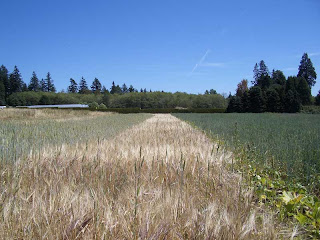
Most students know by now that the future of the UBC Farm is shrouded in uncertainty and controversy. This year strong student supporters of the Farm (particularly Friends of the Farm), wanted to hold a referendum question asking students to increase their student fees to support the farm’s programs and development. The hope was that a passed referendum would show UBC just how much the community supports the farm, and would help secure the farm’s future. But the current political situation within UBC and the region has made some supporters of the referendum question if now is really the right time.

Find out why behind the jump…

A brief history of the UBC Farm:

When UBC first decided to build market housing on campus, they ran into some concerns and push-back from the community (students, faculty, staff, residents in Vancouver and the UEL). So, the GVRD stepped in and said that there would be some regulations and guidelines for how UBC could develop that market housing community. Those rules were all outlined in the Official Community Plan (OCP). Of course, the Farm sits in the middle of prime land that the University ultimately wants to sell to developers. After public outcry over the farm in the development of the OCP, the farm was slated for “future housing reserves” – meaning that they weren’t going to develop housing there right away, but it would be set aside, and we would come back to it later to make a decision (that date is supposed to be 2012).

Of course, this stamp of “future housing reserves” also gave UBC an excuse to not invest in the Farm, and refuse to help build its research capacity and refuse to see its value as a community amenity. In fact, when some market housing residents worked with the farm to create a community garden, UBC denied the proposal and said it wasn’t allowed! UBC has been actively impeding any development of the farm for many years, so that they can more easily deny the farm’s importance in 2012 when the issue is up for consideration.

The current situation:

To understand the current situation, you have to understand some local politics. UBC would like to make changes to the South Campus Neighbourhood Plan – they would like to densify the neighbourhood (add more units, make more money). This requires a change to the OCP, which requires approval from the GVRD.

However, the community has some allies in the GVRD who have an interest in a) preserving the farm, and b) seeing UBC become part of the City of Vancouver. Both of these fit into policies that the GVRD already has (for the farm, they are worried about food security and how quickly farmland in the region is being depleted, for governance, they GVRD would like all electoral areas to become part of a municipality). Therefore, some elected officials at the GVRD were saying to UBC: “We’ll let you densify the South Campus Neighbourhood, if you promise to deal with the farm issue and do a governance review.”

Well, UBC doesn’t really like the prospect of being told what to do by the GVRD when it comes to the Farm or governance, so at the most recent Board of Governors meeting, UBC decided not to pursue the South Campus Neighbourhood densification – for now…

But to appease the GVRD, UBC also said that they are going to deal with the farm issue and the governance review right now. I told the GVRD at a recent meeting that I didn’t really believe UBC’s commitment to dealing with the governance issue – I genuinely believe they are dragging their feet, they have no interest . And the farm issue is going to be dealt with through the Vancouver Campus Plan…this is where the concerns from Friends of the Farm comes from.

Hidden motives:

Nancy Knight, UBC’s Associate VP Campus & Community Planning, has decided to ‘deal with the farm issue’ through the Vancouver Campus Planning process. That may sound like a good idea at first, but its much more complex than it seems.

The Campus Plan process is an institutional planning process, meaning UBC has complete control over that process, meaning the GVRD has no say in what decisions are made. Thus, when the farm gets addressed through the Campus Plan, we lose some really powerful allies in the GVRD who could put a lot more public pressure on UBC to “do the right thing.” For now, we as students and as members of the University community have to flood the Campus Planning process in order to save the farm. Of course, we all know that UBC isn’t that great at listening to students, and is quite selective about what it hears in consultation processes.

The point is that if the farm review is part of any OCP changes, then the broader community, including the GVRD, and the UNA residents have some sort of say in what happens to the farm. If it’s a Campus Plan process, then UBC gets the ultimate say, and the GVRD really has power to interfere. The Campus Plan is about institutional spaces – aka, learning and research spaces. Taking care of the farm through the campus plan process conveniently means that UBC can look at it primarily for its research value, and thus it’s easier justifying that it move to the bio sciences research area – the same amount of research can occur no matter where its located.

Now add to this the fact that Nancy Knight and the team at Campus & Community Planning have gotten external consultants to come in and review the “potential” of the farm. These consultants were chosen without letting the farm or the faculty of Land and Food Systems know, and it has mostly been all behind closed doors. Nancy Knight wants to have these consultants come back and say: “the Farm is very valuable, but they only need half the land and could probably move to the Bio-Sciences research area and still do the same great work.” Perhaps she sees this as some sort of compromise between the Board’s agenda to maximize the $250 million that can be made off of that area, while still preserving some sense of a farm for the community.

As long as the Farm issue is dealt with through the Campus Plan, the result is going to be cutting the area by at least half, or moving it way down to the bottom of campus in a very remote and inconvenient location, or both.

The other thing to consider, is this process to deal with the farm through the Campus Plan is only looking at the farm from a research-value standpoint, and not from a community amenity standpoint. The Farm is so much more than a research facility, it’s a place that brings students and residents and researchers and learning all together in one place. This is more than just an institutional facility, it’s a community facility, and the community should have a much greater say about its future.

Canceling the Farm Referendum

I told the Friends of the Farm that it was a big mistake to back down from the referendum now. The concern is that the political situation is too tense right now to take the risk. I say that a referendum is always going to be extremely risky. The only reason there are more backroom deals being made about the farm right now is because UBC is facing a lot of pressure from the GVRD, students and the community-at-large to save the farm. As long as UBC is facing pressure on the Farm, they are going to push back, and push back hard. The farm lands are worth over $250 million dollars in Endowment revenue. We’re up against a huge beast, and that is never going to change.

But, if we as students could come to the table and say “students care about the farm so much that we are willing
to pay out of our own pockets to develop the farm’s capacity” then we’re in a really strong negotiating position. Don’t forget, it’s UBC who has been financially neglecting and starving the farm for years, and its students who are stepping up and footing the bill.

If the referendum were to fail, then it would be a tragedy. But, as far as I’m concerned, certain people within the University are always going to misconstrue the evidence and use any referendum outcome against us. But there are also a significant number of people in the University who will take a passed referendum seriously, and that will be way more powerful than the few who discredit it.

The Farm needs a student movement behind it right now, and there is nothing better to get a student movement started than through a “Save the Farm referendum campaign.” Getting hundreds of students around campus, handing out pamphlets and saying “UBC is trying to take away our farm, we can’t let that happen” – what better way to start a genuine student-movement. That’s something almost all students can say yes to.
Categories
AMS Elections 2008 VP Academic VP Admin

Caption Contest

“VP-Admin elect Tristan Markle adding ‘Right to Cheat’ to posters in support of
VP-Academic elect Alex Lougheed”

This was obviously meant to be public. If you’re not up on the controversy surrounding the VP Academic race, refer to the Ubyssey here and here. The implications of publicly discrediting a fellow executive-elect are unclear, but probably relevant to future working relationships. Tristan, and Nathan Crompton, the runner-up in Alex’s race are close friends and colleagues. Retrospective and analysis about executive dynamics by Gina coming soon.

Categories
Campus Life

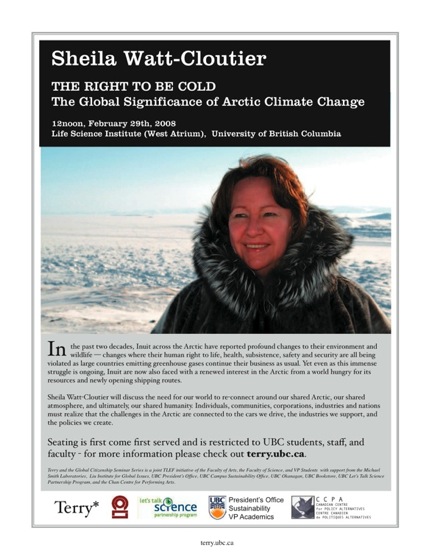
Right To Be Cold – Sheila Watt-Cloutier at UBC

Terry* presents the latest in our Global Citizenship Lecture Series: Sheila Watt-Cloutier’s talk, “Right to Be Cold” will take place this Friday, February 29th, at 12 noon in the West Atrium of the Life Science Centre. Map.

In the past two decades, Inuit across the Arctic have reported profound changes to their environment and wildlife — changes where their human right to life, health, subsistence, safety and security are all being violated as large countries emitting greenhouse gases continue their business as usual. Yet even as this immense struggle is ongoing, Inuit are now also faced with a renewed interest in the Arctic from a world hungry for its resources and newly opening shipping routes.

Sheila Watt-Cloutier will discuss the need for our world to re-connect around our shared Arctic, our shared atmosphere, and ultimately, our shared humanity. Individuals, communities, corporations, industries and nations must realize that the challenges in the Arctic are connected to the cars we drive, the industries we support, and the policies we create.

More info at the fabulous Terry* website: terry.ubc.ca

Terry Limerick:
(with feeling!)
“There once was a project named Terry
That wanted to make people wary
Of things going on
In the world that are wrong
Without making it all seem too scary.”

Categories
Student Movement

CFS Politics. What fun!

You’ve probably noticed them: ads on the 99 B-line with smiling, ethnically diverse young people with “I am CFS” drawn on their outstreached hands in marker. The Canadian Federation of Students (CFS), which is one of the two main federal student lobbies, is gearing up for a huge publicity campaign in the next month to try and prevent SFU students from withdrawing as a member student association of CFS. Numerous other member student societies, including the Kwantlen Students Association, and UVic Graduate Students’ Society, which have also submitted notices of referenda for defederation from CFS. Our student society, the AMS, is a founding member of CFS’s rival federal lobby student lobby, CASA, which formed in 1995 as a breakaway group from CFS of five Candian student unions. The two networks have distinctly different approaches to lobbying, and have differently leaning politics on higher education issues. Also, CFS has much higher membership fees than does CASA by about an order of magnitude (compare 430 000 in dues that SFSS pays to CFS to 47 000 that AMS pays to CASA).

But this story is about the CFS. The Simon Fraser Students Society (SFSS) has been a member student society of CFS since its founding in 1981. In return for about half a million dollars a year of membership fees paid to CFS, they get some student services (like a discount card, rental listings, student phones, and some other stuff) and more importantly, a federal lobbying office and participation in national campaigns, including the national “day of action” which you may have heard of.

Last March, the SFSS included a question about leaving the CFS in their yearly referendum. While only about 5% of students voted in the referendum, 78% of those who did vote wanted out. Proponents of SFSS leaving the CFS cite the high membership fees, redundant services and ineffectual lobbying of the CFS, as well as corruption associated with CFS-friendly student association executives. (SFU, Douglas College, and Kwantlen College all have had tragically good examples of this in hte last fe years). Anyway, despite the clear majority in favour of leaving, last March’s referendum was “non-binding”, since CFS has its own detailed rules about how a member organization may leave the Federation. last March’s vote was intended to get a feel for how students felt about the CFS. This March, the next step is being taken with the official referendum (in accordance with CFS rules) which will determine whether the SFSS stays leaves.

This month I got a couple media releases from the KSA detailing how the CFS’s “secret war-plans” for the “no” campaign had been revealed. These plans included more than a hundred thousand dollars to fund the campaign, plans to fly in pro-CFS campaigners from all over the country (both students from CFS schools, and CFS staffers), and even plans to try and hire CFS-loyal individuals into the staff of member’s student unions. CFS national chair Amanda Aziz rebutted that the “war plan” document was authored by Summer McFadyen of the CFS-BC office alone, with no collaboration from the national office. CFS lawyers have demanded an apology from the KSA, which deliberately leaked the document. More details and opinion in the Maclean’s on Campus blogosphere HERE, HERE, and HERE. While from the CFS’s perspective, it makes sense to invest a lot of resources to prevent the loss of member schools (and with them, member school’s yearly dues), these campaign plans would probably overwhelm any effort the “yes” side could possibly hope to match. While the “yes” side is subject to campaign spending limits according to SFSS referendum rules, expenses paid by the CFS wouldn’t be included in these regulations. Moreover, from the leaked documents, it’s obvious that many prospective campaigners aren’t even students, and are employees of NDP and Union affiliated groups.

In any case, this is just a prelude to the actual campaign. Is the CFS a self-aggrandizing parasite, or real advocate for students on a national level? How effective are they? Of what value are services they offer? Is support for the CFS based in its value as student-issues lobby, or because it’s a leftist organization? All questions that will come up. The war of words has already started in SFU’s student newspaper, The Peak. Have a taste of the debate: “Why we should leave”, and “Why we should stay”. More opinion here, here.

This business with CFS actually does bring up more general questions about high-level student advocacy, lobbying, government relations, and the role of the student movement generally. Should they be larger, and deal with issues outside of higher education, have partisan affiliations, and campaign through protests? (like CFS), or be more narrowly focused, not spend money on publicity, and engage on policy with government in closed-door meetings? (like CASA). Or are these national groups necessary at all? The VP external position in the AMS is purportedly the least busy of the portfolios. There’s no saying what a motivated VPX could do individually if they spent enough time in Ottawa and Victoria.

Categories
Government

Vancouver Quadra by-election rush

UBC’s federal electoral riding, Vancouver Quadra, is having a by-election on March 17th. And if you live on campus, you can vote in it. (Click the image to enlarge)

Quadra is one of the wealthiest and best educated ridings in the country. It contains most of Vancouver’s West side, including UBC. This by-election race has many so UBC connections that make it an great opportunity to get UBC issues out into the community. Lets count the connections: the Quadra riding was vacated by incumbent Liberal MP (and former cabinet minister) Stephen Owen last year. He left politics to join UBC’s executive as VP External, a post he resumed last August (find out what Gina thought of that HERE). One of the candidates in this by-election is actually a current UBC student. The NDP’s Rebbecca Coad is a political science student. The Green Party’s Dan Grice is a recent UBC grad, in Classical Studies and Archeology, and a former AMS councilor for Arts. The Conservative party candidate, Deborah Meredith, is a UBC professor of commercial law in the Sauder School of business. The Liberal party candidate, Joyce Murray, lacks an obvious UBC connection, but she’s a former BC cabinet minister and co-founder of Brinkman Reforestation Ltd, which some of you tree-planters have probably worked for.
By-elections typically have lower voter turnout than general elections, which makes them a bit unpredictable. Owen, who won the riding three times with big margins with the Liberal Party, was definitely a popular MP. But with him gone, and strong local connections for all the candidates, it’s quite an interesting race.

Nitty Gritty:
  • if you’re a student living in the Quadra riding, you can register to vote in this by-election in two ways: going to the Elections Canada Quadra office (suite #218 5511 West Blvd.), or registering on the day by bringing two documents with your name and adress on them, like phone bills, or your housing contract, or some other official mail. You can call them for information at 1866 564 6466.
  • Come to the candidate debate this Monday the 25th at UBC. The four main party candidates will face off in the Meekison Arts Student Space in Buchanan D (room 140) at 2:00-3:30.
  • Get a feel for the candidates: campaign websites and facebook groups are up. You can also read some (somewhat painful) candidate interviews that Jacob Cosman of the Science Undergraduate Society’s rag the 432 conducted HERE. Thanks to Jacob and the 432 for those.

Spam prevention powered by Akismet