We live in interesting times

From The Independent: The big thaw

Research to be published in a few days’ time shows how glaciers that have been stable for centuries have started to shrink dramatically as temperatures in the Arctic have soared with global warming. On top of this, record amounts of the ice cap’s surface turned to water this summer.

The two developments – the most alarming manifestations of climate change to date – suggest that the ice cap is melting far more rapidly than scientists had thought, with immense consequences for civilisation and the planet. Its complete disappearance would raise the levels of the world’s seas by 20 feet, spelling inundation for London and other coastal cities around the globe, along with much of low-lying countries such as Bangladesh.

Don’t worry, Web 2.0 will save us.

Posted in News | 3 Comments

Why teach digital writing?

A nifty overview of the necessity, the resistance to, and the process of teaching writing in networked digital environments.

Computers are not “just tools” for writing. Networked computers create a new kind of writing space that changes the writing process and the basic rhetorical dynamic between writers and readers. Computer technologies have changed the processes, products, and contexts for writing in dramatic ways—and rhetoric theory, composition practice, and writing instruction all need to change to suit how writing is produced in digital spaces.popup

Writing is radically changed by internetworked computer technology. Everybody says that—and researchers in the field of computers and writing have been exploring the implications of this claim for 20 years. But are we really REALLY ready to accept the implications of that claim, even some rather disturbing implications?

The conclusions strike me as persuasive, but they would, wouldn’t they?:

We have anchored digital writing practices to the extension of modes and media, and to the fact that writing, today, means much more than working merely with alphabetic text or with print pages, but that computer applications and digital publishing spaces allow us to weave and orchestrate multiple sign technologies (e.g., images, voice and other sounds, music, video, print, graphics), layered together across space and time to produce artifacts that can be interactive, hyperlinked, and quite powerful.

Fostering, supporting, and enhancing students’ abilities to write within and across digital spaces is complicated by a matrix of media, of rhetorics, of technologies, and of various institutional values. All of these variables and values create the shape of the context for digital writing. Digital writing makes visible needs that writing courses and curricula and programs that we haven’t previously articulated, or needed to articulate. These needs complicate and extend the pressures we already feel and that we already exert—perils and possibilities related to teaching and working spaces, evaluation, class size, access to computer labs, access to wireless teaching spaces, design of curricula, staffing and labor, and more. Many more.

The piece itself is a pretty good hybrid of traditional scholarly discourse and online techniques — be sure to click some of the ‘s…

Via morgan’s log

Posted in Textuality | Comments Off on Why teach digital writing?

Attack of the career-killing blogs…

I somehow made it to this point in my life without knowing what memeorandum was — my first glance turned up this new article on the career implications of academic blogging:

On the one hand, some resistance to the proliferation of blogs is understandable. The value of academic culture is that it stands apart from the ephemeral marketplace. Universities are by their very nature culturally conservative and slow to change. The odd situation would actually have been if universities had automatically embraced blogging. Holbo suggests that from one perspective, blogging is an affront to the traditional idea of the university. “You want to graft this onto the last living medieval guild system?” he imagines a senior scholar protesting.

But in another sense, academic blogging represents the fruition, not a betrayal, of the university’s ideals. One might argue that blogging is in fact the very embodiment of what the political philosopher Michael Oakshott once called “The Conversation of Mankind”—an endless, thoroughly democratic dialogue about the best ideas and artifacts of our culture. Drezner’s blog, for example, is hardly of the “This is what I did today …” variety. Rather, he usually writes about globalization and political economy—the very subjects on which he publishes in prestigious, peer-reviewed presses and journals. If his prose style in the blog is more engaging than that of the typical academic’s, the thinking behind it is no less rigorous or intelligent.

To take only one other example, John Hawks, an assistant anthropology professor at the University of Wisconsin at Madison, posts three to five essays a week on subjects like evolutionary theory. He writes about science with the breadth of the late Stephen Jay Gould and doesn’t see a big difference between most of his online and offline output. “Much of what I write online is scholarly. When I review an issue in human evolution, it is a genuine review. If I criticize something, I back it up,” he says. Indeed, his essays are festooned with citations.

So, might blogging be subversive precisely because it makes real the very vision of intellectual life that the university has never managed to achieve?

Also features a good overview of peer review issues for both weblogs and scholarly work.

Tagged | 4 Comments

Better to burn out?

Better to burn out?

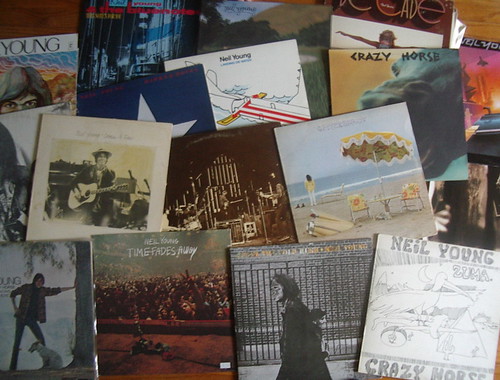
Guess who’s 60
? Neil was probably the first rock star I got into (the album that hooked me at age 11 was “Everybody’s Rocking”, of all things), has never been far from the top of my hit parade, and to this day his music is a staple in our house.

It’s all-Neil, all-vinyl, all day…

Posted in Abject Learning | 5 Comments

WikiRadio2 – Electric Boogaloo

WikiRadio2.jpg

For some reason, DJ Edit and his unfaithful sidekick Harry the Talking Computer have been allowed back on the air, this time in screencast form (requires QuickTime, 42 MB). They are counting down ten hot wikis (need I add, not the ten hottest wikis, no ranking is implied) — and all linked on the companion wiki.

For those of you wondering why this is WikiRadio2 — the original WikiRadio.

Posted in wikis | Comments Off on WikiRadio2 – Electric Boogaloo

If a two-day big bad blog party ain’t enough for ya…


…it looks like relentless co-organizer Boris, not content with heading up the Spaghetti Western Dinner, is hoping to make it a full week of rich, chocolaty, open-publishing goodness:

I may actually extend this conference and try and gather people together for the week preceding Moose Camp/Northern Voice — a gathering of open source CMS/Blogging tools to talk about cross platform issues and working more closely together on standards and interoperability. Watch this space for more info (think Vancouver/Whistler in February: how could you NOT want to come?). At the very least, there will likely be a DrupalCon Vancouver 2006. Moose Camp will be the culmination of this event…

So, any EduBloggers? Knitting Bloggers? Food Bloggers? From journalists to home makers to gardeners to people just telling stories, we want speakers that have things to share. It’s a wide audience, from lots of local Vancouverites wanting to find out more to lots of top bloggers and techies from around the world.

Posted in Abject Learning | 1 Comment

Oiled up and ready to offend

As a follow-up to my other politically-themed post, thank you D’Arcy for stepping forward with some thoughtful and necessary discussion on the implications of the petroleum economy. (Some good comments there too.)

To be honest, most of my periodic blogger-funks have been triggered by some piece of news that further demonstrates the willful blindness we all have about our relationship to the planet and to each other. I’m embarrassed by how often I let brooding over these issues paralyse me. I also carry around a lot of guilt. I try to reduce the damage I am personally doing (busing to work, shivering through winter with the thermostat set masochistically low, happily paying more for organic, locally-produced food) but am ultimately as much part of the problem as anyone. There are many weeks when all I want to write are fierce condemnations of SUV drivers, of short-sighted development, of the machinations of petro-politics (which trump democracy every time), or to note the latest evidence of climate change in our increasingly hostile environment.

What usually (not always) stops me is social fear (some of my best friends drive SUVs), and a recognition of my own ignorance and culpability. But I gotta tell you, sometimes all this happy bloggy talk about social software seems totally absurd — like praising the amazing intercom system on this great new ship Titanic.

So I give the D-Man credit for at least breaking the stupid silence and airing the problem. It may not be my place, and I doubt very much it will make any difference, but I’m not going to pretend that everything is fine anymore. Unsubscribe and de-link at will.

Posted in Uncategorized | 6 Comments

Free Space

Martha Burtis points to this welcome and heartfelt plea from Danah Boyd “capturing why it is that we need to allow space online for young people — and why we need to step aside and let them fill those spaces”:

A few days ago, i started laying out how youth create a public in digital environments because their physical publics are so restricted. Since then, i was utterly horrified to see that some school officials are requiring students to dismantle their MySpace and Xanga accounts or risk suspension. The reason is stated simply in the article: “If this protects one child from being near-abducted or harassed or preyed upon, I make no apologies for this stance.” OMG, this is insane.

In some ways, i wish that the press had never heard of these sites… i wish that i had never participated in helping them know of its value to youth culture. I wish that it remained an obscure teenage site. Because i’m infuriated at how my own participation in information has been manipulated to magnify the culture of fear. The culture of fear is devastating; it is not the same as safety.

…How do youth come of age in this society? What good is it to restrict every social space that they have? Does anyone actually think that this is a good idea? Protectionist actions tends to create hatred, resentment. It destroys families by failing to value trust and responsibility. Ageist rhetoric alienates the younger generation. And for what purpose?

The effects are devastating. Ever wonder why young people don’t vote? Why should they? They’ve been told for so damn long that their voices don’t matter, have been the victims of an oppressive regime. What is motivating about that? How do you learn to use your voice to change power when you’ve been surveilled and controlled for so long, when you’ve made an art out of subversive engagement with peers? When you’ve been put on drugs like Strattera that control your behavior to the point of utter obedience?

Boyd’s piece moves on to a much wider scope than online interaction, but I think argument she makes is dead on. Whether you agree or not, it merits a thoughtful response — this is must reading for any conscientious educator.

I’ve been struggling a lot lately with how to align my work-oriented focus on this weblog with ‘unrelated’ issues. I know people don’t come here to read my political views which, if electoral results and polls are any guide, are out on the fringes, even here in on the Canadian Left Coast. I know I have regular readers who share few of my convictions. I worry about alienating visitors (and friends) with rantings that would likely be as pointless and divisive as ones about sports teams (though I apparently have little difficulty doing that). But reading Boyd’s post, the linkages between my profession and my beliefs are crystal clear, and take on a sense of urgency. Open spaces (real open spaces, not simulations of them) might support a stronger framework for self-determination, and greater respect for individuals that will cascade into broader social benefit. It’s an opportunity to offer up a small counterweight against the seemingly unstoppable cycles of fear and repression (heavy and loaded words, yes, but how else do we describe it?) that are grinding up human spirit like sausage. Yes, new technology is being co-opted and undermined on all sides, being hyped beyond reasonable recognition, and will have unforeseen consequences, but maybe this really is a battle worth fighting.

As a wise friend said to me recently, time grows short.
Posted in Uncategorized | 9 Comments

Social software short shorts

Like half the blogosphere (saw it from Josie first) I am giving Suprglu a shot. I think it will make a nice presentation space for the current run of RipMixFeed for the Text Technologies course, which is just getting started. I love the editable CSS stylesheets, and hope to roll out a new look soon, though I agree with Library Stuff, the end result should output RSS of its own. We gotta keep those feeds flowing.

Quibbles aside, RippedMixedLearning Canadians like me and Alan love it.

On another front, not all of it is “social software” in the purest sense, but I just love this list “I want to…”, a pragmatic and comprehensive list of applications that make our online lives easier and groovier — organized sensibly by how we use them. If only it were a wiki…

Posted in Uncategorized | Comments Off on Social software short shorts

Because the revolution’s here – podcasting in education

I already pointed briefly to Gardner Campbell’s wonderful piece on podcasting, There’s Something in the Air, but it deserves more than a passing glance.

Gardner didn’t merely write a piece on what a podcast is, and offer a few links to examples, though he does cover those basics. What I value most about this article are the many sections that showcase his special contribution to the broader conversation. Like his riff on the “explaining voice“. Or ruminations on the “strange craft” of radio, one that provides a foundation for digital work even as it is transformed by it. Most importantly, Gardner does not shy away from the deeper implications of new technology on learning — embedded in almost every paragraph is a carefully considered and passionate statement on what education should aspire to be, and what it might be. I especially value the section in which Gardner makes the case for academics to take it on themselves to adapt to technology (as they did with word processors, to an extent that to revert seems ludicrous). And the ending of the article is perfection.

In short, even if don’t you think you care about podcasting, you should read this piece.

I’m thrilled that the article is out, and will draw on it as a model and inspiration. It’s out in HTML form now, but if you read anything like me I suggest you take it in off-screen — download the .PDF, print it out (preferably with a colour printer), and find an hour in your busy schedule to give this a careful reading.

Posted in Emergence | 1 Comment