This is one of the last courses I will be taking in the program and as the journey draws to a close, this course has opened up new perspectives on text and technology. Throughout the term, I have been travelling (more than I expected) and as I juggled my courses with the travels, I began to pay more attention to how text is used in different contexts and cultures. Ong, Bolter and the module readings were great for passing time on my plane rides – I learned quite a lot!
I enjoyed working on the research assignment where I was able to explore the movement from icon to symbol. It gave me a more in-depth look at the significance of visual images, which Bolter discusses along with hypertext. Often, I am more used to working with text in a constrained space but after this assignment, I began thinking more about how text and technologies work in wider, more open spaces. By the final project, I found myself exploring a more open space where I could be creative – a place that is familiar to me yet a place that has much exploration left to it – the Internet.
Some of the projects and topics that were particularly related to this new insight include:
Despite the challenges of following the week-to-week discussions from Vista to Wiki to Blog and to the web in general, I was on track most of the time. I will admit I got confused a couple of times and I was more of a passive participant than an active one. Nevertheless, the course was interesting and insightful and it was great learning from many of my peers. Thank you everyone.
Interactive (Non)Fiction
For my project, I used interactive fiction to explore the use of hypermedia and how it has affected my development of digital literacy. I consider my technical abilities to be advanced but I still have the same experiences as that of a technical novice. This self-exploration has enabled me to compare my experiences with studies and articles and also provides some insight into the implications of media literacy and education. The experiences are reflections into how I have come to see, engage and interact with print through its published and online formats. As well, it has given me the opportunity to list some of the many distractions online.
The story begins with a short narrative and then, in interactive fiction form, asks the user to choose a path. Not all the links are found at the bottom of the page and have been embedded within links inside secondary pages. A site map has been included for full exploration of the web site.
Platform
The WordPress platform provided the best environment for which to create my interactive fiction work. Furthermore, it is a platform which I am comfortable with. This work permitted me to write creatively while maintaining a scholarly position at the same time. The web site’s appearance is simple, clean and basic.
Critical Issues
Hypermediacy contains a wide range of issues that I wanted to cover as much as possible in this interactive (non)fiction work. Through use of common distractions such as search engines, news sites, and social media, I was able to cover the issues in a general fashion. The main issues discussed in this interactive fiction piece include multiliteracy, gaming literacy, and media literacy in general. Consequently, there is discussion of how print literacy has evolved into the online world along with the implications of this change.
The New London Group (2006) posits that teachers and students need a language for talking about language, visuals, texts, and meaning-making interactions. Otherwise called a metalanguage. Each reflection conveys the implications of the various aspects and issues in education – how one learns through exploration or with assistance and how the metalanguage affects the user in a variety of different media formats, with respect to the major Web 2.0 tools as well as traditional print materials.
The theme of distraction is congruent with the notion of the multimodal design of the web and the challenges associated with meaning-making (New London Group, 1996). In my reflection on distractions and multimodality, I have come to appreciate the technologies of the past and the present and, with this project, I hope the audience can also reflect on and relate to the implications of digital and hypermedia literacy.
Reference
New London Group. (1996). A Pedagogy of Multiliteracies: Designing Social Futures. Harvard Educational Review. Retrieved from http://wwwstatic.kern.org/filer/blogWrite44ManilaWebsite/paul/articles/A_Pedagogy_of_Multiliteracies_Designing_Social_Futures.htm
My original plan was to have a short animation re-invention video presentation on Ahead but the application proved too frustrating to use. I kept the link for anyone to see on my website which is run with WordPress. Ahead is similar to Prezi, which I am more familiar with. However, when I went to the Prezi website to create my project, it was down for maintenance so I resorted to restarting something else in Capzle. The Capzles project contains a slideshow of photos from my recent trip to Hong Kong in late September.
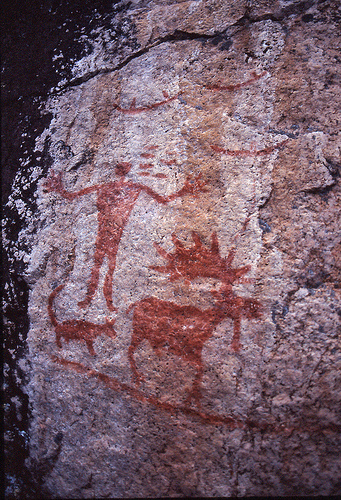
Early Pictographic Communication: Pictographic art from Minnesota shows how Native Americans communicated with one another (jacehgn, 2009).
Icons and symbols are everywhere. Throughout history, icons and symbols have a vital role as a communication tool. In their most simplified forms, they are recognizable and often, comprehensible images and visuals; in their most complex forms, they exist as a series of abstract lines to complex strokes that bear meaning in languages not understood by all. An examination of icons and symbols throughout history and through different cultures will reveal its implications for visual literacy and education.
Starting With Semiotics
In linguistic terms, the icon and the symbol are derived from three semiotic modes developed by philosopher Charles Sanders Pierce, a key figure in semiotics (Chandler, 2009; Huening, 2004). According to Peirce (in Chandler, 2009), the symbol does not represent the object; therefore, one must learn and become familiar with the relationship to the object. Examples where symbols are found include the national flags of each country and the languages with alphabets, punctuation and words. Conversely, the icon resembles, imitates, or represents the object to which it bears similarity. Examples of icons include portraits, scale models, metaphors and sound effects. With semiotics, ‘pure’ icons do not exist and is influenced by an element of cultural convention. Historically, iconic forms have evolved towards symbolic forms (Chandler, 2009).
History
Early evidence of the communication and expression of human thought can be seen in graphical transcriptions such as those found in notched markings in bones during the time of Homo erectus, at least 412,000 years ago. Stone and bone markings from the era of Homo sapiens sapiens, about 100,000 years ago, convey more evidence of symbolic thinking. Cave art from southern France has also provided proof of pictorial communication displaying symbolic references (Fischer, 2001). The appearance of the horse in the cave art could provide one of the earliest representations of the icon in use.
Most early writing systems that once existed are currently extinct and its origins are not very clear; however, writing systems remain one of society’s most versatile means of communication (Fischer, 2001; British Museum, 2009). Symbolic writing is apparent in the Balkan region about as early as 6,500 years ago, where graphical marks and impressions were stored as information into clay tokens that could be easily baked and preserved (Fischer, 2001). By 4,000 B.C., small clay “envelopes” called bullae were used to potentially enclose the clay tokens. Markings and impressions on a bulla would enable one to decipher its contents without breaking it open (Fischer, 2001; Ong, 2002). An earlier known writing system was developed approximately 5,000 years ago in the Middle East, with other scripts invented in Egypt, India, China, and Central America. While each system was developed independently of the other (Ong, 2002), each performs the same basic function – to provide a visual means of recording language (British Museum, 2009).
Other symbolic and pictographic writing systems include the Chinese characters that are also used in Japanese writing. Although Chinese writing is considered logography, one must learn to recognize and learn the meaning of each character. Some more visual examples of recording language include Native American pictography, which conveys complex communication using drawings of specific objects that could be articulated by speech (Fischer, 2001; Ong, 2002). Fischer’s (2001) example of an Abnaki hunter in Maine explains how a birchbark scroll with a drawing could be left outside a wigwam, where the scroll depicts “a man in a canoe and a deer, with a man on foot pointing at a squiggle, and a snow-shoed man pulling a sled” with the translation: “I’m crossing the lake to hunt deer, turning off before the next lake, and won’t be back until spring” (Fischer, 2001, p. 19).
Literacy
The history of the movement from icon to symbol conveys the human need to move from a simplified means of communication to one that is more complex, one that is understood by a deeper meaning. Ong (2002) asserts that writing is a deeply interiorized technology that can be understood by observing its past with orality. Coulmas (1991) further argues that “writing was not invented for literary purposes, but its invention made literature possible – certain kinds of literature, anyway – and it also made possible a whole range of other complex communicative activities not found in non-literate societies” (p. 4).
Queen Elizabeth as Icon and Symbol: Profile of the Queen on a Canadian coin (Devan_Not_Devil, 2009).
Icons, by their semiotic definition, generally have the characteristic of being universally understood, whereas symbols can become lost in translation. However, both icons and symbols do not necessarily need to possess meaning to those who are literate. For instance, the profile of Queen Elizabeth on Canadian coins holds both iconic and symbolic meaning. As an icon, her profiled portrait shows that she is indeed Queen Elizabeth; however, as a symbol, her appearance on the coin suggests a deeper meaning that can be conveyed by Canada’s political, economical and historical ties to the Commonwealth. To an individual who is new to Canada or does not live in the country, the profile would represent that of a woman who is seemingly important yet whose importance bears little to no meaning, with her relation to the image on the reverse side of the coin drawing confusion. Apart from this example, signs and languages composed of symbols can also challenge individual understanding of the object being represented.
Education
The use of pictographic icons and symbols enabled individuals to decipher meaning visually and allegorically. If one could recognize the image being portrayed, there was a chance that the message could be understood (Fischer, 2001; Ong, 2002). Ong (2002) asserts that pictures serve as aide-memoires, or a means to help the memory. This suggests that to learn the code and meaning of a symbol, one must commit it to memory.
Throughout history, writing served as a way to remain organized and keep wealth and power. In ancient Mesopotamia, mostly boys learned how to make a tablet and use a stylus in order to write basic cuneiform and learn thousands of Sumerian words. With enough training, the students could become scribes and thus, members of a privileged social class. Before the advent of mass education in the nineteenth century, literacy was reserved for the wealthy and privileged (British Museum, 2009).
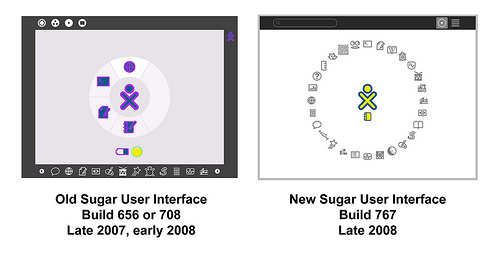
More recent and emerging applications of icons and symbols in education can be found in developments such as the semiotic web, gaming literacy and other applications in informal learning. Gee (2003) observes the prevalence and significance of visual literacy in textbooks today, where more images are part of the content, next to the words. He describes these texts as being multimodal – going beyond words to convey meaning (Gee, 2003). Furthermore, with the existence of multimodal content, students are introduced or led to discover new ways of reading and writing. Education has gone beyond print and moved to the realm of computing, where the output of the monitor consists of numerous symbols (or icons, in computing terms) laid out in a graphical user interface. Learners are often expected to understand the meaning of symbols and icons without context. One example is the Sugar user interface on the One Laptop per Child (OLPC) computer, which was specially designed to meet the needs of children and uses icons to represent the user and his or her collaborative environment (OLPC, 2009).
OLPC's Sugar Interface: Changes to the layout of the Sugar interface - how does this affect users? (curiouslee, 2008).
In today’s modern world, Gee (2003) argues, people need to be more active and literate in different semiotic domains. Marcus (2003) further outlines the existence of these domains as part of the user experience in computing and indicates that basic Chinese has about 3,000 signs that have developed over millennia while software developers have designed two to five times the number in a few years, with the downside to many of those signs being poorly designed and illegible. Icons and symbols are now found in a variety of platforms from desktop computers, mobile devices to vehicle systems. In 1974, the American Institute of Graphic Arts (AIGA), developed a system of 50 symbol signs for use in transportation hubs like airports and at large international events. AIGA’s development of the symbols shows the possibilities of education using the semiotic domain with application of what Gee (2003) refers to as “internal and external design grammars”, where principles and patterns are identified through observation of social practices. The purpose of developing such a system was to provide a system of signs that “communicated the required range of complex messages, addressed people of different ages and cultures, and were clearly legible at a distance” (AIGA, 2009).
Conclusion
Over time, icons and symbols have provided the literate and illiterate with visual representations to convey meaning. Today, icons and symbols are used more widely for environmental uses like wayfinding, in user interfaces, and for communicating information to a more universal audience. Their existence in the semiotic domain demonstrates the need for a well-designed, standard of symbols and icons that can simultaneously address the requirements of the audience for more direct comprehension and learning.
Technology has made significant impacts in oral and written communication and interaction. The difference can be observed between oral and literate cultures through the introduction and evolution of writing technologies. Ong (2002) posits that oral cultures developed mnemonic patterns to aid in memory retention of thought, while literacy forces the creation of grammatical rules and structured dialogue. The jump from orality to literacy would have been a challenge for the cultures wishing to preserve their traditions and thoughts in writing and yet, the knowledge to write and record information has enabled many cultures to pass down important pieces of knowledge to future generations.
Ong (2002) explains how, despite being a late development in human history, writing is a technology that has shaped and powered intellectual activity and that symbols are beyond a mere memory aide. As outlined by Ong, oral cultures had the challenge of retaining information in a particular manner, where, when written, the characteristics of oral speech become more evident with certain patterns of speech. Given that oral cultures had the challenge of retaining information, does literacy require orality? Postman (1992) supports Thamus’ belief where “proper instruction and real knowledge must be communicated” and further argues that despite the prevalence of technology in the classroom, orality still has a place in the space for learning.
As writing technologies evolve, culture and society have the tendency to evolve toward the technology; thus, developing new ways to organize and structure knowledge (Ong, 2002) in order to communicate information and changing the way interactions take place. The construction of speech and the construction of text change depending on the technology. For instance, with the computer, the individual is permitted to delete or backspace any errors in speech or grammar and construct sentences in different ways with the assistance of automatic synonyms, thesaurus or dictionary usage. Before the computer, errors could not be so easily changed with the typewriter, whose ink would remain on the paper until the invention of white out. Tracking the changes to the original Word document with which this paper was composed would reveal the number of modifications and deletions – a feature of technology that cannot be characterized in orality because culture may note errors in speech but cannot effectively track where each error was made. In public speech, one can observe the changes in behaviour, the pauses, and the “umms” and “uhhs” of speech. This is also how the interaction differs from the norm.
With text messaging, the construction of information is often shortened, even more so than one would find with instant messaging. The abbreviated format of text to fit within a limited space has taught individuals to construct conversations differently; in a manner that would not have been so common 15 to 20 years ago. The interaction between individuals changed since text messaging requires more of a tendency to decipher the abbreviated format. In a sense, text messaging uses some form of mnemonics in order to convey messages from one person to another. This seemingly new form of literacy, in some cases, requires more abstract thinking and as Postman (2002) suggests, may require orality to communicate the true message, which may occur in the form of a phone call.
Learning materials presented in shorter formats becomes more important, particularly for educational technologies like mobile learning, where technologies such as netbooks and mobile phones are utilized for classroom learning. Postman (1992) posits there is a need for an increased understanding of the efficiency of the computer as a teaching tool and how it changes the learning processes. With mobile technologies, the interaction could be limited by abbreviated formats, as seen with text messaging, and in some cases, may not be an effective form of learning for some students. Despite the invention of newer technologies, orality often helps clarify thought processes, concepts and information. While the student can absorb knowledge on literacy alone, orality can assist in the retention of information.
The complexity of written communication can be taken a level further with the basis of writing – pictograms – images that can be recognized and deciphered by most individuals. Gelb (in ETEC 540) argues that limited writing systems like international traffic signs avoid language and can yet be deciphered by illiterates or speakers of other languages. Although most traffic signs can be clear, some do require translation for the meaning to be clear, whether the translation is made orally or through writing. Ong (2002) supports the notion that codes need a translation that goes beyond pictures, “either in words or in a total human context, humanly understood” (p. 83).
While writing and writing technologies have evolved and changed the way interactions and communication take place, one thing has not changed: being able to find the most basic way to communicate to individuals illiterate of other languages – a characteristic that orality cannot communicate to individuals who are unfamiliar with a language. Thamus feared that writing would be a burden to society, but its advantages outweigh the disadvantages (in Postman, 2002).
References
Gelb, I. J. (2009). Module 2: From Orality to Literacy. In ETEC 540 – Text Technologies: The Changing Spaces of Reading and Writing. Retrieved October 4, 2009 from http://www.vista.ubc.ca.
Ong, W. J. (2002). Orality and Literacy. London: Routledge.
Postman, N. (1992). Technopoly: The Surrender of Culture to Technology. New York: Vintage Books.
Coming from a design background, I have come to see text as an art form that is often manipulated as content or as part of a layout and for me, that is usually how I intermingle text with technology. Text is no longer a static form but it can also be animated. Looking back at the origins of text in its more static form, some examples of text as an artistic, symbolic form is its use in hieroglyphs and asian characters. Technology works to, in some form, mechanize the text through writing tools, printers and other text-making tools.
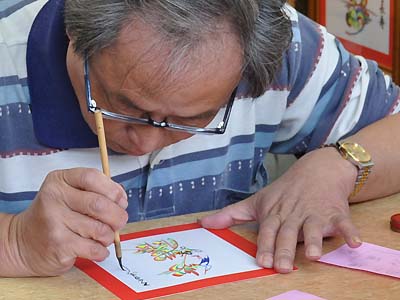
One mingling of text and technology that came to mind is the use of calligraphic tools not just for communication but as an art form. In Asia, the calligraphic brush was more widely used in the past to paint characters in languages. When painted, the symbols have flowing strokes and lines, with some strokes more emphasized than others. Today, those same characters in print have been “mechanized” and converted into harsh lines and strokes that are even throughout. The same can be said for handwriting.
What are the implications of text and technology today: How much have computers created a kind of convenience in the way we communicate and will handwritten texts still exist in the future? In the last 10 years alone, I think technology has done a great deal in changing the way we look at and learn how to use text using computers, cell phones and other, more advanced non-traditional devices.
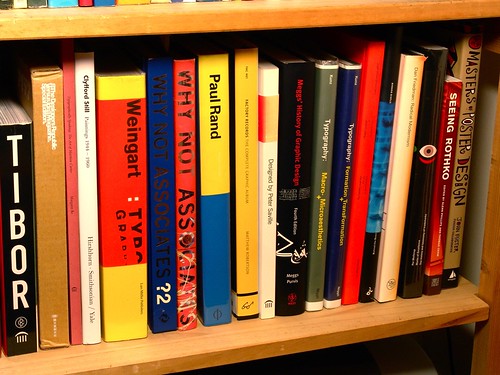
I chose this photo because the bookshelf contains a collection of resources related to design, typography, text, and technologies. In the Module 1 course content, we are challenged to think about text and technologies in their varying forms and how it has evolved, become part of innovation and is being re-innovated. Not only are these books resources, but simple as they look, they also exemplify elements of design in the spines – creative ways of arranging text to convey typography.
My name is Marjorie del Mundo. I have a background in interaction design and have worked in marketing and graphic design. Currently, I am completing my final week as an Educational Programmer for UBC Student Development and am looking forward to the launch of the Discover Your Major guide for undergraduate Arts students which I helped develop over the summer. During my design studies, I had to investigate and explore the use of text and typography as a foundation for creating layouts and spreads. In this course, I hope to expand my knowledge on how text and technologies impact the way we share information and communicate in various contexts.