Kurzweil 3000 is an adaptive technology that provides support for students who have reading and writing difficulties. In order to better present this technology’s affordances please view this video that I have created.

Kurzweil 3000 is an adaptive technology that provides support for students who have reading and writing difficulties. In order to better present this technology’s affordances please view this video that I have created.
Given that we are adding our favourite web 2.0/social media experiences, I thought that I’d provide a very brief history of social media:
Social Technologies have become a staple part of today’s digital world. Millions of people make social connections online through various websites like Facebook, Twitter and Flickr to name just a few. The popularity of such sites have seen incredible growth over the last few years, but when did this trend start? What follows is a brief history of social networking on the Internet.
1980’s :
Compuserve, which was around since the 1970s, evolved into a network that would allow members to share files. Discussion forums began to emerge as a result.
Another network called BBS (Bulletin Board System) allowed users to communicate using a modem over telephone lines. Long distance charges would apply so many Bulletin Boards were strictly local.
1990’s:
AOL (America Online) was in its heyday with member-created communities and searchable profiles.
Classmates.com became very popular as people tried to use the Internet to reconnect.
2000’s:

Friendster is launched. This site allowed members so see the connections that they knew they had and discover connections that they did not realize they had in common with others.
LinkedIn, a networking resource aimed mostly at professionals and businesspeople, is created.
MySpace becomes a huge hit mostly in the US. Its key demographic is the under 30 crowd.

Facebook quickly grows into the world’s largest online social networking site.

Twitter is launched and catches on quickly for those who can’t seem to get enough minutiae. Where and what social networks will evolve into is anybody’s guess.
As I read Kelly’s article “Scan This Book” I was struck by its utopian outlook. It felt almost like it had a Star Trek feel to it. With that in mind I thought that I would discuss the arguments for and against the Universal Library in the form of a “Captain’s Log” from Star Trek:
Captain’s log- Stardate 5938.3:
I have been enjoying reading the novels of 21st century Earth held within Unilib (our Universal Library). It is hard to imagine that people of that time were opposed to the digitization of all books. Concerns over copyright and advertising revenue seemed to dominate the debate over whether or not it would be a good thing to have free access to all books ever written. Now it seems unthinkable to live without Unilib. Just imagine what would have happened to great countries like Somalia and Afghanistan had they not been given the free access to these documents in their language. No doubt their populations would have remained impoverished and unenlightened, forever looking for help from the countries who were wealthy enough to learn from the books they purchased and which their poorer cousins were unable to afford.
What if Unilib failed to emerge? Our world would be vastly different. We would not have developed the deep collaborative spirit that emerged among all readers as they linked, tagged and bookmarked. The vast mashups of reading material would have never materialized. A greater sense of understanding and authority arose as more and more knowledge was linked and connected to each other. Cures for cancer, diabetes and heart disease would not have been imagined because there would not have been the interconnectiveness of the vast scientific wealth.
Thank goodness the differences between the copyright holders and those interested in digitizing the world’s books were able to be settled. Authors whose works lived in obscurity began to become more popular as social book networks virally distributed links to their works. Universities were able to expand their libraries overnight because the cost of a digital book was miniscule compared to the cost of hardcover text.
Not only did universities increase their collection of human knowledge, the entire world did as well. Man’s history was more accurately depicted once governments and publishers no longer asserted and inserted their view of historical events. A more complete picture arose as readers from all walks of life, ethnicity and nationality added links and tags to historical documents. This collective and connected account of man’s story helped foster a better understanding between nations which ultimately led to the formation of our world government and a redistribution of the earth’s resources.
Our universe would be dramatically different had the United States Congress not passed their controversial copyright law of 2100. This law extended copyright indefinitely. The outcry and revolt that followed led to the great consumer boycott of 2112. This boycott, which was organized by Jim Gates (Bill Gates’ great, great grandson), called all consumers to refuse to purchase any product that was covered by copyright law. The resulting economic crash brought the mega corporations of Sonysonic and MicroApple to their senses. They soon were able to work out an agreement that allowed consumers to use intellectual property and at the same time reward those who created the content.
With opposition due to copyright removed Google, Carnegie Mellon University, Microsoft, Yahoo and other interested parties were all able to pursue their digitization projects. It soon became apparent that they should combine forces in order to create a single project that would amount to the world’s single book. With copyright no longer being a concern Google’s practice of having authors opt out of the digitization project was no longer in effect.
Google’s original strategy of having authors opt out had some legacy issues. It is interesting to note how this practice transferred to other segments of the society. Employers used this model to gather sensitive information on their employees if the employees did not opt out of the human medical data base initiative. Governments collected confidential information on the citizens who did not opt out of the Big Brother data bank.
The Unilib movement did have its critics. There were those who claimed that “scanning books and chucking their poor innocent words into a vast, searchable database will only create massive intellectual fraud and confusion” (Keen, 2007) They argued that “taking a few words out of one text, replacing them with a few words from another, is the surest way to undermine the coherence of any textual argument” (Keen, 2007) and that “(re)mixing great books like Plato’s Republic with Hobbes Leviathan will create intellectual garbage.” (Keen, 2007) Fortunately these fears proved to be unfounded as readers fully engaged in the process of reading. The concern that readers would not chose to read entire books was unfounded. Not only did people read complete works but they then created remix anthologies that linked works of a common thread. It was from these threads that humans have been able to evolve to where we are today: a united species seeking self-improvement over financial gain. Without the Universal Library this would not have been possible. Thank goodness mankind was able to work together to create the cornerstone of our society.
References:
Birt, Y. (n.d.). Wisdom and the Universal Library. Retrieved September 22, 2009, from Yahya Birt: http://www.yahyabirt.com/?p=60
Dyson, G. (2005, November 30). The Universal Library. Retrieved September 20, 2009, from Edge The Third Culture: http://www.edge.org/3rd_culture/dyson2.05/dyson2.05_index.html
Google’s Book Scanning Hits Snag. (2008, May 12). Retrieved September 26, 2009, from Wired: http://www.wired.com/culture/lifestyle/news/2005/08/68513
Grafton, A. (2007, November 5). Onward and Upward With The Arts. Retrieved September 19, 2009, from The New Yorker: http://www.newyorker.com/reporting/2007/11/05/071105fa_fact_grafton?currentPage=all
Keen, A. (2007, March 6). Why Google’s universal library is an assault on human identity. Retrieved September 22, 2009, from Blogs ZD Net: http://blogs.zdnet.com/keen/?p=107
Kelly, K. (2006, May 14). Scan This Book. Retrieved September 17, 2009, from Etec 540 website: https://www.vista.ubc.ca/webct/urw/lc5116011.tp0/cobaltMainFrame.dowebct?JSESSIONIDVISTA=5D50KDDPcHTpY10GpYpyjhCc1NYhlkMXYvhjqwsG2LwJjJHplQBH!-1842142989!node07.vista.ubc.ca!20001!-1!-1938337275!node08.vista.ubc.ca!20001!-1
Manjoo, F. (2009, May 6). Your Search Returned 12 Million BooksGoogle’s goal of a universal online library would be great for humanity. It can still be great for authors and publishers, too. Retrieved September 25, 2009, from Slate: http://www.slate.com/id/2217804
O’Donnell, J. J. (n.d.). The Virtual Library:An Idea Whose Time Has Passed. Retrieved September 25, 2009, from http://web.archive.org/web/20070204034556/http:/ccat.sas.upenn.edu/jod/virtual.html
Prpick, S. (Composer). (2009). The Great Library 2.0. [C. R. Ideas, Performer] unknown, unknown, unknown.
Sherman, C. (2006, May 18). Building the Universal Library. Retrieved September 21, 2009, from Search Engine Watch: http://searchenginewatch.com/3607081
Unknown. (2009, June 22). ITC Library. Retrieved September 23, 2009, from ITC: http://www.itc.nl/library/General_info/million_book.asp
I’m new to blogging and I’ve got a question for anybody out there that has the expertise/time/interest to respond:
Is there a way to search for authors? I tried to find the posts that I had created and couldn’t seem to find an easy way to search or sort postings in order to find the ones that I had created.
If you asked me last year to define technology I would have used words like: modern, electronic, fast, technical and expensive. Recently I have come to a different personal understanding of technology. I believe that technology is anything that allows you to work more efficiently. The wheel was a technological wonder in its day as was the pencil. The fellow in this youtube video seems to have the same view of technology. I love working “smarter not harder”. As a matter of fact my wife teases me and says that if I die before she does she is going to engrave “He worked smarter not harder” on my gravestone.
Weblog posting on TEXT
Given the debate over the academic validity of using sites that are created by a ‘community of experts’, I decided to go to the source that most of us equate with this movement, namely Wikipedia. There it was confirmed that ‘text’ has multiple meanings:
To me text simple means a way to getting a message across and that is why I chose the Rosetta Stone as a pictorial representation of text. Without text we would rely on other means of communication (oral, gesturing, smoke signals etc.). Most if not all of these would be far less efficient than using text in one form or the other. I mean how else would I be able to describe to what text means to me without actually using text?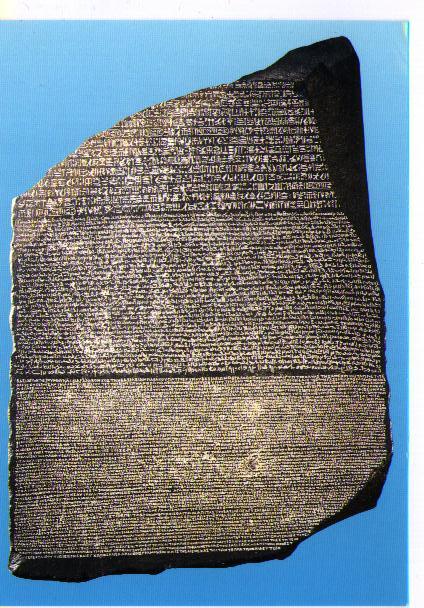

Artis struisvogel leest krant van oppasser / Ostrich reads newspaper of caretaker, originally uploaded by Nationaal Archief.
Hi Everybody,
My name is Ed Stuerle. I am an elementary teacher in Kelowna, BC. I have been teaching here since 1983. I am currently teaching Grade 5 part time and I am doing some prep relief in the computer lab for the rest of the time. I really enjoy my time in the computer lab (that is until the computers start misbehaving). I find that it is very easy to motivate the students and that many students who might struggle in the traditional classroom often are quite comfortable using technology to present their understandings.
I chose this picture mainly because I enjoy the humor in it. I must admit that I’m not the philosophical type so if I claimed that the picture reminded me that all living creatures make sense of their own reality in their own unique way… well I’d be full of bull. What can I say… it’s a funny picture and I like it.
Spam prevention powered by Akismet
