Category Archives: Rouge Forum Update

Rich Gibson: The Empire is Teetering! Why is There No General Strike?

The Empire is Teetering! Why is There No General Strike?

By Rich Gibson

January 4, 2025

Going downhill, like a Slinky on a staircase, the empire rolls down almost imperceptibly, until it reaches the floor and collapses in on itself.

But the empire isn’t a Slinky. It is busy with class and imperial warfare, the few attacking the many in ways more numerous than a short essay can outline.

Where is the resistance? Where are the unions?

Even conservative Catholic, David Brooks, has called for a general strike and mass civil disobedience. It only makes sense.

Let us consider our context:

Combine the vast transfer of wealth to the pecunious in the “Big Beautiful Bill,” the loss of Medicaid benefits for fourteen million people, the vast homeless crisis, climate and vaccine denial, a veritable war of the rich on the poor.

Now the hubris of a socio-pathic narcissist decapitates the head of Venezuela, kidnaps him and his wife using typically amphetamine addled Delta force based on Fort Bragg (see The Fort Bragg Cartel), flies them to New York in preparation for a trial about drugs (?).

Approximately forty people were killed in the operation: collateral damage.

Add this body count to the fast boat murders, about 100 dead, where the evidence was destroyed by guaranteeing the ship were sunk, along with two survivors who were blown up while they waved at the sky.

These were, most certainly boats full of drugs, even the one with eleven people on it—where was the room for the drugs?

Drugs– after pardoning the Honduran convicted of bringing metric tons of drugs into the US?

Consider this contradiction: Maduro is charged with enriching himself from the drug trade. Whether that is true or not, or if it is another Gulf of Tonkin tale, may take years to determine.

For his year in office, Trump and his family have enriched themselves from the ponzi scheme that is crypto (even Melania has a crypto), real estate deals, pay for play dinners with billionaires, ignoring the emoluments class.

It grew so egregious that the New York times is publishing pages of charts about the deals Trump and his allies have made, using his public office as cover for what amounts to electoral extortion.

Prattling about bringing democracy: the Constitution does not follow the flag.

Democracy talk ended on day two of the kidnapping. became, rule by proxy—likely Delcy Rodriguez, who should take a lesson from other allies and puppets, like Vietnam’s Diem (Johnson: “we killed the son of a bitch”), or Libya’s Gadaffi.

Rodriguez has been warned by the administration that if she doesn’t cooperate, “She will get something worse than Maduro.”

For her part, Rodriguez has demanded Maduro’s return.

Daughter of a guerrilla terrorist, Rodriguez, the Vice President, is also the oil minister and has been meeting with Americans for months. She is a prime candidate as the insider who made the abduction possible. And, she may well be able to cooperate. Under Maduro’s fake socialism, she was pursuing open market strategies.

Even so, democracy hasn’t ever ruled in the US.

What has ruled, and still rules, are capitalism and imperialism.

Whether we call the US a democracy (rule of the people) or a republic (somewhat distant rule of the people), they’re matched and overwhelmed by capital (rule of the few). It’s a two-sided contradiction and one side must and did win—capital.

There are answers in history, which ties the past, with the present, and organizes the future.

Founding Father, James Madison, wrote, “what if the poor vote not to pay their debts?” that would be too much democracy for any rich man.

Or, when the 1791 Whiskey Rebellion broke out after a revolution that promised equality and happiness, George Washington raised a militia of around fifteen thousand men, to attack tax protesters in Western Pennsylvania.

President Washington, who to his credit, was with the troops on battlefields during the revolution (unlike the five star hotel generals of today, parodied in the film “War Machine”) left the militia early to lower ranking officers.

They had problems: desertion, drunks, theft, but many of the ranks had no shoes and short rations.

So, how did the officers, including the gentleman Merriweather Lewis, live? The lived very well with plenty of whiskey, beef, sweets, and more.

Discipline, to enforce these inequities, was harsh—typically one hundred lashes laid on hard.

Inequality, ah, trumped, equality, fast—despite the real radicalism of the American Revolution embodied in the Declaration of Independence.

That summons to action for equality and revolution inspired radicals in France, Haiti, and Ho Chi Minh of Vietnam who wrote his declaration almost word for word from Jefferson’s.

Jefferson, per historian Stephen Ambrose, “wanted empire.” He was a slaveholder and land speculator, like Washington, two of the richest men in the country.

He and other landowner/speculators, needed more and more land to serve the soil destroyer, tobacco. It was, as always with empire, expand or die. In this case, internally, but in most cases, expand or die because another empire; now soft-economic power China, is coming.

(The US has at least 750 bases around the world. China has one. The soft power is money and people).

The US government, before and with Trump, is nothing but an executive committee and armed weapon of the ruling class, the exploiters. It is inequality, within the US and the world, not “affordability,” the Democrats mantra.

Now, back to the kidnapping.

Sun Tzu, the Chinese philosopher of war, wrote, about two thousand years ago, “know yourself, know your enemy, know the terrain, and you will win one thousand battles.”

Socio-pathic narcissists can’t know themselves, and their sycophants who trail along, all blinded by “we leader,” only know he’s a genius, that is, for public consumption, otherwise they know they are kidnapped by him.

Venezuela is a huge country, thirty million people, twice the size of Iraq. There a competing militias all over Venezuela, and two Colombian guerrilla forces. The people are armed, and were in training before the abductions. Fifteen thousand troops on ships west of Venezuela won’t be nearly enough to quell a rebellion.

Congressman Gil Cisneros says Trump wants the oil so he can process it and bring it to the US to drive down gas prices. If he is right, it’s a classic example of the US leaders not knowing the terrain, as in Vietnam, Afghanistan, and Iraq.

Venezuela’s oil processing plants are dilapidated. Over twenty years of decay means only oil rigs owned by Chevron are anywhere near full capacity. According to oil industry insiders, it will take years to bring the rigs up to capacity. Others within Trump’s orbit, promise the oil companies will be reimbursed for their efforts.

And who will reimburse them? Taxpayers from an unjust tax system where billionaires like Trump, pay little or no taxes.

Is this a diversion as a former Democratic Party presidential candidate suggests?

Yes, Trump’s popularity ratings have plummeted, and the Democrats did do will in recent elections. In New York, the voters chose a socialist, who probably won’t be able to keep his promises, like Obama’s “hope and change” demagoguery, but billionaires spent millions for Cuomo, and they lost. All true.

Then there are the Epstein files (demand the videos!) which cling to Trump like his orange makeup and wig. They were forgotten for a day.

But this military attack is part and parcel of US imperialism. It is what empire’s MUST do: join in the relentless struggle for cheap labor, raw materials (oil), regional control and markets. Empire sent the US into Vietnam (rice, tin, rubber, strategic location), Afghanistan (strategic location going back to the Great Game) and Iraq (oil again).

Rosa Luxemberg outlined empire long ago.

“In detail, capital in its struggle against societies with a natural economy pursues the following ends:

  1. To gain immediate possession of important sources of productive forces such as land, game in primeval forests, minerals, precious stones and ores, products of exotic flora such as rubber, etc.

  2. To ‘liberate’ labour power and to coerce it into service. 

  3. To introduce a commodity economy.

  4. To separate trade and agriculture.”

The 2025 National Security Strategy, straight from Project 2025, expands on the 1823 Monroe Doctrine, now dubbed the Don-doctrine, declaring all of the Americas the property of the US. Trump, before the kidnapping, declared Venezuelas’ oil, “ours.”

The many-titled Marco Rubio threatened Cuba, Columbia, and Mexico, with the Venezuela treatment. Clearly, Greenland and Canada have reason to worry about the once-peacenik candidate Trump.

My “No Blood for Oil,” buttons and stickers, created in 2001, will be good for the rest of our lives.

Moments after the kidnappings were announced, lawyers leaped forward to declare the actions illegal, under so many laws that I lost count: the UN Charter, no involvement of congress, the War Powers Act, and more. But the law is merely a reflection of political and economic reality. US law is PROPERTY law. There is no right to have a job, home, health care—it’s not about human rights, it is about power, and usually money.

And so, it’s only illegal if you get caught, and sure they are caught, after all they caught themselves by announcing the kidnapping.

No law is going to stop them. Trump has immunity. He can pardon the other co-conspirators in murder and kidnapping, and that will be that.

And, immediately after I heard the big news, I got an email from the Democratic Party Front, Move-on, urging donations and plans to petition congress, and let’s vote in the mid-terms.

Nobody ever voted their way out of fascism, and that is what this modern tyranny is. It will take a mass, activist, anti-racist, class conscious movement with experience in direct action, on the job and off.

General Strike?

Let us wrap up with why there will be no general strike.

I have never been able to get off the merry-go-round of the bogus US unions. I have been writing about them for nearly 20 years, often on Counterpunch.

A sidelight of imperialism is that the core empire loots enough goods and money to bribe certain sections of the working class. Lenin demonstrated this more than 100 years ago. It’s still true.

The upshot of this is that the union bosses who, as above, believe and benefit from, Partners in Production, sell the pacified labor of the union members to the Big Bosses, in exchange for dues income, off of which the labors bosses live very well.

Foe example, a past president of the National Education Union, where I once worked as an organizer, when NEA was actually a union on the early ’80s, made $686, 949 in his last year in office—this in a union where many school workers live in trailers.

It follows that a general strike led by rank and file activists, would upend that sweet deal. They’d realize the union bosses would become worse than irrelevant—enemies. The union bosses know they are corrupt, and they are going to protect their corruption at all costs.

A United Auto Workers president threatened to kill a dissenter in his inner circle.

In the unlikely event that some accelerator, like the Tunisian fruit vendor who self-immolated to set off the disastrous “Arab Spring,” should create a series of rolling strike that coalesce as a General Strike, expect a violent response.

ICE, Border Patrol, and Trump’s own SS, the Proud Boys, the Oath Keepers, unmarked masked men, and others will certainly mobilize and, as in past strikes, like the railroad strike of 1877, people will begin to be “shot back to work.”

Simply withdrawing labor may not be enough.

All the forces of the state, the police, the courts, almost all of congress, the mainstream media, and most cultural institutions would be arrayed against strikers and their allies.

And, then, in the even unlikelier event that class consciousness sees the state itself as a target, the planning gets beyond my pay grade, and my crystal ball becomes opaque. While I like the Declaration’s call for the necessity of revolution, and I have already laid out plenty of similar grievances, a 21st century revolution is difficult for me to imagine.

This is the best I can do. I’ve been thinking and acting like this for more than six decades. The youngers will have to pick up where parts of my generation left off (so many mistakes, sad to say) and carry on the fight for equality and justice.

One last thing.

Justice demands organization. A critical examination of past parties, and the contradictions of democratic centralism, must push forward our battle,

Rich Gibson is professor emeritus of history from San Diego State University. He, with Wayne Ross, is the founder of the Rouge Forum. He can be contacted at: RG@Richgibson.com
Rouge Forum Archive

The Rouge Forum Archive is now available at RougeForum.com The RF Archive includes flyers, broadsides, conference programs, issues of our zine The Rouge Forum News, the Adam Renner Education for Social Justice Lectures, and more. And also check out RougeForum.org for additional information about RF activities.

The Rouge Forum is a group of educators, students, and parents seeking a democratic society.

We are concerned about questions like these:

  • How can we teach against racism, national chauvinism, and sexism in an increasingly authoritarian and undemocratic society?
  • How can we gain enough real power to keep our ideals and still teach—or learn?
  • Whose interests shall schools serve in a society that is ever more unequal?

We are both research and action oriented. We want to learn about equality, democracy, and social justice as we simultaneously struggle to bring into practice our present understanding of what these are.

We seek to build a caring inclusive community that understands an injury to one is an injury to all. At the same time, our caring community is going to need to deal decisively with an opposition that is sometimes ruthless.

Read about the origins and history of The Rouge Forum here.

Why do you call it The Rouge Forum?

The River Rouge runs throughout the Detroit area—where the Rouge Forum was founded in 1998. Once a beautiful river bounteous with fish and plant life, it supported wetlands throughout southeast Michigan. Before industrialization, it was one of three rivers running through what is now the metropolitan area. Today the Rouge meanders through some of the most industrially polluted areas in the United States, past some of the poorest and most segregated areas of North American, only to lead some tributaries to one of the richest cities in the U.S.: Birmingham. The Rouge cares nothing for boundaries. The other two Detroit rivers were paved, early in the life of the city, and now serve as enclosed running sewers. Of the three, the Rouge is the survivor.

The Ford Rouge Plant was built before and during World Way I. By 1920, it was the world’s largest industrial complex. Everything that went into a Ford car was manufactured at the Rouge. It was one of the work’s largest iron foundries and one of the top steel producers. Early on, Henry Ford sought to control every aspect of a worker’s life, mind and body, in the plant and out. Using a goon squad recruited from Michigan prisons led by the infamous Harry Bennet, Ford instituted a code of silence. He systematically divided workers along lines of national origin, sex, race, and language groupings–and set up segregated housing for the work force. Ford owned Dearborn and its politicians. He designed a sociology department, a group of social workers who demanded entry into workers’ homes to discover “appropriate” family relations and to ensure the people ate Ford-approved food, like soybeans, voted right, and went to church.

While Ford did introduce the “Five Dollar Day,” in fact only a small segment of the employees ever got it, and those who did saw their wages cut quickly when economic downturns, and the depression, eroded Ford profits.

The Rouge is the site that defined “Fordism.” Ford ran the line mercilessly. Fordism which centered on conveyor production, single- purpose machines, mass consumption, and mass marketing, seeks to heighten productivity via technique. The processes are designed to strip workers of potentially valuable faculties, like their expertise, to speed production, expand markets, and ultimately to drive down wages. These processes seek to make workers into replaceable machines themselves, but machines also capable of consumption. Contrary to trendy analysis focused on globalization and the technique of production, Ford was carrying on just-in-time practices at the Rouge in the early 1930’s. Ford was and is an international carmaker, in the mid 1970’s one of Europe’s largest sellers. In 1970, Ford recognized the need to shift to smaller cars, and built them, outside the U.S., importing the parts for assembly—early globalism.

Ford was a fascist. He contributed intellectually and materially to fascism. His anti-Semitic works inspired Hitler. Ford accepted the German equivalent of the Medal of Honor from Hitler, and his factories continued to operate in Germany, untouched by allied bombs, throughout WWII.

At its height, more than 100,000 workers held jobs at the Rouge. Nineteen trains ran on 85 miles of track, mostly in huge caverns under the plant. It was the nation’s largest computer center, the third largest producer of glass. It was also the worst polluter. The Environmental Protection agency, in 1970, charged the Rouge with nearly 150 violations.

Today there are 9,000 workers, most of them working in the now Japanese-owned iron foundry. Ford ruthlessly battled worker organizing at the Rouge. His Dearborn cops and goon squad killed hunger marchers during the depression, leading to massive street demonstrations. In the Battle of Overpass Ford unleashed his armed goons on UAW leaders, a maneuver which led to the battle for collective bargaining at Ford, and was the founding monument to what was once the largest UAW local in the world, Local 600, led by radical organizers for years.

On 1 February 1999, the boilers at the aging Rouge plant blew up, killing six workers. The plant, according to workers, had repeatedly failed safety inspections. UAW local president made a statement saying how sorry he was for the families of the deceased–and for William Clay Ford, “who is having one of the worst days of his life.” Papers and the electronic press presented the workers’ deaths as a tough day for the young Ford who inherited the presidency of the company after a stint as the top Ford manager in Europe. The steam went out of Local 600 long ago. The leaders now refer to themselves as “UAW-FORD,” proof that they have inherited the fascist views of the company founder.

When environmentalist volunteers tried to clean the rouge in June 1999, they were ordered out of the water. It was too polluted to clean. So, why the Rouge Forum? The Rouge is both nature and work. The Rouge has never quit; it moves with the resilience of the necessity for labor to rise out of nature itself. The river and the plant followed the path of industrial life throughout the world. The technological advances created at the Rouge, in some ways, led to better lives. In other ways, technology was used to forge the privilege of the few, at the expense of most–and the ecosystems, which brought it to life, The Rouge is a good place to consider a conversation, education, and social action. That is why.

Rouge Forum 2016 – Teaching for Democracy & Justice in an Age of Inequality

THE ROUGE FORUM CONFERENCE 2016

Teaching for Democracy and Justice in an Age of Inequality

May 27-28, 2016
Calgary, AB, Canada

#RougeForum16

Keynote Speaker: E. Wayne Ross, Professor, University of British Columbia
Location: St. Mary’s University [map]
Registration information and form
Submit Proposal
Housing Information
Program and schedule
Session abstracts
Conference web site

The Rouge Forum holds meetings on a regular basis at both local and national levels. The national conferences have been held on a more or less annual basis; all meetings are action-oriented and the national conferences usually include workshops for teachers and students; panel discussions; community-building and cultural events; as well as academic presentations. Many prominent voices for democracy and critical pedagogy have participated in Rouge Forum meetings. On this site you’ll find the latest information about upcoming Rouge Forum meetings and conferences as well information on past conferences, including abstracts, papers, and videos.

Rouge Forum 2014 – The Struggle for Social Justice Inside and Outside the Classroom [Program]

THE ROUGE FORUM CONFERENCE 2014

The Struggle for Social Justice Inside and Outside the Classroom

 JUNE 5-7, 2014

Denver, Colorado

Metropolitan State University of Denver


Program

All sessions at MSUD, Auraria Campus, Downtown Denver, West Classroom Building. Map:http://goo.gl/hvIWiH


THURSDAY JUNE 5

Conference dinner, location TBA

FRIDAY JUNE 6

8:00-8:30am
Outside West Classroom (WC) 164
Registration/Coffee

8:30-9:00am
WC 155
Opening Session
Chair: C. Gregg Jorgensen (Western Illinois University)

9:00-10:00am
WC 155
Plenary Session
Chair: E. Wayne Ross (University of British Columbia)
Featured Speaker:
Hacking Away at Pearson and the Education-Foundation-Industrial Complex
Alan J. Singer (Hofstra University)

10:00 – 10:15am
WC 164
Coffee & Tea Break

10:15 – 11:30am
Breakout Sessions 1

 Breakout 1A – Children and the Social Justice Conversation
WC 259 Presenters:

  • Secret City Secret Scourge, Nancye McCrary (St. Catherine College)
  • Imagining Ourselves in Children’s Literature:  Power Dynamics and Epistemologies amid the Pages and in the Classroom, Mia Sosa-Provencio, University of New Mexico

Breakout 1B – Panel: Engaging Foucault: Rethinking Our Questions
WC 261
Panelists: David Gabbard, Angela Crawford, Marilena “Lenny” Martello, Kelli Kinkela, Sarah Ritter, Mike Boyer, Jennie Moyett, Gregory Martinez, YuWen Chen (Boise State University)

Breakout 1C –  Panel: Mapping Knowledge Wealth and Resources in Diverse School Communities
WC 257
Panelists: Kelli Woodrow, Todd Bell, Melanie Bruce, Cathi Brents, Shana Mondaragon (Regis University)

11:30am-1:00pm
LUNCH

1:00 – 2:15 pm
WC 155
Plenary Session
Chair: Doug Morris (Eastern New Mexico University)
Keynote / Adam Renner Memorial Lecture
Saving The Future
David Barsamian (Alternative Radio)

2:15 – 3:00pm
WC 164
Coffee & Tea Break

3:00 – 4:15pm
Breakout Session 2

Breakout 2A – Creating Counter-narratives to Mainstream 
WC 259
Presenters:

  • The Neoliberal Agenda for Public Education: An Obituary, John Elmore (West Chester University)
  • Push It Real Good: Challenging Dominant Discourses on Race in Teacher Education, Madhavi Tandon & Kara M. Viesca (University of Colorado, Denver)

Breakout 2B – Dialogue Session 
WC 261
Presenter:

  • Changing minds: Teachers’ Perspectives Towards Issues of Diversity and Power, Kelli Woodrow (Regis University) & Victoria Caruana (Regis University)

Breakout 2C –  Panel: Angels for AP Excellence: Increasing Students of Color Enrollment and Success in AP Classes
WC 257
Panelists: Kate Greeley, Amanda West, Nathan Merenstein, Niesha Smith, Joey Halik, Ray Pryor, Janae Brown, Rheadawn Chiles, Christine Miller (Denver Public Schools)


4:15 – 4:30pm
WC 164
Coffee & Tea Break

4:30 – 5:45pm
Plenary Session: Performance & Discussion
 WC155
Celebrating Pete Seeger
Doug Morris (Eastern New Mexico University)

   [End of Day 1. Dinner location TBA]  

SATURDAY JUNE 7

8:00-8:30am
Outside WC 164
Registration/Coffee

8:30-10:00am
Openning Plenary Session
WC 155
Chair:  Greg Queen (Detroit, MI)
Featured Speaker:
Why it is Possible and Imperative to Teach Revolution—and How!
Rich Gibson (San Diego State University)

10:00 – 10:15am
WC 164
Coffee & Tea Break

10:15 – 11:30am
Breakout Session 3

Breakout 3A – Models of Resistance and Activism
WC 164
Presenters:

  • Art, Alienation, and Resistance in the Classroom, Chris Steele (Regis University)
  • Faculty Unites with Student Activists to Redesign Education Policy, C. Gregg Jorgensen (Western Illinois University)

Breakout 3B – Responding to Educational Exclusion
WC 259
Presenters:

  • Praxis: The Exclusion of Native American Teachers, Richard M. Jones  & Terry Albers (Oglala Lakota CollegRe)
  • Increasing Options for the Equality of Returning Veterans in the Classroom, Ashley O’Connor (University of Denver)

Breakout 3C – Virtual and For-Profit Higher Education: Implications of Critical Education
WC 257
Presenters:

  • Destabilizing Post-secondary Education for Profit, Yvette Powe
  • Keeping the Techne in the Classroom: What Marcuse Can Tell Us About MOOCs and the Status of Higher Education, Tyler Suggs (University of Vermont)

Breakout 3D – Voices (Panel)
WC 143
Chair: Lauren Johnston (St. Catharine College)
Panelists: Nancye McCrary, Casey Baryla, Rebecca Just, Rebekah Sams, Amanda Conrad (St. Catharine College)


11:30am-1:00pm
LUNCH

1:00 – 2:15 pm
Breakout Session 4

Breakout 4A – Critical and Revolutionary Pedagogy
WC 259
Presenters:

  • Coming to Critical Pedagogy: A Marxist Autobiography in the History of Higher Education, Curry Stephenson Malott (West Chester University)
  • What Then Must We Do?. Doug Morris (Eastern New Mexico University)

Breakout 4B Counter-narratives and Critical Consciousness
WC 261
Presenters:

  • Teaching Counter-Narratives: Indigenous Peoples, History, and Critical Consciousness, Glenabah Martinez (University of New Mexico)

Breakout 4C Transformative Social Studies Teaching and Learning
WC 257
Chair: E. Wayne Ross
Panelists: Abraham DeLeon (University of Texas, San Antonio), Four Arrows (Fielding Graduate University), C. Gregg Jorgensen (Western Illinois University), Curry Stephenson Malott (West Chester University), Greg Queen (Teacher, Detroit, MI), E. Wayne Ross (University of British Columbia), Doug Selwyn (SUNY Plattsburgh)


2:15 – 3:00pm
WC 164
Coffee/tea Break

3:00 – 4:15pm
Breakout Session 5

Breakout 5A – Planning Lessons to Combat Capitalism
WC 259
Presenters:

  • Class as the Organizing Principle of History Education, Greg Queen (Teacher, Detroit, MI)
  • What Does Lesson Planning Have to do with Capitalism?, Kathryn Young (Metropolitan State University of Denver)

Breakout 5B Social Justice vs. The Psychosis of Success
WC 261
Presenters:

  • The Psychosis of Success, Mike Sliwa
  • Narrow Focus Classroom Affection, Heightened Social Injustice, Perception of Nigerian Educators, Aladegbola Adebusayo

Breakout 5C Public Memory and Revolutionary Pedagogy 
WC 257
Presenters:

  • Hip-Hop as Revolutionary Pedagogy, Brad J. Porfilio (Lewis University)
  • Distance Makes the Heart Grow Stronger: The Legacy of 9/11, Martin Haber


4:15 – 4:30pm
WC 164
Coffee/tea Break


4:30 – 5:45pm
Plenary Session: Performance & Discussion
WC 155
Chair: Gina Stiens
Sex, Death and Other Deviations from the Common Core
William R. Boyer

  Sunday JUNE 8

9:30am – 11:30am
WC 155
Conference Debriefing & Reflections

Steering Committee brunch (location TBA)
[Anyone interested in participating in the RF Steering Committee is invited to attend this meeting]

Adam Renner Education for Social Justice Lecture at Rouge Forum 2014

renner-adam

Rouge Forum 2014 runs from June 5-7 at Metropolitan State University of Denver. Check out the details here.

Every year the Rouge Forum honors the life and work of Adam Renner (August 18, 1970 – December 19, 2010) by inviting a critical scholar, educator, or activist to deliver the Adam Renner Education for Social Justice Lecture.

Adam was a teacher, scholar, musician, revolutionary activist, martial artist, and lover of life. His courage took remarkable forms, from being willing to sacrifice to help others, to always learning, and altering his views, on the path to discover what is true in order to make the world a little better. What could be a more powerful legacy?

He received his BA in Mathematics from Thomas More College. While teaching mathematics at Seton High School in Cincinnati, OH, he completed his MEd at Northern Kentucky University. In 2002, Adam received his PhD in Cultural Studies at the University of Tennessee, Knoxville and subsequently worked as a professor at Bellarmine University in Louisville, KY.

His scholarship focused on service learning, social difference, social justice, and pedagogy and he published in numerous journals including Educational Studies, EcoJustice Review, High School Journal, Journal of Curriculum Theorizing, Rethinking Schools and more. (Many of Adam’s publications are available to read here.)

Along with his life partner, Gina Stiens, he created a service partnership with schools and social service organizations in Jamaica and taught an ongoing course, “Education for Liberation or Domination: A Critical Encounter in Jamaica.” He was a key leader and organizer in the Rouge Forum serving as Community Coordinator and as editor of the Rouge Forum News.

In the fall of 2010, Adam left his professorship at Bellarmine University and returned to the school classroom, as a math teacher at June Jordan School for Social Equity in San Francisco.

In an article for Substance News, published just weeks before he died, Adam wrote,

“For me and my K-12 classroom, for instance, I have been searching for the intersection of liberation, curriculum, and student experience (comprised of individual traumas, structural oppression, nine years of mis-schooling, varying levels of confidence and skill, etc.). How can I shape the revolutionary subjects necessary to help tip the inflexion point toward the necessary qualitative changes?

“When we teach math, social studies, language arts, and science, can we credibly do so in a way that is separate from the growing militarization of our schools and society, gang and drug infestations in our communities, rampant unemployment, a school to prisons pipeline, the assurance of our students’ ignorance through standardization and a teach-to-the-test mafia-like pressure on teachers?

“So, if we shouldn’t teach our classes that way, can we organize in such a way that militates against such explorations?”

Theses are powerful questions that challenge us to embodied the interaction of critical, ethical theory and determined practice, just as Adam did everyday of his life.

Adam Renner Education for Social Justice Memorial Lecturers

2011
Peter McLaren, Professor at the Graduate School of Education and Information Sciences, UCLA, world renowned critical pedagogue and author of over 40 books, including Life in Schools and Revolutionizing Pedagogy.

2012
Susan Ohanian, public school teacher, author, and winner of the National Council of Teachers’ of English “George Orwell Award,” for her outstanding contributions to the critical analysis of public discourse.

2013
Patrick Shannon, Professor of Language and Literacy at Penn State University, former primary grade teacher and author of over 16 books, including Reading Wide Awake and Reading Against Democracy.

2014
David Barsamian, founder and director of Alternative Radio and author of Occupy The Economy: Challenging Capitalism and Targeting Iran. He is best known for his interview books with Noam Chomsky, including What We Say Goes.


Mapping the Rouge Forum from 1998-2014

Join us in June 5-7, 2014 in Denver, CO on the campus of Metropolitan State University of Denver for Rouge Forum 2014.

Rouge Forum meetings and conferences
The Rouge Forum holds meetings on a regular basis at both local and national levels. The national conferences have been held on a more or less annual basis; all meetings are action-oriented and the national conferences usually include workshops for teachers and students; panel discussions; community-building and cultural events; as well as academic presentations. Many prominent voices for democracy and critical pedagogy have participated in Rouge Forum meetings.

  • Detroit, MI (June 1998) International Social Studies Conference of the Rouge Forum
  • Detroit, MI (January 1999) International Social Studies Conference of the Rouge Forum
  • Rochester, NY (February 1999) Developing Democratic Citizens: Teaching Social Education K-16 (with Whole Schooling Consortium)
  • Detroit, MI (June 1999) Whole Schooling Consortium and The Rouge Forum Summer Institute
  • Albany, NY (June 2000) Standardized Testing in K-12 Schooling: Tool of Reform or Tool of Tyranny? (with Whole Schooling Consortium)
  • Detroit, MI (June 2000) International Education Summit for a Democratic Society (with Whole Schooling Consortium and Whole Language Umbrella)
  • Chicago, IL (June 2001) Freedom to Teach, Freedom to Learn: Critical Literacy for Caring Democratic Classrooms (with Whole Schooling Consortium and Whole Language Umbrella)
  • Bethesda, MD (July 2002) Restoring the Passion: Thriving in a Standards Environment (with Whole Schooling Consortium and Whole Language Umbrella)
  • Louisville, KY (June 2003) Rouge Forum Summer Institute on Education and Society
  • Detroit, MI (November 2003) Lessons of War Teach-in for a Democratic Society
  • Sryacuse, NY (June 2004) Rouge Forum Summer Institute on Education and Society
  • Detroit, MI (March 2007) Their Wars Left Behind: Education for Action
  • Louisville, KY (March 2008) Education: Reform or Revolution?
  • Ypsilanti, MI (May 2009) Education, Empire, Economy & Ethics at a Crossroads
  • Williams Bay, WI (August 2010) Education in the Public Interest
  • Chicago (Romeoville) IL (May 20-22, 2011) Education and the State: A Critical Antidote to the Commercialized, Racist, and Militaristic Order
  • Vancouver, BC, Canada (April 13, 2012) The Rouge Forum at the American Educational Research Association
  • Oxford, OH (June 22-24, 2012) Occupy Education! Class Conscious Pedagogies for Social Change
  • Detroit, MI, (May 16-19, 2013) Winning the Class Struggle Against Corporate Education Reform
  • Denver, CO (June 5-7, 2014) The Struggle for Social Justice Inside and Outside the Classroom

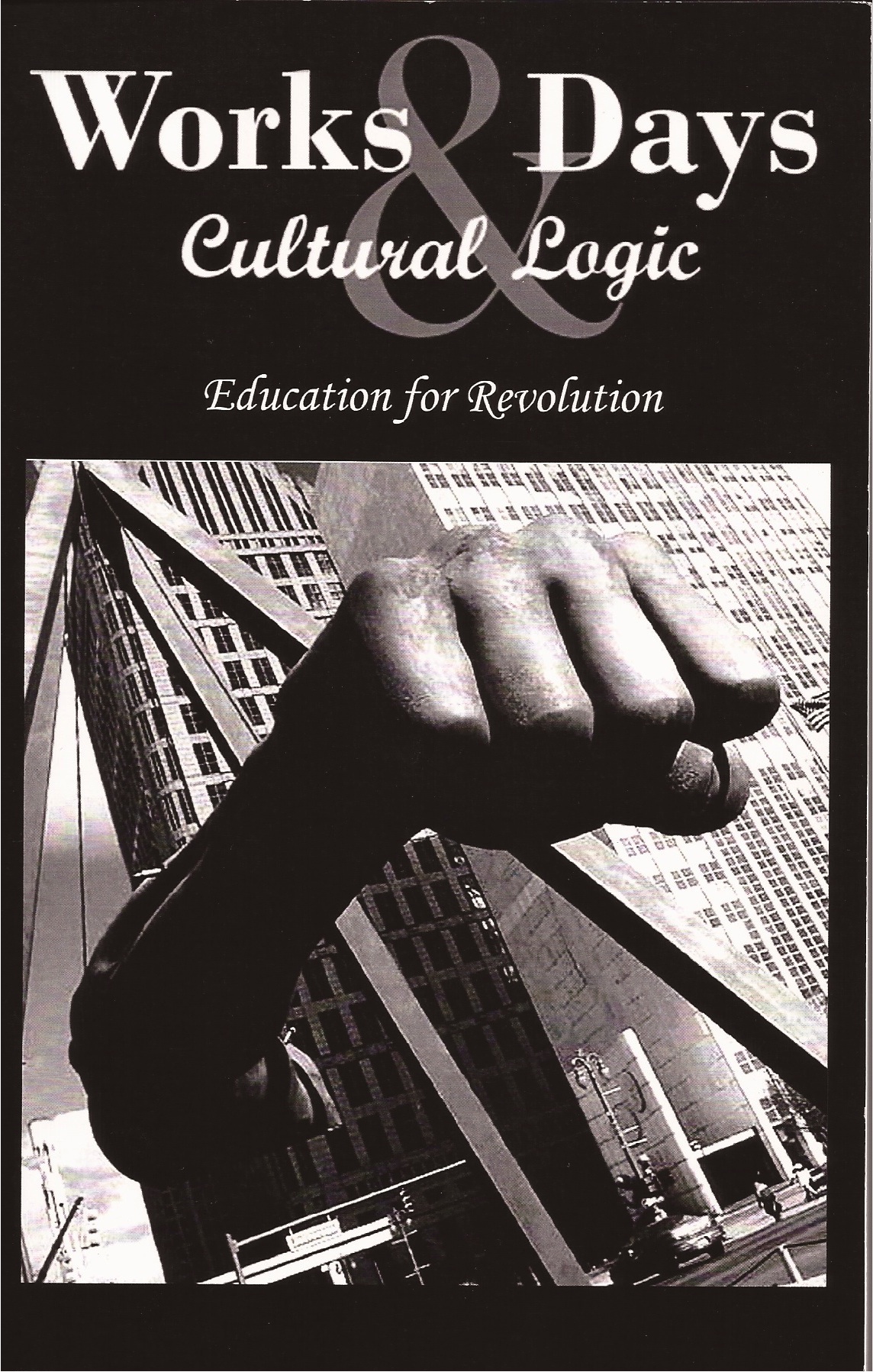
Education for Revolution special issue of Works & Days + Cultural Logic launched

Education for Revolution a special issue collaboration of the journals Works & Days and Cultural Logic has just been launched.

Check out the great cover image (Monument to Joe Louis in Detroit) and the equally great stuff on the inside. Hard copies of the issue available from worksanddays.net and Cultural Logic will be publishing and expanded online version of the issue in the coming months.

Rich and I want to thank David B. Downing and his staff at Works & Days for the fabulous work they did on this issue, which is the second collaboration between the two journals. Read Downing’s foreword to the issue here.

Works & Days + Cultural Logic
Special Issue: Education for Revolution
E. Wayne Ross & Rich Gibson (Editors)
Table of Contents

Barbarism Rising: Detroit, Michigan, and the International War of the Rich on the Poor
Rich Gibson, San Diego State University

Resisting Neoliberal Education Reform: Insurrectionist Pedagogies and the Pursuit of Dangerous Citizenship
E. Wayne Ross, University of British Columbia
Kevin D. Vinson, University of The West Indies

Reimaging Solidarity: Hip-Hop as Revolutionary Pedagogy
Julie Gorlewski, State University of New York, New Paltz
Brad Porfilio, Lewis University

Learning to be Fast Capitalists on a Flat World
Timothy Patrick Shannon, The Ohio State University
Patrick Shannon, Penn State University

Contesting Production: Youth Participatory Action Research in the Struggle to Produce Knowledge
Brian Lozenski, Zachary A. Casey, Shannon K. McManimon, University of Minnesota

Schooling for Capitalism or Education for Twenty-First Century Socialism?
Mike Cole, University of East London

Class Consciousness and Teacher Education: The Socialist Challenge and The Historical Context
Curry Stephenson Malott, West Chester University of Pennsylvania

The Pedagogy of Excess
Deborah P. Kelsh, The College of Saint Rose

Undermining Capitalist Pedagogy: Takiji Kobayashi’s Tōseikatsusha and the Ideology of the World Literature Paradigm
John Maerhofer, Roger Williams University

Marxist Sociology of Education and the Problem of Naturalism: An Historical Sketch
Grant Banfield, Flinders University of South Australia

The Illegitimacy of Student Debt
David Blacker, University of Delaware

Hacking Away at the Corporate Octopus
Alan J. Singer, Hofstra University

A Tale of Two Cities ¬– and States
Richard Brosio, University of Wisconsin, Milwaukee

SDS, The 1960s, and Education for Revolution
Alan J. Spector, Purdue University, Calumet

Rouge Forum 2013: Join Us at Wayne State University (May 16-19)

Rouge Forum 2013: Winning the Class Struggle Against Corporate Education Reform

See links below for Rouge Forum 2013 Conference details:

Conference Registration (click here)

Conference Housing Options (click here)

Conference program overview and keynote speakers (click here)

RF2013posterV3

Download Rouge Forum 2013 Posters: here.

Rouge Forum 2012

The Rouge Forum 2012 will be held at Miami University in Oxford, Ohio. The University’s picturesque campus is located 50 minutes northwest of Cincinnati. The conference will be held June 22-24, 2012.

In addition to plenty of time for large group discussions, the Featured Speakers are:

SUSAN OHANIAN
Susan Ohanian will be a Keynote Speaker at the Rouge Forum 2012. Susan’s advocacy work keeps at its core her 20 years as a teacher. Her more than 300 essays on education issues have appeared in periodicals ranging from Phi Delta Kappan cover stories to The Atlantic, Nation, USA Today, Washington Monthly, Extra! (Fairness and Accuracy in Reporting), and numerous education journals. One of her 26 book on education policy and practice introduced the word Standardisto.

Although currently censored at the NCTE online discussion site, Susan’s website received NCTE’s George Orwell Award for Distinguished Contributions to Honest and Clarity in Public Language. She has delivered the annual MacClement Lecture for Excellence in Education, Queens University, Ontario, Canada, the Helen Oakes lecture at Temple University, and the Biber Lecture, Bank Street College, New York.

Susan notes that although she’s been a featured speaker at both the International Symposium for the Educational Welfare in Seoul, Korea, and British Columbia Teachers’ Federation events, her talk to the Progressive Caucus of the AFT was closed down by angry hoots from the audience.

Susan started a website to protest the passage of NCLB. She had hoped to shut it down by now, but things keep getting worse, so she persists.

MICHAEL PRYSNER
Mike Prysner is the co-founder of March Forward!, an organization of active-duty members of the US military and veterans of the Iraq and Afghanistan conflict that encourages current active duty service personnel to resist deployment to Iraq and Afghanistan. He is a US army veteran that served in Iraq. His rank was corporal and duties in Iraq included ground surveillance, home raids and the interrogation of prisoners. These experiences led him to take a radical anti-war stand. In March of 2008 he testified in the Winter Soldier organized by Iraq Veterans Against the War. Later that year Michael ran a write-in campaign for the US House of Representatives for Florida’s 22nd congressional district (Boca Raton). He is a member of A.N.S.W.E.R. and the Party for Socialism and Liberation. In the recent Occupy movements, he has been active and arrested participating in direct actions.

PAUL STREET
Paul Street is a journalist, author, historian, and political commentator who has authored six books, including The Empire’s New Clothes: Barack Obama in the Real World of Power (Paradigm, 2010). Street has a doctorate in U.S. History at Binghamton University and has taught at numerous colleges and universities in and around Chicago. He was the Director of Research and Vice President for Research and Planning at The Chicago Urban League from 2000 to 2005. Street has published a numerous articles, essays, reviews, and editorials in numerous outlets, including ZNet, Z Magazine, CounterPunch, Black Agenda Report, The Chicago Tribune, Journal of American Ethnic History, Journal of Social History, Mid-America, Critical Sociology, Chicago History,Review of Education, Pedagogy, and Cultural Studies, Studies in History and Politics, History of Education Quarterly, Monthly Review, Iowa City Press-Citizen, In These Times, Economic and Political Weekly (Mumbai, India), Tinabantu: Journal of African National Affairs (Cape Town, South Africa), Synthesis/Regeneration, International Socialist Review, Dissent, Capital City Times (Madison, WI), Black Commentator, Tom’s Dispatch, History News Network, MRZine, Dissident Voice, and Monthly Review.

Rouge Forum @ AERA [Videos]

To Know is Not Enough:
Rouge Forum @ AERA

Friday April 13, 2012
Vancouver, BC
Videos on the ICESchannel at YouTube (or click on links below)

The Rouge Forum @ AERA brought together world-renowned scholars, teachers, community organizers, and other activists to discuss these questions and others related to activist scholarship, social change, academic freedom, and work in the corporate university as part of this one-day interactive conference at the Robson Square Campus of University of British Columbia in downtown Vancouver.

Introduction to the Rouge Fourm @ AERA 2012
E. Wayne Ross, University of British Columbia 

Session I: What might happen when teachers and other academics connect reason to power and power to resistance?
Patrick Shannon, Penn State University
Ken Saltman, DePaul University
E. Wayne Ross on Canada Border Services Agency’s prohibition of Abraham DeLeon from Canada / the Rouge Forum 
Antonia Darder, Loyola Marymount University (unable to attend)
Abraham DeLeon, University of Texas, San Antonio (turned away at border)
Natalia Jaramillo, University of Auckland (unable to attend)
Discussion I
Discussion II
Sandra Mathison comments on recent labour dispute in British Columbia between the BCTF and government

Introduction to the Rouge Forum @ AERA 2012 Afternoon Session
E. Wayne Ross, University of British Columbia 

Session II: How can academic work (in universities and other learning environments) support local and global resistance to global capitalism?
Peter McLaren, UCLA
Gustavo Fischman, Arizona State University
Jill Pickney Pastrana, University of Wisconsin, Eau Claire
Ken Saltman, DePaul University
Rebecca Martusewicz, Eastern Michigan University (unable to attend)
Discussion I
Discussion II

Special Session – Great Schools Project
David Chudnovsky
Discussion I
Discussion II

Session III: How do we respond to the obstacles and threats faced as activist scholars?
Stephen Petrina, University of British Columbia
Nancye E. McCrary, University of Kentucky
Brad Porfilio, Lewis University
Elizabeth Heilman, Michigan State University (unable to attend)

ICES at Community Events

  • ICES at at May Day rally Vancouver (1 May 2012)
  • ICES at Occupy Wall Street (16 April 2012)
  • ICES at BCFed & BCTF rally Vancouver (7 March 2012)
  • ICES at BCFed & BCTF rally Victoria (6 March 2012)
  • ICES at BC Secondary Students’ Walk-Out (2 March 2012)
  • ICES at Occupy Vancouver (October-November 2011)