Health Now Mahrajan Festival at UBC

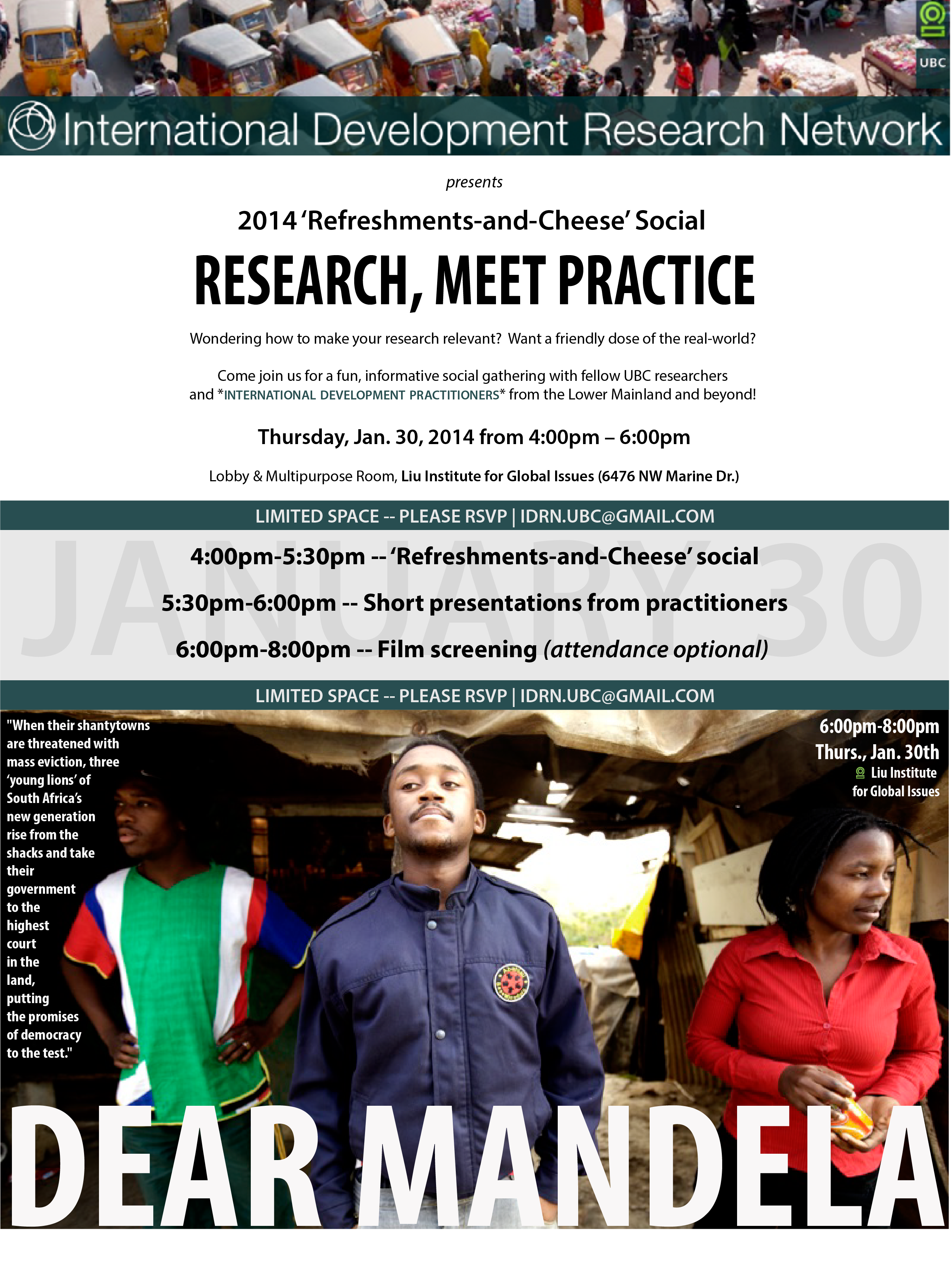
The Health Now Mahrajan Festival is a FREE event at UBC hosted by the Liu Institute for Global Issues’ Global Health Network, Green College, and People’s Health Movement – Canada. The event is designed to offer a fun learning exchange experience for the UBC community, as well as a chance to explore “Health Now” and enhance Global Health.

Featuring: Health Now Fair, Exhibitions, Films, Images, Games, Raffle, Banners, Parade, and more. For more details, you can find the Poster here and Full Schedule here.

Date: Tuesday March 27th, 10:30 am – 4:30 pm

Location: Liu Institute – First Floor, and Green College – Graham House

Please RSVP at: http://app.fluidsurveys.com/surveys/liuinstitute/register-health-now/

Posted in Uncategorized | Leave a comment

Film, Panel and Discussion on Effective Aid and Empowering Women

Film, Panel and Discussion on Effective Aid and Empowering Women
Thursday, March 8, 2012 from 12:00 PM to 1:30 PM (PT)
Vancouver, BC

In celebration of International Women’s Day on Thursday March 8, 2012, you are invited to join a discussion on: International Development: Doing things right while doing the right things – stories from the field

Register at:   http://jes-cida-panel-eorgf.eventbrite.ca/?ebtv=C

The event is organized by the Justice Education Society and the Regional Office of the Canadian International Development Agency.   A short video will be shown to illustrate a positive example of a women and justice project from Vietnam, followed by short presentations on advice and best ways to get involved in overseas development. Light lunch will be served.

Brief details;
Thursday March 8

12:00 to 1:30 (networking optional until 2:00)

2nd Floor, Room # 214

300 West Georgia Street, Vancouver BC

Space is limited to 40 participants.  Please confirm your participation before March 6th.

Following the event, participants are welcome to attend other International Women’s Day events being held in the Library next door. (For details visit www.oxfam.ca).

If you have any questions, please contact Adriana Haukaas at 604.331.5411 or at adriana.haukaas@justiceeducation.ca. For more information on CIDA visit www.acdi-cida.gc.ca.

PROGRAM

12:00   Meet and greet

12:15   Welcome & introductions — Evelyn Neaman, Justice Education Society

12:25   Video ‘Justice through Knowledge: A new vision for public legal education’ — Introduced by Stephen Herman, Canadian lawyer and filmmaker

Shot entirely in Vietnam, this documentary follows a delegation of Canadian and Vietnamese experts as they apply a model for developing public legal education. Viewers are invited into conversations about legal rights and obligations with women, farmers, and local community leaders and learn how public legal education can lead to justice through knowledge.

12:55   Food for thought:  tips for making the right kind of impact overseas

i)                 Frances Gordon, (former) Country Director Vietnam JUDGE project on ‘Methodologies to Build Capacity and Empower Women’

ii)                Umeeda Switlo, Cuso-International Western Representative on ‘Effective Aid: Volunteerism versus Voluntourism’

1:15   Open discussion

1:30   Closing remarks — Rebecca Mellett, CIDA Regional Office

1:35   Networking until 2:00 p.m.

Posted in Aid, Talks and Presentations | 1 Comment

IDRN Development Challenges Competition

Do you want to make an impact in the field of international development? Do you want to bridge gaps between disciplines, and between academia and practice? Do you want to make your research relevant and applicable?

Sign up now to join the IDRN Development Challenges Competition!

Put together a team, small or large, write a ‘Development Action Proposal’ aimed at solving an international-development related issue of your choosing, and earn the chance to win real money, and CV-worthy recognition, for your passion and dedication.

Posted in Aid, Design, Environment, Health | 1 Comment

Arnold Timmer, UNICEF visits UBC

Before the break, Arnold Timmer, Nutrition Specialist in UNICEF regional office for Eastern Europe and Central Asia, came to UBC to speak as part of the IDRN/Liu Institute/Green College Millennium Development Goals speaker series. He gave an open lecture on his thoughts on progress on the Hunger MDG. Slides from his talk can be downloaded here: Arnold Timmer GC talk.

He also participated in a Round Table Discussion with about 13 students from several departments at UBC. We talked about how national-level nutrition stats can hide localized issues and how obesity rates can obscure averages, about what kinds of indicators of malnutrition might be appropriate, about the links between food security and nutrition and how  both issues would likely benefit if they were better-linked, and about the relationships between areas of food deficit and food production in different regions of the same country. We discussed fair trade and local promotion of food crops and how these relate to nutrition, the gender dimension of nutrition issues, and agricultural approaches and nutritional supplement approaches to addressing malnutrition. Mr. Timmer talked to us about what it was like to work for UNICEF and the United Nations in general and about what these agencies do and career paths that lead to this type of work.

Round Table Discussions are a chance for students to connect with a International Development expert in a small group, informal setting. The discussion is facilitated, but goes wherever the group wants. There are opportunities to discuss and ask questions that range from topical to practical, and to network with a potentially important contact in a field.

Round Table Discussions in 2012 will be held in connection with the Green College MDG Speaker Series. To participate, sign up for the IDRN mailing list and watch for announcements about MDG series speakers. When an upcoming speaker is announced, watch for an invite to participate in the Round Table. Or, email IDRN for more information.

Posted in Health, Talks and Presentations | Tagged , , | Leave a comment

Go Global International Service Learning Program

A message from the Go Global program at UBC:

Do you want to participate in meanginful projects led by community partners around the world? Are you interested in connecting your learning in classroom to international issues and perspectives? f you are, apply for UBC Go Global’s International Service Learning Program. With placements in Costa Rica to South Africa, and learning themes from food security and nutrition to ecological education, you can find a placement that suits your passion and interest. Applications are due Monday, January 16, 2012. Financial awards are available. For more information, visit us at www.students.ubc.ca/global or book a drop-in advising session with us online!

Posted in Uncategorized | Leave a comment

New Journal Announcement: Rethinking Development and Inequality

A new journal that may be of interest to  IDRN members accepting submissions for its first issue. Rethinking Development and Inequality: An International Journal for Critical Perspectives is published by the recently formed Academic Network for Development and Inequality Research (ANDIR), funded by the BIARI program at Brown University in the U.S.

According to the journal announcement, it seeks “original contributions, employing empirical or theoretical approaches, on analyzing the reproduction of inequalities in the Global South.” It looks to bring together social scientists from around the world on a variety of themes.

The submission deadline for manuscripts to be considered for the first issue is September 30, 2011. Submission guidelines and additional information about the journal and its scope can be found at: http://rdi.andir-south.org/


Posted in Uncategorized | Leave a comment

Moreno-Brid on Mexico's political economy

For the second installment of our Global Roots of Inequality series, we met up with Dr. Juan Carlos Moreno-Brid, Associate Director of the Mexican office of the United Nations’ CEPAL (Economic Commission for Latin America and the Caribbean–or ECLAC–in English), to discuss inequality and development policy in Mexico and the wider region.

Moreno-Brid has also just recently published a book, with colleague Jaime Ross, through Oxford University Press entitled “Development and Growth in the Mexican Economy: a historical perspective.” It’s now available in both English and Spanish.

In our interview, Moreno-Brid pins Mexico’s inequality ills largely on a lack of fiscal reform, which has been systematically blocked by elites. These established elites, who have an interest in resisting taxation, Moreno-Brid argues, assert that government spending is inefficient and ineffective. It’s a dynamic of control and distrust, he suggests, that can be traced back to Spanish colonization, and the 18th century Bourbon Reforms. Those reforms, while successful at increasing tax revenues, were aimed specifically at improving Spanish –not colonial– economic welfare and political life.

We’ve posted the edited transcript below.

***

Continue reading

Posted in Uncategorized | Leave a comment

Reflections on Community Based Conservation

The latest IDRN event was the screening of the documentary “Milking the Rhino” by David E. Simpson. The film and resulting conversation by attendees at the event captured interesting themes about the benefits, challenges, and ethical concerns involved in wildlife-human conflict, and the conservation approaches embraced by local communities to balance demands for wildlife conservation and human well-being.

Human-wildlife conflict has resulted in the extirpation and extinction of many species, and has been credited with the decline of large wildlife in Africa. Large wildlife, especially carnivores, are often seen as a threat to human safety and development. One potential solution is community based conservation, where local communities set aside land for wildlife and ecotourism. Africa, after all, does have an international advantage when it comes to wildlife tourism. “Milking the Rhino” recounts how conservation interests and human development goals for Kenya`s Maasai and Namibia`s Himba people are co-existing: make wildlife pay for people. These two people are some of the oldest cattle cultures on Earth, and have developed some animosity towards wildlife since colonialists displaced them from their lands to conserve wild game. The growing popularity of wildlife tourism, coinciding with the new land rights bestowed on indigenous people now allows these cultures to “milk” wildlife in a similar way that they milk cattle to promote their livelihoods. On its face, community based conservation is an amazing success story. Wildlife populations are increasing, and indigenous African communities are generating income to pay for schools, hospitals, and other community development. It also helps local people take control over local resources and break the historic chains of imperialism in Africa. But there still are issues to grapple with.

Kenyans and Namibian indigenous cultures have a strong basis in cattle herding, and the switch from managing cattle to catering to tourists is not always an easy transition. The value of the cattle herding is strongly held by some people in both countries. The reliance on wildlife tourism also sets up a fragile economy that is totally dependent on international travel. Situations like the recent political tension in Tanzania can stop the flow of tourists and the resulting flow of income. More insidious is what this effect has on the cultural development of the local people. When your livelihood depends on the happiness of other people, you do what you can to make sure they’re happy. You are a thrall to their pleasures. When tourists expect to see a certain ideal aboriginal way of life, there is pressure to conform to that view. When a paying foreigner want to see a society of “noble savages”, there is no immediate incentive to develop more modern conveniences and ways of life.

For societies that define themselves by their cultural traditions, any change will be met with some suspicion. As the effects of globalization increase in global influence, change will be inevitable. The challenge then, seems to be to meet the multiple values of people and minimize the harm caused in the process. Community based conservation has potential to do this, and the cases in Kenya and Namibia demonstrate some significant successes, but recognizing where hardships persist is needed for a nuanced understanding and appreciation for these inevitable changes.

Posted in Uncategorized | 1 Comment

21 things about CIDA

Three representatives from the Canadian International Development Agency (CIDA), including two members of CIDA’s Food Security program, were recently at UBC. There were several opportunities for students to interact with the CIDA representatives while they were here. Below is a compilation of 21 things about CIDA in general, and about their FS program in particular, that might be of interest to graduate students.

About CIDA:

CIDA’s President, Margaret Biggs, is UBC’s Champion in the Deputy Minister University Champion Program

Rebecca Mellet is the Director of CIDA’s Pacific Regional Office.

CIDA is a granting agency that accomplishes development primarily by giving money to its implementing partners.

CIDA is guided by the Paris Declaration, which include principles of:

  • Ownership – Development is recipient-driven, and the recipient agrees to the activity
  • Alignment – Development aligns with the recipient country’s priorities
  • Partnership – Avoid duplication of effort
  • Results – Two-way accountability between Canada and the recipient country

CIDA has 20 focus countries.

CIDA has 3 priority themes:

  • Securing the future of children and youth
  • Increasing food security
  • Stimulating sustainable economic growth

Gender, environment and good governance are understood to permeate these three themes.

CIDA conducts Strategic Environmental Assessments (SEAs) of all of its programs.

Working for CIDA:
There are no pure or applied researchers at CIDA, although CIDA does give research grants. The IDRC, by contrast, is a research-focused crown corporation. IDRC has awards for student researchers.

CIDA recruits new Development Officers approximately every two years. The next recruitment will be fall 2011. Most positions are filled through the Public Service. More information can be found on CIDA’s Work Opportunities

Speaking French is an asset if you want to work at CIDA. CIDA is based in Gatineau, Quebec. In the past, up to 70% of CIDA’s staff have been francophone. Other languages are also valuable.

Beneficial skills to have if you want to work at CIDA include: program management; business skills e.g. experience with contracts, clients, budgets, etc; policy; communications; partnerships. Consider making the work you are doing demand-driven by the people you work for; make yourself indispensable to your target employer.

CIDA has a consultant database.

CIDA and Food Security
Ryan Clark is CIDA’s food security (FS) team leader.

CIDA considers four dimensions of food security:

  • Availability
  • Access
  • Stability
  • Use

70% of world’s poor are rural and involved in farming; in 2007, 4% of global development assistance focused on agriculture, and 4% of in-country public spending in developing countries.

Following the global food crisis in 2007-8, Canada committed $1.2 billion to FS at the G8 meeting in 2008.

CIDA focuses on smallholder farmers. Smallholders are understood to be part of the private sector. To meet the poverty and FS challenge, smallholder farming must be productive, integrated into markets, environmentally sustainable, and resilient to shocks and climate change. CIDA aims to work within local systems and knowledge.

CIDA emphasizes the importance of women to FS.

CIDA is aiming to strengthen national and regional agricultural systems.

CIDA’s FS program is currently focused mainly on Senegal, Mali, Ghana, Ethiopia, Sudan and Mozambique.

Official development assistance is seen to be only a small part of what is needed; the agricultural development needs private investment.

Some important questions for CIDA’s FS team:

  • How can policy decisions be translated into development programming on the ground?
  • How can smallholders be reached? How are governments reaching their smallholders?
  • How can CIDA ensure a multi-sectoral approach to nutrition?
  • How can CIDA extend and scale up what they know works?
  • How do you facilitate more responsible private sector investment?
  • How can the mistakes made by developed countries in agricultural development be avoided in developing countries?
Posted in Uncategorized | Leave a comment

Building substitutability into development

Willam Easterly, at Aid Watch, makes a very straightforward case for the need to build redundant substitutable elements into development project design. Like the way we build airplanes. See below for details.

Via Aid Watch post: Substitutability: there is no substitute for learning this wonky concept if you want your project to succeed

The debate we had on the HDI brought up the seemingly drop-dead boring jargon “substitutability.” Surprise! This actually turns out to be a USEFUL concept.

Consider two extremes in an everyday example.  For producing the output: “weird music that Bill listens to,” my iPod and my iPhone are perfect substitutes, so one is redundant for this purpose (forget about other purposes for now). For producing this same output, headphones and the iPod are NOT substitutes, they are BOTH required in the proportions: 1 set of headphones for every 1 iPod. So headphones and iPods have zero substitutability.

The exact opposite concept to substitutability is complementarity. Headphones and iPods are perfect complements (you can’t use one unit of either without one unit of the other). At the other extreme, iPods and iPhones have zero complementarity (you CAN use one without the other). This is just a description of technology as it is at the moment, that we might have to take as given (but maybe not, see below).

So why does this matter for, say, aid projects? Aid projects often run into trouble because one of the essential inputs (one of the “complements”) for the desired project output goes missing. So for example, the supply of clean water breaks down because one small part fails on the water pump at the well. None of the other components of the water supply are worth anything as long as the one part of the pump stays broken.

This is a common problem. Indeed, many disasters are caused by the failure of one (sometimes very small) complementary input, like the malfunctioning O-ring that caused the 1986 Challenger Shuttle explosion.[1]

Yet the idea of complementary inputs over-predicts the likelihood of disaster – there are so many different parts that could fail, any one of which would be fatal, you would expect MOST Shuttles to fail. Or you would expect a lot more airline disasters than actually happen, since airplanes are subject to the same problem.

So why are more airplanes not falling out of the sky? Airplane designers do not passively accept perfect complements, they add many backup (redundant) systems in case one part fails. In other words, they deal with a complementary (essential) input by creating a perfect substitute for it in case it fails. I follow the same principle when I carry around both my iPod and my iPhone, to avoid the catastrophe in which the battery runs out on one and I can’t listen to my eccentric music.

The lesson for aid projects is to also build in redundancy for the essential complementary inputs. Make sure you have a good backup system of repairmen and spare parts in case the water pump breaks down. This seemingly obvious advice is often not followed–for example in Malawi, between 30 and 40 percent of all waterpoints don’t work.

Oh, and a final word on the HDI debate. Under their old method, UNDP assumed that inputs into the index (like income and life expectancy) were perfect substitutes, so the amount you have of one doesn’t affect the usefulness of the other. This means that even if, say, Zimbabwe has almost no income, it still gets some credit if life expectancy rises.

The new HDI method instead treats these inputs as complements, meaning that a missing input (or an income level very close to zero) would produce the catastrophe of zero overall human development, just as an iPhone with no headphones nets us no music at all.

In our critiques of the HDI, Martin Ravallion, Laura Freschi, and I thought this was way too extreme. People are resourceful enough to “produce” human development even if their income is extremely low, when they will find back-up substitutes for “low material income.”

An important part of development in general is developing systems that provide back-up redundancies for any essential input into production. Development is also the growth of resourcefulness to work around bottlenecks of any one particular scarce input.

And so, class, today’s lesson is: Aid project managers should imitate this resourcefulness. Whenever you get stuck by complements, look for substitutes.

FOOTNOTES
1. In fact, Michael Kremer used this as an analogy for development failures in his classic paper “The O-ring Theory of Economic Development

Posted in Uncategorized | Leave a comment