A battle of wills, a triumph of the human spirit…


Photo by Kris Krug

Seven walk into a room. They won’t leave until a long list of astonishing submissions are vetted, debated, and slotted into something like a schedule. Yes, it’s planning day for the Northern Voice organizing group, hosted out here at UBC. The digs aren’t as swank as last year, and the choices are tougher. It’s going to be a long day, but I’m more convinced than ever it’s going to a fab event.

Update: We endured, we prevailed. By mid-afternoon we felt comfortable enough with a provisional schedule to adjourn to a nearby restaurant to finish up over chai, just like last year. The sense of relief was palpable and visible.

Posted in Webloggia | 1 Comment

Ready for prime-time players? On the reliability of tagging…

I posted last week about a distributed, tool-agnostic, tag-based framework for online discourse. It’s a key component for one of my looming grant applications — in terms of dollars requested it likely won’t be too big, but in terms of implementing open networked learning it’s a big step. And in this case I don’t even need to convince the instructor to experiment, it’s Jon Beasley-Murray’s idea.

When Jon started using Technorati Tags (a key component in the working plan), they totally jammed up — prompting an unseemly freakout on my part, and paradoxically jump-starting one of the best comments-field discussions ever to grace this blog. At the time, it prompted action from Technorati, and it seemed like things were somewhat resolved (although with a hard lesson learned).

So I’m scheduled to meet with Jon today, to firm up plans for an application that is due imminently. In the run-up to the meeting, I was monitoring how his tagging was going, and noticed some troubling gaps. Today Jon provides the full story:

Technorati have again, it seems, given up a) on indexing this blog and b) on responding to customer support queries.

(See here for previous travails. I’m also still not the only one with this problem. Someone’s even written a poem on the topic.)

Regarding the lack of customer support response, I’m prepared to give them a bit of slack given that it’s been Thanksgiving weekend in the US.

But the erratic indexing itself remains something of a pain. One would like to have a little more faith in the reliability of tagging.

(Meanwhile over on Latin America on Screen, in the last week some posts have been indexed, but others not.)

… this semester I’ve been writing up some notes on readings connected to a class I’ve been teaching. I’d like to be able to point students to the appropriate Technorati tag so that they can access the relevant entries without having to wade through my disquisitions on Agamben or cultural studies or whatever. Their exam is coming up, so they might especially appreciate this in the next week or so.

But if we can’t trust Technorati (or can’t trust them to fix problems in good time), all this rather goes down the tubes.

…it’s not at all obvious why this happens (there’s nothing on Technorati’s help pages that deals with the issue), nor therefore what can be done to prevent it. And if customer response time remains so slow, then it’s not as though it can be rectified unproblematically.

The point here (at least in my case) is not to diss Technorati. As Tim Bray notes, “Nobody who hasn’t been behind the firewall at Technorati or one of their competitors can grasp how pathologically hard it’s been to keep a service like that up and running in the face of the continuing insane growth of the blogosphere.” Updates to Jon’s post indicate some progress is being made, and it’s clear that Dave Sifry pays close personal attention to his tags for clues how the service is performing.

But all the good will in the world is meaningless if nothing is delivered. I have to ask, is the emergent approach really ready for prime time? Because it’s easy to talk trash about BlackWeb and other corporate behemoths, but at the end of the day reliability matters. If we promote a new approach, then instructors and students should have reason to feel confident in it.

I’ve given a lot of thought to some techniques to provide redundancies, but can’t think of anything that doesn’t put burdens on users. We plan some improvements to aggRSSive that might work, but doubt very much they will be ready for January, when we plan the first iteration.

If anyone has any suggestions, I’d love to see them.

Update: Stephen responds with a gentle poke, and a very constructive suggestion. Hmmm…

Posted in Emergence | 1 Comment

What’s my fallacy this time? Or, spinning my wheels…

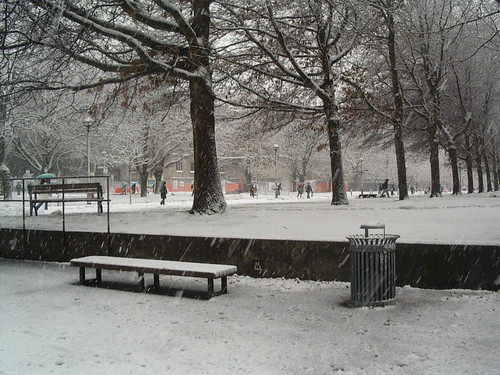
What a Vancouver blizzard looks like...

Vancouver got hit with what passes for a blizzard here (the rest of you Canadians can keep your snickering to yourselves) — only a few centimetres, but enough to wreak havoc with unpracticed drivers, and to remind me why Vancouver is the only Canadian city with a winter threshold low enough for me to tolerate. (Though if last year is any guide, Harry will love this.) It extended my morning commute by nearly an hour, as the bus couldn’t get traction up the hill to campus.

Which sends me back to my incessant, egocentric pathetic fallacy-making mode. If last week I was socked in by a mental foggy trip, today I find myself literally and figuratively snowed in, and spinning my wheels on a treacherous road. Firm deadlines for course design work, grading, a screencast, and mission critical grant proposals loom like Winnipeg snowbanks in January. All I can hope to do is keep digging, try to ignore the frostbite, and focus on that hot toddy waiting inside for me in about two weeks.

So the fortnightly forecast for Abject Learning is for light postings, with intermittent flurries in response to mental turbulence. I think the sun will shine sometime in mid-December, though that might just be typical Canadian winter-induced optimism.

Posted in Abject Learning | 2 Comments

Leigh Blackall shows how it’s done…

I was an admirer of Sean FitzGerald and Leigh Blackall’s Knowledge Sharing, so it’s a groove and a gas to see the Flickrfied Networked Learning emerge as a follow-up. The images are amazing, the audio compelling — this raises the bar for online presentation styles. Oh yeah, the content is killer too.

And as Leigh points out, the material was “created using pictures generously licensed to creative commons. I created an audio track to go with it, using backing music generously licensed creative commons.”

He adds: “This presentation is licensed creative commons, I hope you’ll use it.” I already have started reusing those images (with attribution and a backlink, natch), and suspect these will be a staple in my wikified presentations for some time to come.

Posted in Emergence | 1 Comment

Podcast yummies

Just subscribed to this very promising course on Understanding Computers and the Internet from Harvard. Looks like lots of great stuff that could be useful in a whole lot of online contexts — hey, wasn’t this what learning objects were supposed to deliver?

Via Gardner, who can’t resist digging deeper:

But is it interactive?

Certainly can be. All good listening is interactive. All good listeners are co-creators. That’s not to say that the students should simply listen. No, eventually many or perhaps most of them should make their own podcasts. But there’s an art to listening well, just as there’s an art to reading well or viewing well, and that art is no mean craft. These arts probably aren’t complete unless they lead to speaking, writing, or designing oneself, but the practices are reciprocal, not mutually exclusive.

We need a theory of co-creation that maintains the vital distinction between writer and reader while articulating the common source of energy, inspiration, and attention that fuels them both, and the essential reciprocity that defines their relationship.

I might note that UBC’s Public Affairs unit has launched its own podcast series, mostly featuring high-profile speakers and the like. And there’s a lot of podcast activity bubbling beneath the surface here, the virtual presence of this campus is going to be a noisy place soon…

Posted in Abject Learning | 2 Comments

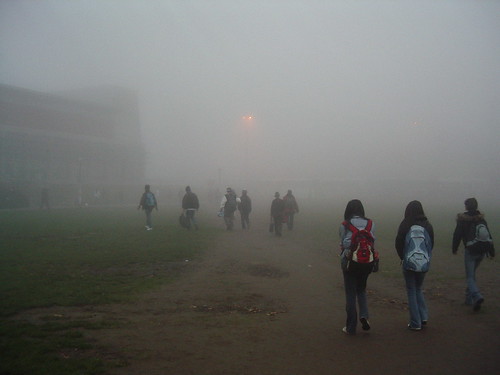
Small pieces more loosely joined… musings from the fog

The fog up

I suppose it’s a form of pathetic fallacy to link the five days of fog we in Vancouver are experiencing with the hazy state of my cognition lately.

One of the things I’ve been batting around in my so-called mind is a framework for ripping, mixing and feeding collections of weblogs and resources for courses… This fall we launched a set of weblog-based courses linked up with aggRSSive. So far, based on the feedback we’ve gotten, I’d say these were successful efforts. We do break most of Farmer’s dictums, but that doesn’t bug me much. Rules are made to be broken, especially with this kind of stuff. None of the instructors had any familiarity with weblogs before we launched, and each had a set of requirements (privacy, etc…) that led to fairly tight integration of our networks. In a sense these are hybrids between weblogs and traditional course management — which is something of a cop-out, but I’m a believer in going where the users are, and for better or for worse these projects reflect that.

I had a promising meeting a couple months back with a professor here who wanted to go the other way… He was all for trying a blog-supported framework, but wanted it to be tool-agnostic (for our current courseblogs we need the students to have UBC-hosted Movable Type accounts, in order to exploit category-based security and RSS feeds), and wanted the individual students to be able to self-select what content they wanted to toss into the collective pool, and better yet to be able to group activity in an emergent, folksonomic way.

In a sense, this is dead simple. Get the students to add Technorati tags (or something like that), pull out the RSS, and render the feeds in something like Suprglu (sample from the Textologies course), backing it up in a searchable database like Blogdigger (ditto). Or we might use a portal-like tool such as Netvibes (which if you haven’t seen it, is worth a look) to pull it all together.

There are downsides to this approach — depending on third-party apps, even well-established ones like Technorati can cause its own form of pain. The risk is higher when using new apps (seemingly in a perpetual beta state) from start-up companies. Then there’s the advertising.

Talking with the resident office tech-heads, it seems we might be able to roll our own complement to this approach, tailored to educational needs, conceivably by taking advantage of already-planned improvements to aggRSSive, and rolling out a simple presentation template to give the collective output some sort of appealing and manageable format. They tell me it wouldn’t even take much programming time — but developers always say that before a project gets rolling.

My current thinking is that we try piloting the course using both approaches — the third party tools, and the custom job. The beauty of RSS is that once the content is created it can be republished and remixed in any number of permutations without any additional hassle to the users. We run the two approaches side by side, comparing and contrasting as we go. I watch the happenings, and write the occasional meandering weblog post like this one.

I don’t see any obvious holes in this plan, but I’m haunted by the sense that I’m missing something. Either that I’m missing an opportunity, or that something will break down. So out of the fog and onto the blog it goes.

Update: just so the fallacy can get a little more pathetic, as I finish writing this post the fog seems to be lifting, and the sun begins to shine in my window…
Posted in Emergence | 4 Comments

Google Love, Oh Google Love

I’ve noted the odd honours that Google algorithms occasionally bestow on this weblog before.

As a Neil Young fan, snagging the top two spots for one of his most famous lyrics is a hit. (Screengrab here.)

A fleeting triumph, alas. My grip is already slipping.

Posted in Abject Learning | 1 Comment

Just because you’re paranoid don’t mean They ain’t after you…

I know I can wobble off the rationality rail sometimes, using apocalyptic and politicized language about restrictions placed by The Man on self-publishing spaces.

But what to make of James Farmer’s edublogs.org being blocked from schools by some faceless, perhaps automated (perhaps not) entity? The phrases that come to my mind in response all contain obscenities. Educators should be singing James’s praises (not to mention cutting him the occasional check to help out with bandwidth) — instead they treat the service like the front edge of a kiddie porn ring.

Via Stephen, who adds that “OLDaily is frequently blocked in Australia – I remember a few weeks ago being shut out of the entire state of Queensland.”

WTF?

Update: D’Arcy just posted a more detailed and more compelling response than I was able to muster…

Posted in Abject Learning | 2 Comments

Grabbag o’ goodness for your computer screen…

My buddy, co-conspirator and guru Jeff Miller, who assures me he will be publicly blogging soon, is in Dubrovnik (lucky bastard), giving what I’m sure was a smashing wikified presentation on emerging technologies for the CARNet Users’ Conference (worth checking out for the selection of CC-licensed images from Flickr alone, not to mention the pretty fine content).

The keynote at the conference was delivered by Joi Ito, who Jeff tells me showed this nifty animation of Technorati tagging. More sizzle than steak, but well-done and it makes the point in succinct fashion.

Which reminds me of this snazzy take-down of Ticketmaster Jeff sent me last week. (Come on Miller, blog it yerself!)

Which reminds me of this truly surreal bit of alien performance art riffing on Tom Cuise and Matt Lauer. (Forget where I found this, probably Boing Boing.)

Posted in Abject Learning | 2 Comments

Special guest post – Rheostatics do the Tarlek

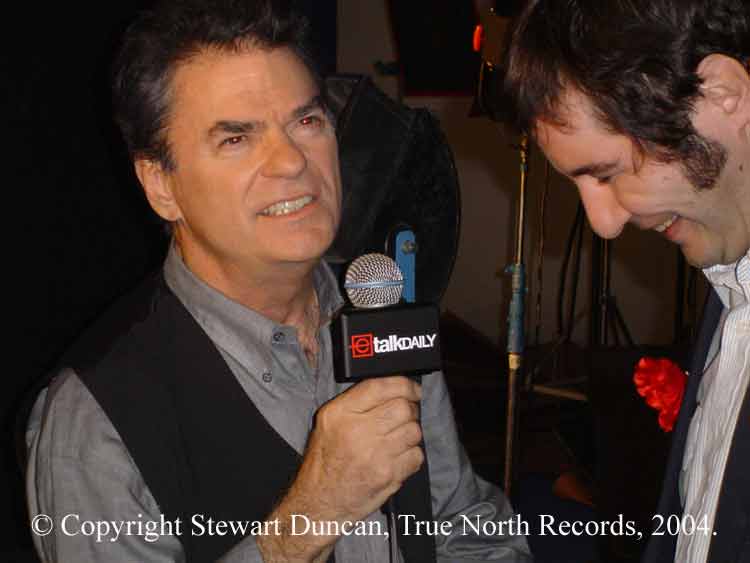
Herb Tarlek is still ready to sell, but only to the Rheostatics.

“Frank Bonner appears as his character, Herb Tarlek, from the sit-com WKRP in Cincinatti that ran from 1978 to 1982. Mr. Bonner apparently gets similar requests all the time and, for the most part, refuses but when he played the Rheos’ track for friends, their enthusiastic response encouraged him to join in the fun. Tarlek, the station’s sleazy salesman, was renowned for impossibly ugly suits, matching white leather belt and shoes, and his relentless efforts to bed Loni Anderson’s character Jennifer.”

It’s possible that I’m just feeling nostalgic for my adolescent late nights watching WKRP but the video for “The Tarleks” made me want to check out Bonner’s filmography. Maybe there’s a brilliant, indie comedy career I don’ t know about? But apparently not. I can emphathize with not wanting to be pigeon-holed by one character (though when it’s clearly your best, why hide him away?) But good on him, in recognizing the Rheo’s were worth donning the white belt and shoes for one more time.

Part of my connection to the Rheo’s is geographical. If you did some origami-like map folding with Yonge and Bloor in Toronto as axes, Etobicoke and Scarborough would end up super-imposed over each other. The first time I went partying over there I stepped out from the Kipling subway station and had the dizzying sensation that I hadn’t traveled at all. In this alternate universe me and the Rheo’s could have all hung out watching WKRP together, and now it seems like we were.

More songs from 2067 the Rheo’s latest, via CBC’s New Music Canada

Thanks to Keira McPhee, who escorted me to the fab Rheos show last Friday in Van Rock City for the post — now if only I could get her to write all my posts, I’d have a blog…

Posted in Uncategorized | 7 Comments