Categories
Rip.Mix.Feed.

Rip, Mix, Feed, Reloaded with SlideShare

Hello Everyone

Here’s my contribution to Rip, Mix, Feed and Reload.

UBC Campus
UBC Campus

You probably recognized the picture and you’re certainly going to be able to relate to the contents of this slide show.

WARNING: Don’t get your hopes up because it’s not really all that exciting! Remember… this is really about trying out new Web 2.0 technologies, right?

Click here to review the SlideShare Presentation

Cheers all

Bruce

Categories
Commentary 3

Commentary #3 – Associative Information Structures Revisited

“Indeed, printing made textual overload a permanent condition: more books were produced in each succeeding century, and new editions preserved all books that changing cultural norms continued to regard as important… What many have called the “information revolution” ushered in by the computer is only the most recent manifestation of a problem that is now 500 years old.” (Bolter, p.83)
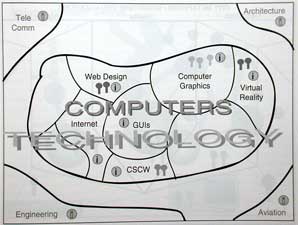
AssociativeInformationStructures

Were Bush and Engelbart’s claims that associative information structures are likely to improve human ability to approach and solve complex problems valid?

Referred to as the conceptual creator of ‘hypertext’, Vannevar Bush was amongst the first to propose the development of a mechanical machine capable of organizing and displaying information in a way that made it possible to ‘make sense’ of it in the hope of solving some rather complex problems. His article, As We May Think, “…presaged the idea of the Internet and the World Wide Web and was directly influential on the fathers of the hypertext and the Internet as we know it today. Ted Nelson, who coined the term “hypertext” in 1967, describes Bush’s article as describing the principles of it.” (Malone)

Bush was convinced that many of the technologies developed by scientists during the war had practical applications for everyday use. “The world has arrived at an age of cheap complex devices of great reliability; and something is bound to come of it.” (Bush, p. 1) Bush was clearly frustrated with the archaic way in which information was being stored and retrieved. “Professionally our methods of transmitting and reviewing the results of research are generations old and by now are totally inadequate for their purpose… publication has been extended far beyond our present ability to make real use of the record.” (Bush, p. 2) He pointed out how improvements in the science of photography led to the development of new technologies like the microfilm and facsimile. He foreshadowed how further modification and extension this technology would eventually lead to things almost beyond imagination “… it would be advantages to be able to snap a camera and look at the picture immediately.” as was the case with the Polaroid camera and today’s digital cameras. (Bush, p. 3) Most visionary however was Bush’s notion of a ‘memex’ machine.

“The memex and its description have long been hailed as inspiration for the creators of hypertext and even the web.” (Malone) As Bush explained it, “Man cannot hope fully to duplicate this mental process [intricacy of trails] artificially… but it should be possible to beat the mind decisively in regard to the permanence and clarity of the items resurrected from storage.” (Bush, p.7) Memex would not only have the capability of storing huge amounts of information (albeit on microfilm), as with the human mind which operates by association, the memex machine would likewise have the ability to select by association. The memex “affords an immediate step, however, to associative indexing, the basic idea of which is a provision whereby any item may be caused at will to select immediately and automatically another. This is the essential feature of the memex. The process of tying two items together is the important thing.” (Bush, p.8) The tying together (trail) of information is precisely what hypertext does today.

Douglas C. Engelbart was another one of those early computer pioneers interested in the study of HCI (human computer interaction) and the development of hypertext. He was credited with inventing the computer mouse. Like Bush, he was also committed to the development and use of computers and computer networks in an effort to solve some of the world’s most perplexing problems.

Engelbart understood the uniqueness behind Bush’s memex machine, particularly the notion of duplicating a trail so that information could be shared with others. “Making it easy to establish and follow the associative trails makes practical a new symbol-structuring process whose use can make a significant difference in the concept structuring and b[a]sic methods of work. It is also probable that clever usage of associative-trail manipulation can augment the human’s process structuring and executing capa[b]ilities so that he could successfully make use of even more powerful symbol-structure man[i]pulation processes utilizing the Memex capabilities.” (Engelbart, Examples and Discussions, Background: Comments Related to Bush’s Article) Engelbart tested this principle by developing a sequencing technique and applying it to his computer card coding system.

Engelbart firmly believed that technologies such as computers would someday help mankind by “…improvin[g] the intellectual effectiveness of the individual human being.” (Engelbart, Introduction) He used computer card coding/punching techniques to demonstrate how associative linking could worked “There was no convenient way to link these cards together so that the train of thought could later be recalled by extracting the ordered series of notecards. An associative-trail scheme similar to that out lined by Bush for his Memex could conceivably be implemented with these cards to meet this need and add a valuable new symbol-structuring process to the system… A very quick and simple human process thus initiates the automatic extraction of the next item on the associative trail.” (Engelbart, Examples and Discussions, Background: Some Possibilities, Associative Linking Possibilities)

Engelbart understood the link between entering data and retrieving results. He realized that more knowledge could be had if we could find some way to link existing knowledge together. He also believed that similar processes could be used to enhance human intellect, something he felt was needed if mankind hoped to keep abreast of the world’s problems “… we will have amplified the intelligence of the human by organizing his intellectual capabilities into higher levels of synergistic structuring.” (Engelbart, Introduction)

Engelbart’s 1968 hypermedia demonstration on human computer interaction showed how the computer could be used to deal with everyday tasks. The information he presented was in a simple hypertext. It demonstrated many different methods of organization and how each was appropriate to the task at hand.

Both Bush and Engelbart firmly believed that properly constructed associative information structures would be useful in helping mankind to solve some of life’s most puzzling and complex problems. Bush’s memex machine was the precursor to the computer. Engelbart worked with some of the first computers ever built. He knew that these machines were capable of performing complicated mathematical calculations more accurately and far quicker than any human could. Like Bush, he realized that the storing and retrieving of vast amounts of information was the next logical step in the development of computer technologies. It would be our responsibility to ensure that both the information and the technology were used in an appropriate manner and to the benefit, and not the detriment, of the entire human race.

References

Bolter, J.D. (2001). Writing Space: Computers, hypertext, and the remediation of print. Mahway, NJ: Lawrence Erlbaum Associates.

Bush, V. (1945). As we may think. The Atlantic Monthly, 176(1), 101-108. Retrieved from: http://www.theatlantic.com/doc/194507/bush

Engelbart, Douglas C. Augmenting Human Intellect: A Conceptual Framework. Summary Report AFOSR-3223 under Contract AF 49(638)-1024, SRI Project 3578 for Air Force Office of Scientific Research, Stanford Research Institute, Menlo Park, Ca., October 1962.

Malone, Erin. (2002). Foreseeing the Future: The Legacy of Vannevar Bush, Boxes and Arrows, 2007.

Picture retrieved from here.

Categories
Commentary 2

Commentary #2 – Which came first, culture or technology?

“It is not a question of seeing writing as an external technological force that influences or changes cultural practices; instead writing is always a part of culture.… technologies do not determine the course of culture or society, because they are not separate agents that can act on culture from the outside.” (Bolter, p. 19)

tn_head-case http://stephilosophy.blogspot.com/

To answer this question, we need to begin with a definition of ‘culture’ and ‘technology’ as it relates to knowledge. Culture can be defined as “… the integrated pattern of human knowledge, belief, and behavior that depends upon the capacity for learning and transmitting knowledge to succeeding generations.” (Merriam-Webster) Technology is defined as “…the practical application of knowledge especially in a particular area.” (Merriam-Webster) The distinction between each is clear, as is the connection between the two. Culture is about acquiring knowledge while technology is about applying knowledge. There has been some debate about culture and technology and whether they are inseparable or not. This commentary will take a look at three of these arguments.

In Writing Space: Computers, Hypertext, and the Remediation of Print, Bolter was very clear as to what he believed, particularly when it came to writing. “The technical and the cultural dimensions of writing are so intimately related that it is not useful to try to separate them…” (Bolter, p. 19) Bolter went to great lengths to explain the connection between technology and culture; how different technologies of writing involved different materials and that these materials were used in different ways and for different reasons. He used ancient writing as an example. Technologies such as papyrus, ink, and the art of book making may have been common to all cultures but what was different were the writing styles and genders of ancient writing and the social and political practices of ancient rhetoric. He argued that modern printing practices followed a similar pattern as does today’s technologies. Computers, browsers, word processors are our writing technologies but these technologies don’t change cultures per say. If anything, culture has a way of initiating changes in technology.

In his book, Orality and Literacy, Ong argued that the introduction of writing and print literacy’s have fundamentally restructured consciousness and culture. In chapter four of his book, Ong discussed the development of script and how this restructures our consciousness. Ong claimed that “…writing (and especially alphabetic writing) is a technology, calling for the use of tools and other equipment… Technologies are not mere exterior aids but also interior transformations of consciousness and never more than when they affect the word.” (Ong, p. 80 – 81) Ong suggested that humans are naturally tool-employing beings and that these tools create opportunities for new modes of expression that would not otherwise exist. He used the example of the violinist who internalizes the technology (violin) making the tool seemly second nature, or a part of the self. “The use of a technology can enrich the human psyche, enlarge the human spirit, intensifying its interior life.” (Ong, p. 82) In terms of culture and technology, Ong’s technological determinism clearly makes it impossible for him to separate the two.

In Understanding Media: The Extensions of Man, Marshall McLuhan argued that technology was nothing more than an extension of man. “The shovel we use for digging holes is a kind of extension of the hands and feet. The spade is similar to the cupped hand, only it is stronger, less likely to break, and capable of removing more dirt per scoop than the hand. A microscope, or telescope is a way of seeing that is an extension of the eye.” (Kappelman) When an individual or society makes use of a technology in such a way that it extends the human body or the human mind, it does so at the expense of some other technology which is then either modified or amputated. “The need to be accurate with the new technology of guns made the continued practice of archery obsolete. The extension of a technology like the automobile “amputates” the need for a highly developed walking culture, which in turn causes cities and countries to develop in different ways. The telephone extends the voice, but also amputates the art of penmanship gained through regular correspondence.” (Kappelman) McLuhan later developed a tetrad to explain his theory. It consisted of four questions or laws; what does the technology extend, what does it make obsolete, what is retrieved and what does the technology reverse into if it is overextended. As was the case with Ong, McLuhan did not make any clear distinction between technology and culture.

Bolter disagrees with the assessment of technological determinists like McLuhan’s “extension of man” claim and Ong’s “restructured consciousness”. He uses cause and effect to prove his point. He points to the early beginnings of the World Wide Web, and how technology (hardware and software) was used to create it. According to Bolter, culture was responsible for changing the Web into “… a carnival of commercial and self-promotional Wes sites…” (Bolter, p. 20) Culture then demanded changes to the hardware and software to allow for such things as censorship. “Wherever we start in such a chain of cause and effect, we can identify an interaction between technical qualities and social constructions – an interaction so intimate that it is hard to see where the technical ends and the social begins.” (Bolter, p. 20) Bolter doesn’t adhere to the ‘doom and gloom’ rhetoric of McLuhan who was “…deeply concerned about man’s willful blindness to the downside of technology.” (Kappelman) and he in mindful of Ong who said “Once the word is technologized, there is no effective way to criticize what technology has done with it…” (Ong, p. 79) Instead, Bolter believed that “… it is possible to understand print technology is an agent of change without insisting that it works in isolation or in opposition to other aspects of culture.” (Bolter, p. 19 – 20)

It seems reasonable to assume that because technology can infringe upon culture and culture can impinge on technology, the two are in a sense inseparable. This may not be a case of one coming before the other as much as both of them coexisting at the same time. Either way, we only need to be cognizant of the fact that both will continue to evolve either as a result of or in spite of the other.

References

Bolter, J.D. (2001). Writing Space: Computers, Hypertext, and the Remediation of Print. Mahway, NJ: Lawrence Erlbaum Associates.

culture. (2009). In Merriam-Webster Online Dictionary. Retrieved October 31, 2009, from http://www.merriam-webster.com/dictionary/culture

Kappelman, Todd (July 2002), Marshall McLuhan:”The Medium is the Message”, Probe Ministries. Retrieved from http://www.leaderu.com/orgs/probe/docs/mcluhan.html#text2

Ong, Walter J. (2002). Orality and Literacy (2nd ed.). New York: Routledge.

technology. (2009). In Merriam-Webster Online Dictionary. Retrieved October 31, 2009, from http://www.merriam-webster.com/dictionary/technology

Picture retrevied from http://stephilosophy.blogspot.com/

Categories
Major Project Uncategorized

Pen and Paper Project

Hello all

Please take a few minutes to explore our Google Website on Pen and Paper.

Enjoy!
Ed Stuerle & Bruce Spencer

Categories
Commentary 1

How has the Technology of Writing Changed the Act of Teaching?

17th Century Parish Registry Letters
Graphic taken with permission from Rootsweb.com

In my opinion…

Teaching today, is highly dependent upon technologies such as writing. As members of a literate culture, writing has been the focal point of most all of our learning. From the time we are born we have been encouraged to learn how to write. Whether it’s from our earlier years when we learned to write the alphabet, build words and create sentences or during adolescence when we were expected to take notes and write comprehensive papers, writing has always been and will probably always be a focal point in our lives.

It is hard for us to imagine what the written word has done for learning because as literate people, we haven’t experienced anything else. We have no other point of reference other than what we have read or heard about. “… to try to construct a logic of writing without investigation in depth of the orality out of which writing is permanently and ineluctably grounded is to limit one’s understanding…” (Ong, p. 76) Before we can discuss how writing has changed how we teach, it would seem logical to consider first how teaching was performed prior to the introduction of the written word.

Language existed long before writing which meant that verbal communication was the medium through which all cultural knowledge was passed on to the next generation. As language and culture continued to evolve so did the need for better modes of communication. Early forms of writing date back to the days of pictographs when people scratched drawings on stone walls depicting important events within the lives of their people. It allowed for the transfer of more complex information, ideas and concepts using visual clues. (Kilmon) From pictographs came ideographs or graphic symbols such as those used by the Egyptians (hieroglyphs), the Sumerians (cuneiform) and the Chinese (Chinese characters). Writing is an extension of these and other systems where agreed upon simple shapes were used to create a codified system of standard symbols. These systems continued to evolve throughout ancient history. The Canaanites, the Phoenicians, the Greeks, the Romans, and the Christians either modified existing systems of simply created their own. These systems were not widely understood and were only used and by relatively few people. More often than not, it was the clergy who played an important role in the development and maintenance of these systems during this time. It took the invention of the printing press and the printed word before literacy began to have any mass appeal. (History of Handwriting)

The development of writing shifted the focus of learning orally to learning visually which, in turn, taught us how to interiorize it thus changing the nature of how we learn. “Writing… is not a mere appendage to speech. Because it moves speech from the oral-aural to a new sensory world, that of vision, it transforms speech and thought as well.” (Ong, p. 84) Speaking and writing are two different processes. Speech is universal. Everybody acquires it. Writing is not speech written down. Writing requires systematic instruction followed by practice. Not everyone learns to read and write. (Literacy Skills: Speaking vs. Writing) “Clearly, there are fundamental differences between the medium of writing and the medium of speech which constitute ‘constraints’ on the ways in which they may be used.” (Chandler) It has taken a considerable amount of time for writing to superseded speech as the primary tool for learning. The transition, while it may have been awkward for some, has succeeded in altering the way in which we now learn.

Learning in today’s literate culture relies more on text and writing and less on the spoken word. We devote more time teaching students to how to read and write and we expect them use these newly acquired literacy skills to think and to reason intellectually. As teachers, we tend to measure success with either a letter grade or a number grade. “If it makes sense to us, that is because our minds have been conditioned by the technology of numbers so that we see the world differently then they did.” (Postman, p.13) For teachers, marking or grading is synonymous with learning. Our indoctrination into the literate culture is so complete that it is difficult if not impossible to separate the two. Our dependence on the written word is so complete that it has taken us head on into a new era known as the information age.

The onslaught of the digital age has raised many new issues within education and with existing teaching models in particular. The field of Information technology has grown so rapidly that it’s impossible to keep up with the pace. Technical gadgetry continues to astound even the most computer savvy individual, and while these technologies may have heightened our awareness of the digital world we now live in, it may have also dulled our sensitivity to the dominance it has had on our literate world. “… embedded in every tool is an ideological bias, a predisposition to construct the world as one thing rather than another, to value one thing over another, to amplify one sense or skill or attitude more loudly than another.” (Postman, P13) Technology, in this case the computer and the internet, which has given us instant access to knowledge in the public domain, has challenged the way we view teaching and learning much the same way that writing did so long, long ago.

In conclusion, while I may not necessarily agree with Ong’s statements about the dichotomy of oral and literate cultures, I do believe that there is some merit to his separation of the two cultures. If nothing else, it has helped to explain how previous learning practices may have been altered and current teaching practices will be shaped. I have similar doubts about Postman, about his technopoly taxonomy and his position on computer technologies. However, it does get us to think about how these technologies can alter our conception of learning. It seems apparent that, for the most part, we are in unchartered waters. As teaching practitioners, we have no other choice but to take all of this into consideration as we go about constructing teaching strategies designed to promote practical learning and abstract thinking.

References

Chandler, D. (2000). Biases of the Ear and Eye. Great Divide Theories. Retrieved on September 25, 2009 from: http://www.aber.ac.uk/media/Documents/litoral/litoral1.html

History of Handwriting. The Development of Handwriting and the Modern Alphabet. Retrieved on September 24, 2009 from http://www.vletter.com/handwriting.htm vletter.com

Kilmon, Jack (1997) The Scriptorium: The History of Writing. Retrieved on September 25, 2009 from http://www.historian.net/hxwrite.htm

Ong, Walter J. (2002). Orality and Literacy. London, England: Routledge / Taylor & Francis Group

Postman, N. (1992). Technopoly: The Surrender of Culture to Technology. New York: Vintage Books.

Todd, Joanne (2001) Examples of Letters of the 17th Center Found in Parish Registers. Retrieved on September 17th, 2009 from http://www.rootsweb.ancestry.com/~genepool/oldalpha.htm Ancestry.com

University of Westminster: Learning Skills Site. Literacy Skills: Speaking vs. Writing. Retrieved on September 23, 2009 from: http://www2.wmin.ac.uk/eic/learning-skills/literacy/sp_vs_writ_dif.shtml

Categories
Discussion

Upon reflection…

See No Evil, Hear No Evil, Speak no Evil

Why this picture you ask? I guess it’s because I feel this proverb epitomizes the changing nature of text and technology and the fact that it’s not something we can or should ignore.

I want to begin by saying that it’s taking a while for me to get use to using this type of forum. As day passes, I believe I’m getting a little better at navigating and contributing to our weblog. I must say I was a little skeptical at first, perhaps because I’m more ‘old school’ and more comfortable using older technologies. That being said, I’m always up for a challenge and this certainly seems to be pushing me to the max. It helps knowing that I’m not the only one that’s struggling on the technology side of things. The bottom line is that I’m learning plenty of new and interesting things.

I was surprised to learn in Module 1 that there were so many different definitions for text and technology and that these terms are used in so many different contexts. I’m used to be surrounded by books but in more recent years, I find myself spending more time working from a computer. I’m not a gamer but I can see the attraction. I think the internet is a wonderful thing and I use it for many reasons, everything from communicating to family and friends, to finding out information on just about anything. I believe that, as a technology, the internet is responsible for transforming the way we see and use text. I don’t know if that’s a good thing or a bad thing.

After I listened to O’Donnell’s From Papyrus to Cyberspace and reviewed the discussion postings on the text and technology, I couldn’t help but wonder what lies ahead. I think it might be interesting to listen to what people are prophesying about today, particularly with respect to where they believe the technology is expected to go but also about how they think it will alter the way we view text. Based on the Papyrus to Cyberspace experience, we shouldn’t be surprised to learn that some of what is said will come to pass. We should also expect the unexpected as it is almost impossible to predict with certainly, just how things will unfold. As with most things in life, what we think will happen and what actually happened are usually two different things.

If I could rewrite my first impressions on text and technology I suspect the entries would quite different than what they are now. I can’t say I would have changed what I wrote previously. Instead, I would probably have expanded it to include all the other things I hadn’t thought of previously or hadn’t known until now. Perhaps it would be worthwhile to reflect on these two terms again, towards the end of the course.

Bruce

Categories
Technology

My original take on technology

Technology defined

Technology – My first thought was the microchip and the profound impact it has had on our daily lives. I realize that one could make an argument that just about anything from our basic needs (i.e. from the cloths we wear, the food we to the things we use to shelter ourselves) to the non-essentials in life (i.e. various modes of transportation, different types of entertainment) could also be categorized as technology. Through the centuries there have been scores of ‘advances’ in just about every field mentionable. Medicine is perhaps the best example of this. Modern warfare is another one. I believe it’s called progress although one has to wonder about some of the choices we have made.

Categories
Text

My original take on text

Text defined

Text – In the strictest sense, I take this to mean the written word. It can be in any language that has a written component to it. Text can appear in just about any order (i.e. left to right, right to left, top to bottom, bottom to top). It can be presented in any number of ways (i.e. carved, painted, etched, engraved) using a variety of mediums (i.e. using paper, wood, stone, metal). Text is a form of expression – painters paint, photographers take pictures, directors make movies and writers write – they all have something they want to say.

Bruce

Categories
Introductions

Bruce’s Choice

Mariano Aupilardjuk, Pond Inlet Drum Dancers at Larga, originally uploaded by ocean.flynn.

MY PICTURE

This picture is about an elder (Mariano Aupilardjuk) from Pond Inlet, Nunavut. He was honored for his work with the youth in his community and for his contributions to his people in general.

I have spent the last nine years working and exploring Canada’s north. The only province/territory I have left to visit is Nunavut. Oral tradition is still very important to Canada’s indigenous people.

WHO AM I

Hello everyone.

My name is Bruce Spencer. I am the Training Coordinator for De Beers Canada. I’m currently living in Yellowknife, NT and I work at Snap Lake Mine, a remote diamond mine 220 km northeast of Yellowknife. I work a four and three rotation, meaning I only work four days. I fly to the mine site Monday morning and return Thursday afternoon.

My job involves a multitude of things – everything from scheduling training courses to maintaining the LMS. I work with a team of four others in providing support to all of our employees, many of whom are of first nations decent.

I teach whenever I can. I am certified to train employees in Confined Space, Fall Protection and First Aid. I teach computer related courses (basic computer skills, various software products, etc.) and I provide basic educational training (literacy and numeracy skills, GED, ADLC, trades exam preparation, and so on) when time permits.

ETEC 540 is my seventh MET course. I have been an educator since 1984 and only just recently made the switch from teaching school age children to adults. I am looking forward to exchanging ideas, stories and even a laugh or two with you all, over the course of the next several months.

Cheers

Spam prevention powered by Akismet

Creative Commons Attribution 3.0 Unported
This work is licensed under a Creative Commons Attribution 3.0 Unported.