Compare and contrast learning goals and theory of T-GEM and Chemland with:
Anchored Instruction and Jasper:
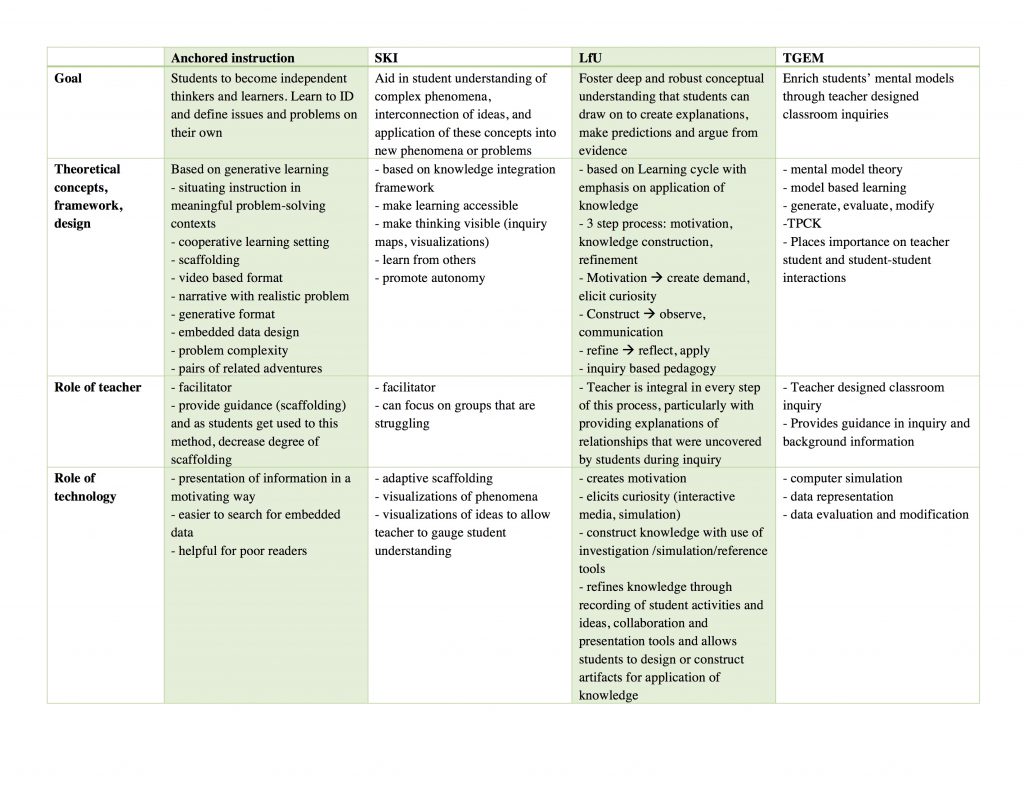
What I liked about Anchored Instruction is that it was “designed to overcome the problem of developing ‘inert knowledge’ – knowledge learned in school that cannot be retrieved when it is needed for another situation” (Zydney, Bathke & Hasselbring, 2014). I found Jasper to be outdated and not as relevant to today’s learners. With a facelift I think it could be beneficial to support problem solving and development of critical thinking skills and collaboration. Comparing T-GEM and Anchored Instruction, we can see theme of constructivism, providing authentic, deep learning, hands-on experiences. This is one of my favorite teaching approaches, as it helps students make connections outside of the classroom, and allows them to explore concepts, take risks, and develop problem-solving strategies (Hickey, D., Moore, A., & Pellegrin, J, (2001). I think that the Jasper project has the potential to support today’s learners.
SKI and WISE:
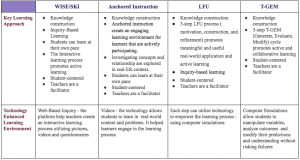
The SKI framework promotes knowledge integration by making thinking visible for students, making science accessible for students, and encouraging students to take ownership over their learning by inquiring about scientific concepts (Linn, Clark, and Slotta, 2003). T-GEM also promotes knowledge integration through its three steps: generate, evaluating, and modifying. Both WISE and T-GEM build on previous knowledge and scaffold the learner, accessing students background knowledge (Linn, Clark, and Slotta, 2002). Comparing WISE and T-GEM, we can see the benefit for teachers as students learning is made visible which supports formative assessment. Looking at the differences, SKI focuses on clearing up misconceptions, which is especially important for younger learners in the science field. SKI focuses on differentiated learning whereas T-GEM does not.
LfU and MyWorld:
Learning-for-Use model using MyWorld are more examples of students constructing their own knowledge through hands-on learning. These are examples of meaningful learning that are relatable outside of the classroom. Similarly to T-GEM it motivates learning by introducing and teaching learners how to observe and explore through direct experience, communicate and describe processes, and apply new knowledge through hands-on activities (Edelson, 2001). The goal of LfU is to incorporate real-world problems into learning activities so that the concepts are meaningful and students are able to connect what they have learned when it is relevant (Edelson, 2001). Differences between LfU and T-GEM is the use of technology, which is necessary for T-GEM. LfU is also situated learning.
Synthesis:
What I’ve learned through researching and exploring the technology-enhanced learning environments is that these approaches are effective ways of brining meaning to a big idea or curricular content. Cross-curricular, paired with technology, provides deep-learning where students are able to take risks, receive formative feedback and test their understandings. I have plans to use many of these methods next year with my class, especially My World and Jasper style problem solving experiences. When it comes to selecting technology for my classroom and learners, my students are at the center of my decision-making. All of the methods we looked at are based on constructivism, paired with collaboration, eliciting curiosity and student-centered inquiry. These methods provide opportunities for students to learn from each other in a project-based learning setting. All of the methods focus on inquiry, collaboration, and student-centered learning, which is the underlying theme in the new BC Curriculum (BC Ministry of Education, 2015).
Moving forward this summer, my plan is to design my new classroom to be a technology enhanced learning environment that provides space for collaboration, inquiry, and problem-based learning. I think I will be pulling from each of the methods presented as I find value for my students in all of the approaches. What I like about these approaches is the inclusion of reflection and helping make students learning visible, which supports student self-assessment.
References:
Edelson, D.C. (2001). Learning-for-use: A framework for the design of technology-supported inquiry activities. Journal of Research in Science Teaching,38(3), 355-385. http://ezproxy.library.ubc.ca/login?url=http://dx.doi.org/
Linn, M., Clark, D., & Slotta, J. (2002). Wise design for knowledge integration. Science Education, 87(4), 517-538.
Zydney, Bathke & Hasselbring (2014) Finding the optimal guidance for enhancing anchored instruction, Interactive Learning Environments, 22:5, 668-683, DOI: 10.1080/10494820.2012.745436