Categories
Mod12: Venture Forum Module Discussions

Venture Pitch submission

This is my submission for our Assignment 3 Venture Forum.

My (fictitious) company is Nucleus e-Learning Solutions, an e-Learning provider specializing in simulation training for Workplace Hazardous Materials training as well as Custom Safety Course Development. Our future offerings will expand into the K-12 Science Education Market.

Please view my elevator pitch here.
I toiled to make it meet the 30 second limit, so once you see what I have to offer in this pitch, I invite you to visit my website to view the entire 11 minute presentation, if you have been given my name for Venture Forum Review.

Categories
Mod09: Serious Game Environments Module Discussions

New Media BC announces top Venture Pitches

In light of our Venture Forum week, I thought I would post this interesting story for you all:

New Media BC is pleased to announce the top 20 companies selected from 37 digital media companies that attended the Fusion ’09 Entrepreneur Boot Camp held at the BC 2010 Showcase Centre.

New Media BC Fusion Forum Top 20 companies

Notably, A Vancouver company, http://www.ecobuddies.com/ has made the top 20 list for educational gaming sites.

See this story in the North Shore News:

Game showing them the way:
EcoBuddies encouraging kids to take action

“EcoBuddies has also been recognized by their peers, having been awarded best in show at New Media B.C.’s Fusion Venture Forum for Digital Media, held two weeks ago in Vancouver. They were among the entrepreneurs who pitched their companies to investors.
“It’s a really great networking tool, for both investors and for entrepreneurs,” says Ferma.
The title came with $1,000 and a three-month placement at the Plug and Play Tech Centre accelerator in Sunnyvale, Calif.”

Categories
Mod09: Serious Game Environments

Society for Applied Learning Technology

In my research for my final project, I spoke to someone in the industry that said I should share this information with my class:

Society for Applied Learning Technology

Specfically, that there is a New Learning Technologies Conference
in Orlando, Florida
March 3-5, 2010

Among the people they suggest should attend are:
School And University Professionals Involved In Technology-Based Instruction Delivery Systems For Education

The topics included in the conference schedule are:
Gaming & Simulation
Compliance
Design
e-Learning
Training
Virtual Worlds
Mobile Learning
Knowledge Management
Social Networks & Web 2.0
Mobile Learning
New Business Technologies

I think that these topics relate to our module themes and team presentations and also to the topics covered in the other MET courses that our classmates might be enrolled in.
The person I spoke to is involved in Gaming and Simulation and Virtual Training, and mentioned the Department of Defence training videos that we were introduced to in the Module 9 presentation on Serious Games.

Hope that this link is interesting / useful for some of you.

Categories
Mod07: One-to-one Technologies Uncategorized

Module 7 One to One Technologies CONCLUSION

To view our concluding statements and a great summative concept map, please come to the CONCLUSION TAB of our NING website.
Thank you all for participating in the discussion forums this week. There was excellent dialogue generated among class members.

Thanks again.
The Module 7 team.

Categories
Mod07: One-to-one Technologies

Education World ® Technology Center: One-to-One Computing

Please view the article (link below): 
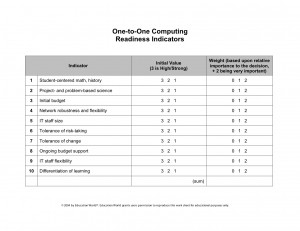
Is your school ready for one to one computing?

Handhelds, laptops, tablet PCs…Which is best for your school? Guest columnist Elizabeth Sky-McIlvain offers a simple rubric for administrators, teachers, and parents to use when evaluating their school’s readiness for one-to-one computing. Print this rubric and share it with your entire school community.

Education World ® Technology Center: One-to-One Computing.

Join in the discussion at our Module 7 NING site:

techcolumnist_rubric_printable_tic

Categories
Mod07: One-to-one Technologies Module Discussions Uncategorized

Module 7 One to One Technologies

Welcome!

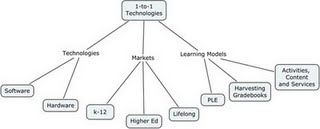
Please begin by looking at this concept map to get a sense of the content we covered in this module.  This initial concept map serves as a Module organizer only.  Check back at the end of this week to see a more interactive concept map that you can use for summative review.
OneToOneTechnologyBare
To start off the dialogue, we would like you to consider the following question FIRST and post your replies here, before proceeding to our NING site.
When you hear the term “One to One Technologies” what does it mean to you?

Once you have responded to the above question, please proceed to our Module 7 website:

http://1to1tech.ning.com

There are instructions on the main page for navigating through the site.
You should be able to SIGN IN using the same email / password that you have used before, for NING.
There are many opportunities for you to engage in dialogue and discussion.
We will also provide an RSS feed so you can follow the discussion here.

Check back here throughout the week to view any posts that pertain to Module 7.
And feel free to post any comments or questions here as well.

Thank you and we hope you enjoy our presentation.
Kathleen Cavanagh, Cathy Jung, Merv LaBrash, Brian Powell, and Erica Toombs

We have also provided a video showing you how to navigate through our Module 7 NING presentation:

YouTube Preview Image
Categories
Questions & Answers

NING help with RSS feeds

Hello Module 4 and Module 5 presenters.  If one of you read this in the immediate future, can you please give me instructions on how to provide the RSS feed from our NING site to this blog page?

Thanks in advance.

Erica Toombs

Categories
Mod04: Social Technologies

Privacy concerns online

Check out this interesting link that was reported on the cbc tonight (October 6):

Teens too open online: privacy watchdog

Jennifer Stoddart, the Privacy Commissioner of Canada, has filed her report that looks at 2008 privacy complaint investigations; technology and privacy issues; and the commissioner’s efforts to encourage the development of international privacy standards.

Watch the Video

Chris Brown reports: Teens too open online, privacy watchdog says (Runs: 2:26)
brown-personal-info-091006.mov

Or go to the address below and click on the QuickTime or RealMedia links.

http://www.cbc.ca/consumer/story/2009/10/06/youth-privacy-commissioner.html

Categories
Mod04: Social Technologies

Identity 2.0

Regarding the link to Dick Hardt of  sxip, Inc., delivering his introduction to Identity 2.0 and how the concept of digital identity is evolving.

Simple eXtensible Identity Protocol

I mentioned in a previous post here in Module 4 that I have always been trepidatious about putting my personal information on the internet.  My facebook page is an exercise in watching what everyone else is doing…not very valuable in terms of getting any information about me.  I am not part of the twitter movement so that people won’t know exactly when I am going to Costco 😉  (as mentioned in the comment by Ed on their module 4 ning)
I like Dick Hardt’s  analysis that your virtual identity is what a website knows about you. But another website doesn’t have access to that information. So your identity is site centric. This means that you are entering information about yourself to an infinite number of website registry pages.  Not an efficient use of time for the user, nor is it an efficient use of your identity information.
So in the end we aren’t really anonymous in terms of our personal information or identity, so why don’t we have a user centric model where my personal information exists and intersects with the various websites that I interact with?
In our world operating under Web 2.0, Identity 2.0 is inevitable.  I agree with him.
And I know that after signing up for a series of networking sites in the last month, that a better way of navigating my way through the internet HAS to exist…and people will seek it out.

Categories
Mod03:The Global Learning Technologies Marketplace

Intel® Teach program

I approached Activity #2 (alternative marketplace offered by international development opportunities) as a cube analysis again…hopefully I interpreted that correctly.

I chose to focus on a companies’ long term investment into a project that will bring them returns later in the future…

Technology giants such as Cisco Systems, Intel, and Microsoft are setting their sights beyond the United States and are investing heavily in global education reform initiatives.  These efforts are benefitting developing nations such as India, Jordan, and Kenya.

Intel is working with governments and educators to help integrate technology into teaching and learning, investing $100 million a year.

See an introductory video here:

www.intel.com/education/video.htm?xmlFilePath=education_intiative.xml
FACE 1:  Market Focus

According to Intel, the goal of  the Intel® Teach program is to help 13 million teachers in more than 40 countries develop new skills to incorporate technology into their curriculum by 2011.

Intel introduces the ®Teach program in communities that are chosen based on the strength of their commitment to the program.
A three-year evaluation of the Intel® Teach Program finds that a large majority of teachers increased the use of technology in the classroom after taking an Intel Teach course.

FACE 2:  Types of Offerings

The Intel® Teach Program helps teachers to be more effective educators.  They provide professional development which focuses on how to integrate technology into their lessons.  This program promotes problem solving, critical thinking and collaboration skills among the students. “With more than 6 million teachers trained in over 50 countries, Intel® Teach is the largest, most successful program of its kind”.
The company works with an initial group of teachers to help them learn 21st-century teaching methods, and these teachers then train other educators in these methods.

The program consists of 24-40 hours of face-to-face, interactive instruction delivered through up to 11 curricular modules through the use of online tools.

The goal is for teachers to leave the course with a standards-based unit plan, support materials, and implementation strategies to improve and assess students’ higher-order thinking with the use of free online tools.

FACE 3:  Who is the Buyer

Intel Foundation

Founded in 1989, the Intel Foundation is a philanthropic organization focused on programs that advance education and improve communities worldwide.

As mentioned in my introductory paragraph, Intel is working with governments and educators to help integrate technology into teaching and learning, investing $100 million a year.

By providing funding for national and localized grants, the foundation helps fuel innovation in classrooms. The goals of the Intel Foundation are to increase interest in math and science education, and to help develop a future workforce that represents the diversity around the world.  In this way they can produce their next generation of employees and customers!

FACE 4:  Global Markets

Intel Corp., a company with four decades of educational reform initiatives—including the Intel International Science and Engineering Fair, the Intel Computer Clubhouse Network, the Learn Program, and the Model School program—has incorporated its Teach program throughout many parts of India.
The focus of Intel and the other major technology giants such as Cisco Systems, and Microsoft, is on developing nations with poor technology resources.

FACE 5:  Development of the Market

The current market that Intel is targeting (developing nations such as India, Jordan, and Kenya) does not support learning technologies.
For reasons of poverty, marginal languages, and poor or restricted Internet infrastructure or geographic isolation, the target market cannot support learning technology ventures of any type that will be viable businesses.
Funding is provided by grants.  The Intel Foundation provides the money (up to $100 million) in national and localized grants.

FACE 6:  Learning Technology competing with other forms of learning

This learning technology substitutes for other types of learning  – enhancing the traditional teacher delivery model that is currently the most cost effective in these developing, yet poor economy countries.
By policy decision, learning technology is displacing other forms of learning. The existing learning solutions are not working (e.g. rural public schools in less developed nations – they do not have the funds to incorporate technology on their own).  As learning technology is not the “best” solution in all cases, gaps in learning performance may persist.  However Intel is not just providing the technology, but is supporting the training of the educators that will implement the technology into their classrooms.
Spam prevention powered by Akismet