Categories
Introductions

The Red Umbrella Mixed Media Collage

The Red Umbrella Mixed Media Collage, originally uploaded by Scarlet_Beautiful.

Making Sense of It All

I chose this mixed media image as it summarizes many of my personal and professional interactions with text and technology. It seems like the young lady is seeking answers from the ancients in the horizontal script while new age pieces of data are falling upon her from above.
Yet, given her attire (umbrella and rain coat) she is prepared to meet the challenges of meshing the old with the new i.e., creating synthesis. I believe I am beginning to find this place of synthesis with my old world skills and attitudes and my new age Web 2.0 abilities.
I also find the juxtaposition with this transpiring out in nature to be a vivid reminder of our connections to the natural world and this is something we must never loose regardless of our reliance upon the new technologies.
My name is Drew Ryan and this is my final course in the MET program. I have been living and teaching on the West Coast of Vancouver Island for 14 years with my wife Christine and sons Tylan (3) and Tayte (15months). My passion is the integration of technology within the K-12 system focussing on First Nations learners. I look forward to this course and its completion:)
Categories
Introductions

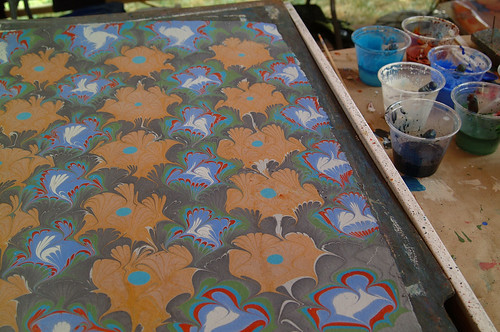
Technology can be beautiful………

Paper Garden, originally uploaded by Smithsonian Institution.

I chose this picture because it demonstrates that technology can be used to create something beautiful. Technology has been successfully integrated into many aspects of society, including the Arts, (textiles, paintings, sculptures, etc) and Humanities. Without the advancements of techniques, the different textures of the paints, the design of the paintbrushes, the construct of the medium, etc., this beautiful mosaic could not be made. Simple, yet beautiful. Technology does not have to be complicated. It can be simple, but at the same time sophisticated and elegant. I generally find that people make it more complicated than it really needs to be.

Hi, my name is Deb Giesbrecht. I have been a nurse for 21 years. I work in Winnipeg and I teach nurses how to use computer programs within their working environment. Many nurses have difficulty with new technology, including computer programs that are designed to assist them in their daily tasks. My role is to support and educate them in this process. Electronic charting is a few years away, however, we are beginning to get nurses acquainted in using computers in their own work environment – which is challenging enough! I have recently implemented a Learning Management System, which allows learners to do online learning prior to face-to-face classroom time. This has proved to be challenging and enlightening all at the same time.

This is my 4th MET course and I am looking forward to seeing what kind of positive impact this will have, not only to me personally, but also in my own classroom. I am always looking for new and varied ways to get messages across to the learner, and I have found that my previous courses in the MET program have equipped me with skills that I than pass along to the learners. I am eagerly anticipating what new skill set I will be acquiring this term!

Categories
Introductions

“Obsolete”

Computer Mountain, originally uploaded by draikar.

When I saw this image of old hardware stored, the thought of how fast we run through different gadgets and fads immediately came to mind. It’s pretty amazing how “new” technology or technological artifacts become obsolete- giving in to something faster, better and simpler. I think that text has also gone through some transformations and stages, giving way to new delivery modes.
I’m Cecilia Tagliapietra; I live in a small USA-bordering town in BC, Mexico and I decided to take this course because the title and content captivated me when I first read them. This semester I’m taking my 6th and 7th courses with the double degree program with UBC and ITESM; I’ll probably ask for a lot for help, since we’ll be working with new, different tools I haven’t had the chance to try before. I honestly hope I can learn from all of your experiences and comments.
I’ll be reading you around 😉

Ceci Tagliapietra

Categories
Introductions

Space vs Meaning

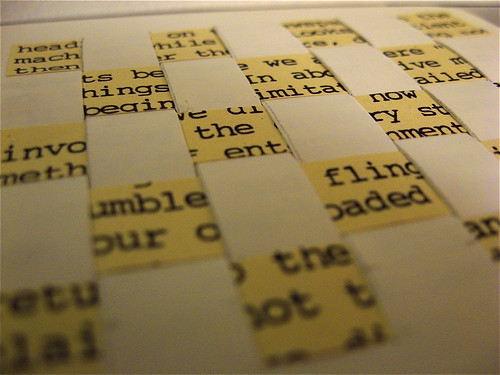
woven journal, originally uploaded by ereneta.

The concept as text being like words woven together really made sense to me. This being my 8th class in the program, I am more drawn to different definitions of text than of technology. The relationship between language and meaning can be so complex, that it’s possible for text to be created merely for the sake of filling space without really conveying meaning. The picture effectively illustrates this possibility.

My name is Ryan Bartlett and although this will be my 8th course in MET, it is my first course directly through UBC. I started the program 1.5 years ago while teaching foreign/second language methodology and EFL at a private university in Oaxaca, Mexico. Since then I have been taking courses online administered through the Tec de Monterrey in Mexico. So long story short, I’m excited to see how UBC works online not to mention very interested to take a deeper look at the complex relationship between language and technology.

Categories
Introductions

Hello from Sarah

Rotary Telephone, originally uploaded by Dave Ward Photography.

I selected this image as I have witnessed (and taken part) in many discussion within the MET community as to what exactly is technology?1?! This summer in trying to organize a large BBQ we had emails/texts/Skye going and finally I picked up the phone and it worked wonders…

This is my 7/8th MET course and I am also taking ETEC 590 this Fall. I took ETEC 565A this Spring and it was awesome. For those of you who have a few electives left I would highly recommend it!

For the past five years I have been working fulltime in Vernon, BC as a Computer/Drafting/Home Ec teacher and this year I have taken a LOA to try to get on in the Kelowna district. So if you live in Kelowna and you need a TOC you know who to call…

Thanks,
Sarah

Categories
Introductions

Woodblock Print, Part 7

Woodblock Print, Part 7, originally uploaded by dailyartmasomenos.

Hello, I’m Carmen Chan. After graduating from UBC four years ago, I packed my bags and flew to China to begin my career as a teacher. I taught in China for four years and is currently teaching in Cairo, Egypt.

One of China’s four greatest inventions is the invention of woodblock printing. The photo above is a modern version of a woodblock print which originated in China. The Chinese woodblock was used for printing on fabric first then later on paper. I selected this image because this invention started China’s print culture. Since then communication and interaction has never been the same.

I look forward to learning more about how text technologies such as the woodblock printing transformed reading and writing.

Categories
Introductions

Keyboard From Stone Age

Keyboard From Stone Age, originally uploaded by elka_cz.

I have selected this image for several reasons.
I think this image evokes feelings of where we have travelled through the democratization of print. The keyboard literally opened pathyways to new knowledge essential for increased knowledge creation. The Internet is wonderful, but knowledge would have been shared with great difficulty were it not for the keyboard!

My name is Erin Gillespie. I am an elementary teacher currently teaching grade 4 (age 9) in Hong Kong at an international school. This is my 9th MET course and the reason I entered the MET program! I can use a keyboard, but now I prefer touch screens with icons.

When I was teaching in Japan (1998-2008), I heard about a course from UBC that had won an award, which led me to an article written by Teresa Dobson entitled “Technologies of Text: Reflections on Teaching, Learning, and Writing with/in Digital Environments” (JCACS, Fall 2005, Vol 3, Issue 1). I was hooked and I searched out the author, which led me to 540 and to the MET program at the end of 2007.

Reflecting on my journey into MET, the image I chose and our readings this week, I feel humanity has come through many ages (the Stone Age, the Bronze Age..etc) and I’m happy to recognize that I am a contributing member of the Information Age.

Erin Gillespie

Image courtesy of Elka Cz (2006): Keyboard from Stone Age

Categories
Introductions

Nancy Bird, London, 1939

Nancy Bird, London, 1939, originally uploaded by State Library of New South Wales collection.

Hi everyone. My name is Louise Thomson. I am currently working on courses number 8 and 9 (!) in the MET program and am working full time as a grade 2 teacher in a rural community in beautiful Vancouver Island.

I chose this picture because of the conversations I have been having with my co-workers all week about technology integration into our non-techie school. I have spent this first week of school with the grade 5’s because our class assignments have not been made and chose to teach them how to do claymation rather than some of the usual first week stuff. They have blown me away with what they created!

When I saw this picture I thought about how exciting new technology often for some and how intimidating it is for others. Like this plane, in the wrong hands it can also be dangerous!!

Cheers,
Louise

Categories
Introductions

Sorry… Nothing deep I just like the picture.

Artis struisvogel leest krant van oppasser / Ostrich reads newspaper of caretaker, originally uploaded by Nationaal Archief.

Hi Everybody,
My name is Ed Stuerle. I am an elementary teacher in Kelowna, BC. I have been teaching here since 1983. I am currently teaching Grade 5 part time and I am doing some prep relief in the computer lab for the rest of the time. I really enjoy my time in the computer lab (that is until the computers start misbehaving). I find that it is very easy to motivate the students and that many students who might struggle in the traditional classroom often are quite comfortable using technology to present their understandings.

I chose this picture mainly because I enjoy the humor in it. I must admit that I’m not the philosophical type so if I claimed that the picture reminded me that all living creatures make sense of their own reality in their own unique way… well I’d be full of bull. What can I say… it’s a funny picture and I like it.

Categories
Introductions

Language (Text) Barrier?

Language Barrier, originally uploaded by Xiangdian.

Though many countries have access to the printed word, be it through the local library, bookstore, or the Internet, there are places where text is censored. I typed into the search engine the words “language barrier” with images already in mind, however when I came across this image, I was immediately taken in another direction. I realized that even though technology is helping to establish dialogue in a greater worldwide community, there is still some censorship. This also made me think about personal experiences where I was traveling that made me crave the written word, albeit a newspaper or a trashy novel. It made me feel connected somehow. This photo reminded me that many are not connected.
This then made me think about the benefits of technology for those in other countries, those with lower literacy levels, etc., but I’ll spare you my meandering thoughts–this is merely an introduction!

I’m Kelly Kerrigan and this is my sixth/seventh course in the MET program. I’m currently taking 512 this semester as well. As an elementary school teacher in the Vancouver area, I am fascinated by the changing role that technology brings to text, to the classroom, and finally to my students.

This looks to be an exciting course! Looking forward to working with you all.

Categories
Introductions

A blank slate, and building blocks


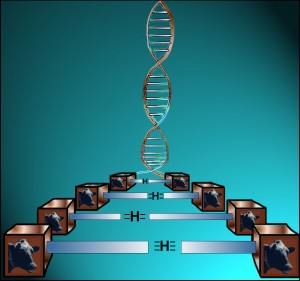
LAclone VPN CAVANAGH

Image from my archives. From a VPN magazine article.

The picture I selected reminds me of writing, as it generates in me a thought that the stitching together of units will result in a synergy; in the case of genes, life. More than the sum of the parts.

How we turn a blank slate (be it stone, paper, or an electronic interface) into a carefully crafted, stitched together collection of units (words, phrases) called writing is a process applied in very different settings and media these days. Successful text technologies are the sum of much more than the jumble of letters one sees if quickly perusing a text-filled page.

In the image, we see a stitching together of the building blocks of life; seeing something with a high degree of order formed using a finite collection of building blocks.

Writers must first face a blank “page”, and their text changes the space. The writing will change those who can assimilate meanings from the words and phrases. How a writer will achieve that end is determined by the traditions and rules of each language, the tools, the cultural setting, and will evolve according to the times they live and work in.

I am taking my 7th an d8th courses this fall. I am involved in technical writing and editing, I coach students for communication skills in veterinary training, and instruct a university course online. I also have developed many educational materials in electronic, print, and graphic art formats over the years. (When not doing family activities and clinical practice!)

I think this will be a fascinating course. I have had the good fortune of being able to wear many hats over the years while working on educational projects, but around every corner in the MET program, I find challenges and enrichment of my understanding of the processes we can apply, in order to turn a “blank slate” into something much more.

Warm regards to all, Kathleen Cavanagh

Categories
Introductions

The power of the written word, or…

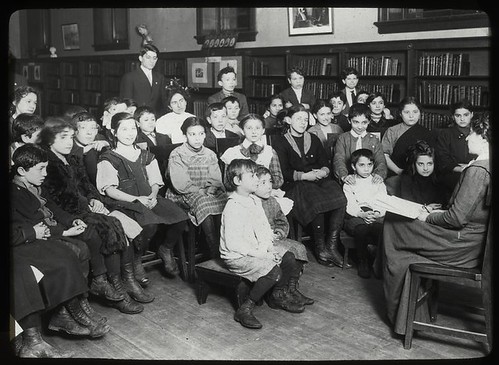
Work with schools : a librarian’s assistant telling a story …, originally uploaded by New York Public Library.

Whenever I see old photos like this I try and imagine being there in the room, able to look around at parts of the scene that aren’t in the picture. At first this photo appealed to me because it shows the power of literacy, the kids appear quite engrossed with the story, or at least most of them do. But then I started walking around the room and realized that right beside the kids is a photographer with a very large camera (this is ca. 1910), some of the kids are looking at the camera but most of them aren’t, so then I have to wonder is the photo a ‘set-up’ taken to demonstrate the power of stories and to promote the library? If you aren’t a cynic like me who looks for set ups and fakery then it works, it does promote literacy and in turn the library, the kids look engrossed, and anything that promotes opening a book is o.k. by me.

A bit about me.

I’m a technology education teacher in Victoria. For a number of years now I’ve been dealing with everyone immediately assuming that I teach something to do with computers. Actually Technology Education is what you would call (correctly) ‘shop class’. My interest in this class comes from a few directions, at one time I was an English major and I’ve always been interested in books and reading, note I said ‘books’, I’m a book person and at this point I’m holding on tight to the idea of being able to hold a book and have it physically in my hand. I can’t see me ever enjoying holding on to a little computer to read a piece of fiction, but I think it’s coming. So I guess this class is to help me with the shock of the new. The other reason I’m interested in the class is because in my field I deal primarily in the verbal rather than the written, so I’m interested in how communication changes and varies from verbal to written or vice versa.

Jim McDonald

Categories
Introductions

Invisible Ink

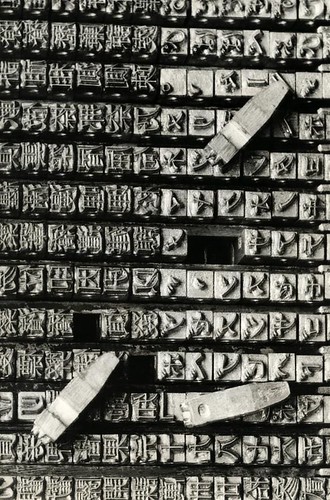
Japanse karakters / Japanese characters, originally uploaded by Nationaal Archief.

This image of Japanese characters caught my attention by mirroring my keyboard… in the past. These carefully crafted characters represent the painstaking process by which raw materials were transformed into symbolic characters which were in turn arranged to form meaningful text. Looking at the neat rows of letters on my own keyboard, I can see how technology has transformed not just the final product of texts, but also the mechanics by which we create text. The sophisticated technologies that have been developed since 1938 (when this image was taken) have removed the ink from the process of mass producing writing and have allowed the push of a button to summon and banish the components of text.

My name is Rachel Bronk and ETEC 540 is my 8th course in the MET program (graduating in April!). I live in North Vancouver, BC and when I’m not “MET’ing” I can be found swimming, reading “non-school books” or planning my wedding. I am the IEP/Assessment Coordinator at the senior campus of Collingwood School in West Vancouver, BC. I admit that my position it not as directly related to educational technology as I would like it to be. However, in working with students who have learning disabilities I am amazed at how technology has been able to provide supports and innovations that are truly breaking down barriers. I mainly coordinate IEPs and assist with programming for students who have a reading disorder or disorder of written expression and the text technologies addressed in ETEC 540 that are “changing the spaces of reading and writing” are doing so for my students as much as they are for anyone else. I look forward to working with everyone in this course.

🙂 Rachel

Categories
Introductions

Industrial Tech – Information Tech – Industrial Tech

shopClass

“Doc Pelton’s” shop class – Nov. 13, 1974″ obtained under a Creative Commons License from http://www.flickr.com/photos/scarlatti2004_images/1573876214/

Hi everyone,

I chose this picture because I think it demonstrates the profound influence that new technology (in this case information technology) can have on our education system.  Around fifteen years ago the NB Dept of Ed. sold off a lot of the industrial tech equipment to buy computers.  The reason being was that the province thought students would be better prepared for the world of tomorrow by teaching them IT literacy skills today.  Years later, it was realized that industrial technology and learning trades was a vital part of the NB economy and they began buying the equipment back so they could reinstate the industrial tech programs again.  I think the lesson of the story is that, although the information age has undoubtedly reshaped culture all around the world, we should not be swept away by the introduction of a world-changing technology.  It may change the way we look at the world and everything around us, but there are somethings that we will always need despite the marvels of the information age.

On a personal note, I am a middle/high technology teacher at the Canadian International School of Beijing and I am currently enrolled in this and ETEC590.  I will have completed my degree requirements at the end of this term.  Can’t wait!

John

Categories
Introductions

Typefaces Galore

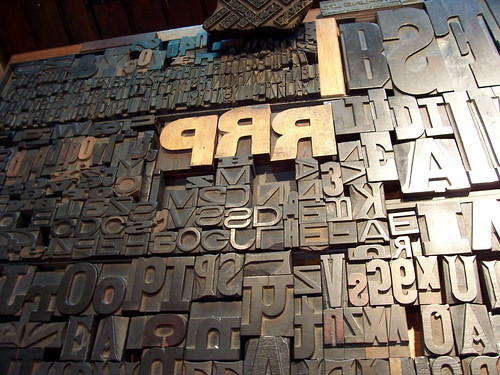
Typefaces Galore, originally uploaded by Kevin Lawver.

My name is Natalie Giesbrecht and I am a Distance Learning Program Development Specialist (aka the fancy name for instructional designer) for the online distance education unit at the University of Guelph. I work with faculty and instructors to design and develop online courses for degree students and adult learners. Prior to this, I guided a team of designers and copyright assistants to produce and distribute course materials. As for education, my degree is from the University of Guelph, where I studied photography, video, sculpture and art history.

Over the last 10 years I have developed a fascination for graphic design and typography. So when thinking about the words text and technology, for me the printing press naturally comes to mind. Thus the photo I choose depicts wood letterforms used in letterpress printing. Letterpress printing is certainly both an art and a craft – though now a dying skill.

Last summer I was lucky enough to get a tour of Coach House Press in Toronto, Ontario and an opportunity to try my hand at letterpress printing. From this experience I learned how much time and accuracy is needed in order to perfectly typeset a final printed product. Consideration is given to every aspect of each letter on a page. Most importantly quality checks on the finished pieces are always done to ensure that the reader has the best experience possible. With the speed and ease of computer publishing, I have a whole new appreciation for traditional ways of printing.

ETEC*540 is my 9th course! During this semester I am interested in exploring the convergence of old and new technologies and how this affects literacy – particularly printed books versus e-books. I am also interested in how new media, mobile and social technologies impact how we communicate – the way we read, write, find and understand information – and how this impacts online education.

With the variety of backgrounds and skill sets of all of us in this course, I think this will be a challenging and rewarding semester!

Categories
Introductions

Mayan writing at Palenque

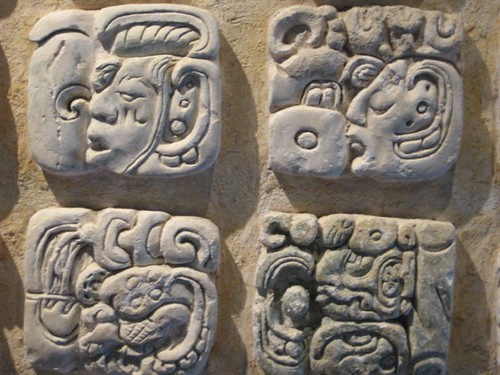
Mayan writing at Palenque, originally uploaded by scrappymoduinne.

I chose this picture as I have been fascinated since I was a small child with the different ways in which human beings communicate with each other. I used to spend hours looking at Egyptian hieroglyphics, trying to imagine what messages could be discovered, if I only knew how to interpret them. From hieroglyphics I moved on to books and by the age of three I learned to read. I think I learned so quickly because words seemed easy after hieroglyphics and I hated having to wait for an adult to read to me. When I moved to Mexico and came across Mayan writing it brought back so many memories from my childhood. Next I moved to Oaxaca and discovered that a lot of the people I met spoke an indigenous language, but did not know how to write it. Writing in their own language has never been necessary for them, as they can write in Spanish or a foreign language such as English, if they need to.
My name is Clare Marie Roche, I am from Liverpool, England and I have been living in Oaxaca, Mexico for the last eighteen years. I am a widow and I have two daughters and a granddaughter, all of whom speak Spanish as their first language. I have been working at a small, private university for the last fourteen years. I am looking forward to working with all of you.

Categories
Introductions

Text Stress

Information Overload, originally uploaded by ~ Solstizio ~.

I chose this image to represent the text overload that engulfs our daily lives.
In the first semester of this master’s degree I discovered the writings of Neil Postman and his vision made a deep impression on me. In his book “Technopoly: The Surrender of Culture to Technology” (1993), the author asserts that no technology is neutral and that we should be conscious of the changes to society that the introduction of new technology provokes. He also notes that we are presently bombarded by more and more information (texts) and that this excess has not made us any happier since few of our problems are caused by a lack of information.

My name is Dilip Verma, and I am married with two children. My background is mixed both racially and professionally, but presently I reside in Oaxaca, Mexico and work as the Director of the School of Languages at the local University. I am studying in a joint degree program between UBC and the Tec de Monterrey. This is my first course with UBC and it is a pleasure to be able to write in English.

I have little experience with blogging and no experience with virtual social networking, but I am not a Luddite either. I understand that the new technologies of communication are here to say and I look forward to discovering a considered, culturally sensitive approach to their incorporation into my teaching.

Categories
Technology

Technology=System

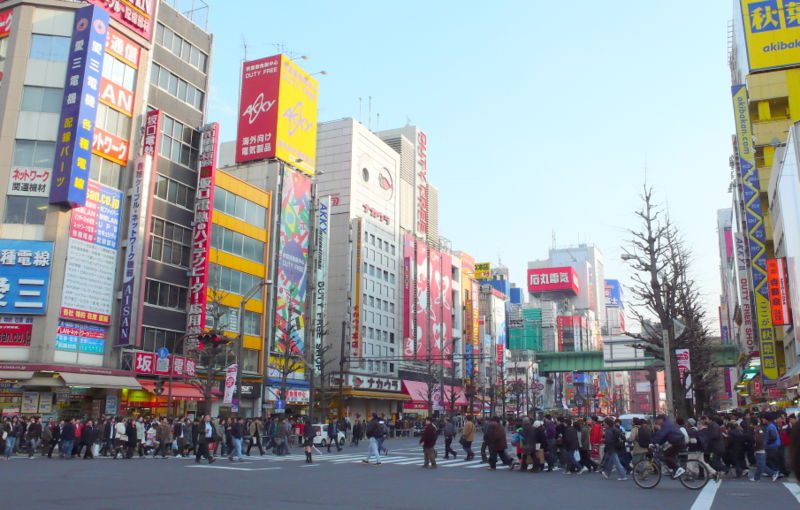
Akihabara, Tokyo, Japan.

What is technology? 

Currently, for me the term “technology” refers to a system in society. It is too difficult for me to consider technology a simple tool. Technology is just as much the ability to use a tool as it is to be the tool. Technology can function within its own system independently (mechanized production) or it may require other elements to function as a system (a human programs a machine).

I chose the image of Akihabara, the electric city, in Tokyo, Japan to translate visually what the term technology means to me. I lived in Tokyo for 10 years and I often went to “Akiba”. Akihabara functions as the system I’m trying to describe in words. Every aspect of it the city is related to the creation, use, improvement and distribution of electronics. It’s one of the most futuristic places in Tokyo and often made me feel like humans were in service to the machines, but in a positive way. I am not stating that electronic=technology, but I am (hopefully) showing the importance of the system and drawing attention to the way society is shaped by and shapes technologies.

Please watch the tour of Akihabara embedded below if you are interested in walking the streets to get a better idea of how the system I’m describing actually functions.  (Erin Gillespie)

YouTube Preview Image


References

Jmho. (2007). Akiba denkigai. Wikimedia Commons. Available online 10, September, 2009, from http://en.wikipedia.org/wiki/File:Akiba_denkigai.jpg

YouTube. (2009) Akihabara electric city Tokyo. Genki Japan.net. Available online 10, September, 2009 from https://www.youtube.com/watch?v=aSeO0c4Q4Ac

Categories
Text

What is text?


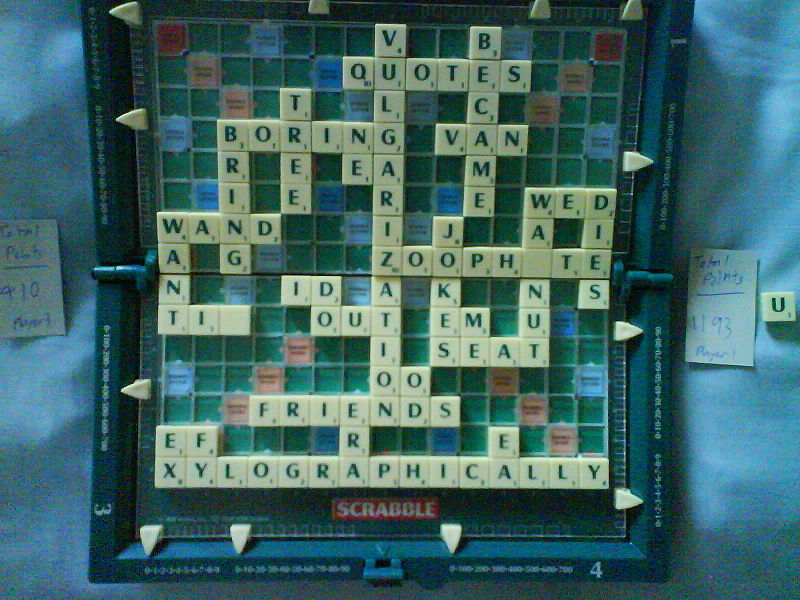
Scrabble
Scrabble

What is text? At the beginning of this course, text for me is the act of putting in a form of writing another form of communication. For example, text can be printed, inscribed or typed to communicate a message.

According to the Oxford English Dictionary Online (OED) text is “The wording of anything written or printed; the structure formed by the words in their order; the very words, phrases, and sentences as written.”, literally that which is woven. Interestingly, there is an area in academic study called “text mining” and according to Hearst (2003) it involves computers discovering unknown text-based  information by extracting what is known and creating new connections to produce new knowledge. This led me to consider text as a system of creating such links, to slowly weave together ideas in society.

I selected this image to represent text to me as a form of expression that is open to new connections and evokes a sense of woven words. The image is based on the popular game Scrabble, where words are connected until the board is filled in an elaborate pattern of text. When I saw the image, I instantly read the words, searching for a meaning.

My name is Erin Gillespie and it is a pleasure to be in 540 with you. I teach grade four at an international primary school and I prefer texting to phone calls.  

References

Hearst, M. (2003). What is text mining? Available online 10, September, 2009, from http://people.ischool.berkeley.edu/~hearst/text-mining.html

Ho, A. (unknown).  Aran Scrabble Layout.  Wikimedia Commons. Available online 10, September, 2009, from http://commons.wikimedia.org/wiki/File:Aran_Scrabble_layout.JPG

Oxford English Dictionary Online. (2009).  Available online 10, September, 2009, from http://dictionary.oed.com/

Categories
Introductions

The Aesthetics of Text

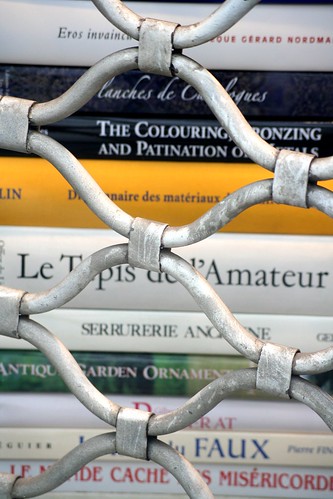
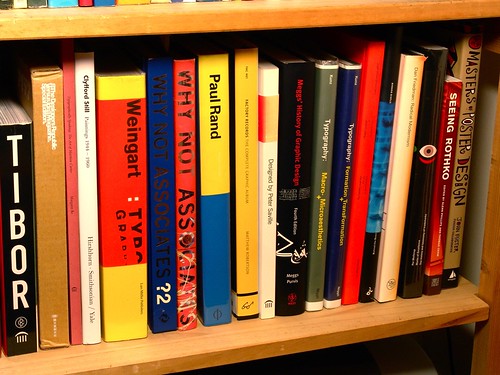
How does each book spine use text to draw the eye to the book?

Design Book Library 01 4, originally uploaded by Outofprint.

I chose this photo because the bookshelf contains a collection of resources related to design, typography, text, and technologies. In the Module 1 course content, we are challenged to think about text and technologies in their varying forms and how it has evolved, become part of innovation and is being re-innovated. Not only are these books resources, but simple as they look, they also exemplify elements of design in the spines – creative ways of arranging text to convey typography.

My name is Marjorie del Mundo. I have a background in interaction design and have worked in marketing and graphic design. Currently, I am completing my final week as an Educational Programmer for UBC Student Development and am looking forward to the launch of the Discover Your Major guide for undergraduate Arts students which I helped develop over the summer. During my design studies, I had to investigate and explore the use of text and typography as a foundation for creating layouts and spreads. In this course, I hope to expand my knowledge on how text and technologies impact the way we share information and communicate in various contexts.

Spam prevention powered by Akismet

Creative Commons Attribution 3.0 Unported
This work is licensed under a Creative Commons Attribution 3.0 Unported.