Categories
Making Connections

Negotiating Spaces and Making Connections

Throughout this course we have interacted with several spaces for reading and writing: our course wiki, the community weblog and the discussion boards. We have also engaged with several spaces outside of the course through peer projects that make use of websites, videos and Web 2.0 technologies. For me, this course has really been about how reading and writing changes within each of these digital spaces.

Bolter (2001) states that “the reflexive character of each technology permits writers to find themselves in the texts they create and therefore to know themselves in new ways” (p. 189). The discussion forums were an essential reflection tool for our course. In the Digital Literacy and Multi-literacies forum, Kathleen Cavanagh reflected on writing in online forums and provided a list of best practices on creating postings that grab the attention of the digital reader (Do Web Browser Affect Literacy, Nov. 21, 2009). In the same thread Erin Gillespie pointed out the importance of generating community for knowledge creation. She also mentioned how ‘the personal touch’, ‘shared insights’ and ‘co-construction of knowledge’ are what makes discussion forums motivating and engaging (Nov. 24, 2009). Drew Murphy followed up by stating that “posting[s] could become a very intense learning experience when people’s ideas are squeezed into a small, community space” (Nov. 24, 2009, para. 2).

Within the short 13-week span of our course, I believe we have built a learning community through simultaneously making use of multiple digital reading and writing spaces. Though work-related challenges limited my participation at times, this environment for me, extended my understanding of the course concepts as my peers provided unique points-of-view. Through individual postings, we collectively pulled together ideas and in turn each person could come away with a new understanding of themselves.

Online, our thoughts can be hyperlinked and thus be flexible, interactive and quickly disseminated. This made me think about how the spaces within our course shift our writings from being informal (discussion threads or weblog comments) to being formal (assignments posted to the weblog, wiki, etc.). However regardless of what is posted, in these content spaces we continually move between being consumers and being producers. Just look at the Community weblog to see exactly how much content, we as a group have generated in such a short amount of time. Then look at all the links we have generated!

In terms of readings, I particularly enjoyed Bolter’s chapter “The Breakout of the Visual” as well as Dobson and Willinsky’s article “Digital Literacy”. With the proliferation of images in multimodal realms there is a need for students today to be multi-literate. In the Multimodality and the Breakout of the Visual forum, Dilip Verma stated that he sees graphic design skills as eventually becoming “as valued as spelling and grammar in the 21st century” (Nov. 5, 2009). In another thread entitled “Visual/Textual?” Kelly Kerrigan reflected on how visual representation has become prominent in society today and that MET courses reflect this transformation by encouraging students to explore different modes of representation. ETEC540 supports this claim as we have had the opportunity to present our work in shared digital spaces, leaving room for us to make use of hypermedia and hyperlinks. It was interesting to peruse the projects where people took a more visual approach:

Final Project – Graphic Novels, Improving Literacy
Catherine Gagnon

A Case For Teaching Visual Literacy – Bev Knutson-Shaw

Pen and Paper Project – Ed Stuerle & Bruce Spencer

Navigating the Hypermedia Sea – Marjorie del Mundo

Hopscotch and Hypertext – Liz Hood

I thoroughly enjoyed this course and appreciated the opportunity to engage frequently in the various spaces of the course.

References

Bolter, J.D. (2001). Writing space: Computers, hypertext, and the remediation of print. New Jersey: Lawrence Erlbaum Associates, Publishers.

Categories
Major Project

Major Project – E-Type: The Visual Language of Typography

Typography shapes language and makes the written word ‘visible’. With this in mind I felt that it was essential to be cognizant about how my major project would be presented in its final format. In support of my research on type in digital spaces, I created an ‘electronic book’ of sorts, using Adobe InDesign CS4 and Adobe Acrobat 9. Essentially I took a traditionally written essay and then modified and designed it to fit a digital space. The end result was supposed to be an interactive .swf file but I ran into too many technical difficulties. So what resulted was an interactive PDF book.

The e-book was designed to have a sequential structure, supported by a table of contents, headings and page numbering – much like that of a traditional printed book. However, the e-book extends beyond the boundaries of the ‘page’ as the user, through hyperlinks, can explore multiple and diverse worlds of information located online. Bolter (2001) uses the term remediation to describe how new technologies refashion the old. Ultimately, this project pays homage to the printed book, but maintains its own unique characteristics specific to the electronic world.

To view the book click on the PDF Book link below. The file should open in a web browser. If by chance, you need Acrobat Reader to view the file and you do not have the latest version you can download it here: http://get.adobe.com/reader/

You can navigate through the document using the arrows in the top navigation bar of the document window. Alternatively you can jump to specific content by using the associated Bookmarks (located in left-hand navigation bar) or by clicking on the chapter links in the Table of Contents. As you navigate through the pages you will be prompted to visit websites as well as complete short activities. An accessible Word version of the essay is also available below.

References

Bolter, J.D. (2001). Writing space: Computers, hypertext, and the remediation of print. New Jersey: Lawrence Erlbaum Associates, Publishers.

To view my project, click on the following links:

E-Type: The Visual Language of Typography (PDF Book)

E-Type: The Visual Language of Typography (Word Version)

Categories
Uncategorized

The Age of Real-Time

I had the opportunity to go to the Annual Conference on Distance Teaching and Learning in Madison, Wisconsin this past August. The last keynote speaker, Teemu Arina discussed how culture and education are changing with emerging technologies. His presentation illustrated how we are moving from linear and sequential environments to those that are nonlinear and serendipitous. Topics of time, space and social media tie into Teemu’s presentation. The video of the presentation is about 45 minutes long but the themes tie nicely into our course and into many other courses within the MET program.

In the Age of Real-Time: The Complex, Social, and Serendipitous Learning Offered via the Web

Categories
Uncategorized

MIT Lab and the “Sixth Sense”

As one of themes of this course relates to technology and information retrieval and storage, I thought I would share this video. The folks at MIT have created a wearable device that enables new interactions between the real world and the world of data. The device, based on personal criteria that you input, allows you to interact with an environment and call up relevant information about it, simply by gesturing (e.g. while shopping a hand gesture will bring up information about a particular product). What is controversial about this device is that it makes it easy to infringe on people’s privacy. Filming and photographing can occur by simply moving one’s hand. Also, think about how annoying it is to listen to a multitude of mobile users chat in public spaces – this device allows a user to project and display information on any surface. Imagine, hundreds of people displaying information all over the place at once!

https://www.youtube.com/watch?v=blBohrmyo-I

Categories
Rip.Mix.Feed.

Remix Culture: Fair Use is Your Friend

As many of us have made digital materials, including video for MET courses, this video created by the American University Center for Social Media may be of interest. It describes fair use in the context of creating online videos and offers some best practices that educators can apply to their practice. Though Fair Use relates to American copyright laws, there are guidelines that we can take away and apply to our own contexts in the absence of any other documentation.

For the American University Center for Social Media’s full report see: Code of Best Practices in Fair Use for Online Video

View Remix Culture: Fair Use is Your Friend Video Here

Categories
Rip.Mix.Feed.

RiP: A Remix Manifesto

Some of you may have come across this project in your past courses but I thought I would share it here as we enter the RipMixFeed section. RiP: A Remix Manifesto is a documentary film about copyright and remix culture. The neat thing about this project is that it is participatory (I think participation is now closed though). Brett Gaylor, the filmmaker, has encouraged people to remix his work by providing his raw film footage to anyone. Ultimately Brett intends to mashup all the remixes submitted. The film is divided into chapters based on specific copyright issues. Each section is a mashup in its own right – to be remixed by others.

Girl Talk is the first chapter of the film and is about Girl Talk, a musician who mashes up music.

See part of the original film: http://films.nfb.ca/rip-a-remix-manifesto/

Now compare it to an example that has been remixed: http://www.boingboing.net/2009/03/19/boing-boing-videos-r.html

(Note: I have provided the links to the videos insteading of embedding them as they go beyond the parameters of the blog post)

In the past I cleared copyright for educational materials and Girl Talk’s music would be a nightmare to clear permissions for. Some say that the Fair Use (USA) or Fair Dealing (Canada) clauses should cover a lot of Girl Talk’s work, as only snippets of music are used. However the debate often overlooks the length of a clip, to instead look at its value; meaning it could be the ‘essence’ of the entire song, thus royalities should be paid. What do you think? Does this limit artistic interpretation? What does this mean for digital literacy?

Categories
Rip.Mix.Feed.

RipMixFeed using del.icio.us

For the RipMixFeed activity I collected a set of resources using the social bookmarking tool del.icio.us. Many of us have already used this application in other courses to create a class repository of resources or to keep track of links relevant to our research projects. What I like about this tool is that the user can collect all of their favourite links, annotate them and then easily search them according to the tagged words that they created. This truly goes beyond the limitations of web browser links.

For this activity I focused on finding resources specifically related to digital and visual literacy and multiliteracies. To do this I conducted web searches as well as searches of other del.icio.us user’s links. As there are so many resources – too many for me to adequately peruse – I have subscribed to the tag ‘digitalliteracy’ in del.icio.us so I connect with others tagging related information. You can find my del.icio.us page at: http://delicious.com/nattyg

Use the tags ‘Module4’ and ‘ETEC540’ to find the selected links or just search using ETEC540 to find all on my links related to this course.

A couple of resources that I want to highlight are:

  1. Roland Barthes: Understanding Text (Learning Object)
    Essentially this is a self-directed learning module on Roland Barthes ideas on semiotics. The section on Readerly and Writerly Texts is particularly relevant to our discussions on printed and electronic texts.

  2. Howard Rheingold on Digital Literacies
    Rheingold states that a lot people are not aware of what digital literacy is. He briefly discusses five different literacies needed today. Many of these skills are not taught in schools so he poses the question how do we teach these skills?

  3. New Literacy: Document Design & Visual Literacy for the Digital Age Videos
    University of Maryland University College faculty, David Taylor created a five part video series on digital literacy. For convenience sake here is one Part II where he discusses the shift to the ‘new literacy’. Toward the end of the video, Taylor (2008) makes an interesting statement that “today’s literacy means being capable of producing fewer words, not more”. This made me think of Bolter’s (2001) notion of the “breakout of the visual” and the shift from textual to visual ways of knowing.

Alexander (2006) suggests that social bookmarking can work to support “collaborative information discovery” (p. 36). I have no people in my Network as of yet. I think it would be valuable to connect with some of my MET colleagues so if you would like share del.icio.us links let’s connect! My username is nattyg.

References

Alexander, B. (2006). Web 2.0: A new wave for teaching and learning? Educause Review, Mar/Apr, 33-44.

Bolter, J.D. (2001). Writing space: Computers, hypertext and the remediation of print. London: Lawrence Erlbaum Associates, Publishers.

Taylor, D. (2008). The new literacy: document design and visual literacy for the digital age: Part II. Retrieved November 13, 2009, from https://www.youtube.com/watch?v=RmEoRislkFc

Categories
Rip.Mix.Feed.

Spelling with Flickr

I love fonts so in the spirit of our RipMixFeed activity, I found this tool for spelling out words using Flickr images. You can change up the images on-the-fly until you get a ‘word image’ that you like. Here is a sample of what I came up with:

typewriter key letter D I wood type letter G letter i T44 A l31

L orange letter I letter T letter E R A C Y

Create your own Flickr words at: http://metaatem.net/words/

Categories
Uncategorized

Lost and Found in the Digital Age

By connecting through Web 2.0 tools and sharing information online, it is easy to create links to new people. However, even small bits of information you share may tell others (globally) more about you than you may think.

In September of this year, Evan Ratliff, reporter for Wired Magazine tried to disappear for a month. But as we leave digital footprints of our personal information, it becomes harder and harder to hide ourselves. Once information is online it is difficult, if not impossible to erase. This is why information literacy (as part of digital literacy) is such an important component of education today.

Check out the short ABC news clip: How to Disappear in the Digital Age. The story made me stop and think twice about all of our public collaborative spaces and who may run across them. In Evan Ratliff’s instance, people were encouraged to tracked him down. However I think the example shows that locating someone with an online presence can be quite easy.

Best,
Natalie

Categories
Uncategorized

Library 2.0 – The Community of the Library

This past week the Toronto Star reported on the reinvention of libraries in the City of Toronto. Though the article does not delve into the deeper issues of knowledge organization, it illustrates how libraries have been evolving to remain relevant within their communities.

Library 2.0: Libraries are Toronto’s Living Room, Playground, Even Concert Venue, Writes Christopher Hume

Cheers,
Natalie

Categories
Research Paper

Printing a Changing Language

My research project entitled Printing a Changing Language: The Printing Press and the Standardisation of English can be found on the ETEC540 Wiki. The following video gives a great but short overview of the topic I attempted to tackle.

Best,
Natalie


Categories
Uncategorized

Bada-Bing! The Oxford English Dictionary Taps into Internet Culture

When I think about standardization of language, my first thought is to refer to the dictionary. Sam Winston, a UK artist, has done some neat pieces that use dictionaries as a springboard for playing with language and text. What I like about this project is that the artist’s intent is to make art accessible – which in the context of this course relates back to the press as means to make literature accessible to the masses. Here is short video clip of the project Dictionary Story.

In the video clip, Winston mentions James Gleick’s article for the New York Times, Cyber-Neologoliferation as a source of inspiration. As this course has fueled my interest in language and technology, I decided to search this article out.

Before reading the article I did not have a clue what ‘neologoliferation’ meant. What I learned is that neologism refers to “a newly coined word that may be in the process of entering common use, but has not yet been accepted into mainstream language (Wikipedia, Neologism, para. 1). This word seems completely appropriate to use in the context of the Oxford English Dictionary and their pursuit to capture “a perfect record, perfect repository, perfect[ly] mirror of the entire [English] language (Gleick, 2006, para. 5).

The Oxford English Dictionary (OED) has a long history, dating back about a century and half, and has played an essential role in standardizing the English language. In his article, Gleick explores the workings of the dictionary today and how the online environment is changing the evolution of language. The OED has evolved its immense printed resource of 20 volumes in its second edition to a 3rd edition that now resides completely online. The Internet has not only been a vehicle that houses the dictionary but a tool that allows lexicographers to eavesdrop on the “expanding cloud of messaging in speech” that occurs in resources such as newspapers, online news groups and chat rooms (para. 2).

With these tactics for tapping into culture, the dictionary has moved from being a ‘dictionary of written of language’, where lexicographers comb through works of Shakespeare to find words, to one where ‘spoken language’ is the resource (para.12). Surprisingly, text messaging also serves as a source for new vocabulary. Beyond OED’s hunting and gathering processes, the general public can also connect with them to have a new word assessed for inclusion into the dictionary. The ‘living document’ of the dictionary now seems to require of the participation of the masses. With this, more and more colloquial language is being added to the dictionary (e.g. bada-bing).

The printing press worked to standardized spelling but according to Gleick (2006) with mass communication spelling variation is on the rise. With the Internet, OED is coming to terms with the boundlessness of language. In the past variations of the English language were spoken in many different pockets around the world. These variations still exist but now are more accessible through the Internet (Gleick, 2006). Peter Gilliver, a lexicographer at OED believes that the Internet transmits information differently than past vehicles for communication. He suggests that the ability to broadcast to the masses or communicate one-to-one is impacting the change in language. For OED, the ability to tap into a wide variety of online conversations affords a more accurate representation of word usage all over the world.

Standards in language help us to clearly communicate in a way that is commonly understood. This article makes me wonder, with all the slang being added to the dictionary, what will language look like in 50 years? 100 years? Will a new English language evolve? How will this affect spoken and written language? Will standards become more lax? With all these questions, OED becomes an important historical documentation of the evolution of the English language.

References

Gleick, J. (2006, November 5). Cyber-neologoliferation. New York Times. Retrieved October 18, 2009, from http://www.nytimes.com/2006/11/05/magazine/05cyber.html?_r=1&adxnnl=1&pagewanted=print&adxnnlx=1255864379-QjA08nvBb8FH9FU9ZHJbRg

Neologism. (n.d.). Retrieved from Wikipedia: http://en.wikipedia.org/wiki/Neologism

Categories
Commentary 1

Cautions and Considerations for Technological Change: A Commentary on Neil Postman’s The Judgment of Thamus

Cautions and Considerations for Technological Change:
A Commentary on Neil Postman’s The Judgment of Thamus

Natalie Giesbrecht
ETEC 540
University of British Columbia
October 4, 2009

Introduction

Kurzweil (2001) suggests that nowadays there is a common expectation of “continuous technological progress and the social repercussions that follow” (para. 2). In “The Judgment of Thamus”, chapter one of Technopoly, Neil Postman (1992) cautions us of the implications of technological innovation. More specifically he warns us of the “one-eyed prophets” or Technophiles, “who see only what new technologies can do and are incapable of imagining what they will undo” (Postman, 1992, p. 5). Postman consciously avoids boasting the opportunities of new technologies in favour of reminding us of the dangers of blindly accepting these. This skepticism and somewhat of an alarmist attitude could be construed as Chandler (2000) calls it “pessimistic determinism” – an almost fatalist perception where we cannot escape the wrath of technology (para. 14). What we are left with is an unbalanced argument whereby Postman assumes his readers are naïve and may well fall prey to the technological imperative. Underlying his negative outlook though, Postman presents key points to consider when thinking about technological change: 1) costs and benefits; 2) winners and losers; and 3) ecological impact.

Costs and Benefits

Postman (1992) uses Plato’s Phaedrus as a springboard for his discussion on technological change. From this story we learn that it is a mistake to believe that “technological innovation has a one-sided effect” (Postman, 1992, p. 4). Postman (1992) argues that every culture must always be in negotiation with technology as it can “giveth” and “taketh away” (p. 5). This stance asserts that technology is an autonomous force, and as Chandler (2001) explains it, technology becomes “an independent, self-controlling, self-determining, self-generating, self-propelling, self-perpetuating and self-expanding force” (para. 1). Postman briefly attempts to illustrate a more balanced critique of the costs and benefits of technological innovation by citing Freud (1930):

…If I can, as often as I please hear the voice of a child of mine who is living hundreds of miles away…if there had been no railway to conquer distances, my child would never have left his native town (p. 70 as cited in Postman, 1992, p. 6).

Postman might argue here, what has technology undone? He contends that there are unforeseen side-effects of technology and that we can’t predict what is at the end of the road of technological progress – as “our inventions are but improved means to an unimproved end” (Thoreau, 1908, p. 45 as cited in Postman, 1992, p. 8).

Winners and Losers

Innis (1951) discussed the idea of ‘knowledge monopolies’, where those who have control of particular technologies gain power and conspire against those “who have no access to the specialized knowledge made available by the technology” (Postman, 1992, p. 9). Postman (1992) infers that the benefits and costs of technology are not equally distributed throughout society and that there are clear winners and losers. A key example he refers to is the blacksmith, who praises the development of the automobile, but eventually his profession is rendered obsolete by it (Postman, 1992). Again, this viewpoint sees technology “as an autonomous force acting on its users” (Chandler, 2008, para. 8).

There is an unsaid expectation that the winners will encourage the losers to be advocates for technology; however, in the end the losers will surrender to those that have specialized technological knowledge (Postman, 1992). Postman (1992) states that for democratic cultures, that are highly receptive and enthusiastic to new technologies, technological progress will “spread evenly among the entire population” (p. 11). This sweeping statement is what Rose (2003) warns us against. Postman writes off the entire population as passive, mindless victims that have fallen prey to the autonomy of technology. However, he fails to acknowledge that the population may “resist the reality of technological impacts and imperatives every day” (Rose, 2003, p. 150).

Ecological Impact

Technological change is ecological and when new technologies compete with old ones it becomes a battle of world-views (Postman, 1992). For instance, a tug-o-war occurred when print entered the oral space of the classroom. On one side, there is orality, which “stresses group learning, cooperation, and a sense of social responsibility” and on the other is print, which fosters “individualized learning, competition, and personal autonomy” (Postman, 1992, p. 17). Each medium eventually found their respective place to change the environment of learning. Now orality and print wage a new war with computers. Postman (1992) asserts that each time a new technology comes along it “does not add or subtract something. It changes everything” (p. 18). Institutions mirror the world-view endorsed by the technology and when a new technology enters the scene, the institution is threatened – “culture finds itself in crisis” (Postman, 1992, p. 18). With this, Postman gives us a sense that technology is out of control, further evidencing his alarmist viewpoint of technological change.

Finally, the ecological impact of technology extends beyond our social, economic and political world to enter our consciousness. Postman (1992) believes that technology alters what we think about, what we think with and the environment in which thought is developed (Postman, 1992). Postman suggests that the population has a “dull” and “stupid awareness” of the ecological impact of technology (Postman, 1992, p. 20) – indicating that technology may be ‘pulling the wool’ over our eyes.

Conclusion

Rose (2003) warns us against taking extreme stances on technological changes – this leads to ideas that “become concretized in absolute terms rather than remaining fluid and open for analysis and debate” (p. 155). Nardi and O’Day (1999) suggest that extreme positions on technology critique should be replaced by a middle ground where we carefully consider the impact of both sides without rejecting one or another hastily (p. 20). Although it clear that Postman is biased toward a pessimistic outlook of technological change, he presents several key points that encourage us to think twice before accepting any technology and “do so with our eyes wide open” (p. 7). In the end, it is difficult to look past Postman’s bias and thus it is still questionable if in fact culture has blindly surrendered to technology as he suggests.

References

Chandler (2000). Techno-evolution as ‘progress’. In Technological or media determinism. Retrieved October 2, 2009, from http://www.aber.ac.uk/media/Documents/tecdet/tdet10.html

Chandler, D. (2001).Technological autonomy. In Technological or media determinism. Retrieved October 2, 2009, from http://www.aber.ac.uk/media/Documents/tecdet/tdet06.html

Chandler, D. (2008). Technology as neutral or non-neutral. In Technological or media
determinism
. Retrieved October 2, 2009, from http://www.aber.ac.uk/media/Documents/tecdet/tdet08.html

Innis, H. A. (1951). The bias of communication. Toronto, ON: University of Toronto Press.

Kurzweil, R. (2001). The law of accelerating returns. Retrieved October 2, 2009, from http://www.kurzweilai.net/articles/art0134.html?printable=1

Nardi, B. A., & O’Day, V. L. (1999). Information ecologies: Using technology with heart. Cambridge, MA: MIT Press.

Postman, N. (1992). Technopoly: The surrender of culture to technology. New York: Vintage Books.

Rose, E. (2003). The errors of Thamus: An analysis of technology critique. Bulletin of Science, Technology and Society, 23, 147-156.

Thoreau, H.D. (1908). Walden. London: J.M. Dent & Sons, Ltd.

Categories
Discussion

Module 1 Reflection: Collecting People, Collecting Knowledge

Last semester for ETEC*565, I created blog which housed my personal learning journey for the course. This was my first foray into blogging. From this experience I learned how important it is to regularly contribute to a blog in order to fully engage with the subject matter. As well I ended up with a nice snapshot of my growth over the course of the semester. Our Community Weblog takes a different approach in that all of us post to the same blog – a shift from building individual knowledge to creating distributed knowledge, built on collaborative and network literacies. This exposes all of us to diverse perspectives allowing each of us to construct new understandings of the topics raised. As our communal writing space archives all contributions, we will also be able to reflect back on our collaborative journey by the end of the course.

Postman (1992) states “new technologies alter the structure of our interests: the things we think about. They alter the character of our symbols: the things we think with. And they alter the nature of community: the arena in which thoughts develop” (p. 20). With our Community Weblog environment we can create a knowledge database with a structure that allows for spontaneity, the ability to link back to original sources and the ability to embed images and video to support our writings. The disorientating nature of the navigation differs so greatly from the linear ways of learning most of us are familiar with, thus it can be frustrating for many to determine where to start or how to proceed with participating.

On the other hand, the blog environment encourages us to push our understandings beyond text-to-text communication to create dynamic and flexible interpretations that we can continue to build on. Unlike our discussion forums, ideas are much more dispersed and are organized only by the tags and categories the participants employ. This allows for each individual to create their own connections and take responsibility for their own learning. The comments feature allows us to make connections and begin to tie ideas together. We all are responsible for the success of our shared space and thus participation will be essential throughout the semester for this to be a truly valuable experience.

On that note, with two sections contributing to the blog the amount of posts to-date is overwhelming – almost too many to keep track of. The search, tagging and category functions are absolutely key to being able to find information – somewhat of an organized chaos!

Karen Stephenson states that “experience has long been considered the best teacher of knowledge. Since we cannot experience everything, other people’s experiences, and hence other people, become the surrogate for knowledge. ‘I store my knowledge in my friends’ is an axiom for collecting knowledge through collecting people” (Stephenson, in Siemens, 2004, An Alternative Theory, para.1). As we all have different skills sets, experiences and knowledge we bring to the table, as a collective we are much stronger than we are on our own. Our weblog then becomes yet another link of our personal learning networks. It will be truly interesting to see how this space evolves over time.

References

Postman, N. (1992). Technopoly: The surrender of culture to technology. New York: Vintage Books.

Siemens, G. (2004). Connectivism: A learning theory for the digital age. Retrieved September 20, 2009, from http://www.elearnspace.org/Articles/connectivism.htm

Categories
Text

Texts are Material Artifacts that Take Many Forms

wwquotetattoo, originally uploaded by kawaface.

Like technology, the word text is difficult define as its meaning is altered depending upon context and form of communication. I found the definition of text provided by Florida State University, a good starting point to understanding the relationship between of text and technologies.

“Texts are material artifacts that take many different forms: cave paintings, tattoos, stone tablets, clay tablets, papyrus scrolls, manuscript books, musical scores, maps, printed books, engravings, newspapers, photographs, films, DVDs, computers. Every kind of text is produced by a special technology, but all those technologies share a simple purpose: they were designed to supplement the fragile human mind by providing a more durable artificial memory system. Those technologically preserved and transmitted memories are the foundation of all human culture”
(Emmerson et al., 2009, para. 1).

Prior to finding this definition I had never given much thought to tattoos as text. Emmerson et al. (2009) refer to technologies that produce text as “durable artificial memory system[s]”. Many people get tattoos as a permanent reminder of a special memory or person or a meaningful image, saying or word. Though I know many cultures use tattooing in traditional rituals, I had not considered the deeper implication of human skin as a vehicle for preserving and communicating information and memories. I choose the accompanying photo as it depicts tattoos of a person’s family names as well as a Walt Whitman quote – meaningful to the person whose skin it is preserved on.


References

Emmerson, R., Gontarski, S.E., Taylor, G., Walters, L., & Wiegand, W.A. (2009). Pathways to excellence: History of text technologies (HOTT) from cave paintings to personal computers. Retrieved September 13, 2009, from http://pathways.fsu.edu/faculty/hott/

Categories
Technology

Technology as a System

seoul subway map, originally uploaded by oceandesetoiles.

Technology is an abstract concept that is multi-faceted and is therefore difficult to describe. Lorenzo Simpson (1995) defines technology as a “constellation of knowledge, processes, skills and products whose aim is to control and transform” (p. 16). To expand on this, Franklin (1999) believes that “technology is a system that goes beyond individual material components – it “involves organization, procedures, symbols, new words, equations, and most of all, a mindset” (p. 3). According to Murphie and Potts (2003) technology also involves cultural values, ideologies, ethical concerns and is shaped by political and economic determinants (p. 4).

In thinking of technology as a system I chose an image of the Seoul subway map. The subway is a system that works to control the movement of people across the city. The map looks complex however it is based on an organized system that relies on procedures, processes, knowledge and symbols. Culturally, the subway system is woven into the everyday lives of many individuals. Ethically, public transport allows us to be more environmentally friendly. Economically, public transport is an affordable way to travel. Ultimately, the subway map illustrates how many small and simple systems (routes) can work together to form a more complex whole.


References

Franklin, U. M. (1999). The real world of technology. Toronto: House of Anansi Press, Inc.

Murphie, A., & Potts, J. (2003). Culture and technology. New York: Palgrave Macmillan.

Simpson, L. (1995). Technology and the conversations of modernity. New York: Routledge.

Categories
Introductions

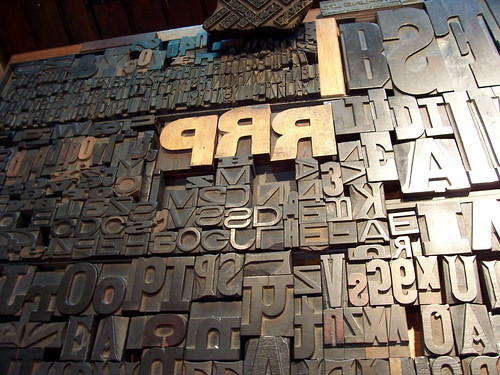
Typefaces Galore

Typefaces Galore, originally uploaded by Kevin Lawver.

My name is Natalie Giesbrecht and I am a Distance Learning Program Development Specialist (aka the fancy name for instructional designer) for the online distance education unit at the University of Guelph. I work with faculty and instructors to design and develop online courses for degree students and adult learners. Prior to this, I guided a team of designers and copyright assistants to produce and distribute course materials. As for education, my degree is from the University of Guelph, where I studied photography, video, sculpture and art history.

Over the last 10 years I have developed a fascination for graphic design and typography. So when thinking about the words text and technology, for me the printing press naturally comes to mind. Thus the photo I choose depicts wood letterforms used in letterpress printing. Letterpress printing is certainly both an art and a craft – though now a dying skill.

Last summer I was lucky enough to get a tour of Coach House Press in Toronto, Ontario and an opportunity to try my hand at letterpress printing. From this experience I learned how much time and accuracy is needed in order to perfectly typeset a final printed product. Consideration is given to every aspect of each letter on a page. Most importantly quality checks on the finished pieces are always done to ensure that the reader has the best experience possible. With the speed and ease of computer publishing, I have a whole new appreciation for traditional ways of printing.

ETEC*540 is my 9th course! During this semester I am interested in exploring the convergence of old and new technologies and how this affects literacy – particularly printed books versus e-books. I am also interested in how new media, mobile and social technologies impact how we communicate – the way we read, write, find and understand information – and how this impacts online education.

With the variety of backgrounds and skill sets of all of us in this course, I think this will be a challenging and rewarding semester!

Spam prevention powered by Akismet

Creative Commons Attribution 3.0 Unported
This work is licensed under a Creative Commons Attribution 3.0 Unported.